REVIEW 3 major objections 6 minor 4 references
Concordance to links with an unknotted component
T0 review · 3 major / 6 minor · reviewed 2026-08-14 · deepseek-v4-flash
Pith's one-line read The paper constructs links with arbitrarily many slice components, all proper sublinks concordant to links with an unknotted component, yet the full link is not concordant to any link with even one unknotted component.
desk verdict A genuinely new note with a clean Alexander-module obstruction, but the examples’ generation hypotheses are verified by figure rather than by computation. read the letter →
The pith
A machine-rendered reading of the paper's core claim, the machinery that carries it, and where it could break.
The reading
What carries the argument
The key object is the Alexander module $A(K) = H_1(\widetilde{E(K)};\mathbb{Q})$, the first homology of the infinite cyclic cover of the exterior of a knot $K$, viewed as a module over $\mathbb{Q}[t,t^{-1}]$. The load-bearing mechanism is Corollary 2.2: when the classes of the lifts of the other components generate $A(L_1)$, a concordance to a link whose first component has relatively prime Alexander polynomial would force those classes to be trivial in the Alexander module of a slice disk for $L_1$. That is impossible because the map $A(L_1) \to A(D)$ from the knot module to the slice-disk module is not the zero homomorphism, a consequence of the nonsingular form on the Alexander module and the Lagrangian-kernel criterion for slice disks. The diagrams are engineered so that the generation hypothesis holds: in the two-component example a single lift generates $A(L_1)$, and in the cyclic $n$-component examples the lifts of the two neighboring components generate it.
What would settle it
Compute, for the three-component link of Figure 2, the Alexander module $A(L_1)$ and the submodule generated by the lifts of $L_2$ and $L_3$; a nonzero quotient would show the generation hypothesis fails and the claimed obstruction does not apply to that diagram, while an explicit concordance from the same link to a link with an unknotted component would directly refute Theorem 1.3. For Theorem 1.4, exhibit a finite set $D$ such that for every integer $m$ the polynomial $\Delta_{L_1(m,U)}(t)$ shares a nontrivial factor with some element of $D$; that would refute the asserted existence of $m$.
Extended reading notes
Core claim
The central claim is an Alexander-module obstruction with a sharp consequence: if a link $L = L_1 \cup \cdots \cup L_n$ has vanishing pairwise linking numbers, $L_1$ is a slice knot with nontrivial Alexander polynomial, and the classes of the lifts of $L_2,\dots,L_n$ generate the Alexander module $A(L_1)$, then $L$ is not concordant to any link $L' = L'_1 \cup \cdots \cup L'_n$ for which $\Delta_{L_1}(t)$ and $\Delta_{L'_1}(t)$ are relatively prime; in particular, $L$ is not concordant to any link whose first component is unknotted. The paper applies this to explicit diagrams in which each component is a copy of the slice knot $9_{46}$, arranged in a cycle so that homotopy pictures show the lifts of neighboring components generate the Alexander module of each component. For every $n\ge 3$ the resulting $n$-component link has slice two-component sublinks and every proper sublink concordant to a link with an unknotted component, while the full link is not. A second construction, using twist parameters, replaces 'trivial Alexander polynomial' by any finite set $D$ of knot Alexander polynomials: for any knot $J$ with $\Delta_J(t)\in D$, there is a two-component link with both components concordant to $J$ that is not concordant to any link with at least one component whose Alexander polynomial lies in $D$.
Load-bearing premise
The argument rests on the claim, verified by pictures and the phrase 'straightforward to verify' rather than by a written computation, that in each constructed diagram the lifts of the other components generate the Alexander module of the chosen component; Theorem 1.4 additionally assumes, without demonstration, that for any finite set of Alexander polynomials a twist parameter can be chosen so that the relevant Alexander polynomial is relatively prime to every polynomial in the set.
Editorial extensions
If this is right
- For every $n\ge 3$, there is an $n$-component link whose every proper sublink is concordant to a link with an unknotted component but whose full link is not; this kind of concordance obstruction is invisible to any proper sublink.
- Every component of the constructed links is slice, so a link can have all components slice and still fail to be concordant to any link with even one unknotted component.
- The same Alexander-module obstruction shows the constructed links are not concordant to any boundary link, since in a boundary link the lifts of the other components are trivial in the Alexander module of the chosen component.
- For any finite set $D$ of knot Alexander polynomials and any knot $J$ with $\Delta_J(t)\in D$, there is a two-component link with both components concordant to $J$ that is not concordant to any link with at least one component whose Alexander polynomial lies in $D$; when $D=\{1\}$ this covers the case of a component with trivial Alexander polynomial, which in particular includes the unknot.
- Because the proof works in the topological (locally flat) category and uses only Alexander modules, the conclusion is obtained by a classical invariant rather than by the more intricate concordance invariants of earlier constructions, and it yields the stronger no-unknotted-component statement.
Reading between the lines
- The paper leaves open whether its Alexander-module generation condition is detected by Milnor invariants; if it were, the same diagrams would obstruct concordance for links with vanishing Milnor invariants, making the phenomenon visible at the level of link homotopy data.
- A natural next step is to check whether the generation property survives $1/p$-surgery; if it does, the resulting homology-sphere links are concrete candidates for the paper's open question about concordance to links in $S^3$, and would generalize the known knot case in the topological category.
- An explicit formula for the Alexander polynomial $\Delta_{L_1(m,U)}(t)$ as a function of the twist parameter $m$ would turn the asserted existence of a suitable $m$ in Theorem 1.4 into a checkable number-theoretic condition and would make the required size of $m$ explicit.
Signed reviews
Editorial analysis
A structured set of objections, weighed in public.
Referee Report
Summary. The paper introduces an obstruction based on the Alexander module of a link component together with the lifts of the other components, and uses it to construct explicit links with slice components that are not concordant to any link having an unknotted component. After proving the obstruction (Corollary 2.2), the authors give a two-component example (Theorem 1.1), a three-component example (Theorem 1.2), an n-component family (Theorem 1.3), and a family whose components are concordant to a prescribed knot J and which are not concordant to any link with a component whose Alexander polynomial lies in a prescribed finite set D (Theorem 1.4). The proofs are short and rely on the verification, from figures and from phrases such as 'it is straightforward to verify,' that the lifts of the non-chosen components generate the Alexander module of the chosen component.
Significance. If the examples are valid, the paper substantially strengthens earlier results: previous examples had one component that was already unknotted, whereas here every component is slice and yet no concordant link can have any component that is unknotted (or that has Alexander polynomial in a prescribed finite set). The use of a classical invariant, the Alexander module, is elegant, and the obstruction is external to the paper's examples, so there is no circularity or fitted parameter. The paper is clearly written and would be a useful short contribution. However, two load-bearing assertions are not fully justified: the generation hypothesis for the n-component examples and the existence of a sufficiently large twist parameter m in Theorem 1.4. These are verification gaps rather than demonstrated errors, but they must be repaired before the main theorems are established.
major comments (3)
- [§3, proof of Theorem 1.3] The assertion 'it is straightforward to verify that the classes of lifts of L_{k-1} and L_{k+1} generate A(L_k)' is load-bearing, because Corollary 2.2 applies only when this generation holds. Since A(L_k) is cyclic of order (1-2t)(2-t), generation can fail if both adjacent lifts are annihilated by a common proper factor or both lie in the same irreducible summand. The manuscript gives a homotopy in Figure 4 for the two-component link, but for the three-component local picture in Figure 3 no explicit computation or diagrammatic verification is provided. Please add a written computation of the classes of the lifts in the cyclic module, or an explicit sequence of figures analogous to Figure 4 that demonstrates generation for the local picture in Figure 3.
- [§3, proof of Theorem 1.4] The statement 'We choose m large enough so that Δ_{L1(m,U)}(t) = Δ_{L2(m,U)}(t) is relatively prime to every polynomial in the finite set D' is asserted without proof. The Alexander polynomial of L1(m,U) depends on m in a nontrivial way, and it is not immediate that a single value of m avoids the finite union of irreducible factors of all polynomials in D. Because Theorem 1.4's conclusion depends on this relative primality to apply Corollary 2.2, this is a load-bearing gap. Please provide a formula for Δ_{L1(m,U)}(t) as a function of m, or another argument proving the existence of such an m.
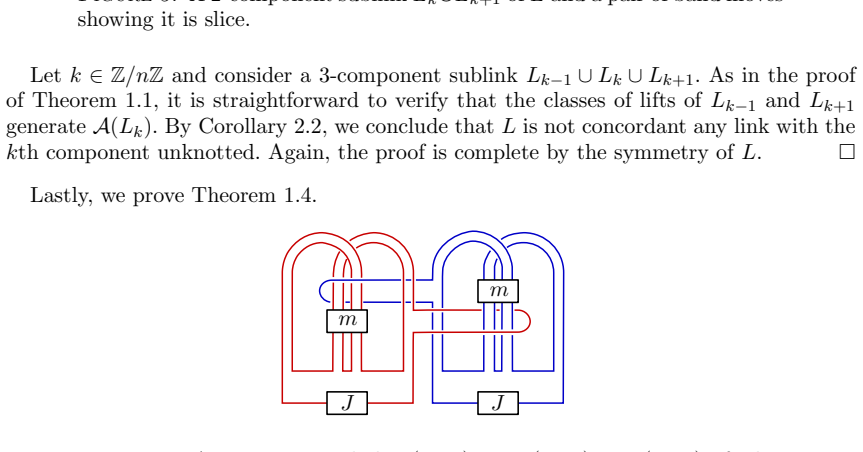
- [§3, proof of Theorem 1.4] The proof also relies on the assertion 'it is straightforward to verify that each component of L(m,U) is slice and the class of the lift of L2(m,U) generates A(L1(m,U))' without supplying the verification. This is the same generation hypothesis needed for Corollary 2.2, and it is not demonstrated for the family in Figure 6. Please provide an explicit proof, for example by exhibiting the slice disks for the components and computing the relevant lift classes, or by reducing the verification to the two-component case of Figure 1 via an explicit isotopy.
minor comments (6)
- [§1] The sentence 'Theorem 1.2 is a special case of a the following more general result' contains a typo: 'a the' should be 'the'.
- [§2] The word 'Lagrandian' should be 'Lagrangian' in the sentence 'the kernel of the map from A(K) to A(D) is a Lagrandian submodule'.
- [§3, proof of Theorem 1.3] The phrase 'L is not concordant any link with the kth component unknotted' is missing the word 'to'; it should read 'not concordant to any link'.
- [§3, proof of Theorem 1.3] Corollary 2.2 requires vanishing pairwise linking numbers, but the proof does not explicitly state that the 3-component sublink L_{k-1}∪L_k∪L_{k+1} has this property. The vanishing is implicit in the description of the 2-component sublinks as either Figure 5(a) or the split link, but it would be helpful to state it explicitly before applying the corollary.
- [§3, proof of Theorem 1.1] The claim that each component is isotopic to the 9_46 knot and that 9_46 is slice would benefit from a citation or an explicit diagram, since the identification is not otherwise justified in the text.
- [§2, Corollary 2.2] The notion of 'relatively prime' for polynomials in Q[t,t^{-1}] is standard, but it may be worth clarifying the coefficient ring to avoid ambiguity.
Circularity Check
No circularity: the Alexander-module obstruction is external, and the examples are checked by explicit diagrams; two unproved verification steps are gaps, not circular reductions.
full rationale
The paper's derivation chain is self-contained against a classical, external invariant. The obstruction (Corollary 2.2) is proved from Proposition 2.1, which in turn rests on standard Blanchfield/Kearton facts, not on the paper's own conclusions. The examples are then constructed so that the hypotheses of Corollary 2.2 hold: the components are the known slice knot 9_46; the Alexander module computation is stated, and the generation hypothesis is supported by the explicit homotopy and isotopy in Figure 4 for the two-component case and by visual argument for the n-component case. No parameter is fitted to the target conclusion, no prediction is renamed from an input, and no load-bearing self-citation appears. The cited works [Coc91, CO90, CO93, CR12] are contextual and are not used to justify the main obstruction. The closest concerns are two verification gaps: the phrase 'it is straightforward to verify that the classes of lifts of L_{k-1} and L_{k+1} generate A(L_k)' in the proof of Theorem 1.3, and the assertion 'We choose m large enough so that ... relatively prime to every polynomial in D' in the proof of Theorem 1.4. These are omitted computations or unproved existence claims, but they are not circular: neither claim is equivalent to the theorem being proved, and neither presupposes the desired non-concordance conclusion. Therefore the honest finding is no significant circularity.
Assumptions & free parameters
free parameters (1)
- m (twist parameter in Theorem 1.4) =
unspecified 'large enough' integer
assumptions (5)
- standard math Blanchfield form and Lagrangian kernel facts for Alexander modules of slice knots.
- standard math Concordance invariance of linking numbers and of Alexander module classes of lifted components.
- domain assumption The knot 9_46 is slice and has Alexander module Q[t,t^-1]/((1-2t)(2-t)).
- ad hoc to paper For the diagrams in Figures 3, 4, 5, and 6, the pairwise linking numbers vanish and the lifts of the non-chosen components generate the Alexander module of the chosen component.
- ad hoc to paper For any finite set D of Alexander polynomials, there exists m such that the Alexander polynomial of L1(m,U) is relatively prime to every polynomial in D.
Cite this review
Pith. "Pith review of Concordance to links with an unknotted component." pith.science (2026). https://pith.science/paper/QWVLPAA2
@misc{pith2026190802396,
  author       = {Pith},
  title        = {Pith review of: Concordance to links with an unknotted component},
  year         = {2026},
  howpublished = {\url{https://pith.science/paper/QWVLPAA2}},
  note         = {Machine review of arXiv:1908.02396}
}
read the original abstract
We construct links of arbitrarily many components each component of which is slice and yet are not concordant to any link with even one unknotted component. The only tool we use comes from the Alexander modules.
Figures


Figures from the paper (3 more)


Reference graph
Works this paper leans on
-
[1]
Blanchfield, Intersection theory of manifolds with operators with applications to knot theory, Ann
[Bla57] Richard C. Blanchfield, Intersection theory of manifolds with operators with applications to knot theory, Ann. of Math. (2) 65 (1957), 340–356. MR0085512 [CO90] Tim D. Cochran and Kent E. Orr, Not all links are concordant to boundary links , Bull. Amer. Math. Soc. (N.S.) 23 (1990), no. 1, 99–106. MR1031581 [CO93] , Not all links are concordant to b...
work page 1957
-
[47]
MR3589337 [Liv90] Charles Livingston, Links not concordant to boundary links , Proc. Amer. Math. Soc. 110 (1990), no. 4, 1129–1131. MR1031670 Department of Mathematics, University of Wisconsin–Eau Claire E-mail address: daviscw@uwec.edu URL: people.uwec.edu/daviscw School of Mathematics, Georgia Institute of Technology E-mail address: junghwan.park@math.g...
work page 1990
-
[654]
MR1055569 [CR12] Jae Choon Cha and Daniel Ruberman, Concordance to links with unknotted components, Algebr. Geom. Topol. 12 (2012), no. 2, 963–977. MR2928901 [HLL18] Jennifer Hom, Adam S. Levine, and Tye Lidman, Knot concordance in homology cobordisms ,
work page 2012
-
[2018]
[Kea75] Cherry Kearton, Cobordism of knots and Blanchfield duality , J. London Math. Soc. (2) 10 (1975), no. 4, 406–408. MR0385873 (52 #6732) [Lev16] Adam S. Levine, Nonsurjective satellite operators and piecewise-linear concordance, Forum Math. Sigma 4 (2016), e34,
work page 1975
Reviewed August 14, 2026 · model on record in the stance chip above.
Discussion (0). Continue with ORCID to comment.