REVIEW 1 major objections 5 minor 43 references
On Admissible Locations of Transonic Shock Fronts for Steady Euler Flows in an Almost Flat Finite Nozzle with Prescribed Receiver Pressure
T0 review · 1 major / 5 minor · reviewed 2026-08-14 · deepseek-v4-flash
Pith's one-line read The paper proves that in a nearly flat nozzle, an explicit solvability condition selects admissible transonic shock locations, and wavy walls can yield several shocks for one exit pressure.
desk verdict A genuinely new approach to shock-location selection in almost flat nozzles, with a real but plausibly fixable gap in the contraction proof of Lemma 5.3. read the letter →
The pith
A machine-rendered reading of the paper's core claim, the machinery that carries it, and where it could break.
The reading
What carries the argument
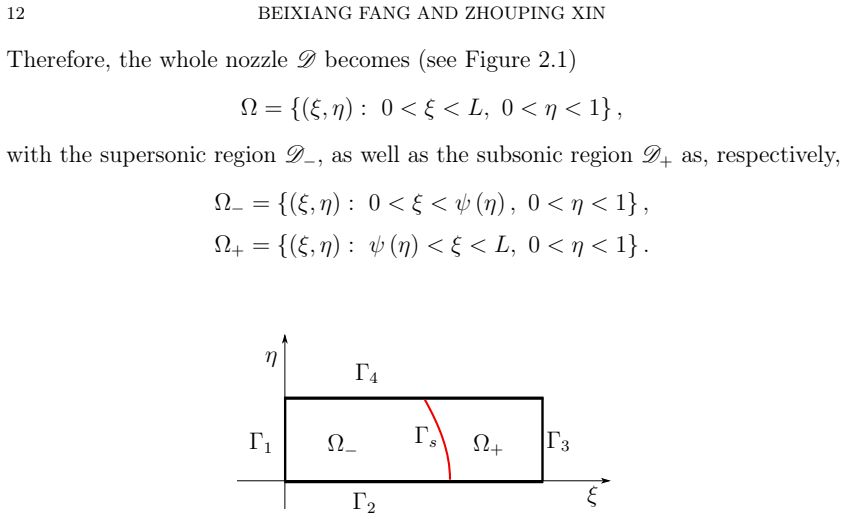
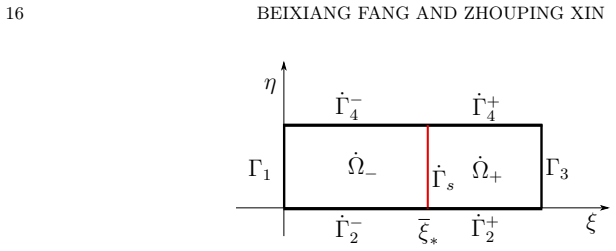
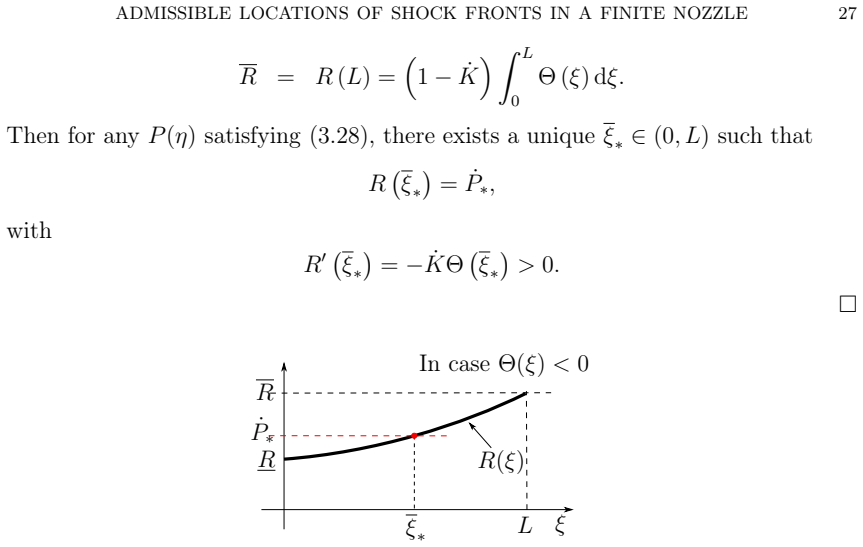
The load-bearing object is the linearized free boundary problem formed after the Lagrange transformation straightens the streamlines into a rectangle: the subsonic part of the linearized Euler system becomes a first-order elliptic system for the linearized pressure $\dot p$ and angle $\dot\theta$, with boundary data on the two walls, the exit pressure, and the linearized Rankine-Hugoniot conditions. For such a system on a rectangle, solvability forces an integral compatibility condition; here that condition collapses to $R(\xi_*)=\dot P_*$, where $R(\xi)=\int_0^L \Theta(\tau)\,d\tau - \dot K\int_0^\xi \Theta(\tau)\,d\tau$ and $\dot P_*$ is the averaged exit-pressure perturbation. This equation determines the initial approximating shock position $\xi_*$. The nonlinear argument then defines an iteration $\mathcal{J}_s$ on a small ball around the linearized solution and shows that the iteration stays in that ball (Lemma 5.2) and asserts contractiveness in Lemma 5.3, which yields the actual shock solution via a fixed point.
What would settle it
Evaluate the missing estimate behind (5.20): for two nearby states in $K_\sigma$, compute the right-hand side of (5.21) and check whether the output distance is at most half the input distance; a contraction factor larger than $1/2$, or a smallness condition on $\sigma$ stronger than the one allowed in Lemma 5.1, would invalidate the proof. As an independent check, solve the 2D steady Euler equations numerically for the wall angle $\Theta(\xi)=\sin^2(k\pi\xi/L)$ with receiver pressure in the admissible range: the theorem predicts a shock near each of the $2k$ algebraic roots, so failure to find a shock near any one of them would refute the claim.
Extended reading notes
Core claim
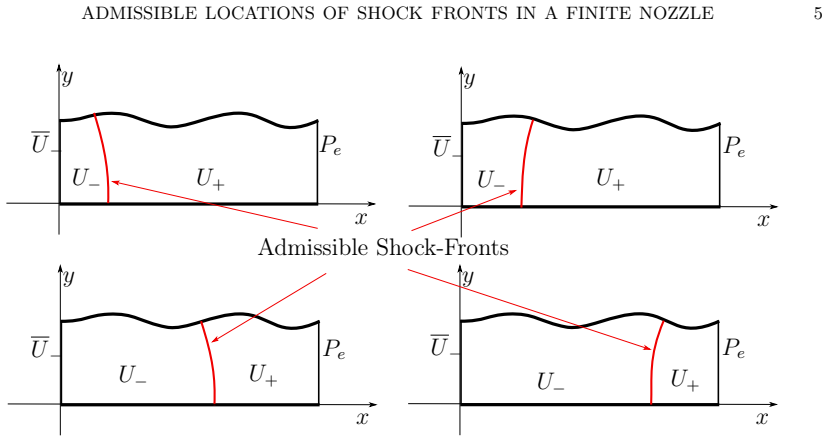
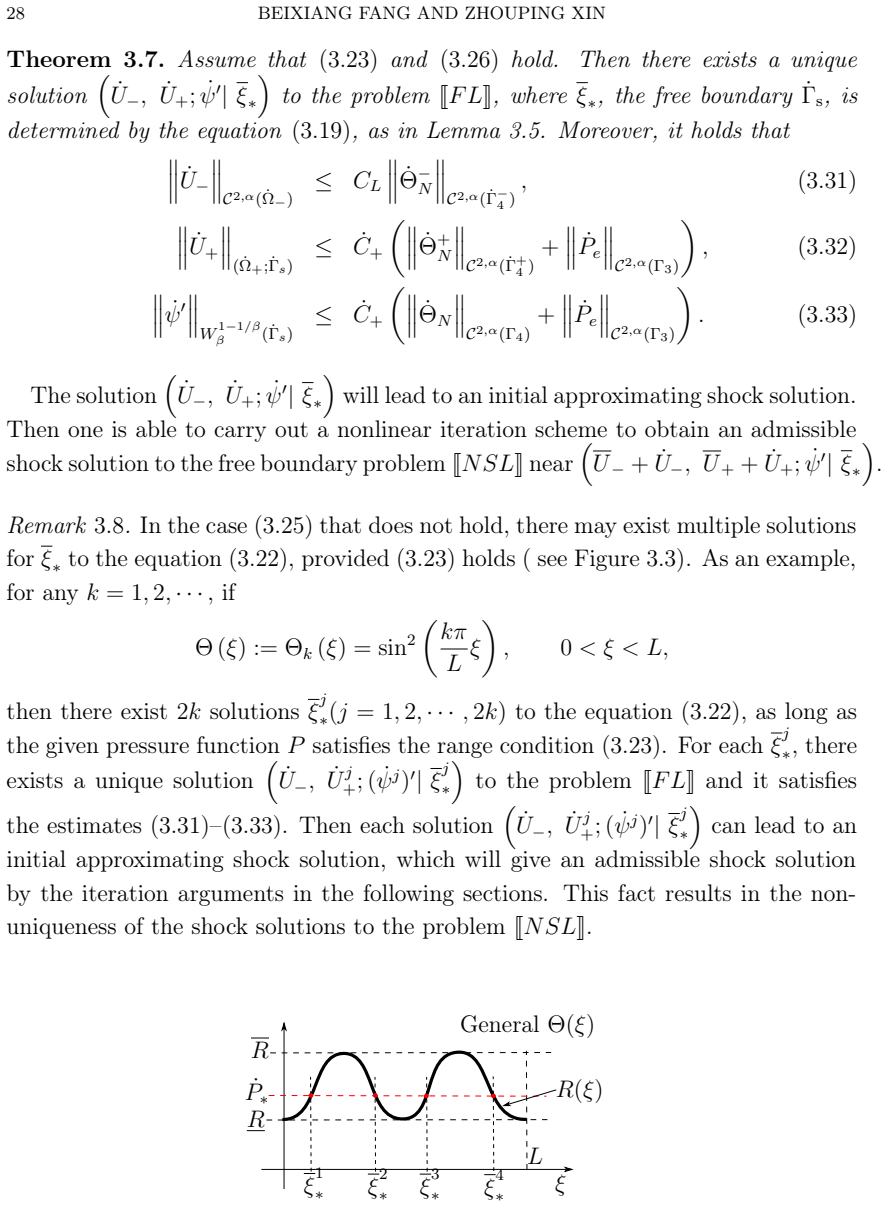
The central claim is Theorem 2.4: if $\xi_*$ solves (2.72) and $\Theta(\xi_*)\neq 0$, then for any sufficiently small wall deviation $\sigma$ there is a genuine transonic shock solution whose front lies within order $\sigma$ of the vertical line $\xi=\xi_*$, with the subsonic state and shock slope close to the linearized approximation. The discovery is that the shock position is selected by the solvability condition of the first-order elliptic system satisfied by the linearized pressure and flow angle behind the shock. In a strictly monotone nozzle this selection is unique, while in a nozzle with alternating expanding and contracting parts, for instance $\Theta(\xi)=\sin^2(k\pi \xi/L)$, the equation can have $2k$ roots, and each root with nonzero wall slope generates an admissible shock solution. Thus the same prescribed exit pressure can support multiple transonic shocks, and the flat nozzle's one-parameter family of normal shock locations breaks into finitely many admissible positions determined by the wall shape.
Load-bearing premise
The load-bearing premise is that the nonlinear iteration mapping $\mathcal{J}_s$ is contractive on its small ball (Lemma 5.3); the text does not prove that contractiveness directly, saying only that it follows by analogous computations to Lemma 5.2, so the existence theorem stands or falls on that omitted estimate.
Editorial extensions
If this is right
- For a strictly expanding or contracting almost flat nozzle with receiver pressure in the admissible range, the theorem yields existence of a transonic shock solution and the leading-order shock location is unique.
- For a non-monotone wall, the same receiver pressure can produce several transonic shock solutions, one near each algebraic root of (2.72) at which the wall slope is nonzero.
- The flat nozzle's continuum of normal shock positions is not structurally stable: generic small wall perturbations reduce the possible shock locations to a discrete set selected by the integrated wall angle and exit pressure.
- The shock front and subsonic flow are, up to order $\sigma$, exactly what the linearized free boundary problem predicts, with error of order $\sigma^{3/2}$ between the nonlinear solution and the linearized approximation.
Reading between the lines
- Because $R$ depends on $\Theta$ only through its integrals, two nozzle shapes with the same cumulative wall-angle profile should have identical leading-order shock positions; this is a testable prediction the paper does not state.
- The sign of $\Theta(\xi_*)$ makes $R$ locally monotone increasing or decreasing, which suggests that the selected shock locations might carry different dynamical stability properties in an unsteady setting, mirroring the quasi-one-dimensional picture; the paper does not address time dependence.
- Varying the exit-pressure perturbation $\dot P_*$ across the range of $R$ should make admissible shock positions appear and disappear in pairs at extrema of $R$, so the algebraic condition supplies a one-dimensional bifurcation diagram for shock location versus receiver pressure.
Signed reviews
Editorial analysis
A structured set of objections, weighed in public.
Referee Report
Summary. The paper studies two-dimensional steady compressible Euler flows in a finite nozzle that is a small perturbation of a flat nozzle, with a prescribed receiver pressure at the exit. Because a flat nozzle admits normal shocks at arbitrary locations, the authors propose a linearized free boundary problem whose solvability condition determines an initial approximation ξ* of the shock location via equation (2.72), R(ξ*) = P*. They prove that for monotone nozzles this condition has a unique root, while for nozzles with both expanding and contracting portions multiple roots can occur. The main result, Theorem 2.4, asserts that for any root ξ* satisfying Θ(ξ*)≠0 and sufficiently small wall perturbation amplitude σ, there exists a transonic shock solution to the nonlinear free boundary problem JNSL K, with the shock front close to ξ* and satisfying the estimates (2.75)–(2.80). The proof is based on a nonlinear iteration scheme in which the linearized problem (4.11)–(4.19) is solved first, the shock-position correction δξ* is determined from the solvability condition (4.23), and the iteration mapping Js is shown to be well-defined and contractive on a small ball Kσ(˙U+;˙ψ′).
Significance. If Theorem 2.4 is correct, it provides a rigorous first-principles criterion for admissible transonic shock locations in almost flat nozzles under the physical Courant–Friedrichs exit-pressure condition, and it predicts genuine non-uniqueness of shock solutions for non-monotone nozzle walls. The linearized analysis is a genuine strength: the solvability condition (2.72) is derived from the elliptic system rather than imposed, the coefficients in Lemma 2.1 are computed explicitly, and the elliptic boundary-value theory in Appendix A is developed in a self-contained manner with explicit solvability conditions. The paper also clearly identifies the dependence of the smallness constant on 1/|Θ(ξ*)| and states the range condition for the receiver pressure. However, the central existence proof relies on a contraction estimate in Lemma 5.3 that is asserted rather than proved; until that estimate is supplied, the main theorem must be regarded as conditional.
major comments (1)
- [Section 5, Lemma 5.3] The proof of the contraction estimate (5.20) is not completed. After establishing (5.22), the text states that 'by analogous computations as in Lemma 5.2, with the help of the estimate (5.22), we can show that the inequality (5.20) holds.' Inequality (5.20) is exactly the contraction bound needed for the fixed-point argument: it requires the difference of two iterates to be bounded by half the distance between the input states. This is the load-bearing step for Theorem 2.4, since without contractiveness the iteration scheme does not produce the existence of a solution to JNSL K. The passage from (5.22) to (5.20) involves estimating differences of the nonlinear source terms f_j, g_j, δP3, and δΘ4 in the norms appearing in Theorem 4.3; these include compositions such as δP3(η;δU) through Y(L,η;δU) and δΘ4(ξ;δξ*) through the map Πψ, as well as products of O(σ) quantities in the trace norms W^{1−1/β,β}. These estimates are not shown, and they are not immediate consequences of (5.22). The authors should write out the 'analogous computations' in full; as it stands, the manuscript does not prove the existence theorem it announces.
minor comments (5)
- [Section 5, Lemma 5.2] In the proof of Lemma 5.2, the estimate for the term involving g4 is delegated by the sentence 'Analogous computations show also that' before (5.18). While this estimate is less central than the contraction estimate, providing the explicit bound for g4 would make the proof more complete and would illustrate the pattern that is later claimed in Lemma 5.3.
- [Section 3.1] There is a typo in the first paragraph: 'constant efficients' should read 'constant coefficients.'
- [Remark 2.6] The phrase 'For a expanding nozzle' should be 'For an expanding nozzle.'
- [Abstract and Remark 2.6] The abstract states that for strictly expanding or contracting nozzles 'there exists only one solution,' which could be misread as global uniqueness of the nonlinear shock problem. Remark 2.6 clarifies that only one solution is established by the present argument and that global uniqueness has not been proved; the abstract should be rephrased to match this qualification.
- [Section 2.4 and Section 3.3] The function R(ξ) is defined twice, in (2.70) and in (3.21), with identical formulas. The duplication is harmless but could be streamlined by defining it once in Section 2 and referring back to it in Section 3.
Circularity Check
No circular derivation: shock-location equation comes from a linearized solvability condition; the deferred contraction estimate in Lemma 5.3 is a proof gap, not a circular step.
full rationale
The paper's central derivation is self-contained and does not reduce any prediction to an input. The shock-location equation (2.72) is obtained in Lemma 3.3 by applying the solvability condition (A.47) of the linear elliptic system (2.58)-(2.59) to the data Theta and P; it is a genuine scalar equation R(xi*)=P*, not a fitted relation. The nonlinear iteration in Sections 4-5 is a standard contraction argument: delta_xi* is determined through the implicit-function-theorem nondegeneracy condition (5.15), namely dI/d(delta_xi*)(0;0,0;U-) = -sigma K Theta(xi*) + O(sigma^{3/2}), so the hypothesis Theta(xi*) != 0 enters as a nondegeneracy assumption rather than a pre-imposed conclusion. The estimates in Lemma 5.2 show that the iteration maps the ball K_sigma into itself with O(sigma^2) accuracy, and Lemma 5.3 would complete the fixed-point argument. However, Lemma 5.3's proof is not carried out: after deriving (5.22), the text states 'by analogous computations as in Lemma 5.2, with the help of the estimate (5.22), we can show that the inequality (5.20) holds'. Inequality (5.20) is exactly the contraction estimate; this is an omitted proof and a genuine completeness risk, but it is not a circular step because (5.20) is not assumed as an input and no equation in the paper reduces to an earlier input by definition. Finally, the self-citations [22,23,27] supply the Lagrange-transformation and iteration framework, but those are published theorems for different background configurations, and the elliptic well-posedness used here is proved in Appendix A via Grisvard [21]; hence the self-citations are not load-bearing in a circular sense. No circularity score above 0 is warranted.
Assumptions & free parameters
assumptions (6)
- domain assumption The flow is modeled by the steady 2D compressible Euler system with a polytropic gas law (2.5).
- standard math Classical local existence theory for quasilinear hyperbolic systems (Li-Yu [28]) applies in the supersonic region.
- standard math Grisvard's elliptic regularity theory [21] provides W^2_q estimates for the Poisson and mixed boundary-value problems in a rectangle.
- standard math The subsonic Euler system decomposes into a first-order elliptic system for (p,θ) plus transport equations for (q,S).
- domain assumption The nozzle wall and exit pressure are small, compatible perturbations of the flat nozzle and uniform exit pressure, satisfying (2.14)-(2.16).
- ad hoc to paper The range condition (2.73) holds and the selected root ξ* of (2.72) satisfies Θ(ξ*)≠0.
Cite this review
Pith. "Pith review of On Admissible Locations of Transonic Shock Fronts for Steady Euler Flows in an Almost Flat Finite Nozzle with Prescribed Receiver Pressure." pith.science (2026). https://pith.science/paper/KTJWHTYL
@misc{pith2026190802463,
  author       = {Pith},
  title        = {Pith review of: On Admissible Locations of Transonic Shock Fronts for Steady Euler Flows in an Almost Flat Finite Nozzle with Prescribed Receiver Pressure},
  year         = {2026},
  howpublished = {\url{https://pith.science/paper/KTJWHTYL}},
  note         = {Machine review of arXiv:1908.02463}
}
read the original abstract
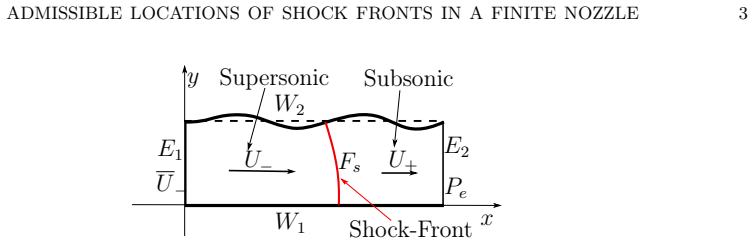
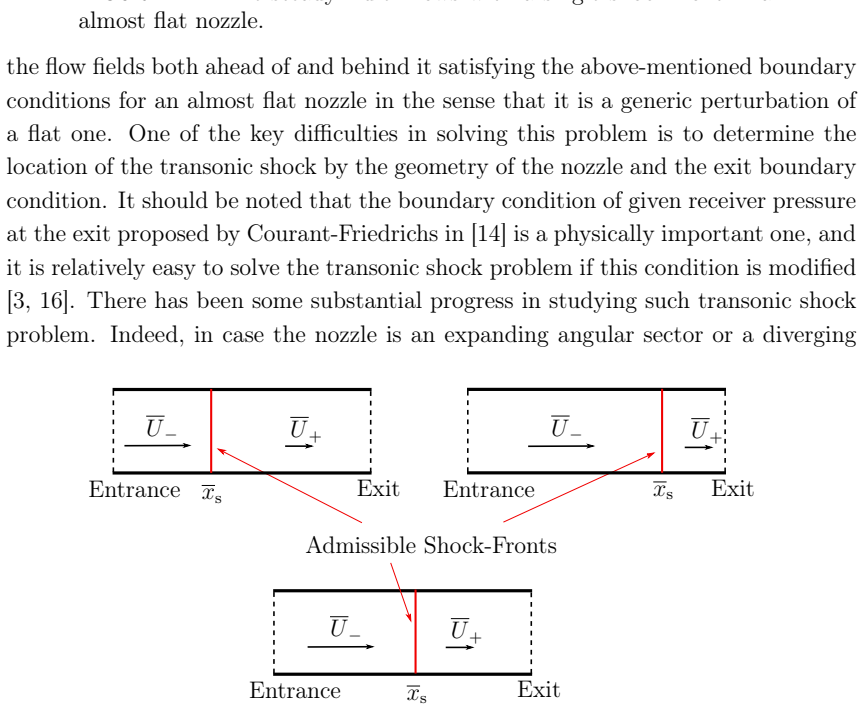
This paper concerns the existence of transonic shock solutions to the 2-D steady compressible Euler system in an almost flat finite nozzle ( in the sense that it is a generic small perturbation of a flat one ), under physical boundary conditions proposed by Courant-Friedrichs in \cite{CourantFriedrichs1948}, in which the receiver pressure is prescribed at the exit of the nozzle. In the resulting free boundary problem, the location of the shock-front is one of the most desirable information one would like to determine. However, the location of the normal shock-front in a flat nozzle can be anywhere in the nozzle so that it provides little information on the possible location of the shock-front when the nozzle's boundary is perturbed. So one of the key difficulties in looking for transonic shock solutions is to determine the shock-front. To this end, a free boundary problem for the linearized Euler system will be proposed, whose solution will be taken as an initial approximation for the transonic shock solution. In this paper, a sufficient condition in terms of the geometry of the nozzle and the given exit pressure is derived which yields the existence of the solutions to the proposed free boundary problem. Once an initial approximation is obtained, a further nonlinear iteration could be constructed and proved to lead to a transonic shock solution.
Figures

Figures from the paper (7 more)


Reference graph
Works this paper leans on
-
[1]
M. Bae, M. Feldman; Transonic shocks in multidimensional divergent nozzles.Arch. Ration. Mech. Anal.201 (2011), no. 3, 777–840
work page 2011
-
[2]
G.-Q. Chen, J. Chen, M. Feldman; Transonic shocks and free boundary problems for the full Euler equations in infinite nozzles.J. Math. Pures Appl.(9) 88 (2007), no. 2, 191–218
work page 2007
-
[3]
G.-Q. Chen, J. Chen, K. Song; Transonic nozzle flows and free boundary problems for the full Euler equations.J. Differential Equations229 (2006), no. 1, 92–120
work page 2006
-
[4]
G.-Q. Chen, M. Feldman; Multidimensional transonic shocks and free boundary problems for nonlinear equations of mixed type.J. Amer. Math. Soc.16 (2003), no. 3, 461–494
work page 2003
-
[5]
G.-Q. Chen, M. Feldman; Steady transonic shocks and free boundary problems for the Euler equations in infinite cylinders.Comm. Pure Appl. Math.57 (2004), no. 3, 310–356
work page 2004
-
[6]
G.-Q. Chen, M. Feldman; Existence and stability of multidimensional transonic flows through an infinite nozzle of arbitrary cross-sections.Arch. Ration. Mech. Anal.184 (2007), no. 2, 185–242
work page 2007
- [7]
-
[8]
Chen; Stability of transonic shock fronts in two-dimensional Euler systems.Trans
S. Chen; Stability of transonic shock fronts in two-dimensional Euler systems.Trans. Amer. Math. Soc.357 (2005), no. 1, 287–308
work page 2005
Show all 43 references
-
[9]
Chen; Transonic shocks in 3-D compressible flow passing a duct with a general section for Euler systems.Trans
S. Chen; Transonic shocks in 3-D compressible flow passing a duct with a general section for Euler systems.Trans. Amer. Math. Soc.360 (2008), no. 10, 5265–5289
2008
-
[10]
Chen; Compressible flow and transonic shock in a diverging nozzle.Comm
S. Chen; Compressible flow and transonic shock in a diverging nozzle.Comm. Math. Phys. 289 (2009), no. 1, 75–106
2009
-
[11]
S. Chen, J. Geng, Y. Zhang; Isentropic approximation of quasi-one-dimensional unsteady nozzle flow.SIAM J. Math. Anal.41 (2009), no. 4, 1693–1712
2009
-
[12]
S. Chen, Z. Wang, Y. Zhang; The setting of boundary conditions for boundary value problems of hyperbolic-elliptic coupled systems. Acta Math. Appl. Sin. Engl. Ser. 24 (2008), no. 3, 375–390
2008
-
[13]
S. Chen, H. Yuan; Transonic shocks in compressible flow passing a duct for three-dimensional Euler systems.Arch. Ration. Mech. Anal.187 (2008), no. 3, 523–556
2008
-
[14]
Courant, K.O
R. Courant, K.O. Friedrichs;Supersonic flow and shock waves, Springer-Verlag, New York, 1948. 52 BEIXIANG F ANG AND ZHOUPING XIN
1948
-
[15]
D. Cui, H. Yin; The uniqueness of a transonic shock in a nozzle for the 2-D complete Euler system with the variable end pressure. J. Partial Differential Equations21 (2008), no. 3, 263–288
2008
-
[16]
B. Duan, S. Weng; Transonic shock in finitely long nozzle with porous medium boundary condition. J. Differential Equations251 (2011), no. 4-5, 1128–1156
2011
-
[17]
Embid, J
P. Embid, J. Goodman, A. Majda; Multiple steady states for 1-D transonic flow.SIAM J. Sci. Statist. Comput.5 (1984), no. 1, 21–41
1984
-
[18]
B. Fang, L. Liu, H. Yuan; Global uniqueness of transonic shocks in two-dimensional steady compressible Euler flows.Arch. Ration. Mech. Anal.207 (2013), no. 1, 317–345
2013
-
[19]
Gilbarg, N.S
D. Gilbarg, N.S. Trudinger;Elliptic Partial Differential Equations of Second Order,2nd ed., Grundlehren Math. Wiss. 224, Springer, Berlin, New York, 1983
1983
-
[20]
H. M. Glaz, T.-P. Liu; The asymptotic analysis of wave interactions and numerical calculations of transonic nozzle flow.Adv. in Appl. Math.5 (1984), no. 2, 111–146
1984
-
[21]
Grisvard,Elliptic Problems in Nonsmooth Domains, Monographs and Studies in Mathe- matics, 24, Pitman: Boston, 1985
P. Grisvard,Elliptic Problems in Nonsmooth Domains, Monographs and Studies in Mathe- matics, 24, Pitman: Boston, 1985
1985
-
[22]
J. Li, Z. Xin, H. Yin; On transonic shocks in a nozzle with variable end pressures.Comm. Math. Phys.291 (2009), no. 1, 111–150
2009
-
[23]
J. Li, Z. Xin, H. Yin; A free boundary value problem for the full Euler system and 2-D transonic shock in a large variable nozzle.Math. Res. Lett.16 (2009), no. 5, 777–796
2009
-
[24]
J. Li, Z. Xin, H. Yin; On transonic shocks in a conic divergent nozzle with axi-symmetric exit pressures. J. Differential Equations248 (2010), no. 3, 423–469
2010
-
[25]
J. Li, Z. Xin, H. Yin; The existence and monotonicity of a three-dimensional transonic shock in a finite nozzle with axisymmetric exit pressure.Pacific J. Math.247 (2010), no. 1, 109–161
2010
-
[26]
J. Li, Z. Xin, H. Yin; Monotonicity and uniqueness of a 3D transonic shock solution in a conic nozzle with variable end pressure.Pacific J. Math.254 (2011), no. 1, 129–171
2011
-
[27]
J. Li, Z. Xin, H. Yin; Transonic shocks for the full compressible Euler system in a general two-dimensional de Laval nozzle.Arch. Ration. Mech. Anal.207 (2013), no. 2, 533–581
2013
-
[28]
Li, W.-C
T.-T. Li, W.-C. Yu;Boundary value problems for quasilinear hyperbolic systems.Duke Univer- sity Mathematics Series 5. Duke University, Mathematics Department, Durham, N.C., (1985)
1985
-
[29]
L. Liu, H. Yuan; Stability of cylindrical transonic shocks for the two-dimensional steady compressible Euler system.J. Hyperbolic Differ. Equ.5 (2008), no. 2, 347–379
2008
-
[30]
L.Liu, H.Yuan; Globaluniquenessoftransonicshocksindivergentnozzlesforsteadypotential flows.SIAM J. Math. Anal.41 (2009), no. 5, 1816–1824
2009
-
[31]
L. Liu, G. Xu, H. Yuan; Stability of spherically symmetric subsonic flows and transonic shocks under multidimensional perturbations.Adv. Math.291 (2016), 696–757
2016
-
[32]
Liu; Transonic gas flow in a duct of varying area.Arch
T.-P. Liu; Transonic gas flow in a duct of varying area.Arch. Rational Mech. Anal.80 (1982), no. 1, 1–18
1982
-
[33]
Liu; Nonlinear stability and instability of transonic flows through a nozzle.Comm
T.-P. Liu; Nonlinear stability and instability of transonic flows through a nozzle.Comm. Math. Phys. 83 (1982), no. 2, 243–260
1982
-
[34]
Rauch, C
J. Rauch, C. Xie, Z. Xin; Global stability of steady transonic Euler shocks in quasi-one- dimensional nozzles.J. Math. Pures Appl.(9) 99 (2013), no. 4, 395–408
2013
-
[35]
Serre; Écoulements de fluides parfaits en deux variables indépendantes de type espace
D. Serre; Écoulements de fluides parfaits en deux variables indépendantes de type espace. Réflexion d’un choc plan par un dièdre compressif. (French) [Perfect fluid flow in two inde- pendent space variables. Reflection of a planar shock by a compressive wedge]Arch. Rational Mech. A...
1995
-
[36]
Smith; Non-uniqueness and multi-shock solutions for transonic nozzle flows.IMA J
D.H. Smith; Non-uniqueness and multi-shock solutions for transonic nozzle flows.IMA J. Appl. Math.71 (2006), no. 1, 120–132
2006
-
[37]
F. Xie, C. Wang; Transonic shock wave in an infinite nozzle asymptotically converging to a cylinder. J. Differential Equations242 (2007), no. 1, 86–120
2007
-
[38]
Z. Xin, W. Yan, H. Yin; Transonic shock problem for the Euler system in a nozzle.Arch. Ration. Mech. Anal.194 (2009), no. 1, 1–47
2009
-
[39]
Z. Xin, H. Yin; Transonic shock in a nozzle. I. Two-dimensional case.Comm. Pure Appl. Math. 58 (2005), no. 8, 999–1050
2005
-
[40]
Z. Xin, H. Yin; The transonic shock in a nozzle, 2-D and 3-D complete Euler systems.J. Differential Equations245 (2008), no. 4, 1014–1085
2008
-
[41]
Z. Xin, H. Yin; Three-dimensional transonic shocks in a nozzle.Pacific J. Math.236 (2008), no. 1, 139–193
2008
-
[42]
Yuan; A remark on determination of transonic shocks in divergent nozzles for steady compressible Euler flows.Nonlinear Anal
H. Yuan; A remark on determination of transonic shocks in divergent nozzles for steady compressible Euler flows.Nonlinear Anal. Real World Appl.9 (2008), no. 2, 316–325
2008
-
[43]
Yuan; Persistence of shocks in ducts.Nonlinear Anal.75 (2012), no
H. Yuan; Persistence of shocks in ducts.Nonlinear Anal.75 (2012), no. 9, 3874–3894. B.X. F ang: School of Mathematical Sciences, and MOE-LSC, Shanghai Jiao Tong University, Shanghai 200240, China E-mail address: bxfang@sjtu.edu.cn Z.P. Xin: The Institute of Mathematical Scienc...
2012
Reviewed August 14, 2026 · model on record in the stance chip above.
Discussion (0). Continue with ORCID to comment.