REVIEW 6 major objections 5 minor 22 references
Separable Reversible Data Hiding Based on Integer Mapping and Multi-MSB Prediction for Encrypted 3D Mesh Models
T0 review · 6 major / 5 minor · reviewed 2026-08-14 · deepseek-v4-flash
Pith's one-line read A reversible data-hiding scheme for encrypted 3D meshes embeds up to 18.12 bits per vertex and recovers the quantized original exactly, with zero extraction error.
desk verdict First separable multi-MSB RDH-ED for 3D meshes with a genuinely new vertex-partition idea, but the printed equations do not support the lossless-recovery claim as written. read the letter →
The pith
A machine-rendered reading of the paper's core claim, the machinery that carries it, and where it could break.
The reading
What carries the argument
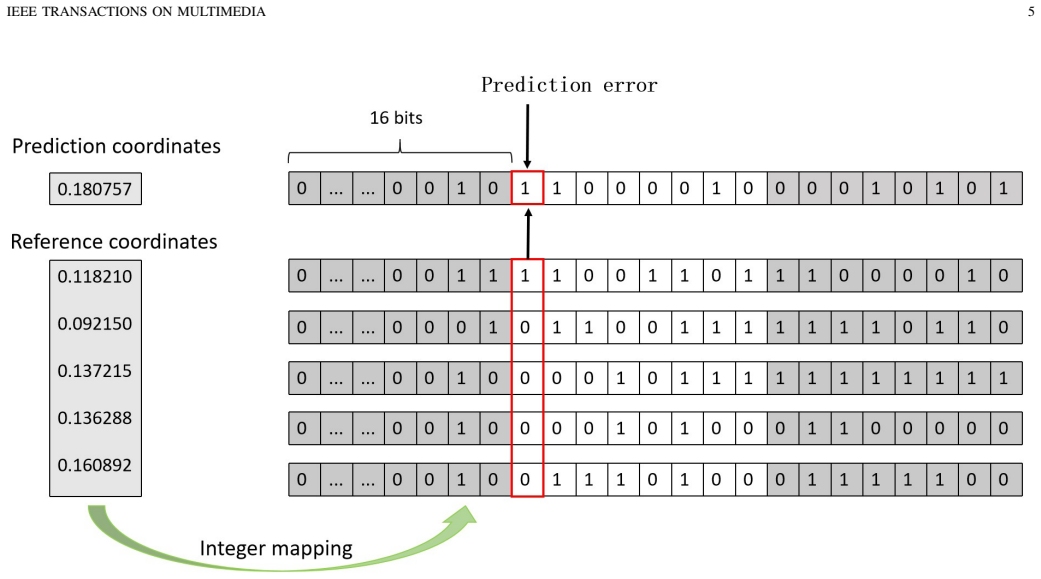
The load-bearing object is the Multi-MSB prediction rule operating over topological rings. After integer mapping $\bar{v}_{i,j} = \lfloor v_{i,j} \times 10^m \rfloor$ (Eq. 1) fixes each coordinate to an $l$-bit integer, the sender counts, from MSB down to LSB, whether the majority of an embedded vertex's neighboring reference vertices share the same bit value; the length $L$ is the largest prefix of bits for which this holds on all axes. Data embedding replaces those $n \leq L$ MSBs of the embedded vertex's coordinates with payload bits (Eq. 7), and recovery uses the same ring-prediction to regenerate them. This converts spatial smoothness of the mesh geometry into a bit-substitution channel that survives stream-cipher encryption.
What would settle it
Run the proposed preprocessing with m=4 on a mesh that contains a vertex coordinate of 7.0, for example a cube of side 7. The mapped integer is 70000, which is larger than $2^{16}-1$, the 16-bit length that Eq. (3) assigns for m=4; Eq. (7) then truncates the coordinate's high bits, and no ring-prediction can restore the original value, contradicting the paper's zero-error and exact-recovery claims.
Extended reading notes
Core claim
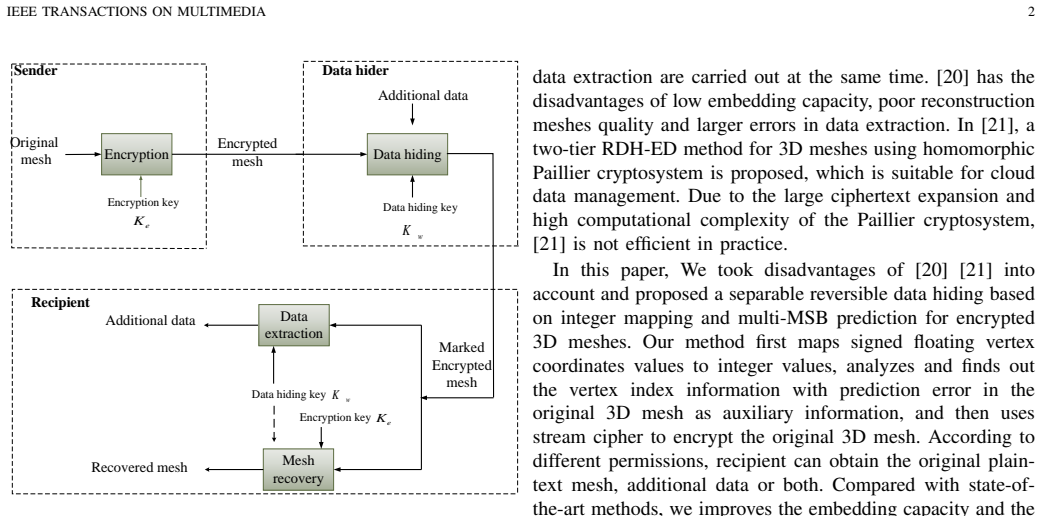
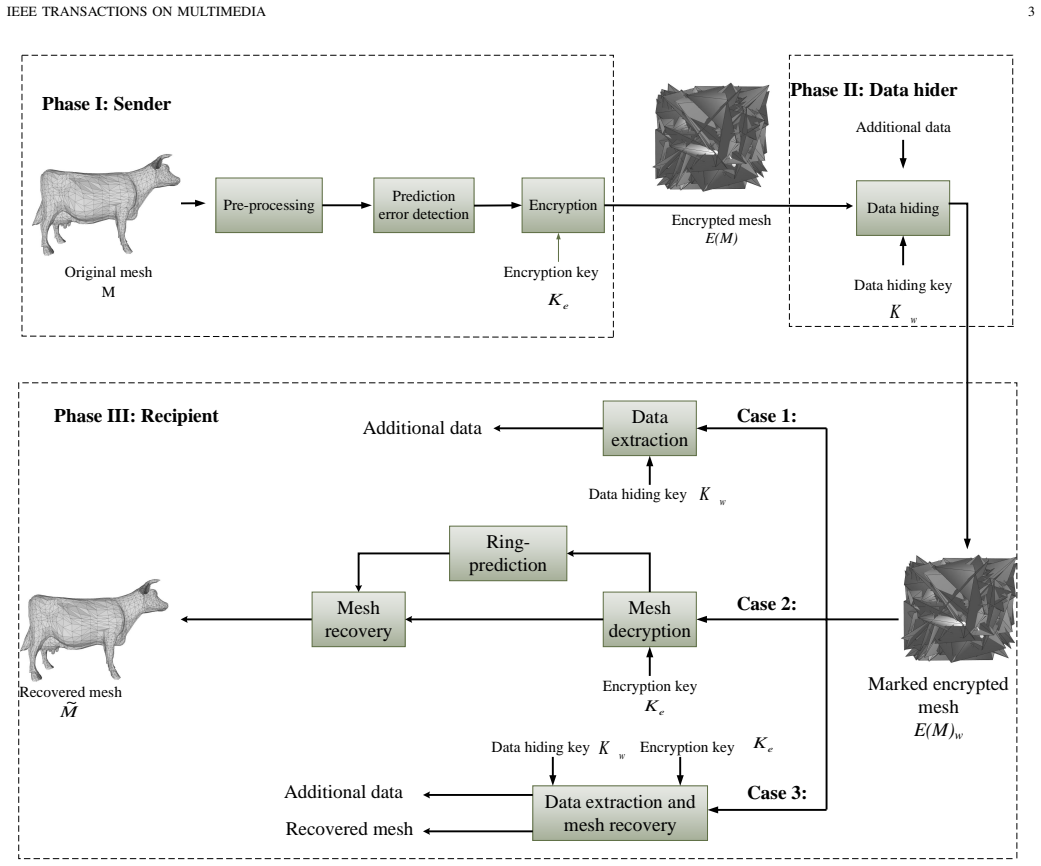
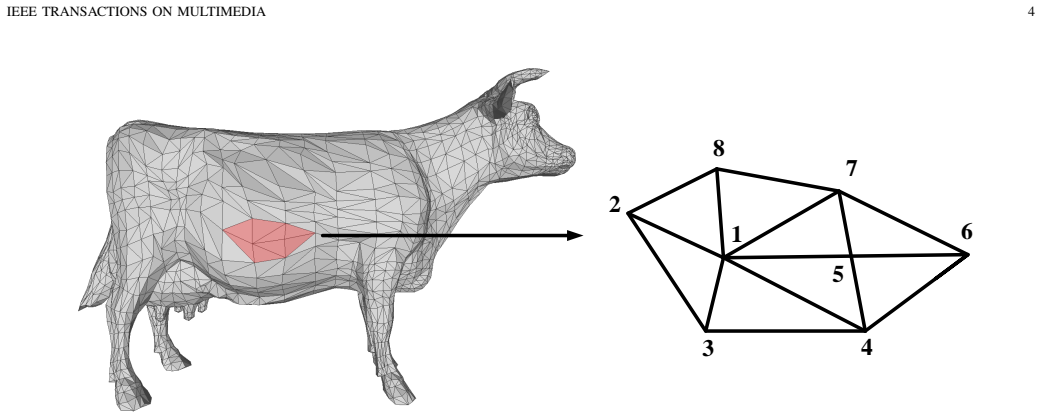
The central claim is that the most significant bits of mesh vertex coordinates carry reliable, encryption-invariant redundancy that can be harvested for reversible data hiding. The method splits vertices into an "embedded" set and a "reference" set, computes, for each embedded vertex, the maximum number of MSBs that can be guessed by a majority vote over the corresponding bits of its adjacent reference vertices, and then encrypts the whole mesh with a stream cipher. Payload bits are substituted into those predictable MSBs, and the data-hiding key alone reads them back from the ciphertext without any reference to the original geometry. A recipient with only the encryption key predicts the removed MSBs from the surrounding vertices and recovers the integer-mapped mesh exactly, which the paper calls "perfectly" recovering the original mesh; the original floating-point coordinates are recovered to the precision m chosen in the integer-mapping step.
Load-bearing premise
The scheme assumes all vertex coordinates are smaller than 1 in absolute value so that the integer-mapping step in Eq. (1) always produces values that fit the bit-length table in Eq. (3); meshes with larger coordinates would overflow that bit-length assignment and break both embedding and recovery.
Editorial extensions
If this is right
- Encrypted 3D content can be annotated or watermarked by an untrusted data hider without the hider ever seeing the plaintext geometry.
- Payload capacities on the order of 14–19 bits per vertex are high enough to embed meaningful metadata, such as provenance, integrity hashes, or access-control tags, inside ciphertext for large meshes.
- Zero extraction error eliminates the error-correcting overhead that earlier LSB-based encrypted-mesh methods needed, so the recovered payload is directly usable.
- Separability of extraction and recovery means a cloud service can provide data management on encrypted models, while only the model owner can recover the geometry, a division of trust that matches privacy-preserving storage workflows.
Reading between the lines
- The same majority-vote MSB prediction could be applied to ordered point clouds or to meshes with a spatial-index-based neighbor definition, not only to triangular faces; the paper's experiments stop at standard triangle meshes.
- The scheme fixes one embedding length L for the whole mesh, so a single vertex with a poorly predictable MSB caps the payload for every embedded vertex; an adaptive per-vertex length selection would likely push the average rate closer to the per-mesh maximum.
- The "perfect recovery" guarantee is relative to the integer-mapped, precision-m quantized mesh, not to the original floating-point coordinates; the choice of m is therefore a real lossy parameter hidden inside the reversible pipeline.
- The bit-length table in Eq. (3) is derived from a normalization assumption that coordinates lie in (-1,1); for meshes in other ranges the bit length must be recomputed, and the paper's capacity figures cannot be assumed to transfer.
Signed reviews
Editorial analysis
A structured set of objections, weighed in public.
Referee Report
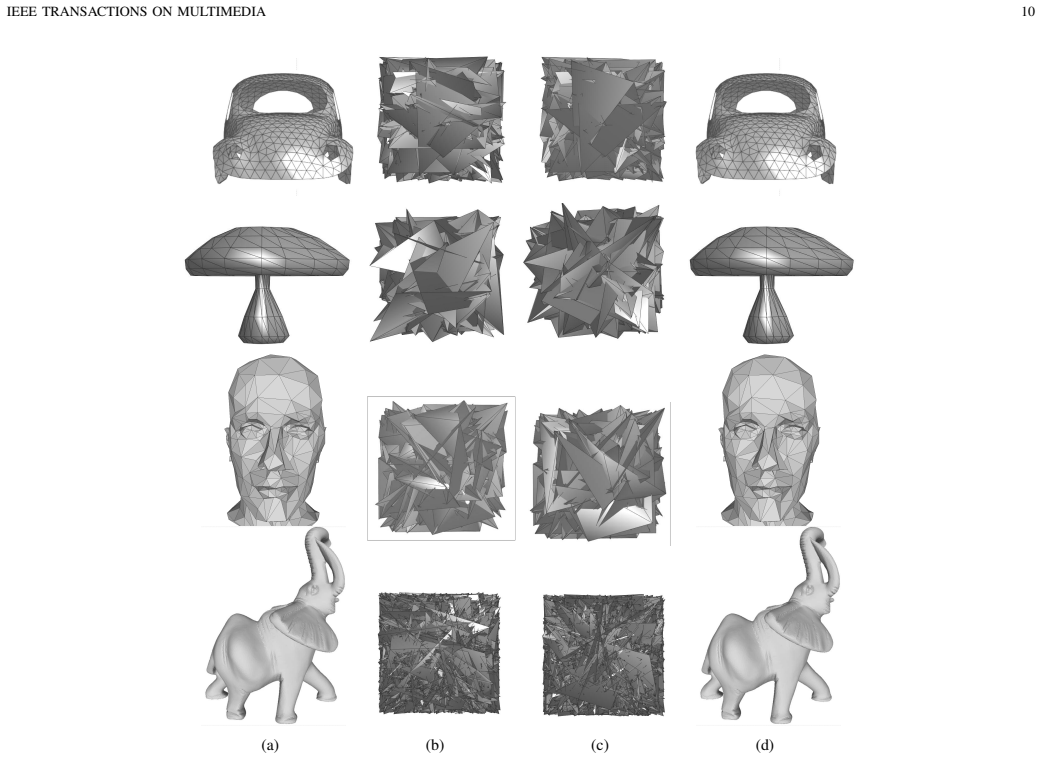
Summary. The paper proposes a separable reversible data hiding in encrypted domain (RDH-ED) method for 3D meshes. Vertex coordinates are scaled to integers, vertices are split into an 'embedded' set and a 'reference' set, prediction-error-free embedded vertices are identified, the mesh is encrypted with a stream cipher, and additional data are embedded by substituting the n most significant bits (MSBs) of encrypted coordinates. Three recipient cases are considered: data extraction with only the data-hiding key, mesh recovery with only the encryption key, and joint extraction/recovery with both keys. The paper reports embedding rates up to 18.12 bpv on the Elephant mesh, zero extraction error, and claims higher embedding capacity and better recovered-mesh quality than prior methods [20], [21].
Significance. If correct, the scheme would be a useful extension of MSB-prediction-based RDH-ED from images to 3D meshes, with an attractive separable design and high reported capacities. The paper has some strengths: capacity figures appear to be measured rather than fitted, dense-mesh results are reported, and the comparison with prior work is explicitly attempted. However, the central embedding and recovery equations as written are internally inconsistent, the preprocessing is only specified for a narrow coordinate range with no signed-integer handling, and the reported comparison tables are mutually inconsistent. These issues strike at the paper's main claims of reversibility, error-free extraction, and improved performance, so the contributions cannot be accepted in their current form.
major comments (6)
- [Section II.C, Eq. (6)] Equation (6) defines E_{i,j} = sum_{u=0}^{l-1} e_{i,j,u} × 10^m, which weights every bit identically and therefore reconstructs neither the binary integer from Eq. (4) nor the encrypted coordinate. The bit positions must be weighted by powers of 2 (2^u), not by 10^m. As written, Eq. (6) returns 10^m times the number of 1-bits, so the subsequent XOR decryption in Eq. (9) and the modular arithmetic in Eq. (7) operate on the wrong quantity. This invalidates the encryption-to-embedding-to-recovery pipeline.
- [Section II.D, Eq. (7)] Equation (7) writes v'' = s1·2^{l-1} + ... + sn·2^{l-n} + v' mod 2^{l-(n+1)}. For n-MSB substitution, the untouched lower part of v' should be v' mod 2^{l-n}; the printed modulus 2^{l-(n+1)} discards bit position l-n-1, which is not stored anywhere, making exact recovery of the original coordinate impossible. The expression is also undefined for n=l, since the exponent becomes -1. This is a load-bearing defect in the reversibility claim because the lost bit is not recoverable by any subsequent prediction step.
- [Section II.E, Eq. (8)] Equation (8), s_k = v''/2^{l-k}, does not extract the k-th embedded bit. If division is integer division, the right-hand side gives the k-bit value formed by the top k MSBs; if it is real division, the result is generally non-integer. No floor, rounding, or modulo operation is specified, so the extraction rule does not correctly recover the individual bits s_k. Error-free extraction is therefore not established by the stated formula.
- [Section II.A, Eqs. (1)-(4)] The preprocessing assumes each vertex coordinate satisfies |v_{i,j}| < 1 and states that the integer value is between 0 and 2^m, but the paper's own example uses negative coordinates: v = (-0.202018, -0.0740184, 0.288808) with m=4, giving integer coordinates (-2020, -7400, 2888). This contradicts Eq. (1), since floor(-0.202018 × 10^4) = floor(-2020.18) = -2021, not -2020, and negative integers are outside the stated range [0, 2^m]. No normalization or signed-integer representation is specified for Eq. (4)'s bit decomposition, so the entire integer mapping is undefined for the negative coordinates that are common in real 3D meshes.
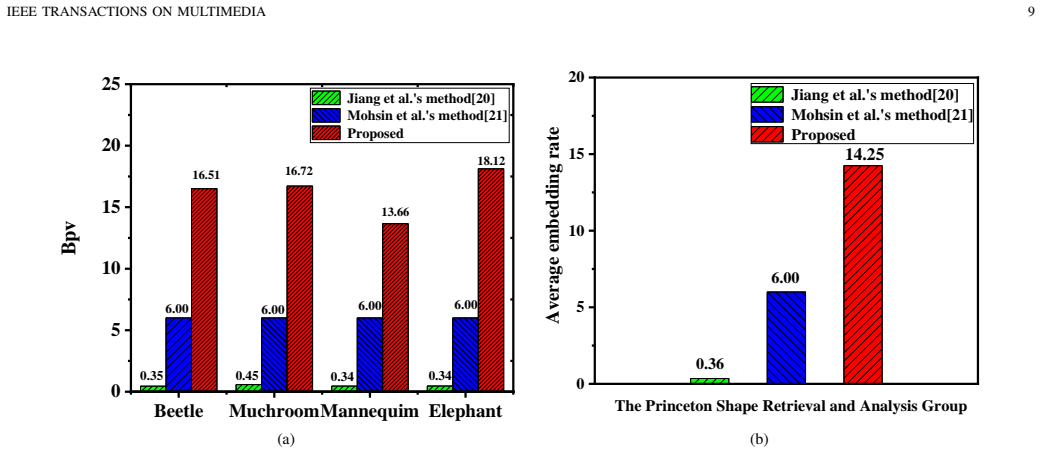
- [Section III.A and Table III] The text in Section III.A reports maximum embedding rates of 16.72 bpv for Mushroom and 13.66 bpv for Mannequin, which matches Table II. Table III, however, lists 13.66 bpv for Muchroom and 16.20 bpv for Mannequin. These swapped or inconsistent values undermine the comparison with [20] and [21] and the paper's headline capacity claims.
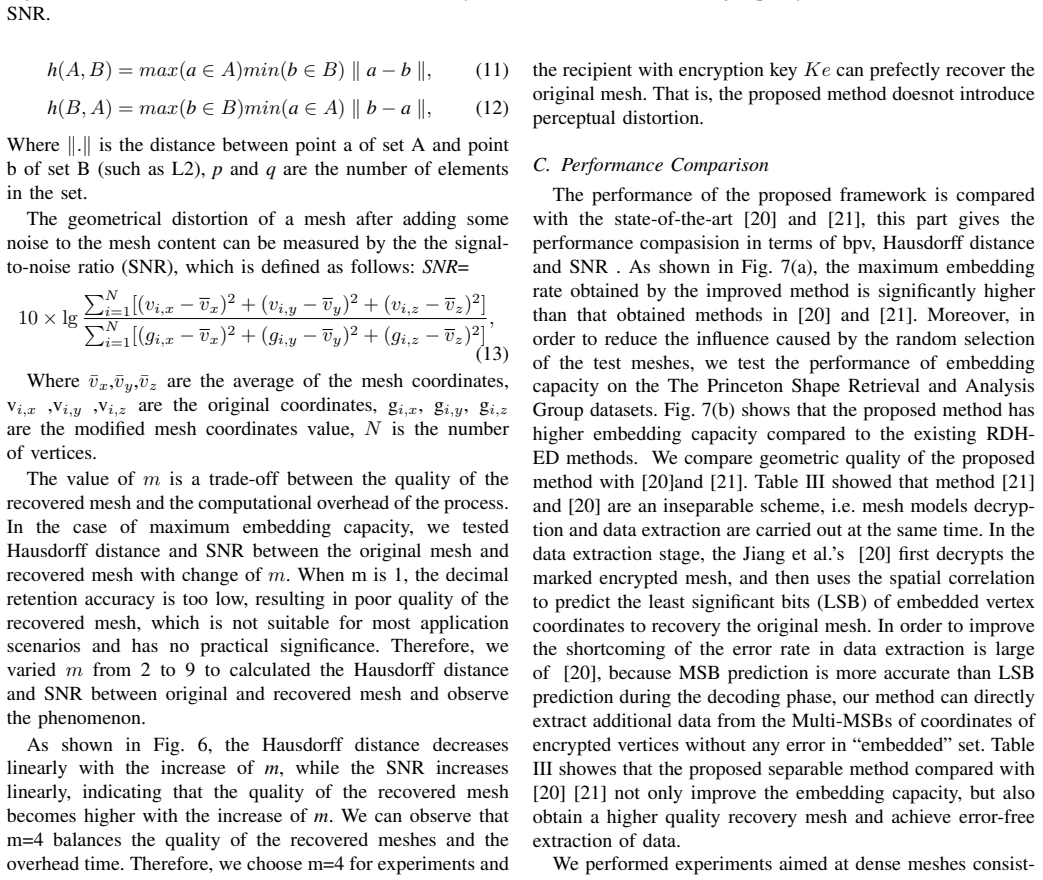
- [Section III.B, Eq. (13)] The SNR formula in Eq. (13) is non-standard: the numerator is the power of the original coordinates about their mean, while the denominator is the power of the modified coordinates about the original mean. The standard SNR uses the introduced error (e.g., sum (g_i - v_i)^2) in the denominator. As written, the metric conflates signal power with noise power and can be artificially inflated by a uniform offset or scaling. Since SNR is used as a quality comparison in Table III and Fig. 6, this definition needs to be justified or replaced.
minor comments (5)
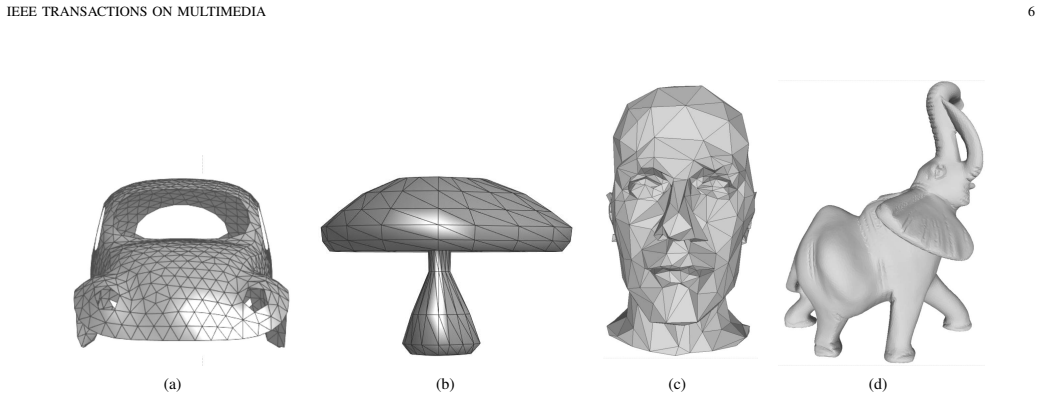
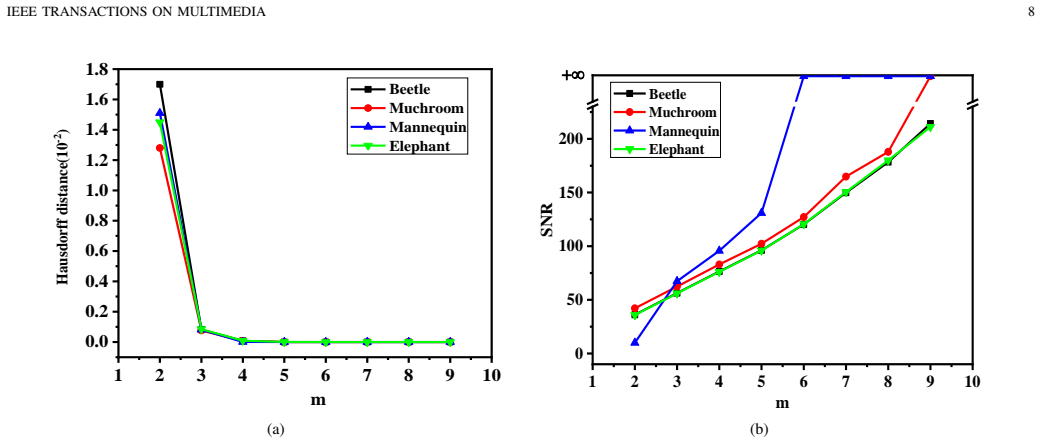
- [Section III.A and Table II] The text states that Elephant reaches 18.12 bpv when m=5 and n=18, but Table II shows that the value 18.12 appears at n=19 (columns 17, 18, and 19 read 17.29, 17.92, and 18.12, respectively). Please correct the reported operating point.
- [Section III.B] The text says 'the recipient with encryption key Ke can prefectly recover the original mesh,' but Case 2 in Section II.E describes the result as a 'high-quality recovered mesh,' not an exact recovery. These statements should be reconciled; exact recovery in Case 2 would require justification beyond MSB prediction.
- [Throughout] There are numerous typos and naming inconsistencies: 'atart-of-the-art', 'shouws', 'descibe', 'prefectly', 'Muchroom' vs. 'Mushroom', 'Mannequim' in Fig. 7(a), and 'compasision'. The authors should perform a careful proofreading pass.
- [Section II.D, Eq. (7)] The range condition 'l≤k≤n' after Eq. (7) should presumably be '1≤k≤n'; otherwise the summation indices are inconsistent with the usage of s_k as embedded data bits.
- [Section II.C, Eq. (4)] The notation 'l≤i≤N' in Eq. (4) should be '1≤i≤N'; as written, the index range excludes the first vertex.
Circularity Check
No circularity found: the prediction-error prescreening is a construction step, capacities are measured, and the flagged equation defects are correctness issues, not circular reductions.
full rationale
The claimed derivation chain is self-contained and contains no step in which an output is equal to an input by construction or in which a fitted parameter is renamed as a prediction. The prediction-error pre-detection in Section II.B is a screening step: it identifies vertices whose n-MSBs can be predicted from unmodified reference neighbors, and only those vertices are embedded via Eq. (7). The recovery step in Section II.E.2 applies the same neighbor-majority prediction to those preselected vertices; because the reference set is left unmodified, the recovery claim follows legitimately from the construction rather than circularly. The embedding rates in Table II and Fig. 7 are measured outcomes of the algorithm over a grid of (m,n), not parameters fitted to match the reported bpv values. No load-bearing claim is justified by a self-citation, and no uniqueness theorem is imported from the authors' prior work. The apparent mathematical defects in Section II.C-D (Eq. (6) weights bits by 10^m instead of 2^u, and Eq. (7) uses modulus 2^{l-(n+1)} rather than preserving the lower l-n bits) and the unnormalized-coordinate assumption |v_{i,j}|<1 are serious correctness and validity concerns, but they are not circularity: they concern whether the printed equations implement the stated reversible substitution, not whether any result reduces to its own input.
Assumptions & free parameters
free parameters (2)
- m (quantization precision) =
4 (quality), 5 (capacity)
- n (MSB embedding length) =
16, 15, 15, 18 for the four test meshes
assumptions (3)
- domain assumption All vertex coordinates satisfy |vi,j| < 1 (Section II.A).
- domain assumption The mesh is sufficiently smooth that majority-vote MSB prediction over neighboring reference vertices is error-free for the chosen n on the selected vertices.
- standard math Stream cipher encryption is applied and the encrypted domain preserves the algebraic structure of the coordinates for XOR-based MSB substitution.
Cite this review
Pith. "Pith review of Separable Reversible Data Hiding Based on Integer Mapping and Multi-MSB Prediction for Encrypted 3D Mesh Models." pith.science (2026). https://pith.science/paper/OTUUYSR2
@misc{pith2026190802473,
  author       = {Pith},
  title        = {Pith review of: Separable Reversible Data Hiding Based on Integer Mapping and Multi-MSB Prediction for Encrypted 3D Mesh Models},
  year         = {2026},
  howpublished = {\url{https://pith.science/paper/OTUUYSR2}},
  note         = {Machine review of arXiv:1908.02473}
}
read the original abstract
Reversible data hiding in encrypted domain (RDH-ED) has received tremendous attention from the research community because data can be embedded into cover media without exposing it to the third party data hider and the cover media can be losslessly recovered after the extraction of the embedded data. Although, in recent years, extensive studies have been carried out about images based RDH-ED, little attention is paid to RDH-ED in 3D meshes due to its complex data structure and irregular geometry. In this paper, we propose a separable RDH-ED method for 3D meshes based on integer mapping and Multi-MSB (multiplication most significant bit) prediction. The proposed method divides all the vertices of the mesh into the "embedded" set and "reference" set, and maps decimals of the vertex into integers. Then, we calculate the Multi-MSB prediction errors for the vertices of the "embedded" set and a bit-stream encryption technique will be executed. Finally, additional data is embedded by replacing the Multi-MSB of the encrypted vertex coordinates. According to different permissions, recipient can obtain the original plaintext meshes, additional data or both. Experimental results show that the proposed method has higher embedding capacity and higher quality of the recovered meshes compared to the state-of-art methods.
Figures
Figures from the paper (7 more)

Reference graph
Works this paper leans on
-
[20]
IEEE Transactions on Multimedia 20(1), 5567 (2017)
Jiang, R., Zhou, H., Zhang, W., Yu, N.: Reversible data hiding in en- crypted threedimensional mesh models. IEEE Transactions on Multimedia 20(1), 5567 (2017)
work page 2017
-
[21]
Arabian Journal for Science and Engineering 43(12), 81458157 (2018)
Shah, M., Zhang, W., Hu, H., Zhou, H., Mahmood, T.: Homomorphic encryptionbased reversible data hiding for 3d mesh models. Arabian Journal for Science and Engineering 43(12), 81458157 (2018)
work page 2018
-
[1]
In: Security and Watermarking of Multimedia Contents IV
Fridrich, J., Goljan, M., Du, R.: Lossless data embedding for all image formats. In: Security and Watermarking of Multimedia Contents IV . vol. 4675, pp. 572583. International Society for Optics and Photonics (2002)
work page 2002
-
[2]
IEEE transactions on image processing14(2), 253266 (2005)
Celik, M.U., Sharma, G., Tekalp, A.M., Saber, E.: Lossless generalized- lsb data embedding. IEEE transactions on image processing14(2), 253266 (2005)
work page 2005
-
[3]
IEEE transactions on circuits and systems for video technology 13(8), 890896 (2003)
Tian, J.: Reversible data embedding using a difference expansion. IEEE transactions on circuits and systems for video technology 13(8), 890896 (2003)
work page 2003
-
[4]
IEEE Transactions on Multimedia 10(8), 15001512 (2008)
Hu, Y ., Lee, H.K., Chen, K., Li, J.: Difference expansion based reversible data hiding using two embedding directions. IEEE Transactions on Multimedia 10(8), 15001512 (2008)
work page 2008
-
[5]
IEEE transactions on image processing 13(8), 11471156 (2004)
Alattar, A.M.: Reversible watermark using the difference expansion of a generalized integer transform. IEEE transactions on image processing 13(8), 11471156 (2004)
work page 2004
-
[6]
IEEE Transactions on Information Forensics and Security 10(9), 20162027 (2015)
Li, X., Zhang, W., Gui, X., Yang, B.: Efficient reversible data hiding based on multiple histograms modifcation. IEEE Transactions on Information Forensics and Security 10(9), 20162027 (2015)
work page 2015
Show all 22 references
-
[7]
IEEE Transactions on image pro- cessing 22(6), 21812191 (2013)
Li, X., Li, B., Yang, B., Zeng, T.: General framework to histogram- shifting-based reversible data hiding. IEEE Transactions on image pro- cessing 22(6), 21812191 (2013)
2013
-
[8]
IEEE trans- actions on cybernetics 47(2), 315326 (2016)
Wang, J., Ni, J., Zhang, X., Shi, Y .Q.: Rate and distortion optimization for reversible data hiding using multiple histogram shifting. IEEE trans- actions on cybernetics 47(2), 315326 (2016)
2016
-
[9]
IEEE signal processing letters 18(4), 255258 (2011)
Zhang, X.: Reversible data hiding in encrypted image. IEEE signal processing letters 18(4), 255258 (2011)
2011
-
[10]
IEEE transactions on information forensics and security 7(2), 826832 (2011)
Zhang, X.: Separable reversible data hiding in encrypted image. IEEE transactions on information forensics and security 7(2), 826832 (2011)
2011
-
[11]
9: Dense meshes: (a) Dragon, (b) Armadillo, (c) Happyvrip
Qian, Z., Zhang, X.: Reversible data hiding in encrypted images with IEEE TRANSACTIONS ON MULTIMEDIA 11 (a) (b) (c) Fig. 9: Dense meshes: (a) Dragon, (b) Armadillo, (c) Happyvrip. distributed source encoding. IEEE Transactions on Circuits and Systems for Video Technology 26(4)...
2015
-
[12]
IEEE Transactions on information forensics and security 8(3), 553562 (2013)
Ma, K., Zhang, W., Zhao, X., Yu, N., Li, F.: Reversible data hiding in en- crypted images by reserving room before encryption. IEEE Transactions on information forensics and security 8(3), 553562 (2013)
2013
-
[13]
IEEE Transac- tions on Information Forensics and Security 13(7), 16701681 (2018)
Puteaux, P., Puech, W.: An efcient msb prediction-based method for highcapacity reversible data hiding in encrypted images. IEEE Transac- tions on Information Forensics and Security 13(7), 16701681 (2018)
2018
-
[14]
In: Proceedings of the 2005 IEEE/WIC/ACM International Conference on Web Intelligence
Wu, H.T., Cheung, Y .m.: A reversible data hiding approach to mesh authentication. In: Proceedings of the 2005 IEEE/WIC/ACM International Conference on Web Intelligence. pp. 774777. IEEE Computer Society (2005)
2005
-
[15]
Advances in Multimedia2016, 110 (2016)
Tsai, Y .Y .: A distortion-free data hiding scheme for triangular meshes based on recursive subdivision. Advances in Multimedia2016, 110 (2016)
2016
-
[16]
Multimedia Tools and Applications 77(5), 52635280 (2018)
Jiang, R., Zhang, W., Hou, D., Wang, H., Yu, N.: Reversible data hiding for 3d mesh models with three-dimensional prediction-error histogram modifcation. Multimedia Tools and Applications 77(5), 52635280 (2018)
2018
-
[17]
In: 2006 IEEE International Symposium on Signal Processing and Information Technology
Luo, H., Lu, Z.m., Pan, J.s.: A reversible data hiding scheme for 3d point cloud model. In: 2006 IEEE International Symposium on Signal Processing and Information Technology. pp. 863867. IEEE (2006)
2006
-
[18]
In: 2006 international conference on intelligent information hiding and multimedia
Sun, Z., Lu, Z.M., Li, Z.: Reversible data hiding for 3d meshes in the pvq-compressed domain. In: 2006 international conference on intelligent information hiding and multimedia. pp. 593596. IEEE (2006)
2006
-
[19]
The Visual Computer 27(6-8), 781792 (2011)
Lee, H., Dikici, ., Lavou, G., Dupont, F.: Joint reversible watermarking and progressive compression of 3d meshes. The Visual Computer 27(6-8), 781792 (2011)
2011
-
[22]
In: Proceedings of the 22nd annual conference on Computer graphics and interactive techniques
Deering, M.: Geometry compression. In: Proceedings of the 22nd annual conference on Computer graphics and interactive techniques. pp. 1320. Citeseer (1995)
1995
Reviewed August 14, 2026 · model on record in the stance chip above.
Discussion (0). Continue with ORCID to comment.