REVIEW 3 major objections 4 minor 39 references
Jumping numbers of analytic multiplier ideals (with an appendix by S\'ebastien Boucksom)
T0 review · 3 major / 4 minor · reviewed 2026-08-14 · deepseek-v4-flash
Pith's one-line read For toric singularities on the unit bidisk, jumping numbers have cluster points exactly when the Newton convex body fails to meet one of its coordinate asymptotes, and then all cluster points are explicit rational numbers.
desk verdict A genuinely new complete characterization of cluster points of jumping numbers for toric psh functions in dimension 2, with repairable gaps in the proof and a valuable appendix by Boucksom. read the letter →
The pith
A machine-rendered reading of the paper's core claim, the machinery that carries it, and where it could break.
The reading
What carries the argument
The load-bearing object is the Newton convex body $P(\phi)$ of a toric psh function, together with the criterion (Proposition 2.7) that the multiplier ideal $J(\phi)$ is monomial and $z_1^{a_1}\cdots z_n^{a_n}\in J(\phi)$ if and only if $(a_1+1,\dots,a_n+1)$ lies in the interior of $P(\phi)$. This turns the analytic question of when multiplier ideals jump into the convex-geometric question of which lattice points cross the boundary $\partial P(c\phi)$ as $c$ varies. In dimension 2, the asymptotic behavior of the boundary of $P(\phi)$ near its two coordinate asymptotes then determines all cluster points.
What would settle it
Take a toric psh function on $D^2$ whose Newton convex body $P$ has a horizontal asymptote $y=y_0>0$ disjoint from $P$ and a vertical asymptote at $x=0$ meeting $P$; Theorem 5.7 predicts exactly the cluster points $\{k/y_0:k\in\mathbb{Z}_{>0}\}$. Compute $\mathrm{Jump}(\phi)_0$ directly as the closure of $C(\phi)$ from lattice points on $\partial P(c\phi)$; any cluster point outside that predicted set, or any missing predicted point, would falsify the characterization.
Extended reading notes
Core claim
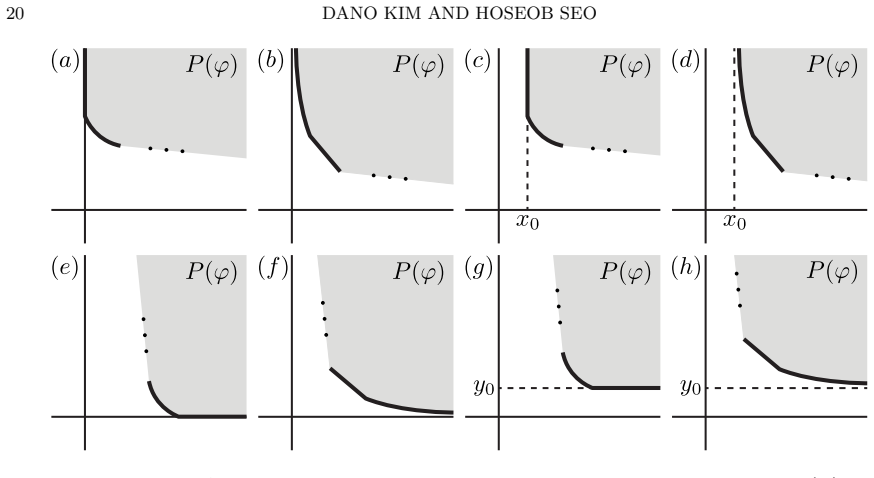
For a toric psh function $\phi$ on $D^2$ with Newton convex body $P(\phi)$, write $x_0=\inf \mathrm{pr}_1(P(\phi))$ and $y_0=\inf \mathrm{pr}_2(P(\phi))$. Theorem 5.7 states that $\mathrm{Jump}(\phi)_0$ has a cluster point if and only if either $x_0>0$ and the vertical line $\{(x_0,t):t\in\mathbb{R}\}$ misses $P(\phi)$, or $y_0>0$ and the horizontal line $\{(t,y_0):t\in\mathbb{R}\}$ misses $P(\phi)$. In that case the set of cluster points is exactly $\{k/m:k\in\mathbb{Z}_{>0},\, m\in S\}$, where $S\subseteq\{x_0,y_0\}$ contains $x_0$ exactly in the first case and $y_0$ exactly in the second. The paper also proves that for toric psh functions on $D^n$, if $c$ is a jumping number then all integer multiples $mc$ are jumping numbers, and that periodicity of jumping numbers fails in general; the appendix proves that asymptotic multiplier ideals of a graded system of ideals equal the analytic multiplier ideals of the associated psh function.
Load-bearing premise
The central argument assumes that a toric psh function's multiplier ideal is completely encoded by the integer lattice points inside its Newton convex body, via the criterion that $z^A$ belongs exactly when $A+\mathbf{1}$ lies in the interior; if that encoding failed for even one toric psh function, the lattice-point boundary analysis behind the cluster-point theorem would collapse.
Editorial extensions
If this is right
- If a toric psh function in dimension 2 has one cluster point, then it has infinitely many cluster points, and they form an unbounded set.
- Every cluster point of jumping numbers is itself a jumping number, so the failure of discreteness occurs at values that still belong to the jumping set.
- For the earlier psh example whose jumping numbers accumulate at 1, the full set of cluster points is precisely the positive integers.
- Periodicity of jumping numbers, which holds in the algebraic case, can fail for general psh functions; an explicit example with no period is presented.
- The asymptotic multiplier ideal of a graded system of ideals equals the analytic multiplier ideal of the associated psh function, so algebraic and analytic constructions can be used interchangeably in this setting.
Reading between the lines
- Because the asymptote-disjoint condition is open in the space of Newton convex bodies, cluster-point behavior should be generic among toric psh singularities in dimension 2, not a rare pathology.
- The same asymptote criterion can be tested for mixed jumping numbers $\mathrm{Jump}(\phi;\psi)_0$ by Minkowski addition of the two Newton bodies, giving an explicit recipe for clustering in additive families.
- In higher dimensions the natural extension is that cluster points are governed by coordinate hyperplane asymptotes of $P(\phi)$; the dimension-2 proof suggests the cluster set will be generated by reciprocals of the missing asymptote distances, possibly with new phenomena such as cluster points of cluster points.
- The equality between asymptotic and analytic multiplier ideals suggests one can engineer psh singularities with prescribed cluster sets by choosing Newton convex bodies with the desired asymptote structure, which may inform the open algebraic question of whether cluster points occur for multiplier ideals on singular varieties.
Signed reviews
Editorial analysis
A structured set of objections, weighed in public.
Referee Report
Summary. The paper extends the study of jumping numbers of multiplier ideals from the algebraic setting (Ein–Lazarsfeld–Smith–Varolin) to general plurisubharmonic functions. After establishing basic properties via the Guan–Zhou openness theorem, the authors analyze v-equivalence of psh functions, construct Siu psh functions from graded systems of ideals, and prove several examples. The main result, Theorem 5.7, gives a complete characterization, in terms of the Newton convex body, of when a toric psh function on the unit polydisk in C^2 has cluster points of jumping numbers at the origin, and identifies the set of such cluster points. An appendix by Boucksom proves that analytic multiplier ideals of Siu psh functions coincide with the asymptotic multiplier ideals of the underlying graded system.
Significance. If the proof gaps are repaired, Theorem 5.7 would be a substantial contribution: it completely describes the cluster-point phenomenon for toric psh functions in dimension two, generalizing the two known examples of Guan–Li and Ein–Lazarsfeld–Smith–Varolin and producing uncountably many new examples. The convex-geometric formulation is elegant, and the appendix by Boucksom is of independent interest, as it settles a natural comparison between analytic and algebraic asymptotic multiplier ideals. The paper is clearly written and the main statement is plausible and consistent with the worked examples.
major comments (3)
- [§5.2, proof of Theorem 5.7] The sequence conditions (1)–(2) in the proof are internally inconsistent. Since ε_{k+1} < ε_k, the set intP((c−ε_{k+1})ϕ) is a superset of intP((c−ε_k)ϕ), so no lattice point A_k+1 can satisfy both A_k+1 ∈ intP((c−ε_k)ϕ) and A_k+1 ∉ intP((c−ε_{k+1})ϕ). The same inconsistency appears in the sufficiency direction with B_j. The intended condition presumably involves intP(cϕ) or intP((c+ε_{k+1})ϕ); as written, the existence of the sequence is impossible, so the proof of the cluster-point characterization is not valid.
- [§5.2, proof of Theorem 5.7] The subsequence extraction is unjustified and, as stated, false. From 'exactly one coordinate of A_k increases at each step' it does not follow that there is a subsequence with one coordinate constant and the other strictly increasing; for example, the sequence (0,0),(0,1),(1,1),(1,2),(2,2),(2,3),... has both coordinates unbounded along every subsequence. The proof needs an additional argument showing that because A_k+1 ∉ intP(cϕ), at least one coordinate is bounded along a subsequence; this is exactly the step that converts a cluster point into a vertical or horizontal asymptote, so the main theorem is not established as written.
- [§5.1, proof of Theorem 5.3] The proof only treats the case c ∈ C(ϕ). For a jumping number c that lies in the closure of C(ϕ) but not in C(ϕ), Proposition 3.3 gives c ∈ closure(C(ϕ)), but the argument showing mC(ϕ) ⊂ C(ϕ) does not directly imply mc ∈ Jump(ϕ)_0. One needs an approximation argument using the fact that Jump(ϕ)_0 is closed, or an alternative argument; as printed, the theorem is not proved for cluster-point jumping numbers.
minor comments (4)
- [Throughout] There are several typographical errors: 'absense' in the introduction, 'Newon' in Example 3.12, and 'Theorem 5.10' in the proof of Corollary 5.11 should likely be Theorem 5.7 or 5.3.
- [§3.1, Proposition 3.3] The proof of the inclusion for non-cluster jumping numbers assumes that a single lattice point A can be chosen independently of ε; this deserves a brief justification using Noetherianity of the stalks.
- [§5.2, sufficiency direction] The construction of the sequence (α_j) in the sufficiency direction is only sketched; it would be helpful to explain explicitly why such lattice points can be chosen with the stated nesting property, especially given the inconsistency noted in the first major comment.
- [Appendix] The proof of Theorem 2.2 is very terse; in particular, the passage from v(ϕ) = v(a•) to the multiplier ideal equality uses the valuative criteria without recalling the normalization condition on v in the singular case. This is understandable for an appendix by an expert but could be clarified for the reader.
Circularity Check
No circularity: the central characterization is built from external convex-geometric and valuative results, with no fitted parameter or self-referential definition.
full rationale
The paper's main theorem (Theorem 5.7) reduces jumping numbers for toric psh functions to lattice points on the Newton convex body using Proposition 2.7, a result of Guenancia and Rashkovskii that is external to the paper. The other load-bearing inputs—Guan-Zhou openness, the valuative descriptions of multiplier ideals in [BFJ] and [BFFU], and the Boucksom appendix proving Theorem 2.2—are independent of the paper's conclusions and are not derived from the cluster-point statement. No parameter is fitted to the jumping numbers it later predicts: the cluster points are computed from P(ϕ) by a convex-geometric boundary analysis. Citations to the authors' own work (K15, K19, KR) appear only for auxiliary notions such as v-equivalence, coefficient-dependence of Siu psh functions, and Cegrell-class ideal behavior; none is load-bearing for Theorem 5.7. The skeptic's concern about an unjustified subsequence extraction in the necessity direction of Theorem 5.7 (and a similar gap in Theorem 5.3) is a possible proof gap, not a circularity: replacing that step by a bounded-coordinate argument would repair the proof, and at no point does the argument assume the target set of cluster points as an input.
Assumptions & free parameters
assumptions (6)
- standard math Guan-Zhou strong openness theorem: for psh functions ψ,ϕ, ⋃_{ε>0} J(ψ+εϕ) = J(ψ).
- standard math For a toric psh function ϕ, J(ϕ) is a monomial ideal and z^a ∈ J(ϕ) iff (a+1) ∈ intP(ϕ) (Guenancia, Rashkovskii).
- standard math Valuative characterization of multiplier ideals: f∈J(cϕ) iff there exists ε>0 such that v(f) ≥ (1+ε)v(cϕ) − A(v) for all divisorial valuations v (BFJ).
- standard math Asymptotic multiplier ideal membership via normalizing subschemes: f∈J(c·a•) iff for every normalizing subscheme N and every 0<δ≪1, v(f) ≥ c v(a•) − A(v) + δ v(I_N) (BFFU).
- standard math Subadditivity of multiplier ideals: J(ψ+ϕ) ⊆ J(ψ)J(ϕ) (DEL, Theorem 2.6).
- standard math Valuation of a graded system: v(a•)=inf_k v(a_k)/k = lim_k v(a_k)/k (JM, Lemma 2.3).
Cite this review
Pith. "Pith review of Jumping numbers of analytic multiplier ideals (with an appendix by S\'ebastien Boucksom)." pith.science (2026). https://pith.science/paper/PNOYIFQ4
@misc{pith2026190802474,
  author       = {Pith},
  title        = {Pith review of: Jumping numbers of analytic multiplier ideals (with an appendix by S\'ebastien Boucksom)},
  year         = {2026},
  howpublished = {\url{https://pith.science/paper/PNOYIFQ4}},
  note         = {Machine review of arXiv:1908.02474}
}
read the original abstract
We extend the study of jumping numbers of multiplier ideals due to Ein-Lazarsfeld-Smith-Varolin from the algebraic case to the case of general plurisubharmonic functions. While many properties from Ein-Lazarsfeld-Smith-Varolin are shown to generalize to the plurisubharmonic case, important properties such as periodicity and discreteness do not hold any more. Previously only two particular examples with a cluster point (i.e. failure of discreteness) of jumping numbers were known, due to Guan-Li and to Ein-Lazarsfeld-Smith-Varolin respectively. We generalize them to all toric plurisubharmonic functions in dimension 2 by characterizing precisely when cluster points of jumping numbers exist and by computing all those cluster points. This characterization suggests that clustering of jumping numbers is a rather frequent phenomenon. In particular, we obtain uncountably many new such examples.
Figures
Reference graph
Works this paper leans on
-
[1]
S. Boucksom, P. Eyssidieux, V. Guedj and A. Zeriahi, Monge-Amp\`ere equations in big cohomology classes, Acta Math. 205 (2010), 199 - 262
work page 2010
-
[2]
S. Boucksom, T. de Fernex, C. Favre and S. Urbinati, Valuation spaces and multiplier ideals on singular varieties, Recent advances in algebraic geometry, 29 - 51, London Math. Soc. Lecture Note Ser., 417, Cambridge Univ. Press, Cambridge, 2015
work page 2015
-
[3]
S. Boucksom, C. Favre and M. Jonsson, Valuations and plurisubharmonic singularities, Publ. Res. Inst. Math. Sci 44 (2008), no.2, 449-494
work page 2008
-
[4]
M. Blickle, K. Schwede, S. Takagi and W. Zhang, Discreteness and rationality of F-jumping numbers on singular varieties, Math. Ann. 347 (2010), no. 4, 917–949
work page 2010
-
[5]
N. Budur and M. Saito, Multiplier ideals, V-filtration, and spectrum, J. Algebraic Geom. 14 (2005), no. 2, 269–282
work page 2005
-
[6]
Cegrell, The general definition of the complex Monge-Amp\`ere operator, Ann
U. Cegrell, The general definition of the complex Monge-Amp\`ere operator, Ann. Inst. Fourier (Grenoble) 54 (2004), no. 1, 159-179
work page 2004
-
[7]
C. Berkesch and A. Leykin, Algorithms for Bernstein-Sato polynomials and multiplier ideals, ISSAC 2010—Proceedings of the 2010 International Symposium on Symbolic and Algebraic Computation, 99–106, ACM, New York, 2010
work page 2010
-
[8]
J.-P. Demailly, Monge-Amp\`ere operators, Lelong numbers and intersection theory, Complex analysis and geometry, 115-193, Univ. Ser. Math., Plenum, New York, 1993
work page 1993
Show all 39 references
-
[9]
Demailly, Analytic methods in algebraic geometry, Surveys of Modern Mathematics, 1
J.-P. Demailly, Analytic methods in algebraic geometry, Surveys of Modern Mathematics, 1. International Press, Somerville, MA; Higher Education Press, Beijing, 2012. (Also July 2011 version from the author's website. )
2012
-
[10]
Demailly, Extension of holomorphic functions defined on non reduced analytic subvarieties, The legacy of Bernhard Riemann after one hundred and fifty years
J.-P. Demailly, Extension of holomorphic functions defined on non reduced analytic subvarieties, The legacy of Bernhard Riemann after one hundred and fifty years. Vol. I, 191 - 222, Adv. Lect. Math., 35.1, Int. Press, Somerville, MA, 2016
2016
-
[11]
Demailly, L.Ein and R.Lazarsfeld, A subadditivity property of multiplier ideals, Michigan Math
J.-P. Demailly, L.Ein and R.Lazarsfeld, A subadditivity property of multiplier ideals, Michigan Math. J. 48 (2000), 137 -156
2000
-
[12]
Dinew, V
S. Dinew, V. Guedj and A. Zeriahi, Open problems in pluripotential theory, Complex Var. Elliptic Equ. 61 (2016), no. 7, 902-930
2016
-
[13]
Demailly and H.H
J.-P. Demailly and H.H. Pham, A sharp lower bound for the log canonical threshold, Acta Math. 212 (2014), no. 1, 1-9
2014
-
[14]
L. Ein, R. Lazarsfeld, K. Smith and D. Varolin, Jumping coefficients of multiplier ideals, Duke Math. J. 123 (2004), no. 3, 469-506
2004
-
[15]
L. Ein, R. Lazarsfeld and K. Smith, Uniform bounds and symbolic powers on smooth varieties, Invent. Math. 144 (2001), no. 2, 241–252
2001
-
[16]
Favre and M
C. Favre and M. Jonsson, Valuations and multiplier ideals, J. Amer. Math. Soc. 18 (2005), no. 3, 655–684
2005
-
[17]
Graf, The jumping coefficients of non- -Gorenstein multiplier ideals, J
P. Graf, The jumping coefficients of non- -Gorenstein multiplier ideals, J. Algebra 450 (2016), 323–348
2016
-
[18]
Guan and Z
Q. Guan and Z. Li, Cluster points of jumping coefficients and equisingularties of plurisubharmonic functions, arXiv:1604.03406
-
[19]
Guan and X
Q. Guan and X. Zhou, A proof of Demailly's strong openness conjecture, Ann. of Math. (2) 182 (2015), no. 2, 605-616
2015
-
[20]
Guenancia, Toric plurisubharmonic functions and analytic adjoint ideal sheaves, Math
H. Guenancia, Toric plurisubharmonic functions and analytic adjoint ideal sheaves, Math. Z. 271 (2012), 1011 - 1035
2012
-
[21]
ormander, Notions of Convexity, Modern Birkh \
L. H\"ormander, Notions of Convexity, Modern Birkh \"a user Classics, Birkh \"a user Boston, 2007
2007
-
[22]
Jonsson and M
M. Jonsson and M. Musta t a , Valuations and asymptotic invariants for sequences of ideals, Ann. Inst. Fourier (Grenoble) 62 (2012), no. 6, 2145-2209
2012
-
[23]
Kawamata, Deformations of canonical singularities, J
Y. Kawamata, Deformations of canonical singularities, J. Amer. Math. Soc. 12 (1999), no. 1, 85–92
1999
-
[24]
Kim, Equivalence of plurisubharmonic singularities and Siu-type metrics, Monatsh
D. Kim, Equivalence of plurisubharmonic singularities and Siu-type metrics, Monatsh. Math. 178 (2015), no. 1, 85-95
2015
-
[25]
Kim, Canonical bundle formula and semipositivity theorems, preprint, 2019
D. Kim, Canonical bundle formula and semipositivity theorems, preprint, 2019
2019
-
[26]
Kim and A
D. Kim and A. Rashkovskii, Higher Lelong numbers and convex geometry, arXiv:1803.07948
-
[27]
Koike, Minimal singular metrics of a line bundle admitting no Zariski decomposition, Tohoku Math
T. Koike, Minimal singular metrics of a line bundle admitting no Zariski decomposition, Tohoku Math. J. (2) 67 (2015), no. 2, 297-321
2015
-
[28]
Lazarsfeld, Positivity in Algebraic Geometry, Ergebnisse der Mathematik und ihrer Grenzgebiete
R. Lazarsfeld, Positivity in Algebraic Geometry, Ergebnisse der Mathematik und ihrer Grenzgebiete. 3. Folge. 48 - 49. Springer-Verlag, Berlin, 2004
2004
-
[29]
Musta t a , On multiplicities of graded sequences of ideals, J
M. Musta t a , On multiplicities of graded sequences of ideals, J. Algebra 256 (2002), no. 1, 229-249
2002
-
[30]
Nakayama, Zariski-decomposition and abundance, MSJ Memoirs, 14
N. Nakayama, Zariski-decomposition and abundance, MSJ Memoirs, 14. Mathematical Society of Japan, Tokyo, 2004
2004
-
[31]
Rashkovskii, Tropical analysis of plurisubharmonic singularities, Tropical and idempotent mathematics, 305–315, Contemp
A. Rashkovskii, Tropical analysis of plurisubharmonic singularities, Tropical and idempotent mathematics, 305–315, Contemp. Math., 495, Amer. Math. Soc., Providence, RI, 2009
2009
-
[32]
Rashkovskii, Analytic approximations of plurisubharmonic singularities, Math
A. Rashkovskii, Analytic approximations of plurisubharmonic singularities, Math. Z. 275 (2013), no. 3-4, 1217-1238
2013
-
[33]
Rashkovskii, Multi-circled singularities, Lelong numbers, and integrability index, J
A. Rashkovskii, Multi-circled singularities, Lelong numbers, and integrability index, J. Geom. Anal. 23 (2013), no. 4, 1976-1992
2013
-
[34]
Saito, On b-function, spectrum and rational singularity, Math
M. Saito, On b-function, spectrum and rational singularity, Math. Ann. 295 (1993), no. 1, 51–74
1993
-
[35]
Saito, Multiplier ideals, b-function, and spectrum of a hypersurface singularity, Compos
M. Saito, Multiplier ideals, b-function, and spectrum of a hypersurface singularity, Compos. Math. 143 (2007), no. 4, 1050-1068
2007
-
[36]
Siu, Invariance of plurigenera, Invent
Y.-T. Siu, Invariance of plurigenera, Invent. Math., 134 (1998), 661 - 673
1998
-
[37]
Smith and H
K. Smith and H. Thompson, Irrelevant exceptional divisors for curves on a smooth surface, Algebra, geometry and their interactions, 245-254, Contemp. Math., 448, Amer. Math. Soc., Providence, RI, 2007
2007
-
[38]
Tucker, Jumping numbers on algebraic surfaces with rational singularities, Trans
K. Tucker, Jumping numbers on algebraic surfaces with rational singularities, Trans. Amer. Math. Soc. 362 (2010), no. 6, 3223–3241
2010
-
[39]
Urbinati, Discrepancies of non- -Gorenstein varieties, Michigan Math
S. Urbinati, Discrepancies of non- -Gorenstein varieties, Michigan Math. J. 61 (2012), no. 2, 265–277
2012
Reviewed August 14, 2026 · model on record in the stance chip above.
Discussion (0). Continue with ORCID to comment.