REVIEW 4 major objections 4 minor 9 references
Some comments on Laakso graphs and sets of differences
T0 review · 4 major / 4 minor · reviewed 2026-08-14 · deepseek-v4-flash
Pith's one-line read This paper proves that the set of differences of the Kuratowski embedding of a particular doubling metric space is not itself doubling.
desk verdict Plausible new result about difference sets of Laakso spaces, but the main proof has an unaddressed separation gap that undermines the covering argument. read the letter →
The pith
A machine-rendered reading of the paper's core claim, the machinery that carries it, and where it could break.
The reading
What carries the argument
The mechanism is the cycle-counting argument on the iterated graphs. An edge cycle is a square loop produced in $X_i$ by the six-to-one gluing, and there are $6^{i-1}$ of them at level $i$. The proof makes each covering centre $g_j=d(t_j,\cdot)-d(s_j,\cdot)$ own at least one cycle by showing that an unwitnessed cycle supports a difference function that cannot be within distance $r$ of any $g_j$. The Kuratowski embedding is the translating device: it turns metric distances $\varrho(x,y)$ into $L^\infty$ norms of difference functions, so metric separation in the graph becomes separation in the function space.
What would settle it
Compute, on the finite graphs $X_i$, the minimum number $N_i$ of radius-$4^{-i}$ balls in $L^\infty(X_i)$ needed to cover $\{d(x,\cdot)-d(y,\cdot):d(x,y)<2\cdot4^{-i}\}$; if $N_i$ stays bounded as $i$ grows, the lower bound $N_i\ge6^{i-1}$ asserted in the proof is wrong and the non-doubling claim fails.
Extended reading notes
Core claim
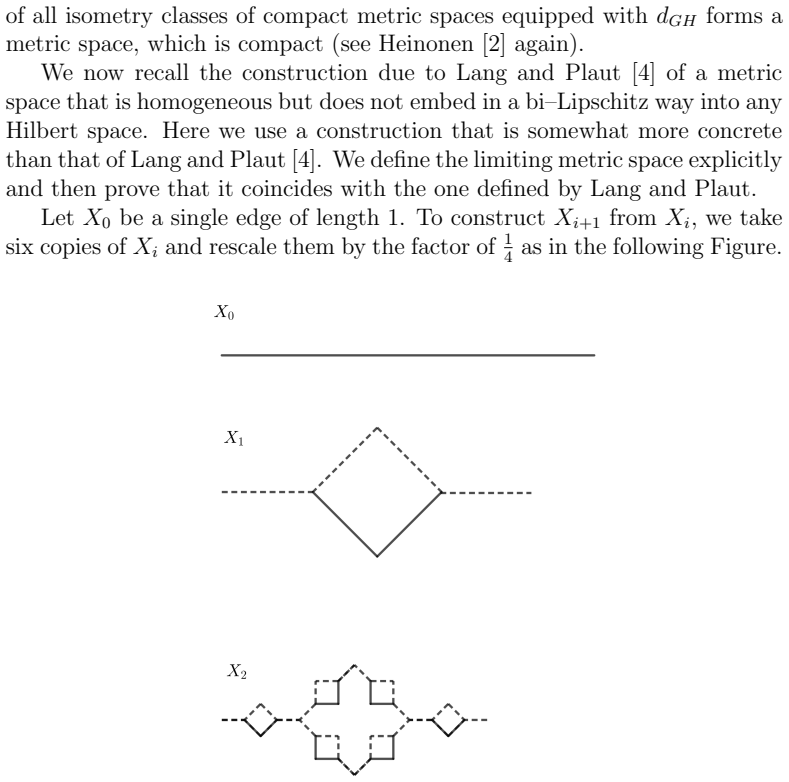
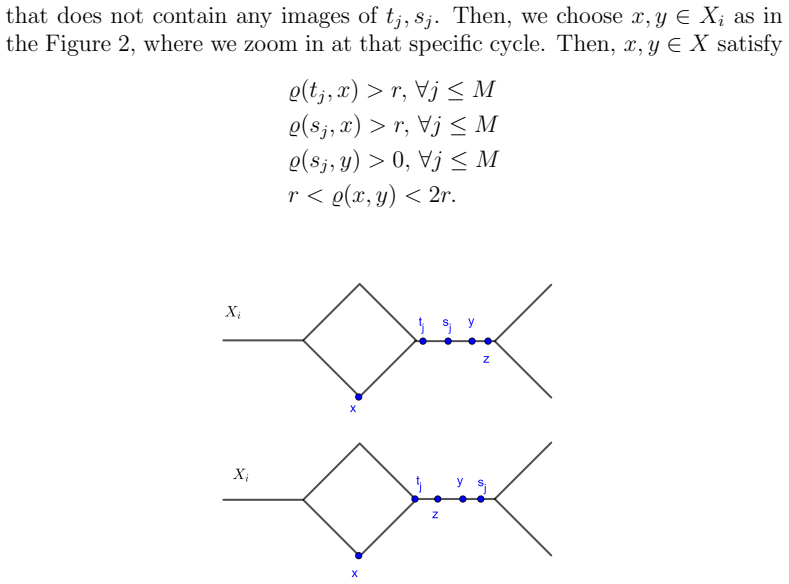
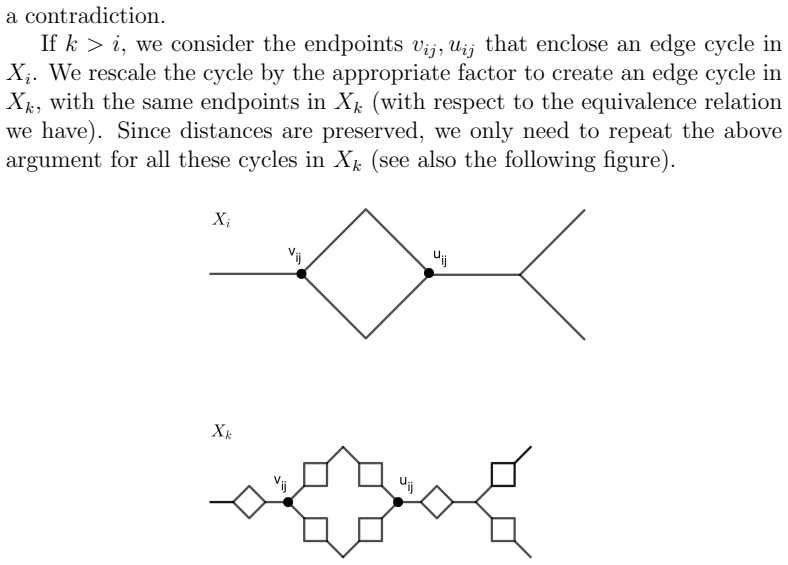
On the paper's own terms, the central result is Theorem 2.2. The space $X$ is the Gromov-Hausdorff limit of finite graphs $X_i$, where $X_0$ is a single edge of length $1$ and $X_{i+1}$ is six copies of $X_i$ scaled by $1/4$ and identified at endpoints; each $X_i$ contains $6^{i-1}$ edge cycles. The Kuratowski embedding $\Phi(x)=d(x,\cdot)$ sends $X$ isometrically into $L^\infty(X)$. The theorem asserts that the difference set $\Phi(X)-\Phi(X)$ is not doubling. Assuming it were doubling, the proof takes $r=(1/4)^i$, a cover of $B(0,2r)$ by $M$ balls of radius $r$, and a stage $k$ containing all the centres' defining points. Each edge cycle of $X_i$ must contain one of these defining points; otherwise a difference function $f=d(x,\cdot)-d(y,\cdot)$ localised in that cycle is farther than $r$ from every centre. With $6^{i-1}$ cycles and only $M$ centres, letting $i$ grow gives the contradiction; the case where $k>i$ is handled by rescaling the cycle from $X_i$ to $X_k$.
Load-bearing premise
The proof assumes, without proving it and with only a figure as evidence, that the isometric copies of earlier stages sit inside later stages in a way that keeps the edge cycles sufficiently separate for each covering centre to witness at most one cycle.
Editorial extensions
If this is right
- Since a metric space is homogeneous exactly when it is doubling, $\Phi(X)-\Phi(X)$ is not homogeneous, so the almost bi-Lipschitz embedding theorem quoted in the introduction cannot be applied to this difference set.
- At $r=(1/4)^i$, every cover of the difference ball $B(0,2r)$ by radius-$r$ balls needs at least $6^{i-1}$ balls, an explicit covering-number obstruction at a fixed radius ratio.
- The space $X$ itself remains doubling with constant $6$, so the example separates the doubling property of a space from the doubling property of its Kuratowski difference set.
- The explicit description of $X$ as a union of identified stages shows that the limiting space used in earlier constructions can be built concretely rather than only as a Gromov-Hausdorff limit.
- The question of whether $X$ itself admits an almost bi-Lipschitz Euclidean embedding is left open, but the difference-set route to such an embedding is ruled out.
Reading between the lines
- A natural test is to compute the exact covering numbers $N_i$ on the finite graphs $X_i$; if $N_i=6^{i-1}$ holds numerically, it would confirm the geometric separation assumption that the proof leaves to a figure.
- The cycle-counting mechanism should generalise to any iterated graph in which each stage replaces an edge by a fixed number $b$ of scaled copies: the exponential growth of cycles at a fixed radius ratio is what breaks doubling, so the phenomenon does not depend on the precise choices $6$ and $1/4$.
- If every doubling metric space is eventually shown to admit an almost bi-Lipschitz Euclidean embedding, this example would indicate that hypotheses on the difference set are not the right sufficient condition, since the set of differences fails here for a purely combinatorial reason.
Signed reviews
Editorial analysis
A structured set of objections, weighed in public.
Referee Report
Summary. The paper recalls the Laakso / Lang--Plaut construction of a doubling metric space X that is not bi-Lipschitz embeddable into any Hilbert space, gives a more explicit description of X as a Gromov--Hausdorff limit of a sequence of graphs X_i (each obtained from X_{i-1} by gluing six rescaled copies), and then states Theorem 2.2: if Phi: X -> L^infinity(X) is the Kuratowski embedding, the difference set Phi(X)-Phi(X) is not doubling. The proof assumes doubling of Phi(X)-Phi(X), covers a ball of radius 2r at 0 by M balls of radius r, and tries to force M >= 6^{i-1} by showing that every 'edge cycle' of X_i must contain one of the points t_j,s_j representing the centers. The paper concludes that Theorem 1.1 cannot be applied to this X and poses two open problems about almost bi-Lipschitz embeddings.
Significance. The motivating question is genuine and the proposed theorem, if established, would be a useful negative result: it shows that even for a doubling metric space with a very rigid self-similar structure, the set of differences under the Kuratowski embedding can fail to be doubling, so the hypotheses of Robinson's embedding theorem (Theorem 1.1) are not automatically satisfied. The paper's main contribution is a clean formulation of this obstruction and a concrete description of the Laakso-type space. However, the significance is conditional on the proof of Theorem 2.2 being completed; as written, the proof relies on several unproved geometric assertions. The paper does not include machine-checked proofs or reproducible code, but the strategy of deriving a covering lower bound from edge cycles is natural and, if carried out rigorously, would be convincing.
major comments (4)
- [§2, Theorem 2.2 (k <= i case)] The proof claims that if an edge cycle of X_i contains no images of any t_j or s_j, then one can choose x,y in that cycle such that rho(t_j,x) > r and rho(s_j,x) > r for every j, with r = 4^{-i}. This separation statement is not proved and is not a formal consequence of the recursive gluing construction. A point t_j lying in an adjacent square that shares a vertex with the chosen cycle can be at distance less than r from points x near that vertex, so the strict inequalities require a quantitative choice of x,y and a proof that avoids all centers simultaneously. Since the subsequent contradiction uses these inequalities to conclude ||f - g_j||_infty > r, this missing separation lemma is load-bearing; without it the covering argument collapses.
- [§2, Theorem 2.2 (counting edge cycles)] Even if every edge cycle of X_i is forced to contain at least one of the points t_j,s_j, the deduction 'since there are 6^{i-1} edge cycles contained in X_i, we deduce that M >= 6^{i-1}' does not follow as stated, because one point can belong to several edge cycles that meet at shared vertices. The proof needs a uniform bound on the multiplicity of cycles through any point (for example, bounded by the graph degree), after which the conclusion becomes M >= c^{-1} 6^{i-1}. The missing constant may be harmless for the contradiction, but the argument as written is not valid.
- [§2, Theorem 2.2 (k > i case)] The treatment of the case k > i is deferred to Figure 3 and the word 'rescaling'. The proof must show that after embedding X_i into X_k, the chosen points x,y from X_i and the centers t_j,s_j in X_k satisfy the same distance inequalities with respect to the fixed radius r = 4^{-i}. This is not automatic, because r is not rescaled when passing to X_k, and the relation between balls in X and in the embedded copies under the quotient construction is not described. The case k > i therefore is not a formal consequence of the previous case as written.
- [§2, construction of X] The isometric embeddings h_{i->j} used to define the limit space X are never specified, only indicated by a figure, and the quotient construction is asserted rather than verified. In particular, the equivalence relation x ~ y iff rho*(x,y) = 0 requires a proof that rho* is a pseudometric and that the quotient distance rho([x],[y]) = rho*(x,y) is independent of representatives. Since Theorem 2.2 is stated for this X, the theorem's hypotheses are not fully defined until these steps are supplied.
minor comments (4)
- [Abstract and Introduction] The abstract cites Lang and Plaut as [3], but in the introduction Lang and Plaut are correctly cited as [4]; the abstract citation should be corrected.
- [§1, definition of homogeneous space] In the definition of (M,s)-homogeneous, the expression (R/r)^s is written but R is not defined; the intended quantity is presumably (r/rho)^s. Please correct this typo.
- [§2, doubling of X] The proof that X is doubling is deferred to 'For a proof see [5]', where [5] is an unpublished PhD thesis. Since this fact is used as motivation, it would be preferable either to include a proof or to cite a published source.
- [§2, edge cycles] The term 'edge cycle' is used informally; a formal definition of the cycles and of the endpoints v_i^j, u_i^j would make the counting and covering arguments easier to verify.
Circularity Check
No circularity: Theorem 2.2 is a direct covering-counting contradiction; the only self-citations are contextual, not load-bearing.
full rationale
The main theorem is proved by assuming that Phi(X)-Phi(X) is doubling and deriving a covering contradiction: a hypothetical M-ball cover of B(0,2r) forces every one of the 6^(i-1) edge cycles of X_i to contain one of the centers t_j or s_j, giving M >= 6^(i-1) for all i. None of these steps assumes the target non-doubling conclusion, and no parameter is fitted or renamed as a prediction. The construction of X is taken from Laakso and Lang-Plaut, with the paper giving a more concrete presentation; the fact that X is doubling is attributed externally to Lang and Plaut [4], and the pointer to [5] (the same author's thesis) is a more transparent proof of that same external theorem, not an input to Theorem 2.2. The motivational citations to Olson-Robinson and Robinson [6,7] are not used in the proof. The proof does rely on unproved geometric separation assertions about the edge cycles (Figures 2 and 3), but a missing justification or a possible geometric gap is a correctness risk, not circularity: the argument does not reduce to its own inputs by definition or by self-citation. Therefore there is no significant circularity.
Assumptions & free parameters
assumptions (3)
- domain assumption The iterative Laakso graph construction yields a well-defined compact doubling metric space X with the stated properties.
- standard math The Kuratowski embedding Phi: X -> L^infinity(X), x -> d(x,.), is an isometry.
- domain assumption The spaces Xi converge in the Gromov-Hausdorff metric to the limiting space X.
Cite this review
Pith. "Pith review of Some comments on Laakso graphs and sets of differences." pith.science (2026). https://pith.science/paper/MBBNKLYD
@misc{pith2026190802491,
  author       = {Pith},
  title        = {Pith review of: Some comments on Laakso graphs and sets of differences},
  year         = {2026},
  howpublished = {\url{https://pith.science/paper/MBBNKLYD}},
  note         = {Machine review of arXiv:1908.02491}
}
abstract
We recall a variation of a construction due to Laakso \cite{LA}, also used by Lang and Plaut \cite{LA} of a doubling metric space $X$ that cannot be embedded into any Hilbert space. We give a more concrete version of this construction and motivated by the results of Olson \& Robinson \cite{OR}, we consider the Kuratowski embedding $\Phi(X)$ of $X$ into $L^{\infty}(X)$ and prove that $\Phi(X)-\Phi(X)$ is not doubling.
Figures
Reference graph
Works this paper leans on
-
[4]
Lang, U. and Plaut, C., 2001. Bilipschitz embeddings of metric spaces into space forms. Geometriae Dedicata, 87(1-3), pp.285-307
work page 2001
-
[3]
Plane with A∞-weighted metric not Bi-Lipschitz embeddable to Rn
Laakso, T.J., 2002. Plane with A∞-weighted metric not Bi-Lipschitz embeddable to Rn. Bulletin of the London Mathematical Society, 34(6), pp.667-676
work page 2002
-
[1]
‘Plongements Lipschitziens dans Rn’, Bull
Assouad, P. ‘Plongements Lipschitziens dans Rn’, Bull. Soc. Math. France 111, 429-448 (1983)
work page 1983
-
[2]
Heinonen, J. ‘Geometric Embeddings of Metric Spaces.’ Lectures in the Finnish Graduate School of Mathematics, University of Jyvaskyla (2003)
work page 2003
-
[5]
Phd Thesis, University of Warwick, Department of Math- ematics, 2019
Margaris, A. Phd Thesis, University of Warwick, Department of Math- ematics, 2019
work page 2019
-
[6]
Olson, E. and Robinson, J. C., 2010. Almost bi-Lipschitz embeddings and almost homogeneous sets. Transactions of the American Mathemat- ical Society, 362(1), pp.145-168
work page 2010
-
[7]
Robinson, J. C. Log-Lipschitz embeddings of homogeneous sets with sharp logarithmic exponents and slicing products of balls. Proceedings of the American Mathematical Society. 2014;142(4):1275-88
work page 2014
-
[8]
Robinson, J. C. ‘Dimensions, Embeddings and Attractors”, Cambridge Tracts in Mathematics, Vol. 186 (2011)
work page 2011
Show all 9 references
-
[9]
Semmes, S. (1996). On the nonexistence of bilipschitz parameteriza- tions and geometric problems about A∞-weights. Revista Matemtica Iberoamericana, 12(2), 337-410. 9
1996
Reviewed August 14, 2026 · model on record in the stance chip above.
Discussion (0). Continue with ORCID to comment.