REVIEW 1 major objections 6 minor 41 references
EC 22536-5304: SALT identifies a new lead-rich intermediate helium subdwarf
T0 review · 1 major / 6 minor · reviewed 2026-08-14 · deepseek-v4-flash
Pith's one-line read SALT spectra of the hot subdwarf EC 22536-5304 reveal a surface lead abundance about 60,000 times the solar value, the strongest lead enrichment measured in an intermediate helium subdwarf.
desk verdict A credible detection of a new lead-rich subdwarf whose 'record' claim outruns its error bars. read the letter →
The pith
A machine-rendered reading of the paper's core claim, the machinery that carries it, and where it could break.
The reading
What carries the argument
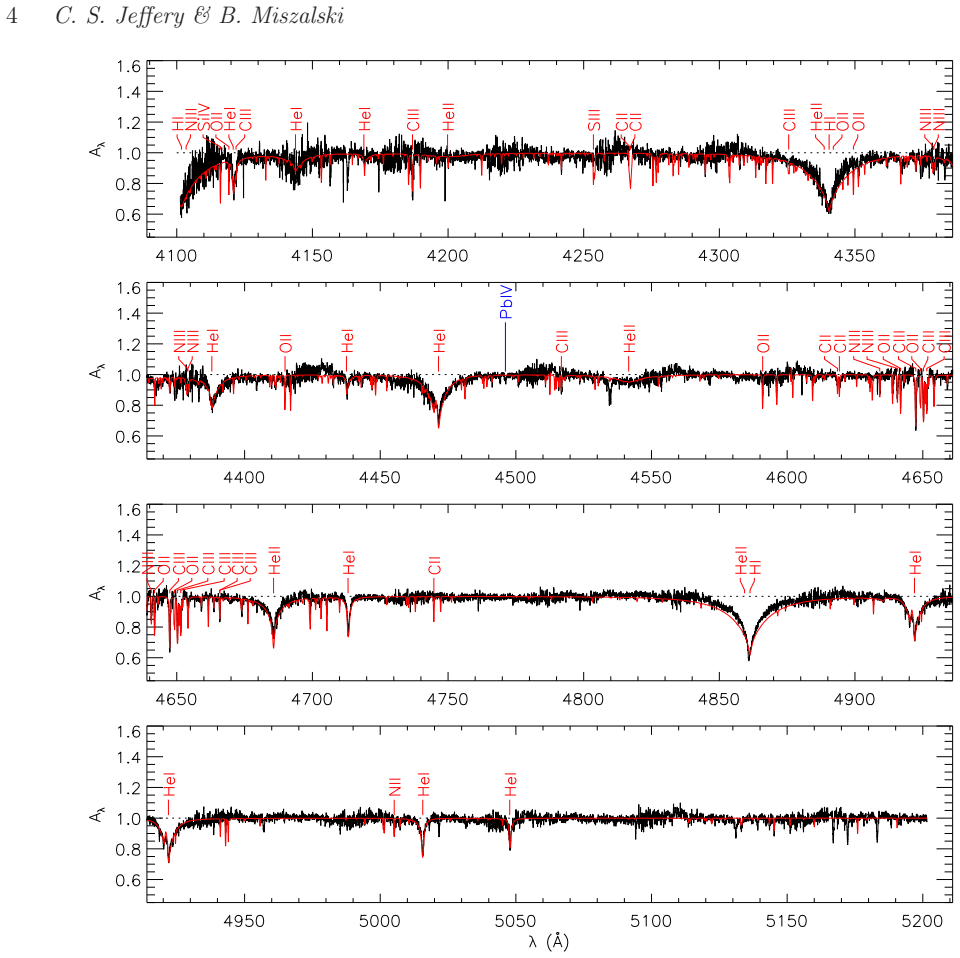
The feature that carries the argument is the Pb IV absorption at 4050 Å and 4496 Å, where Pb IV means triply ionized lead, Pb$^{3+}$. The 4496.15 Å line, with equivalent width $51 \pm 6$ mÅ, is compared with synthetic spectra from a grid of LTE model atmospheres with $T_{\rm eff}$ near 36 000 K, $\log g$ near 6.0, $n_{\rm He}$ near 0.2, and microturbulence 5 km s$^{-1}$. The lower-resolution RSS spectrum independently measures the 4050 Å line, equivalent width $86 \pm 20$ mÅ, giving $\log \epsilon_{\rm Pb} = 6.66 \pm 0.16$; the agreement of the two lines converts the identification into a measured surface abundance.
What would settle it
A higher-signal-to-noise spectrum covering both Pb IV lines, with each line measured independently and analysed under non-LTE with freshly computed Pb IV atomic data, would settle it: a disagreement between the lines, or a revised atomic strength moving the abundance outside the quoted errors, would overturn the record claim.
Extended reading notes
Core claim
EC 22536-5304 is an intermediate helium-rich hot subdwarf with adopted surface parameters $T_{\rm eff} = 35\,550 \pm 1\,500$ K, $\log g = 5.92 \pm 0.15$ (cm s$^{-2}$), and helium abundance $n_{\rm He} = 0.17 \pm 0.05$. Measuring the Pb IV $\lambda$4496.15 Å line, equivalent width $51 \pm 6$ mÅ, in the SALT/HRS spectrum, together with the Pb IV $\lambda$4050 Å line in the RSS spectrum, gives a lead abundance $\log \epsilon_{\rm Pb} = 6.53 \pm 0.25$, which is 4.8 dex, or about $6\times10^{4}$ times, the solar lead abundance. This is the highest lead abundance reported for an intermediate helium subdwarf, placing the star at the extreme of the known heavy-metal subdwarf population.
Load-bearing premise
The measurement stands on the assumption that the lead lines form in a layer of the star whose temperature, pressure, and motion match the adopted model atmosphere, and that the intrinsic strength of the lead transition is known; if either assumption is off, the derived lead abundance shifts.
Editorial extensions
If this is right
- The star becomes the most extreme confirmed case of lead enrichment in an intermediate helium subdwarf, with surface lead about $6\times10^{4}$ times solar.
- Because the zirconium upper limit ($\log \epsilon_{\rm Zr} < 5.0$) lies far below the lead value, the enrichment is element-selective rather than a blanket overabundance of trans-iron material.
- Strong Pb IV lines visible even in low-resolution RSS spectra mean that archival and future SALT observations can pick out additional lead-rich subdwarfs without waiting for high-resolution follow-up.
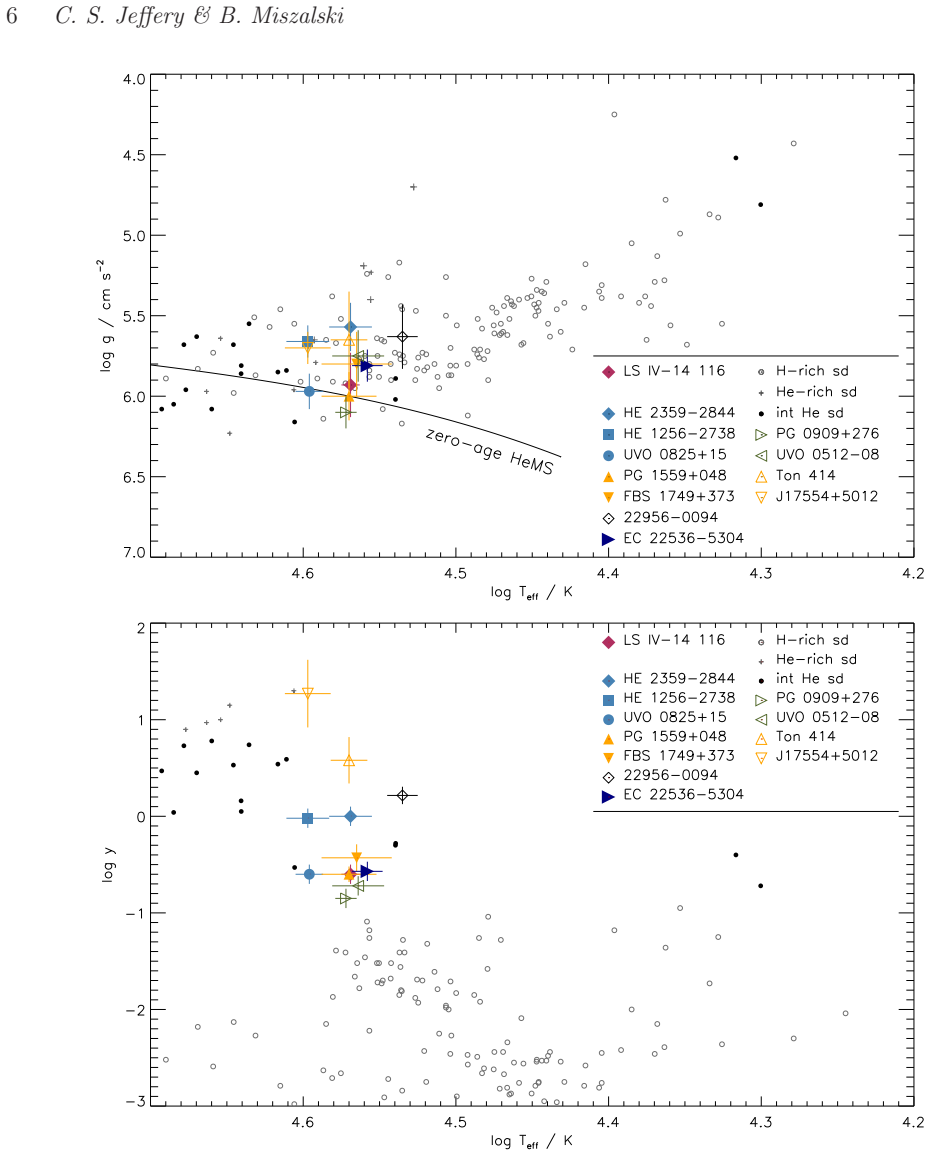
- Adding this object to the temperature–gravity–helium diagram places the most lead-rich case near the cool boundary of the known heavy-metal subdwarf cluster, tightening the conditions under which such abundances appear.
Reading between the lines
- Beyond the paper: the radial-velocity shift between the two HRS epochs, if real, would make EC 22536-5304 a binary, and a companion could matter for how the lead-rich atmosphere formed; the paper does not pursue this.
- Beyond the paper: the record abundance rests on one strong line plus one weaker confirmation, so if lead is concentrated in a thin surface layer rather than mixed evenly, the true surface abundance could be lower; a stratified or non-LTE model is the natural next test.
- Beyond the paper: other helium-rich subdwarfs already in SALT archives could be screened for the Pb IV 4496 Å line; detecting it in more objects would test whether lead-richness is a distinct class or a tail of a continuous distribution.
Signed reviews
Editorial analysis
A structured set of objections, weighed in public.
Referee Report
Summary. This paper presents SALT/HRS and SALT/RSS spectroscopy of the hot subdwarf EC 22536-5304, identifies triply-ionized lead absorption at 4496 Å in the HRS spectrum and at 4496 and 4049 Å in the RSS spectrum, and derives photospheric parameters (Teff = 35.6 kK, log g = 5.92, nHe = 0.17) using LTE model atmospheres from the Armagh grid. Line-by-line equivalent-width analysis gives log eps(Pb) = 6.53 ± 0.25, roughly 4.8 dex above solar, together with C, N, and O abundances. On this basis the paper argues that EC 22536-5304 is the most lead-rich intermediate helium subdwarf discovered so far.
Significance. The paper's value lies in adding an independently observed case of a lead-rich intermediate-helium subdwarf with a clearly detected Pb IV line, extending the small sample in Fig. 3. The equivalent-width data are tabulated, the detection is corroborated by two SALT instruments, and the authors explicitly discuss the sensitivity of the abundances to microturbulence and gravity. These are genuine strengths. The conclusion that the object is a heavy-metal subdwarf with a large Pb overabundance is credible; the superlative claim that it is the most lead-rich object is not statistically justified at the quoted precision.
major comments (1)
- [Abstract; §3.3; Table 2; §5] The claim that EC 22536-5304 is 'the most lead-rich intermediate helium subdwarf discovered so far' is not supported by the quoted errors. Table 2 reports log eps(Pb) = 6.53 ± 0.25 for EC 22536-5304 and 6.39 ± 0.23 for HE 1256-2738; the difference of 0.14 dex is much smaller than the quadrature-summed uncertainty of 0.34 dex. In addition, the RSS measurement of the same Pb IV 4496.2 Å line (EW 35 ± 20 mÅ; §3.3) gives log eps(Pb) = 6.36 ± 0.30, below the HE 1256-2738 value. The sentence in §5 goes further and calls the star 'the most lead-rich subdwarf identified to date', a broader statement for which no test is provided. Please either add a quantitative significance test that accounts for correlated systematics or replace the superlative with a statement such as 'one of the most lead-rich', and harmonize the abstract and conclusion wording.
minor comments (6)
- [§3.3] The RSS Pb IV features are described as 'weak features covering 2 pixels each'; because at R ≈ 3600 a 2-pixel feature is not resolved, please state the pixel scale and clarify whether the quoted equivalent-width errors include the systematic uncertainty associated with measuring unresolved lines.
- [§5] There are two typographical slips in this section: 'the inferred abundance inferred is' repeats 'inferred', and 'the potential or SALT' should read 'the potential of SALT'.
- [Table 2 / §4] The object in Table 2 is labelled 'FPS 1749+3734' while the text and references consistently call it FBS 1749+373; please make the nomenclature uniform.
- [Table A1] In the N iii block of Table A1, the line at 4200.10 Å appears twice with different equivalent widths; please check whether one entry is mislabeled or whether two separate components are intended.
- [Fig. 3 caption] The caption contains the typo 'helium abudance'; it should read 'helium abundance'.
- [§3.2] The adopted solution Bhrs is selected after increasing the weight of the helium lines by a factor of 30, but the text gives no sensitivity test for the Pb abundance under the alternative solutions Ahrs and Brss; a one-sentence statement that the Pb value is unchanged (or changes by a given amount) across the Table 1 solutions would strengthen the analysis.
Circularity Check
No circular derivation: Pb abundance is measured from observed Pb IV equivalent widths against a model grid in which lead is not a fitted input; self-citations are methodological and not load-bearing.
full rationale
The paper's central claim is an abundance measurement, not a prediction derived from a fitted parameter. The Pb abundance is obtained line-by-line from the observed equivalent width of Pb IV 4496.15 A (51 +/- 6 mA, Table A.1) using the model atmosphere code, returning log eps Pb = 6.53 +/- 0.25. The atmospheric parameters (Teff = 35,550 K, log g = 5.92, nHe = 0.17) were themselves fitted to hydrogen, helium, carbon, nitrogen, and oxygen features, and the adopted hiz model grid does not include a fitted lead abundance. Thus the Pb result is not equivalent by construction to any input. The paper's self-citations to the Armagh radiative transfer codes and to earlier heavy-metal subdwarf analyses are methodological or comparative; the comparison Pb abundances in Table 2 come from external published measurements (Naslim et al. 2011, 2013; Jeffery et al. 2017), not from a self-citation chain that contains the present result. The 'most lead-rich' superlative in the abstract and conclusion is not supported by a significance test -- the 0.14 dex difference from HE 1256-2738 is smaller than the combined uncertainties, and the RSS Pb line gives a lower abundance (6.36 +/- 0.30) -- but that is a statistical-support and correctness concern about a comparative claim, not circularity. No derivation step reduces to its own input, and no fitted parameter is renamed as a prediction.
Assumptions & free parameters
free parameters (4)
- Effective temperature (adopted) =
35,550 K
- Surface gravity (log g) =
5.92 cm/s^2
- Helium abundance (nHe) =
0.17
- Microturbulent velocity (vturb) =
5 km/s
assumptions (4)
- domain assumption Local thermodynamic equilibrium (LTE) holds in the model atmospheres and formal solutions.
- domain assumption The atomic data, including oscillator strengths for Pb IV and the other ions, are accurate.
- standard math Linear interpolation between grid models is adequate for parameter and abundance fitting.
- ad hoc to paper The hiz model grid, with reduced light-element abundances, solar iron, and enhanced calcium, provides a suitable background for measuring Pb.
Cite this review
Pith. "Pith review of EC 22536-5304: SALT identifies a new lead-rich intermediate helium subdwarf." pith.science (2026). https://pith.science/paper/KBYESWGO
@misc{pith2026190802500,
  author       = {Pith},
  title        = {Pith review of: EC 22536-5304: SALT identifies a new lead-rich intermediate helium subdwarf},
  year         = {2026},
  howpublished = {\url{https://pith.science/paper/KBYESWGO}},
  note         = {Machine review of arXiv:1908.02500}
}
read the original abstract
SALT spectra of the helium-rich hot subdwarf EC22536-5304 show strong absorption lines of triply-ionized lead. Analysis of the HRS spectrum and a follow-up SALT/RSS spectrum show EC22536-5304 to have surface properties (temperature, gravity, helium/hydrogen ratio) similar to other heavy-metal subdwarfs. With a lead overabundance of 4.8 dex relative to solar, EC22536-5304 is the most lead-rich intermediate helium subdwarf discovered so far.
Figures

Reference graph
Works this paper leans on
-
[1]
J., Scott P., 2009, , 47, 481
Asplund M., Grevesse N., Sauval A. J., Scott P., 2009, , 47, 481
2009
- [2]
-
[3]
Buckley D. A. H., Swart G. P., Meiring J. G., 2006, in Society of Photo-Optical Instrumentation Engineers (SPIE) Conference Series Vol. 6267 of , Completion and commissioning of the Southern African Large Telescope . p. 62670Z
work page 2006
-
[4]
Burgh E. B., Nordsieck K. H., Kobulnicky H. A., Williams T. B., O'Donoghue D., Smith M. P., Percival J. W., 2003, in Iye M., Moorwood A. F. M., eds, Instrument Design and Performance for Optical/Infrared Ground-based Telescopes Vol. 4841 of , Prime Focus Imaging Spectrograph for the Southern African Large Telescope: optical design . pp 1463--1471
work page 2003
-
[5]
M., , 2015, pyhrs: Spectroscopic data reduction package for SALT , Astrophysics Source Code Library
Crawford S. M., , 2015, pyhrs: Spectroscopic data reduction package for SALT , Astrophysics Source Code Library
work page 2015
-
[6]
M., Crause L., Depagne \'E ., et al
Crawford S. M., Crause L., Depagne \'E ., et al. 2016, in Ground-based and Airborne Instrumentation for Astronomy VI Vol. 9908 of , Data reductions and data quality for the high resolution spectrograph on the Southern African Large Telescope . p. 99082L
work page 2016
-
[7]
M., Still M., Schellart P., et al
Crawford S. M., Still M., Schellart P., et al. 2010, in Observatory Operations: Strategies, Processes, and Systems III Vol. 7737 of , PySALT: the SALT science pipeline . p. 773725
work page 2010
-
[8]
Daszy \'n ska-Daszkiewicz J., Szewczuk W., 2011, , 728, 17
work page 2011
Show all 41 references
-
[9]
de Jager C., 1954, , 173, 680
1954
-
[10]
Dorsch M., Latour M., Heber U., Schindewolf M., 2018, doi.org/10.5281/zenodo.1476885
2018 doi
-
[11]
at Erlangen-N\
Edelmann H., 2003, PhD thesis, Friedrich-Alexander-Universit\"at Erlangen-N\"urnberg
2003
-
[12]
Edelmann H., Heber U., Hagen H.-J., Lemke M., Dreizler S., Napiwotzki R., Engels D., 2003, , 400, 939
2003
-
[13]
H., Nemeth P., Gentile Fusillo N
Geier S., stensen R. H., Nemeth P., Gentile Fusillo N. P., G \"a nsicke B. T., Telting J. H., Green E. M., Schaffenroth J., 2017, , 600, A50
2017
-
[14]
M., Guvenen B., O'Malley C
Green E. M., Guvenen B., O'Malley C. J., O'Connell C. J., Baringer B. P., Villareal A. S., Carleton T. M., Fontaine G., Brassard P., Charpinet S., 2011, , 734, 59
2011
-
[15]
Han Z., Podsiadlowski P., Maxted P. F. L., Marsh T. R., Ivanova N., 2002, , 336, 449
2002
-
[16]
Heber U., 1986, , 155, 33
1986
-
[17]
N., Werner K., 2000, , 363, 198
Heber U., Reid I. N., Werner K., 2000, , 363, 198
2000
-
[18]
Hundt E., 1973, , 29, 17
1973
-
[19]
I., 1990, , 353, 215
Iben Jr. I., 1990, , 353, 215
1990
-
[20]
S., Baran A
Jeffery C. S., Baran A. S., Behara N. T., et al. 2017, , 465, 3101
2017
-
[21]
S., Woolf V
Jeffery C. S., Woolf V. M., Pollacco D. L., 2001, , 376, 497
2001
-
[22]
L., O'Donoghue D., Koen C., Koen T., Hambly N., MacGillivray H., Stobie R
Kilkenny D., Worters H. L., O'Donoghue D., Koen C., Koen T., Hambly N., MacGillivray H., Stobie R. S., 2016, , 459, 4343
2016
-
[23]
Y., 2016, Technical report, MIDAS pipeline for HRS: the absolute accuracy of radial velocities
Kniazev A. Y., 2016, Technical report, MIDAS pipeline for HRS: the absolute accuracy of radial velocities. Southern Africa Large Telescope
2016
-
[24]
Y., Gvaramadze V
Kniazev A. Y., Gvaramadze V. V., Berdnikov L. N., 2016, , 459, 3068
2016
-
[25]
Y., Gvaramadze V
Kniazev A. Y., Gvaramadze V. V., Berdnikov L. N., 2017, ASPCS, 510, 480
2017
-
[26]
A., Nordsieck K
Kobulnicky H. A., Nordsieck K. H., Burgh E. B., Smith M. P., Percival J. W., Williams T. B., O'Donoghue D., 2003, in Iye M., Moorwood A. F. M., eds, Instrument Design and Performance for Optical/Infrared Ground-based Telescopes Vol. 4841 of , Prime focus imaging spectrograph f...
2003
-
[27]
Koen C., Miszalski B., V \"a is \"a nen P., Koen T., 2017, , 465, 4723
2017
-
[28]
M., Fontaine G., 2019, , 623, L12
Latour M., Green E. M., Fontaine G., 2019, , 623, L12
2019
-
[29]
S., Ahmad A., Behara N
Naslim N., Jeffery C. S., Ahmad A., Behara N. T., S ah \` n T., 2010, , 409, 582
2010
-
[30]
S., Behara N
Naslim N., Jeffery C. S., Behara N. T., Hibbert A., 2011, , 412, 363
2011
-
[31]
S., Hibbert A., Behara N
Naslim N., Jeffery C. S., Hibbert A., Behara N. T., 2013, , 434, 1920
2013
-
[32]
S., Woolf V
Naslim N., Jeffery C. S., Woolf V. M., 2019, , submitted
2019
-
[33]
N \'e meth P., Kawka A., Vennes S., 2012, , 427, 2180
2012
-
[34]
O'Donoghue D., Buckley D. A. H., Balona L. A., et al. 2006, , 372, 151
2006
-
[35]
Schulz H., Wegner G., Heber U., 1991, , 103, 435
1991
-
[36]
Traving G., 1964, Zeitschrift fur Astrophysik, 60, 167
1964
-
[37]
G., 2001, , 113, 1420
van Dokkum P. G., 2001, , 113, 1420
2001
-
[38]
F., Jeffery C
Wild J. F., Jeffery C. S., 2018, , 473, 4021
2018
-
[39]
S., 2012, , 419, 452
Zhang X., Jeffery C. S., 2012, , 419, 452
2012
-
[40]
write newline
" write newline "" before.all 'output.state := FUNCTION fin.entry write newline FUNCTION new.block output.state before.all = 'skip after.block 'output.state := if FUNCTION new.sentence output.state after.block = 'skip output.state before.all = 'skip after.sentence 'output.stat...
-
[41]
write newline
" write newline "" before.all 'output.state := FUNCTION fin.entry write newline FUNCTION new.block output.state before.all = 'skip after.block 'output.state := if FUNCTION new.sentence output.state after.block = 'skip output.state before.all = 'skip after.sentence 'output.stat...
Reviewed August 14, 2026 · model on record in the stance chip above.
Discussion (0). Continue with ORCID to comment.