REVIEW 4 major objections 5 minor 1 cited by
Unraveling the hidden organisation of urban systems and their mobility flows
T0 review · 4 major / 5 minor · reviewed 2026-08-14 · deepseek-v4-flash
Pith's one-line read This paper claims that the functional organization of cities—how people's flows connect urban areas—follows size-driven regularities and that the transport layer is what holds a city together, with removing it able to cut integration by…
desk verdict A useful empirical mapping of urban integration and segregation from Foursquare check-ins, but the unvalidated trip proxy and small sample mean the transport-layer headline should be read as suggestive, not conclusive. read the letter →
The pith
A machine-rendered reading of the paper's core claim, the machinery that carries it, and where it could break.
The reading
What carries the argument
The argument runs on two normalized measures applied to paired structural and functional networks. Integration is measured by the global communication efficiency GCE, a weighted generalization of average inverse shortest-path distance, normalized by a physically grounded ideal network so weighted and unweighted networks can be compared; segregation is the maximal modularity Q* found by the Louvain algorithm. The functional network is a multilayer network whose nodes are 500m by 500m cells and whose weighted edges are consecutive check-ins between venues, stratified into fifteen activity layers with intra- and inter-layer flows. Null models—Watts-Strogatz small-world networks and random geometric networks with rewiring—are used to show that edge density and spatial scale reproduce the integration-segregation trade-off, and layer-removal attacks identify which activity types carry the integrating role.
What would settle it
Take one of the ten cities, rebuild the functional network from an independent mobility source such as mobile-phone location data over the same area, and compare the integration and segregation values with and without the transport layer; if the integration drop after removing transport disappears or reverses, the central claim fails for that city.
Extended reading notes
Core claim
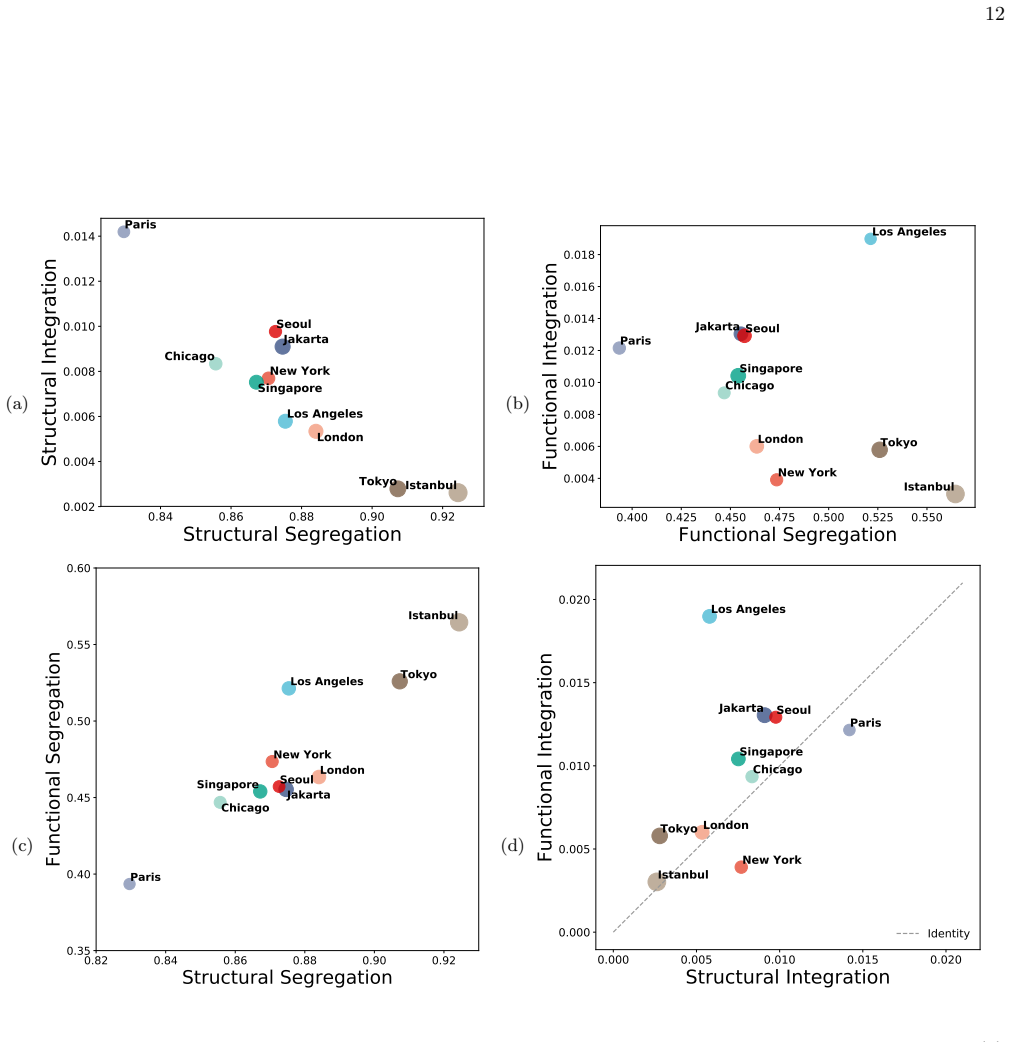
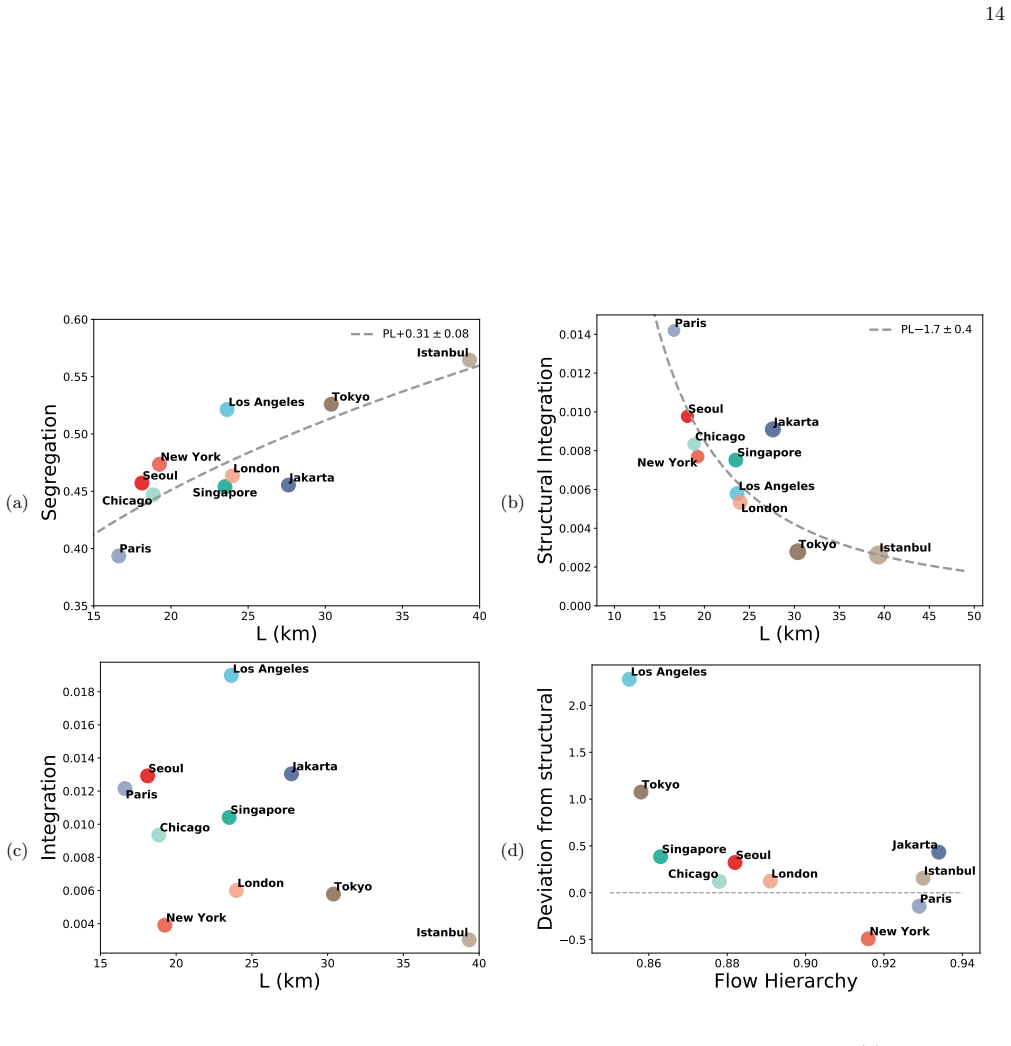
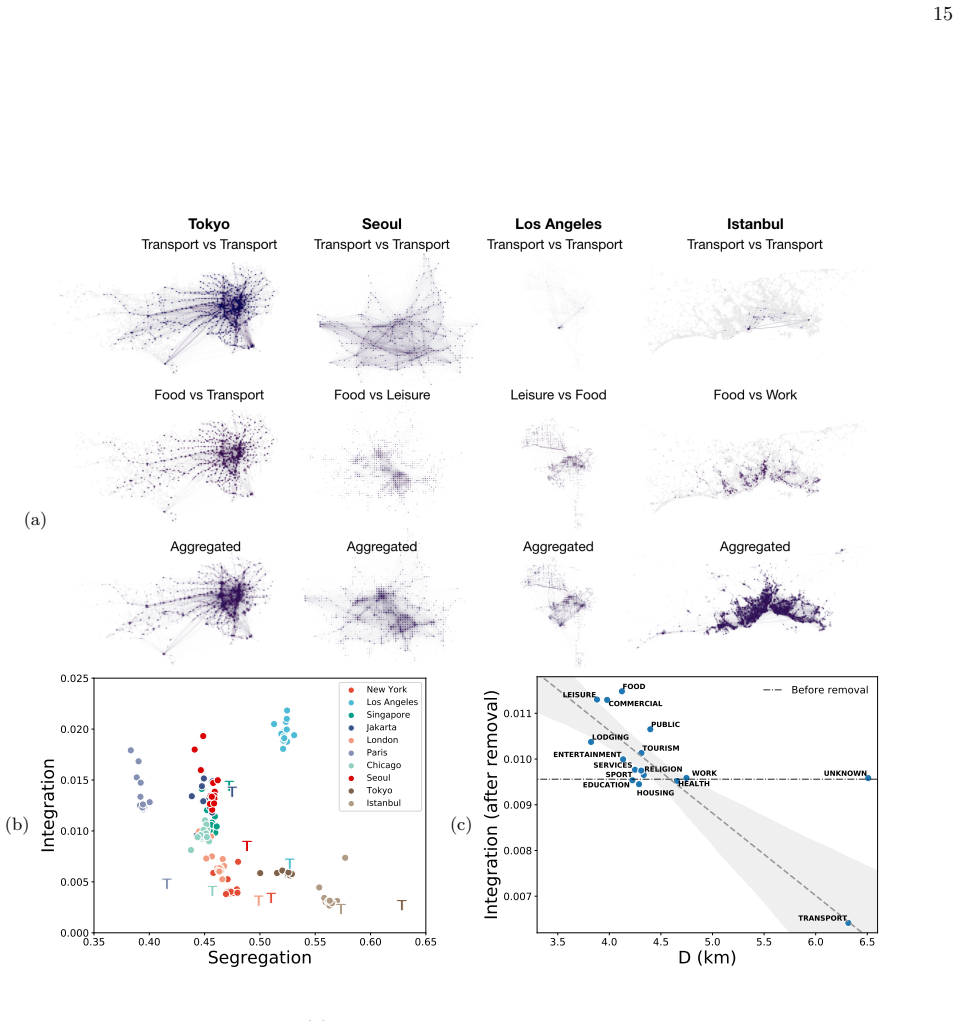
On the paper's own terms, the discovery is that a city's functional organization—how people's flows connect its areas—obeys regular, partly size-driven patterns that differ from its street geometry. For ten world megacities, larger cities tend to be more segregated and less integrated: functional segregation grows with city size and structural integration falls with it, while functional integration is not explained by size alone. The flow weights matter: deviations of functional from structural integration align with the city's flow hierarchy, so cities whose flows connect central and marginal areas more directly are more integrated than their size predicts. Finally, targeted removal of activity layers shows that the transport layer is the backbone: its removal raises segregation in all ten cities and reduces integration by up to about half in some, whereas removing short-range layers such as restaurants or leisure can slightly improve integration.
Load-bearing premise
The entire analysis assumes that consecutive anonymous check-ins by the same user are a faithful proxy for actual trips between city areas, so any bias in who checks in or which stops are recorded would change the measured integration and segregation.
Editorial extensions
If this is right
- Across the ten cities, functional segregation and structural integration scale with city size, so size alone explains most of their variance ($R^2=0.67$ and $R^2=0.71$), whereas functional integration does not ($R^2=0.05$).
- A city with low flow hierarchy—more direct connections between hubs and marginal areas—is more integrated than its size predicts, so flow distribution, not just geometry, shapes integration.
- Closing transport-related flows increases segregation in all ten cities and can halve integration; closing short-range layers such as restaurants or leisure can slightly increase integration.
- The multilayer, activity-aware view shows that the city's functional organization differs by activity type and time of day, so the same urban area contains several distinct 'cities within the city'.
Reading between the lines
- If the transport-layer result generalizes, emergency mobility restrictions should be evaluated not only by trip counts but also by the resulting change in integration and segregation; the paper's layer-removal protocol offers a ready-made stress test for such policies.
- The flow-hierarchy finding suggests a testable design rule for urban planning: adding direct links between peripheral and central areas should raise functional integration even without changing city size or street density.
- Because the integration measure is scale-independent, the same comparative approach could be applied to non-urban systems such as multimodal regional transport or online activity flows to see whether the small-world and transport-backbone patterns are universal.
- A direct validation would compare the check-in-derived flows against independent mobility data for the same cities; if the proxy misses intermediate stops or underrepresents certain populations, the transport layer's integrating role could be overestimated.
Signed reviews
Editorial analysis
A structured set of objections, weighed in public.
Referee Report
Summary. The paper studies the structural and functional organization of ten megacities by combining OpenStreetMap street networks with Foursquare check-in flows. Functional networks are built from coarse-grained 500m-by-500m cells, with edge weights derived from consecutive anonymized check-ins; structural networks are topological undirected street networks on the same grid. Integration is measured by a normalized global communication efficiency (GCE) and segregation by modularity Q*. The authors report that functional segregation and structural integration scale with city size L, that functional integration is not size-determined but instead correlates with flow hierarchy from an independent dataset, that topological versions of the functional networks lie on the Watts-Strogatz small-world curve, and that targeted removal of the transport layer increases segregation in all cities and strongly reduces integration in most, with outliers such as Singapore, Jakarta, and Istanbul. The paper presents these results as evidence for cross-city regularities in urban functional organization and as quantitative support for restriction-policy decisions during emergencies.
Significance. If the empirical claims hold, the paper would provide measurable, cross-city regularities connecting urban size, structural topology, and functional mobility, and would offer a quantitative framework for evaluating activity-layer closures. Strengths include the use of a purpose-built normalized integration measure from the authors' companion work, comparisons against two spatial null models, explicit significance checks for modularity against configuration-model ensembles, and the use of an independent dataset for flow hierarchy in Fig. 4(d). The paper is also commendably candid about several limitations, including the narrow size range for scaling exponents, the need for better segregation normalization, and undersampling issues in monthly topological networks. However, the central empirical claims rest on a mobility-flow proxy that is not validated and on a small number of cities without uncertainty quantification, which substantially tempers the strength of the conclusions as currently supported.
major comments (4)
- [Methods: Geographic coarse-graining] The definition of flows from 'subsequent anonymized check-ins into Foursquare venues' is load-bearing for every result in the paper, yet the manuscript provides no time-window or trip-segmentation rule. Because the data are pre-aggregated by venue pair, month, and hour-of-day, two check-ins by the same user separated by days are counted as a single mobility flow. This can systematically over-represent long, unlikely transitions and distort edge weights, shortest-path efficiency, modularity, and the topological network used for the small-world comparison. I therefore request an explicit validation of the consecutive-check-in proxy against independent origin-destination data (e.g., smart-card, GPS, or mobile-phone data) for at least a subset of cities, or, failing that, a carefully argued sensitivity analysis using temporal strata or trip-length filtering that shows the main results are robust.
- [Fig. 5 and Fig. 6] The headline transport-layer finding is vulnerable to a check-in-behavior confound. Whether removal of the transport layer strongly drops integration (Tokyo, Seoul) or leaves it essentially unchanged (Singapore, Jakarta, Istanbul) may reflect how often Foursquare users check in at transit stations in those cities rather than the true role of transport in mobility. Since transport venues are precisely the places where station-based check-ins are common, the pattern in Fig. 6(b) could be an artifact of venue-check-in propensity. The paper needs a control for this, for example by excluding transport check-ins whose origin or destination is a transit station and recomputing the layer-attack analysis, or by validating the transport-layer result against an independent mobility dataset.
- [Fig. 4, Supplementary Fig. 2, Supplementary Table I] The central scaling and cross-city correlations are based on only ten cities, with no error bars, bootstrapping, or confidence intervals reported for the Pearson correlations, the power-law fits, or the R² values. With n=10, a single city such as Los Angeles can drive the apparent deviation in Fig. 4(d), and the reported exponents in Fig. 4(a,b) and Supplementary Fig. 3 are accompanied by the authors' own caveat that the size range is not diverse enough for meaningful exponent estimation. In addition, Supplementary Fig. 2 explicitly states that 'an improved and correctly normalized definition of segregation is still needed' because the segregation values across the three network types are not consistent. Since segregation is one of the two principal measures, this admission directly weakens the comparisons in Fig. 2 and the scaling result in Fig. 4(a) and should be addressed, for instance by reporting a normalized modularity or by restricting segregation claims to comparisons within, not across, network types.
- [Fig. 3] The claim that city functional networks resemble small-world networks is supported only by the visual proximity of the topological functional-network points to the Watts-Strogatz regression line in the integration-segregation plane. The paper does not report clustering coefficients, characteristic path lengths, or small-world coefficients, nor does it quantify the fit between the empirical points and the WS curve relative to the random-geometric-network curve. Given that the small-world claim appears in the abstract and is presented as a central organizational finding, a quantitative comparison is needed, for example a goodness-of-fit or model-selection statistic on the (integration, segregation) pairs against the two generative models.
minor comments (5)
- [Methods] The model name 'Watts-Strograts' should be 'Watts-Strogatz'.
- [Fig. 5 caption] The phrase 'which strongly influence a the urban functional connectivity' contains a typo; it should read 'which strongly influence the urban functional connectivity.'
- [Fig. 6, results text] In the sentence 'for others (notably Singapore, Jakarta and Istanbul) integration is unchained, or even slightly increased', the word 'unchained' is likely intended to be 'unchanged'.
- [Data availability] The data availability statement only offers aggregated data 'upon request' and no code is provided; for a network-science paper whose claims rely on specific data-processing choices, releasing the reconstruction code and a de-identified aggregate network would materially improve reproducibility.
- [Fig. 4(d)] The use of an independent flow-hierarchy dataset is a strength, but the text should state more explicitly that this comparison is at the city level and therefore has n=10; a scatter plot with city labels and a correlation coefficient with confidence interval would help assess the robustness of the reported relation.
Circularity Check
No significant circularity: the paper's central claims are empirical measurements from external flow and street data, with self-citations limited to methodological tools and independent supporting data.
full rationale
The paper's derivation chain is self-contained and does not reduce any claimed result to its own inputs. The core integration measure (normalized GCE) is cited to the authors' own prior work [71], but that prior work supplies a parameter-free normalization method whose stated construction (artificial shortcut links carrying the total flow of each weighted shortest path) does not assume the urban integration/segregation patterns reported here. It is a methodological self-citation, not a circular reduction: the empirical anti-correlation between GCE and modularity, the deviation of Los Angeles, and the scaling with city size are all measured outcomes rather than properties enforced by the definitions. The flow hierarchy values used to explain deviations from structural integration are taken from a different dataset in [74], with numerical values available externally, so this is independent support rather than a self-citation loop. The power-law fits in Fig. 4 are explicitly described as rough indications ('the sizes of the cities considered are not diverse enough for initiating a meaningful discussion based on the value of the exponents observed'), and are not used as predictions. The layer-removal transport analysis is a direct perturbation of the measured flow network, not a fitted parameter renamed as a prediction. The only serious weakness is the validity of consecutive Foursquare check-ins as a proxy for real trips, but that is a data-assumption/correctness concern, not a circularity concern: no equation or citation in the paper makes a conclusion equivalent to an input by construction.
Assumptions & free parameters
free parameters (3)
- Power-law exponent for functional segregation vs L =
0.31 ± 0.08
- Power-law exponent for structural integration vs L =
1.7 ± 0.4
- Power-law exponents for edge density, average weight, hotspot fraction =
2.2 ± 0.4, 1.1 ± 0.3, -1.3 ± 0.5
assumptions (4)
- standard math Efficiency of communication between two areas is inversely proportional to topological distance.
- domain assumption Normalized global communication efficiency from Bertagnolli et al. [71] correctly measures integration and allows comparison across weighted and unweighted networks.
- domain assumption Foursquare consecutive check-ins are a valid proxy for human mobility between city areas.
- domain assumption OpenStreetMap street networks completely and correctly represent the structural road network in the selected areas.
Cite this review
Pith. "Pith review of Unraveling the hidden organisation of urban systems and their mobility flows." pith.science (2026). https://pith.science/paper/HFL3RI6Z
@misc{pith2026190802538,
  author       = {Pith},
  title        = {Pith review of: Unraveling the hidden organisation of urban systems and their mobility flows},
  year         = {2026},
  howpublished = {\url{https://pith.science/paper/HFL3RI6Z}},
  note         = {Machine review of arXiv:1908.02538}
}
read the original abstract
Increasing evidence suggests that cities are complex systems, with structural and dynamical features responsible for a broad spectrum of emerging phenomena. Here we use a unique data set of human flows and couple it with information on the underlying street network to study, simultaneously, the structural and functional organisation of 10 world megacities. We quantify the efficiency of flow exchange between areas of a city in terms of integration and segregation using well defined measures. Results reveal unexpected complex patterns that shed new light on urban organisation. Large cities tend to be more segregated and less integrated, while their overall topological organisation resembles that of small world networks. At the same time, the heterogeneity of flows distribution might act as a catalyst for further integrating a city. Our analysis unravels how human behaviour influences, and is influenced by, the urban environment, suggesting quantitative indicators to control integration and segregation of human flows that can be used, among others, for restriction policies to adopt during emergencies and, as an interesting byproduct, allows us to characterise functional (dis)similarities of different metropolitan areas, countries, and cultures.
Figures


Figures from the paper (4 more)


Forward citations
Cited by 1 Pith paper
-
Role Detection in Bicycle-Sharing Networks Using Multilayer Stochastic Block Models
A time-dependent stochastic block model with mixed or discrete membership classifies bicycle-sharing stations into home and work roles in Los Angeles, San Francisco, and a Manhattan subnetwork of New York City.
Reference graph
Works this paper leans on
-
[1]
The statistical physics of cities
Marc Barthelemy. The statistical physics of cities. Nature Reviews Physics, page 1, 2019
work page 2019
-
[2]
Community structure in time-dependent, multiscale, and multiplex networks
Peter J Mucha, Thomas Richardson, Kevin Macon, Ma- son A Porter, and Jukka-Pekka Onnela. Community structure in time-dependent, multiscale, and multiplex networks. science, 328(5980):876–878, 2010
work page 2010
-
[3]
Multirelational organization of large-scale social net- works in an online world
Michael Szell, Renaud Lambiotte, and Stefan Thurner. Multirelational organization of large-scale social net- works in an online world. Proceedings of the National Academy of Sciences, 107(31):13636–13641, 2010
work page 2010
-
[4]
Mathematical formu- lation of multilayer networks
Manlio De Domenico, Albert Sol´ e-Ribalta, Emanuele Cozzo, Mikko Kivel¨ a, Yamir Moreno, Mason A Porter, Sergio G´ omez, and Alex Arenas. Mathematical formu- lation of multilayer networks. Physical Review X , 3(4): 041022, 2013
work page 2013
-
[5]
M De Domenico. Multilayer network modeling of inte- grated biological systems: Comment on” network science of biological systems at different scales: A review” by gosak et al. Physics of Life Reviews , 24:149, 2018
work page 2018
-
[6]
Mikko Kivel¨ a, Alex Arenas, Marc Barthelemy, James P Gleeson, Yamir Moreno, and Mason A Porter. Multilayer networks. Journal of complex networks , 2(3):203–271, 2014
work page 2014
-
[7]
The physics of spreading processes in multilayer networks
Manlio De Domenico, Clara Granell, Mason A Porter, and Alex Arenas. The physics of spreading processes in multilayer networks. Nature Physics, 12(10):901, 2016
work page 2016
-
[8]
Measuring information transfer
Thomas Schreiber. Measuring information transfer. Physical review letters, 85(2):461, 2000
work page 2000
Show all 79 references
-
[9]
Granger causality and transfer entropy are equivalent for gaussian variables
Lionel Barnett, Adam B Barrett, and Anil K Seth. Granger causality and transfer entropy are equivalent for gaussian variables. Physical review letters , 103(23): 238701, 2009
2009
-
[10]
Escaping the curse of dimensionality in estimating multivariate transfer entropy
Jakob Runge, Jobst Heitzig, Vladimir Petoukhov, and J¨ urgen Kurths. Escaping the curse of dimensionality in estimating multivariate transfer entropy. Physical review letters, 108(25):258701, 2012
2012
-
[11]
De- tecting causality in complex ecosystems
George Sugihara, Robert May, Hao Ye, Chih-hao Hsieh, Ethan Deyle, Michael Fogarty, and Stephan Munch. De- tecting causality in complex ecosystems. science, 338 (6106):496–500, 2012
2012
-
[12]
Synergy and redundancy in the granger causal analysis of dynamical networks
Sebastiano Stramaglia, Jesus M Cortes, and Daniele Marinazzo. Synergy and redundancy in the granger causal analysis of dynamical networks. New Journal of Physics, 16(10):105003, 2014
2014
-
[13]
Causal feedbacks in climate change
Egbert H Van Nes, Marten Scheffer, Victor Brovkin, Timothy M Lenton, Hao Ye, Ethan Deyle, and George Sugihara. Causal feedbacks in climate change. Nature Climate Change, 5(5):445, 2015
2015
-
[14]
Information flow between resting-state networks
Ibai Diez, Asier Erramuzpe, Inaki Escudero, Beat- riz Mateos, Alberto Cabrera, Daniele Marinazzo, Ernesto J Sanz-Arigita, Sebastiano Stramaglia, Jesus M Cortes Diaz, and Alzheimer’s Disease Neuroimaging Ini- tiative. Information flow between resting-state networks. Brain connec...
2015
-
[15]
Integrated information theory: from con- sciousness to its physical substrate
Giulio Tononi, Melanie Boly, Marcello Massimini, and Christof Koch. Integrated information theory: from con- sciousness to its physical substrate. Nature Reviews Neu- roscience, 17(7):450, 2016
2016
-
[16]
Information flows? a critique of transfer entropies
Ryan G James, Nix Barnett, and James P Crutchfield. Information flows? a critique of transfer entropies. Phys- ical review letters, 116(23):238701, 2016
2016
-
[17]
Information leverage in interconnected ecosystems: Overcoming the curse of di- mensionality
Hao Ye and George Sugihara. Information leverage in interconnected ecosystems: Overcoming the curse of di- mensionality. Science, 353(6302):922–925, 2016
2016
-
[18]
Efficient behavior of small-world networks
Vito Latora and Massimo Marchiori. Efficient behavior of small-world networks. Physical Review Letters, 87(19): 198701, 2001
2001
-
[19]
Analysis of weighted networks
Mark EJ Newman. Analysis of weighted networks. Phys- ical review E, 70(5):056131, 2004
2004
-
[20]
Functional cartography of complex metabolic networks
Roger Guimera and Luis A Nunes Amaral. Functional cartography of complex metabolic networks. nature, 433 (7028):895, 2005
2005
-
[21]
Detecting rich-club or- dering in complex networks
Vittoria Colizza, Alessandro Flammini, M Angeles Ser- rano, and Alessandro Vespignani. Detecting rich-club or- dering in complex networks. Nature physics , 2(2):110, 2006
2006
-
[22]
Human brain networks in health and disease
Danielle S Bassett and Edward T Bullmore. Human brain networks in health and disease. Current opinion in neu- rology, 22(4):340, 2009
2009
-
[23]
Complex network mea- sures of brain connectivity: uses and interpretations
Mikail Rubinov and Olaf Sporns. Complex network mea- sures of brain connectivity: uses and interpretations. Neuroimage, 52(3):1059–1069, 2010
2010
-
[24]
Rich-club organization of the human connectome
Martijn P Van Den Heuvel and Olaf Sporns. Rich-club organization of the human connectome. Journal of Neu- roscience, 31(44):15775–15786, 2011
2011
-
[25]
Network attributes for segregation and in- tegration in the human brain
Olaf Sporns. Network attributes for segregation and in- tegration in the human brain. Current opinion in neuro- biology, 23(2):162–171, 2013
2013
-
[26]
The social origins of networks and diffu- sion
Damon Centola. The social origins of networks and diffu- sion. American Journal of Sociology , 120(5):1295–1338, 2015
2015
-
[27]
Rethinking segregation and inte- gration: contributions of whole-brain modelling
Gustavo Deco, Giulio Tononi, Melanie Boly, and Morten L Kringelbach. Rethinking segregation and inte- gration: contributions of whole-brain modelling. Nature Reviews Neuroscience, 16(7):430, 2015
2015
-
[28]
The segregation and integration of distinct brain networks and their re- lationship to cognition
Jessica R Cohen and Mark D’Esposito. The segregation and integration of distinct brain networks and their re- lationship to cognition. Journal of Neuroscience, 36(48): 12083–12094, 2016
2016
-
[29]
Brain networks under attack: ro- bustness properties and the impact of lesions
Hannelore Aerts, Wim Fias, Karen Caeyenberghs, and Daniele Marinazzo. Brain networks under attack: ro- bustness properties and the impact of lesions. Brain, 139 (12):3063–3083, 2016
2016
-
[30]
The diverse club
MA Bertolero, BTT Yeo, and M D’esposito. The diverse club. Nature communications, 8(1):1277, 2017
2017
-
[31]
A mechanistic model of con- nector hubs, modularity and cognition
Maxwell A Bertolero, BT Thomas Yeo, Danielle S Bas- sett, and Mark D’Esposito. A mechanistic model of con- nector hubs, modularity and cognition. Nature human behaviour, 2(10):765, 2018
2018
-
[32]
Impact of modular organization on dynamical richness in cortical networks
Hideaki Yamamoto, Satoshi Moriya, Katsuya Ide, Takeshi Hayakawa, Hisanao Akima, Shigeo Sato, Shigeru Kubota, Takashi Tanii, Michio Niwano, Sara Teller, et al. Impact of modular organization on dynamical richness in cortical networks. Science advances, 4(11):eaau4914, 2018
2018
-
[33]
Influence of augmented humans in on- line interactions during voting events
Massimo Stella, Marco Cristoforetti, and Manlio De Domenico. Influence of augmented humans in on- line interactions during voting events. PloS one , 14(5): e0214210, 2019
2019
-
[34]
Big data, smart cities and city planning
Michael Batty. Big data, smart cities and city planning. Dialogues in Human Geography, 3(3):274–279, 2013
2013
-
[35]
Quantifying urban form: compactness ver- sus’ sprawl’
Yu-Hsin Tsai. Quantifying urban form: compactness ver- sus’ sprawl’. Urban studies, 42(1):141–161, 2005. 8
2005
-
[36]
Built-up en- croachment and the urban field: A comparison of forty european cities
Marianne Guerois and Denise Pumain. Built-up en- croachment and the urban field: A comparison of forty european cities. Environment and Planning A: Economy and Space, 40(9):2186–2203, 2008. doi: 10.1068/a39382
2008 doi
-
[37]
Urban form revisited?selecting indicators for characterising european cities
Nina Schwarz. Urban form revisited?selecting indicators for characterising european cities. Landscape and urban planning, 96(1):29–47, 2010
2010
-
[38]
From mobile phone data to the spatial structure of cities
Thomas Louail, Maxime Lenormand, Oliva G Cantu Ros, Miguel Picornell, Ricardo Herranz, Enrique Frias- Martinez, Jos´ e J Ramasco, and Marc Barthelemy. From mobile phone data to the spatial structure of cities. Sci- entific reports, 4:5276, 2014
2014
-
[39]
Gately, Lucy R
Conor K. Gately, Lucy R. Hutyra, and Ian Sue Wing. Cities, traffic, and CO2: A multidecadal assessment of trends, drivers, and scaling relationships. Proceed- ings of the National Academy of Sciences , 112(16):4999– 5004, April 2015. doi: 10.1073/pnas.1421723112. URL https://doi...
2015 doi
-
[40]
Compactness versus sprawl: A review of recent evidence from the united states
Reid Ewing and Shima Hamidi. Compactness versus sprawl: A review of recent evidence from the united states. Journal of Planning Literature , 30(4):413–432, 2015
2015
-
[41]
Modelling the scaling properties of human mo- bility
Chaoming Song, Tal Koren, Pu Wang, and Albert-L´ aszl´ o Barab´ asi. Modelling the scaling properties of human mo- bility. Nature Physics, 6(10):818–823, September 2010. doi: 10.1038/nphys1760. URL https://doi.org/10. 1038/nphys1760
2010 doi
-
[42]
Uncov- ering the spatial structure of mobility networks
Thomas Louail, Maxime Lenormand, Miguel Picornell, Oliva Garc´ ıa Cant´ u, Ricardo Herranz, Enrique Frias- Martinez, Jos´ e J Ramasco, and Marc Barthelemy. Uncov- ering the spatial structure of mobility networks. Nature communications, 6:6007, 2015
2015
-
[43]
A stochastic model of ran- domly accelerated walkers for human mobility
Riccardo Gallotti, Armando Bazzani, Sandro Rambaldi, and Marc Barthelemy. A stochastic model of ran- domly accelerated walkers for human mobility. Na- ture Communications , 7(1), August 2016. doi: 10. 1038/ncomms12600. URL https://doi.org/10.1038/ ncomms12600
2016
-
[44]
Human mobility: Models and appli- cations
Hugo Barbosa, Marc Barthelemy, Gourab Ghoshal, Charlotte R James, Maxime Lenormand, Thomas Louail, Ronaldo Menezes, Jos´ e J Ramasco, Filippo Simini, and Marcello Tomasini. Human mobility: Models and appli- cations. Physics Reports, 734:1–74, 2018
2018
-
[45]
Traffic and related self-driven many- particle systems
Dirk Helbing. Traffic and related self-driven many- particle systems. Reviews of modern physics, 73(4):1067, 2001
2001
-
[46]
Percolation transition in dynamical traffic network with evolving critical bottlenecks
Daqing Li, Bowen Fu, Yunpeng Wang, Guangquan Lu, Yehiel Berezin, H Eugene Stanley, and Shlomo Havlin. Percolation transition in dynamical traffic network with evolving critical bottlenecks. Proceedings of the National Academy of Sciences, 112(3):669–672, 2015
2015
-
[47]
Gonz´ alez
Serdar C ¸ olak, Antonio Lima, and Marta C. Gonz´ alez. Understanding congested travel in urban areas. Na- ture Communications , 7(1), March 2016. doi: 10. 1038/ncomms10793. URL https://doi.org/10.1038/ ncomms10793
2016
-
[48]
De- congestion of urban areas with hotspot pricing
Albert Sol´ e-Ribalta, Sergio G´ omez, and Alex Arenas. De- congestion of urban areas with hotspot pricing. Networks and Spatial Economics, 18(1):33–50, 2018
2018
-
[49]
From global scaling to the dynamics of individual cities
Jules Depersin and Marc Barthelemy. From global scaling to the dynamics of individual cities. Proceedings of the National Academy of Sciences, 115(10):2317–2322, 2018
2018
-
[50]
Urban spatial structure, daily mo- bility and energy consumption: a study of 34 european cities
Florent Le N´ echet. Urban spatial structure, daily mo- bility and energy consumption: a study of 34 european cities. Cybergeo: European Journal of Geography, 2012
2012
-
[51]
Urban sprawl and air quality in large US cities
Brian Stone. Urban sprawl and air quality in large US cities. Journal of Environmental Management , 86(4): 688–698, March 2008. doi: 10.1016/j.jenvman.2006.12
2008 doi
-
[52]
URL https://doi.org/10.1016/j.jenvman.2006. 12.034
2006 doi
-
[53]
Transport impacts on atmosphere and climate: Land transport
Elmar Uherek, Tomas Halenka, Jens Borken-Kleefeld, Yves Balkanski, Terje Berntsen, Carlos Borrego, Michael Gauss, Peter Hoor, Katarzyna Juda-Rezler, and Jos Lelieveld. Transport impacts on atmosphere and climate: Land transport. Atmospheric Environment, 44(37):4772– 4816, Dece...
2010 doi
-
[54]
An idealized study of city structure, urban climate, energy consumption, and air quality
Alberto Martilli. An idealized study of city structure, urban climate, energy consumption, and air quality. Ur- ban Climate, 10:430–446, December 2014. doi: 10.1016/ j.uclim.2014.03.003. URL https://doi.org/10.1016/j. uclim.2014.03.003
2014 doi
-
[55]
Reid Ewing, Gail Meakins, Shima Hamidi, and Arthur C. Nelson. Relationship between urban sprawl and physi- cal activity, obesity, and morbidity – update and refine- ment. Health & Place , 26:118–126, March 2014. doi: 10.1016/j.healthplace.2013.12.008. URL https://doi. org/10.10...
2014 doi
-
[56]
Newby, Pier M
David E. Newby, Pier M. Mannucci, Grethe S. Tell, Andrea A. Baccarelli, Robert D. Brook, Ken Donald- son, Francesco Forastiere, Massimo Franchini, Oscar H. Franco, Ian Graham, Gerard Hoek, Barbara Hoffmann, Marc F. Hoylaerts, Nino K¨ unzli, Nicholas Mills, Juha Pekkanen, Annett...
2014 doi
-
[57]
Rice, Petter L
Mary B. Rice, Petter L. Ljungman, Elissa H. Wilker, Kirsten S. Dorans, Diane R. Gold, Joel Schwartz, Pet- ros Koutrakis, George R. Washko, George T. O’Connor, and Murray A. Mittleman. Long-term exposure to traffic emissions and fine particulate matter and lung function decline in...
2015 doi
-
[58]
Dorans, Elissa H
Wenyuan Li, Kirsten S. Dorans, Elissa H. Wilker, Mary B. Rice, Michelle T. Long, Joel Schwartz, Brent A. Coull, Petros Koutrakis, Diane R. Gold, Caroline S. Fox, and Murray A. Mittleman. Residential proximity to major roadways, fine particulate matter, and hep- atic steatosis. ...
2017 doi
-
[59]
Nicholl, J
J. Nicholl, J. West, S. Goodacre, and J. Turner. The re- lationship between distance to hospital and patient mor- tality in emergencies: an observational study. Emer- gency Medicine Journal, 24(9):665–668, September 2007. doi: 10.1136/emj.2007.047654. URL https://doi.org/ 10.1...
2007 arXiv
-
[60]
Growth, innovation, scaling, and the pace of life in cities
Lu´ ıs MA Bettencourt, Jos´ e Lobo, Dirk Helbing, Chris- tian K¨ uhnert, and Geoffrey B West. Growth, innovation, scaling, and the pace of life in cities. Proceedings of the national academy of sciences , 104(17):7301–7306, 2007
2007
-
[61]
The origins of scaling in cities
Lu´ ıs MA Bettencourt. The origins of scaling in cities. 9 Science, 340(6139):1438–1441, 2013
2013
-
[62]
The spatial organization of cities: Delib- erate outcome or unforeseen consequence? UC Berkeley IURD Working Paper Series , 2004
Alain Bertaud. The spatial organization of cities: Delib- erate outcome or unforeseen consequence? UC Berkeley IURD Working Paper Series , 2004
2004
-
[63]
The spatial organi- zation of the population density in cities
Valerio Volpati and Marc Barthelemy. The spatial organi- zation of the population density in cities. arXiv preprint arXiv:1804.00855, 2018
2018 arXiv
-
[64]
Modeling the polycen- tric transition of cities
R´ emi Louf and Marc Barthelemy. Modeling the polycen- tric transition of cities. Physical review letters , 111(19): 198702, 2013
2013
-
[65]
How congestion shapes cities: from mobility patterns to scaling
R´ emi Louf and Marc Barthelemy. How congestion shapes cities: from mobility patterns to scaling. Scientific Re- ports, 4(1), July 2014. doi: 10.1038/srep05561. URL https://doi.org/10.1038/srep05561
2014 doi
-
[66]
Activity-aware map: Identifying human daily activity pattern using mobile phone data
Santi Phithakkitnukoon, Teerayut Horanont, Giusy Di Lorenzo, Ryosuke Shibasaki, and Carlo Ratti. Activity-aware map: Identifying human daily activity pattern using mobile phone data. In International Work- shop on Human Behavior Understanding , pages 14–25. Springer, 2010
2010
-
[67]
Exploiting foursquare and cellular data to infer user activity in urban environments
Anastasios Noulas, Cecilia Mascolo, and Enrique Frias- Martinez. Exploiting foursquare and cellular data to infer user activity in urban environments. In 2013 IEEE 14th International Conference on Mobile Data Management . IEEE, June 2013. doi: 10.1109/mdm.2013.27. URL https://...
2013 doi
-
[68]
The economy of brain network organization
Ed Bullmore and Olaf Sporns. The economy of brain network organization. Nature Reviews Neuroscience, 13 (5):336, 2012
2012
-
[69]
Osmnx: New methods for acquiring, con- structing, analyzing, and visualizing complex street net- works
Geoff Boeing. Osmnx: New methods for acquiring, con- structing, analyzing, and visualizing complex street net- works. Computers, Environment and Urban Systems , 65: 126–139, 2017
2017
-
[70]
https://www
Future cities challenge. https://www. futurecitieschallenge.com. Accessed: 2019-08-05
2019
-
[71]
Patterns of residential segregation
R´ emi Louf and Marc Barthelemy. Patterns of residential segregation. PloS one, 11(6):e0157476, 2016
2016
-
[72]
Quantifying efficient information exchange in real network flows
Giulia Bertagnolli, Riccardo Gallotti, and Manlio De Domenico. Quantifying efficient information exchange in real network flows. arXiv preprint arXiv:2003.11374 , 2020
2003 arXiv
-
[73]
Fast algorithm for detecting com- munity structure in networks
Mark EJ Newman. Fast algorithm for detecting com- munity structure in networks. Physical review E , 69(6): 066133, 2004
2004
-
[74]
Anatomy and efficiency of urban multimodal mobility
Riccardo Gallotti and Marc Barthelemy. Anatomy and efficiency of urban multimodal mobility. Scientific re- ports, 4(1):1–9, 2014
2014
-
[75]
Hierarchical organization of urban mobility and its connection with city livability
Aleix Bassolas, Hugo Barbosa-Filho, Brian Dickinson, Xerxes Dotiwalla, Paul Eastham, Riccardo Gallotti, Gourab Ghoshal, Bryant Gipson, Surendra A Hazarie, Henry Kautz, et al. Hierarchical organization of urban mobility and its connection with city livability. Nature communicat...
2019
-
[76]
Structural and func- tional brain networks: from connections to cognition
Hae-Jeong Park and Karl Friston. Structural and func- tional brain networks: from connections to cognition. Science, 342(6158):1238411, 2013
2013
-
[77]
https: //developer.foursquare.com/docs/api/venues/ categories
Foursquare developers venue categories. https: //developer.foursquare.com/docs/api/venues/ categories. Accessed: 2019-08-02
2019
-
[78]
Economic small- world behavior in weighted networks
Vito Latora and Massimo Marchiori. Economic small- world behavior in weighted networks. The European Physical Journal B-Condensed Matter and Complex Sys- tems, 32(2):249–263, 2003
2003
-
[79]
Small Worlds
Vincent D Blondel, Jean-Loup Guillaume, Renaud Lam- biotte, and Etienne Lefebvre. Fast unfolding of commu- nities in large networks. Journal of statistical mechanics: theory and experiment, 2008(10):P10008, 2008. 10 11 FIG. 1: Modeling Structure and Function of Urban Systems. ...
2008
Reviewed August 14, 2026 · model on record in the stance chip above.
Discussion (0). Continue with ORCID to comment.