REVIEW 4 major objections 5 minor 80 references
Recoiling supermassive black holes in analytical and numerical galaxy potential
T0 review · 4 major / 5 minor · reviewed 2026-08-14 · deepseek-v4-flash
Pith's one-line read This paper establishes that evolving numerical merger remnant potentials give supermassive black hole escape velocities up to about 25 percent lower than static analytical potentials, making spatially offset active galactic nuclei more…
desk verdict A solid numerical check that static potentials overestimate recoil escape velocities in major mergers, but the headline 25 per cent rests on one extreme orbit and needs robustness testing before being used quantitatively. read the letter →
The pith
A machine-rendered reading of the paper's core claim, the machinery that carries it, and where it could break.
The reading
What carries the argument
The engine of the comparison is the N-body merger simulation evolving the galactic potential while the recoiling black hole travels through it, set against a static analytical potential built from an NFW dark halo, a power-law bulge, and an exponential disc treated as spherical. Violent relaxation—the rapid, collisionless rearrangement of particle energies during a merger that pushes weakly bound stars beyond the virial radius—is the physical mechanism that reduces the outer mass profile and hence the escape velocity. The paper measures escape velocity as the kick speed needed for the black hole to return to the host halo after about 10 Gyr, and integrates the trajectory with Chandrasekhar dynamical friction included.
What would settle it
Run a suite of equal-mass merger simulations of $10^{12}$ solar-mass progenitors with orbital eccentricities from 0.3 to 1.0 and pericentres from 0.5 to 10 percent of the virial radius at fixed resolution; if the mean numerical escape velocity stays within a few percent of the static analytical value for the non-parabolic orbits, the claim that numerical potentials reduce escape velocities by up to 25 percent would not generalise.
Extended reading notes
Core claim
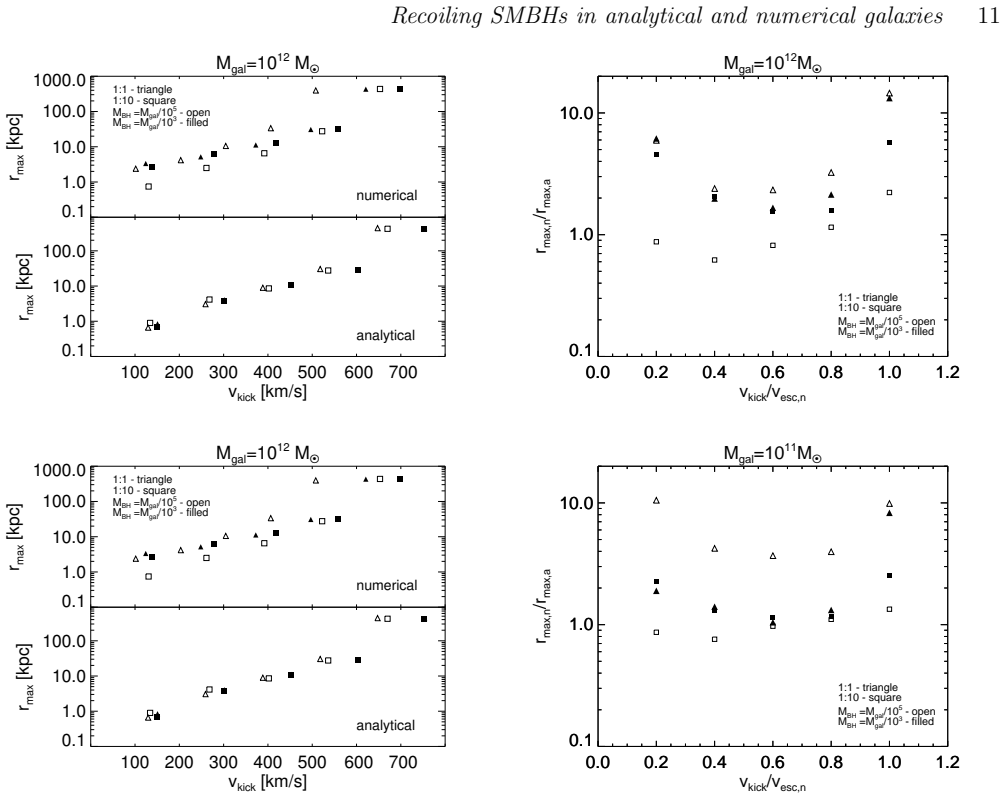
The central claim is that escape velocities of recoiling supermassive black holes in numerical major merger remnant galaxies are up to about 25 percent lower than in analytical models, because violent relaxation during the merger lowers the galaxy's mass profile at large radii. The paper shows that the numerical and analytical models agree for isolated progenitor galaxies, isolating the merger itself as the source of the difference. In major merger remnants, the numerical potential has lower enclosed mass at large radii and a higher central density, and the outer mass loss wins: a black hole needs a smaller kick to leave and, for a given kick, reaches several to ten times larger maximum galactocentric distance over a Hubble time. The paper concludes that static analytical models overestimate escape velocities and underestimate the number of spatially offset active galactic nuclei.
Load-bearing premise
The 25 percent gap rests on one simulated merger geometry—a parabolic encounter with pericentre 0.5 percent of the primary virial radius and $10^6$ particles—being representative of the violent-relaxation mass loss in real major mergers; with less radial orbits or different resolution, the gap could shrink.
Editorial extensions
If this is right
- Offset active galactic nuclei should be more common than static-potential estimates predict, because lower kick speeds can still displace the black hole and a displaced black hole spends more time on bound orbits outside the nucleus.
- For a given kick-to-escape ratio, numerical major merger remnants put recoiling black holes up to about ten times farther from the centre than analytical models do, making them easier to detect.
- Black hole retention is lower after major than after minor mergers, so merger-driven black hole growth should be somewhat suppressed in major-merger remnants.
- Escape velocities of roughly $10^{11}$ and $10^{12}$ solar-mass remnants fall in ranges of about 170–350 and 500–700 km/s depending on black hole mass and merger type, so typical kicks below a few hundred km/s matter most for the smaller host.
Reading between the lines
- I infer that the 25 percent headline is tied to the one orbital family tested (parabolic, pericentre 0.5 percent of the primary virial radius); real mergers with smaller eccentricity or larger pericentre would likely lose less mass, so the analytical–numerical gap should shrink.
- A testable extension would be to rerun the same comparison varying orbital parameters and numerical resolution; if the gap persists across a realistic orbit distribution, observational campaigns for offset active galactic nuclei should weight the numerical predictions more heavily.
- I infer that the enhanced separations at $v_{\rm kick}/v_{\rm esc} \sim 0.2$ translate directly into discovery-rate predictions: the same spin-alignment assumptions that keep black holes in the central kiloparsec in analytic models place them several kiloparsecs out in numerical remnants.
Signed reviews
Editorial analysis
A structured set of objections, weighed in public.
Referee Report
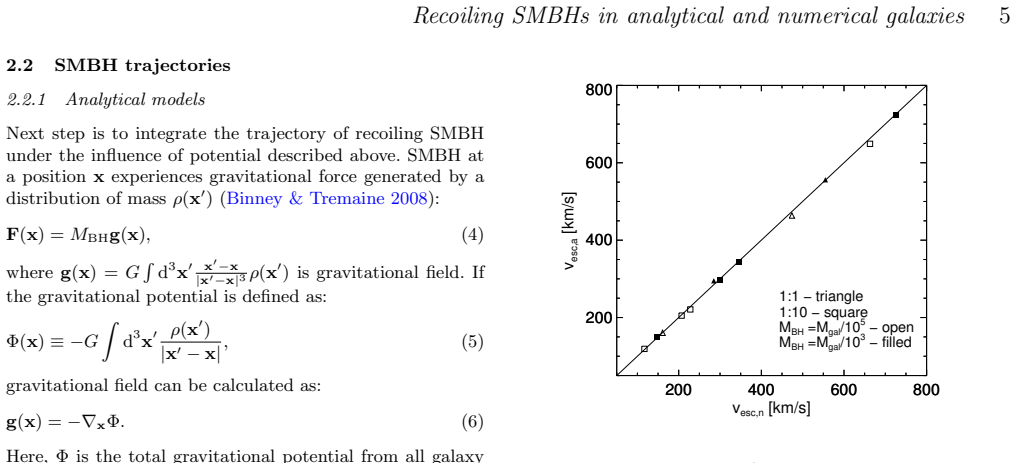
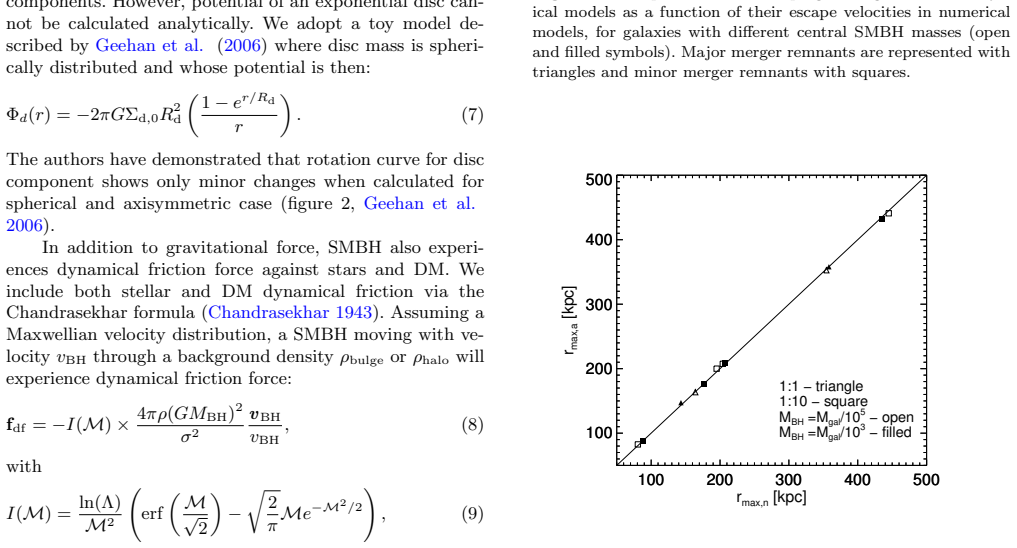
Summary. The paper compares the trajectories of recoiling supermassive black holes (SMBHs) in static analytical galaxy potentials and in GADGET-2 N-body merger simulations, for remnant masses 10^11 and 10^12 Msun, major (1:1) and minor (1:10) mergers, and two SMBH mass scalings (Mgal/10^5 and Mgal/10^3). The numerical setup is first validated against analytical models for isolated progenitors by comparing escape velocities and maximal SMBH separations (Figs 2 and 3). The authors then simulate mergers with a single orbital configuration (e=1, pericentric distance 0.5% of the primary virial radius), construct analytical remnants from conserved progenitor masses, and compare escape velocities, mass profiles, and SMBH orbits. The central claim is that static analytical models overestimate SMBH escape velocities, with numerical major-merger remnants having escape velocities up to ~25 per cent lower, because violent relaxation during major mergers reduces the mass at large radii. The paper concludes that numerical models predict more spatially offset AGNs.
Significance. If the quantitative claim is robust, this is a useful and potentially important result: it identifies a systematic bias in static-potential models of post-merger galaxies and suggests that recoiling SMBHs are retained less often and found at larger offsets than those models predict. The paper has real strengths: the numerical method is validated against analytical models for progenitor galaxies (Figs 2 and 3), the stability of the initial galaxy models is checked, a softening-length test is reported, and the comparison with Illustris-based results of Blecha et al. (2016) grounds the work in the existing literature. The qualitative direction of the effect, driven by mass loss in major mergers, is plausible and physically well motivated. However, the headline magnitude of the effect rests on a narrow numerical setup: one orbital configuration, one realization per case, and an analytical remnant construction that needs to be stated more precisely. These limitations matter because the 25 per cent figure is the paper's main quantitative deliverable and is repeated in the abstract and conclusions.
major comments (4)
- [Section 2.3.1; Fig. 4; conclusion item (i)] The central quantitative claim that numerical major-merger escape velocities are up to ~25 per cent lower than analytical ones is established for only one orbital configuration: e=1 with Rperi=0.5% Rvir,1, which the manuscript itself describes as an almost head-on collision chosen to save computational time. The mass loss that drives the reduced escape velocity is expected to depend strongly on orbital angular momentum, so a near-radial encounter is likely to maximize the effect. I request either an additional merger simulation (or an energy-based estimate) with a more typical pericentric distance to show that the effect is not an artifact of this extreme orbit, or a revision of the abstract and conclusions to present the 25 per cent figure as an upper bound for near-radial mergers rather than as the typical difference.
- [Section 2.3.1; Figs 4 and 8] All merger outcomes are based on single realizations with no scatter estimates or multiple random seeds. The ratios rmax,n/rmax,a in Fig. 8 reach factors of ~10 for kicks near the escape velocity, and the claim that numerical models predict a greater number of spatially offset AGNs depends on these large ratios. Without a measure of realization-to-realization variance, the reader cannot assess whether the differences are statistically significant or partly due to the particular initial particle draw. At minimum, the authors should report the variance across realizations or soften the quantitative claims accordingly.
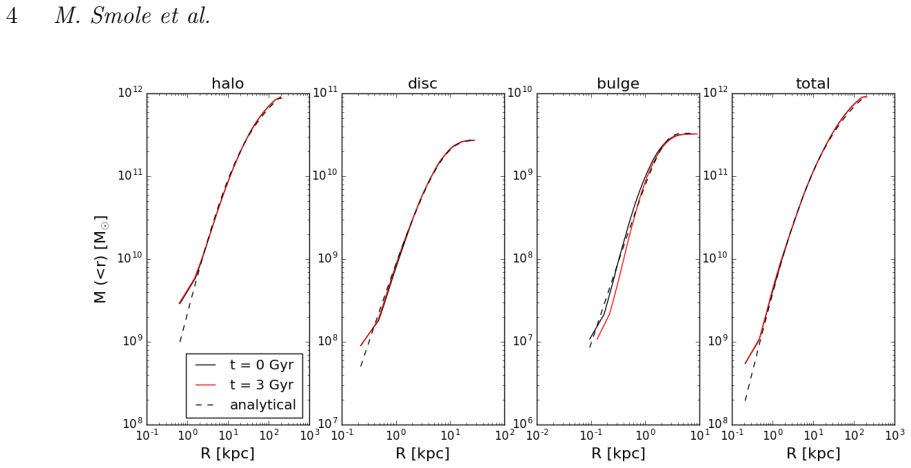
- [Section 2.3.2; Section 3.3] The construction of the analytical merger remnants needs to be stated precisely because it is load-bearing for the main comparison. The sentence 'We make numerical models of isolated galaxies and then fit their mass profiles in order to produce analytical galaxies with the same properties' is ambiguous: if the analytical remnant parameters in Table 2 are fits to the numerical post-merger mass profiles, then the escape-velocity comparison would be partly circular. If instead the analytical remnants are constructed from conserved progenitor masses and the same density-profile shapes as the progenitors, with no fitting to the post-merger profiles shown in Fig. 5, that should be stated explicitly. The current wording does not rule out the circular reading.
- [Section 2.2.1; Fig. 6] The escape velocity is operationally defined as the kick velocity needed for the SMBH to return to the host halo after ~10 Gyr, rather than the classical escape speed of the instantaneous potential. This is a legitimate choice, but the comparison in Figs 4 and 5 is made at the time of SMBH merger/ejection, when the numerical remnant is still evolving (Fig. 6 shows continued central-profile evolution after ejection). The authors should justify that their conclusions are not sensitive to the chosen ejection time, for example by evaluating whether the early relaxation of the central regions is fully captured before the SMBH is kicked.
minor comments (5)
- [Introduction, Section 1] The phrase 'so-cold final parsec problem' should read 'so-called final parsec problem'.
- [Section 2.3.1 and Section 3.5] There are typographical repetitions: 'adopt the the similar approach' in Section 2.3.1 and 'the the galactic nucleus' in Section 3.5; these should be corrected.
- [Figure 5 caption] The caption says 'Panels show major and minor merger remnants' but the individual panels are not labeled in the caption text; identifying which panel corresponds to which case (for example, left versus right, upper versus lower) would improve readability.
- [Section 3.2] The text states that 'Escape velocities in weakened potential of major merger remnant are ≲ 25 per cent lower compared to minor merger remnants' before introducing the analytical-versus-numerical comparison in Section 3.3; the reader should be told explicitly that this is a statement about numerical models only, to avoid confusion with the 25 per cent figure presented later.
- [General] The reference list contains a few formatting inconsistencies (for example 'Gonz´ alez' and the incomplete journal name in the 2007 reference), and the phrase 'decreasement' should be replaced by 'decrease' throughout the text.
Circularity Check
Central numerical-vs-analytical escape-velocity comparison is self-contained; only a minor progenitor-fitting consistency check reduces by construction.
-
other
[Section 2.1.2 and Section 2.2.2 (progenitor galaxy validation, Figs 2 and 3)]
"Those parameters represent a fit to the mass profiles of galaxy components resulting from numerical models. ... In order to validate the accuracy of numerical method, we compare escape velocities from analytical and numerical models of progenitor galaxies."
The analytical progenitor models are calibrated by fitting their density-profile parameters to the numerical mass profiles. Since escape velocity is a global integral of the mass distribution, matching the mass profiles makes the escape-velocity agreement in Figs 2-3 partly a consistency check by construction rather than an independent test of the numerical method. This is a minor, non-central self-consistency: the paper's headline result is the post-merger gap, which is produced by mass loss during the N-body merger and is not fitted into the analytical remnant models.
full rationale
The central claim—that numerical major-merger remnants have escape velocities up to ~25 per cent lower than static analytical remnants—is not circular. The analytical merger-remnant models are constructed from the summed progenitor masses and fitted to isolated galaxy models, while the numerical remnants lose mass through violent relaxation during the merger itself; the reduction in escape velocity therefore emerges from the N-body dynamics, not from a fitted parameter. The only step that reduces by construction is the progenitor-level validation: analytical profile parameters are fitted to numerical mass profiles, and escape velocities derived from those profiles agree largely by definition. The paper discloses this fitting explicitly, and it is a consistency check rather than the main result. Self-citations (Smole 2015; Micic et al. 2011) are used as background and as inputs for kick-velocity ranges; they are not invoked as uniqueness theorems or as the sole support for the central derivation. The adopted spherical-disc potential is an external approximation from Geehan et al. (2006), not an ansatz smuggled in via self-citation. The orbital-choice robustness concern (e = 1, Rperi = 0.5% Rvir) is a physical limitation and a correctness risk, not a circularity. Overall, the derivation is self-contained apart from a minor fitted-input consistency check, so the circularity score is low.
Assumptions & free parameters
free parameters (5)
- Coulomb logarithm ln(Lambda) =
3.1 (adopted from Blecha & Loeb 2008)
- SMBH merger time delay =
0.1 Gyr/q; q=1 for major, q=0.1 for minor
- Gravitational softening length =
0.1 kpc for all particle types
- SMBH mass scaling =
Mgal/10^5 and Mgal/10^3
- Kick velocity sampling points =
0.2, 0.4, 0.6, 0.8, 1.0 times vesc
assumptions (6)
- standard math Chandrasekhar dynamical friction formula with Maxwellian velocity distribution (Equation 8)
- domain assumption Galaxy escape velocity is the kick velocity that returns the SMBH to the halo after about 10 Gyr (Section 2.2.1)
- domain assumption All mergers use parabolic orbits e=1 with pericenter 0.5% of the primary virial radius (Section 2.3.1)
- domain assumption SMBH mass ratio equals galaxy mass ratio, q=1 for major and q=0.1 for minor (Section 2.3.1)
- domain assumption Analytical disc is treated as a spherical mass distribution (Geehan et al. 2006 toy model, Equation 7)
- domain assumption Violent relaxation (Lynden-Bell 1967) is the mechanism producing mass loss in the numerical remnants (Section 3.2)
Cite this review
Pith. "Pith review of Recoiling supermassive black holes in analytical and numerical galaxy potential." pith.science (2026). https://pith.science/paper/IJVPIJD2
@misc{pith2026190802563,
  author       = {Pith},
  title        = {Pith review of: Recoiling supermassive black holes in analytical and numerical galaxy potential},
  year         = {2026},
  howpublished = {\url{https://pith.science/paper/IJVPIJD2}},
  note         = {Machine review of arXiv:1908.02563}
}
abstract
We follow trajectories of recoiling supermassive black holes (SMBHs) in analytical and numerical models of galaxy merger remnants with masses of $10^{11} \rm{M_{sun}}$ and $10^{12} \rm{M_{sun}}$. We construct various merger remnant galaxies in order to investigate how the central SMBH mass and the mass ratio of progenitor galaxies influence escape velocities of recoiling SMBHs. Our results show that static analytical models of major merger remnant galaxies overestimate the SMBHs escape velocities. During major mergers violent relaxation leads to the decrease of galaxy mass and lower potential at large remnant radii. This process is not depicted in static analytical potential but clearly seen in our numerical models. Thus, the evolving numerical model is a more realistic description of dynamical processes in galaxies with merging SMBHs. We find that SMBH escape velocities in numerical major merger remnant galaxies can be up to 25 per cent lower compared to those in analytical models. Consequently, SMBHs in numerical models generally reach greater galactocentric distances and spend more time on bound orbits outside of the galactic nuclei. Thus, numerical models predict a greater number of spatially-offset active galactic nuclei (AGNs).
Figures
Figures from the paper (5 more)



Reference graph
Works this paper leans on
-
[1]
C., Blandford R
Begelman M. C., Blandford R. D., Rees M. J., 1980, Nature, 287, 307
1980
- [2]
-
[3]
Berczik P., Merritt D., Spurzem R., Bischof H.P., 2006, ApJ, 642, L21
work page 2006
-
[4]
Berentzen I., Preto M., Berczik P., Merritt D., Spurzem R., 2009, ApJ, 695, 455
work page 2009
-
[5]
Binney J., Tremaine S., 2008, Galactic Dynamics: Second Edition
2008
-
[6]
Blecha L., Loeb A., 2008, MNRAS, 390, 1311
work page 2008
-
[7]
J., Loeb A., Hernquist L., 2011, MNRAS, 412, 2154
Blecha L., Cox T. J., Loeb A., Hernquist L., 2011, MNRAS, 412, 2154
work page 2011
-
[8]
Blecha L., Sijacki D., Kelley L. Z., Torrey P., Vogelsberger M., Nelson D., Springel V., Snyder G., Hernquist L., 2016, MNRAS, 456, 961
work page 2016
Show all 80 references
-
[9]
Blecha L., Brisken W., Burke-Spolaor S., Civano F., Comerford J., Darling J., Lazio T. J. W., Maccarone T. J., 2019, Science White Paper submitted to the Astro2020 Decadal Survey, arXiv:1903.09301
2019 arXiv
-
[10]
Bovy J., Rix H.-W., 2013, ApJ, 779, 115
2013
-
[11]
Bovy J., 2015, ApJS, 216, 29
2015
-
[12]
C., Jiang F., Hearin A., Campbell D., Watson D., Padmanabhan N., 2014, MNRAS, 445, 1713
van den Bosch F. C., Jiang F., Hearin A., Campbell D., Watson D., Padmanabhan N., 2014, MNRAS, 445, 1713
2014
-
[13]
Callegari S., Mayer L., Kazantzidis S., Colpi M., Governato F., Quinn T., Wadsley J., 2009, ApJ, 696, L89
2009
-
[14]
M., Quinn T., Wadsley J., 2011, ApJ, 729, 85
Callegari S., Kazantzidis S., Mayer L., Colpi M., Bellovary J. M., Quinn T., Wadsley J., 2011, ApJ, 729, 85
2011
-
[15]
O., Zlochower Y., Merritt D., 2007, Phys
Campanelli M., Lousto C. O., Zlochower Y., Merritt D., 2007, Phys. Rev. Lett., 98, 231102
2007
-
[16]
Chandrasekhar S., 1943, ApJ, 97, 255
1943
-
[17]
P., Silk J., Moster B., 2017, MNRAS, 472, 1526
Choksi N., Behroozi P., Volonteri M., Schneider R., Ma C. P., Silk J., Moster B., 2017, MNRAS, 472, 1526
2017
-
[18]
J., Jonsson P., Somerville R
Cox T. J., Jonsson P., Somerville R. S. Primack J. R., Dekel A.,2008, MNRAS, 384, 386
2008
-
[19]
Dehnen W., 2001, MNRAS, 324, 273
2001
-
[20]
Devecchi B., Rasia E., Dotti M., Volonteri M., Colpi M., 2009, MNRAS, 394, 633
2009
-
[21]
K., 1991, Nature, 354, 212
Ebisuzaki T., Makino J., Okumura S. K., 1991, Nature, 354, 212
1991
-
[22]
B., Coppi P
Escala A., Larson R. B., Coppi P. S., Mardones D., 2004, ApJ, 607, 765
2004
-
[23]
B., Coppi P
Escala A., Larson R. B., Coppi P. S., Mardones D., 2005, ApJ, 630, 152
2005
-
[24]
Ferrarese L., 2002, ApJ, 578, 90
2002
-
[25]
Fiacconi D., Mayer L., Ro s kar R., Colpi M., 2013, ApJ, 777, L14
2013
-
[26]
L., Athanassoula E
Gajda G., Łokas E. L., Athanassoula E.. 2018, ApJ, 868, 10
2018
-
[27]
J., Fardal M
Geehan J. J., Fardal M. A., Babul A., Guhathakurt P., 2006, MNRAS, 366, 996
2006
-
[28]
G., Sesana A., Cuadra J., Stasyszyn F., 2017, MNRAS, 472, 514
Goicovic F. G., Sesana A., Cuadra J., Stasyszyn F., 2017, MNRAS, 472, 514
2017
-
[29]
A., Hannam M., Sperhake U., Brugmann B., Husa S., 2007, Phys
Gonz\' a lez J. A., Hannam M., Sperhake U., Brugmann B., Husa S., 2007, Phys. Rev. Lett., 98w1101G
2007
-
[30]
Gualandris A., Merritt D., 2008, ApJ, 678, 780
2008
-
[31]
Gualandris A., Read J., Dehnen W., Bortolas E., 2017, MNRAS, 464, 11
2017
-
[32]
Guedes J., Madau P., Mayer L., Callegari S., 2011, ApJ, 729, 125
2011
-
[33]
Haiman Z., 2004, ApJ, 613, 36
2004
-
[34]
P., Thomas J., Burkert A., Jesseit R., 2012, MNRAS, 3136, 311
Hilz M., Naab T., Ostriker J. P., Thomas J., Burkert A., Jesseit R., 2012, MNRAS, 3136, 311
2012
-
[35]
M., Just A., Merritt D., 2011, ApJ, 732, 89
Khan F. M., Just A., Merritt D., 2011, ApJ, 732, 89
2011
-
[36]
M., Holley-Bockelmann K., Berczik P., Just A., 2013, ApJ, 773, 100
Khan F. M., Holley-Bockelmann K., Berczik P., Just A., 2013, ApJ, 773, 100
2013
-
[37]
M., Fiacconi D., Mayer L., Berczik P., Just A., 2016, ApJ, 828, 73
Khan F. M., Fiacconi D., Mayer L., Berczik P., Just A., 2016, ApJ, 828, 73
2016
-
[38]
Khochfar S., Burkert A., 2006, A&A, 445, 403
2006
-
[39]
Komossa S., Merritt D., 2008, ApJ, 689, L89
2008
-
[40]
C., 2013, ARA&A, 51, 511
Kormendy J., Ho L. C., 2013, ARA&A, 51, 511
2013
-
[41]
Kuijken K., Dubinski J., 1995, MNRAS, 277, 1341
1995
-
[42]
Loeb A., 2007, Phys. Rev. Lett., 99, 041103
2007
-
[43]
O., Zlochower Y., 2011, Phys
Lousto C. O., Zlochower Y., 2011, Phys. Rev. Lett., 107, 1102
2011
-
[44]
Lynden-Bell D., 1967, MNRAS, 136, 101
1967
-
[45]
Madau P., Quataert E., 2004, ApJ, 606, L17
2004
-
[46]
K., 2003, ApJ, 589, L21
Marconi A., Hunt L. K., 2003, ApJ, 589, L21
2003
-
[47]
Quantum Gravity, 30, 244008
Mayer L., 2013, Class. Quantum Gravity, 30, 244008
2013
-
[48]
Mayer L., Kazantzidis S., Madau P., Colpi M., Quinn T., Wadsley J., 2007, Science, 316, 187
2007
-
[49]
J., Ma C.-P., 2013, ApJ, 764, 184
McConnell N. J., Ma C.-P., 2013, ApJ, 764, 184
2013
-
[50]
McMillan P., 2011, MNRAS, 414, 2446
2011
-
[51]
Merritt D., 1996, AJ, 111, 2462
1996
-
[52]
Merritt D., Milosavljevi \'c M., Favata M., Hughes S.A., Holz D.E., 2004, ApJ, 607, L9
2004
-
[53]
Micic M., Abel T., Sigurdsson S., 2006, MNRAS, 372, 154
2006
-
[54]
Micic M., Holley Bockelmann K., Sigurdsson S., 2011, MNRAS, 414, 1127
2011
-
[55]
Milosavljevi \'c M., Merritt D., 2001, ApJ, 563, 34
2001
-
[56]
P., Naab T., White S
Moster B. P., Naab T., White S. D. M., 2013, MNRAS, 428, 3121
2013
-
[57]
F., Frenk C
Navarro J. F., Frenk C. S., White S. D. M., 1997, ApJ, 490, 493
1997
-
[58]
F., Jenkins A., Frenk C
Power C., Navarro J. F., Jenkins A., Frenk C. S., White S. D. M., Springel V., Stadel J., Quinn T., 2003, MNRAS, 338, 14
2003
-
[59]
Preto M., Berentzen I., Berczik P., Spurzem R., 2011, ApJ, 732, L26
2011
-
[60]
Rantala A., Pihajoki P., Johansson P., Naab T., Lah\' e n N., Sawala T., 2017, ApJ, 840, 53
2017
-
[61]
H., Rees M
Redmount I. H., Rees M. J., 1989, Comments on Astrophysics, 14, 165
1989
-
[62]
R., Wadsley J., 2015, MNRAS, 449, 494
Ro s kar R., Mayer L., Fiacconi D., Kazantzidis S., Quinn T. R., Wadsley J., 2015, MNRAS, 449, 494
2015
-
[63]
L., 2016, in IAU Symposium, Vol
Schechter P. L., 2016, in IAU Symposium, Vol. 317, The General Assembly of Galaxy Halos: Structure, Origin and Evolution, ed. A. Bragaglia, M. Arnaboldi, M. Rejkuba, D. Romano, 35\-38
2016
-
[64]
D., 2007, ApJ, 667, L133
Schnittman J. D., 2007, ApJ, 667, L133
2007
-
[65]
Sesana A., 2007, MNRAS, 382, L6
2007
-
[66]
G., 2011, MNRAS, 414, 3656
Sijacki D., Springel V., Haehnelt M. G., 2011, MNRAS, 414, 3656
2011
-
[67]
Smole M., 2015, Serb. Astron. J, 191, 17
2015
-
[68]
Springel V., 2005, MNRAS, 364, 1105
2005
-
[69]
Tanaka T., Haiman Z., 2009, ApJ, 696, 1798
2009
-
[70]
R., Pontzen A., 2018, MNRAS, 475, 4967
Tremmel M., Governato F., Volonteri M., Quinn T. R., Pontzen A., 2018, MNRAS, 475, 4967
2018
-
[71]
Vogelsberger M., Genel S., Springel V., Torrey P., Sijacki D., Xu D., Snyder G., Bird S., Nelson D., Hernquist L., 2014a, Nature, 509, 177
-
[72]
Vogelsberger M., Genel S., Springel V., Torrey P., Sijacki D., Xu D., Snyder G., Nelson D., Hernquist L., 2014b, MNRAS, 444, 1518
-
[73]
Volonteri M., 2007, ApJ, 663, L5
2007
-
[74]
Volonteri M., Gultekin K., Dotti M., 2010, MNRAS, 404, 2143
2010
-
[75]
M., Dubinski J., 2005, ApJ, 631, 838
Widrow L. M., Dubinski J., 2005, ApJ, 631, 838
2005
-
[76]
M., Pym B., Dubinski J., 2008, ApJ, 679, 1239
Widrow L. M., Pym B., Dubinski J., 2008, ApJ, 679, 1239
2008
-
[77]
del Valle L., Escala A., Maureira-Fredes C., Molina J., Cuadra J., Amaro-Seoane P., 2015, ApJ, 811, 5
2015
-
[78]
J., Geller M
Zahid H. J., Geller M. J., Fabricant D. G., Hwang H. S., 2016, ApJ, 832, 20
2016
-
[79]
J., Sohn J., Geller M
Zahid H. J., Sohn J., Geller M. J., 2018, ApJ, 859, 96
2018
-
[80]
Zhang T., Liao S., Li M., Gao L., 2019, MNRAS, 487, 1227
2019
Reviewed August 14, 2026 · model on record in the stance chip above.
Discussion (0). Continue with ORCID to comment.