REVIEW 2 major objections 5 minor 61 references
Fractional dynamics on circulant multiplex networks: optimal coupling and long-range navigation for continuous-time random walks
T0 review · 2 major / 5 minor · reviewed 2026-08-14 · deepseek-v4-flash
Pith's one-line read For node-centric continuous-time random walks on two-layer multiplexes, the normalized fractional supra-Laplacian has an algebraic connectivity that peaks at a finite inter-layer diffusion coefficient, making relaxation time minimal at…
desk verdict The optimal-coupling result is real and well supported; the long-range interlayer power-law needs a clearer finite-size caveat and a few equation typos before this is fully publishable, but the paper deserves a serious referee. read the letter →
The pith
A machine-rendered reading of the paper's core claim, the machinery that carries it, and where it could break.
The reading
What carries the argument
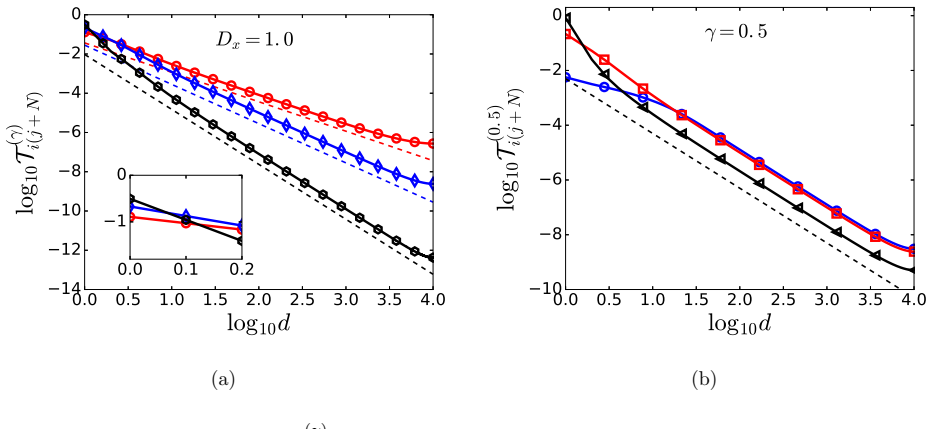
The machinery is the fractional supra-Laplacian $(L_M)^\gamma$, obtained by raising the combinatorial supra-Laplacian $L_M = L_\ell + L_x$ of the two-layer multiplex to a fractional power $\gamma \in (0,1)$, then normalizing node-wise to $\mathcal{L}^{(\gamma)} = K^{-1}(L_M)^\gamma$. For two identical circulant layers, Fourier diagonalization yields closed-form eigenvalues and eigenvectors, and the algebraic connectivity collapses to the two-branch formula in Eq. (38). The long-range inter-layer result rests on an integral representation of the fractional Laplacian: replacing the finite Fourier sums by integrals in the thermodynamic limit and using the Gamma-function identity of Eq. (66) gives the transition probability $T^{(\gamma)}_{i(j+N)} \sim d^{-(1+2\gamma)}$.
What would settle it
Compute $\Lambda_2$ exactly or numerically for a regular two-layer cycle multiplex with $J=1$ over a range of $N$, $D_x$, and $\gamma$, and compare the location of the maximum with $D_x = A_c/2$; if the maximizing coupling shifts with $N$ or with $\gamma$, or if the measured inter-layer transition probability exponent departs from $1+2\gamma$ as $N$ grows, the central claim fails.
Extended reading notes
Core claim
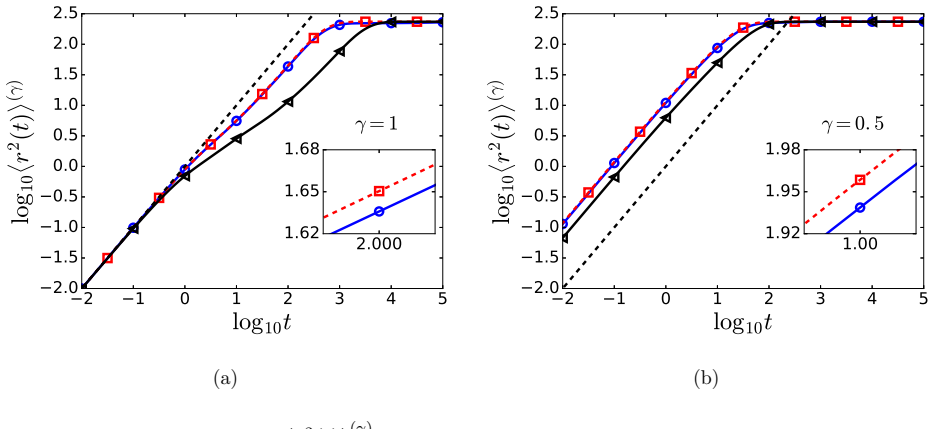
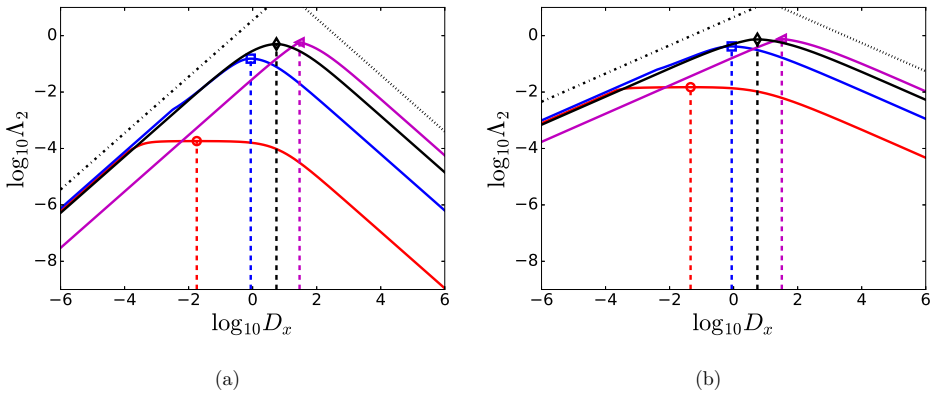
The central claim is that for Poissonian node-centric continuous-time random walks on a two-layer multiplex, the spectral gap $\Lambda_2$ of the normalized fractional supra-Laplacian $\mathcal{L}^{(\gamma)}$ is nonmonotonic in the inter-layer diffusion constant $D_x$: it increases as $(2D_x)^\gamma/\sigma^{(\gamma)}$ when $D_x$ is small and decreases as $A_c^\gamma/\sigma^{(\gamma)}$ when $D_x$ is large, attaining a unique maximum at $D_x = A_c/2$ (Eq. 38). The optimal coupling is independent of $\gamma$, while smaller $\gamma$ yields larger $\Lambda_2$ and therefore faster convergence. The same nonmonotonic behavior is observed numerically in non-regular multiplexes, with a more pronounced peak for more random layer topologies. The paper further claims that fractional dynamics introduces a new inter-layer navigation mechanism: a walker can switch layers and land at a distant vertex in the same jump, and in the thermodynamic limit the inter-layer transition probability decays as $d^{-(1+2\gamma)}$ for $d \gg 1$. Despite this enhanced diffusion, the mean-square displacement on finite circulant multiplexes scales linearly with time before saturation, so the fractional walk remains Gaussian in that finite-size regime.
Load-bearing premise
The load-bearing premise is that the thermodynamic limit $N \to \infty$, in which the discrete Fourier sums are replaced by integrals with the short-distance term $K_d$ included only at $d = 0$ and $d = 1$, accurately describes finite multiplexes; if finite-size corrections alter that integral approximation, the predicted inter-layer power law $d^{-(1+2\gamma)}$ and the claimed long-range navigation would not hold as stated.
Editorial extensions
If this is right
- For any fixed two-layer circulant multiplex, tuning the inter-layer diffusion to $D_x = A_c/2$ minimizes relaxation time, and this setting does not change when the fractional order $\gamma$ is varied.
- Smaller $\gamma$ increases $\Lambda_2$ for fixed $D_x$, so stronger fractional dynamics makes node-centric walks converge to the stationary state faster, with $\tau \sim 1/\Lambda_2$.
- Fractional node-centric walks on multiplexes can switch layers and land far away in the same hop, with inter-layer jump probability decaying as $d^{-(1+2\gamma)}$; small $\gamma$ makes the inter-layer jumps longer-tailed.
- Even though fractional dynamics enhances diffusion, the mean-square displacement of these walks on finite circulant multiplexes remains linear in time before saturation, so the enhanced mixing does not imply super-diffusive transport.
- The nonmonotonic dependence of $\Lambda_2$ on $D_x$ persists in non-circular multiplexes and becomes more pronounced as the layers become more random, so choosing the inter-layer coupling optimally matters most for irregular multiplex topologies.
Reading between the lines
- An operator tuning a multiplex transport system could treat the optimal coupling as a one-time spectral calculation: since $A_c$ is the smallest nonzero Laplacian eigenvalue of the layer, the setting $D_x = A_c/2$ is fixed by layer structure alone and remains optimal across fractional regimes.
- For multiplexes with more than two layers, the same mechanism should produce a nonmonotonic spectral gap, but the exact optimum would likely depend on the full inter-layer coupling matrix rather than a single $A_c/2$; re-deriving that formula is a natural extension.
- A direct test of the thermodynamic-limit derivation would be to measure inter-layer jump-length distributions on finite multiplexes: if the $d^{-(1+2\gamma)}$ tail persists at moderate $N$, the integral approximation is robust enough for practical use, and if not, a finite-size corrected exponent should replace it.
Signed reviews
Editorial analysis
A structured set of objections, weighed in public.
Referee Report
Summary. The paper extends the fractional continuous-time random walk (CTRW) framework of Refs. [16-18] to two-layer multiplex networks. For node-centric Poissonian CTRWs, the walker's transition matrix is derived from the normalized fractional supra-Laplacian. The authors obtain exact eigenvalues and eigenvectors for multiplexes with two circulant layers, and analyze the algebraic connectivity Lambda_2 of the normalized fractional supra-Laplacian as a function of the inter-layer diffusion coefficient D_x. For regular layers with J1=J2=J they derive a closed-form expression, Eq. (38), showing that Lambda_2 is nonmonotonic in D_x and has a global maximum at D_x=A_c/2 that is independent of the fractional exponent gamma. The paper also claims that fractional dynamics produces a new type of long-range inter-layer navigation, with transition probabilities decaying as d^{-(1+2gamma)} in the thermodynamic limit, and reports numerical simulations of the mean-square displacement showing normal diffusion (epsilon=1) even in the enhanced-diffusion regime.
Significance. The regular-layer optimal-coupling result is the strongest part of the paper. It is derived without any fitted parameters: for J1=J2=J the eigenvalues of the normalized fractional supra-Laplacian are mu_m^gamma/sigma^(gamma), so Eq. (38) follows directly from the spectrum, and the prediction that the optimal D_x=A_c/2 is independent of gamma is confirmed by Fig. 1. The analytic machinery in Appendices A and B is detailed and self-consistent. If the long-range-navigation derivation is corrected, the paper would provide a useful, falsifiable design rule for optimizing transport on interconnected networks and a novel characterization of fractional walkers on multiplexes. The numerical check of Eq. (38) and the absence of fitted parameters are notable strengths; the long-range claim, however, needs substantial repair before the paper can be accepted.
major comments (2)
- [IV B and Appendix C, Eqs. (39), (64), (66)] The definition of A_m is internally inconsistent. For J=1, Eq. (22) gives A_m = 2 - 2 cos(2 pi (m-1)/N), whereas Eq. (39) and Eq. (64) state A_m = 2 + 2 cos(2 theta_m) with theta_m = 2 pi (m-1)/N, which is 2 + 2 cos(4 pi (m-1)/N). The integral identity in Eq. (66) is the standard Fourier integral for the symbol 2 - 2 cos theta, so as printed it cannot be applied to the A_m appearing in Eq. (39). Consequently, the derivation of Eqs. (41)-(45), including the power law T ~ d^{-(1+2 gamma)}, is not supported by the equations as written. The authors should either correct the definition of A_m consistently with Eq. (22) or redo the derivation from the correct finite-sum expression and re-verify Eq. (45) against the exact numerical values of T^(gamma)_{i(j+N)}.
- [IV B and Appendix C, Eqs. (64)-(66)] The replacement of the finite Fourier sum over m=1,...,N by an integral over theta in [0,2 pi) is a thermodynamic-limit step whose finite-N error is not controlled. For a cycle, the exact sum is periodic in the distance d with period N, and the trapezoidal-rule/Poisson-summation error introduces aliased contributions at d ± N, d ± 2N, and so on. When d is near N/2, the alias at N-d is of the same order as the leading term, so the asserted power-law decay T ~ d^{-(1+2 gamma)} is at best an asymptotic statement for d << N, not a finite-N result. Since Fig. 2 uses N=20001 and d up to about 10^4, this is not a purely formal caveat. The paper should either restrict the long-range claim explicitly to the thermodynamic limit throughout the abstract, main text, and conclusions, or provide quantitative finite-N error estimates and numerical verification of Eq. (45) in the regime where aliasing is expected to matter.
minor comments (5)
- [Section IV A, text before Eq. (38)] The text states that the eigenvalues of the normalized supra-Laplacian are lambda_m = mu_m/sigma^(gamma), but the exponent gamma is missing: the correct relation for the fractional normalized supra-Laplacian is lambda_m = mu_m^gamma/sigma^(gamma), as is in fact used in Eq. (38). Please correct this line.
- [Figure 3] Figure 3 shows no error bars or statistical details for the simulated MSD curves, and the inset labels appear garbled (for example '2.0001.62 1.65 1.68' and '1.001.92 1.95 1.98'). The authors should clarify what these numbers are and report the number of realizations or an equivalent error measure.
- [Section IV B, text around Eq. (41)] The text cites Ref. [43] for a discussion of the integral in the thermodynamic limit, but Ref. [43] is a synchronization paper and does not appear to contain such a discussion; the relevant references are likely Refs. [16-18] and [60].
- [Conclusions and Supplemental Material] The manuscript refers several times to a Supplemental Material file, but no supplement is included in the arXiv version; all claims attributed to the supplement should either be verifiable in the main text or the supplement should be provided.
- [Throughout] There are several typographical errors, including 'sucessful', 'paramenter' (twice), 'thermodinamic', 'therodynamic', 'hoping' for 'hopping', and 'aditional'; a careful proofreading pass is needed.
Circularity Check
No significant circularity: the spectral derivations are self-contained, no fitted parameter is renamed as a prediction, and no load-bearing self-citation chain is present.
full rationale
The paper's fractional dynamics is defined, following Refs. [16–18], as the matrix power (L_M)^γ with the normalized version L^(γ)=K^(−1)(L_M)^γ. This is a model definition from prior work, not a circular prediction. For regular circulant multiplexes, Eq. (38) is obtained by substituting the exact eigenvalues µ_{2m−1}=A_m+2D_x and µ_{2m}=A_m into the definition λ_m=µ_m^γ/σ^(γ) and then taking the smallest nonzero eigenvalue; the optimum D_x=A_c/2 follows directly from min(A_m,2D_x). No parameter is fitted against data, and no fitted quantity is relabeled as a prediction. The long-range navigation claim T^(γ)∼d^{−(1+2γ)} follows from the spectral representation of (L_M)^γ and the Fourier integral in Eq. (66); that integral identity is attributed to Refs. [16–18,60], which are not authored by Allen-Perkins or Andrade, so the result is not a self-citation chain. Figures 1 and 2 test Eqs. (38) and (45) against direct numerical evaluation rather than supplying the formulas by fit. The only self-citation, Ref. [45], concerns Kuramoto oscillators and is not load-bearing. The skeptic's concerns—the printed sign convention for A_m in Eq. (39) versus Eq. (22), and the finite-N-to-integral replacement in Appendix C—are correctness or approximation issues in the thermodynamic-limit derivation, not circularity: even if the exponent derivation were flawed, it would not reduce to its own inputs by construction.
Assumptions & free parameters
assumptions (6)
- standard math Spectral theorem for symmetric matrices diagonalizes L_M, so the fractional power is defined via eigenvalues.
- standard math Fourier diagonalization of circulant matrices gives exact eigenvalues and eigenvectors of each layer.
- standard math Known integral identity Eq. (66) for fractional Laplacians on cycle graphs.
- domain assumption Node-centric Poissonian CTRW model: active nodes trigger moves with probability proportional to link weight.
- domain assumption The multiplex has exactly two undirected layers with equal intra-layer constants D1 = D2 = 1 and odd N; all inter-layer couplings equal D_x.
- domain assumption The normalized fractional supra-Laplacian is obtained by dividing each row by its diagonal fractional strength.
Cite this review
Pith. "Pith review of Fractional dynamics on circulant multiplex networks: optimal coupling and long-range navigation for continuous-time random walks." pith.science (2026). https://pith.science/paper/VOEZS34Y
@misc{pith2026190802609,
  author       = {Pith},
  title        = {Pith review of: Fractional dynamics on circulant multiplex networks: optimal coupling and long-range navigation for continuous-time random walks},
  year         = {2026},
  howpublished = {\url{https://pith.science/paper/VOEZS34Y}},
  note         = {Machine review of arXiv:1908.02609}
}
abstract
This work analyzes fractional continuous-time random walks on two-layer multiplexes. A node-centric dynamics is used, in which it is assumed a Poisson distribution of a walker to become active, while a jump to one of its neighbors depends on the connection weight. Synthetic multiplexes with well known topology are used to illustrate dynamical features obtained by numerical simulations, while exact analytical expressions are presented for multiplexes assembled by circulant layers with finite number of nodes. Special attention is given to the effect of inter- $D_x$ and intra-layer $D_i$ coefficients on the system's behavior. In opposition to usual discrete time dynamics, the relaxation time has a well defined minimum at an optimal value of $D_x/D_i$. It is found that, even for the enhanced diffusion condition, the walkers mean square displacement increases linearly with time.
Figures

Figures from the paper (1 more)
Reference graph
Works this paper leans on
-
[1]
Albert R and Barab´ as A-Li, Statistical mechanics of complex networks , 2002 Rev. Mod. Phys. 74, 47-97
work page 2002
-
[2]
Newman MEJ, The structure and function of complex networks , 2003 SIAM Rev. 45, 167-256
work page 2003
-
[3]
Boccaletti S, Latora V, Moreno Y, Chavez M and Hwang D-U, Complex Networks: Structure and Dynamics , 2006 Phys. Rep. 424, 175
work page 2006
-
[4]
Barrat A, Barthlemy M and Vespignani A, Dynamical Processes on Complex Networks 1st ed., 2008 (Cambridge University Press, New York)
work page 2008
-
[5]
Ferraz de Arruda G, Rodrigues F A and Moreno Y, Fundamentals of spreading processes in single and multilayer complex networks , 2018 Phys. Rep. Volume 756, 5, Pages 1-59
work page 2018
-
[6]
Dorogovtsev SN, Goltsev A V and Mendes JFF, Critical phenomena in complex networks , 2008 Rev. Mod. Phys. 80, 1275
work page 2008
-
[7]
Tang Y, Qian F, Gao H and Kurths J, Synchronization in complex networks and its application - A survey of recent advances and challenges , 2014 Annu. Rev. Control 38, Issue 2, Pages 184- 198
work page 2014
-
[8]
Rodrigues F A, Peron TK DM, Ji P and Kurths J, The Kuramoto model in complex networks , 2016 Phys. Rep. 610, 1-98
work page 2016
Show all 61 references
-
[9]
Noh JD and Rieger H, Random Walks on Complex Networks , 2004 Phys. Rev. Lett. 92, 118701
2004
-
[10]
Klafter J and Sokolov IM, First steps in random walks: from tools to applications , 2011 Oxford University Press
2011
-
[11]
Masuda N, Porter MA and Lambiotte R, Random walks and diffusion on networks , 2017 Phys. Rep. 716–717, 1-58
2017
-
[12]
Riascos AP and Mateos JL, Long-range navigation on complex networks using L´ evy rand om walks, 2012 Phys. Rev. E 86, 056110
2012
-
[13]
Guo Q, Cozzo E, Zheng Z and Moreno Y, L´ evy random walks on multiplex networks , 2016 Sci. Rep. volume 6: 37641
2016
-
[14]
Complex Netw
Estrada E, Delvenne JC, Hatano N, Mateos JL, Metzler R, R iascos AP and Schaub MT, Random multi-hopper model: super-fast random walks on grap hs, 2018 J. Complex Netw. 6, 28 382-403
2018
-
[15]
de Nigris S, Carletti T and Lambiotte R, Onset of anomalous diffusion from local motion rules, 2017 Phys. Rev. E 95, 022113
2017
-
[16]
Riascos AP and Mateos JL, Fractional dynamics on networks: Emergence of anomalous di f- fusion and L´ evy flights, 2014 Phys. Rev. E 90, 032809
2014
-
[17]
Riascos AP and Mateos JL, Fractional diffusion on circulant networks: emergence of dy nam- ical small world , 2015 J. Stat. Mech. , P07015
2015
-
[18]
Michelitsch T, Riascos AP, Collet B, Nowakowski A, and N icolleau F, Fractional Dynamics on Networks and Lattices , 2019 (ISTE Ltd and John Wiley & Sons, Inc., UK and USA)
2019
-
[19]
Lomholt M, Tal K, Metzler R, and Joseph K, L´ evy strategies in intermittent search processes are advantageous, 2008 PNAS, 105, 32, 11055-11059
2008
-
[20]
Humphries NE, Queiroz N, Dyer JRN, Pade NG, Musyl M, Scha efer KM, Fuller DW, Brunnschweiler JM, Doyle TK, Houghton JDR, Hays GC, Jones CS , Noble LR, Wearmouth VJ, Southall EJ and Sims DW, Environmental context explains L´ evy and Brownian movement patterns of marine predator...
2010
-
[21]
Song C, Koren T, Wang P and Barab´ asi A-L, Modelling the scaling properties of human mobility, 2010 Nat. Phys. 6, 10, 818-823
2010
-
[22]
Rhee I, Shin M, Hong S, Lee K, Kim SJ and Chong S, On the levy-walk nature of human mobility, 2011 IEEE/ACM TON , 19, 3, 630-643
2011
-
[23]
Press, New York)
Viswanathan GM, da Luz MGE, Raposo E and Stanley HE, Physics of Foraging , 2011 (Cam- bridge U. Press, New York)
2011
-
[24]
Boccaletti S, Bianconi G, Criado R, Del Genio CI, G´ omez -Garde˜ nes J, Romance M, Sendi˜ na- Nadal I, Wang Z and Zanin M, The structure and dynamics of multilayer networks , 2014 Phys. Rep. 544(1):1-122
2014
-
[25]
Complex Netw
Kivel¨ a M, Arenas A, Barthelemy A, Gleeson JP, Moreno Y a nd Porter MA, Multilayer net- works, 2014 J. Complex Netw. 2, 203-71
2014
-
[26]
Battiston F, Nicosia V and Latora V, The new challenges of multiplex networks: measures and models, 2017 Eur. Phys. J. Spec. Top. 226, 401-16
2017
-
[27]
Bianconi G, Multilayer Networks: Structure and Function , 2018 (Oxford, Oxford University Press, New York)
2018
-
[28]
Szell M, Lambiotte R and Thurner S, Multirelational organization of large-scale social networks 29 in an online world , 2010 PNAS USA , 107:13636
2010
-
[29]
Cozzo E, Ba˜ nos RA, Meloni S and Moreno Y, Contact-Based Social Contagion in Multiplex Networks, 2013 Phys. Rev. E 88, 050801
2013
-
[30]
Li W, Tang S, Fang W, Guo Q, Zhang X and Zheng Z, How Multiple Social Networks Affect User Awareness: The information Diffusion Process in Multipl ex Networks , 2015 Phys. Rev. E 92, 042810
2015
-
[31]
de Arruda GF, Cozzo E, Peixoto TP, Rodrigues F A and Moren o Y, Disease Localization in Multilayer Networks , 2017 Phys. Rev. X 7, 011014
2017
-
[32]
Cozzo E, Arenas A, and Moreno Y, Stability of Boolean Multilevel Networks , 2012 Phys. Rev. E 86, 036115
2012
-
[33]
De Domenico M, Sol´ e-Ribalta A, G´ omez S, and Arenas A, Navigability of Interconnected Networks under Random Failures , 2014 PNAS USA 111, 8351
2014
-
[34]
Aleta A, Meloni S and Moreno Y, A Multilayer Perspective for the Analysis of Urban Trans- portation Systems , 2017 Sci. Rep. 7, 44359
2017
-
[35]
G´ omez S, D ´ ıaz-Guilera A, G´ omez-Garde˜ nes J, P´ erez-Vicente CJ, Moreno Y and Arenas A, Diffusion Dynamics on Multiplex Networks , 2013 Phys. Rev. Lett. 110, 028701
2013
-
[36]
Cencetti G and Battiston F, Diffusive behavior of multiplex networks , 2019 New J. Phys. , Volume 21, March
2019
-
[37]
De Domenico M, Granell C, Porter MA, and Arenas A, The physics of spreading processes in multilayer networks , 2016 Nat. Phys. 12:901
2016
-
[38]
Tejedor A, Longjas A, Foufoula-Georgiou E, Georgiou TT and Moreno Y, Diffusion Dynamics and Optimal Coupling in Multiplex Networks with Directed Lay ers, 2018 Phys. Rev. X 8, 031071
2018
-
[39]
Asllani M, Busiello DM, Carletti T, Fanelli D and Planch on G, Turing patterns in multiplex networks, 2014 Phys. Rev. E 90, 042814
2014
-
[40]
Kouvaris NE, Hata S and D ´ ıaz-Guilera A, Pattern formation in multiplex networks , 2015 Sci. Rep. 5 10840
2015
-
[41]
Busiello DM, Carletti T and Fanelli D, Homogeneous-per-layer patterns in multiplex networks , 2018 EPL 121 48006
2018
-
[42]
Gambuzza L V, Frasca M and G´ omez-Garde˜ nes J, Intra-layer synchronization in multiplex networks, 2015 EPL 110:20010. 30
2015
-
[43]
Sevilla-Escoboza R, Guti´ errez R, Huerta-Cuellar G, B occaletti S, G´ omez-Garde˜ nes J, Arenas A and Buld´ u JM, Enhancing the stability of the synchronization of multivar iable coupled oscillators, 2015 Phys. Rev. E 92, 032804
2015
-
[44]
del Genio CI, G´ omez-Garde˜ nes J, Bonamassa I and Boccaletti S, Synchronization in networks with multiple interaction layers , 2016 Sci. Adv. 2 e1601679
2016
-
[45]
Allen-Perkins A, de Assis TA, Pastor JM and Andrade RFS, Relaxation time of the global order parameter on multiplex networks: The role of interlay er coupling in Kuramoto oscillators 2017 Phys. Rev. E 96, 042312
2017
-
[46]
Serrano AB, G´ omez-Garde˜ nes J and Andrade RFS, Optimizing diffusion in multiplexes by maximizing layer dissimilarity , 2017 Phys. Rev. E 95, 052312
2017
-
[47]
Sol´ e-Ribalta A, De Domenico M, Kouvaris NE, D ´ ıaz-Gui lera A, G´ omez S and Arenas A, Spectral properties of the laplacian of multiplex networks , 2013 Phys. Rev. E 88, 032807
2013
-
[48]
Radicchi F and Arenas A, Abrupt transition in the structural formation of interconn ected networks, 2013 Nat. Phys. 9, 717
2013
-
[49]
Cozzo E and Moreno Y, Characterization of Multiple Topological Scales in Multipl ex Networks through Supra-Laplacian Eigengaps , 2016 Phys. Rev. E 94, 052318
2016
-
[50]
S´ anchez-Garc ´ ıa RJ, Cozzo E and Moreno Y,Dimensionality reduction and spectral properties of multilayer networks , 2014 Phys. Rev. E 89, 052815
2014
-
[51]
In: Garas A (eds) Interconnected Networks
Cozzo E, de Arruda F A, Rodrigues F A, and Moreno Y, Multilayer networks: metrics and spectral properties Interconnected Networks. In: Garas A (eds) Interconnected Networks. Un- derstanding Complex Systems . 2016 Springer, Cham (Berlin: Springer) pp 17–35
2016
-
[52]
de Arruda GF, Cozzo E, Rodrigues F A and Moreno Y, A polynomial eigenvalue approach for multiplex networks , 2018 New J. Phys. 20, 095004
2018
-
[53]
Aldous D and Fill JA, 2002 Reversible Markov Chains and Random Walks on Graphs
2002
-
[54]
Lov´ asz L, Random walks on graphs: A Survey , 1993 Combinatorics, Paul Erdos Is Eighty, 2, 1–46
1993
-
[55]
Almaas E, Kulkarni R V, and Stroud D, Scaling properties of random walks on small-world networks, 2003 Phys. Rev. E 68, 056105
2003
-
[56]
Gallos LK, Random walk and trapping processes on scale-free networks , 2004 Phys. Rev. E 70, 046116
2004
-
[57]
Metzler R and Klafter J, The random walk’s guide to anomalous diffusion: a fractional d y- 31 namics approach, 2000 Phys. Rep. 339, 1, pp. 1-77
2000
-
[58]
Van Mieghem, Graph Spectra for Complex Networks 2011 (Cambridge University Press, Cambridge)
P. Van Mieghem, Graph Spectra for Complex Networks 2011 (Cambridge University Press, Cambridge)
2011
-
[59]
In the ER-model, p is the probability for edge creation between two nodes
In the BA-random model, m represents the number of edges to attach from a new node to existing nodes. In the ER-model, p is the probability for edge creation between two nodes
-
[60]
Zoia A, Rosso A and Kardar M, Fractional Laplacian in bounded domains , 2007 Phys. Rev. E 76, 021116
2007
-
[61]
Silvester J, Determinants of Block Matrices , 2000 Math. Gazette. 84, 501, pp. 460-467. 32
2000
Reviewed August 14, 2026 · model on record in the stance chip above.
Discussion (0). Continue with ORCID to comment.