REVIEW 3 major objections 3 minor 21 references
Wavelet Spectra for Multivariate Point Processes
T0 review · 3 major / 3 minor · reviewed 2026-08-14 · deepseek-v4-flash
Pith's one-line read A temporally smoothed wavelet periodogram of a multivariate point process is asymptotically a scaled complex Wishart matrix, giving closed-form coherence distributions and a chi-square test for non-stationarity.
desk verdict The eigen-wavelet representation is a real advance, but the asymptotic Wishart result in Theorem 2 is a moment-matched approximation, not a genuine limiting distribution. read the letter →
The pith
A machine-rendered reading of the paper's core claim, the machinery that carries it, and where it could break.
The reading
What carries the argument
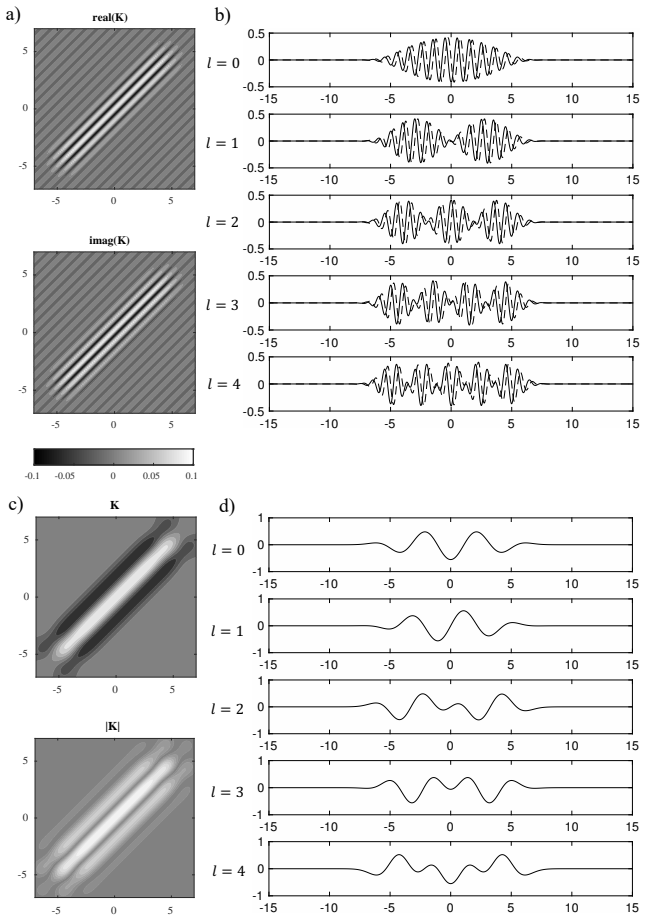
The load-bearing object is the Hermitian kernel $K(s,t)=\int h_\kappa(u)\psi(s-u)\psi^*(t-u)\,du$ formed from the wavelet $\psi$ and smoothing window $h$, together with its Mercer eigen-decomposition into eigen-wavelets $\{\phi_l\}$ and eigenvalues $\{\eta_l\}$. The identity $\sum_l \eta_l |\Phi_l(f)|^2 = |\Psi(f)|^2$ preserves the wavelet's frequency response across the channel bank. This machinery converts temporal smoothing into a finite, in practice, number of approximately independent wavelet channels, so that the smoothed periodogram becomes a weighted sum of Wishart matrices; the weights $\eta_l$ directly set the effective degrees of freedom $n=1/\sum_l \eta_l^2$.
What would settle it
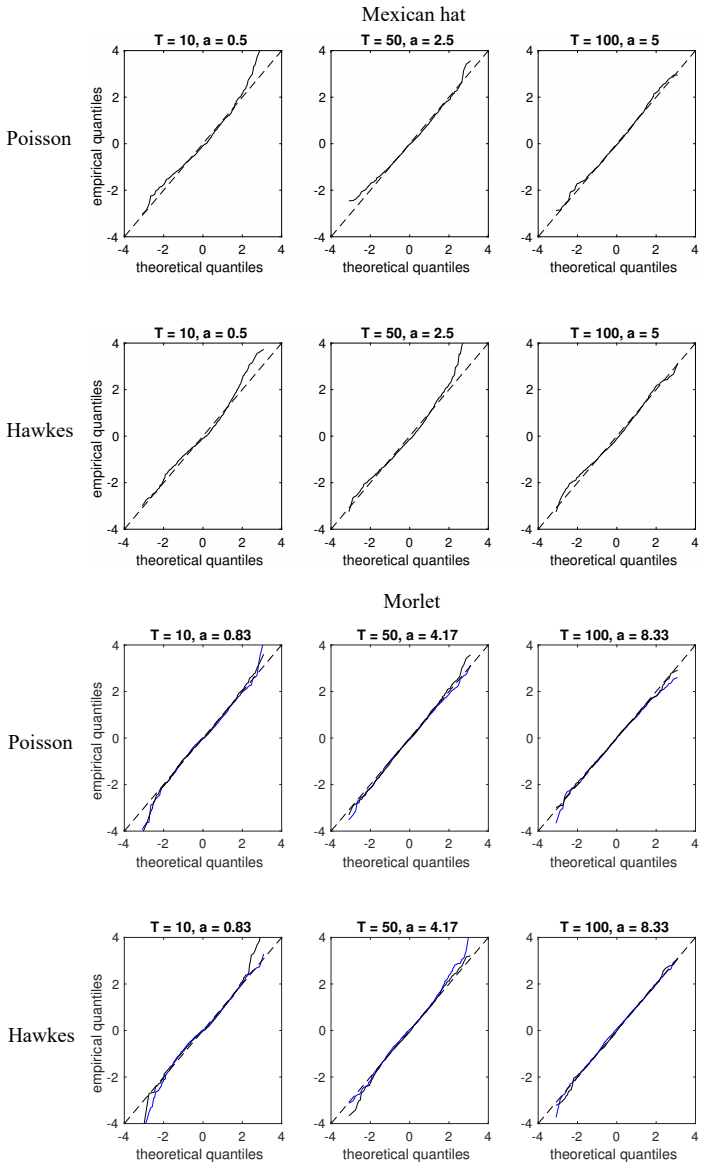
Run a stationary bivariate Hawkes or Poisson process through the estimator and compare the empirical distribution of the smoothed periodogram, or the coherence, against the claimed $(1/n)\mathrm{WC}_p$ law with $n$ taken from the kernel eigenvalues; a statistically significant deviation, or a failure of the empirical covariance of $w^{(T)}$ and its conjugate to decay to zero as $T$ grows, would refute Theorem 2.
Extended reading notes
Core claim
On the paper's own terms, the central discovery is a distributional equivalence: for a $p$-dimensional stationary point process with spectral density matrix $S(f)$, the temporally smoothed wavelet periodogram $\Omega^{(T)}(\tilde a,\tilde b)$ is asymptotically $(1/n)\,\mathrm{WC}_p\{n, S(f_{\tilde a})\}$ as $T\to\infty$, where $n=1/\sum_l \eta_l^2$ is computed from the eigenvalues of the kernel $K(s,t)=\int h_\kappa(u)\psi(s-u)\psi^*(t-u)\,du$. The proof runs through the Mercer expansion $K(s,t)=\sum_l \eta_l \phi_l(s)\phi_l^*(t)$, which makes the smoothed periodogram a weighted sum of eigen-wavelet periodograms, each asymptotically complex normal by a cumulant argument under the paper's mixing condition. The Wishart law then yields a closed-form density for temporally smoothed wavelet coherence (Corollary 1) and, through a likelihood-ratio construction, an asymptotic $\chi^2$ test for stationarity at dyadic scales (Theorem 3).
Load-bearing premise
The argument's load-bearing premise is that the complex wavelet used is analytic, meaning it has no response at negative frequencies; the paper states this as orthogonality to its own complex conjugate, a condition that cannot hold for a unit-norm wavelet, and the Morlet wavelet used in the applications only satisfies the intended condition approximately.
Editorial extensions
If this is right
- Wavelet coherence of point processes can be thresholded without bootstrap or permutation: the 95% contour follows from Corollary 1 with $n$ taken from the kernel eigenvalues.
- The likelihood-ratio statistic gives a scale-by-scale stationarity test with known $\chi^2$ degrees of freedom, and the scale-specific tests combine into a global test.
- The degrees of freedom grow linearly with the smoothing width $\kappa$ for a rectangular window (Proposition 4), so users can trade time resolution against test power explicitly.
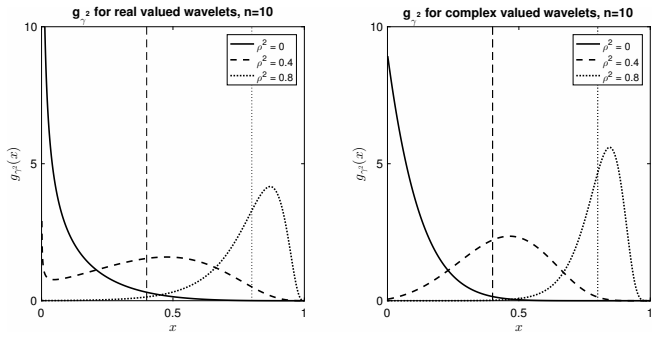
- Real-valued wavelets such as the Mexican hat inherit the framework with a real Wishart limit and a Beta null coherence distribution, so the same calibration applies there.
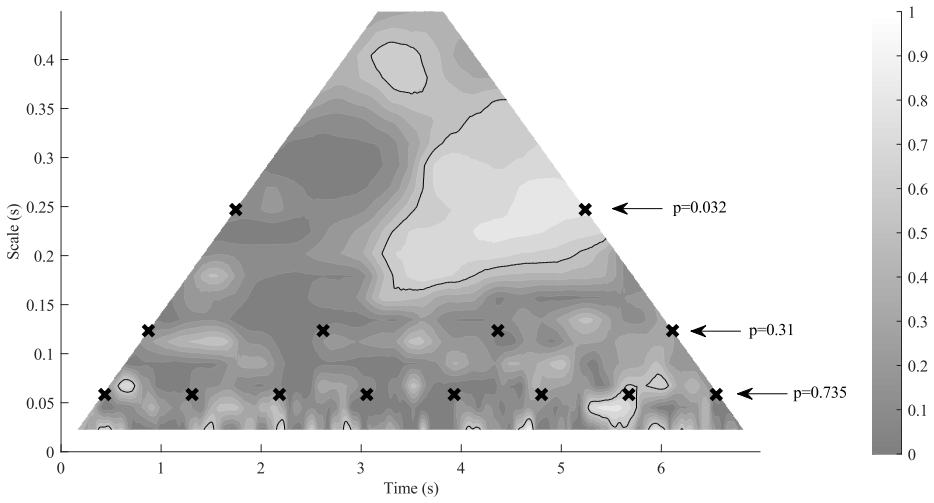
- In applications to neural spike trains, the test can flag changes in cross-stream correlation over short single-trial recordings.
Reading between the lines
- Extension: the identity $\Omega=\sum_l \eta_l v_l v_l^H$ suggests that the same $n=1/\sum_l\eta_l^2$ calibration should apply to any non-negative definite, trace-one smoothing kernel, not only the rectangular-window examples; testing a different $h$ would be a direct check.
- Extension: the paper tests each dyadic scale separately, but the rejection information across scales could be combined into a change-point localizer for when the dependence structure changes, something the authors do not attempt.
- Extension: because the Morlet wavelet is not exactly analytic, the circular-complex-normal step holds only approximately; a finite-sample study of how far the Wishart approximation drifts with the size of $\int\psi(t)^2\,dt$ would quantify the practical gap.
Signed reviews
Editorial analysis
A structured set of objections, weighed in public.
Referee Report
Summary. The paper develops a temporally smoothed wavelet periodogram for multivariate point processes, expresses it as a weighted sum of eigen-wavelet periodograms, and derives asymptotic distributional results. Under stationarity, Theorem 1 claims the wavelet transform is asymptotically circular complex normal, and Theorem 2 claims the smoothed periodogram is asymptotically a scaled complex Wishart with degrees of freedom n = 1/Σ_l η_l² determined by the eigenvalues of the smoothing kernel. From Theorem 2 the authors derive the distribution of wavelet coherence (Corollary 1) and construct a likelihood-ratio test for stationarity across scales (Theorem 3). The paper includes simulation support, a real neural spike-train analysis, and a GitHub implementation. The main novelty is the eigen-wavelet representation and the attempt to extend multitaper-style Wishart asymptotics to point-process wavelet spectra.
Significance. If Theorem 2 and its corollaries were correct, the paper would provide a practically useful and theoretically motivated inferential framework for wavelet coherence and stationarity testing in point-process data, extending earlier work by Cohen and Walden from time series to point processes. The eigen-wavelet representation in Section 3 is elegant and Proposition 2 is a clean and useful result. The authors also provide simulations, a real-data example, and reproducible code, which are strengths. However, the central distributional claim is not valid as stated: the weighted sum of independent complex Wisharts that arises in the eigen-wavelet representation is not itself a scaled complex Wishart when the eigenvalue weights are unequal, and the weights are fixed as T→∞. Since Corollary 1 and Theorem 3 inherit this claim, the paper's main inferential results do not follow. The manuscript is therefore not publishable in its current form, although the underlying ideas may be salvageable if reframed as an approximation with explicit error control.
major comments (3)
- [Section 4.2, Theorem 2 and its proof in Supplementary Material Section 1] The proof of Theorem 2 does not establish the stated Wishart limit. From Eq. (S5) and Lemma 3, the asymptotics give Ω(T)(ã,b̃) ≈ Σ_l η_l v_l v_l^H with the v_l asymptotically independent CN_p(0,S). Each term v_l v_l^H is WC_p(1,S), but a weighted sum of independent complex Wisharts with unequal weights is not a scaled WC_p(n,S); a WC_p(n,S) distribution corresponds to an unweighted average of n i.i.d. rank-one terms. Choosing n = 1/Σ_l η_l² matches the mean and a certain covariance adjustment, but this is the Satterthwaite/Box equivalent-degrees-of-freedom approximation, not an exact asymptotic distribution. The mismatch does not vanish as T→∞ because the eigenvalues η_l are fixed. For example, for p=1 with weights (0.9,0.1), the MGF of Σ η_l Exp(1) at t=1 is 1/{(1−0.9)(1−0.1)} ≈ 11.1, while the claimed (1/n)WC_p(n,S) MGF is (1 − (1/n)t)^{-n} ≈ 8.0 at t=1. The citation to Walden (2000, p. 776) concerns unweighted multitaper averaging and does not cover unequal eigenvalues. This issue directly invalidates Corollary 1 and the distributional statements used in Theorem 3 and Proposition 7.
- [Section 4.1, Assumption 4; also Lemma 2 and Theorem 1 proof in Supplementary Material] Assumption 4 as printed is internally inconsistent: it states that ψ is orthogonal to its complex conjugate, i.e. ∫ ψ(t)ψ*(t)dt = 0, but Assumption 1 requires ∫|ψ(t)|²dt = 1, so this condition is impossible. The proofs actually require the different condition ∫ ψ(t)ψ(t)dt = 0; see Lemma 2, where ψ1 = ψ*(T) and ψ2 = ψ(T) are used to conclude ∫ ψ*(T)(t)ψ*(T)(t)dt = 0. This stronger condition is not satisfied exactly by the Morlet wavelet used throughout the paper. If it fails, cov{w(T), w*(T)} does not vanish asymptotically, so the limit is not circular complex normal and the complex Wishart claim in Theorem 2 does not follow. The authors should either restrict to wavelets for which the intended condition holds exactly, or quantify the effect of its violation on the limiting distribution.
- [Theorem 2 proof and Proposition 5 proof, Supplementary Material Section 1] The statement that the eigen-wavelet coefficients v_l are asymptotically independent is only sketched. Lemma 2 bounds a second-order cumulant between two wavelet transforms with orthogonal wavelets, but asymptotic joint normality of the infinite family {v_l} requires control of all higher-order joint cumulants, or a suitable infinite-dimensional CLT. The phrase 'Lemma 2 combined with a similar argument to Theorem 1' does not supply this argument. This matters for Theorem 2 because the weighted-sum law in the preceding comment presupposes independence of the v_l; it also matters for Proposition 5, where independence of the periodograms at different dyadic locations is asserted from non-overlap of kernels. An explicit proof, or a reference that covers joint asymptotic normality of wavelet coefficients in point-process settings, is needed.
minor comments (3)
- [Main text Theorem 3 vs. Supplementary Material Theorem 3] The main text states 0 < c < 1/2, while the supplementary statement of Theorem 3 says 0 < c < 1. Since β = min{c, 1/2 − c} is used, the condition c < 1/2 is required; the supplementary statement should be corrected for consistency.
- [Supplementary Material, proof of Proposition 1] In the proof of Proposition 1, the sentence 'Property (iii) is immediate from Proposition 1 and the fact that ψ(t) itself obeys the admissibility condition' appears to contain a typo: it should cite Proposition 2, not Proposition 1.
- [Section 2.2, approximating wavelet] The paper states that ψ(t) is used to denote both the original and the approximating wavelet with support (−α/2, α/2). Since several theoretical results rely on the approximating support, the dependence of the asymptotics on α should be made explicit in the statements of Proposition 4 and Theorem 2, rather than only in the informal discussion.
Circularity Check
No significant circularity: derivation is self-contained; the cited self-work is contextual and not load-bearing.
full rationale
No circular step is exhibited. The temporally smoothed wavelet periodogram is expanded via Mercer's theorem into a weighted eigen-wavelet sum (Eq. S5), and the asymptotic normality of each eigen-wavelet transform (Theorem 1) is proved from Brillinger's cumulant mixing conditions (Assumption 3) and an external CLT argument; the proof of Theorem 2 then combines these with a Wishart argument cited to Walden (2000). The degrees of freedom n = 1/Ση_l^2 is computed from the kernel eigenvalues, not fitted to data, and the centrality matrix S(f̃_a) is a parameter of the assumed stationary model, not estimated from the data being predicted. The self-citations to Cohen and Walden (2010a,b) appear only in the introduction as background and in the definition of central frequency; they do not carry the load of Theorem 2, Corollary 1, or Theorem 3. The Assumption 4 orthogonality condition is misprinted (∫ψψ* dt = 0 contradicts ||ψ||=1) and the intended analytic-wavelet condition is used in the proof; this is a correctness issue, not a circularity. The skeptic's point that a weighted sum of independent complex Wisharts is not exactly Wishart with unequal weights is also a correctness/approximation concern (the n chosen by moment matching gives only an equivalent-dof approximation), not a circularity, because the claimed distribution is not used as an input to derive itself.
Assumptions & free parameters
free parameters (3)
- Smoothing width scaling κ =
κ = 10 in the real data example; no fitted value
- Wavelet approximating support α =
α = 4 (real data example); α = 8 suggested for Morlet; no fitted value
- Stationarity test scale parameter c =
c = 1/4 optimal in Theorem 3; no fitted value
assumptions (8)
- domain assumption Assumption 1: wavelet ψ satisfies ∫ψ = 0, ||ψ|| = 1, admissibility ∫ f^{-1}|Ψ(f)|^2 df < ∞.
- domain assumption Assumption 2: smoothing function h(t) is non-negative, symmetric, continuous on (−1/2,1/2), normalized to integrate to 1.
- domain assumption Assumption 3: the point process is strictly stationary with all moments, jointly integrable cumulants, and ∫|u||r(u)|du < ∞ (Brillinger mixing condition).
- ad hoc to paper Assumption 4: complex wavelet orthogonal to its own conjugate (∫ψ(t)ψ(t)dt = 0 as used in the proof; printed with a typo as ∫ψ(t)ψ*(t)dt = 0).
- domain assumption Assumption 5: h satisfies a Lipschitz-type condition ∫|h(t+u)−h(t)|dt ≤ C'|u|.
- standard math Mercer's theorem for the Hermitian kernel K(s,t).
- standard math Brillinger (1972) cumulant expansion for stochastic integrals (Lemma 1).
- standard math Goodman (1963) distribution of coherence of complex Wishart matrices.
Cite this review
Pith. "Pith review of Wavelet Spectra for Multivariate Point Processes." pith.science (2026). https://pith.science/paper/LIE2IOTO
@misc{pith2026190802634,
  author       = {Pith},
  title        = {Pith review of: Wavelet Spectra for Multivariate Point Processes},
  year         = {2026},
  howpublished = {\url{https://pith.science/paper/LIE2IOTO}},
  note         = {Machine review of arXiv:1908.02634}
}
read the original abstract
Wavelets provide the flexibility to analyse stochastic processes at different scales. Here, we apply them to multivariate point processes as a means of detecting and analysing unknown non-stationarity, both within and across data streams. To provide statistical tractability, a temporally smoothed wavelet periodogram is developed and shown to be equivalent to a multi-wavelet periodogram. Under a stationary assumption, the distribution of the temporally smoothed wavelet periodogram is demonstrated to be asymptotically Wishart, with the centrality matrix and degrees of freedom readily computable from the multi-wavelet formulation. Distributional results extend to wavelet coherence; a time-scale measure of inter-process correlation. This statistical framework is used to construct a test for stationarity in multivariate point-processes. The methodology is applied to neural spike train data, where it is shown to detect and characterise time-varying dependency patterns.
Figures

Figures from the paper (5 more)


Reference graph
Works this paper leans on
-
[1]
Bartlett, M. S. (1963). The spectral analysis of point processes. Journal of the Royal Statistical Society. Series B\/ 25\/ (2), 264--296
work page 1963
-
[2]
Brillinger, D. R. (1972). The spectral analysis of stationary interval functions . Proceedings of the Sixth Berkeley Symposium on Mathematical Statistics and Probability, Volume 1: Theory of Statistics\/ , 483--513
work page 1972
-
[3]
Brillinger, D. R. (1996). Some uses of cumulants in wavelet analysis . Journal of Nonparametric Statistics\/ 6 , 93--114
work page 1996
-
[4]
Carter, G. (1987). Coherence and time delay estimation . Proceedings of the IEEE\/ 75\/ (2), 236--255
work page 1987
-
[5]
Cohen, E. A. K. and A. T. Walden (2010a). A statistical analysis of Morse wavelet coherence . IEEE Transactions on Signal Processing\/ 58\/ (3 PART 1), 980--989
work page 2010
-
[6]
Cohen, E. A. K. and A. T. Walden (2010b). A statistical study of temporally smoothed wavelet coherence. IEEE Transactions on Signal Processing\/ 58\/ (6), 2964--2973
work page 2010
-
[7]
Goodman, N. (1963). Statistical analysis based on a certain multivariate complex G aussian distribution (an introduction). Annals of Mathematical Statistics\/ 34\/ (1), 152--177
work page 1963
-
[8]
Grinsted, A, J., C. Moore, and S. Jevrejeva (2004). Application of the cross wavelet transform and wavelet coherence to geophysical time series. Nonlinear Processes in Geophysics\/ 11\/ (5), 561--566
work page 2004
Show all 21 references
-
[9]
Hawkes, A. G. (1971). Spectra of some self-exciting and mutually exciting point processes. Biometrika\/ 58\/ (1), 83--90
1971
-
[10]
Kythe, P. K. and P. Puri (2001). Computational Methods for Linear Integral Equations . Springer
2001
-
[11]
Mallat, S. and G. Peyr\' e (2008). A Wavelet Tour of Signal Processing \/ (3 ed.). Elsevier Science and Technology
2008
-
[12]
Mercer, J. (1909). Functions of positive and negative type, and their connection with the theory of integral equations. Philosophical Transactions of the Royal Society A: Mathematical, Physical and Engineering Sciences\/ 209\/ (441-458), 415--446
1909
-
[13]
Olhede, S. C. and A. T. Walden (2002). Generalized M orse wavelets. IEEE Transactions on Signal Processing\/ 50\/ (11), 2661--2670
2002
-
[14]
Tang, S., S. C. Ardila Jimenez , S. Chakraborty, and S. R. Schultz (2015). Visual receptive field properties of neurons in the mouse lateral geniculate nucleus . Plos One\/ 11\/ (1), 1--34
2015
-
[15]
Thomson, D. J. (1982). Spectrum estimation and harmonic analysis. Proceedings of the IEEE\/ 70\/ (9)
1982
-
[16]
Torrence, C. and P. Webster (1999). Interdecadal changes in the ESNO -monsoon system. Journal of Climate\/ 12 , 2679--2690
1999
-
[17]
Walden, A. T. (2000). A unified view of multitaper multivariate spectral estimation . Biometrika\/ 87\/ (4), 767--788
2000
-
[18]
Welch, P. (1967). The use of fast F ourier transform for the estimation of power spectra: a method based on time averaging over short, modified periodograms. IEEE Transactions on Audio Electroacoustics\/ 15 , 70--73
1967
-
[19]
Barndorff-Nielsen, O. E. and D. R. Cox (1989). Asymptotic Techniques for Use in Statistics . Chapman and Hall
1989
-
[20]
Fisher, R. A. (1928). The general sampling distribution of the multiple correlation coefficient. Proceedings of the Royal Society Series A\/ 121\/ (788)
1928
-
[21]
Muirhead, R. J. (1985). Aspects of Multivariate Statistical Theory \/ (2 ed.). John Wiley & Sons, Inc
1985
Reviewed August 14, 2026 · model on record in the stance chip above.
Discussion (0). Continue with ORCID to comment.