REVIEW 2 major objections 4 minor 27 references
Kinematics of Mass Loss from the Outer Lagrange Point L2
T0 review · 2 major / 4 minor · reviewed 2026-08-14 · deepseek-v4-flash
Pith's one-line read Even streams launched slower than corotation can still escape a binary if they start with the right offset from L2.
desk verdict A useful extension of Shu et al. with a headline sub-corotation result that is not yet self-consistent and needs a closer look. read the letter →
The pith
A machine-rendered reading of the paper's core claim, the machinery that carries it, and where it could break.
The reading
What carries the argument
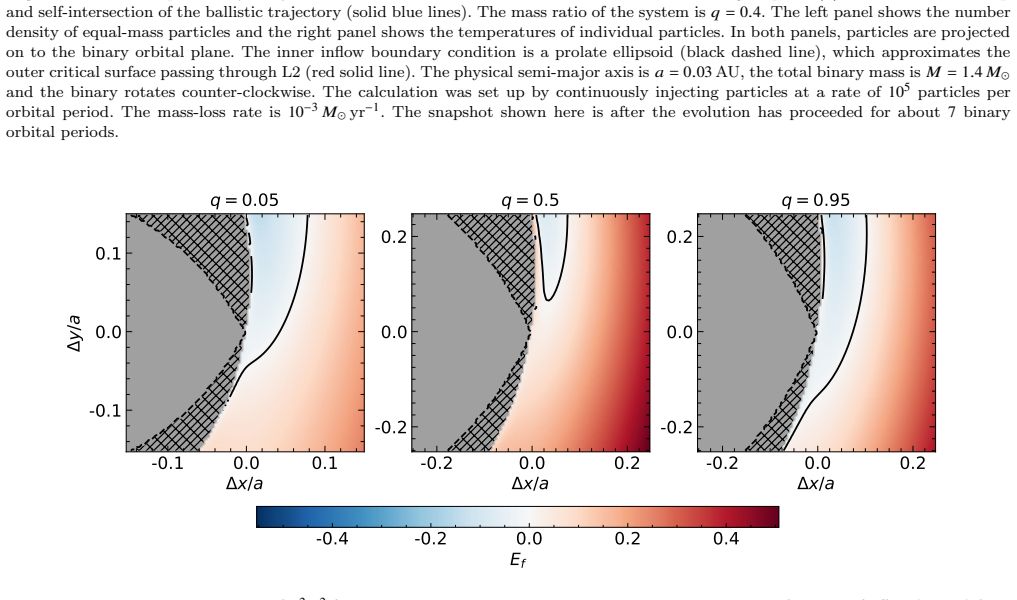
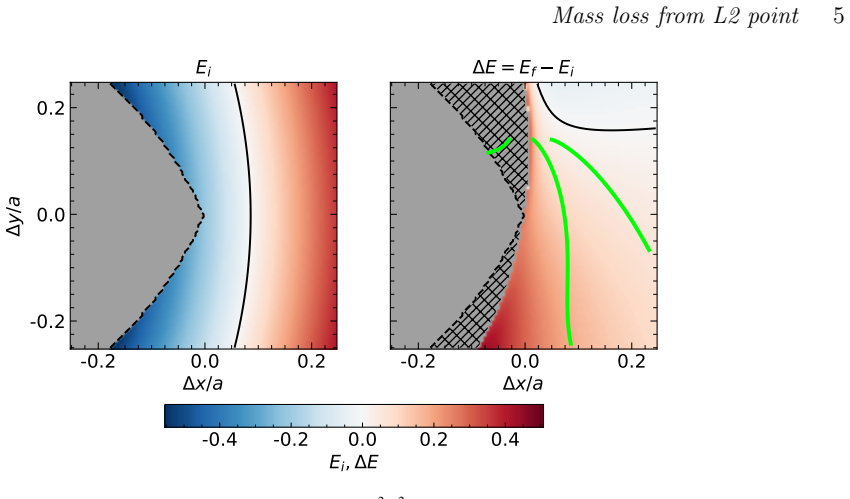
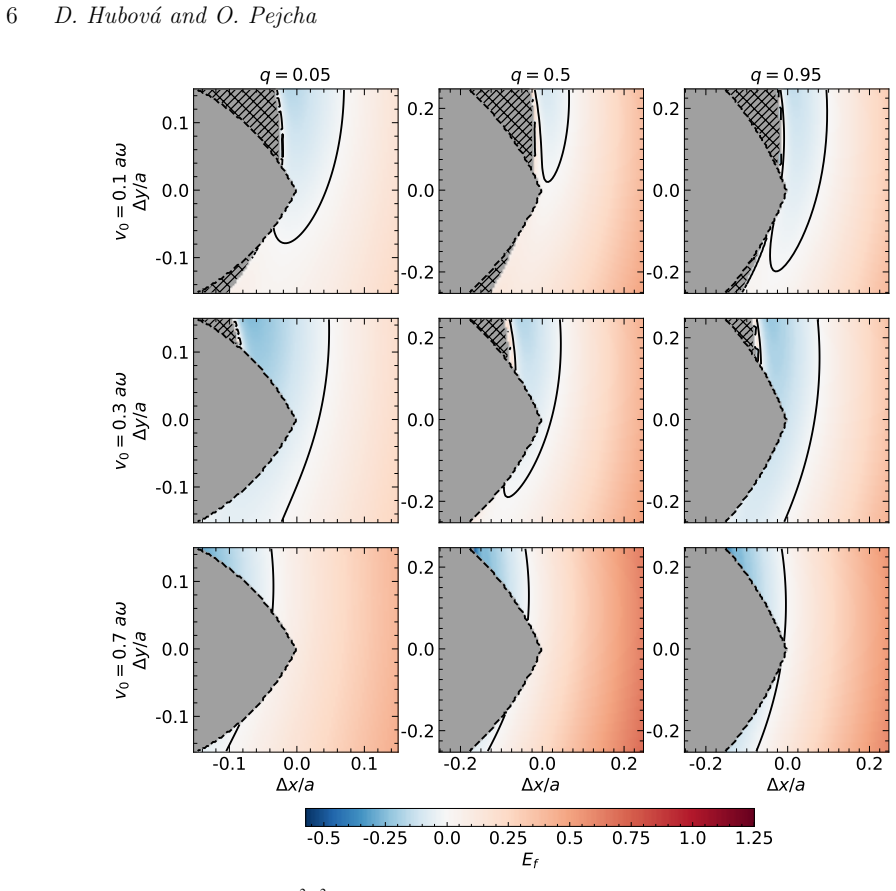
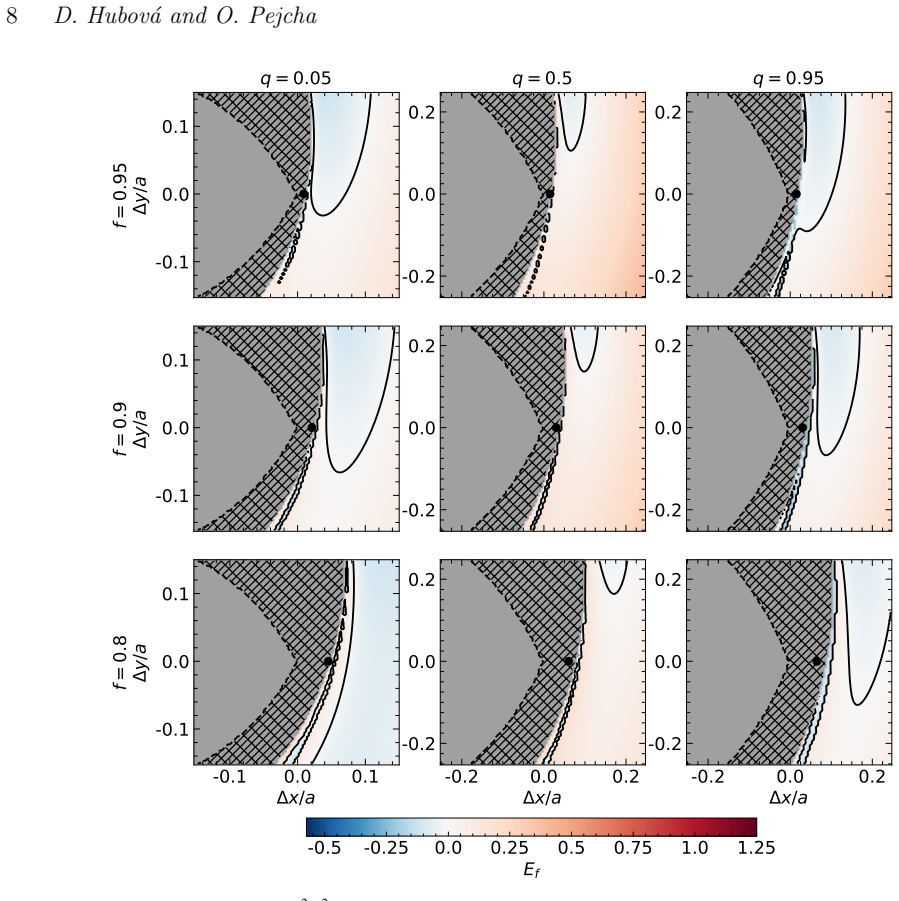
The central machinery is the restricted three-body ballistic trajectory integration in the frame corotating with the binary. The key quantity is the final specific energy $E_f$: positive means unbound outflow, negative means fallback into a decretion disk, with collisions and self-intersections detected geometrically. Initial conditions are parameterized by the offset ($\Delta x, \Delta y$) from L2, by the radial speed $v_0$, or by the angular-frequency ratio $f=\omega'/\omega$ relative to the binary; for $f\neq 1$ the paper recomputes the effective L2 position from Eq. (2) using the standard modified Lagrange point for non-corotating orbits. The energy gain $\Delta E$ is set by tidal torquing, whose sign and strength depend on where the particle sits relative to the binary, and the maps of $E_f$ are the paper's main output.
What would settle it
Compute the f<1 maps with the collision boundary replaced by the self-consistent equipotential through the shifted L2 point; if the positive-final-energy regions shrink or vanish, the sub-corotation escape claim fails as stated. Alternatively, run a hydrodynamic simulation starting a stream at f=0.95 with the specific offset that the ballistic calculation says escapes, and check whether the gas becomes unbound despite being slower than corotation.
Extended reading notes
Core claim
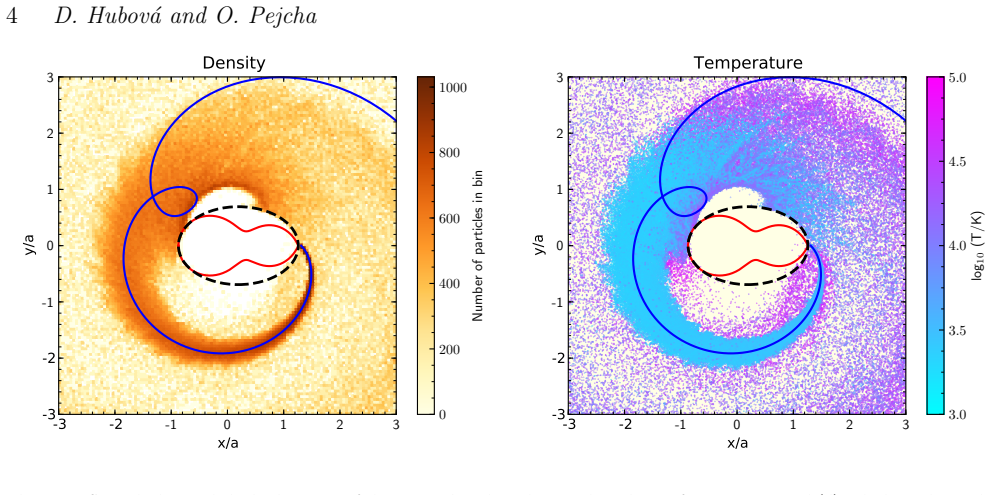
On the paper's own terms, the discovery is that the asymptotic outcome of ballistic L2 mass loss is a sensitive function of initial position and velocity. For a binary with mass ratio $q$, launching a particle exactly at L2 in corotation reproduces the classic $q$-dependent division between unbound streams and decretion disks, but any offset in position ($\Delta x, \Delta y$) or any deviation of the initial velocity from corotation opens up new outcomes, including collision with the star and self-intersecting trajectories. The most striking new finding is a thin arc of initial offsets toward the side the binary rotates into ($\Delta y > 0$) where tidal torquing is strong enough to give positive final energy even when the initial angular frequency is only $f=0.8$ of corotation. The paper further shows that the efficiency of tidal energy gain, $\Delta E$, varies sharply on scales comparable to the stellar size, which explains why small shifts in launch conditions flip the trajectory type; and it demonstrates with smoothed-particle hydrodynamics that the self-intersecting case produces a hot, shocked inner arc near the binary.
Load-bearing premise
The paper assumes that a particle collides with the star when it crosses the equipotential surface of the corotating binary, even for cases where the launch point is based on a slower rotation rate; if that surface is wrong for those cases, some trajectories counted as escaping would actually hit the star.
Editorial extensions
If this is right
- Small shifts in the launch point near L2 can switch a stream between colliding with the binary, forming a decretion disk, and escaping, so simulations of binary mass loss must treat initial conditions as a range rather than a single corotating point.
- Even streams launched slower than corotation (down to about $f=0.8$) can still become unbound for some offsets, so a sub-corotation launch velocity does not by itself imply fallback.
- The newly identified self-intersecting trajectories deposit low-angular-momentum, shock-heated gas close to the binary, which resembles decretion-disk formation but with hotter material nearer the stars.
- For the pre-merger binary V1309 Sco, the maps imply that decreasing $f$ toward merger raises the fraction of initial conditions that collide with the binary, naturally explaining the rising initial temperature of the L2 stream inferred from observations.
- The outcome maps provide a reference for interpreting hydrodynamic simulations: a simulated stream that remains bound may be reflecting its particular initial velocity rather than a universal rule for L2 mass loss.
Reading between the lines
- Because the outcome boundaries in the maps are only a few hundredths of the orbital separation wide, real stellar surface activity such as convection or magnetic spots could push a stream across a boundary on short timescales, making the observed outflow type effectively stochastic even at fixed binary parameters.
- The authors note self-intersections and possible deterministic chaos near other Lagrange points; a finite-width stream would therefore mix trajectory types, so real outflows may look like superpositions of the clean map categories rather than a single one.
- A concrete test: repeat the $f<1$ maps with the collision boundary replaced by the self-consistent modified equipotential; the authors themselves expect more collisions, so the true sub-corotation escape regions are probably smaller than plotted.
- Extending the ballistic model with gas pressure and radiative cooling would likely blur the sharp outcome boundaries, so hydrodynamic simulations at finite resolution may miss the thin escape arc even where it exists in the ballistic limit.
Signed reviews
Editorial analysis
A structured set of objections, weighed in public.
Referee Report
Summary. The paper studies ballistic mass loss from the vicinity of the second Lagrange point L2 in a circular binary, using the restricted three-body problem. For test particles launched with various position offsets and velocities relative to L2, the authors integrate the equations of motion and classify outcomes into unbound outflow (Ef > 0), fallback leading to a decretion disk (Ef < 0), collision with the binary, and self-intersecting/shocked trajectories. They map these outcomes as functions of initial offset, radial velocity, and initial angular frequency ratio f = ω′/ω. The central new claim, stated in the abstract, is that even for initial velocities slower than corotation (f < 1), a set of initial position offsets leads to unbound outflows. The paper also presents a smoothed particle hydrodynamics (SPH) illustration of a self-intersecting stream that produces a shock. The results are intended as a reference for interpreting hydrodynamic simulations and observations of L2 mass loss in merging binaries, common envelope evolution, and related transients.
Significance. If the results hold, this paper provides a useful and previously missing systematic map of ballistic outcomes near L2, going beyond the point-like, corotating injection assumption of earlier work (e.g., Shu et al. 1979). The demonstration that outcomes are sensitive to small offsets and velocity deviations is valuable for interpreting hydrodynamic simulations, as the authors connect to MacLeod et al. (2018b). A clear strength is the direct numerical integration of the standard restricted three-body equations with tight tolerances (10^-12), giving parameter-free outcome maps. The SPH shock illustration is a nice complement, though it is explicitly indicative rather than definitive. The main caveat is that the abstract's headline sub-corotation escape claim rests on the f < 1 runs in Fig. 7, whose inner collision boundary is not self-consistent with the modified potential; this needs to be resolved before the claim can be considered established.
major comments (2)
- [Section 3.3, Fig. 7] The f < 1 runs, which carry the abstract's claim that unbound outflow occurs for initial velocities slower than corotation, use the original f = 1 corotating equipotential as the inner collision boundary while Eq. (2) places the modified L2 point farther out for f < 1. The authors concede in Section 3.3 that 'taking into account the modified equipotential would increase the number of colliding trajectories.' This is a load-bearing inconsistency: trajectories currently classified as escaping (Ef > 0) may instead collide with the binary if the self-consistent f < 1 equipotential is used. Please re-run the f < 1 calculations with the modified equipotential as the inner boundary (or otherwise quantify how many of the Ef > 0 regions survive) before claiming that sub-corotation unbound outflow exists.
- [Section 2.1, Eq. (2)] Equation (2) as printed reads f x_L2 − μ/(x_L2 − 1 + μ)^2 − (1 − μ)/(x_L2 + μ)^2 = 0. For a particle on a circular orbit with angular frequency ω′ = fω, the radial force balance in units where ω = 1 should have the centrifugal term f^2 x, not f x, because the required centripetal acceleration is ω′^2 x. Consequently, the 'modified position of L2' marked in Fig. 7 is not the correct equilibrium point for the stated frequency ratio. Please correct Eq. (2), recompute the marked L2 positions, and check whether the interpretation of the f < 1 results is affected.
minor comments (4)
- [Section 3.1, footnote] The unresolved discrepancy with Shu et al. (1979) on the bound/unbound dividing line (q = 0.792 versus 0.78) deserves a brief discussion of possible causes, such as the stopping distance at 200a, the definition of final energy, or the inner boundary treatment.
- [Section 2.1, termination condition] The inner equipotential crossing is checked only every 0.25/ω time units; please comment on whether this temporal discretization could miss a fast collision and slightly alter the hatched collision regions in Figs. 3, 5, 6, and 7.
- [Introduction, first paragraph] The phrase 'a only a small perturbation' contains a grammatical error; it should be 'only a small perturbation.'
- [Section 4, MacLeod comparison] The reference to 'Fig. 5 of MacLeod et al. (2018b)' is vague; please specify what is shown there (e.g., the stream density or velocity field) so the reader can follow the comparison.
Circularity Check
No significant circularity: the outcome maps are produced by direct numerical integration of the standard restricted three-body equations, with no fitted parameters and no load-bearing self-citations.
full rationale
The central results are outcome maps obtained by integrating the standard circular restricted three-body equations with fixed point masses; the initial conditions (positional offset, radial velocity magnitude, and angular-frequency ratio f) are scanned as free parameters and are not derived from, or fitted to, the final energies or trajectory classifications. The paper explicitly compares with Shu et al. (1979) and reports a small discrepancy in the critical mass ratio, which indicates the calculation is an independent numerical experiment rather than a repackaging of prior results. The only author self-citations are contextual: the SPH code is used for an illustrative shock simulation, and the V1309 Sco discussion is an application, not an input to the ballistic maps. The manuscript's own admission that the f<1 runs still use the original corotating equipotential as the collision boundary is an internal-consistency limitation, not a circular reduction; it is flagged explicitly as likely increasing the number of colliding trajectories, and it does not define the reported final energies in terms of the conclusions. No self-definitional, fitted-input-called-prediction, self-citation-load-bearing, imported-uniqueness, or ansatz-smuggling pattern is present.
Assumptions & free parameters
free parameters (3)
- SPH inner boundary ellipsoid axes
- SPH injection rate and mass-loss rate =
10^5 particles per orbital period; 10^-3 Msun/yr
- Grid discretization of initial conditions
assumptions (4)
- domain assumption Restricted three-body problem with circular binary orbit and point mass stars; test particles do not affect the binary
- domain assumption Motion is confined to the binary orbital plane
- standard math Particle escape is defined by positive specific energy Ef > 0 in the inertial frame
- domain assumption Collision with the binary is defined by crossing the L2 equipotential (approximated by a polygon)
Cite this review
Pith. "Pith review of Kinematics of Mass Loss from the Outer Lagrange Point L2." pith.science (2026). https://pith.science/paper/OE3MMMCL
@misc{pith2026190802659,
  author       = {Pith},
  title        = {Pith review of: Kinematics of Mass Loss from the Outer Lagrange Point L2},
  year         = {2026},
  howpublished = {\url{https://pith.science/paper/OE3MMMCL}},
  note         = {Machine review of arXiv:1908.02659}
}
read the original abstract
We investigate kinematics of mass loss from the vicinity of the second Lagrange point L2 with applications to merging binary stars, common envelope evolution and the associated transient brightenings. For ballistic particle trajectories, we characterize initial velocities and positional offsets from L2 which lead to unbound outflow, fall back followed by a formation of a decretion disk, collision with the binary surface, or a hydrodynamic shock close to the binary, where some particle trajectories loop and self-intersect. The latter two final states occur only when the trajectories are initiated with offset from L2 or with velocity vector different from corotation with the binary. We find that competition between the time-dependent and steeply radially decreasing tidal torques from the binary, Coriolis force and initial conditions lead to a non-trivial distribution of outcomes in the vicinity of L2. Specifically, even for initial velocities slower than corotation, we find that a set of initial position offsets lead to unbound outflows. Our results will aid in the interpretation of the morphology of mass loss streams in hydrodynamic simulations.
Figures

Figures from the paper (4 more)

Reference graph
Works this paper leans on
-
[1]
write newline
" write newline "" before.all 'output.state := FUNCTION fin.entry write newline FUNCTION new.block output.state before.all = 'skip after.block 'output.state := if FUNCTION new.sentence output.state after.block = 'skip output.state before.all = 'skip after.sentence 'output.state := if if FUNCTION not #0 #1 if FUNCTION and 'skip pop #0 if FUNCTION or pop #1...
-
[2]
Andrews J. E., Smith N., 2018, @doi [ ] 10.1093/mnras/sty584 , http://adsabs.harvard.edu/abs/2018MNRAS.477...74A 477, 74
-
[3]
H., 1996, @doi [ ] 10.1086/310200 , http://adsabs.harvard.edu/abs/1996ApJ...467L..77A 467, L77
Artymowicz P., Lubow S. H., 1996, @doi [ ] 10.1086/310200 , http://adsabs.harvard.edu/abs/1996ApJ...467L..77A 467, L77
doi:10.1086/310200 1996
-
[4]
Balsara D. S., 1995, @doi [Journal of Computational Physics] 10.1016/S0021-9991(95)90221-X , http://adsabs.harvard.edu/abs/1995JCoPh.121..357B 121, 357
-
[5]
Fabrika S. N., 1993, @doi [ ] 10.1093/mnras/261.2.241 , http://adsabs.harvard.edu/abs/1993MNRAS.261..241F 261, 241
-
[6]
Flannery B. P., Ulrich R. K., 1977, @doi [ ] 10.1086/155072 , http://adsabs.harvard.edu/abs/1977ApJ...212..533F 212, 533
doi:10.1086/155072 1977
-
[7]
P., 1941, @doi [ ] 10.1086/144252 , http://adsabs.harvard.edu/abs/1941ApJ....93..133K 93, 133
Kuiper G. P., 1941, @doi [ ] 10.1086/144252 , http://adsabs.harvard.edu/abs/1941ApJ....93..133K 93, 133
doi:10.1086/144252 1941
-
[8]
Li K.-L., et al., 2017, @doi [Nature Astronomy] 10.1038/s41550-017-0222-1 , http://adsabs.harvard.edu/abs/2017NatAs...1..697L 1, 697
Show all 27 references
-
[9]
Linial I., Sari R., 2017, @doi [ ] 10.1093/mnras/stx1041 , http://adsabs.harvard.edu/abs/2017MNRAS.469.2441L 469, 2441
2017 doi
-
[10]
Livio M., Salzman J., Shaviv G., 1979, @doi [ ] 10.1093/mnras/188.1.1 , http://adsabs.harvard.edu/abs/1979MNRAS.188....1L 188, 1
1979 doi
-
[11]
C., Stone J
MacLeod M., Ostriker E. C., Stone J. M., 2018a, @doi [ ] 10.3847/1538-4357/aacf08 , http://adsabs.harvard.edu/abs/2018ApJ...863....5M 863, 5
-
[12]
C., Stone J
MacLeod M., Ostriker E. C., Stone J. M., 2018b, @doi [ ] 10.3847/1538-4357/aae9eb , http://adsabs.harvard.edu/abs/2018ApJ...868..136M 868, 136
-
[13]
Meyer F., Meyer-Hofmeister E., 1979, , http://adsabs.harvard.edu/abs/1979A
1979
-
[14]
J., Gingold R
Monaghan J. J., Gingold R. A., 1983, @doi [Journal of Computational Physics] 10.1016/0021-9991(83)90036-0 , http://adsabs.harvard.edu/abs/1983JCoPh..52..374M 52, 374
1983 doi
-
[15]
J., Lai D., 2016, @doi [ ] 10.3847/0004-637X/827/1/43 , http://adsabs.harvard.edu/abs/2016ApJ...827...43M 827, 43
Mu \ n oz D. J., Lai D., 2016, @doi [ ] 10.3847/0004-637X/827/1/43 , http://adsabs.harvard.edu/abs/2016ApJ...827...43M 827, 43
2016 doi
-
[16]
73, Structure and Evolution of Close Binary Systems
Paczynski B., 1976, in Eggleton P., Mitton S., Whelan J., eds, IAU Symposium Vol. 73, Structure and Evolution of Close Binary Systems. p. 75
1976
-
[17]
Pejcha O., 2014, @doi [ ] 10.1088/0004-637X/788/1/22 , http://adsabs.harvard.edu/abs/2014ApJ...788...22P 788, 22
2014 doi
-
[18]
D., Tomida K., 2016a, @doi [ ] 10.1093/mnras/stv2592 , http://adsabs.harvard.edu/abs/2016MNRAS.455.4351P 455, 4351
Pejcha O., Metzger B. D., Tomida K., 2016a, @doi [ ] 10.1093/mnras/stv2592 , http://adsabs.harvard.edu/abs/2016MNRAS.455.4351P 455, 4351
-
[19]
D., Tomida K., 2016b, @doi [ ] 10.1093/mnras/stw1481 , http://adsabs.harvard.edu/abs/2016MNRAS.461.2527P 461, 2527
Pejcha O., Metzger B. D., Tomida K., 2016b, @doi [ ] 10.1093/mnras/stw1481 , http://adsabs.harvard.edu/abs/2016MNRAS.461.2527P 461, 2527
-
[20]
D., Tyles J
Pejcha O., Metzger B. D., Tyles J. G., Tomida K., 2017, @doi [ ] 10.3847/1538-4357/aa95b9 , http://adsabs.harvard.edu/abs/2017ApJ...850...59P 850, 59
2017 doi
-
[21]
F., Willems B., Kalogera V., 2007, @doi [ ] 10.1086/513736 , http://adsabs.harvard.edu/abs/2007ApJ...660.1624S 660, 1624
Sepinsky J. F., Willems B., Kalogera V., 2007, @doi [ ] 10.1086/513736 , http://adsabs.harvard.edu/abs/2007ApJ...660.1624S 660, 1624
2007 doi
-
[22]
H., Lubow S
Shu F. H., Lubow S. H., Anderson L., 1979, @doi [ ] 10.1086/156948 , http://adsabs.harvard.edu/abs/1979ApJ...229..223S 229, 223
1979 doi
-
[23]
Smith N., et al., 2018, @doi [ ] 10.1093/mnras/sty1500 , http://adsabs.harvard.edu/abs/2018MNRAS.480.1466S 480, 1466
2018 doi
-
[24]
N., Saigo K., 2013, @doi [ ] 10.1088/0004-637X/763/1/6 , http://adsabs.harvard.edu/abs/2013ApJ...763....6T 763, 6
Tomida K., Tomisaka K., Matsumoto T., Hori Y., Okuzumi S., Machida M. N., Saigo K., 2013, @doi [ ] 10.1088/0004-637X/763/1/6 , http://adsabs.harvard.edu/abs/2013ApJ...763....6T 763, 6
2013 doi
-
[25]
Tylenda R., et al., 2011, @doi [ ] 10.1051/0004-6361/201016221 , http://adsabs.harvard.edu/abs/2011A
2011 doi
-
[26]
F., 1976, @doi [ ] 10.1086/154781 , http://adsabs.harvard.edu/abs/1976ApJ...209..829W 209, 829
Webbink R. F., 1976, @doi [ ] 10.1086/154781 , http://adsabs.harvard.edu/abs/1976ApJ...209..829W 209, 829
1976 doi
-
[27]
F., 1977, @doi [ ] 10.1086/154998 , http://adsabs.harvard.edu/abs/1977ApJ...211..881W 211, 881
Webbink R. F., 1977, @doi [ ] 10.1086/154998 , http://adsabs.harvard.edu/abs/1977ApJ...211..881W 211, 881
1977 doi
Reviewed August 14, 2026 · model on record in the stance chip above.
Discussion (0). Continue with ORCID to comment.