REVIEW 1 major objections 4 minor 1 cited by
Search for dark photons in decays of Higgs bosons produced in association with Z bosons in proton-proton collisions at $\sqrt{s} =$ 13 TeV
T0 review · 1 major / 4 minor · reviewed 2026-08-14 · deepseek-v4-flash
Pith's one-line read No Higgs-to-dark-photon decays found; rate capped at 4.6 percent
desk verdict First dedicated H→invisible+massless dark photon limit from CMS, clean and standard; the single WZ normalization for two subcomponents is the one question I'd push. read the letter →
The pith
A machine-rendered reading of the paper's core claim, the machinery that carries it, and where it could break.
The reading
What carries the argument
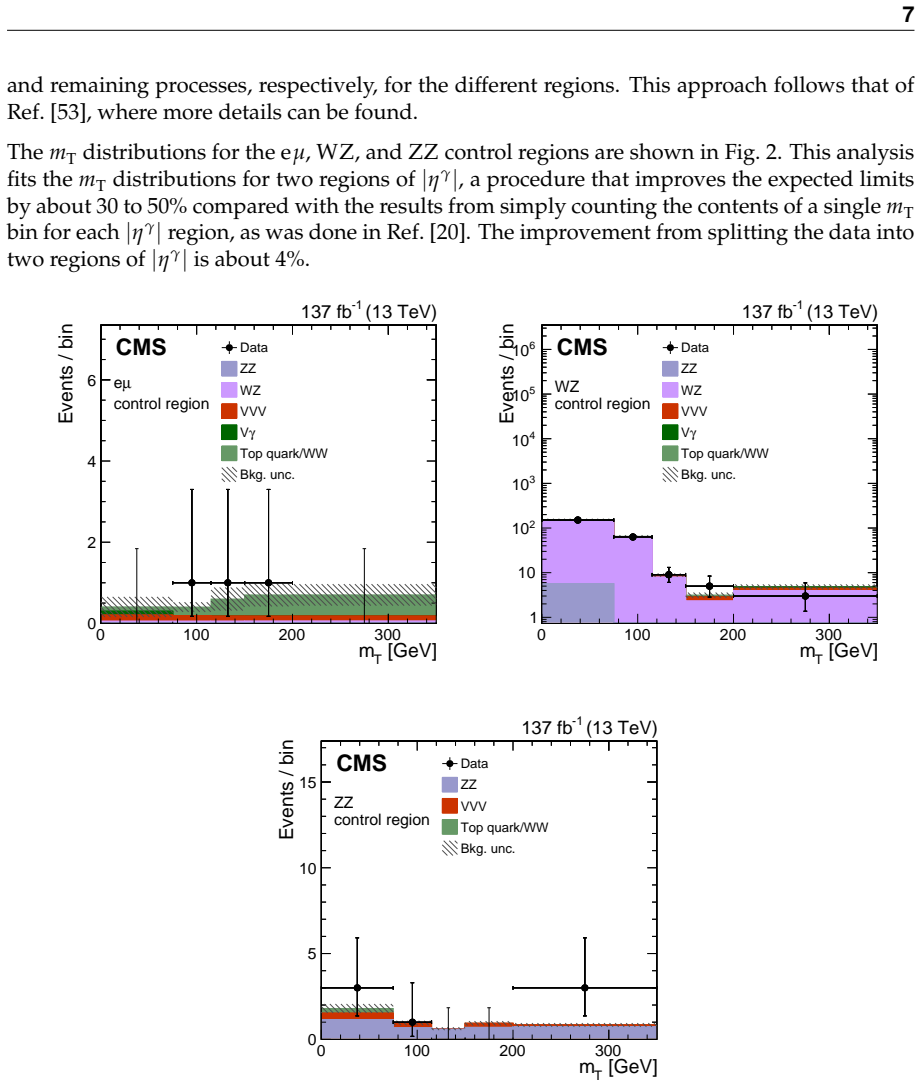
The discriminating variable is the transverse mass $m_T=\sqrt{2 p_T^{\text{miss}} p_T^{\gamma}[1-\cos\Delta\phi(\vec p_T^{\text{miss}},\vec p_T^{\gamma})]}$ of the missing-transverse-momentum and photon system. Signal events from $H\to\gamma+\text{invisible}$ populate a Jacobian peak with an endpoint near $m_T\sim m_H$, while the dominant WZ, ZZ, and nonresonant backgrounds are flat or rise toward low $m_T$. The extraction is a binned maximum-likelihood fit to the $m_T$ distribution, split into low-$|\eta_\gamma|$ and high-$|\eta_\gamma|$ regions, with three data control regions (same-flavor lepton pairs, trilepton WZ, and four-lepton ZZ) fixing the background normalizations; a modified frequentist CLs procedure produces the limits.
What would settle it
Recompute the 95% confidence-level limit twice, once with the WZ background $m_T$ shape taken directly from the trilepton control-region data and once from simulation; if the two limits differ by more than the quoted systematic uncertainty, the background-shape assumption breaks. Alternatively, a dedicated data sample of WZ events with a fully identified third lepton, selected with the same missing-transverse-momentum and photon requirements as the signal region, would reveal any $m_T$ shape mismatch between data and simulation in the relevant phase space.
Extended reading notes
Core claim
The analysis targets the process $pp\to Z(\ell\ell)H$ with $H\to\gamma\gamma_D$, where $\gamma_D$ is a massless dark photon that escapes detection, leaving a final state of a same-flavor lepton pair, one isolated photon, and large missing transverse momentum. After event selection, 14 events are observed against 13.3 $\pm$ 3.8 expected background events, and a binned maximum-likelihood fit to the transverse-mass spectrum of the photon plus missing momentum finds no significant signal. At $m_H=125$ GeV, assuming the standard model ZH production cross section, the observed (expected) 95% confidence-level upper limit on the branching fraction $\mathcal{B}(H\to\text{invisible}+\gamma)$ is 4.6 (3.6)%. The same fit excludes the product $\sigma_{ZH}\times\mathcal{B}(H\to\text{invisible}+\gamma)$ from about 40 fb at 125 GeV to about 4 fb at 300 GeV, and the paper states these are the first limits on Higgs boson decays to final states that include an undetected massless dark photon.
Load-bearing premise
The limit assumes the simulated shapes of the $m_T$ distributions for the WZ and ZZ backgrounds are correct in the signal region, because the analysis normalizes those simulations in control regions containing only a handful of events and then relies on the same shapes to model the signal region.
Editorial extensions
If this is right
- Any 125 GeV Higgs-like scalar with a branching fraction above 4.6% to a photon plus an invisible massless particle is excluded, independent of the specific dark-photon model details.
- The exclusion extends to heavy neutral Higgs bosons, ruling out $\sigma_{ZH}\times\mathcal{B}(H\to\text{invisible}+\gamma)$ from about 40 fb at 125 GeV down to about 4 fb at 300 GeV.
- Fitting the $m_T$ shape rather than counting events improves the expected sensitivity by 30–50%, showing that shape-based extraction is the effective route in this final state.
- The irreducible standard model background from $H\to Z\gamma\to\nu\nu\gamma$ is below 0.1 events, so the search is limited by instrumental and reducible backgrounds, not by the standard model Higgs itself.
Reading between the lines
- I infer that the same analysis, applied to the full High-Luminosity LHC data set of roughly 3000 fb$^{-1}$, would push the branching-fraction limit below 1%, directly testing the ~5% benchmark that motivates the search.
- The result can likely be reinterpreted for a massive dark photon: a nonzero $\gamma_D$ mass would shift the $m_T$ endpoint below $m_H$, so the existing limit curve could be recast as a constraint on the dark photon mass within the model.
- The same-flavor control region used for nonresonant backgrounds contains only 3 events, so that background shape is validated on very sparse data; a future measurement with higher statistics in that region would be the most direct check on the quoted limit.
- Combining this ZH-associated search with gluon-fusion production, as the earlier 8 TeV analysis did, could roughly double the signal acceptance and tighten the limit further.
Editorial analysis
A structured set of objections, weighed in public.
Referee Report
Summary. The paper reports a search by the CMS Collaboration for a Higgs boson produced in association with a Z boson and decaying to an undetected particle together with an isolated photon, focusing on the massless dark photon interpretation. The analysis uses the full 13 TeV data set of 137 fb^-1 and selects events with a Z->ll candidate, a high-pT photon, large missing transverse momentum, and low jet activity. A binned maximum-likelihood fit is performed on the transverse mass mT spectrum in the signal region together with three dedicated control regions (e-mu for nonresonant backgrounds, three-lepton for WZ, and four-lepton for ZZ), with separate bins in photon pseudorapidity. Background normalizations for the dominant WZ and ZZ processes are fitted to data, nonresonant backgrounds are estimated from an e-mu control region, and a set of experimental and theoretical systematic uncertainties is included. No significant excess over the standard model background is found: 14 events are observed against a total background estimate of 13.3 +/- 3.8. Upper limits at 95% CL are set on sigma_ZH times B(H->invisible+gamma) as a function of mH, and for mH=125 GeV, assuming the SM ZH production cross section, the observed (expected) limit on the branching fraction is 4.6% (3.6%).
Significance. If the result holds, this is the first experimental limit on a Higgs boson decay to a massless dark photon plus invisible particles in the ZH production channel. The analysis follows a well-established profile-likelihood strategy, uses data-driven control regions for the dominant backgrounds, and documents the systematic uncertainties. The result is of direct interest to dark-sector and BSM Higgs searches, and it provides a template for future searches of this signature. The paper is clearly written and the statistical methodology is sound. The main caveat is the validation of a subdominant WZ background component, discussed in the major comments.
major comments (1)
- [Section 5.2, Eq. (1)] The WZ background in the signal region contains two components: (a) events in which the electron from the W boson decay is misidentified as a photon, and (b) events in which the W lepton is not identified and a genuine hard photon is radiated. In the likelihood of Eq. (1), a single normalization parameter muWZ multiplies both components, and the three-lepton control region directly constrains only component (a), because it requires the W-decay lepton to be identified and used as the photon proxy. Component (b) is thus constrained only through its simulated ratio to component (a), and its mT shape is not validated by any data control region. Since WZ is the dominant background (8.1 +/- 2.0 out of a total of 13.3 +/- 3.8) and the observed limit corresponds to roughly eight signal events, an O(1) event shift in this background would change the mH=125 GeV limit by about 0.5 percentage points. The authors should report the relative contribution of component (b) and either validate it with a dedicated control region or assign an explicit systematic uncertainty to the ratio of the two components.
minor comments (4)
- [Section 6, Section 8] Signal samples are generated only at mH = 125, 200, and 300 GeV, while limits are shown as a continuous function of mH between 125 and 300 GeV. The paper should state how the signal acceptance and mT shapes are interpolated between the generated masses.
- [Section 7] The systematic uncertainties are described in the text, but a summary table listing each nuisance parameter, its prior, and its typical impact on the signal and background yields would improve the reproducibility and readability of the analysis.
- [Section 5.2] The sentence describing the electron-to-photon misidentification rate would be clearer if it specified whether the quoted 1-5% range is per-candidate and how it is applied as a function of |eta_gamma| and pT.
- [Table 2 and Figure 3] The signal predictions in Table 2 are quoted for a signal size of 0.1 sigma_ZH; for clarity, the corresponding branching fraction assumed for the signal should be stated explicitly in the table caption or text.
Circularity Check
No circularity: the analysis measures a signal strength as a free parameter in a likelihood fit against data, with backgrounds constrained by independent control regions and theory inputs from external references.
full rationale
The paper is a direct experimental search. The central result, the upper limit on the product of ZH production cross section and B(H -> invisible + gamma), is obtained from a binned maximum-likelihood fit in which the signal strength mu is a free parameter (Eq. 1) and no target quantity is defined in terms of a fitted parameter. The background normalizations (mu_Nonres, mu_WZ, mu_ZZ) are constrained by dedicated data control regions (e-mu, WZ three-lepton, ZZ four-lepton), and the signal shape and acceptance are taken from simulated ZH events normalized to external theory cross sections (Refs. [28, 29]). The dark-photon interpretation is imported from independent theoretical papers, not derived from the data or from self-citations by the experimental collaboration. The skeptical concern about the WZ background shape being validated only sparsely, while legitimate as a modeling risk, is not a circularity: it concerns the accuracy of an external simulation input, not a reduction of the conclusion to its own assumptions. No step in the derivation chain equates an output with an input by construction, and no self-citation is load-bearing for the main limit. The result is therefore self-contained as an experimental measurement, with no significant circularity.
Assumptions & free parameters
free parameters (3)
- mu_Nonres
- mu_WZ
- mu_ZZ
assumptions (4)
- domain assumption GEANT4 simulation accurately reproduces the CMS detector response to the final states considered.
- domain assumption POWHEG, MadGraph, and PYTHIA describe the signal and background kinematics accurately.
- domain assumption The electron-to-photon misidentification rate, measured in Z to ee data, is valid for the signal region.
- domain assumption The integrated luminosity measurements are correct to within the quoted uncertainties.
Cite this review
Pith. "Pith review of Search for dark photons in decays of Higgs bosons produced in association with Z bosons in proton-proton collisions at $\sqrt{s} =$ 13 TeV." pith.science (2026). https://pith.science/paper/7YQY4JXX
@misc{pith2026190802699,
  author       = {Pith},
  title        = {Pith review of: Search for dark photons in decays of Higgs bosons produced in association with Z bosons in proton-proton collisions at $\sqrts =$ 13 TeV},
  year         = {2026},
  howpublished = {\url{https://pith.science/paper/7YQY4JXX}},
  note         = {Machine review of arXiv:1908.02699}
}
abstract
A search is presented for a Higgs boson that is produced in association with a Z boson and that decays to an undetected particle together with an isolated photon. The search is performed by the CMS Collaboration at the Large Hadron Collider using a data set corresponding to an integrated luminosity of 137 fb$^{-1}$ recorded at a center-of-mass energy of 13 TeV. No significant excess of events above the expectation from the standard model background is found. The results are interpreted in the context of a theoretical model in which the undetected particle is a massless dark photon. An upper limit is set on the product of the cross section for associated Higgs and Z boson production and the branching fraction for such a Higgs boson decay, as a function of the Higgs boson mass. For a mass of 125 GeV, assuming the standard model production cross section, this corresponds to an observed (expected) upper limit on this branching fraction of 4.6 (3.6)% at 95% confidence level. These are the first limits on Higgs boson decays to final states that include an undetected massless dark photon.
Figures


Figures from the paper (1 more)

Forward citations
Cited by 1 Pith paper
-
Search for light long-lived neutral particles produced in $pp$ collisions at $\sqrt{s} =$ 13 TeV and decaying into collimated leptons or light hadrons with the ATLAS detector
No evidence for displaced dark-photon jets is found, and 95% confidence limits exclude cross sections above about 4 pb for H to two dark photons with decay lengths from 1.5 mm to 307 mm.
Reference graph
Works this paper leans on
-
[1]
ATLAS Collaboration, “Observation of a new particle in the search for the standard 12 model Higgs boson with the ATLAS detector at the LHC”, Phys. Lett. B 716 (2012) 1, doi:10.1016/j.physletb.2012.08.020, arXiv:1207.7214
arXiv 2012
-
[2]
Observation of a new boson at a mass of 125 GeV with the CMS experiment at the LHC
CMS Collaboration, “Observation of a new boson at a mass of 125 GeV with the CMS experiment at the LHC”, Phys. Lett. B 716 (2012) 30, doi:10.1016/j.physletb.2012.08.021, arXiv:1207.7235
arXiv 2012
-
[3]
Observation of a new boson with mass near 125 GeV in pp collisions at√s = 7 and 8 TeV
CMS Collaboration, “Observation of a new boson with mass near 125 GeV in pp collisions at√s = 7 and 8 TeV”, JHEP 06 (2013) 081, doi:10.1007/JHEP06(2013)081, arXiv:1303.4571
arXiv 2013
-
[4]
Looking for an Invisible Higgs Signal at the LHC
D. Ghosh et al., “Looking for an invisible Higgs signal at the LHC”, Phys. Lett. B 725 (2013) 344, doi:10.1016/j.physletb.2013.07.042, arXiv:1211.7015
work page Pith review arXiv 2013
-
[5]
Motivation and detectability of an invisibly-decaying Higgs boson at the Fermilab Tevatron
S. P . Martin and J. D. Wells, “Motivation and detectability of an invisibly decaying Higgs boson at the Fermilab Tevatron”, Phys. Rev. D 60 (1999) 035006, doi:10.1103/PhysRevD.60.035006, arXiv:hep-ph/9903259
work page Pith review arXiv 1999
-
[6]
Measuring the Invisible Higgs Width at the 7 and 8 TeV LHC
Y. Bai, P . Draper, and J. Shelton, “Measuring the invisible Higgs width at the 7 and 8 TeV LHC”, JHEP 07 (2012) 192, doi:10.1007/JHEP07(2012)192, arXiv:1112.4496
work page Pith review arXiv 2012
-
[7]
Exotic decays of the 125 GeV Higgs boson
D. Curtin et. al., “Exotic decays of the 125 GeV Higgs boson”, Phys. Rev. D 90 (2014) 075004, doi:10.1103/PhysRevD.90.075004, arXiv:1312.4992
arXiv 2014
-
[8]
ATLAS and CMS Collaborations, “Combined measurement of the Higgs boson mass in pp collisions at√s = 7 and 8 TeV with the ATLAS and CMS experiments”, Phys. Rev. Lett. 114 (2015) 191803, doi:10.1103/PhysRevLett.114.191803, arXiv:1503.07589
arXiv 2015
Show all 64 references
-
[9]
Measurements of properties of the Higgs boson decaying into the four-lepton final state in pp collisions at√s = 13 TeV
CMS Collaboration, “Measurements of properties of the Higgs boson decaying into the four-lepton final state in pp collisions at√s = 13 TeV”, JHEP 11 (2017) 047, doi:10.1007/JHEP11(2017)047, arXiv:1706.09936
2017 arXiv
-
[10]
Measurements of the Higgs boson production and decay rates and constraints on its couplings from a combined ATLAS and CMS analysis of the LHC pp collision data at√s = 7 and 8 TeV
ATLAS and CMS Collaborations, “Measurements of the Higgs boson production and decay rates and constraints on its couplings from a combined ATLAS and CMS analysis of the LHC pp collision data at√s = 7 and 8 TeV”, JHEP 08 (2016) 045, doi:10.1007/JHEP08(2016)045, arXiv:1606.02266
2016 arXiv
-
[11]
Combined measurements of Higgs boson couplings in proton-proton collisions at√s = 13 TeV
CMS Collaboration, “Combined measurements of Higgs boson couplings in proton-proton collisions at√s = 13 TeV”, Eur. Phys. J. C 79 (2019) 421, doi:10.1140/epjc/s10052-019-6909-y , arXiv:1809.10733
2019 arXiv
-
[12]
Higgs boson decays into light gravitinos
A. Djouadi and M. Drees, “Higgs boson decays into light gravitinos”, Phys. Lett. B 407 (1997) 243, doi:10.1016/S0370-2693(97)00670-9, arXiv:hep-ph/9703452
1997 arXiv
-
[13]
Higgs decay with monophoton +⁄ET signature from low scale supersymmetry breaking
C. Petersson, A. Romagnoni, and R. Torre, “Higgs decay with monophoton +⁄ET signature from low scale supersymmetry breaking”, JHEP 10 (2012) 016, doi:10.1007/JHEP10(2012)016, arXiv:1203.4563
2012 arXiv
-
[14]
Exponentially spread dynamical Yukawa couplings from nonperturbative chiral symmetry breaking in the dark sector
E. Gabrielli and M. Raidal, “Exponentially spread dynamical Yukawa couplings from nonperturbative chiral symmetry breaking in the dark sector”, Phys. Rev. D 89 (2014) 015008, doi:10.1103/PhysRevD.89.015008, arXiv:1310.1090. References 13
2014 arXiv
-
[15]
Dark photons and resonant monophoton signatures in Higgs boson decays at the LHC
E. Gabrielli, M. Heikinheimo, B. Mele, and M. Raidal, “Dark photons and resonant monophoton signatures in Higgs boson decays at the LHC”, Phys. Rev. D 90 (2014) 055032, doi:10.1103/PhysRevD.90.055032, arXiv:1405.5196
2014 arXiv
-
[16]
Dark-photon searches via Higgs-boson production at the LHC
S. Biswas, E. Gabrielli, M. Heikinheimo, and B. Mele, “Dark-photon searches via Higgs-boson production at the LHC”, Phys. Rev. D 93 (2016) 093011, doi:10.1103/PhysRevD.93.093011, arXiv:1603.01377
2016 arXiv
-
[17]
Searching for massless dark-photons at the LHC via Higgs boson production
S. Biswas, E. Gabrielli, M. Heikinheimo, and B. Mele, “Searching for massless dark-photons at the LHC via Higgs boson production”, in Proceedings, 2017 European Physical Society Conference on High Energy Physics (EPS-HEP 2017): Venice, Italy, July 5-12, 2017, volume EPS-HEP201...
2017 doi
-
[18]
Search for the decay of a Higgs boson in the 𝓁𝓁γ channel in proton-proton collisions at√s = 13 TeV
CMS Collaboration, “Search for the decay of a Higgs boson in the 𝓁𝓁γ channel in proton-proton collisions at√s = 13 TeV”, JHEP 11 (2018) 152, doi:10.1007/JHEP11(2018)152, arXiv:1806.05996
2018 arXiv
-
[19]
Searches for the Zγ decay mode of the Higgs boson and for new high-mass resonances in pp collisions at√s = 13 TeV with the ATLAS detector
ATLAS Collaboration, “Searches for the Zγ decay mode of the Higgs boson and for new high-mass resonances in pp collisions at√s = 13 TeV with the ATLAS detector”, JHEP 10 (2017) 112, doi:10.1007/JHEP10(2017)112, arXiv:1708.00212
2017 arXiv
-
[20]
Search for exotic decays of a Higgs boson into undetectable particles and one or more photons
CMS Collaboration, “Search for exotic decays of a Higgs boson into undetectable particles and one or more photons”, Phys. Lett. B 753 (2016) 363, doi:10.1016/j.physletb.2015.12.017, arXiv:1507.00359
2016 arXiv
-
[21]
The CMS Experiment at the CERN LHC
CMS Collaboration, “The CMS Experiment at the CERN LHC”, JINST 3 (2008) S08004, doi:10.1088/1748-0221/3/08/S08004
2008 doi
-
[22]
The CMS trigger system
CMS Collaboration, “The CMS trigger system”, JINST 12 (2017) P01020, doi:10.1088/1748-0221/12/01/P01020, arXiv:1609.02366
2017 arXiv
-
[23]
Matching NLO QCD computations and parton shower simulations
S. Frixione and B. R. Webber, “Matching NLO QCD computations and parton shower simulations”, JHEP 06 (2002) 029, doi:10.1088/1126-6708/2002/06/029, arXiv:hep-ph/0204244
2002 arXiv
-
[24]
A new method for combining NLO QCD with shower Monte Carlo algorithms
P . Nason, “A new method for combining NLO QCD with shower Monte Carlo algorithms”, JHEP 11 (2004) 040, doi:10.1088/1126-6708/2004/11/040, arXiv:hep-ph/0409146
2004 arXiv
-
[25]
Matching NLO QCD computations with parton shower simulations: the POWHEG method
S. Frixione, P . Nason, and C. Oleari, “Matching NLO QCD computations with parton shower simulations: the POWHEG method”, JHEP 11 (2007) 070, doi:10.1088/1126-6708/2007/11/070, arXiv:0709.2092
2007 arXiv
-
[26]
NLO vector-boson production matched with shower in POWHEG
S. Alioli, P . Nason, C. Oleari, and E. Re, “NLO vector-boson production matched with shower in POWHEG”, JHEP 07 (2008) 060, doi:10.1088/1126-6708/2008/07/060, arXiv:0805.4802
2008 arXiv
-
[27]
A general framework for implementing NLO calculations in shower Monte Carlo programs: the POWHEG BOX
S. Alioli, P . Nason, C. Oleari, and E. Re, “A general framework for implementing NLO calculations in shower Monte Carlo programs: the POWHEG BOX”, JHEP 06 (2010) 043, doi:10.1007/JHEP06(2010)043, arXiv:1002.2581
2010 arXiv
-
[28]
Handbook of LHC Higgs cross sections: 3. Higgs properties
S. Heinemeyer et al., “Handbook of LHC Higgs cross sections: 3. Higgs properties”, CERN Report CERN-2013-004, 2013. doi:10.5170/CERN-2013-004, arXiv:1307.1347. 14
2013 arXiv
-
[29]
Handbook of LHC Higgs cross sections: 4. Deciphering the nature of the Higgs sector
D. de Florian et al., “Handbook of LHC Higgs cross sections: 4. Deciphering the nature of the Higgs sector”, CERN Report CERN-2017-002-M, 2016. doi:10.23731/CYRM-2017-002, arXiv:1610.07922
2017 arXiv
-
[30]
The automated computation of tree-level and next-to-leading order differential cross sections, and their matching to parton shower simulations
J. Alwall et al., “The automated computation of tree-level and next-to-leading order differential cross sections, and their matching to parton shower simulations”, JHEP 07 (2014) 079, doi:10.1007/JHEP07(2014)079, arXiv:1405.0301
2014 arXiv
-
[31]
MadGraph 5: going beyond
J. Alwall et al., “MadGraph 5: going beyond”, JHEP 06 (2011) 128, doi:10.1007/JHEP06(2011)128, arXiv:1106.0522
2011 arXiv
-
[32]
Merging meets matching in MC@NLO
R. Frederix and S. Frixione, “Merging meets matching in MC@NLO”, JHEP 12 (2012) 061, doi:10.1007/JHEP12(2012)061, arXiv:1209.6215
2012 arXiv
-
[33]
Parton distributions for the LHC Run II
NNPDF Collaboration, “Parton distributions for the LHC Run II”, JHEP 04 (2015) 040, doi:10.1007/JHEP04(2015)040, arXiv:1410.8849
2015 arXiv
-
[34]
Parton distributions from high-precision collider data
NNPDF Collaboration, “Parton distributions from high-precision collider data”, Eur. Phys. J. C 77 (2017) 663, doi:10.1140/epjc/s10052-017-5199-5 , arXiv:1706.00428
2017 arXiv
-
[35]
A brief introduction to PYTHIA 8.1
T. Sj ¨ostrand, S. Mrenna, and P . Z. Skands, “A brief introduction to PYTHIA 8.1”,Comput. Phys. Commun. 178 (2008) 852, doi:10.1016/j.cpc.2008.01.036, arXiv:0710.3820
2008 arXiv
-
[36]
Tuning PYTHIA 8.1: the Monash 2013 tune
P . Skands, S. Carrazza, and J. Rojo, “Tuning PYTHIA 8.1: the Monash 2013 tune”, Eur. Phys. J. C 74 (2014) 3024, doi:10.1140/epjc/s10052-014-3024-y , arXiv:1404.5630
2014 arXiv
-
[37]
Event generator tunes obtained from underlying event and multiparton scattering measurements
CMS Collaboration, “Event generator tunes obtained from underlying event and multiparton scattering measurements”, Eur. Phys. J. C 76 (2016) 155, doi:10.1140/epjc/s10052-016-3988-x , arXiv:1512.00815
2016 arXiv
-
[38]
Extraction and validation of a new set of CMS PYTHIA8 tunes from underlying-event measurements
CMS Collaboration, “Extraction and validation of a new set of CMS PYTHIA8 tunes from underlying-event measurements”, (2019). arXiv:1903.12179. Submitted to Eur. Phys. J. C
2019 arXiv
-
[39]
GEANT 4— a simulation toolkit
G EANT 4 Collaboration, “GEANT 4— a simulation toolkit”, Nucl. Instrum. Meth. A 506 (2003) 250, doi:10.1016/S0168-9002(03)01368-8
2003 doi
-
[40]
Particle-flow reconstruction and global event description with the CMS detector
CMS Collaboration, “Particle-flow reconstruction and global event description with the CMS detector”, JINST 12 (2017) P10003, doi:10.1088/1748-0221/12/10/P10003, arXiv:1706.04965
2017 arXiv
-
[41]
The anti-kT jet clustering algorithm
M. Cacciari, G. P . Salam, and G. Soyez, “The anti-kT jet clustering algorithm”, JHEP 04 (2008) 063, doi:10.1088/1126-6708/2008/04/063, arXiv:0802.1189
2008 arXiv
-
[42]
Jet energy scale and resolution in the CMS experiment in pp collisions at 8 TeV
CMS Collaboration, “Jet energy scale and resolution in the CMS experiment in pp collisions at 8 TeV”, JINST 12 (2017) P02014, doi:10.1088/1748-0221/12/02/P02014, arXiv:1607.03663
2017 arXiv
-
[43]
Pileup removal algorithms
CMS Collaboration, “Pileup removal algorithms”, CMS Physics Analysis Summary CMS-PAS-JME-14-001, 2014. References 15
2014
-
[44]
FastJet user manual
M. Cacciari, G. P . Salam, and G. Soyez, “FastJet user manual”, Eur. Phys. J. C 72 (2012) 1896, doi:10.1140/epjc/s10052-012-1896-2 , arXiv:1111.6097
2012 arXiv
-
[45]
Identification of heavy-flavour jets with the CMS detector in pp collisions at 13 TeV
CMS Collaboration, “Identification of heavy-flavour jets with the CMS detector in pp collisions at 13 TeV”, JINST 13 (2018) P05011, doi:10.1088/1748-0221/13/05/P05011, arXiv:1712.07158
2018 arXiv
-
[46]
Performance of the CMS missing transverse momentum reconstruction in pp data at√s = 8 TeV
CMS Collaboration, “Performance of the CMS missing transverse momentum reconstruction in pp data at√s = 8 TeV”, JINST 10 (2015) P02006, doi:10.1088/1748-0221/10/02/P02006, arXiv:1411.0511
2015 arXiv
-
[47]
Performance of electron reconstruction and selection with the CMS detector in proton-proton collisions at√s = 8 TeV
CMS Collaboration, “Performance of electron reconstruction and selection with the CMS detector in proton-proton collisions at√s = 8 TeV”, JINST 10 (2015) P06005, doi:10.1088/1748-0221/10/06/P06005, arXiv:1502.02701
2015 arXiv
-
[48]
Performance of the CMS muon detector and muon reconstruction with proton-proton collisions at√s = 13 TeV
CMS Collaboration, “Performance of the CMS muon detector and muon reconstruction with proton-proton collisions at√s = 13 TeV”, JINST 13 (2018) P06015, doi:10.1088/1748-0221/13/06/P06015, arXiv:1804.04528
2018 arXiv
-
[49]
Measurements of properties of the Higgs boson decaying to a W boson pair in pp collisions at√s = 13 TeV
CMS Collaboration, “Measurements of properties of the Higgs boson decaying to a W boson pair in pp collisions at√s = 13 TeV”, Phys. Lett. B 791 (2019) 96, doi:10.1016/j.physletb.2018.12.073, arXiv:1806.05246
2019 arXiv
-
[50]
Performance of photon reconstruction and identification with the CMS Detector in proton-proton collisions at√s = 8 TeV
CMS Collaboration, “Performance of photon reconstruction and identification with the CMS Detector in proton-proton collisions at√s = 8 TeV”, JINST 10 (2015) P08010, doi:10.1088/1748-0221/10/08/P08010, arXiv:1502.02702
2015 arXiv
-
[51]
Review of particle physics
Particle Data Group Collaboration, “Review of particle physics”, Phys. Rev. D 98 (2018) 030001, doi:10.1103/PhysRevD.98.030001
2018 doi
-
[52]
Search for new physics in events with a leptonically decaying Z boson and a large transverse momentum imbalance in proton-proton collisions at√s = 13 TeV
CMS Collaboration, “Search for new physics in events with a leptonically decaying Z boson and a large transverse momentum imbalance in proton-proton collisions at√s = 13 TeV”, Eur. Phys. J. C 78 (2018) 291, doi:10.1140/epjc/s10052-018-5740-1 , arXiv:1711.00431
2018 arXiv
-
[53]
Procedure for the LHC Higgs boson search combination in Summer 2011
The ATLAS Collaboration, The CMS Collaboration, The LHC Higgs Combination Group, “Procedure for the LHC Higgs boson search combination in Summer 2011”, Technical Report CMS-NOTE-2011-005, ATL-PHYS-PUB-2011-11, 2011
2011
-
[54]
CMS luminosity measurement for the 2016 data-taking period
CMS Collaboration, “CMS luminosity measurement for the 2016 data-taking period”, CMS Physics Analysis Summary CMS-PAS-LUM-17-001, 2017
2016
-
[55]
CMS luminosity measurement for the 2017 data-taking period at√s = 13 TeV
CMS Collaboration, “CMS luminosity measurement for the 2017 data-taking period at√s = 13 TeV”, CMS Physics Analysis Summary CMS-PAS-LUM-17-004, 2017
2017
-
[56]
CMS luminosity measurement for the 2018 data-taking period at√s = 13 TeV
CMS Collaboration, “CMS luminosity measurement for the 2018 data-taking period at√s = 13 TeV”, CMS Physics Analysis Summary CMS-PAS-LUM-18-002, 2018
2018
-
[57]
Measurement of the inelastic proton-proton cross section at√s = 13 TeV with the ATLAS detector at the LHC
ATLAS Collaboration, “Measurement of the inelastic proton-proton cross section at√s = 13 TeV with the ATLAS detector at the LHC”, Phys. Rev. Lett. 117 (2016) 182002, doi:10.1103/PhysRevLett.117.182002, arXiv:1606.02625
2016 arXiv
-
[58]
Measurement of the inelastic proton-proton cross section at√s = 13 TeV
CMS Collaboration, “Measurement of the inelastic proton-proton cross section at√s = 13 TeV”, JHEP 07 (2018) 161, doi:10.1007/JHEP07(2018)161, arXiv:1802.02613. 16
2018 arXiv
-
[59]
Soft gluon resummation for Higgs boson production at hadron colliders
S. Catani, D. de Florian, M. Grazzini, and P . Nason, “Soft gluon resummation for Higgs boson production at hadron colliders”, JHEP 07 (2003) 028, doi:10.1088/1126-6708/2003/07/028, arXiv:hep-ph/0306211
2003 arXiv
-
[60]
The t t cross section at 1.8 TeV and 1.96 TeV: a study of the systematics due to parton densities and scale dependence
M. Cacciari et al., “The t t cross section at 1.8 TeV and 1.96 TeV: a study of the systematics due to parton densities and scale dependence”, JHEP 04 (2004) 068, doi:10.1088/1126-6708/2004/04/068, arXiv:hep-ph/0303085
2004 arXiv
-
[61]
PDF4LHC recommendations for LHC run II
J. Butterworth et al., “PDF4LHC recommendations for LHC run II”, J. Phys. G 43 (2016) 023001, doi:10.1088/0954-3899/43/2/023001, arXiv:1510.03865
2016 arXiv
-
[62]
Presentation of search results: the CL s technique
A. L. Read, “Presentation of search results: the CL s technique”, J. Phys. G 28 (2002) 2693, doi:10.1088/0954-3899/28/10/313
2002 doi
-
[63]
Confidence level computation for combining searches with small statistics
T. Junk, “Confidence level computation for combining searches with small statistics”, Nucl. Instrum. Meth. A 434 (1999) 435, doi:10.1016/S0168-9002(99)00498-2, arXiv:hep-ex/9902006
1999 arXiv
-
[64]
Asymptotic formulae for likelihood-based tests of new physics
G. Cowan, K. Cranmer, E. Gross, and O. Vitells, “Asymptotic formulae for likelihood-based tests of new physics”, Eur. Phys. J. C 71 (2011) 1554, doi:10.1140/epjc/s10052-011-1554-0 , arXiv:1007.1727. [Erratum: doi:10.1140/epjc/s10052-013-2501-z ]. 17 A The CMS Collaboration Yer...
2011 arXiv
Reviewed August 14, 2026 · model on record in the stance chip above.
Discussion (0). Continue with ORCID to comment.