REVIEW 3 major objections 5 minor 34 references
Maximum likelihood convolutional beamformer for simultaneous denoising and dereverberation
T0 review · 3 major / 5 minor · reviewed 2026-08-14 · deepseek-v4-flash
Pith's one-line read The paper proves that the WPD convolutional beamformer, previously assembled by combining criteria without derivation, is a maximum likelihood estimator under a generative speech model, and that WPE-based steering-vector estimation makes…
desk verdict ML interpretation of an existing beamformer, with the practical gain actually coming from the WPE-based steering vector estimation; worth a revision but the theoretical claim is shakier than the abstract suggests. read the letter →
The pith
A machine-rendered reading of the paper's core claim, the machinery that carries it, and where it could break.
The reading
What carries the argument
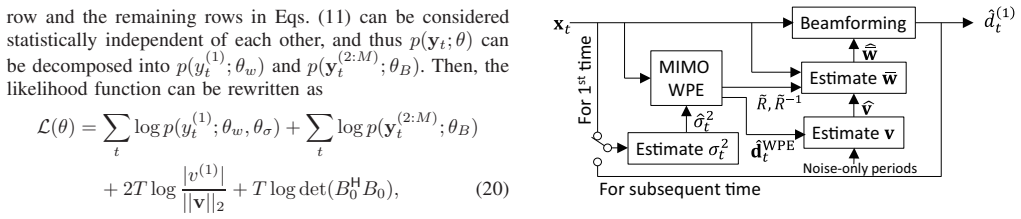
The central objects are the convolutional beamformer matrix $W_t = [w_t, \; B_t]$, whose first column $w_t$ performs denoising and dereverberation while $B_t$ blocks the target subspace, and the power-normalized temporal-spatial covariance matrix $R = \sum_t \bar{x}_t \bar{x}_t^{\mathrm{H}} / \hat{\sigma}_t^2$. The argument runs through a determinant decomposition, $|\det(W_0)| = |v^{(1)}| \det(B_0^{\mathrm{H}} B_0)^{1/2} / \|v\|_2$, which separates the steering-vector part from the blocking-matrix part and allows the likelihood to split into independently optimizable terms. With the distortionless constraint $w_0^{\mathrm{H}} v = v^{(1)}$, the Lagrange multiplier solution $\bar{w} = R^{-1}\bar{v} / (\bar{v}^{\mathrm{H}} R^{-1} \bar{v})$ is exactly the WPD update. MIMO WPE supplies the dereverberated signal used for steering-vector estimation, and because WPE and WPD share the calculation of $R$ and its inverse, this estimation can be folded into the framework at little extra cost.
What would settle it
Compute the WPD output under the proposed algorithm and measure the residual term $\tilde{r}_t + \tilde{n}_t$ from Eq. (11), checking whether the target row and blocking rows are statistically independent. In a simulated room with long reverberation or low signal-to-noise ratio, where residuals are substantial, the likelihood in Eq. (20) should fail to decompose as written; if the alternating updates then no longer match a direct numerical maximization of Eq. (24), the central maximum likelihood claim would be shown to rest on the zero-residual assumption.
Extended reading notes
Core claim
The central claim is that the WPD beamformer is not merely a heuristic blend of weighted prediction error dereverberation and minimum-power distortionless response beamforming: it solves a maximum likelihood problem. When the desired signal at the reference microphone is modeled as complex Gaussian with unknown time-varying variance, and when the optimal beamformer is assumed to reduce residual reverberation and noise to negligible levels, the likelihood separates into a target-row term and a blocking-row term; maximizing the target term under the distortionless constraint yields exactly the WPD power-normalized covariance update. The paper further claims that estimating the steering vector from WPE-dereverberated multichannel signals, rather than from the raw captured signal, is what makes the method effective, and reports that WPD with WPE outperformed WPE, MPDR, and a WPE-plus-MPDR cascade on REVERB challenge data.
Load-bearing premise
The derivation assumes the ideal beamformer removes almost all reverberation and noise from its output, so that the wanted speech and the leftover interference can be treated as statistically independent; if noticeable residuals remain, the likelihood decomposition and the derived update are only approximate.
Editorial extensions
If this is right
- The WPD update rule can be described as alternating maximization of a well-defined likelihood, so its stationary-point behavior and distortionless property follow from standard maximum likelihood reasoning rather than from an ad hoc construction.
- Because WPE and WPD share the bulk of the computation, namely the covariance matrix $R$ and its inverse, steering-vector estimation inside the WPD framework adds only a small cost beyond running WPE itself.
- If the claim is right, the weighted power minimization objective is not an arbitrary regularizer but the negative log-likelihood of the enhanced target signal under the generative model.
- Accurate steering-vector estimation is the load-bearing practical component: using WPE-dereverberated signals for this estimate is central to the method, not a peripheral convenience.
- The same probabilistic formulation reduces to MPDR when reverberation is absent, the convolutional filters beyond the first tap are set to zero, and the desired-signal variance is time invariant.
Reading between the lines
- A natural extension is to relax the zero-residual independence assumption by modeling the residual $\tilde{r}_t + \tilde{n}_t$ as a structured, low-rank, or time-varying component; the paper's likelihood decomposition shows exactly where such a correction would enter.
- Because each frequency bin is processed independently, the model ignores inter-frequency coupling of speech; adding a temporal or spectral smoothness prior on the desired-signal variance $\sigma_t^2$ is a plausible next step suggested by the generative formulation.
- The paper's footnote indicates that a certain cascade configuration of WPE followed by MPDR can produce the same outputs as WPD; if that equivalence is proved in future work, the maximum likelihood interpretation would also legitimize the cascade, not only the unified filter.
Signed reviews
Editorial analysis
A structured set of objections, weighed in public.
Referee Report
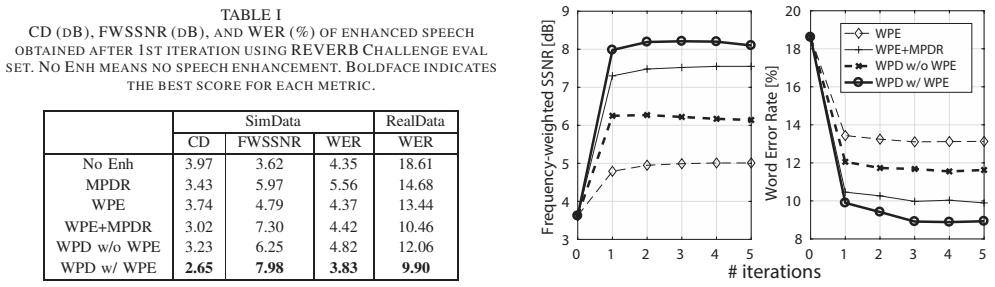
Summary. The paper presents a probabilistic formulation of the Weighted Power minimization Distortionless response convolutional beamformer (WPD), which unifies WPE-based dereverberation and MPDR-based denoising. The authors define a generative model in which the desired speech component is complex Gaussian with time-varying variance, and in which the residual reverberation and noise after optimal filtering are negligible; under these assumptions the WPD update rule is shown to be a maximum likelihood estimate. They also propose a WPE-based method for estimating the steering vector inside the same framework. Experiments on the REVERB challenge show that WPD with WPE yields the best cepstrum distance, frequency-weighted segmental SNR, and word error rate among the compared methods.
Significance. The paper's main contribution is a principled theoretical grounding for a previously heuristic criterion, together with a practical recipe for estimating the steering vector without external direction information. The derivation is careful, and the computational reuse of the covariance matrix for both WPE and WPD is an efficiency argument worth crediting. However, the maximum-likelihood interpretation is conditional on an unverified independence assumption, the experiments are reported without statistical significance, and the self-admitted equivalence with a cascade configuration tempers the novelty claim. If the assumptions are validated and the comparison clarified, the paper would be a useful reference for unified dereverberation and denoising.
major comments (3)
- [Section III, Eq. (20)] The factorization of the likelihood into p(y1_t) and p(y2:M_t) relies on the assumption, stated immediately before Eq. (20), that the optimal beamformer makes r̃_t + ñ_t negligible. If this residual is only small but nonzero, the first and remaining rows of y_t share the past desired and reverberant components (see Eqs. (12)–(15)), so they are not statistically independent and the Gaussian likelihood in Eq. (21) is misspecified; the update in Eq. (26) is then an approximate, rather than exact, maximum-likelihood solution. The paper does not provide any empirical check of the residual level after convergence, for example on the REVERB conditions with 20 dB SNR and reverberation times up to 0.7 s. Please add a measurement of the post-filtering residual power relative to the desired-signal power, or otherwise justify why the assumption holds. Without this evidence, the central claim of an ML-derived beamformer should be softened to an approximate-ML derivation.
- [Section II, footnote 1] The footnote admits that WPD yields the same outputs as a certain cascade configuration consisting of WPE and MPDR. This is in tension with the abstract's characterization of WPD as simultaneously and optimally performing dereverberation and denoising, and with the experimental comparison against the WPE+MPDR baseline. The paper should specify (i) the exact cascade configuration that is equivalent, (ii) whether the WPE+MPDR baseline in Table I matches that configuration, and (iii) what differentiates the reported gains if the outputs are equivalent. Without this clarification, the reader cannot separate the effect of the unified optimization from the effect of the iterative steering-vector estimation and reweighting used in the proposed method.
- [Section V, Table I and Figure 2] All results are reported as single numbers with no error bars, confidence intervals, or significance tests. Differences such as the SimData WER of 3.83 for WPD w/ WPE versus 4.42 for WPE+MPDR may be within utterance-level variability. Please report per-utterance statistics and pairwise significance tests, or provide scatter plots, to substantiate the claim that WPD w/ WPE 'greatly outperformed all the other methods' for all iteration times.
minor comments (5)
- [Eq. (20) and Appendix] The expressions for the Jacobian term appear to have missing division signs in the typeset version (for example, "2T log |v(1)| ||v||2" and "|v(1)| ||v||2"); please verify the LaTeX and use unambiguous notation such as |v^{(1)}| / \|v\|_2.
- [Section IV-B] The GEVD-based steering vector estimation is described tersely; please add a brief description or a specific citation indicating how the principal eigenvector after noise whitening yields the desired steering vector.
- [Figure 2] The caption states that FWSSNRs are evaluated on SimData and WERs on RealData; please label the two panels directly and ensure the x-axis iteration numbering is clear in the figure itself.
- [Abstract and Conclusion] The abstract and conclusion use the word 'optimal' without qualification; suggest adding 'under the modeling assumptions' to avoid overclaiming, especially in light of the approximation discussed in Major Comment 1.
- [Section V-B] Clarify whether the iterative update of σ²_t is performed jointly with the WPE-based steering vector update in every iteration, and how the number of iterations is chosen for the results in Table I and Figure 2.
Circularity Check
No significant circularity: the ML derivation of WPD is self-contained; the residual-negligible approximation is a stated modeling assumption, not a circular step.
full rationale
The paper's central derivation takes a stated generative model—y_t^(1) complex Gaussian with time-varying variance sigma_t^2 (Eqs. 21-22)—together with the distortionless constraints (Eqs. 9-10) and derives the WPD update (Eq. 26) by maximizing the resulting likelihood (Eq. 24) via Lagrange multipliers. This is not self-definitional: the generative model does not assume the WPD filter form; the filter form falls out of the optimization. The time-varying variance is a model parameter updated iteratively as the output power, a standard alternating ML/EM-style scheme, not a fitted parameter renamed as a prediction. The likelihood factorization (Eq. 20) relies on the explicitly stated 'residual negligible' approximation in Section III, which is an idealization that limits the exactness of the ML claim under high reverberation/noise, but it is not circular because it does not presuppose the WPD solution. The steering vector is estimated with WPE [11], an independently established and externally benchmarked method; no uniqueness theorem from the authors' prior work is invoked to force the form. The empirical REVERB comparisons are external and do not reduce to the paper's own fitted values. Self-citations to the earlier WPD paper [26] and WPE [10,11] are contextual, not load-bearing for the derivation. Therefore no circular step is present.
Assumptions & free parameters
free parameters (4)
- sigma_t^2 (time-varying desired signal power) =
Updated iteratively as the power of the beamformer output, |d_hat_t^(1)|^2
- prediction delay b =
b = 4 frames
- prediction filter length Lw =
Lw = 12, 10, and 6 for frequency ranges 0-0.8 kHz, 0.8-1.5 kHz, and 1.5-8 kHz
- noise-only periods for steering vector estimation =
225 ms at beginning and 75 ms at end of each utterance
assumptions (4)
- domain assumption The early component d_t, late reverberation r_t, and additive noise n_t are statistically independent.
- domain assumption The transfer function of the desired signal is modeled as a steering vector product d_t = v s_t.
- ad hoc to paper The residual reverberation and noise after filtering are negligible (rtilde_t + ntilde_t approximately 0).
- domain assumption The desired component y_t^(1) follows a zero-mean complex Gaussian distribution with time-varying variance sigma_t^2.
Cite this review
Pith. "Pith review of Maximum likelihood convolutional beamformer for simultaneous denoising and dereverberation." pith.science (2026). https://pith.science/paper/TCSTCARQ
@misc{pith2026190802710,
  author       = {Pith},
  title        = {Pith review of: Maximum likelihood convolutional beamformer for simultaneous denoising and dereverberation},
  year         = {2026},
  howpublished = {\url{https://pith.science/paper/TCSTCARQ}},
  note         = {Machine review of arXiv:1908.02710}
}
read the original abstract
This article describes a probabilistic formulation of a Weighted Power minimization Distortionless response convolutional beamformer (WPD). The WPD unifies a weighted prediction error based dereverberation method (WPE) and a minimum power distortionless response beamformer (MPDR) into a single convolutional beamformer, and achieves simultaneous dereverberation and denoising in an optimal way. However, the optimization criterion is obtained simply by combining existing criteria without any clear theoretical justification. This article presents a generative model and a probabilistic formulation of a WPD, and derives an optimization algorithm based on a maximum likelihood estimation. We also describe a method for estimating the steering vector of the desired signal by utilizing WPE within the WPD framework to provide an effective and efficient beamformer for denoising and dereverberation.
Figures
Reference graph
Works this paper leans on
-
[1]
Acoustic beamf orming for speaker diarization of meetings,
X. Anguera, C. Wooters, and J. Hernando, “Acoustic beamf orming for speaker diarization of meetings,” IEEE Trans. ASLP , vol. 15, no. 7, pp. 2011–2022, 2007
work page 2011
-
[2]
H. L. V . Trees, Optimum Array Processing, Part IV of Detection, Estimation, and Modulation Theory . New Y ork: Wiley-Interscience, 2002
work page 2002
-
[3]
Resolving power and sensitivity to mismatch of o ptimum array processors,
H. Cox, “Resolving power and sensitivity to mismatch of o ptimum array processors,” The Journal of the Acoustical Society of America , vol. 54, pp. 771–785, 1973
work page 1973
-
[4]
T. Higuchi, N. Ito et al., “Online MVDR beamformer based on complex Gaussian mixture model with spatial prior for noise robust A SR,” IEEE/ACM Transactions on Audio, Speech, and Language Proce ssing, vol. 25, no. 4, pp. 780–793, 2017
work page 2017
-
[5]
Improved MVDR beamforming using single-channel mask prediction networks,
H. Erdogan, J. R. Hershey et al., “Improved MVDR beamforming using single-channel mask prediction networks,” Proc. Interspeech, pp. 1981– 1985, 2016
work page 1981
-
[6]
Distortionless beamforming optimized with l1-norm minimization,
S. Emura, S. Araki et al. , “Distortionless beamforming optimized with l1-norm minimization,” IEEE Signal Processing Letters , vol. 25, no. 7, pp. 936–940, 2018
work page 2018
-
[7]
Blind acoustic beamform ing based on generalized eigenvalue decomposition,
E. Warsitz and R. Haeb-Umbach, “Blind acoustic beamform ing based on generalized eigenvalue decomposition,” IEEE Transactions on Audio, Speech, and Language Processing , vol. 15, no. 5, 2007
work page 2007
-
[8]
Blind speech separat ion in a meeting situation with maximum SNR beamformer,
S. Araki, H. Sawada, and S. Makino, “Blind speech separat ion in a meeting situation with maximum SNR beamformer,” Proc. IEEE ICASSP, pp. 41–44, 2007
work page 2007
Show all 34 references
-
[9]
Beamnet: end-to-end training of a beamformer-supported multichannel ASR system,
J. Heymann, L. Drude et al. , “Beamnet: end-to-end training of a beamformer-supported multichannel ASR system,” Proc. IEEE ICASSP , pp. 5235–5329, 2017
2017
-
[10]
Speech dereverberation based on variance-normalized delayed linear prediction,
T. Nakatani, T. Y oshioka et al. , “Speech dereverberation based on variance-normalized delayed linear prediction,” IEEE Transactions on Audio, Speech, and Language Processing , vol. 18, no. 7, pp. 1717–1731, 2010
2010
-
[11]
Generalization of multi- channel linear prediction methods for blind MIMO impulse response shorten ing,
T. Y oshioka and T. Nakatani, “Generalization of multi- channel linear prediction methods for blind MIMO impulse response shorten ing,” IEEE Transactions on Audio, Speech and Language Processing , vol. 20, no. 10, pp. 2707–2720, 2012
2012
-
[12]
Adaptive dereverberation of speech signals with speaker-position change detection,
T. Y oshioka, H. Tachibana et al. , “Adaptive dereverberation of speech signals with speaker-position change detection,” Proc. IEEE ICASSP , pp. 3733–3736, 2009
2009
-
[13]
Multi-channel linear prediction- based speech dereverberation with sparse priors,
A. Juki´ c, T. van Waterschoot et al. , “Multi-channel linear prediction- based speech dereverberation with sparse priors,” IEEE/ACM Transac- tions on Audio, Speech and Language Processing , vol. 23, no. 9, pp. 1509–1520, 2015
2015
-
[14]
Speech dereverberatio n based on convex optimization algorithms for group sparse linear pre diction,
D. Giacobello and T. L. Jensen, “Speech dereverberatio n based on convex optimization algorithms for group sparse linear pre diction,” Proc. IEEE ICASSP , pp. 446–450, 2018
2018
-
[15]
Strategies for distant speech recognition in reverberant environments,
M. Delcroix, T. Y oshioka et al., “Strategies for distant speech recognition in reverberant environments,” EURASIP J. Adv. Signal Process , vol. Article ID 2015:60, doi:10.1186/s13634-015-0245-7, 2015
2015 doi
-
[16]
Dereverberation with differential microphone arrays and the weighted-prediction-error method,
W. Y ang, G. Huang et al., “Dereverberation with differential microphone arrays and the weighted-prediction-error method,” Proc. IWAENC, 2018
2018
-
[17]
Multichannel online speech dereverberati on under noisy environments,
M. Togami, “Multichannel online speech dereverberati on under noisy environments,” Proc. EUSIPCO , pp. 1078–1082, 2015
2015
-
[18]
Integrating neural network based beamforming and weighted prediction error dereverberatio n,
L. Drude, C. Boeddeker et al. , “Integrating neural network based beamforming and weighted prediction error dereverberatio n,” Proc. Interspeech, pp. pp. 3043–3047, 2018
2018
-
[19]
A summary of the REVERB challenge: state-of-the-art and remaining challenges in reverberant speech process- ing research,
K. Kinoshita, M. Delcroix et al., “A summary of the REVERB challenge: state-of-the-art and remaining challenges in reverberant speech process- ing research,” EURASIP Journal on Advances in Signal Processing , vol. doi:10.1186/s13634-016-0306-6, 2016
-
[20]
The third ‘CHiME’ speech separation and recognition challenge: Dataset, task and baselines,
J. Barker, R. Marxer et al. , “The third ‘CHiME’ speech separation and recognition challenge: Dataset, task and baselines,” Proc. IEEE ASRU- 2015, pp. 504–511, 2015
2015
-
[21]
CHiME4 Challenge,
E. Vincent, S. Watanabe et al. , “CHiME4 Challenge,” http://spandh.dcs.shef.ac.uk/chime challenge/chime2016/
-
[22]
CHiME5 Challen ge,
J. Barker, S. Watanabe, and E. Vincent, “CHiME5 Challen ge,” http://spandh.dcs.shef.ac.uk/chime challenge/
-
[23]
Acoustic modeling for Google Home,
B. Li, T. N. Sainath et al., “Acoustic modeling for Google Home,” Proc. Interspeech, 2017
2017
-
[24]
Opti mizing Siri on HomePod in far-field settings,
Audio Software Engineering and Siri Speech Team, “Opti mizing Siri on HomePod in far-field settings,” Apple Machine Learning Journal , vol. 1, no. 12, 2018
2018
-
[25]
Speech processing for digital home assistants,
R. Haeb-Umbach, S. Watanabe et al. , “Speech processing for digital home assistants,” IEEE Signal Processing Magazine , 2019
2019
-
[26]
A unified convolutional b eamformer for simultaneous denoising and dereverberation,
T. Nakatani and K. Kinoshita, “A unified convolutional b eamformer for simultaneous denoising and dereverberation,” IEEE Signal Processing Letters, vol. 26, no. 6, pp. 903–907, 2019
2019
-
[27]
Joint multi-microphone speech derever- beration and noise reduction using integrated sidelobe can cellation and linear prediction,
T. Dietzen, S. Doclo et al. , “Joint multi-microphone speech derever- beration and noise reduction using integrated sidelobe can cellation and linear prediction,” Proc. IWAENC, 2018
2018
-
[28]
Blind speech dereverberation with multi-channel linear prediction based on short time Fourie r transform representation,
T. Nakatani, T. Y oshioka et al. , “Blind speech dereverberation with multi-channel linear prediction based on short time Fourie r transform representation,” Proc. IEEE ICASSP , pp. 85–88, 2008
2008
-
[29]
On the importance of early reflections for speech in rooms,
J. S. Bradley, H. Sato, and M. Picard, “On the importance of early reflections for speech in rooms,” The Journal of the Acoustic Sociaty of America, vol. 113, pp. 3233–3244, 2003
2003
-
[30]
Inverses of 2 x 2 block matrice s,
T.-T. Lu and S.-H. Shiou, “Inverses of 2 x 2 block matrice s,” Computers & Mathematics with Applications , vol. 43, pp. 119–129, 2002
2002
-
[31]
Probabilistic spatial dictionary based online adaptive beamforming for meeting recognition in noisy and r everberant environments,
N. Ito, S. Araki et al. , “Probabilistic spatial dictionary based online adaptive beamforming for meeting recognition in noisy and r everberant environments,” Proc. IEEE ICASSP , pp. 681–685, 2017
2017
-
[32]
Performance analys is of the covariance subtraction method for relative transfer funct ion estimation and comparison to the covariance whitening method,
S. Markovich-Golan and S. Gannot, “Performance analys is of the covariance subtraction method for relative transfer funct ion estimation and comparison to the covariance whitening method,” pp. 544 –548, 2015
2015
-
[33]
Evaluation of objective quality measures for speech enhancement,
Y . Hu and P . C. Loizou, “Evaluation of objective quality measures for speech enhancement,” IEEE T-ASLP, vol. 16, no. 1, pp. 229–238, 2008
2008
-
[34]
The Kaldi speech recognition toolkit,
D. Povey, A. Ghoshal et al. , “The Kaldi speech recognition toolkit,” Proc. IEEE ASRU , 2011
2011
Reviewed August 14, 2026 · model on record in the stance chip above.
Discussion (0). Continue with ORCID to comment.