REVIEW 2 major objections 4 minor 59 references
Properties and nature of Be stars 31. The binary nature, light variability, physical elements, and emission-line changes of HD~81357
T0 review · 2 major / 4 minor · reviewed 2026-08-14 · deepseek-v4-flash
Pith's one-line read HD 81357 is a 33.77-day double-lined binary with a 10:1 mass ratio and a Roche-lobe-filling cool star, observed in the final slow phase of mass exchange.
desk verdict A careful, data-rich first study of a newly identified Be binary, but the quoted semimajor axis contradicts Kepler's third law given the paper's own masses and period, and the formal errors are unrealistic. read the letter →
The pith
A machine-rendered reading of the paper's core claim, the machinery that carries it, and where it could break.
The reading
What carries the argument
The load-bearing machinery is the simultaneous model of the ellipsoidal light curve and the radial-velocity curve of the cool component, anchored by a very accurate trigonometric parallax. The ellipsoidal variations carry the geometric information: their amplitude and its decrease from red to blue passbands require the cool star to fill its Roche lobe, and the parallax converts the measured flux of the hot component into a physical radius, which in turn fixes the scale of the orbit. Effective temperatures of both stars are first pinned down by an automated comparison of observed and synthetic blue spectra; the light-curve and orbital model then yields masses, radii, inclination, and the mass ratio. A binary stellar evolution code provides the time dimension, showing that conservative mass exchange from an initially more massive star produces the present-day masses, period, and the inflated cool star.
What would settle it
A clean radial-velocity curve of the hot component, obtained from lines free of circumstellar emission (for example in the ultraviolet), would directly test the mass ratio: if its semi-amplitude K1 differs significantly from the adopted value near 8 km/s, the masses 3.36 and 0.34 solar masses would have to be revised. Alternatively, high-angular-resolution observations that resolved the cool star's disk could test the central geometrical premise that its radius equals its Roche-lobe radius.
Extended reading notes
Core claim
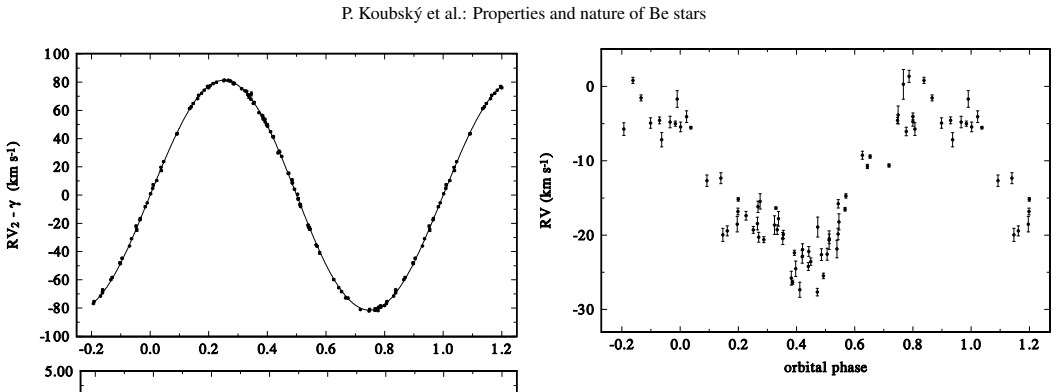
On the paper's own terms, the central discovery is that HD 81357 is a new member of the class of hot emission-line binaries with a Roche-lobe-filling cool secondary, and that it is caught near the end of its mass-transfer phase. The double-wave ellipsoidal light variations, the clean sinusoidal radial-velocity curve of the cool star with semi-amplitude 81.8 km/s, and the broad, partly circumstellar-veiled lines of the hot star together define a binary with period 33.77445 days and a circular orbit. A combined fit to all photometry and radial velocities, constrained by an accurate parallax, gives masses 3.36 and 0.34 solar masses, radii 3.9 and 14.0 solar radii, and mass ratio 10.0. Because detached models cannot reproduce the light-curve amplitudes, the authors conclude that the cool star fills its Roche lobe. Evolutionary modelling then shows that a binary starting with roughly 1.5 and 2.2 solar masses in a 2.4-day orbit evolves conservatively into exactly such a system, so HD 81357 is interpreted as being observed in the final slow phase of mass exchange after the mass-ratio reversal.
Load-bearing premise
The result rests on the assumption that the ellipsoidal variability comes entirely from a cool star that exactly fills its Roche lobe, rotates synchronously, and obeys the adopted gravity-darkening and albedo laws; because the model's total chi-squared changes by less than three percent over a wide range of inclinations and mass ratios, a different acceptable set of these assumptions could shift the inferred masses and inclination.
Editorial extensions
If this is right
- HD 81357 becomes a well-measured example of a Be binary in the late stage of Algol-like mass exchange, useful for calibrating the end points of mass-transfer theory.
- The derived masses, radii, and temperatures give direct constraints on the structure of a low-mass star with an inflated envelope after most of its mass has been transferred.
- Because the cool star fills its Roche lobe, the ellipsoidal light curve is a monitor of the system's present geometry; future photometry can check for slow changes in the amplitudes.
- The absence of cyclic light variations on timescales an order of magnitude longer than the orbital period, in contrast with similar binaries, supports the suggestion that such cycles are not present at the end of the mass-exchange phase.
- The H-alpha emission follows the hot component's orbital motion with a phase shift of about five days, indicating an asymmetric distribution of circumstellar matter around the mass-gaining star.
Reading between the lines
- The same recipe of using a precise parallax to convert ellipsoidal light-curve amplitudes into physical radii could break the mass-ratio degeneracy in other emission-line binaries with cool Roche-lobe-filling stars, where spectral disentangling alone leaves a wide range of acceptable mass ratios.
- If the system is truly near the end of mass transfer, its orbital period should be changing only very slowly; monitoring the times of the ellipsoidal light-curve minima over decades could test this prediction.
- The model predicts specific passband-dependent ellipsoidal amplitudes; space-based ultraviolet photometry, where the hot star dominates, would provide an independent check of the inclination and of the cool star's contribution.
- The presence of long-term cyclic variations in some similar systems but not in this one may indicate that those cycles require an actively sustained mass-transfer rate or an extended outer disk, not merely the existence of a Roche-lobe-filling donor.
Signed reviews
Editorial analysis
A structured set of objections, weighed in public.
Referee Report
Summary. This paper presents a multi-technique study of the little-known Be-type binary HD 81357, based on new and archival spectroscopy and photometry. The authors infer a double-lined spectroscopic binary and ellipsoidal variable with an orbital period of 33.77445 d, an inclination near 63°, component masses of about 3.36 and 0.34 M⊙, radii of about 3.9 and 14.0 R⊙, and a mass ratio near 10. They interpret the system as a semi-detached binary in the final slow phase of mass exchange after mass-ratio reversal, and they support this with MESA evolutionary models that reproduce the observed masses, period, and secondary radius for a set of adopted initial conditions.
Significance. If the derived parameters are correct, HD 81357 is a valuable new representative of the rare class of hot emission-line binaries with a Roche-lobe-filling cool secondary, and the paper's careful multi-pronged approach—independent RV methods, MCMC-based effective-temperature estimation, two independent light-curve codes, a Gaia parallax constraint, and an explicit consistency check between photometric and spectroscopic radii—sets a high methodological standard. The paper is also refreshingly honest about the degeneracies it encounters, particularly the template-dependent hot-component RVs and the flat χ² landscape. However, the central quantitative claims rest on a PHOEBE solution that is internally inconsistent with Kepler's third law, and the quoted error bars do not reflect the admitted degeneracy; both issues must be resolved before the physical elements can be accepted.
major comments (2)
- [Section 3.6, Table 6] The published solution is not self-consistent. With P=33.77445 d, M1=3.36 M⊙, M2=0.34 M⊙, Kepler's third law requires a=4.2067 (M_total)^(1/3) P^(2/3) R⊙ ≈ 68.0 R⊙, whereas Table 6 quotes a=63.01±0.09 R⊙. The RV amplitudes give the same answer: K1+K2=89.5 km/s and i=63° imply a sin i = P(K1+K2)/(2π) ≈ 59.8 R⊙, hence a≈67.1 R⊙. The quoted a corresponds instead to a total mass of about 2.95 M⊙, a ~20% deficit. This is not marginal: it changes the Roche-lobe geometry materially, with R_L2≈13.0 R⊙ for a=63.0 R⊙ (implying an overfill of ~7%) versus R_L2≈14.1 R⊙ for a=68.0 R⊙ (implying nominal lobe filling). The physical elements, the semi-detached conclusion, and the evolutionary comparison in Section 5 therefore rest on a solution that violates the adopted orbital constraints. The authors must recompute the PHOEBE solution with the Kepler relation enforced (or demonstrate that the quoted a and masses are not the ones actually used), and re-derive all derived quantities that depend on a, including the Roche-lobe radius and the MESA comparison.
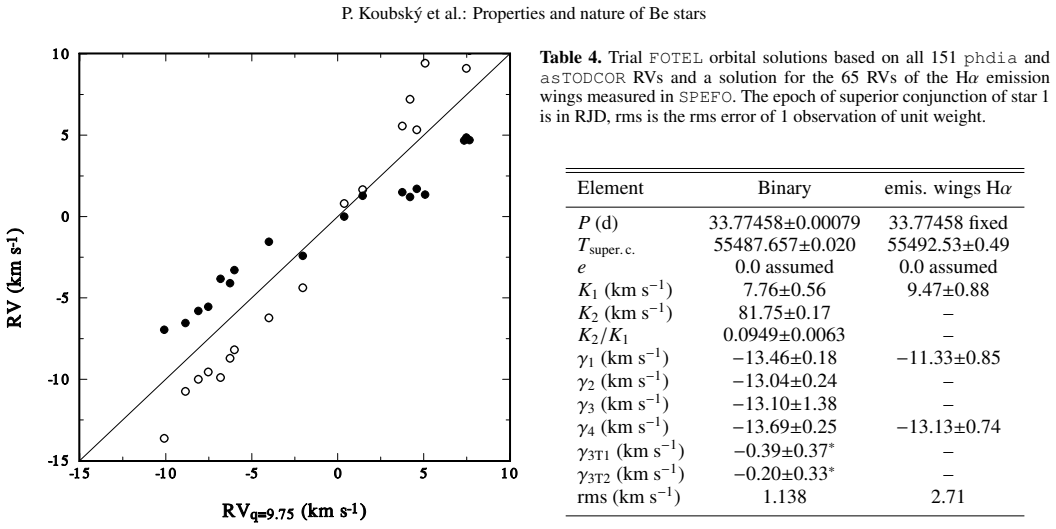
- [Section 3.6, Abstract and Table 6] The formal errors quoted for the masses and radii are not a realistic measure of the solution's uncertainty. The text states that over a large range of inclinations and a tolerable range of mass ratios the total χ² changes by less than 3%, and Section 3.3.2 concedes that the mass ratio cannot be uniquely determined from the RVs (K1 varies from 4.78 to 11.09 km/s among the three KOREL templates). The Table 6 errors are derived from the covariance matrix only and take none of this degeneracy into account. Yet the abstract and tables report, for example, M1=3.36±0.15 M⊙ and M2=0.34±0.04 M⊙, which will be read as tight constraints. The paper should either quantify the true parameter correlations with a grid-based or MCMC marginalization, or explicitly present the parameters as a representative solution within a broad, unquantified degeneracy. As published, the error budget is understated.
minor comments (4)
- [Abstract vs. Table 6] The abstract gives the secondary radius as 13.97±0.05 R⊙, but Table 6 lists R2=14.0±0.7 R⊙. Please reconcile the value and, in particular, the uncertainty, which differs by more than an order of magnitude.
- [Figure 9 caption] The caption refers to an observed semimajor axis a=63.95 R⊙, while Table 6 quotes a=63.01±0.09 R⊙. These two numbers should be made consistent, and the source of the difference explained.
- [Equation (1)] Equation (1) is difficult to parse as typeset; the relationship between the synchronicity parameter F1, the orbital period, v1 sin i, and the equatorial radius should be written with explicit parentheses and units so that the reader can reproduce the iterative update.
- [General text] There are several typos: "re-caculated" in Section 3.6, "absortion" in Section 4, and "shorward" in Section 4. A careful proofreading pass is recommended.
Circularity Check
No circularity: the physical elements are derived from observed radial velocities, photometry, and Gaia parallax, while the MESA evolution is an acknowledged consistency check rather than an independent prediction.
full rationale
The central derivation is data-driven, not circular. The orbital period, radial-velocity semi-amplitudes, effective temperatures, and light-curve amplitudes come from independent spectroscopic and photometric observations, and the PHOEBE combined solution uses Keplerian constraints and Roche geometry plus the Gaia DR2 parallax to fix masses and radii. The Gaia-parallax radius check via Eq. (2) is an external consistency constraint, not an input recycled as an output. The MESA section is explicitly framed as a test of whether evolution with mass exchange 'can produce a system similar to HD 81357,' with initial masses and periods searched over stated ranges; the paper concedes that alternative initial conditions also work and that the final R1 is not well reproduced, so the evolutionary model is not presented as a first-principles prediction of the observed values. Self-citations (Koubský et al. 2012, Harmanec et al. 2015, Nemravová et al. 2016) are methodological and are backed by new data or published, independently applicable tools; they are not load-bearing circular premises. The reported inconsistency between a = 63.01 R_sun and Kepler's third law for the quoted masses and period is a correctness/self-consistency concern, not a circularity, and does not make the derivation equivalent to its inputs.
Assumptions & free parameters
free parameters (5)
- Gravity darkening exponent of component 2 (beta_2) =
0.6 (adopted from Claret 1998)
- Bolometric albedo of component 2 (A_2) =
0.5 (adopted from Claret 2001)
- Synchronicity parameter of component 2 (F2) =
1.0 (fixed)
- MESA initial masses and orbital period =
M1 = 1.5 M_sun, M2 = 2.2 M_sun, P = 2.4 d
- Maximum mass-transfer rate and magnetic braking exponent =
Mdot_max = 1e-7 M_sun/yr; gamma = 3
assumptions (5)
- domain assumption The observed light variations are entirely ellipsoidal distortion of a Roche-lobe-filling, synchronously rotating cool star; the hot star contributes only as a point-like light source.
- domain assumption The cool component's orbit is circular and its RVs (SPEFO/phdia metallic lines) trace its true orbital motion; the hot component's RVs are unreliable due to circumstellar contamination, so the solution uses only component 2 RVs plus photometry.
- domain assumption Gaia DR2 parallax (p = 0.0016000 ± 0.0000345 arcsec) and Flower (1996) bolometric corrections are accurate, so the radius constraint Mbol = 42.35326 - 5 log R1 - 10 log Teff1 can be used to restrict the mass ratio.
- domain assumption Stellar evolution with conservative mass transfer, zero eccentricity, no tidal interactions and no irradiation (MESA setup) adequately represents this binary's history.
- domain assumption Radial-velocity zero points for the four data subsets can be treated as independent systemic velocities because no telluric-line calibration was possible.
Cite this review
Pith. "Pith review of Properties and nature of Be stars 31. The binary nature, light variability, physical elements, and emission-line changes of HD~81357." pith.science (2026). https://pith.science/paper/HUF4CT55
@misc{pith2026190802719,
  author       = {Pith},
  title        = {Pith review of: Properties and nature of Be stars 31. The binary nature, light variability, physical elements, and emission-line changes of HD~81357},
  year         = {2026},
  howpublished = {\url{https://pith.science/paper/HUF4CT55}},
  note         = {Machine review of arXiv:1908.02719}
}
abstract
Reliable determination of the basic physical properties of hot emission-line binaries with Roche-lobe filling secondaries is important for developing the theory of mass exchange in binaries. It is not easy, however, due to the presence of circumstellar matter. Here, we report the first detailed investigation of a new representative of this class of binaries, HD~81357, based on the analysis of spectra and photometry from several observatories. HD~81357 was found to be a double-lined spectroscopic binary and an ellipsoidal variable seen under an intermediate orbital inclination of $\sim(63\pm5)^\circ$, having an orbital period of 33\fd77445(41) and a~circular orbit. From an automated comparison of the observed and synthetic spectra, we estimate the component's effective temperatures to be 12930(540)~K and 4260(24)~K. The combined light-curve and orbital solutions, also constrained by a very accurate Gaia Data Release 2 parallax, give the following values of the basic physical properties: masses $3.36\pm0.15$ and $0.34\pm0.04$~\Mnom, radii $3.9\pm0.2$ and 13.97\pm0.05$~\Rnom, and a~mass ratio $10.0\pm0.5$. Evolutionary modelling of the system including the phase of mass transfer between the components indicated that HD~81357 is a~system observed in the final slow phase of the mass exchange after the mass-ratio reversal. Contrary to what has been seen for similar binaries like AU~Mon, no cyclic light variations were found on a~time scale an~order of magnitude longer than the orbital period. 243,1 15%
Figures


Figures from the paper (6 more)




Reference graph
Works this paper leans on
-
[1]
, " * write output.state after.block = add.period write newline
ENTRY address author booktitle chapter edition editor howpublished institution journal key month note number organization pages publisher school series title type volume year label extra.label sort.label short.list INTEGERS output.state before.all mid.sentence after.sentence after.block FUNCTION init.state.consts #0 'before.all := #1 'mid.sentence := #2 '...
-
[2]
write newline
" write newline "" before.all 'output.state := FUNCTION n.dashify 't := "" t empty not t #1 #1 substring "-" = t #1 #2 substring "--" = not "--" * t #2 global.max substring 't := t #1 #1 substring "-" = "-" * t #2 global.max substring 't := while if t #1 #1 substring * t #2 global.max substring 't := if while FUNCTION word.in bbl.in " " * FUNCTION format....
-
[3]
Adrianzyk , G., Baietto , J. C., Berger , J. P., et al. 1978, , 63, 279
work page 1978
-
[4]
Allen , D. A. 1973, , 161, 145
work page 1973
- [5]
-
[6]
V., Harmanec , P., Boyarchuk , A
Bisikalo , D. V., Harmanec , P., Boyarchuk , A. A., Kuznetsov , O. A., & Hadrava , P. 2000, , 353, 1009
work page 2000
-
[7]
2013, Central European Astrophysical Bulletin, 37, 9
Bo z i \'c , H., Harmanec , P., & Koubsk \'y , P. 2013, Central European Astrophysical Bulletin, 37, 9
work page 2013
-
[8]
1984, MK spectral classifications
Buscombe , W. 1984, MK spectral classifications. Sixth general catalogue
work page 1984
Show all 59 references
-
[9]
1998, , 131, 395
Claret , A. 1998, , 131, 395
1998
-
[10]
2001, , 327, 989
Claret , A. 2001, , 327, 989
2001
-
[11]
C., & Plez , B
de Laverny , P., Recio-Blanco , A., Worley , C. C., & Plez , B. 2012, , 544, A126
2012
-
[12]
2010, , 401, 418
Desmet , M., Fr \'e mat , Y., Baudin , F., et al. 2010, , 401, 418
2010
-
[13]
Flower , P. J. 1996, , 469, 355
1996
-
[14]
W., Lang , D., & Goodman , J
Foreman-Mackey , D., Hogg , D. W., Lang , D., & Goodman , J. 2013, , 125, 306
2013
-
[15]
Gaia Collaboration , Brown , A. G. A., Vallenari , A., et al. 2018, , 616, A1
2018
-
[16]
Gaia Collaboration , Brown , A. G. A., Vallenari , A., et al. 2016, , 595, A2
2016
-
[17]
1990, Contr
Hadrava , P. 1990, Contr. Astron. Obs. Skalnat\'e Pleso, 20, 23
1990
-
[18]
1995, , 114, 393
Hadrava , P. 1995, , 114, 393
1995
-
[19]
1997, , 122, 581
Hadrava , P. 1997, , 122, 581
1997
-
[20]
2004 a , Publ
Hadrava , P. 2004 a , Publ. Astron. Inst. Acad. Sci. Czech Rep., 92, 1
2004
-
[21]
2004 b , Publ
Hadrava , P. 2004 b , Publ. Astron. Inst. Acad. Sci. Czech Rep., 92, 15
2004
-
[22]
Halbedel , E. M. 1996, , 108, 833
1996
-
[23]
1983, Hvar Observatory Bulletin, 7, 55
Harmanec , P. 1983, Hvar Observatory Bulletin, 7, 55
1983
-
[24]
1998, , 335, 173
Harmanec , P. 1998, , 335, 173
1998
-
[25]
& Horn , J
Harmanec , P. & Horn , J. 1998, Journal of Astronomical Data, 4, 5
1998
-
[26]
1994, , 104, 121
Harmanec , P., Horn , J., & Juza , K. 1994, , 104, 121
1994
-
[27]
A., et al
Harmanec , P., Koubsk \'y , P., Nemravov \'a , J. A., et al. 2015, , 573, A107
2015
-
[28]
1996, , 312, 879
Harmanec , P., Morand , F., Bonneau , D., et al. 1996, , 312, 879
1996
-
[29]
1996, , 309, 521
Horn , J., Kub\'at , J., Harmanec , P., et al. 1996, , 309, 521
1996
-
[30]
Z., Kochanek , C
Jayasinghe , T., Stanek , K. Z., Kochanek , C. S., et al. 2019, , 485, 961
2019
-
[31]
S., Shappee , B
Kochanek , C. S., Shappee , B. J., Stanek , K. Z., et al. 2017, , 129, 104502
2017
-
[32]
& Eyer , L
Koen , C. & Eyer , L. 2002, , 331, 45
2002
-
[33]
2012, ArXiv 1205.2259
Koubsk \'y , P., Kotkov \'a , L., Votruba , V., et al. 2012, ArXiv 1205.2259
2012 arXiv
-
[34]
2008, http://astro.troja.mff.cuni.cz/ftp/hec/SPEFO/
Krpata , J. 2008, http://astro.troja.mff.cuni.cz/ftp/hec/SPEFO/
2008
-
[35]
Linnell , A. P. 1984, , 54, 17
1984
-
[36]
Linnell , A. P. 2000, , 319, 255
2000
-
[37]
Linnell , A. P. & Hubeny , I. 1994, , 434, 738
1994
-
[38]
Linnell , A. P. & Hubeny , I. 1996, , 471, 958
1996
-
[39]
Mennickent , R. E. 2017, Serbian Astronomical Journal, 194, 1
2017
-
[40]
E., Ko aczkowski , Z., Djura s evi\'c , G., et al
Mennickent , R. E., Ko aczkowski , Z., Djura s evi\'c , G., et al. 2012, , 427, 607
2012
-
[41]
Merrill , P. W. & Burwell , C. G. 1950, , 112, 72
1950
-
[42]
Moore , C. E. 1945, Contributions from the Princeton University Observatory, 20, D23
1945
-
[43]
A., Harmanec , P., Bro z , M., et al
Nemravov \'a , J. A., Harmanec , P., Bro z , M., et al. 2016, , 594, A55
2016
-
[44]
2010, , 516, A13
Palacios , A., Gebran , M., Josselin , E., et al. 2010, , 516, A13
2010
-
[45]
2011, , 192, Id
Paxton , B., Bildsten , L., Dotter , A., et al. 2011, , 192, Id. 3
2011
-
[46]
2015, , 220, 15
Paxton , B., Marchant , P., Schwab , J., et al. 2015, , 220, 15
2015
-
[47]
Perryman , M. A. C. & ESA . 1997, The HIPPARCOS and TYCHO catalogues (Astrometric and photometric star catalogues derived from the ESA Hipparcos Space Astrometry Mission, Publisher: Noordwijk, Netherlands: ESA Publications Division, 1997, Series: ESA SP Series 1200)
1997
-
[48]
Peters , G. J. & Polidan , R. S. 2007, in Astronomical Society of the Pacific Conference Series, Vol. 367, Massive Stars in Interactive Binaries, ed. N. St. -Louis & A. F. J. Moffat , 337
2007
-
[49]
2016, , 152, 41
Pr s a , A., Harmanec , P., Torres , G., et al. 2016, , 152, 41
2016
-
[50]
& Zwitter , T
Pr s a , A. & Zwitter , T. 2005, , 628, 426
2005
-
[51]
& Zwitter , T
Pr s a , A. & Zwitter , T. 2006, , 36
2006
-
[52]
Rappaport , S., Verbunt , F., & Joss , P. C. 1983, , 275, 713
1983
-
[53]
1988, , 202, 93
Ritter , H. 1988, , 202, 93
1988
-
[54]
J., Prieto , J
Shappee , B. J., Prieto , J. L., Grupe , D., et al. 2014, , 788, 48
2014
-
[55]
1996, in ASP Conf
S koda , P. 1996, in ASP Conf. Ser. 101: Astronomical Data Analysis Software and Systems V, 187--189
1996
-
[56]
2011, , 528, A146
Sudar , D., Harmanec , P., Lehmann , H., et al. 2011, , 528, A146
2011
-
[57]
& De Greve , J
Van Rensbergen , W. & De Greve , J. P. 2016, , 592, A151
2016
-
[58]
E., Oudmaijer , R
Wheelwright , H. E., Oudmaijer , R. D., & Goodwin , S. P. 2010, , 401, 1199
2010
-
[59]
& Mazeh , T
Zucker , S. & Mazeh , T. 1994, , 420, 806
1994
Reviewed August 14, 2026 · model on record in the stance chip above.
Discussion (0). Continue with ORCID to comment.