REVIEW 1 major objections 5 minor 38 references
Parallel Finger Search Structures
T0 review · 1 major / 5 minor · reviewed 2026-08-14 · deepseek-v4-flash
Pith's one-line read This paper presents two parallel finger search structures, FS1 and FS2, and claims they are the first to be work-optimal with respect to the finger bound while keeping parallelism within a polylogarithmic factor of optimal.
desk verdict First work-optimal parallel finger structure with polylog parallelism overhead; the central claims likely hold, but the unproved batch-parallel map from a self-cited companion paper is a genuine load-bearing dependency. read the letter →
The pith
A machine-rendered reading of the paper's core claim, the machinery that carries it, and where it could break.
The reading
What carries the argument
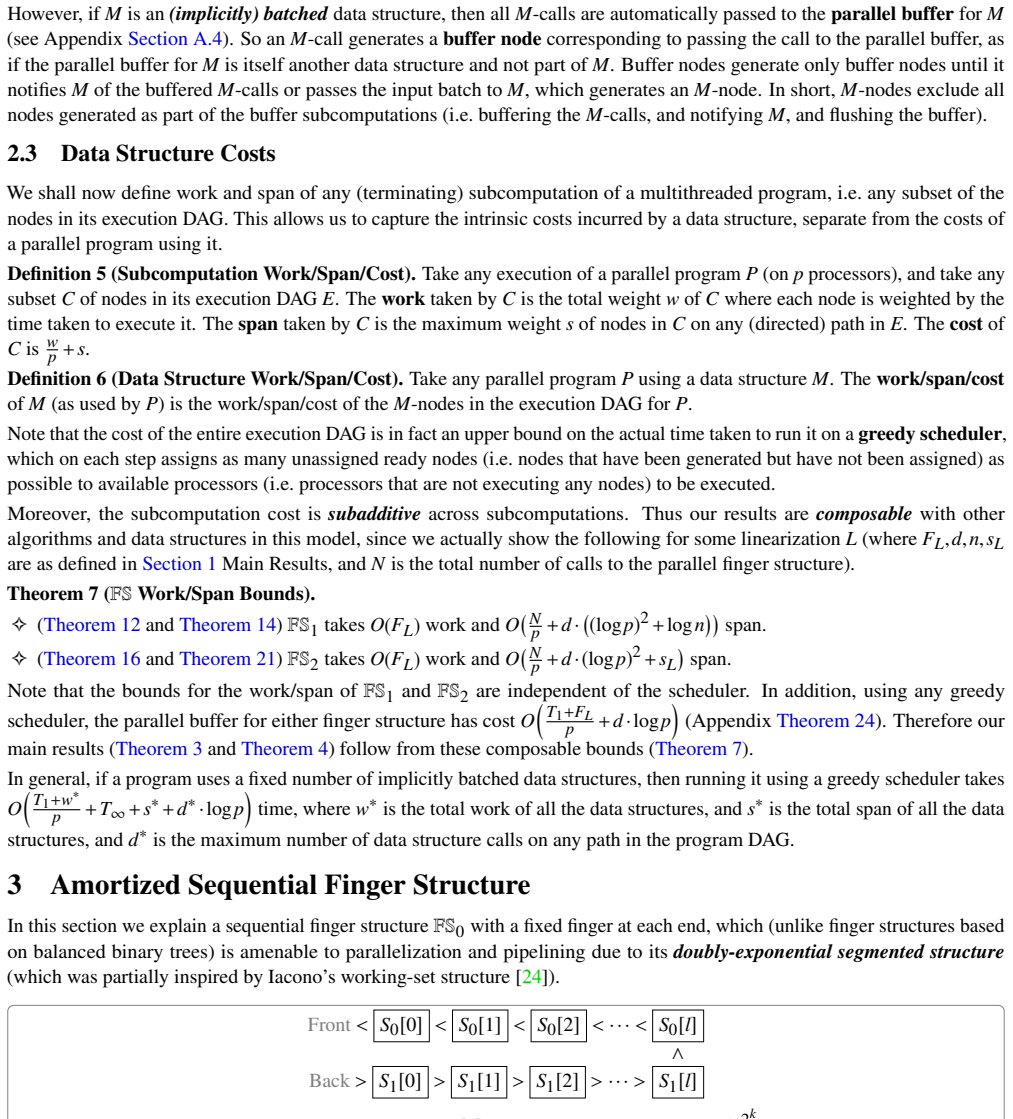
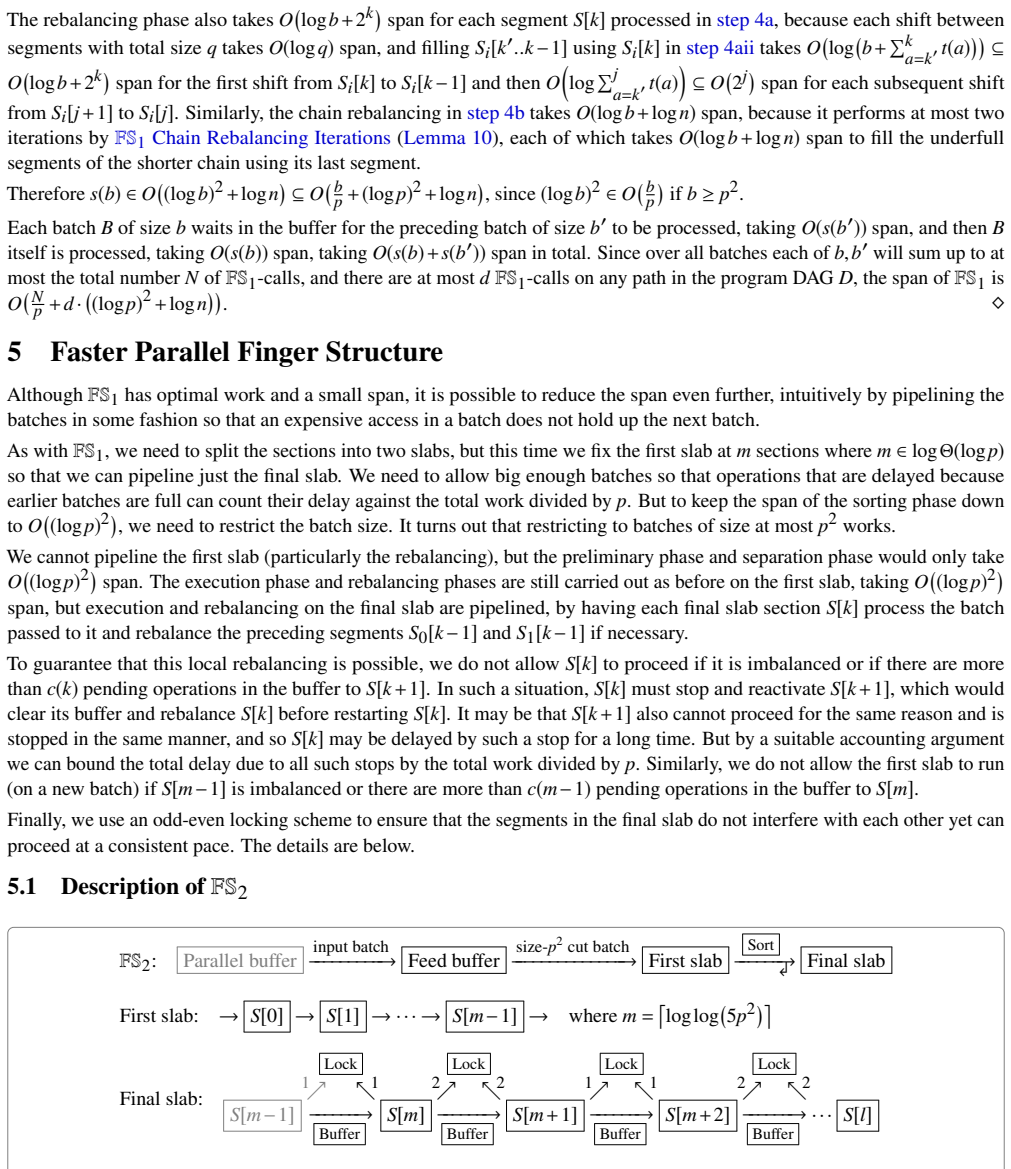
The load-bearing object is the segmented structure with doubly exponential segment sizes. Items are kept in two chains, front and back, with segment $\mathrm{Si}[k]$ a balanced tree of size around $2\cdot c(k)$, where $c(k)=2^{2^{k+1}}$; the first $\Theta(\log\log n)$ segments contain all items very close to a finger. Operations are processed in batches: a preliminary unsorted search of the small segments eliminates ineffectual operations cheaply, residual operations are entropy-sorted and executed as sorted batches on each segment, and rebalancing shifts items between neighbouring segments with a credit invariant that makes all rebalancing $O(1)$ amortized per operation. FS2's extra machinery is an odd-even neighbour-lock pipeline on the larger segments, with a deferral rule that keeps segments balanced and a delay-charging argument bounding the deferment time by $O(N/p)$.
What would settle it
Fix a batch of $b$ insertions and $b$ deletions all targeting the smallest segment, run FS1 on one processor, and instrument the credit invariant: a segment holding $q$ items beyond its target must hold at least $q\cdot 2^{-k}$ credits. If any segment is found with fewer credits, or if total work on such batches grows faster than $O(b)$, the amortized finger-bound claim is false.
Extended reading notes
Core claim
The paper's discovery is that the sequential finger property can be preserved under parallel batching. Its construction FS0 stores the ordered items in two chains of segments whose sizes grow doubly exponentially, $c(k)=2^{2^{k+1}}$; an access at finger distance $r$ lands in a segment of index about $\log\log r$, so searching costs $O(\log r+1)$. FS1 turns FS0 into a batch-parallel structure by filtering each batch through the small segments unsorted, entropy-sorting only the surviving residual operations, and executing them segment by segment; rebalancing is paid for by a stored-credit invariant, $q\cdot 2^{-k}$ credits for a segment $q$ items beyond its target size, giving $O(F_L)$ total work. FS2 adds a pipeline over the larger segments, with neighbour locks and a deferral mechanism, to shrink the data-structure span to $O(N/p + d(\log p)^2 + s_L)$. The results are stated for any program modelled by a DAG and any greedy scheduler, with the guarantee expressed through some linearization $L$ of the data-structure calls consistent with the results. The authors also sketch an extension to a fixed number of movable fingers by concatenating sector-wise basic finger structures.
Load-bearing premise
The argument assumes the batch-parallel dictionary that stores each segment actually performs a batch of $b$ searches in $O(b\log n)$ work with the stated span; these primitives come from a companion paper and are not proved here, so any error in them would invalidate the finger-bound and running-time theorems.
Editorial extensions
If this is right
- If the work bound holds, a program whose calls to FS1 are spread over $p$ processors finishes in $O((T_1+F_L)/p + T_\infty + d((\log p)^2+\log n))$ time, so the structure adds no more than a polylogarithmic penalty per call along a critical path.
- Operations on items close to a finger keep their sequential advantage: an access at finger distance $r$ costs $O(\log r+1)$ amortized work, so local workloads cost far less than $\log n$ per operation.
- FS2's pipelining reduces the per-call span penalty to $O((\log p)^2)$ plus the weighted span $s_L$, meaning expensive far-away accesses no longer hold up later batches except through their own finger cost.
- The same framework supports any fixed number $f$ of movable fingers by concatenating $f+1$ basic finger structures, preserving the finger-bound work and the parallelism bounds.
- The work and span bounds compose with other implicitly batched data structures under greedy scheduling, so the structure can be used as a black box inside a larger multithreaded program.
Reading between the lines
- If the cited batch-parallel map delivers its stated costs, the same segmented skeleton might be reused to parallelize other distribution-sensitive structures, such as a splay-tree-like structure with both working-set and finger properties, which the paper itself raises as an open question.
- A testable consequence not checked in the paper: on workloads with strong locality, FS2 should show speedup scaling with $p$ on clustered insertions and deletions, while random far-apart accesses should approach ordinary balanced-tree costs; this could be benchmarked against batch-parallel balanced trees.
- The guarantee is existential over a chosen linearization $L$ of calls consistent with the results, so an adversary who forces widely separated accesses in every linearization will face costs closer to the balanced-tree bound rather than the finger bound.
- Because the credit invariant is tied to segment sizes rather than the internal map, replacing the 2-3 tree inside each segment with another batch-parallel map should preserve the amortized bounds, enabling cache-optimized or footprint-optimized variants.
Signed reviews
Editorial analysis
A structured set of objections, weighed in public.
Referee Report
Summary. The manuscript presents two parallel finger search structures, FS1 and FS2, in the QRMW pointer-machine model. FS1 processes implicit-batching input batches one at a time, filtering operations through a small first slab by unsorted search before entropy-sorting the remaining operations; FS2 additionally pipelines the final slab using bounded buffers, a feed-buffer of cut batches, and an odd-even neighbour-lock scheme. The paper claims that, for some linearization L of the data-structure calls, each structure performs O(F_L) total work, where F_L is the finger bound, with span O(N/p + d((log p)^2 + log n)) for FS1 and O(N/p + d(log p)^2 + s_L) for FS2, and derives the corresponding end-to-end running times for programs running on a greedy scheduler. The paper also sketches extensions to movable fingers and to work-stealing schedulers. The main technical content is a set of amortized credit arguments for the doubly-exponential segmented layout and a modular cost accounting that separates data-structure work and span from scheduler overhead.
Significance. Modulo the unproved batch-parallel map bounds imported from the companion paper [28], the contribution is substantial. This appears to be the first parallel finger search structure that is work-optimal with respect to the finger bound while maintaining polylogarithmic span overhead, and the modular treatment within the extended implicit batching framework makes the result composable with other data structures. The amortized segment analyses (Lemmas 8, 13, 17) and the span-accounting structure are coherent and clearly presented, and the paper is careful about the computation model, including contention costs. The paper is a purely theoretical analysis; no experimental validation is claimed. The main weakness is self-containment: the central theorems inherit all of their per-segment operation costs from [28], a self-cited arXiv preprint whose results are not proved here. If those bounds are correct and are supplied, the paper meets the bar for a strong theory contribution.
major comments (1)
- [Appendix A.3 (batch-parallel map); used in Sections 4.1 and 5.1] The batch-parallel map bounds are load-bearing and are not proved in this manuscript. Every segment of FS1 and FS2 is stored in a batch-parallel map, and each batch is processed through unsorted batch search, sorted batch access, split and join; Theorems 12, 14, 16 and 21 count these operations as O(b log c(k)) work and O(log b + log c(k)) or O(log b log c(k)) span and then sum these costs to obtain the central O(F_L) work bound and the span bounds. Appendix A.3 states only that these bounds 'can be achieved in the QRMW pointer machine model [28]', where [28] is a self-cited arXiv preprint, and no proof or exact companion-theorem reference is supplied. If the companion map has an extra logarithmic factor, a hidden batch-size restriction, or a hidden dependence on duplicate items, that error propagates directly into every main theorem. Please include a complete proof of the four map primitives, or state and prove the exact theorems of [28] on which the paper relies, so that the central claim is verifiable from this manuscript alone.
minor comments (5)
- [Theorem 12 / Theorem 16 (proofs)] The proofs bound part of the work by F_{L'} and part by F_{L*} and conclude O(max(F_{L*}, F_{L'})); it would be clearer to state explicitly that since max(F_{L*}, F_{L'}) is O(F_L) when L is chosen to be the linearization with the larger finger bound, the theorem's single-linearization form follows. As written, the reader must supply this step.
- [Theorem 21 (FS2 Span)] The sentence 'over all X, each of b, b′, g, i·p2, j·p2 above will sum up to at most the total number N of FS2-calls' is not justified in the text. Because the span bound's O(N/p) term rests on it, please give the charging argument explicitly, in particular why a queued cut batch is charged only once along a given path and why a path contains at most one call from each input batch.
- [Section 4.1 and Figure 2] The definition of m is inconsistent: the text says m = ⌈log log(2b)⌉ + 1 while Figure 2 labels the first slab with m = ⌈log log(2b)⌉. Please align the notation.
- [Section 7] The adaptation to work-stealing schedulers is only sketched; for the claim that the bounds hold on average under a work-stealing scheduler, please provide at least a proof outline with the key lemmas, or explicitly label the section as non-rigorous.
- [Appendix A.3] The sorted batch access primitive is specified as O(b log n) work and O(log b + log n) span; it would help to state whether duplicate keys are allowed in the batch and how they are resolved, since the main text uses the primitive after combining duplicates into group-operations.
Circularity Check
No significant circularity: the finger-structure theorems depend on the companion batch-parallel map [28], but that map is a parameter-free external component whose stated costs do not encode the finger bound.
full rationale
The derivation is modular rather than circular. Section 4.1 says 'The items in each segment are stored in a batch-parallel map (Appendix Section A.3)', and Appendix A.3 states 'This can be achieved in the QRMW pointer machine model [28]'. These map costs enter Theorems 12, 14, 16, and 21 as per-segment operation costs, but [28] (Lim, arXiv:1905.05254) is a companion paper on batch-parallel 2-3 trees whose stated guarantees (O(b log n) work for unsorted batch search, O(b log n) for sorted batch access, and O(log n) for split/join) are parameter-free, are stated for a model that does not include the present finger bound, and are not derived from the finger structure. Invoking [28] is therefore a standard modular reduction, not a self-referential one. No fitted parameter is renamed as a prediction, no uniqueness theorem or ansatz is imported from the authors' prior work, and the amortized credit arguments and pipelining analysis are carried out in the text. The fact that [28] is not re-proved here is a completeness and correctness-risk concern, not circularity.
Assumptions & free parameters
free parameters (4)
- Segment size function c(k) =
c(k) = 2^(2^k+1)
- First slab length m =
m = ceil(log log(5p^2)) for FS2; m = ceil(log log(2b))+1 for FS1
- FS2 cut batch size =
p^2
- Balance slack constants =
target t(k)=2c(k); balance range [c(k), 3c(k)] roughly
assumptions (4)
- ad hoc to paper The batch-parallel map of [28] supports unsorted batch search and sorted batch access with the stated work/span in the QRMW pointer machine model.
- domain assumption The extended implicit batching framework [4] provides a parallel buffer with the properties needed for Theorem 24 (buffer cost O((T1+w)/p + d log p)).
- domain assumption The QRMW pointer machine model and the parallel primitives (fork/join, suspend/resume, non-blocking and dedicated locks, reactivation wrapper) have the stated O(1) time and fairness guarantees.
- standard math Comparison-based sorting lower bound (Lemma 25, from Munro and Spira [30]) and the maximum finger bound relation (Theorem 28).
invented entities (3)
-
Deferred flag per section
-
Feed buffer of bunches
-
Neighbour-lock odd-even locking scheme
Cite this review
Pith. "Pith review of Parallel Finger Search Structures." pith.science (2026). https://pith.science/paper/TQPCONPM
@misc{pith2026190802741,
  author       = {Pith},
  title        = {Pith review of: Parallel Finger Search Structures},
  year         = {2026},
  howpublished = {\url{https://pith.science/paper/TQPCONPM}},
  note         = {Machine review of arXiv:1908.02741}
}
read the original abstract
In this paper we present two versions of a parallel finger structure FS on p processors that supports searches, insertions and deletions, and has a finger at each end. This is to our knowledge the first implementation of a parallel search structure that is work-optimal with respect to the finger bound and yet has very good parallelism (within a factor of O( (log p)^2 ) of optimal). We utilize an extended implicit batching framework that transparently facilitates the use of FS by any parallel program P that is modelled by a dynamically generated DAG D where each node is either a unit-time instruction or a call to FS. The total work done by either version of FS is bounded by the finger bound F[L] (for some linearization L of D ), i.e. each operation on an item with finger distance r takes O( log r + 1 ) amortized work; it is cheaper for items closer to a finger. Running P using the simpler version takes O( ( T[1] + F[L] ) / p + T[inf] + d * ( (log p)^2 + log n ) ) time on a greedy scheduler, where T[1],T[inf] are the size and span of D respectively, and n is the maximum number of items in FS, and d is the maximum number of calls to FS along any path in D. Using the faster version, this is reduced to O( ( T[1] + F[L] ) / p + T[inf] + d * (log p)^2 + s[L] ) time, where s[L] is the weighted span of D where each call to FS is weighted by its cost according to F[L]. We also sketch how to extend FS to support a fixed number of movable fingers. The data structures in our paper fit into the dynamic multithreading paradigm, and their performance bounds are directly composable with other data structures given in the same paradigm. Also, the results can be translated to practical implementations using work-stealing schedulers.
Figures

Reference graph
Works this paper leans on
-
[28]
Optimal Multithreaded Batch-Parallel 2-3 Trees
Wei Quan Lim. Optimal multithreaded batch-parallel 2-3 trees. arXiv:1905.05254, 2019
work page Pith review arXiv 1905
-
[1]
The cb tree: a practical concurrent self-adjusting search tree
Yehuda Afek, Haim Kaplan, Boris Korenfeld, Adam Morrison, and Robert E Tarjan. The cb tree: a practical concurrent self-adjusting search tree. Distributed computing, 27(6):393–417, 2014
work page 2014
-
[2]
Cbtree: A practical concurrent self-adjusting search tree
Yehuda Afek, Haim Kaplan, Boris Korenfeld, Adam Morrison, and Robert Endre Tarjan. Cbtree: A practical concurrent self-adjusting search tree. In DISC, volume 7611 of Lecture Notes in Computer Science, pages 1–15. Springer, 2012
work page 2012
-
[3]
Provably good scheduling for parallel programs that use data structures through implicit batching
Kunal Agrawal, Jeremy T Fineman, Kefu Lu, Brendan Sheridan, Jim Sukha, and Robert Utterback. Provably good scheduling for parallel programs that use data structures through implicit batching. In Proceedings of the 26th ACM symposium on Parallelism in algorithms and architectures, pages 84–95. ACM, 2014
work page 2014
-
[4]
Parallel working-set search structures
Kunal Agrawal, Seth Gilbert, and Wei Quan Lim. Parallel working-set search structures. In Proceedings of the 30th ACM symposium on Parallelism in algorithms and architectures, pages 321–332. ACM, 2018
work page 2018
-
[5]
Fast parallel operations on search trees
Yaroslav Akhremtsev and Peter Sanders. Fast parallel operations on search trees. In 2016 IEEE 23rd International Conference on High Performance Computing (HiPC), pages 291–300. IEEE, 2016
work page 2016
-
[6]
Parallel Combining: Benefits of Explicit Synchronization
Vitaly Aksenov, Petr Kuznetsov, and Anatoly Shalyto. Parallel Combining: Benefits of Explicit Synchronization. In Jiannong Cao, Faith Ellen, Luis Rodrigues, and Bernardo Ferreira, editors, 22nd International Conference on Principles of Distributed Systems (OPODIS 2018), volume 125 of Leibniz International Proceedings in Informatics (LIPIcs), pages 11:1–11:...
work page 2018
-
[7]
Nimar S Arora, Robert D Blumofe, and C Greg Plaxton. Thread scheduling for multiprogrammed multiprocessors.Theory of computing systems, 34(2):115–144, 2001
work page 2001
Show all 38 references
-
[8]
Just join for parallel ordered sets
Guy E Blelloch, Daniel Ferizovic, and Yihan Sun. Just join for parallel ordered sets. In Proceedings of the 28th ACM Symposium on Parallelism in Algorithms and Architectures, pages 253–264. ACM, 2016
2016
-
[9]
Optimal parallel algorithms in the binary-forking model
Guy E Blelloch, Jeremy T Fineman, Yan Gu, and Yihan Sun. Optimal parallel algorithms in the binary-forking model. arXiv preprint arXiv:1903.04650, 2019
1903 arXiv
-
[10]
Blelloch and Margaret Reid-Miller
Guy E. Blelloch and Margaret Reid-Miller. Pipelining with futures. In Proceedings of the ninth annual ACM symposium on Parallel algorithms and architectures, SPAA ’97, pages 249–259, New York, NY , USA, 1997. ACM
1997
-
[11]
Blelloch and Margaret Reid-Miller
Guy E. Blelloch and Margaret Reid-Miller. Fast set operations using treaps. In Proceedings of the tenth annual ACM symposium on Parallel algorithms and architectures, pages 16–26, 1998
1998
-
[12]
Scheduling multithreaded computations by work stealing
Robert D Blumofe and Charles E Leiserson. Scheduling multithreaded computations by work stealing. Journal of the ACM (JACM), 46(5):720–748, 1999
1999
-
[13]
A general technique for non-blocking trees
Trevor Brown, Faith Ellen, and Eric Ruppert. A general technique for non-blocking trees. In ACM SIGPLAN Notices, volume 49, pages 329–342. ACM, 2014
2014
-
[14]
Cormen, Charles E
Thomas H. Cormen, Charles E. Leiserson, Ronald L. Rivest, and Clifford Stein. Introduction to Algorithms. The MIT Press, third edition, 2009
2009
-
[15]
Contention in shared memory algorithms.Journal of the ACM (JACM), 44(6):779–805, 1997
Cynthia Dwork, Maurice Herlihy, and Orli Waarts. Contention in shared memory algorithms.Journal of the ACM (JACM), 44(6):779–805, 1997
1997
-
[16]
The amortized complexity of non-blocking binary search trees
Faith Ellen, Panagiota Fatourou, Joanna Helga, and Eric Ruppert. The amortized complexity of non-blocking binary search trees. In Proceedings of the 2014 ACM symposium on Principles of distributed computing, pages 332–340. ACM, 2014
2014
-
[17]
Non-blocking binary search trees
Faith Ellen, Panagiota Fatourou, Eric Ruppert, and Franck van Breugel. Non-blocking binary search trees. In Proceedings of the 29th ACM SIGACT-SIGOPS Symposium on Principles of Distributed Computing, PODC ’10, pages 131–140, New York, NY , USA, 2010. ACM
2010
-
[18]
Parallel bi-objective shortest paths using weight-balanced b-trees with bulk updates
Stephan Erb, Moritz Kobitzsch, and Peter Sanders. Parallel bi-objective shortest paths using weight-balanced b-trees with bulk updates. In International Symposium on Experimental Algorithms, pages 111–122. Springer, 2014
2014
-
[19]
Kallimanis
Panagiota Fatourou and Nikolaos D. Kallimanis. Revisiting the combining synchronization technique. In PPoPP, pages 257–266, 2012
2012
-
[20]
Leiserson, and Keith H
Matteo Frigo, Charles E. Leiserson, and Keith H. Randall. The implementation of the Cilk-5 multithreaded language. In Proceedings of the ACM SIGPLAN Conference on Programming Language Design and Implementation (PLDI), pages 212–223, 1998
1998
-
[21]
Sorting on a parallel pointer machine with applications to set expression evaluation
Michael T Goodrich and S Rao Kosaraju. Sorting on a parallel pointer machine with applications to set expression evaluation. Journal of the ACM (JACM), 43(2):331–361, 1996
1996
-
[22]
A new representation for linear lists
Leo J Guibas, Edward M McCreight, Michael F Plass, and Janet R Roberts. A new representation for linear lists. In Proceedings of the ninth annual ACM symposium on Theory of computing, pages 49–60. ACM, 1977. 22
1977
-
[23]
Flat combining and the synchronization-parallelism tradeoff
Danny Hendler, Itai Incze, Nir Shavit, and Moran Tzafrir. Flat combining and the synchronization-parallelism tradeoff. In Proceedings of the ACM Symposium on Parallelism in Algorithms and Architectures (SPAA), pages 355–364, 2010
2010
-
[24]
Alternatives to splay trees with O(log n) worst-case access times
John Iacono. Alternatives to splay trees with O(log n) worst-case access times. In Proceedings of the twelfth annual ACM-SIAM symposium on Discrete algorithms, pages 516–522. Society for Industrial and Applied Mathematics, 2001
2001
-
[25]
Intel Cilk Plus Language Extension Specification, Version 1.1 , 2013
Intel Corporation. Intel Cilk Plus Language Extension Specification, Version 1.1 , 2013. Document 324396- 002US. Available from http://cilkplus.org/sites/default/files/open_specifications/Intel_Cilk_ plus_lang_spec_2.htm
2013
-
[26]
An introduction to parallel algorithms, volume 17
Joseph JáJá. An introduction to parallel algorithms, volume 17. Addison-Wesley Reading, 1992
1992
-
[27]
Localized search in sorted lists
S Rao Kosaraju. Localized search in sorted lists. In Proceedings of the thirteenth annual ACM symposium on Theory of computing, pages 62–69. ACM, 1981
1981
-
[29]
Queue locks on cache coherent multiprocessors
Peter Magnusson, Anders Landin, and Erik Hagersten. Queue locks on cache coherent multiprocessors. In Parallel Processing Symposium, 1994. Proceedings., Eighth International, pages 165–171. IEEE, 1994
1994
-
[30]
Sorting and searching in multisets
Ian Munro and Philip M Spira. Sorting and searching in multisets. SIAM journal on Computing, 5(1):1–8, 1976
1976
-
[31]
OpenMP application program interface, version 4.0
OpenMP Architecture Review Board. OpenMP application program interface, version 4.0. Available from http: //www.openmp.org/mp-documents/OpenMP4.0.0.pdf, July 2013
2013
-
[32]
Oyama, K
Y . Oyama, K. Taura, and A. Yonezawa. Executing parallel programs with synchronization bottlenecks efficiently. In Proceedings of the International Workshop on Parallel and Distributed Computing for Symbolic and Irregular Applications (PDSIA), pages 182–204, 1999
1999
-
[33]
Parallel dictionaries on 2–3 trees
Wolfgang Paul, Uzi Vishkin, and Hubert Wagener. Parallel dictionaries on 2–3 trees. Automata, Languages and Programming, pages 597–609, 1983
1983
-
[34]
Intel Threading Building Blocks: Outfitting C++ for Multi-Core Processor Parallelism
James Reinders. Intel Threading Building Blocks: Outfitting C++ for Multi-Core Processor Parallelism. O’Reilly, 2007
2007
-
[35]
Ics 643: Advanced parallel algorithms lecture 10.http://www2.hawaii.edu/~nodari/teaching/ f16/notes/notes10.pdf, 2016
Nodari Sitchinava. Ics 643: Advanced parallel algorithms lecture 10.http://www2.hawaii.edu/~nodari/teaching/ f16/notes/notes10.pdf, 2016
2016
-
[36]
Self-adjusting binary search trees
Daniel Dominic Sleator and Robert Endre Tarjan. Self-adjusting binary search trees. Journal of the ACM (JACM) , 32(3):652–686, 1985
1985
-
[37]
http://msdn.microsoft.com/en-us/magazine/cc163340.aspx, October 2007
The Task Parallel Library. http://msdn.microsoft.com/en-us/magazine/cc163340.aspx, October 2007
2007
-
[38]
Batch-parallel euler tour trees
Thomas Tseng, Laxman Dhulipala, and Guy Blelloch. Batch-parallel euler tour trees. In 2019 Proceedings of the Twenty-First Workshop on Algorithm Engineering and Experiments (ALENEX), pages 92–106. SIAM, 2019. 23
2019
Reviewed August 14, 2026 · model on record in the stance chip above.
Discussion (0). Continue with ORCID to comment.