REVIEW 3 major objections 3 minor 1 cited by
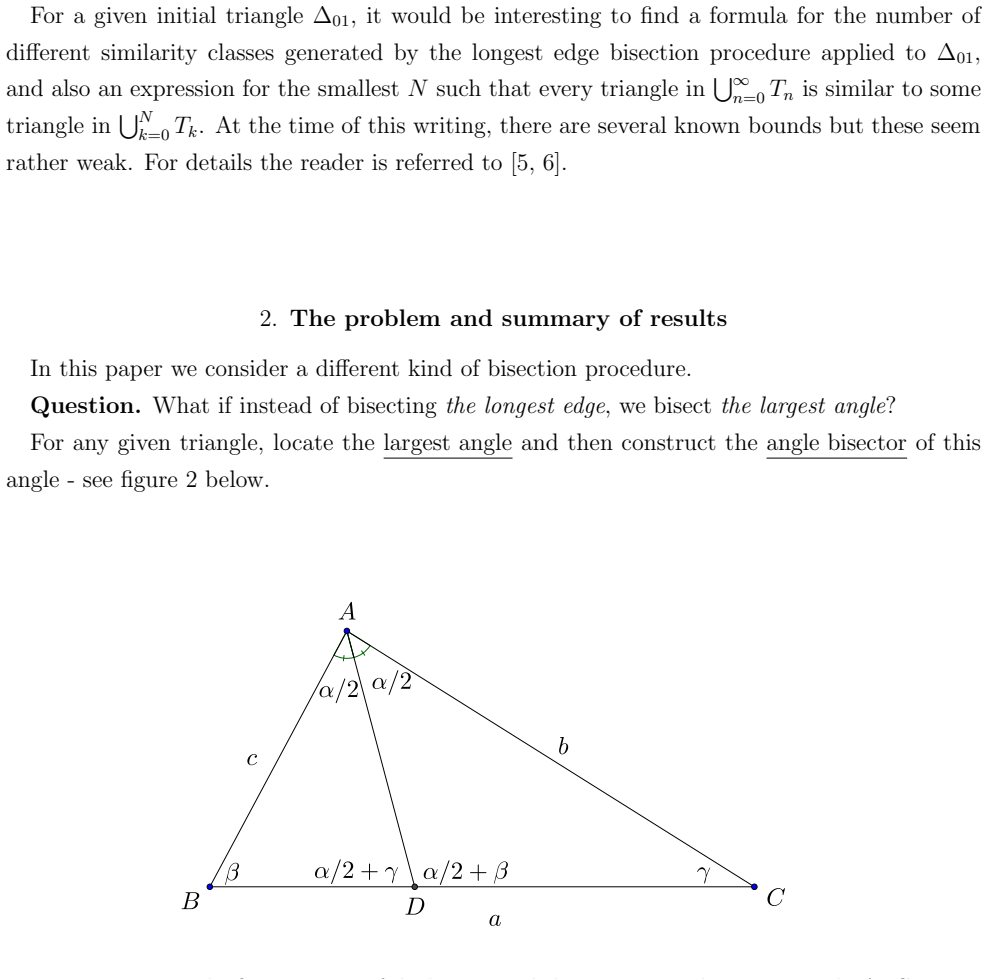
The largest angle bisection procedure
T0 review · 3 major / 3 minor · reviewed 2026-08-14 · deepseek-v4-flash
Pith's one-line read This paper proves that repeatedly bisecting the largest angle of a triangle makes every triangle diameter shrink to zero while smallest angles stay bounded away from zero.
desk verdict A clean, complete treatment of largest-angle bisection; the mesh-decay proof is sound, with only minor exposition issues. read the letter →
The pith
A machine-rendered reading of the paper's core claim, the machinery that carries it, and where it could break.
The reading
What carries the argument
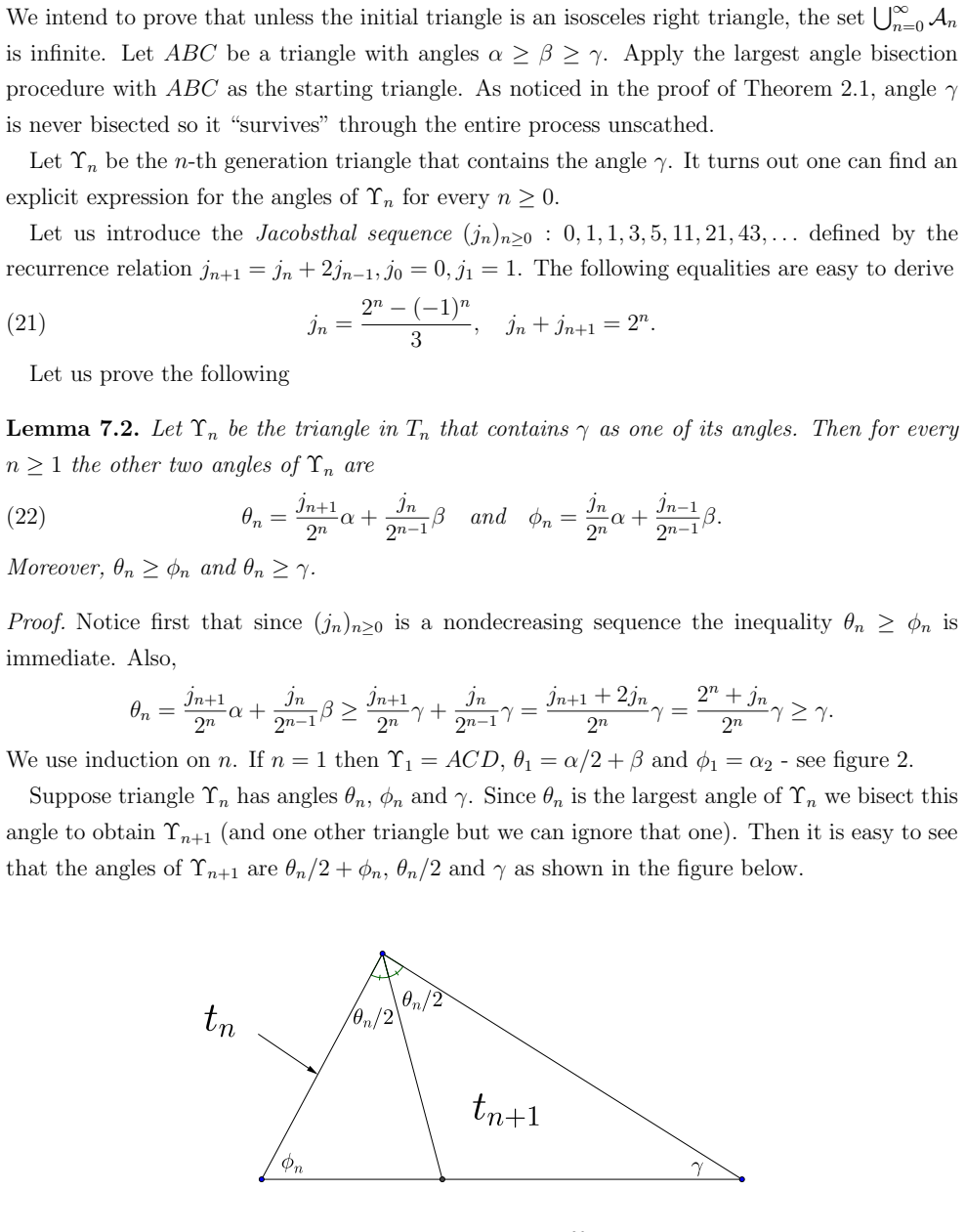
The central object is the aspect ratio r(T)=a/(b+c), with a the longest side; it lies strictly between 1/2 and 1 and can be written as sin(α/2)·sec((β−γ)/2). The paper's key lemma (5.1) shows that after two bisection steps, no descendant has aspect ratio larger than ρ0=max(r0,r1,√3/2), where r0 is the aspect ratio of the initial triangle and r1 is the aspect ratio of its first-generation child that contains the smallest angle. Because the same argument applies to any triangle as the parent, the maximum aspect ratio of generation n+2 is bounded by the maximum of the parent and child generations, so ρ_n=max(r_n,r_{n+1},√3/2) is nonincreasing. Feeding this into a two-step comparison of longest sides yields m_{n+2} ≤ m_n ρ_n ≤ m_n ρ_0. For the similarity-type half of the paper, the machinery is the Jacobsthal sequence j_n=(2^n−(−1)^n)/3, which gives explicit formulas for the two angles of the unique n-th generation triangle that still contains the original smallest angle γ, and proves those largest angles are all distinct unless α=2β.
What would settle it
Run a fine angle-triple search over α ≥ β ≥ γ with sum 180°; for each, compute r0, r1 and the four second-generation aspect ratios and check whether all four lie under max(r0, r1, √3/2). A single violation would overturn the exponential mesh decay proof.
Extended reading notes
Core claim
On its own terms, the paper's central discovery is that the largest-angle bisection procedure is a well-behaved triangle refinement scheme. Writing r(T) for the aspect ratio longest side over the sum of the other two sides, and letting ρ0 = max(r0, r1, √3/2) where r0 and r1 are the aspect ratios of the initial triangle and of its child containing the smallest angle, the authors prove that the n-th generation mesh satisfies m_n ≤ m0 $ρ0^{{⌊n/2⌋}}$. Since ρ0 < 1, the mesh tends to 0. They also prove the exact angle bound γ_n = min(γ, α/2) for all n ≥ 1, and show that the set of similarity types is infinite for every starting triangle except the isosceles right triangle, which produces a single repeating shape.
Load-bearing premise
The decay bound rests on the trigonometric case analysis in Lemma 5.1, which asserts that no second-generation triangle has aspect ratio above max(r0, r1, √3/2); if any of its inequalities fails for some triangle, the exponential convergence to zero is unproven.
Editorial extensions
If this is right
- For every starting triangle, the mesh of the n-th generation decays to 0 at least like a geometric sequence, so the refinement rule is convergent in the sense used in finite-element mesh generation.
- The smallest angle bound γ_n = min(γ, α/2) means no angle ever tends to 0, the property that rules out Schwarz-type area paradoxes in surface approximation.
- Except for isosceles right triangles, the number of dissimilar triangles grows without bound, so the procedure is fundamentally different from the longest-edge bisection, which yields only finitely many similarity classes.
- The decay rate is triangle-dependent through ρ0, not a universal constant; very thin initial triangles can be refined arbitrarily slowly.
- The formulas for the angles of Υ_n give a complete description of the one descendant that preserves the original smallest angle through all bisections.
Reading between the lines
- The definition leaves tie-breaking unspecified when two angles tie for largest; the proofs work with an ordering α ≥ β ≥ γ, and the reader may want to check whether the same ρ0 bound survives every tie-breaking choice.
- The aspect-ratio bound suggests a simple stopping criterion for practical refinement: once ρ0 is close to 1, further bisections yield little diameter gain, so a mesh generator could switch to a different rule.
- The Jacobsthal angle formulas might allow counting how many similarity classes appear by iteration n, or identifying the first n at which a new class appears, a problem left open here.
Signed reviews
Editorial analysis
A structured set of objections, weighed in public.
Referee Report
Summary. The paper introduces the largest angle bisection procedure for triangles, in which at each step the angle bisector of a largest angle is drawn, and studies the three questions analogous to those posed by Rosenberg and Stenger for the longest edge bisection method. The authors prove that the smallest angle among all 2^n triangles is bounded below by min(γ, α/2), that the mesh size m_n (the longest side among all triangles) converges to 0 at a geometric rate controlled by the first two generations and an absolute constant √3/2, and that, with the single exception of the isosceles right triangle, the number of dissimilar similarity types grows without bound. The main technical contribution is a detailed trigonometric case analysis bounding the aspect ratio r = (longest side)/(sum of the other two sides) of second-generation triangles, which is then propagated by an induction to give m_n → 0.
Significance. The paper cleanly answers a natural variant of a classical problem in computational geometry, and the contrast with the longest edge bisection procedure—finite versus infinite similarity types—is a valuable addition to the literature. The proofs are self-contained, the constants are explicit, and the aspect ratio is defined within the paper rather than fitted, so the results are genuinely predictive. The mesh-decay proof is nontrivial and the accompanying trigonometric estimates are mostly rigorous and detailed. If the small gaps identified below are corrected, the paper will be a solid contribution to the study of triangle subdivision schemes.
major comments (3)
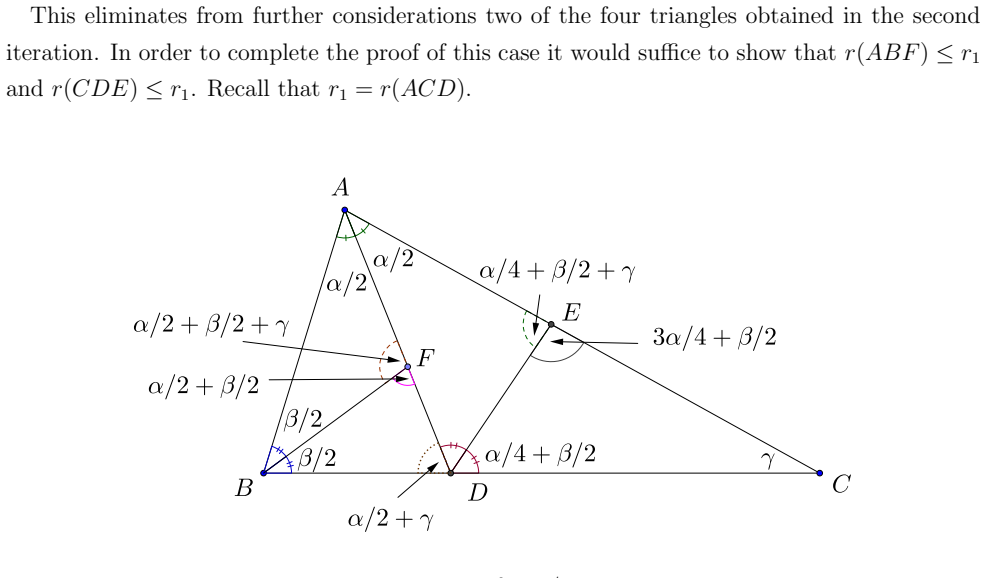
- [Section 5, Lemma 5.1, Subcase 2.1] In the proof of the inequality r(CDE) ≤ r0, the displayed equivalence after applying the product-to-sum identity is incorrect as written: the difference of sines reduces to sin((α - 2β)/8) · cos((α + β - γ)/2) ≥ 0, not sin((α - 2β)/2) · cos((α + β - γ)/2) ≥ 0. The stated inequality is nevertheless true in this subcase because α ≥ 2β and α + β - γ < 180°, so the proof is repairable, but the false identity occurs in the central lemma on which the mesh-decay theorem rests and should be corrected.
- [Section 2, definition of the procedure] The largest angle bisection procedure is not uniquely specified when the largest angle is not unique, e.g., when α = β or the triangle is equilateral. The proofs throughout assume a fixed labeling α ≥ β ≥ γ and treat the angle α as the one bisected, but no tie-breaking rule is stated and the independence of the results from the choice of an equally large angle is not discussed. Since the theorems are claimed for the procedure as defined, the authors should either specify a tie-breaking rule or explicitly argue that the main results hold for any choice of largest angle when ties occur.
- [Section 7, Lemma 7.3] In the proof of Lemma 7.3, the deduction from equations (24) and (25) divides by the coefficient j_q/2^{q-1} - j_p/2^{p-1} and implicitly assumes that this coefficient is nonzero for p ≠ q. The paper does not justify this division. The needed fact is that the sequence n ↦ j_n/2^{n-1} is injective for n ≥ 1, which follows quickly from (21), but this observation should be stated, otherwise the proof has a gap.
minor comments (3)
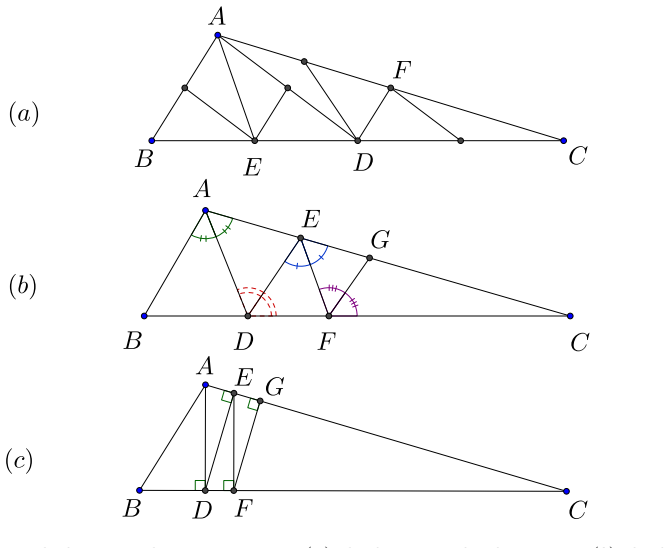
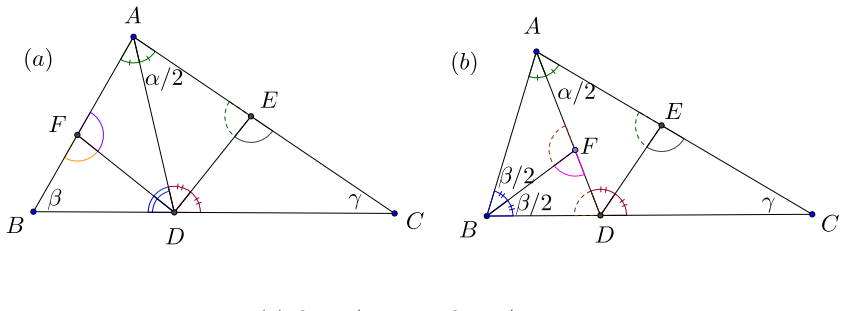
- [Section 6, Lemma 6.1] In the case split of the n = 0 argument, the text states 'It remains to see what happens if β ≥ α + γ/2.' This should read β ≥ α/2 + γ, since α + γ/2 is always larger than α and cannot occur with β ≤ α.
- [Section 6, Lemma 6.1] The phrase 'Segment BF is the angle bisector corresponding to the largest side of triangle ABD' is imprecise: BF is the internal angle bisector of the largest angle of triangle ABD, not the bisector of the largest side. The subsequent use of inequality (10) is correct, but the wording should be adjusted.
- [Section 7, proof of Theorem 7.4] In the case α = 2β, when applying the earlier reasoning to triangle ABD, the paper does not explicitly verify that the angles of ABD satisfy the required order and that the smallest angle β is indeed never bisected. This is true, but a short remark would help the reader.
Circularity Check
No circularity found: all main theorems follow from explicit derivations starting from the procedure's definition.
full rationale
The derivation chain is self-contained. The central quantity is the aspect ratio r(ABC) = a/(b+c), introduced in Definition 4.1 and expressed in angles in equation (9). The paper then defines r0 = r(ABC), r1 = r(ACD), and rho0 = max(r0, r1, sqrt(3)/2). These quantities are not fitted to the target mesh decay; they are computed from the first two generations of the procedure using elementary geometry. Lemma 5.1 proves, by a trigonometric case analysis, that all second-generation aspect ratios are bounded by max(r0, r1, sqrt(3)/2). This is a genuine mathematical proof, not an assumption or a redefinition. Corollary 5.3 propagates the bound to all generations by applying Lemma 5.1 to an arbitrary nth-generation triangle, and Lemma 6.1 obtains the corresponding bound on the mesh m_{n+2} <= m_n * rho_n. Theorem 7.1 then iterates these inequalities to obtain m_n <= m0 * rho0^{floor(n/2)}, with rho0 < 1 because every aspect ratio is < 1 by the triangle inequality and sqrt(3)/2 < 1. The proof of Theorem 2.1 is a direct induction on angles, and Theorem 7.4 uses the explicit Jacobsthal-sequence formula for the angles of the triangle containing the original smallest angle, Lemma 7.3 giving injectivity of theta_n when alpha != 2 beta. No load-bearing step is justified by citing the authors' own prior work; citations to Rosenberg-Stenger, Kearfott, Stynes, and Adler are used only as background and comparison for the previously studied longest-edge bisection procedure. No uniqueness theorem is imported from the authors, and no ansatz is smuggled in via citation. The only noted blemish is an underspecified tie-breaking convention for equal largest angles, but this is a completeness issue, not circularity, since the proofs can absorb any tie-breaking choice by relabeling angles. Thus the paper's claims are derived from its definitions and standard trigonometry, with no circular reduction from outputs back to inputs.
Assumptions & free parameters
assumptions (3)
- standard math Every nondegenerate triangle has angles summing to 180 degrees and satisfies the strict triangle inequality.
- standard math The angle bisector theorem and the laws of sines and cosines are valid.
- standard math Trigonometric product-to-sum identities are applied correctly.
Cite this review
Pith. "Pith review of The largest angle bisection procedure." pith.science (2026). https://pith.science/paper/TBF7ON7W
@misc{pith2026190802749,
  author       = {Pith},
  title        = {Pith review of: The largest angle bisection procedure},
  year         = {2026},
  howpublished = {\url{https://pith.science/paper/TBF7ON7W}},
  note         = {Machine review of arXiv:1908.02749}
}
abstract
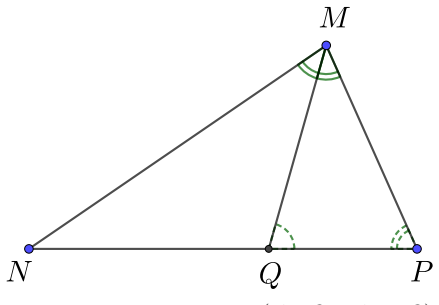
The {\it largest angle bisection} procedure is the operation which partitions a given triangle, $T$, into two smaller triangles by constructing the angle bisector of the largest angle of $T$. Applying the procedure to each of these two triangles produces a partition of $T$ into four smaller triangles. Continuing in this manner, after $n$ iterations, the initial triangle is divided into $2^n$ small triangles. We prove that as $n$ approaches infinity, the diameters of all these $2^n$ triangles tend to $0$, the smallest angle of all these triangles is bounded away from $0$, and that, with the exception of $T$ being an isosceles right triangle, the number of dissimilar triangles is unbounded.
Figures

Figures from the paper (5 more)

Forward citations
Cited by 1 Pith paper
-
On Triangulations Generated by the Largest-Angle $n$-Section Algorithm
For every n≥2, largest-angle n-section produces triangles whose angles stay bounded below and above, and whose diameters shrink to zero.
Reference graph
Works this paper leans on
-
[1]
Adler, On the bisection method for triangles
A. Adler, On the bisection method for triangles. Math. Comp. 40 (1983), no. 162, 571-574
work page 1983
-
[2]
Kearfott, A proof of convergence and an error bound for the method of bisection in Rn
B. Kearfott, A proof of convergence and an error bound for the method of bisection in Rn. Math. Comp. 32 (1978), no. 144, 1147-1153
work page 1978
-
[3]
I. G. Rosenberg and F. Stenger, A lower bound on the angles of triangles constructed by bisecting the longest side, Math. Comp. 29 (1975), 390-395
work page 1975
-
[4]
M. C. Rivara, LEPP-bisection algorithms, applications and mathematical properties. Appl. Numer. Math. 59 (2009), no. 9, 2218-2235
work page 2009
-
[5]
M. C. Rivara and G. Iribarren, The 4-triangles longest-side partition of triangles and linear refinement algo- rithms. Math. Comp. 65 (1996), no. 216, 1485-1502
work page 1996
- [6]
-
[7]
H. A. Schwarz, Sur une d´ efinition erron´ ee de l’aire d’une surface courbe,Gesammelte Mathematische Abhand- lungen von H. A. Schwarz , vol. 2, 1890, 309–311
-
[8]
Stynes, On faster convergence of the bisection method for all triangles
M. Stynes, On faster convergence of the bisection method for all triangles. Math. Comp. 35 (1980), no. 152, 1195-1201
work page 1980
Show all 9 references
-
[9]
Stynes, On faster convergence of the bisection method for certain triangles
M. Stynes, On faster convergence of the bisection method for certain triangles. Math. Comp. 33 (1979), no. 146, 717-721. Mathematics Department, Hofstra University, Hempstead, NY 11549 E-mail address : dan.p.ismailescu@hofstra.edu Fort Lee High School, NJ 07024 E-mail address ...
1979
Reviewed August 14, 2026 · model on record in the stance chip above.
Discussion (0). Continue with ORCID to comment.