REVIEW 3 major objections 5 minor 52 references
Valence bond solid and possible deconfined quantum criticality in an extended kagome lattice Heisenberg antiferromagnet
T0 review · 3 major / 5 minor · reviewed 2026-08-14 · deepseek-v4-flash
Pith's one-line read This paper reports conclusive numerical evidence for a stable diamond valence-bond solid (VBS) with a 12-site unit cell in an extended kagome Heisenberg antiferromagnet with ferromagnetic further-neighbor couplings, located between the…
desk verdict Solid ED evidence for a diamond VBS in an extended kagome model, but the 'conclusive thermodynamic' claim outruns the finite-size data. read the letter →
The pith
A machine-rendered reading of the paper's core claim, the machinery that carries it, and where it could break.
The reading
What carries the argument
The central tools are (i) the connected dimer-dimer correlation function $D_{kl}$ and its predicted sign pattern for the diamond VBS, aggregated into an order parameter $O_{\mathrm{VBS}}$ with a sign mask $\theta_{\mathrm{VBS}}$; (ii) tower-of-states spectroscopy, comparing momentum and space-group quantum numbers of the first excited state against predictions for each candidate phase; and (iii) a 36-site cluster whose Brillouin zone contains both the $K$ and $M$ points needed to distinguish $\sqrt{3}\times\sqrt{3}$ and q=0 orders. The dimer sign structure fingerprints the VBS; the space-group quantum numbers (e.g., a low-lying $\Gamma.D6.E2$ singlet and the absence of a low-lying $\Gamma.D6.A2$ level) discriminate the resonant diamond VBS from the static pinwheel VBS.
What would settle it
Compute the diamond-VBS order parameter $O_{\mathrm{VBS}}$ and the low-lying spectrum on substantially larger clusters (e.g., N=72 or N=96) with the same shape and perform a finite-size scaling: if $O_{\mathrm{VBS}}$ extrapolates to zero or the characteristic $M.D2.A2$ and $\Gamma.D6.E2$ singlet levels cease to be the lowest excitations, the VBS phase is a finite-size artifact. Alternatively, a direct measurement of the energy gap at the q=0/VBS transition would settle whether it closes continuously (deconfined) or jumps (first order).
Extended reading notes
Core claim
For the model of Eq. (1) with $J_1>0$ and ferromagnetic $J_2,J_3<0$, exact diagonalization of the 36-site kagome cluster (and selected 48-site data) shows a parameter region where the ground state has a singlet first excitation in the $M.D2.A2$ sector and strong, sign-coherent dimer-dimer correlations matching a diamond VBS: a 12-site unit cell of resonating dimers arranged in diamond lozenges. The paper concludes that this VBS is a stable phase of the model, distinct from both adjacent magnetic orders and from the pinwheel VBS, and that the transition between q=0 order and the VBS is likely continuous, putting it forward as a possible deconfined quantum critical point. It also reports a separate lattice-symmetry-breaking phase, possibly spin-nematic with quadrupolar correlations, near the ferromagnetic region.
Load-bearing premise
The load-bearing premise is that the 36-site periodic cluster, with selected 48-site data, represents the thermodynamic limit: the low-lying quantum numbers and the dimer-correlation sign pattern identifying the diamond VBS are assumed not to reorder or vanish on larger or differently shaped clusters.
Editorial extensions
If this is right
- The VBS is a stable zero-temperature phase of the extended kagome model, so the phase diagram of frustrated kagome magnets includes a spin-gapped, symmetry-breaking singlet phase alongside magnetic orders and spin liquids.
- If the q=0-to-VBS transition is indeed continuous, this model becomes a concrete lattice example where deconfined quantum criticality, with emergent fractionalized excitations at the critical point, can be studied numerically.
- The diamond VBS reaching close to the nearest-neighbor point provides a concrete competing scenario for interpreting the nature of the nearest-neighbor kagome Heisenberg ground state.
- The likely spin-nematic phase near the ferromagnet shows that lattice-symmetry breaking without conventional magnetic order can appear in this model, with quadrupolar correlations as a fingerprint.
Reading between the lines
- If the continuous q=0/VBS transition survives larger-scale study, the model becomes a rare lattice example where deconfined quantum criticality can be probed by exact numerics and possibly emulated on quantum simulators.
- The diamond-lozenge resonance pattern suggests a natural connection to the Dirac spin liquid: the VBS can be viewed as a confinement of spinon excitations, and one testable extension is to compute the central charge or gap closure at the critical point on cylindrical clusters.
- In kagome compounds with competing ferromagnetic couplings, the predicted 12-site superlattice should show up as a characteristic low-temperature lattice distortion or a structural signature in scattering experiments.
Signed reviews
Editorial analysis
A structured set of objections, weighed in public.
Referee Report
Summary. The manuscript studies the spin-1/2 kagome lattice Heisenberg antiferromagnet with ferromagnetic second- and third-neighbor couplings (Eq. 1) by exact diagonalization on clusters up to N=48. It reports a diamond valence-bond solid with a 12-site unit cell in a parameter region between q=0 and sqrt(3)xsqrt(3) magnetic orders, identified through dimer correlations (Eqs. 5-7), an order parameter (Eq. 7), and low-energy spectrum quantum numbers. A second lattice-symmetry-breaking, possibly spin-nematic phase is reported near the ferromagnetic boundary. The authors also suggest that the q=0-to-VBS transition may be a continuous deconfined quantum critical point.
Significance. If the central claim holds, the paper identifies a new VBS phase in a well-studied frustrated magnet and provides a concrete candidate for deconfined quantum criticality. The strengths are the use of exact diagonalization, consistent quantum-number analysis across N=24, 36, and 48 clusters for the VBS spectral fingerprints, and the explicit dimer-correlation sign patterns. However, the thermodynamic-limit conclusion rests on a small number of cluster sizes with no systematic finite-size scaling, so the evidence as presented is suggestive rather than conclusive.
major comments (3)
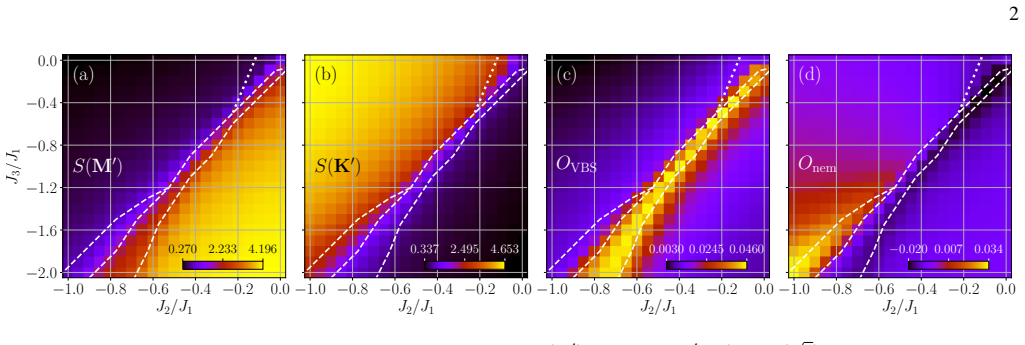
- [Diamond VBS phase] The central claim of a thermodynamic-limit VBS phase relies on the order parameter O_VBS in Eq. (7), but Fig. 2(c) and the main text present it only on the 36-site cluster; the N=48 results are limited to dimer correlations in Fig. 3. Because the 36-site cluster contains only three 12-site unit cells and is commensurate with the proposed diamond pattern, a finite-size artifact cannot be excluded without a scaling analysis of O_VBS (or of an equivalent correlation ratio) over several cluster sizes and shapes. The statement in the introduction that the paper presents 'conclusive numerical evidence' for the VBS phase is therefore overstated; the evidence is consistent with VBS order but does not yet establish it.
- [Diamond VBS phase] The distinction between the diamond and pinwheel VBS, which is load-bearing for the identification, is made through the presence of a singlet Γ.D6.E2 level and the absence of Γ.D6.A2, described qualitatively by 'close inspection' of Fig. 4(a)&(c). The paper does not report the numerical energies or gaps of these levels, nor their system-size dependence. Please provide a quantitative table or plot of these levels on the clusters used, so the reader can verify that the level ordering is robust.
- [Discussion and Outlook] The phase diagram in Fig. 1 and the 'apparent second-order nature' of the q=0–VBS transition are inferred from first-excitation quantum numbers and order parameters on a single 36-site cluster, with boundary lines explicitly marked as a guide to the eye. No finite-size crossing, gap scaling, or order-parameter extrapolation is presented that would support a continuous transition or deconfined quantum criticality. The 'possible deconfined quantum criticality' claim should be framed as a speculation, or the scaling evidence should be added.
minor comments (5)
- [Introduction] The phrase 'conclusive numerical evidence' in the abstract and introduction should be tempered given the finite-size limitations noted above.
- [Fig. 2 caption] The Fig. 2(d) caption calls Onem the 'plaquette-nematic phase' while the text calls it 'spin nematic'; unify the terminology.
- [Diamond VBS phase] Eq. (6) defines only the Sz component of the dimer correlation, whereas Eq. (5) is rotationally invariant; the text should state explicitly that Eq. (6) is used only to display the sign pattern.
- [Magnetic order] The structure factor in Eq. (2) uses the extended Brillouin zone without defining the reciprocal lattice vectors; a brief definition would help the reader.
- [Diamond VBS phase] The sign patterns theta_VBS and theta_nem are essential for reproducibility but are only cited to the supplementary material; they should be included in the main text or appendix.
Circularity Check
No circularity: the VBS claim is a direct numerical ED result, corroborated by independent order parameters and spectral fingerprints.
full rationale
The derivation chain is not circular. The central claim ('conclusive numerical evidence' for a diamond VBS phase) rests on exact-diagonalization data on N=36 and N=48 clusters: spin structure factors S(M') and S(K'), the dimer-correlation-based order parameter O_VBS, and tower-of-states quantum numbers. O_VBS is not equivalent to the conclusion by construction: it is a measured overlap of the ground-state dimer correlations with a hypothesized sign pattern, and its value could in principle be small or negative; the paper separately identifies the phase region using the first-excitation quantum numbers (pink region: S=0, M.D2.A2) and distinguishes diamond from pinwheel VBS by the presence of a low-lying singlet Γ.D6.E2 level rather than by the order parameter. No fitted parameter is later presented as a prediction, and no uniqueness theorem or ansatz is imported from the authors' prior work to force the choice. Self-citations ([25], [35], [36]) are either computational methodology or prior numerical observations cited as context, not as load-bearing justification for the new phase. The acknowledged limitations (approximate phase boundaries, 'guide to the eye', unresolved characterization of the nematic phase, no systematic extrapolation) are finite-size and completeness concerns, not circularity. The paper is self-contained against its external benchmarks (classical phase diagram and known spectral predictions), so the appropriate finding is no significant circularity.
Assumptions & free parameters
assumptions (5)
- domain assumption Finite-size clusters N=36 and 48 with periodic boundary conditions are representative of the thermodynamic limit for the phases identified.
- domain assumption Tower-of-states analysis, comparing the quantum numbers of low-lying ED eigenstates with theoretical predictions, identifies the spontaneous symmetry breaking of the thermodynamic ground state.
- domain assumption The candidate diamond and pinwheel VBS model states, and their spectral decomposition in the supplementary material, provide a complete set of distinguishing low-energy quantum numbers.
- domain assumption The order-parameter sign patterns theta_VBS and theta_nem are correct fingerprints of the respective orders.
- domain assumption The apparent second-order character of the q=0 to VBS transition on finite clusters persists in the thermodynamic limit.
Cite this review
Pith. "Pith review of Valence bond solid and possible deconfined quantum criticality in an extended kagome lattice Heisenberg antiferromagnet." pith.science (2026). https://pith.science/paper/JUVQMM2E
@misc{pith2026190802762,
  author       = {Pith},
  title        = {Pith review of: Valence bond solid and possible deconfined quantum criticality in an extended kagome lattice Heisenberg antiferromagnet},
  year         = {2026},
  howpublished = {\url{https://pith.science/paper/JUVQMM2E}},
  note         = {Machine review of arXiv:1908.02762}
}
abstract
We present numerical evidence for the emergence of an extended valence bond solid (VBS) phase at $T=0$ in the kagome $S=1/2$ Heisenberg antiferromagnet with ferromagnetic further-neighbor interactions. The VBS is located at the boundary between two magnetically ordered regions and extends close to the nearest-neighbor Heisenberg point. It exhibits a diamond-like singlet covering pattern with a $12$-site unit-cell. Our results suggest the possibility of a direct, possibly continuous, quantum phase transition from the neighboring $\mathbf{q}=0$ coplanar magnetically ordered phase into the VBS phase. Moreover, a second phase which breaks lattice symmetries, and is of likely spin-nematic type, is found close to the transition to the ferromagnetic phase. The results have been obtained using numerical Exact Diagonalization. We discuss implications of our results on the nature of nearest-neighbor Heisenberg antiferromagnet.
Figures


Figures from the paper (1 more)

Reference graph
Works this paper leans on
-
[1]
Spin liquids in frustrated magnets,
Leon Balents, “Spin liquids in frustrated magnets,” Nature 464, 199–208 (2010)
work page 2010
-
[2]
Quantum spin liquids: a re- view,
Lucile Savary and Leon Balents, “Quantum spin liquids: a re- view,” Reports on Progress in Physics80, 016502 (2016)
work page 2016
-
[3]
for q = 0 order, (3) K′ = (8π/3, 0) for √ 3× √ 3 order, (4) in the extended Brillouin zone, cf. [30]. Hence, S(M′) and S(K′) shown in Fig. 2(a) and (b) identify both magnetic phases, respectively. The regions where these structure factors are peaked coincide with the blue and green regions in Fig. 1. The blue region in Fig. 1(a) is given by the points, wh...
-
[4]
On nextnearest- neighbor interaction in linear chain. i,
Chanchal K. Majumdar and Dipan K. Ghosh, “On nextnearest- neighbor interaction in linear chain. i,” Journal of Mathematical Physics 10, 1388–1398 (1969)
work page 1969
-
[5]
Planar pyrochlore: A valence-bond crystal,
J.-B. Fouet, M. Mambrini, P. Sindzingre, and C. Lhuillier, “Planar pyrochlore: A valence-bond crystal,” Phys. Rev. B 67, 054411 (2003)
work page 2003
-
[6]
Matthieu Mambrini, Andreas L ¨auchli, Didier Poilblanc, and Fr´ed´eric Mila, “Plaquette valence-bond crystal in the frustrated heisenberg quantum antiferromagnet on the square lattice,” Phys. Rev. B 74, 144422 (2006)
work page 2006
-
[7]
Valence-bond crystal phase of a frustrated spin-1/2 square-lattice antiferromagnet,
M. E. Zhitomirsky and Kazuo Ueda, “Valence-bond crystal phase of a frustrated spin-1/2 square-lattice antiferromagnet,” Phys. Rev. B 54, 9007–9010 (1996)
work page 1996
-
[8]
Yasir Iqbal, Federico Becca, and Didier Poilblanc, “Valence- bond crystal in the extended kagome spin- 1 2 quantum heisen- berg antiferromagnet: A variational monte carlo approach,” Phys. Rev. B 83, 100404(R) (2011)
work page 2011
Show all 52 references
-
[9]
Pinwheel valence-bond solid and triplet excitations in the two-dimensional deformed kagome lattice,
K. Matan, T. Ono, Y . Fukumoto, T. J. Sato, J. Yamaura, M. Yano, K. Morita, and H. Tanaka, “Pinwheel valence-bond solid and triplet excitations in the two-dimensional deformed kagome lattice,” Nature Physics6, 865–869 (2010)
2010
-
[10]
A pinwheel without wind,
Christian R ¨uegg, “A pinwheel without wind,” Nature Physics 6, 837–838 (2010)
2010
-
[11]
Possible valence-bond condensation in the frustrated cluster magnet LiZn2Mo3O8,
J. P. Sheckelton, J. R. Neilson, D. G. Soltan, and T. M. Mc- Queen, “Possible valence-bond condensation in the frustrated cluster magnet LiZn2Mo3O8,” Nature Materials 11, 493 – 496 (2012)
2012
-
[12]
Team of rivals in a kagome material: Quan- tum spin liquid, spin order, and valence bond crystal,
Rebecca W. Smaha, Wei He, Jack Mingde Jiang, Charles J. Ti- tus, Jiajia Wen, Yi-Fan Jiang, John P. Sheckelton, Suyin Grass Wang, Yu-Sheng Chen, Simon J. Teat, Adam A. Aczel, Yang Zhao, Guangyong Xu, Jeffrey W. Lynn, Hong-Chen Jiang, and Young S. Lee, “Team of rivals in a kagom...
2019 arXiv
-
[13]
Spinpeierls and spinliquid phases of kagom quantum antiferromagnets,
J. B. Marston and C. Zeng, “Spinpeierls and spinliquid phases of kagom quantum antiferromagnets,” Journal of Applied Physics 69, 5962–5964 (1991)
1991
-
[14]
Numerical studies of a 36-site kagome antiferromagnet,
P. W. Leung and Veit Elser, “Numerical studies of a 36-site kagome antiferromagnet,” Phys. Rev. B47, 5459–5462 (1993)
1993
-
[15]
Physics of low-energy singlet states of the kagome lattice quantum heisenberg antiferromagnet,
P. Nikolic and T. Senthil, “Physics of low-energy singlet states of the kagome lattice quantum heisenberg antiferromagnet,” Phys. Rev. B 68, 214415 (2003)
2003
-
[16]
Ground state of the spin- 1/2 kagome-lattice heisenberg antiferromagnet,
Rajiv R. P. Singh and David A. Huse, “Ground state of the spin- 1/2 kagome-lattice heisenberg antiferromagnet,” Phys. Rev. B 76, 180407(R) (2007)
2007
-
[17]
p6 chiral resonating valence bonds in the kagome antiferromagnet,
Sylvain Capponi, V . Ravi Chandra, Assa Auerbach, and Mar- vin Weinstein, “ p6 chiral resonating valence bonds in the kagome antiferromagnet,” Phys. Rev. B87, 161118(R) (2013)
2013
-
[18]
Spin- Liquid Ground State of the S = 1/2 Kagome Heisenberg An- tiferromagnet,
Simeng Yan, David A. Huse, and Steven R. White, “Spin- Liquid Ground State of the S = 1/2 Kagome Heisenberg An- tiferromagnet,” Science332, 1173–1176 (2011)
2011
-
[19]
Nature of the Spin-Liquid Ground State of the S = 1 /2 Heisenberg Model on the Kagome Lattice,
Stefan Depenbrock, Ian P. McCulloch, and Ulrich Schollw ¨ock, “Nature of the Spin-Liquid Ground State of the S = 1 /2 Heisenberg Model on the Kagome Lattice,” Phys. Rev. Lett. 109, 067201 (2012)
2012
-
[20]
Projected-wave-function study of the spin- 1/2 heisen- berg model on the kagom´e lattice,
Ying Ran, Michael Hermele, Patrick A. Lee, and Xiao-Gang Wen, “Projected-wave-function study of the spin- 1/2 heisen- berg model on the kagom´e lattice,” Phys. Rev. Lett.98, 117205 (2007)
2007
-
[21]
Spin- 1 2 heisenberg J1−J2 antiferromagnet on the kagome lattice,
Yasir Iqbal, Didier Poilblanc, and Federico Becca, “Spin- 1 2 heisenberg J1−J2 antiferromagnet on the kagome lattice,” Phys. Rev. B 91, 020402(R) (2015)
2015
-
[22]
Projected wave function study ofZ2 spin liquids on the kagome lattice for the spin- 1 2 quantum Heisenberg antiferromagnet,
Yasir Iqbal, Federico Becca, and Didier Poilblanc, “Projected wave function study ofZ2 spin liquids on the kagome lattice for the spin- 1 2 quantum Heisenberg antiferromagnet,” Phys. Rev. B 84, 020407(R) (2011)
2011
-
[23]
Gapless spin-liquid phase in the kagome spin-1 2 heisen- berg antiferromagnet,
Yasir Iqbal, Federico Becca, Sandro Sorella, and Didier Poil- blanc, “Gapless spin-liquid phase in the kagome spin-1 2 heisen- berg antiferromagnet,” Phys. Rev. B87, 060405(R) (2013)
2013
-
[24]
Signatures of dirac cones in a dmrg study of the kagome heisenberg model,
Yin-Chen He, Michael P. Zaletel, Masaki Oshikawa, and Frank Pollmann, “Signatures of dirac cones in a dmrg study of the kagome heisenberg model,” Phys. Rev. X7, 031020 (2017)
2017
-
[25]
Gapless spin-liquid ground state in thes = 1/2 kagome antiferromagnet,
H. J. Liao, Z. Y . Xie, J. Chen, Z. Y . Liu, H. D. Xie, R. Z. Huang, B. Normand, and T. Xiang, “Gapless spin-liquid ground state in thes = 1/2 kagome antiferromagnet,” Phys. Rev. Lett.118, 137202 (2017)
2017
-
[26]
S = 1 2 kagome Heisenberg antiferromagnet revisited,
Andreas M. L ¨auchli, Julien Sudan, and Roderich Moessner, “S = 1 2 kagome Heisenberg antiferromagnet revisited,” Phys. Rev. B 100, 155142 (2019)
2019
-
[27]
Chiral spin liquid and emergent anyons in a kagome lattice mott insulator,
B. Bauer, L. Cincio, B. P. Keller, M. Dolfi, G. Vidal, S. Trebst, and A. W. W. Ludwig, “Chiral spin liquid and emergent anyons in a kagome lattice mott insulator,” Nature Communications 5, 5137 (2014)
2014
-
[28]
Emergent chiral spin liquid: Fractional quantum hall effect in a kagome heisen- berg model,
Shou-Shu Gong, Wei Zhu, and D. N. Sheng, “Emergent chiral spin liquid: Fractional quantum hall effect in a kagome heisen- berg model,” Sci. Reports4, 6317 (2014)
2014
-
[29]
Nature of chiral spin liquids on the kagome lattice,
Alexander Wietek, Antoine Sterdyniak, and Andreas M. L¨auchli, “Nature of chiral spin liquids on the kagome lattice,” Phys. Rev. B 92, 125122 (2015)
2015
-
[30]
Chiral spin liq- uid in a frustrated anisotropic kagome heisenberg model,
Yin-Chen He, D. N. Sheng, and Yan Chen, “Chiral spin liq- uid in a frustrated anisotropic kagome heisenberg model,” Phys. Rev. Lett. 112, 137202 (2014)
2014
-
[31]
Lattice symme- tries and regular magnetic orders in classical frustrated antifer- romagnets,
L. Messio, C. Lhuillier, and G. Misguich, “Lattice symme- tries and regular magnetic orders in classical frustrated antifer- romagnets,” Phys. Rev. B83, 184401 (2011)
2011
-
[32]
Kagome antiferromagnet: A chiral topological spin liquid?
Laura Messio, Bernard Bernu, and Claire Lhuillier, “Kagome antiferromagnet: A chiral topological spin liquid?” Phys. Rev. Lett. 108, 207204 (2012)
2012
-
[33]
Kapell- asite: A kagome quantum spin liquid with competing interac- tions,
B. F ˚ak, E. Kermarrec, L. Messio, B. Bernu, C. Lhuillier, F. Bert, P. Mendels, B. Koteswararao, F. Bouquet, J. Ollivier, A. D. Hillier, A. Amato, R. H. Colman, and A. S. Wills, “Kapell- asite: A kagome quantum spin liquid with competing interac- tions,” Phys. Rev. Lett.109, 0...
2012
-
[34]
Spin dynamics and disorder effects in thes = 1 2 kagome heisenberg spin-liquid phase of kapellasite,
E. Kermarrec, A. Zorko, F. Bert, R. H. Colman, B. Koteswararao, F. Bouquet, P. Bonville, A. Hillier, A. Amato, J. van Tol, A. Ozarowski, A. S. Wills, and P. Mendels, “Spin dynamics and disorder effects in thes = 1 2 kagome heisenberg spin-liquid phase of kapellasite,” Phys. Re...
2014
-
[35]
Intertwined nematic orders in a frustrated ferromagnet,
Yasir Iqbal, Pratyay Ghosh, Rajesh Narayanan, Brijesh Kumar, Johannes Reuther, and Ronny Thomale, “Intertwined nematic orders in a frustrated ferromagnet,” Phys. Rev. B 94, 224403 (2016)
2016
-
[36]
Sublattice cod- ing algorithm and distributed memory parallelization for large- scale exact diagonalizations of quantum many-body systems,
Alexander Wietek and Andreas M. L ¨auchli, “Sublattice cod- ing algorithm and distributed memory parallelization for large- scale exact diagonalizations of quantum many-body systems,” Phys. Rev. E 98, 033309 (2018)
2018
-
[37]
Ground-state energy and spin gap of spin- 1 2 kagom´e- heisenberg antiferromagnetic clusters: Large-scale exact diag- 6 onalization results,
Andreas M. L ¨auchli, Julien Sudan, and Erik S. Sørensen, “Ground-state energy and spin gap of spin- 1 2 kagom´e- heisenberg antiferromagnetic clusters: Large-scale exact diag- 6 onalization results,” Phys. Rev. B83, 212401 (2011)
2011
-
[38]
See the supplementary material for further information on the geometry of the lattice, its reciprocal lattice and the naming convention of the representations of the space group
-
[39]
Order versus disorder in the quantum heisenberg antifer- romagnet on the kagom ´e lattice using exact spectra analysis,
P. Lecheminant, B. Bernu, C. Lhuillier, L. Pierre, and P. Sindz- ingre, “Order versus disorder in the quantum heisenberg antifer- romagnet on the kagom ´e lattice using exact spectra analysis,” Phys. Rev. B 56, 2521–2529 (1997)
1997
-
[40]
Competing valence bond crystals in the kagome quantum dimer model,
Didier Poilblanc and Gr ´egoire Misguich, “Competing valence bond crystals in the kagome quantum dimer model,” Phys. Rev. B 84, 214401 (2011)
2011
-
[41]
Vison states and confinement transitions of Z2 spin liquids on the kagome lattice,
Yejin Huh, Matthias Punk, and Subir Sachdev, “Vison states and confinement transitions of Z2 spin liquids on the kagome lattice,” Phys. Rev. B84, 094419 (2011)
2011
-
[42]
Z2 gauge theory for valence bond solids on the kagome lattice,
Kyusung Hwang, Yejin Huh, and Yong Baek Kim, “ Z2 gauge theory for valence bond solids on the kagome lattice,” Phys. Rev. B 92, 205131 (2015)
2015
-
[43]
Spin nematic phases in quan- tum spin systems,
K. Penc and A. M. L ¨auchli, “Spin nematic phases in quan- tum spin systems,” in Introduction to Frustrated Magnetism , Springer Series in Solid-State Sciences, V ol. 164, edited by C. Lacroix, P. Mendels, and F. Mila (Springer, Berlin, Hei- delberg, 2010) Chap. 13
2010
-
[44]
Ne- matic order in square lattice frustrated ferromagnets,
Nic Shannon, Tsutomu Momoi, and Philippe Sindzingre, “Ne- matic order in square lattice frustrated ferromagnets,” Phys. Rev. Lett. 96, 027213 (2006)
2006
-
[45]
Oc- tupolar order in the multiple spin exchange model on a triangu- lar lattice,
Tsutomu Momoi, Philippe Sindzingre, and Nic Shannon, “Oc- tupolar order in the multiple spin exchange model on a triangu- lar lattice,” Phys. Rev. Lett.97, 257204 (2006)
2006
-
[46]
Vector chiral and multipolar orders in the spin- 1 2 frus- trated ferromagnetic chain in magnetic field,
Toshiya Hikihara, Lars Kecke, Tsutomu Momoi, and Akira Fu- rusaki, “Vector chiral and multipolar orders in the spin- 1 2 frus- trated ferromagnetic chain in magnetic field,” Phys. Rev. B 78, 144404 (2008)
2008
-
[47]
Emergent multipolar spin correlations in a fluctuating spiral: The frustrated ferromagnetic spin-1 2 heisenberg chain in a mag- netic field,
Julien Sudan, Andreas L ¨uscher, and Andreas M. L ¨auchli, “Emergent multipolar spin correlations in a fluctuating spiral: The frustrated ferromagnetic spin-1 2 heisenberg chain in a mag- netic field,” Phys. Rev. B80, 140402(R) (2009)
2009
-
[48]
Destroying a topological quantum bit by condensing ising vortices,
Zhihao Hao, Stephen Inglis, and Roger Melko, “Destroying a topological quantum bit by condensing ising vortices,” Nature Communications 5, 5781 EP – (2014)
2014
-
[49]
Microscopic theory of the nearest-neighbor valence bond sec- tor of the spin- 1 2 kagome antiferromagnet,
Arnaud Ralko, Fr ´ed´eric Mila, and Ioannis Rousochatzakis, “Microscopic theory of the nearest-neighbor valence bond sec- tor of the spin- 1 2 kagome antiferromagnet,” Phys. Rev. B 97, 104401 (2018)
2018
-
[50]
Deconfined quantum critical points,
T. Senthil, Ashvin Vishwanath, Leon Balents, Subir Sachdev, and Matthew P. A. Fisher, “Deconfined quantum critical points,” Science303, 1490–1494 (2004)
2004
-
[51]
Deconfined quantum critical point on the trian- gular lattice,
Chao-Ming Jian, Alex Thomson, Alex Rasmussen, Zhen Bi, and Cenke Xu, “Deconfined quantum critical point on the trian- gular lattice,” Phys. Rev. B97, 195115 (2018)
2018
-
[52]
Unifying description of competing orders in two- dimensional quantum magnets,
Xue-Yang Song, Chong Wang, Ashvin Vishwanath, and Yin- Chen He, “Unifying description of competing orders in two- dimensional quantum magnets,” Nature Communications 10, 4254 (2019)
2019
Reviewed August 14, 2026 · model on record in the stance chip above.
Discussion (0). Continue with ORCID to comment.