REVIEW 3 major objections 6 minor 1 cited by
Inter-Plasmoid Compton Scattering and the Compton Dominance of BL Lacs
T0 review · 3 major / 6 minor · reviewed 2026-08-14 · deepseek-v4-flash
Pith's one-line read This paper demonstrates that inter-plasmoid Compton scattering in reconnection layers raises BL Lac flare Compton ratios to the observed range without breaking particle-field equipartition.
desk verdict A genuine new radiative coupling between plasmoids, with clean kinematics and honest caveats; the 'roughly half' population claim is softer than the abstract suggests. read the letter →
The pith
A machine-rendered reading of the paper's core claim, the machinery that carries it, and where it could break.
The reading
What carries the argument
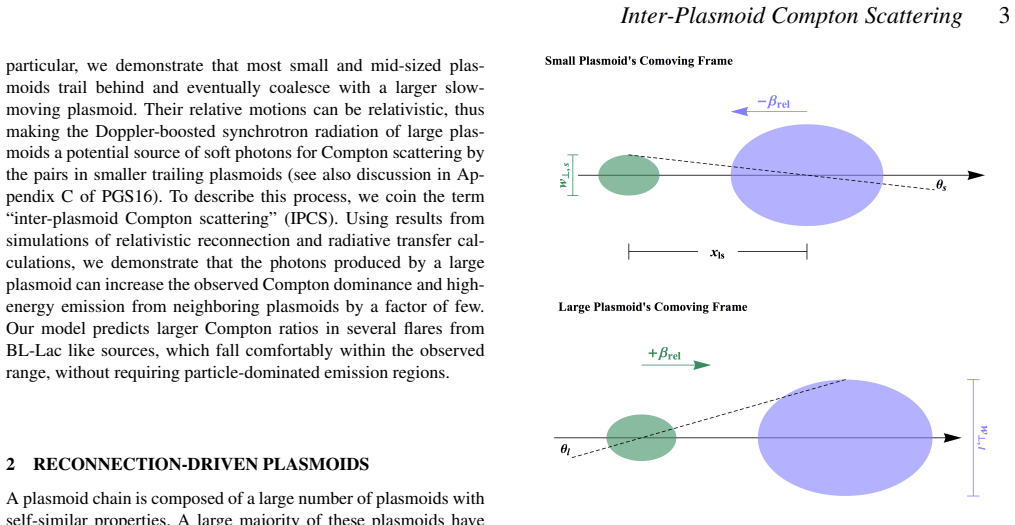
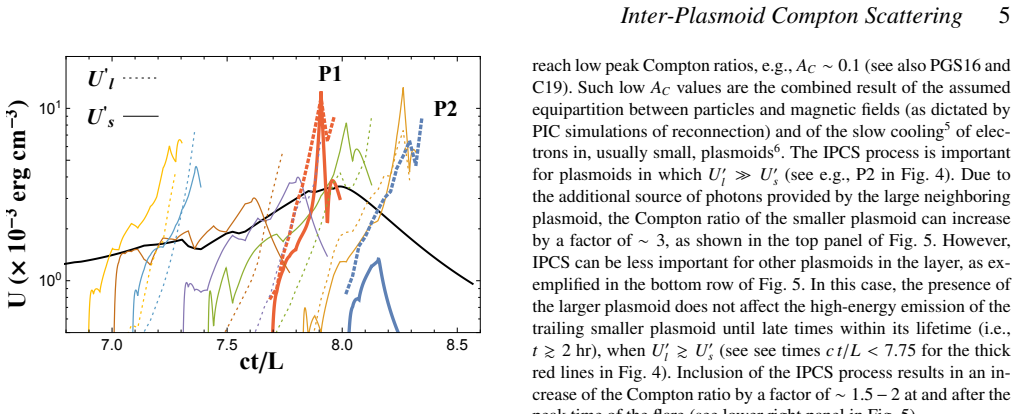
The mechanism is a pair of Lorentz-transformation factors, $f'_s$ and $f''_l$, that convert one plasmoid's co-moving synchrotron photon energy density into the frame of a neighboring plasmoid. For a small plasmoid trailing a large one, the relevant quantity is $U'_l = f''_l\,U''_l$, the large plasmoid's photon energy density as seen by the small one, versus $U'_s$, the small plasmoid's own synchrotron field. Because reconnection simulations show roughly equal particle and magnetic energy densities across plasmoid sizes, the authors take $U'_s \sim U''_l$, so the comparison reduces to geometry and relative Lorentz factor: $f''_l$ grows as the small plasmoid accelerates toward the large one and as the large plasmoid's angular size as seen from the small one increases. When $f''_l$ exceeds a few, the external seed field dominates and IPCS boosts the Compton output. The radiative transfer is computed with a time-dependent radiative code that includes all relevant cooling and emission processes.
What would settle it
Run a three-dimensional particle-in-cell simulation of relativistic reconnection in pair plasma with $\sigma=10$ and no guide field, and measure, for all small plasmoids trailing larger ones, the quantity $f''_l$ (or directly $U'_l/U'_s$) over each plasmoid's lifetime. If fewer than roughly half of small plasmoids ever reach $U'_l \gtrsim U'_s$, the IPCS-boosted Compton ratios shown in the paper would not be representative of a reconnection layer, and the population-level increase in Compton ratios would be smaller than claimed.
Extended reading notes
Core claim
The paper's central claim is that inter-plasmoid Compton scattering (IPCS) is a naturally occurring, previously neglected radiation process in relativistic reconnection layers that can reconcile plasmoid-dominated emission models with observed BL Lac Compton ratios. In a reconnection layer, most small and mid-sized plasmoids trail behind and eventually merge into a larger slow-moving plasmoid, and their relative motion can be relativistic. The large plasmoid's synchrotron radiation, Doppler-boosted in the small plasmoid's rest frame, can exceed the small plasmoid's own synchrotron photon energy density, so it becomes the dominant seed photon field for Compton scattering. Using plasmoid trajectories from a $\sigma=10$ pair-plasma particle-in-cell simulation and a time-dependent radiative code, the authors show that including IPCS raises the Compton ratio of two representative small plasmoids to $A_{\rm C}\sim 0.3$\textendash $0.5$, increases the Fermi-LAT band flux by a factor of 2\textendash 4, and broadens the high-energy spectrum. They further find that for roughly half of the small plasmoids in the layer, the large plasmoid's photon field is strong enough ($f''_l$ of order 3\textendash 10) for IPCS to matter, so the effect should imprint itself as a general increase in flare Compton ratios across BL Lac sources while keeping particle and magnetic energy densities in equipartition.
Load-bearing premise
The largest assumption is that the reconnection layer used for the statistics\textemdash a single two-dimensional particle-in-cell simulation of pair plasma with magnetization $\sigma=10$ and no guide field\textemdash represents real BL Lac reconnection, and that synchrotron photon energy densities are roughly equal across plasmoids of all sizes in their own frames; if three-dimensional effects or different magnetizations change relative speeds or photon densities, the fraction of plasmoids with strong IPCS could shift.
Editorial extensions
If this is right
- If IPCS is as widespread as the paper argues, reconnection-based BL Lac flare models no longer need particle-dominated regions to match observed Compton ratios around 0.2\textendash 2.
- Flares powered by small trailing plasmoids should show gamma-ray fluxes a factor of 2\textendash 4 higher, and a broader high-energy component, than isolated-plasmoid models predict.
- Compton ratios should vary from flare to flare in a single source, since only about half of small plasmoids have strong enough external seed fields; some flares remain essentially synchrotron-self-Compton dominated.
- IPCS will be visible mainly in the BL Lac class; in flat-spectrum radio quasars the external radiation fields from the broad-line region overwhelm plasmoid photons, so plasmoids there can still be treated as isolated.
- The process also provides an additional, non-thermal source of particle cooling for small plasmoids, which affects their electron energy distributions and therefore their synchrotron spectra.
Reading between the lines
- A direct test: in a single BL Lac object, compare the gamma-ray and synchrotron light curves during repeated flares; IPCS predicts flares whose gamma-ray component is both brighter and spectrally broader relative to the synchrotron hump than in isolated-plasmoid flares.
- If three-dimensional or higher-magnetization reconnection simulations produce similar plasmoid velocity and size statistics, IPCS should be included as a standard ingredient in reconnection-based blazar spectral models; the factor-of-few boost matters for population-level Compton ratio distributions.
- The same inter-plasmoid seed-photon geometry may operate in any relativistic reconnection layer containing a hierarchy of moving magnetized blobs, for example in stripped pulsar wind nebulae or magnetar flares, wherever a fast small blob overtakes a slow large one.
Signed reviews
Editorial analysis
A structured set of objections, weighed in public.
Referee Report
Summary. This paper proposes a new radiative process, inter-plasmoid Compton scattering (IPCS), in which synchrotron photons emitted by a large, slow-moving plasmoid serve as seed photons for inverse Compton scattering by particles in smaller, faster trailing plasmoids within the same relativistic reconnection layer. The authors derive Lorentz-transformed photon energy densities (Section 2.2), apply them to tracks from a σ=10 2D PIC simulation (Fig. 1), and compute SEDs and Compton ratios for two representative plasmoids using the radiative code of C19 (Fig. 5). They find that IPCS can increase the Compton ratio by a factor of ~1.5–3, bringing AC into the 0.2–2 range observed for BL Lacs, and argue in Section 4 that roughly half of small plasmoids in the layer may be affected. The paper concludes that IPCS can alleviate the discrepancy between equipartition-based plasmoid models and observed BL Lac Compton dominance without requiring particle-dominated emission regions.
Significance. If the population-level claim holds, IPCS would be a genuinely new and natural ingredient in reconnection-based blazar flare models, with implications for the Compton dominance of BL Lacs and for flare-to-flare variability. The analytic transformations in Section 2.2 are transparent and correct in the point-source limit, the two radiative calculations are self-consistent, and no parameter is fitted to observed Compton ratios; these are clear strengths. The mechanism also makes falsifiable predictions, namely increased γ-ray flux in the Fermi-LAT band and broader high-energy spectra during plasmoid-coalescence flares, as well as variability of AC between flares. The main limitation is that the quantitative extrapolation to the BL Lac population rests on a single 2D PIC simulation and a small hand-picked sample, so the result is currently at proof-of-concept level.
major comments (3)
- [Section 4, Fig. 1] The claim that 'roughly half' of small plasmoids have sufficiently large f''_l is not supported by any quantitative analysis shown in the paper. The eight plasmoids in Figs. 3 and 4 are hand-picked from the right panel of Fig. 1, and the extrapolation to 100 plasmoids in the left panel is presented without a histogram, a distribution of f''_l, or an uncertainty estimate. Because this fraction is what connects the two worked examples to the BL Lac Compton-dominance discrepancy, this is a load-bearing point. Please either provide a systematic census from the simulation (e.g., a distribution of f''_l over all small plasmoids) or soften the claim to a statement about a non-negligible fraction.
- [Section 4 vs. Section 3.1] The mapping U'_s ~ U''_l via U_syn ~ U_e is used to convert the geometric factor f''_l into the ratio U'_l/U'_s, but Section 3.1 states that small plasmoids are typically slow-cooling. For slow-cooling plasmoids, U'_s < U_e, so the equality U'_s ~ U''_l is not self-evident, and Fig. 4 indeed shows U'_s varying among plasmoids and with time. The paper does not estimate the size of the resulting bias. This matters because the direction is two-sided: slower cooling in small plasmoids would make IPCS relevant for a larger fraction, whereas geometric dilution in a 3D layer or a different magnetization would make it smaller. Please quantify or explicitly condition the population claim on this assumption.
- [Section 2, Fig. 1] All dynamical inputs come from a single 2D PIC run at σ=10, pair plasma, and no guide field. The paper does not discuss how the relative velocities, separation distances, and plasmoid size distribution—and hence the IPCS fraction—depend on σ, guide field strength, or three-dimensionality. Since the claimed BL Lac resolution depends on the fraction of affected plasmoids, a statement about the expected range of validity (or an explicit caveat that this is one realization) is needed before the result can be taken as general.
minor comments (6)
- [Section 3.1] The phrase 'see see times c t/L < 7.75' contains a duplicated 'see'; it should read 'see times c t/L < 7.75'.
- [Section 3.1] The symbol '&' in 't & 2 hr' appears to be a LaTeX rendering issue; it should be typeset as 't ≳ 2 hr'.
- [Section 3.2] There is a typo in 'their own synchrotron phootn energy density'; 'phootn' should be 'photon'.
- [Section 2.1] The footnote marker '2' appears inline as 'exceeding 2 the Alfvén velocity'; it should be formatted as a superscript footnote to avoid confusing the reader.
- [Fig. 4] The color coding of thick versus thin lines is described only in the text; consider stating explicitly in the caption that thick lines denote P1 and P2.
- [Section 3.1] The treatment of the anisotropic seed photon field from the large plasmoid in the radiative code is not described; a brief statement would help the reader assess the approximation.
Circularity Check
No significant circularity: the IPCS boost is a direct radiative consequence of an independently simulated seed-photon field, and no parameter is fitted to the target Compton ratios.
full rationale
The paper's derivation chain is self-contained rather than circular. Section 2.2 computes the geometric boost factors f'_s and f''_l from standard Lorentz transformations of photon energy densities, using plasmoid positions, sizes, and velocities taken from a fixed sigma=10 PIC simulation (Sironi et al. 2016). The radiative-transfer calculations of Section 3 use the code described in C19 with the same model parameters; no parameter is adjusted to match observed BL Lac Compton ratios. The increase in A_C upon adding the large plasmoid's synchrotron field is a direct physical consequence of introducing an extra seed-photon population, not an identity with the inputs. The mapping U'_s ~ U''_l in Section 4 is an explicitly stated approximation based on equipartition and on the near-constancy of U_e in the cited PIC simulations; it is an input assumption with stated conditions, not a restatement of the conclusion. The 'about half' population statement is an extrapolation from eight tracked plasmoids to a larger sample, which is a statistical/sampling limitation, not a circular reduction; no observed Compton ratio is used to define f''_l or U'_l. Self-citations are frequent (Sironi et al. 2016; PGS16; C19), but the cited results are parameter-fixed simulations and radiative codes whose assumptions do not include the target A_C range, so they constitute independent evidence under the review rules. No step was found in which a prediction is equivalent by construction to a fitted value or to a self-citation chain.
Assumptions & free parameters
free parameters (2)
- Magnetic field strength B in plasmoids =
0.6 G (adopted from C19 BL10 model)
- Radiative model inputs (electron distribution index, minimum Lorentz factor, injection luminosity) =
As in C19 BL10 model
assumptions (7)
- standard math Invariance of U(epsilon, mu)/epsilon^3 under Lorentz transformations
- domain assumption Plasmoids emit isotropically in their co-moving frame and are homogeneous
- domain assumption A single 2D PIC simulation with sigma=10 and no guide field is representative of reconnection layers
- domain assumption Synchrotron photon energy density is roughly equal across large and small plasmoids in their rest frames (U'_s ~ U''_l)
- domain assumption Only synchrotron photons from the large plasmoid serve as seed photons; SSC photons are neglected
- domain assumption Rigid-body motion of plasmoids, including during mergers
- domain assumption Finite light travel time between plasmoids and Compton drag are negligible
Cite this review
Pith. "Pith review of Inter-Plasmoid Compton Scattering and the Compton Dominance of BL Lacs." pith.science (2026). https://pith.science/paper/WN5QYHBI
@misc{pith2026190802764,
  author       = {Pith},
  title        = {Pith review of: Inter-Plasmoid Compton Scattering and the Compton Dominance of BL Lacs},
  year         = {2026},
  howpublished = {\url{https://pith.science/paper/WN5QYHBI}},
  note         = {Machine review of arXiv:1908.02764}
}
read the original abstract
Blazar emission models based on magnetic reconnection succeed in reproducing many observed spectral and temporal features, including the short-duration luminous flaring events. Plasmoids, a self-consistent by-product of the tearing instability in the reconnection layer, can be the main source of blazar emission. Kinetic simulations of relativistic reconnection have demonstrated that plasmoids are characterized by rough energy equipartition between their radiating particles and magnetic fields. This is the main reason behind the apparent shortcoming of plasmoid-dominated emission models to explain the observed Compton ratios of BL Lac objects. Here, we demonstrate that the radiative interactions among plasmoids, which have been neglected so far, can assist in alleviating this contradiction. We show that photons emitted by large, slow-moving plasmoids can be a potentially important source of soft photons to be then up-scattered, via inverse Compton, by small fast-moving, neighboring plasmoids. This inter-plasmoid Compton scattering process can naturally occur throughout the reconnection layer, imprinting itself as an increase in the observed Compton ratios from those short and luminous plasmoid-powered flares within BL Lac sources, while maintaining energy equipartition between radiating particles and magnetic fields.
Figures


Figures from the paper (2 more)

Forward citations
Cited by 1 Pith paper
-
Anisotropic electron populations in BL Lac jets: consequences for the observed emission
Anisotropic electron pitch-angle distributions allow one-zone SSC fits of the Mkn 421 blazar spectrum under magnetic field/electron equipartition, and predict harder TeV spectra.
Reference graph
Works this paper leans on
-
[1]
write newline
" write newline "" before.all 'output.state := FUNCTION fin.entry write newline FUNCTION new.block output.state before.all = 'skip after.block 'output.state := if FUNCTION new.sentence output.state after.block = 'skip output.state before.all = 'skip after.sentence 'output.state := if if FUNCTION not #0 #1 if FUNCTION and 'skip pop #0 if FUNCTION or pop #1...
-
[2]
Acciari V. A., et al., 2011, @doi [ ] 10.1088/0004-637X/738/1/25 , https://ui.adsabs.harvard.edu/abs/2011ApJ...738...25A 738, 25
-
[3]
Ackermann M., et al., 2015, @doi [ ] 10.1088/0004-637X/810/1/14 , https://ui.adsabs.harvard.edu/abs/2015ApJ...810...14A 810, 14
-
[4]
Aharonian F., et al., 2007, @doi [ ] 10.1086/520635 , https://ui.adsabs.harvard.edu/abs/2007ApJ...664L..71A 664, L71
doi:10.1086/520635 2007
-
[5]
Ahnen M. L., et al., 2016, @doi [ ] 10.1051/0004-6361/201628447 , https://ui.adsabs.harvard.edu/abs/2016A&A...593A..91A 593, A91
-
[6]
Ahnen M. L., et al., 2017, @doi [ ] 10.1051/0004-6361/201629540 , https://ui.adsabs.harvard.edu/abs/2017A&A...603A..31A 603, A31
-
[7]
Albert J., et al., 2007, @doi [ ] 10.1086/521382 , https://ui.adsabs.harvard.edu/abs/2007ApJ...669..862A 669, 862
doi:10.1086/521382 2007
-
[8]
Beloborodov A. M., 2017, @doi [ ] 10.3847/1538-4357/aa8f4f , http://adsabs.harvard.edu/abs/2017ApJ...850..141B 850, 141
Show all 49 references
-
[9]
D., Rees M
Blandford R. D., Rees M. J., 1978, @doi [ ] 10.1088/0031-8949/17/3/020 , https://ui.adsabs.harvard.edu/abs/1978PhyS...17..265B 17, 265
1978 doi
-
[10]
D., Znajek R
Blandford R. D., Znajek R. L., 1977, @doi [ ] 10.1093/mnras/179.3.433 , https://ui.adsabs.harvard.edu/abs/1977MNRAS.179..433B 179, 433
1977 doi
-
[11]
D., Marscher A
Bloom S. D., Marscher A. P., 1996, @doi [ ] 10.1086/177092 , https://ui.adsabs.harvard.edu/abs/1996ApJ...461..657B 461, 657
1996 doi
-
[12]
Celotti A., Ghisellini G., 2008, @doi [ ] 10.1111/j.1365-2966.2007.12758.x , https://ui.adsabs.harvard.edu/abs/2008MNRAS.385..283C 385, 283
2008
-
[13]
Chiaberge M., Ghisellini G., 1999, @doi [ ] 10.1046/j.1365-8711.1999.02538.x , https://ui.adsabs.harvard.edu/abs/1999MNRAS.306..551C 306, 551
1999
-
[14]
M., Petropoulou M., Sironi L., Giannios D., 2019, @doi [ ] 10.1093/mnras/sty2636 , http://adsabs.harvard.edu/abs/2019MNRAS.482...65C 482, 65
Christie I. M., Petropoulou M., Sironi L., Giannios D., 2019, @doi [ ] 10.1093/mnras/sty2636 , http://adsabs.harvard.edu/abs/2019MNRAS.482...65C 482, 65
2019 doi
-
[15]
D., Schlickeiser R., 1994, @doi [ ] 10.1086/191929 , https://ui.adsabs.harvard.edu/abs/1994ApJS...90..945D 90, 945
Dermer C. D., Schlickeiser R., 1994, @doi [ ] 10.1086/191929 , https://ui.adsabs.harvard.edu/abs/1994ApJS...90..945D 90, 945
1994 doi
-
[16]
D., Schlickeiser R., Mastichiadis A., 1992, , https://ui.adsabs.harvard.edu/abs/1992A&A...256L..27D 256, L27
Dermer C. D., Schlickeiser R., Mastichiadis A., 1992, , https://ui.adsabs.harvard.edu/abs/1992A&A...256L..27D 256, L27
1992
-
[17]
D., 2013, @doi [ ] 10.1088/0004-637X/763/2/134 , https://ui.adsabs.harvard.edu/abs/2013ApJ...763..134F 763, 134
Finke J. D., 2013, @doi [ ] 10.1088/0004-637X/763/2/134 , https://ui.adsabs.harvard.edu/abs/2013ApJ...763..134F 763, 134
2013 doi
-
[18]
Fossati G., et al., 2008, @doi [ ] 10.1086/527311 , https://ui.adsabs.harvard.edu/abs/2008ApJ...677..906F 677, 906
2008 doi
-
[20]
Giannios D., 2013, @doi [ ] 10.1093/mnras/stt167 , https://ui.adsabs.harvard.edu/abs/2013MNRAS.431..355G 431, 355
2013 doi
-
[21]
C., 2006, @doi [ ] 10.1051/0004-6361:20054107 , http://adsabs.harvard.edu/abs/2006A
Giannios D., Spruit H. C., 2006, @doi [ ] 10.1051/0004-6361:20054107 , http://adsabs.harvard.edu/abs/2006A
2006 doi
-
[22]
A., Begelman M
Giannios D., Uzdensky D. A., Begelman M. C., 2009, @doi [ ] 10.1111/j.1745-3933.2009.00635.x , https://ui.adsabs.harvard.edu/abs/2009MNRAS.395L..29G 395, L29
2009
-
[23]
Guo F., Li H., Daughton W., Liu Y.-H., 2014, @doi [Physical Review Letters] 10.1103/PhysRevLett.113.155005 , http://adsabs.harvard.edu/abs/2014PhRvL.113o5005G 113, 155005
2014 doi
-
[24]
Guo F., Liu Y.-H., Daughton W., Li H., 2015, @doi [ ] 10.1088/0004-637X/806/2/167 , http://adsabs.harvard.edu/abs/2015ApJ...806..167G 806, 167
2015 doi
-
[25]
Maraschi L., et al., 1999, @doi [Astroparticle Physics] 10.1016/S0927-6505(99)00046-8 , https://ui.adsabs.harvard.edu/abs/1999APh....11..189M 11, 189
1999 doi
-
[26]
G., 1995, , https://ui.adsabs.harvard.edu/abs/1995A&A...295..613M 295, 613
Mastichiadis A., Kirk J. G., 1995, , https://ui.adsabs.harvard.edu/abs/1995A&A...295..613M 295, 613
1995
-
[27]
J., Potter W
Morris P. J., Potter W. J., Cotter G., 2019, @doi [ ] 10.1093/mnras/stz920 , https://ui.adsabs.harvard.edu/abs/2019MNRAS.486.1548M 486, 1548
2019 doi
-
[28]
Nalewajko K., Gupta M., 2017, @doi [ ] 10.1051/0004-6361/201731329 , https://ui.adsabs.harvard.edu/abs/2017A&A...606A..44N 606, A44
2017 doi
-
[29]
C., Uzdensky D
Nalewajko K., Giannios D., Begelman M. C., Uzdensky D. A., Sikora M., 2011, @doi [ ] 10.1111/j.1365-2966.2010.18140.x , https://ui.adsabs.harvard.edu/abs/2011MNRAS.413..333N 413, 333
2011
-
[30]
Nalewajko K., Yuan Y., Chru \'s li \'n ska M., 2018, @doi [Journal of Plasma Physics] 10.1017/S0022377818000624 , https://ui.adsabs.harvard.edu/abs/2018JPlPh..84c7501N 84, 755840301
2018 doi
-
[31]
Padovani P., et al., 2017, @doi [ ] 10.1007/s00159-017-0102-9 , https://ui.adsabs.harvard.edu/abs/2017A&ARv..25....2P 25, 2
2017 doi
-
[32]
Petropoulou M., Giannios D., Sironi L., 2016, @doi [ ] 10.1093/mnras/stw1832 , http://adsabs.harvard.edu/abs/2016MNRAS.462.3325P 462, 3325
2016 doi
-
[33]
M., Sironi L., Giannios D., 2018, @doi [ ] 10.1093/mnras/sty033 , http://adsabs.harvard.edu/abs/2018MNRAS.475.3797P 475, 3797
Petropoulou M., Christie I. M., Sironi L., Giannios D., 2018, @doi [ ] 10.1093/mnras/sty033 , http://adsabs.harvard.edu/abs/2018MNRAS.475.3797P 475, 3797
2018 doi
-
[34]
arXiv:1906.03297
Petropoulou M., Sironi L., Spitkovsky A., Giannios D., 2019, arXiv e-prints, https://ui.adsabs.harvard.edu/abs/2019arXiv190603297P p. arXiv:1906.03297
2019 arXiv
-
[35]
B., Lightman A
Rybicki G. B., Lightman A. P., 1986, Radiative Processes in Astrophysics
1986
-
[36]
C., Rees M
Sikora M., Begelman M. C., Rees M. J., 1994, @doi [ ] 10.1086/173633 , https://ui.adsabs.harvard.edu/abs/1994ApJ...421..153S 421, 153
1994 doi
-
[37]
Sironi L., Spitkovsky A., 2014, @doi [ ] 10.1088/2041-8205/783/1/L21 , http://adsabs.harvard.edu/abs/2014ApJ...783L..21S 783, L21
2014 doi
-
[38]
Sironi L., Petropoulou M., Giannios D., 2015, @doi [ ] 10.1093/mnras/stv641 , https://ui.adsabs.harvard.edu/abs/2015MNRAS.450..183S 450, 183
2015 doi
-
[39]
Sironi L., Giannios D., Petropoulou M., 2016, @doi [ ] 10.1093/mnras/stw1620 , http://adsabs.harvard.edu/abs/2016MNRAS.462...48S 462, 48
2016 doi
-
[40]
E., 2019, @doi [ ] 10.1093/mnras/stz044 , https://ui.adsabs.harvard.edu/abs/2019MNRAS.484.1192S 484, 1192
Sobacchi E., Lyubarsky Y. E., 2019, @doi [ ] 10.1093/mnras/stz044 , https://ui.adsabs.harvard.edu/abs/2019MNRAS.484.1192S 484, 1192
2019 doi
-
[41]
C., Daigne F., Drenkhahn G., 2001, @doi [ ] 10.1051/0004-6361:20010131 , https://ui.adsabs.harvard.edu/abs/2001A&A..369..694S 369, 694
Spruit H. C., Daigne F., Drenkhahn G., 2001, @doi [ ] 10.1051/0004-6361:20010131 , https://ui.adsabs.harvard.edu/abs/2001A&A..369..694S 369, 694
2001 doi
-
[42]
Tavecchio F., Ghisellini G., 2016, @doi [ ] 10.1093/mnras/stv2790 , https://ui.adsabs.harvard.edu/abs/2016MNRAS.456.2374T 456, 2374
2016 doi
-
[43]
arXiv:1908.02183
Tavecchio F., Sobacchi E., 2019, arXiv e-prints, https://ui.adsabs.harvard.edu/abs/2019arXiv190802183T p. arXiv:1908.02183
2019 arXiv
-
[44]
Tavecchio F., Ghisellini G., Ghirlanda G., Foschini L., Maraschi L., 2010, @doi [ ] 10.1111/j.1365-2966.2009.15784.x , https://ui.adsabs.harvard.edu/abs/2010MNRAS.401.1570T 401, 1570
2010
-
[45]
C., Narayan R., 2009, @doi [ ] 10.1088/0004-637X/699/2/1789 , https://ui.adsabs.harvard.edu/abs/2009ApJ...699.1789T 699, 1789
Tchekhovskoy A., McKinney J. C., Narayan R., 2009, @doi [ ] 10.1088/0004-637X/699/2/1789 , https://ui.adsabs.harvard.edu/abs/2009ApJ...699.1789T 699, 1789
2009 doi
-
[46]
C., 2011, @doi [ ] 10.1111/j.1745-3933.2011.01147.x , https://ui.adsabs.harvard.edu/abs/2011MNRAS.418L..79T 418, L79
Tchekhovskoy A., Narayan R., McKinney J. C., 2011, @doi [ ] 10.1111/j.1745-3933.2011.01147.x , https://ui.adsabs.harvard.edu/abs/2011MNRAS.418L..79T 418, L79
2011
-
[47]
M., Padovani P., 1995, @doi [ ] 10.1086/133630 , https://ui.adsabs.harvard.edu/abs/1995PASP..107..803U 107, 803
Urry C. M., Padovani P., 1995, @doi [ ] 10.1086/133630 , https://ui.adsabs.harvard.edu/abs/1995PASP..107..803U 107, 803
1995 doi
-
[48]
A., Loureiro N
Uzdensky D. A., Loureiro N. F., Schekochihin A. A., 2010, @doi [Physical Review Letters] 10.1103/PhysRevLett.105.235002 , http://adsabs.harvard.edu/abs/2010PhRvL.105w5002U 105, 235002
2010 doi
-
[49]
R., Uzdensky D
Werner G. R., Uzdensky D. A., Cerutti B., Nalewajko K., Begelman M. C., 2016, @doi [ ] 10.3847/2041-8205/816/1/L8 , http://adsabs.harvard.edu/abs/2016ApJ...816L...8W 816, L8
2016 doi
-
[50]
R., Uzdensky D
Werner G. R., Uzdensky D. A., Begelman M. C., Cerutti B., Nalewajko K., 2018, @doi [ ] 10.1093/mnras/stx2530 , http://adsabs.harvard.edu/abs/2018MNRAS.473.4840W 473, 4840
2018 doi
Reviewed August 14, 2026 · model on record in the stance chip above.
Discussion (0). Continue with ORCID to comment.