REVIEW 3 major objections 5 minor 21 references
Extreme coverage in 5G Narrowband IoT: a LUT-based strategy to optimize shared channels
T0 review · 3 major / 5 minor · reviewed 2026-08-14 · deepseek-v4-flash
Pith's one-line read A precomputed lookup table of optimal link parameters can replace iterative link adaptation in NB-IoT extreme coverage.
desk verdict A sensible LUT-based link adaptation idea whose evaluation is weakened by a self-consistent simulation loop; the qualitative claim is promising but the quantitative gains are not yet proven. read the letter →
The pith
A machine-rendered reading of the paper's core claim, the machinery that carries it, and where it could break.
The reading
What carries the argument
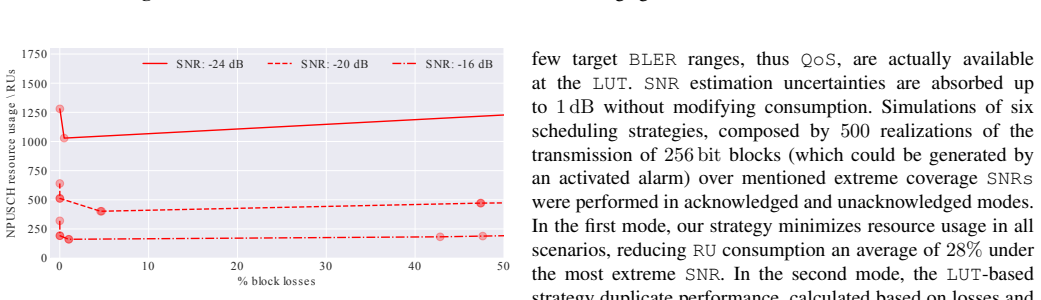
The load-bearing object is the lookup table of optimal link parameters, built from simulated BLER curves for each (ITBS, IRU, IREP) triple on the NPUSCH. A row maps a transport block size, an SNR estimate, and a target BLER (which collapses into a small set of 'good', 'poor', 'bad' QoS levels) to the tuple (ITBS, NR) that consumes the fewest resource units. When an exact row is missing, the retrieval rule picks the closest row with SNR and BLER no larger than requested and the minimum RU cost. The table removes the multi-transmission convergence loop of conventional schedulers, and the small number of available QoS levels makes the selection robust to SNR estimation error: the same tuple remains optimal across roughly 0.5–1 dB of SNR uncertainty.
What would settle it
Run LUTS against an iterative scheduler on a channel model not represented in the LUT (e.g., a standardized multipath fading profile or a channel with time-varying SNR), using the same 256-bit blocks and BLERt=0.05; if the LUT-based selection consistently consumes more RUs than the iterative strategy for acknowledged mode, or loses more than 10% of blocks in unacknowledged mode, the claim that the table is optimal for extreme coverage would be refuted. This is testable with the authors' own simulator by replacing the AWGN BLER curves with those of a fading channel.
Extended reading notes
Core claim
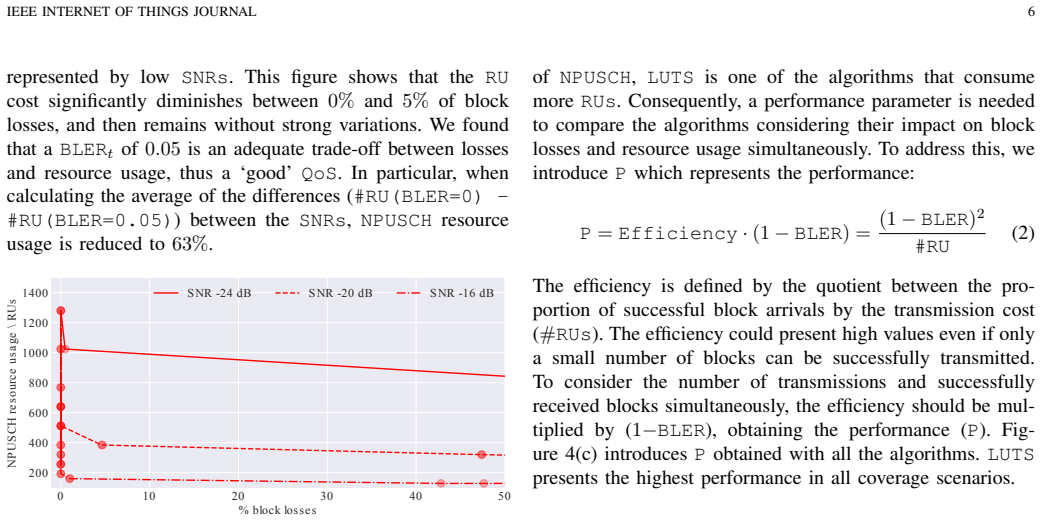
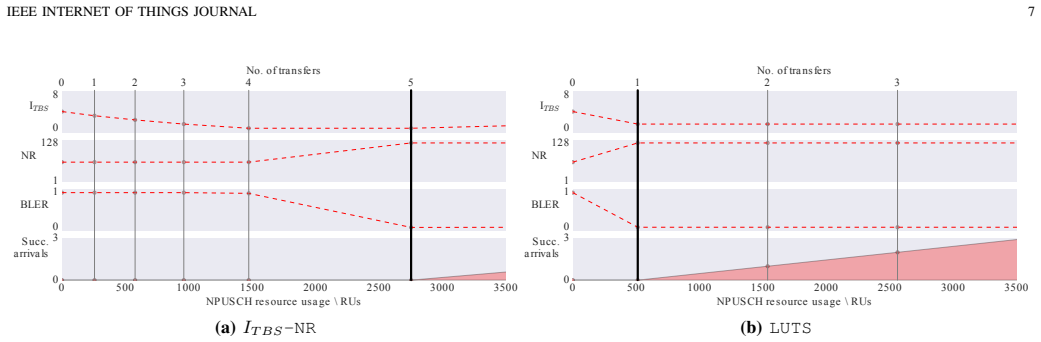
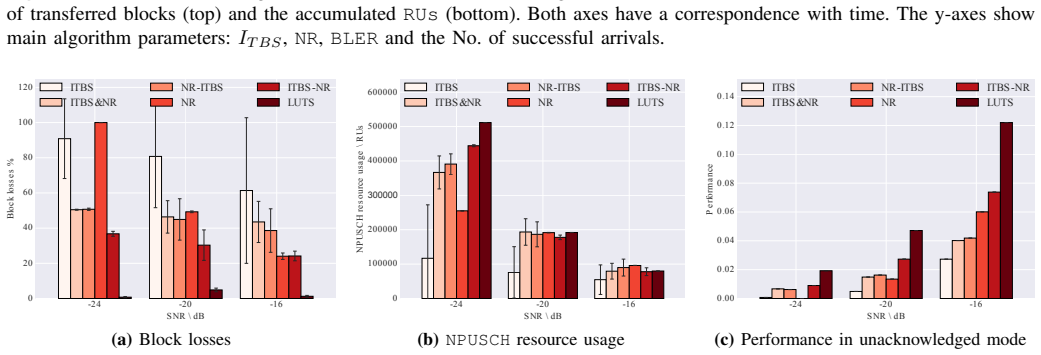
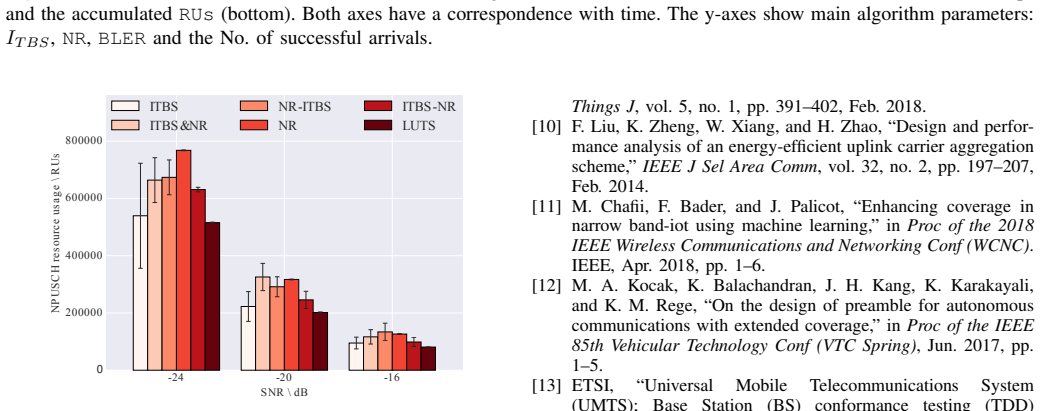
The central claim is that the optimal link parameters for an NB-IoT shared channel at a given SNR can be precomputed and stored, so the base station does not need to search for them during transmission. The lookup table is keyed by transport block size (TBS), estimated SNR, and target BLER, and returns the (ITBS, NR) tuple with the minimum resource-unit cost; when no exact row exists, the closest row with SNR and BLER at or below the requested values is used. The paper shows that for TBS of 256 bits over the NPUSCH with AWGN, this table has only a few relevant quality-of-service entries, and that using it makes the scheduler converge in one transmission while five to fifteen are needed by iterative strategies. In acknowledged mode LUTS minimizes NPUSCH resource usage at every tested SNR, with an average reduction of about 28% relative to the best alternative at −24 dB; in unacknowledged mode it roughly doubles the performance metric P=(1−BLER)^2/#RU compared with the other five strategies.
Load-bearing premise
The strategy assumes the lookup table has been fully populated and stays accurate for the channel the device actually experiences; in this paper the table is built from the same AWGN-channel simulations used to score the strategies, so a real channel with different fading or a stale or incomplete table would break the claimed optimality.
Editorial extensions
If this is right
- In acknowledged mode, LUTS consumes fewer NPUSCH resources than the other five schedulers at every tested extreme-coverage SNR, with the largest gain—about 28% average reduction at −24 dB—occurring where convergence is most expensive.
- In unacknowledged mode, LUTS delivers the highest value of P=(1−BLER)^2/#RU at all tested SNRs, meaning more successful 256-bit blocks per radio resource for the same loss budget.
- Because the LUT converges in one scheduling decision rather than five to fifteen, it cuts the number of downlink control exchanges and HARQ retransmissions, freeing base-station capacity for additional connections.
- The observation that only a few QoS rows exist per TBS means the table is small (kilobytes to a few megabytes), so the strategy trades a one-time memory cost for real-time computation.
Reading between the lines
- If correct, the same row-retrieval logic could be carried over to the downlink shared channel (NPDSCH) and to multi-carrier NPUSCH configurations; each would need its own BLER curves and RU-cost tables, but the mechanism does not depend on the uplink specifics.
- If correct, the LUT could be made adaptive by building it from a family of channel models rather than a single AWGN curve: the base station could detect when live BLER reports drift from the table's prediction and refresh only those rows, turning the one-time initialization into a self-updating procedure.
- If correct, the reported tolerance of about 1 dB of SNR uncertainty suggests the strategy would work with the coarse SNR estimates available in low-cost NB-IoT devices; this is testable by feeding the scheduler an estimator with known bias and variance instead of the ideal SNR used in the simulations.
Signed reviews
Editorial analysis
A structured set of objections, weighed in public.
Referee Report
Summary. The paper proposes a look-up table (LUT) based link adaptation strategy for NB-IoT uplink shared channels (NPUSCH) in extreme coverage scenarios. The BS uses a precomputed table to select the modulation and coding scheme (ITBS) and number of repetitions (NR) given a target block error rate (BLERt), instead of iteratively adapting these parameters based on ACK/NACK feedback. The authors compare LUTS against five iterative strategies (ITBS-NR, NR-ITBS, ITBS, NR, ITBS&NR) using a custom Python simulator with a Matlab-based AWGN channel model, over SNRs of -24, -20, and -16 dB. In acknowledged mode they report that LUTS minimizes NPUSCH resource usage; in unacknowledged mode they report that LUTS minimizes block losses and achieves the highest value of a composite performance metric P = (1-BLER)^2/#RU. The paper also describes a LUT initialization algorithm and analyzes the impact of SNR estimation errors.
Significance. If the claimed gains hold in realistic settings, the LUT-based approach could reduce the convergence overhead of NB-IoT link adaptation and increase the number of supported connections under extreme coverage. The paper contributes an open-source simulator, a LUT initialization procedure, and a useful analysis of the limited number of QoS levels available in such conditions. However, the significance is currently tempered by an experimental setup in which LUTS is given a table that is exact for the same channel model used in the evaluation, making the central optimality claim close to true by construction. The paper would be strengthened by testing the strategy under model mismatch and by justifying the arbitrary performance metric.
major comments (3)
- [Sections V and VI] The evaluation gives LUTS privileged access to the exact BLER model used to determine block success. The LUT is populated from the same Matlab-based NB-IoT AWGN simulation that apparently supplies the BLER curves used by the Python scheduler to decide whether a transmission succeeds. Consequently, the claim that LUTS 'minimizes resource usage' in acknowledged mode (Fig. 7) is an expected consequence of the table being an exact oracle for the simulated channel, rather than an empirical demonstration of the strategy's merit in a mismatched or imperfectly calibrated deployment. The comparison against iterative strategies that must adapt from scratch is therefore favorable by construction. The authors should either explicitly frame LUTS as an oracle benchmark and discuss how the results translate when the table is not exact, or add a robustness experiment in which the LUT is generated from a different channel model (e.g., a different coding implementation, a different fading assumption, or an SNR offset) and then evaluate LUTS against the originally simulated channel.
- [Section VI-A, Eq. (2)] The unacknowledged-mode performance claim rests on the composite metric P = (1-BLER)^2/#RU, whose quadratic exponent is introduced without justification. In Fig. 4(b), LUTS consumes more RUs than several alternatives, so the claim that it 'duplicates performance' depends entirely on the squaring of (1-BLER). A different metric, such as (1-BLER)/#RU, could rank the strategies differently. The authors should either justify the choice of the exponent with a utility or loss-function argument, or present the block-loss and resource-usage results as separate trade-off dimensions and avoid a single scalar ranking.
- [Section IV-E and Section V] The experiments assume that the LUT initialization stage has been completed before the simulation starts, but the paper provides no evaluation of the transient period during which the table is being populated. Algorithm 4 states that a large number of connections are needed to fill the table, and Section V simply states that initialization is a one-time process. Since a deployed BS would operate in this transient regime for some time, and during that regime LUTS degenerates to the underlying iterative strategy, the practical relevance of the approach depends on the duration and cost of initialization. The authors should quantify the initialization overhead or, at minimum, discuss realistic assumptions about how many connections are required and how performance degrades before the table is complete.
minor comments (5)
- [Table I] The mapping between MCS and ITBS in Table I is confusing: the header reads 'MCS≡ITBS' and the rows list '0≡0', '2≡1', '1≡2', '3≡3', suggesting that the MCS indices are not in ascending numeric order. A clearer statement of the equivalence and the ordering would avoid confusion.
- [Algorithm 2] In Algorithm 2, several 'else if then' clauses have an empty condition (e.g., line 8). This appears to be a formatting artifact, but it should be cleaned up so each branch has an explicit condition, as is done elsewhere.
- [Section VI-B] The sentence 'when an average between consumption differences (e.g. #RU(ITBS) - #RU(LUTS)) is calculated, LUTS reduces this resource usage consumption by around 28%' is unclear. The average is presumably taken over the three SNR values, but the phrasing should be revised for precision.
- [Figures 3 and 6] The four-panel evolution figures are information-dense and the small axis labels are difficult to read, particularly the 'BLER' and 'Succ. arrivals' subplots. Enlarging the fonts or separating the panels would improve readability.
- [References] Reference [16] points to a document on Scribd. For a standards-based claim about max retransmission thresholds, a more citable source (e.g., an official 3GPP or vendor technical report) would be preferable.
Circularity Check
The LUT and the evaluation channel are generated from the same BLER model, so the claimed resource-usage optimality of LUTS is forced by construction rather than independently predicted.
-
fitted input called prediction
[Section V (Simulation) and Section IV-E (LUT initialization), evaluated in Sections VI-A/VI-B]
"LUT values are obtained from a simulation based on the NB-IoT Uplink Waveform Generation from the Matlab Toolkit. In this simulation, for each (ITBS, IRU, IREP) 3-tuple, BLER curves were traced for a single sub-carrier mode NPUSCH over a simulated AWGN channel. ... In all the experiments, it is assumed that the LUT initialization stage had been completed before performing the experiment."
The LUT entries are produced by tracing BLER curves over AWGN with the same NB-IoT physical-layer model that the Python simulator uses to decide whether each transmitted block succeeds. The paper itself defines the link relation as BLER(TBS,SNR,MCS,NR) (Section III), and the LUT stores the (ITBS,NR) row that minimizes RU consumption according to those very curves. When LUTS retrieves 'the optimal row', it is therefore reading off the exact function used to generate the experimental outcomes. The claimed result that LUTS 'minimizes resource usage' in acknowledged mode and gives the highest performance in unacknowledged mode is thus a direct consequence of giving LUTS a perfect table of the simulation's own true BLER function, while the comparison strategies must estimate and iterate.
full rationale
The paper is transparent: it states explicitly that the LUT initialization is assumed complete before the experiment and that LUT values come from the same NB-IoT AWGN BLER simulation used in the testbed. There is no self-citation chain, and the scheduling algorithms are implemented in an open-source simulator, so the work has genuine engineering content. The circularity is in the validation loop, not in the authorship. The central empirical claim that LUTS achieves the minimum resource usage is forced by construction: the table is populated from the same BLER model that determines block success in the evaluation, so LUTS necessarily selects the function minimizer in every simulated scenario. The paper also tests robustness to SNR estimation error, which is a real but limited check that stays inside the same model. Because the main performance gain reduces to giving LUTS perfect knowledge of the simulation's own channel law, while the comparison strategies lack that information, the evaluation is partially circular. The score is 6 rather than lower because the LUT concept and convergence analysis have independent algorithmic content, but the headline numerical advantage is a built-in property of the experimental setup, not an independently predicted outcome.
Assumptions & free parameters
free parameters (2)
- Target block error rate BLERt ('good' QoS) =
0.05
- Exponent in performance metric P =
2
assumptions (5)
- domain assumption The AWGN channel model is representative of extreme-coverage NPUSCH links.
- ad hoc to paper The LUT is fully populated and accurate before the experiments.
- domain assumption The simulator correctly implements the 3GPP NPUSCH TX-RX chain.
- domain assumption The expected RU cost formula for acknowledged mode (Eq. 1) correctly captures HARQ retransmission behavior.
- domain assumption The BS can estimate SNR and BLER accurately enough for the LUT and baseline strategies.
invented entities (1)
-
Performance metric P
Cite this review
Pith. "Pith review of Extreme coverage in 5G Narrowband IoT: a LUT-based strategy to optimize shared channels." pith.science (2026). https://pith.science/paper/DZVC7H7R
@misc{pith2026190802798,
  author       = {Pith},
  title        = {Pith review of: Extreme coverage in 5G Narrowband IoT: a LUT-based strategy to optimize shared channels},
  year         = {2026},
  howpublished = {\url{https://pith.science/paper/DZVC7H7R}},
  note         = {Machine review of arXiv:1908.02798}
}
read the original abstract
One of the main challenges in IoT is providing communication support to an increasing number of connected devices. In recent years, narrowband radio technology has emerged to address this situation: Narrowband Internet of Things (NB-IoT), which is now part of 5G. Supporting massive connectivity becomes particularly demanding in extreme coverage scenarios such as underground or deep inside buildings sites. We propose a novel strategy for these situations focused on optimizing NB-IoT shared channels through the selection of link parameters: modulation and coding scheme, as well as the number of repetitions. These parameters are established by the base station (BS) for each block transmitted until reaching a target block error rate (BLER_t ). A wrong selection of these magnitudes leads to radio resource waste and a decrease in the number of possible concurrent connections. Specifically, our strategy is based on a look-up table (LUT) scheme which is used for rapidly delivering the optimal link parameters given a target QoS. To validate our proposal, we compare with alternative strategies using an open source NB-IoT uplink simulator. The experiments are based on transmitting blocks of 256 bits using an AWGN channel over the NPUSCH. Results show that, especially under extreme conditions, only a few options for link parameters are available, favoring robustness against measurement uncertainties. Our strategy minimizes resource usage in all scenarios of acknowledged mode and remarkably reduces losses in the unacknowledged mode, presenting also substantial gains in performance. We expect to influence future BS software design and implementation, favoring connection support under extreme environments.
Figures

Figures from the paper (4 more)

Reference graph
Works this paper leans on
-
[1]
Smart Choice for the Smart Grid: Narrowband Internet of Things (NB-IoT),
Y . Li, X. Cheng, Y . Cao, D. Wang, and L. Yang, “Smart Choice for the Smart Grid: Narrowband Internet of Things (NB-IoT),” IEEE Internet Things J , vol. 5, no. 3, pp. 1505–1515, June 2017
work page 2017
-
[2]
Nb-iot technology overview and experience from cloud-ran implementation,
Y . D. Beyene, R. Jantti, O. Tirkkonen, K. Ruttik, S. Iraji, A. Larmo, T. Tirronen, and J. Torsner, “Nb-iot technology overview and experience from cloud-ran implementation,”IEEE Wirel Commun, vol. 24, no. 3, pp. 26–32, Jun. 2017
work page 2017
-
[3]
NB-IoT Test Solutions Demon- stration,
Keysight Technologies Inc., “NB-IoT Test Solutions Demon- stration,” https://www.keysight.com/us/en/resources.html, 2018
work page 2018
-
[4]
Prediction-based energy saving mechanism in 3gpp nb-iot networks,
J. Lee and J. Lee, “Prediction-based energy saving mechanism in 3gpp nb-iot networks,”Sensors, vol. 17, no. 9, 2017. [Online]. Available: https://www.mdpi.com/1424-8220/17/9/2008
work page 2017
-
[5]
Uplink scheduling and link adaptation for narrowband internet of things systems,
C. Yu, L. Yu, Y . Wu, Y . He, and Q. Lu, “Uplink scheduling and link adaptation for narrowband internet of things systems,” IEEE Access , vol. 5, pp. 1724–1734, Feb. 2017
work page 2017
-
[6]
Narrow band internet of things: Simulation and modelling,
Y . Miao, W. Li, D. Tian, M. S. Hossain, and M. F. Alhamid, “Narrow band internet of things: Simulation and modelling,” IEEE Internet Things J , vol. 5, no. 4, pp. 2304–2314, Aug 2018
work page 2018
-
[7]
Study on Cellular IoT support and evolution for the 5G System (Release 16),
TSGR, “Study on Cellular IoT support and evolution for the 5G System (Release 16),” ETSI Standard, Sep. 2018
work page 2018
-
[8]
Random access preamble design and detection for 3gpp narrowband iot sys- tems,
X. Lin, A. Adhikary, and Y .-P. E. Wang, “Random access preamble design and detection for 3gpp narrowband iot sys- tems,” IEEE Wirel Commun Le , vol. 5, no. 6, pp. 640–643, Dec. 2016
work page 2016
Show all 21 references
-
[9]
Op- timization of random access channel in nb-iot,
R. Harwahyu, R.-G. Cheng, C.-H. Wei, and R. F. Sari, “Op- timization of random access channel in nb-iot,” IEEE Internet Things J , vol. 5, no. 1, pp. 391–402, Feb. 2018
2018
-
[10]
Design and perfor- mance analysis of an energy-efficient uplink carrier aggregation scheme,
F. Liu, K. Zheng, W. Xiang, and H. Zhao, “Design and perfor- mance analysis of an energy-efficient uplink carrier aggregation scheme,” IEEE J Sel Area Comm , vol. 32, no. 2, pp. 197–207, Feb. 2014
2014
-
[11]
Enhancing coverage in narrow band-iot using machine learning,
M. Chafii, F. Bader, and J. Palicot, “Enhancing coverage in narrow band-iot using machine learning,” in Proc of the 2018 IEEE Wireless Communications and Networking Conf (WCNC) . IEEE, Apr. 2018, pp. 1–6
2018
-
[12]
On the design of preamble for autonomous communications with extended coverage,
M. A. Kocak, K. Balachandran, J. H. Kang, K. Karakayali, and K. M. Rege, “On the design of preamble for autonomous communications with extended coverage,” in Proc of the IEEE 85th V ehicular Technology Conf (VTC Spring) , Jun. 2017, pp. 1–5
2017
-
[13]
Universal Mobile Telecommunications System (UMTS); Base Station (BS) conformance testing (TDD) (3GPP TS 25.142 version 12.1.0 Release 12). Annex F
ETSI, “Universal Mobile Telecommunications System (UMTS); Base Station (BS) conformance testing (TDD) (3GPP TS 25.142 version 12.1.0 Release 12). Annex F.” https://www.etsi.org/deliver/etsi ts/125100 125199/125142/12. 01.00 60/ts 125142v120100p.pdf, 2015
2015
-
[14]
LTE;Evolved Universal Terrestrial Radio Access (E- UTRA); Physical layer procedures (3GPP TS 36.213 version 14.4.0 Release 14),
——, “LTE;Evolved Universal Terrestrial Radio Access (E- UTRA); Physical layer procedures (3GPP TS 36.213 version 14.4.0 Release 14),” 2017
2017
-
[15]
LTE; E-UTRA; Multiplexing and channel coding (3GPP TS 36.212 version 14.4.0 Release 14),
TSGR, “LTE; E-UTRA; Multiplexing and channel coding (3GPP TS 36.212 version 14.4.0 Release 14),” ETSI Standard, 2017
2017
-
[16]
NB-IoT Radio and Performance Basics Feature Parameter Description,
HUAWEI TECHNOLOGIES CO. LTD., “NB-IoT Radio and Performance Basics Feature Parameter Description,” https://www.scribd.com/document/360229008/ NB-IoT-Radio-and-Performance-Basics-ERAN12-1-05, 2017
2017
-
[17]
A. S. Tanenbaum and D. J. Wetherall, Computer Networks , 5th ed. Pearson, Oct. 2010
2010
-
[18]
A comparison of snr estimation techniques for the awgn channel,
D. R. Pauluzzi and N. C. Beaulieu, “A comparison of snr estimation techniques for the awgn channel,” IEEE T Commun , vol. 48, no. 10, pp. 1681–1691, Oct. 2000
2000
-
[19]
LTE; E-UTRA; Physical channels and modulation (3GPP TS 36.211 version 14.4.0 Release 14),
TSGR, “LTE; E-UTRA; Physical channels and modulation (3GPP TS 36.211 version 14.4.0 Release 14),” ETSI Standard, 2017
2017
-
[20]
NB-IoT Uplink Scheduler Sim- ulator,
E. Luj ´an and J. A. Z. Mellino, “NB-IoT Uplink Scheduler Sim- ulator,” https://gitlab.com/csc-smart-grid/nbiot-uplink-sched, 2018
2018
-
[21]
Cloud computing for smart energy man- agement (CC-SEM project),
E. Luj ´an, A. Otero, S. Valenzuela, E. Mocskos, L. A. Steffenel, and S. Nesmachnow, “Cloud computing for smart energy man- agement (CC-SEM project),” in Smart Cities , S. Nesmachnow and L. Hern ´andez Callejo, Eds., vol. 978. Cham: Springer, 2019, pp. 116–131
2019
Reviewed August 14, 2026 · model on record in the stance chip above.
Discussion (0). Continue with ORCID to comment.