REVIEW 2 major objections 3 minor 23 references
Biangular Gabor frames and Zauner's conjecture
T0 review · 2 major / 3 minor · reviewed 2026-08-14 · deepseek-v4-flash
Pith's one-line read This paper proposes a non-constructive route to Zauner's conjecture: if the variety of biangular Gabor frames is path-connected, the intermediate value theorem produces a SIC.
desk verdict The biangular relaxation is a fresh idea, but Lemma 3's path-connectivity hypothesis is ill-posed as written: B_d contains 0 and is trivially path-connected, so the central lemma needs a corrected statement. read the letter →
The pith
A machine-rendered reading of the paper's core claim, the machinery that carries it, and where it could break.
The reading
What carries the argument
The central object is $B_d$, the real algebraic variety of all $v\in\mathbb{C}^d$ whose Gabor frame $G(v)=\{M^\ell T^k v\}$ is biangular: squared inner products equal $\alpha$ among nonzero translations and $\beta$ among nonzero modulation-translations. The relation $\alpha+d\beta=\|v\|_2^4$ (Lemma 1) makes the two angle parameters dependent. The argument runs on the function $\Delta(t)=\beta(t)-\alpha(t)$ along a path: the intermediate value theorem forces a point with $\alpha=\beta$, which by definition is an equiangular Gabor frame, i.e. a SIC. Gabor MUBs obtained from cubic-phase sequence constructions provide the starting point with $\alpha=0$, and the all-ones vector provides the endpoint with $\alpha=1$.
What would settle it
In any dimension where the path-connectivity claim fails, for example a $d$ in which $C_d$ has two separate components one containing the trivial all-ones frame and the other containing every biangular frame with $\alpha<1/(d+1)$, Lemma 3 would not apply; a concrete check is to compute the real irreducible components of $C_d$ for, say, $d=7$ and see whether one component meets both endpoint sets.
Extended reading notes
Core claim
The central claim is conditional but explicit: Lemma 3 states that if there exists a Gabor MUB in $\mathbb{C}^d$ and the variety $B_d$ of biangular Gabor frames is path-connected, then there exists a SIC in $\mathbb{C}^d$. The proof tracks the continuous gap $\Delta(t)=\beta(t)-\alpha(t)$ along a path in $B_d$. At a Gabor MUB one has $\alpha=0$ and $\beta=1/d$, so $\Delta=1/d$; at the trivial all-ones Gabor frame one has $\alpha=1$ and $\beta=0$, so $\Delta=-1$. Along any path of biangular frames the sign must change, and a zero of $\Delta$ is exactly a frame with equal angles, i.e. an equiangular tight frame, hence a SIC. Because biangular frames form a real algebraic variety, with the relation $\alpha+d\beta=\|v\|_2^4$, the authors recast Zauner's conjecture as a question of whether this variety connects the MUB point to the trivial point. They prove the $d=2$ case and pose the path-connectivity of $B_d$ as the key open problem.
Load-bearing premise
The load-bearing premise is that the real variety of biangular Gabor frames ($B_d$, or the normalized slice $C_d$) is path-connected in every dimension; the paper proves this only for $d=2$ and offers numerical evidence for $d=4$ and $d=5$.
Editorial extensions
If this is right
- Solving the paper's Problem 6 (path-connectivity of $C_d$ in every dimension) would yield a non-constructive proof of the SIC existence conjecture, because Gabor MUBs with $\alpha=0$ are known in infinitely many prime dimensions.
- The method works with a weaker endpoint hypothesis: any biangular frame with $\alpha<1/(d+1)$ that is path-connected to one with $\alpha>1/(d+1)$ produces a SIC, so explicit SICs are not needed at either endpoint (Problem 7).
- A non-constructive proof would bypass the apparent need for explicit algebraic descriptions of fiducial coordinates, which currently seem to require deep number-theoretic conjectures.
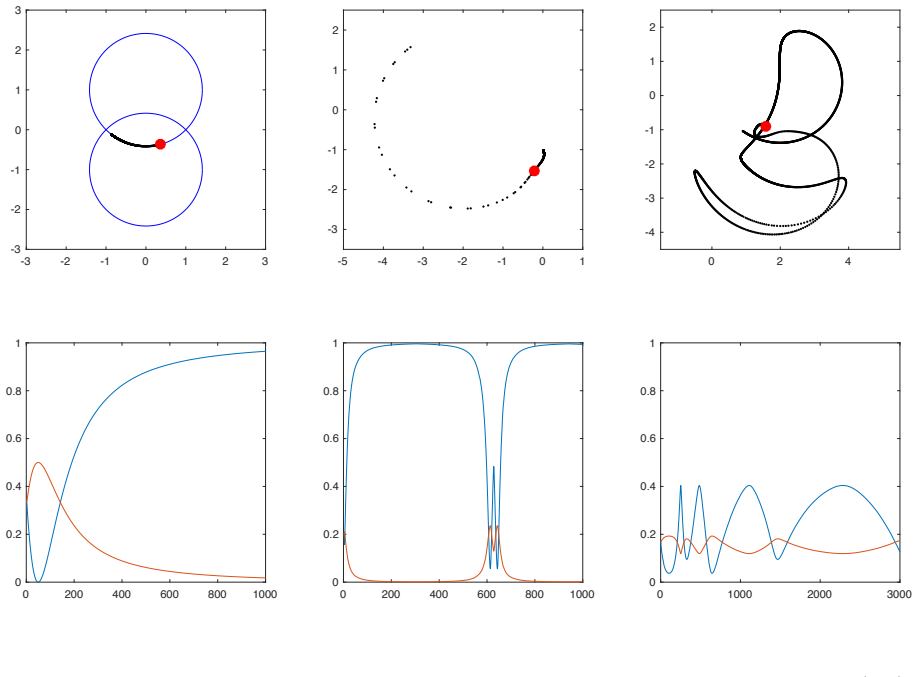
- The paper's numerical path-tracing procedure generates a one-parameter family of biangular frames passing through a SIC; the same scheme could be developed as a search heuristic for approximate SICs in larger dimensions.
Reading between the lines
- The paper leaves implicit that path-connectivity, if established, would make SIC existence a topological consequence rather than an arithmetic miracle; one could then predict SICs in dimensions where algebraic constructions remain unknown, including non-prime-power dimensions.
- A testable extension is to compute the real irreducible components of $C_d$ for dimensions beyond 5 and check whether every component contains both the trivial all-ones frame and a point with $\alpha<1/(d+1)$; the numerical experiments suggest this may hold generically.
- The same intermediate-value mechanism might apply to other families of frames in which two angle parameters swap order along a connected variety, potentially widening the route beyond Gabor frames.
Signed reviews
Editorial analysis
A structured set of objections, weighed in public.
Referee Report
Summary. The paper proposes a non-constructive route to Zauner's conjecture. It introduces biangular Gabor frames, proves structural facts about them, and shows that if a Gabor mutually unbiased basis (MUB) exists and the variety of biangular Gabor frames is path-connected, then an intermediate-value argument yields a SIC. The paper proves the existence of a SIC in dimension 2 as a proof of concept, gives a lemma connecting path-connectivity of a normalized slice to path-connectivity of the full variety, and presents numerical experiments for d=2,4,5 that are explicitly described as illustrations. It isolates path-connectivity of the variety as the main open problem.
Significance. If the proposed program can be completed, it would provide a genuinely new, non-constructive approach to Zauner's conjecture and would complement the current Stark-units-based constructive program. The paper is self-contained, proves its elementary lemmas cleanly, and is appropriately careful to label the numerical experiments as heuristic rather than rigorous evidence. The main obstacle is correctly formulating the path-connectivity hypothesis: as written, the central lemma suffers from a correctness gap, though the gap appears repairable by restating the hypothesis in terms of the normalized slice or the punctured variety. The paper is a reasonable research contribution once that issue is resolved.
major comments (2)
- [Section 2, Problem 6] Under the literal definition of B_d, the hypothesis of Lemma 3 is vacuous and the 'Without loss of generality, it holds that ||v(t)||_2 = 1' step is unjustified. The zero vector satisfies the biangular conditions with alpha=beta=0, and every nonzero v in B_d is connected to 0 by the segment t |-> (1-t)v, so B_d is path-connected in every dimension. A path from the Gabor MUB v0 to v1 may therefore pass through 0, in which case the normalized curve v(t)/||v(t)|| is not defined and the formula Delta(t) = (1-(d+1)alpha(t))/d, which relies on unit norm, does not follow. The intended hypothesis must be path-connectivity of the normalized slice C_d, or of B_d \ {0}, or at minimum the existence of a path between v0 and v1 that avoids 0. With such a corrected hypothesis the intermediate-value argument would go through, since scaling a path that avoids 0 by 1/||v(t)|| preserves biangularity.
- [Section 2, Problem 6] Problem 6 as stated is trivial: because B_d contains 0 and is a cone, B_d is path-connected for every dimension d. The intended open problem must be about the normalized or projective variety, e.g., whether C_d is path-connected. This is not merely a wording issue, because Lemma 3 requires a path that stays away from 0; Lemma 4 proves that C_d path-connected implies B_d path-connected, but the converse direction is not what the proof of Lemma 3 needs. The authors should restate Problem 6 and Lemma 3 in terms of the normalized slice C_d (or B_d^\times) and make the avoidance of 0 an explicit part of the argument.
minor comments (3)
- [Section 3] The first paragraph contains the typo 'Zuaner's conjecture'; this should be 'Zauner's conjecture'.
- [Section 2] The sentence 'For each d in {2,4,5}, we consider the numerical fiducial reported by Scott and Grassl (when d=3, the variety of SIC fiducials is already interesting)' is confusing, since the parenthetical does not explain why d=3 is excluded from the experiment; please clarify.
- [Section 2] The phrase 'B_d/C^\times is at times one-dimensional' is informal; since C^\times acts on B_d, a more precise formulation would specify whether the dimension refers to the quotient variety or to the slice C_d.
Circularity Check
No circularity: the paper's conditional derivation is self-contained, with the unproved path-connectivity hypothesis stated explicitly rather than imported from the conclusion.
full rationale
The paper's derivation chain is conditional and self-contained. Lemma 3 assumes the existence of a Gabor MUB and path-connectivity of B_d as hypotheses, and derives the existence of a SIC by the intermediate value theorem using the identity alpha + d*beta = ||v||^4 from Lemma 1. The SIC is the output of the argument, not an input. The proof does not fit any parameter to data and then rename it a prediction; the numerical experiments in Figure 2 are illustrations, not load-bearing evidence. The only unproved premise, path-connectivity of B_d, is explicitly isolated in Problem 6, and the paper proves it only for d=2 via Corollary 5. The self-citations to prior work on frame path-connectivity (references [21] and [22]) are contextual and not used to justify the central conditional claim. A possible correctness issue is that B_d as literally defined contains 0, making the bare statement 'B_d is path-connected' potentially vacuous or requiring a normalization caveat in Lemma 3; however, that is a well-posedness or proof-gap concern, not circularity, since the conclusion does not feed into the hypothesis. Accordingly, no circular step is exhibited, and the score is 0.
Assumptions & free parameters
assumptions (4)
- standard math Gabor frames G(v) are tight with frame bound d||v||^2.
- standard math Intermediate value theorem for continuous real-valued functions.
- domain assumption Existence of a Gabor mutually unbiased basis in C^d, known for prime d from Alltop sequences.
- ad hoc to paper Path-connectivity of the variety B_d of biangular Gabor frames (or its slice C_d).
Cite this review
Pith. "Pith review of Biangular Gabor frames and Zauner's conjecture." pith.science (2026). https://pith.science/paper/GXMPFIQS
@misc{pith2026190802801,
  author       = {Pith},
  title        = {Pith review of: Biangular Gabor frames and Zauner's conjecture},
  year         = {2026},
  howpublished = {\url{https://pith.science/paper/GXMPFIQS}},
  note         = {Machine review of arXiv:1908.02801}
}
abstract
Two decades ago, Zauner conjectured that for every dimension $d$, there exists an equiangular tight frame consisting of $d^2$ vectors in $\mathbb{C}^d$. Most progress to date explicitly constructs the promised frame in various dimensions, and it now appears that a constructive proof of Zauner's conjecture may require progress on the Stark conjectures. In this paper, we propose an alternative approach involving biangular Gabor frames that may eventually lead to an unconditional non-constructive proof of Zauner's conjecture.
Figures

Reference graph
Works this paper leans on
-
[1]
Lower bounds on the maximum cross correlation of signals (corresp.),
L. Welch, “Lower bounds on the maximum cross correlation of signals (corresp.),” IEEE Transactions on Information theory 20(3), pp. 397–399, 1974
work page 1974
-
[2]
The road to deterministic matrices with the restricted isometry property,
A. S. Bandeira, M. Fickus, D. G. Mixon, and P. Wong, “The road to deterministic matrices with the restricted isometry property,” Journal of Fourier Analysis and Applications 19(6), pp. 1123–1149, 2013
work page 2013
-
[3]
Fingerprinting with equiangular tight frames,
D. G. Mixon, C. J. Quinn, N. Kiyavash, and M. Fickus, “Fingerprinting with equiangular tight frames,” IEEE Transactions on Information Theory 59(3), pp. 1855–1865, 2013
work page 2013
-
[4]
Grassmannian frames with applications to coding and communication,
T. Strohmer and R. W. Heath Jr, “Grassmannian frames with applications to coding and communication,” Applied and computational harmonic analysis 14(3), pp. 257–275, 2003
work page 2003
-
[5]
Symmetric informationally complete quantum measurements,
J. M. Renes, R. Blume-Kohout, A. J. Scott, and C. M. Caves, “Symmetric informationally complete quantum measurements,” Journal of Mathematical Physics 45(6), pp. 2171–2180, 2004
work page 2004
-
[6]
P. W. Lemmens, J. J. Seidel, and J. Green, “Equiangular lines,” in Geometry and Combinatorics , pp. 127– 145, Elsevier, 1991
work page 1991
-
[7]
Grundz uge einer nichtkommutativen designtheorie,
G. Zauner, “Grundz uge einer nichtkommutativen designtheorie,” 1999
work page 1999
-
[8]
A. Roy and A. Scott, “Weighted complex projective 2-designs from bases: Optimal state determination by orthogonal measurements,” Journal of mathematical physics 48(7), p. 072110, 2007
work page 2007
Show all 23 references
-
[9]
The SIC question: History and state of play,
C. Fuchs, M. Hoang, and B. Stacey, “The SIC question: History and state of play,” Axioms 6(3), p. 21, 2017
2017
-
[10]
A global Lojasiewicz inequality for algebraic varieties,
S. Ji, J. Koll´ ar, and B. Shiffman, “A global Lojasiewicz inequality for algebraic varieties,” Transactions of the American Mathematical Society 329(2), pp. 813–818, 1992
1992
-
[11]
Symmetric informationally complete positive-operator-valued measures: A new computer study,
A. J. Scott and M. Grassl, “Symmetric informationally complete positive-operator-valued measures: A new computer study,” Journal of Mathematical Physics 51(4), p. 042203, 2010
2010
-
[12]
SICs and algebraic number theory,
M. Appleby, S. Flammia, G. McConnell, and J. Yard, “SICs and algebraic number theory,” Foundations of Physics 47(8), pp. 1042–1059, 2017
2017
-
[13]
Constructing exact symmetric informationally com- plete measurements from numerical solutions,
M. Appleby, T.-Y. Chien, S. Flammia, and S. Waldron, “Constructing exact symmetric informationally com- plete measurements from numerical solutions,” Journal of Physics A: Mathematical and Theoretical 51(16), p. 165302, 2018
2018
-
[14]
L-functions at s = 1. III. Totally real fields and Hilbert’s twelfth problem,
H. M. Stark, “ L-functions at s = 1. III. Totally real fields and Hilbert’s twelfth problem,” Advances in Mathematics 22(1), pp. 64–84, 1976
1976
-
[15]
SIC-POVMs and the Stark conjectures,
G. S. Kopp, “SIC-POVMs and the Stark conjectures,” arXiv preprint arXiv:1807.05877 , 2018
2018 arXiv
-
[16]
SIC fiducials
“SIC fiducials.” http://www.gerhardzauner.at/sicfiducials.html
-
[17]
Exact SIC fiducial vectors
“Exact SIC fiducial vectors.” http://www.physics.usyd.edu.au/~sflammia/SIC/
-
[18]
Fixed point theorems and equiangular lines
“Fixed point theorems and equiangular lines.” https://mathoverflow.net/questions/30894/ fixed-point-theorems-and-equiangular-lines
-
[19]
A survey of finite algebraic geometrical structures underlying mutually unbiased quantum measurements,
M. Planat, H. C. Rosu, and S. Perrine, “A survey of finite algebraic geometrical structures underlying mutually unbiased quantum measurements,” Foundations of Physics 36(11), pp. 1662–1680, 2006
2006
-
[20]
Complex sequences with low periodic correlations (corresp.),
W. Alltop, “Complex sequences with low periodic correlations (corresp.),” IEEE Transactions on Informa- tion Theory 26(3), pp. 350–354, 1980
1980
-
[21]
Connectivity and irreducibility of algebraic varieties of finite unit norm tight frames,
J. Cahill, D. G. Mixon, and N. Strawn, “Connectivity and irreducibility of algebraic varieties of finite unit norm tight frames,” SIAM Journal on Applied Algebra and Geometry 1(1), pp. 38–72, 2017
2017
-
[22]
Constructing finite frames of a given spectrum and set of lengths,
J. Cahill, M. Fickus, D. G. Mixon, M. J. Poteet, and N. Strawn, “Constructing finite frames of a given spectrum and set of lengths,” Applied and Computational Harmonic Analysis 35(1), pp. 52–73, 2013
2013
-
[23]
Symplectic geometry and connectivity of spaces of frames,
T. Needham and C. Shonkwiler, “Symplectic geometry and connectivity of spaces of frames,” arXiv preprint arXiv:1804.05899 , 2018
2018 arXiv
Reviewed August 14, 2026 · model on record in the stance chip above.
Discussion (0). Continue with ORCID to comment.