REVIEW 2 major objections 6 minor 75 references
AGNs at the cosmic dawn: predictions for future surveys from a $\Lambda$CDM cosmological model
T0 review · 2 major / 6 minor · reviewed 2026-08-14 · deepseek-v4-flash
Pith's one-line read A galaxy formation model predicts what four new telescopes will find at $z>7$: black holes of $10^{5}$–$10^{8}\,M_\odot$ at $z=7$, each survey selecting a different slice of the population.
desk verdict A competent extension of a calibrated model to z>7, with survey forecasts that are useful but whose absolute counts are conditional on unconstrained super-Eddington accretion. read the letter →
The pith
A machine-rendered reading of the paper's core claim, the machinery that carries it, and where it could break.
The reading
What carries the argument
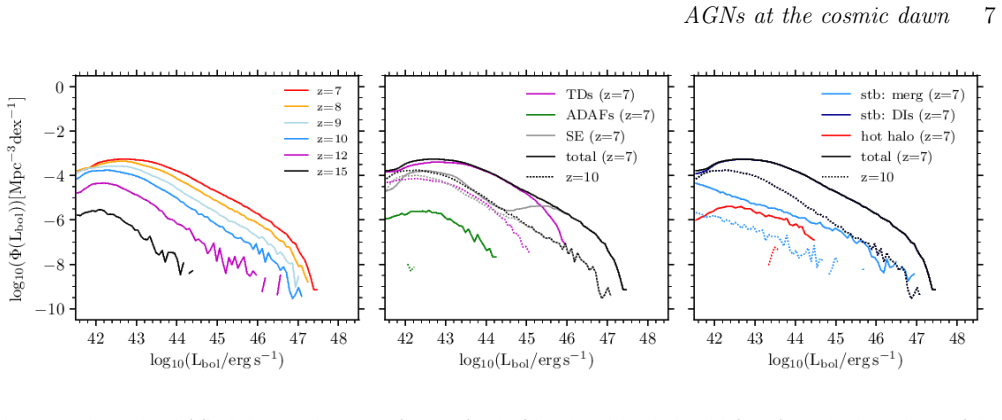
The load-bearing machinery is the supermassive black hole growth model inside the galform semi-analytic galaxy formation code: black holes grow through starburst-driven accretion (from both mergers and disc instabilities), quiescent hot-halo accretion, and black hole mergers, with spin evolving through each accretion episode and merger. The crucial element is that gas accretion is not Eddington-limited; instead the accretion flow passes through three regimes — advection-dominated, thin disc, and super-Eddington slim disc — each with its own luminosity law, so super-Eddington sources shine with $L_{\rm bol}=\eta_{\rm Edd}\bigl(1+\ln\frac{\dot m}{\eta_{\rm Edd}}\frac{\varepsilon(a)}{0.1}\bigr)L_{\rm Edd}$. The Eddington luminosity is the power at which radiation pressure balances gravity, and $\dot m$ is the accretion rate normalised to the Eddington rate. This single choice lets small seeds reach about $10^{8}\,M_\odot$ by $z\sim7$; capping accretion at the Eddington rate cuts the predicted $z=7$ SMBH number density by one to two and a half orders of magnitude. A template AGN SED and empirical obscuration visible fractions then convert bolometric luminosity into the specific bands of each telescope, and confusion-limit calculations set the X-ray survey sensitivities.
What would settle it
Count the faint AGNs in a deep JWST or Lynx field at $z\approx7$ and measure their Eddington ratios. The model predicts roughly 800 Lynx AGNs per field of view at $z=7$ and says the bright $z=10$ quasars accrete above the Eddington rate; finding far fewer sources, or showing that every high-redshift AGN accretes at or below the Eddington rate, would falsify the super-Eddington growth channel on which the predictions rest.
Extended reading notes
Core claim
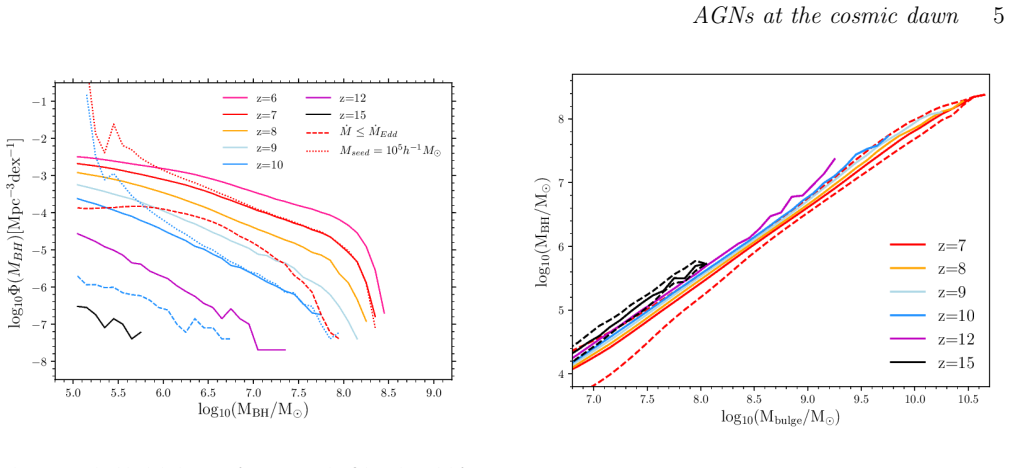
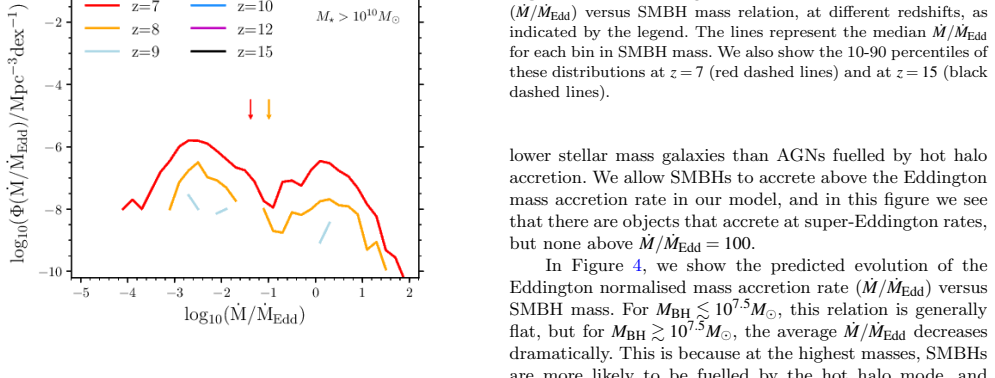
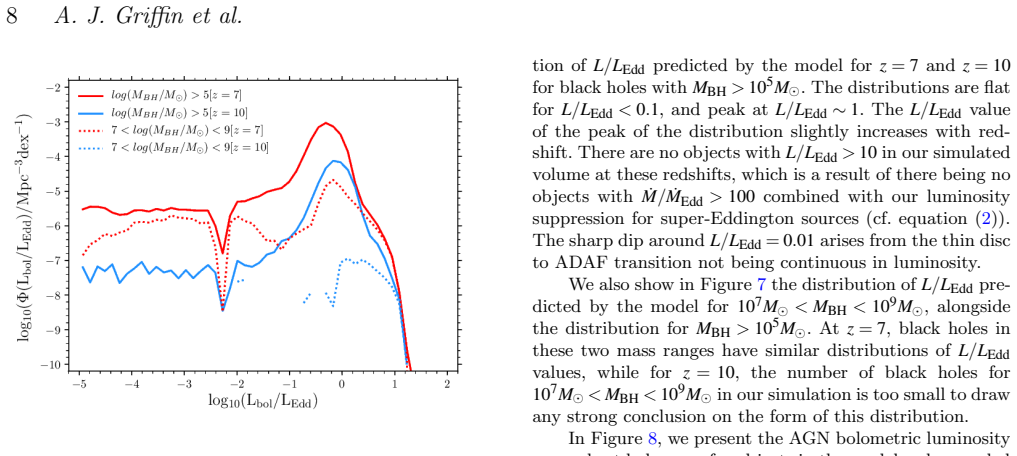
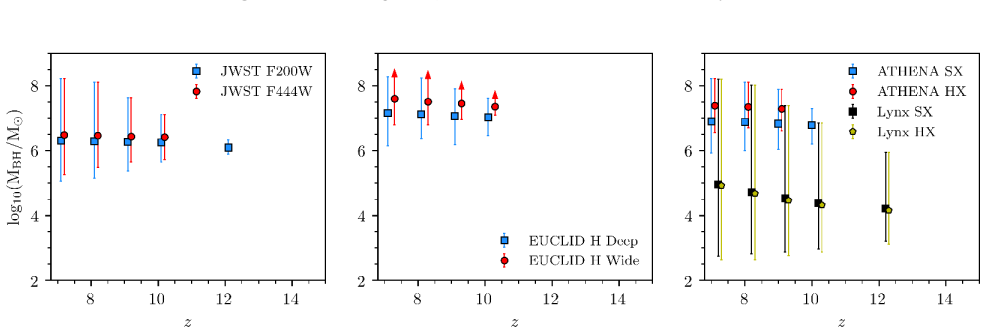
On its own terms, the paper's claim is that a model in which supermassive black hole masses and spins evolve self-consistently within a $\Lambda$CDM galaxy formation model produces a well-defined, observable AGN population at $z\ge7$. The bolometric luminosity function declines with redshift as hierarchical growth dictates; the dominant fuelling mechanism is starbursts triggered by disc instabilities, not galaxy mergers; and at $z=10$ the luminous quasars are mostly accreting above the Eddington rate. Because the model does not cap accretion at the Eddington rate, seeds of roughly $10\,M_\odot$ grow fast enough to populate the predicted abundance, and the luminosity functions are insensitive to seed mass except at $L_{\rm bol}<10^{43}\,\rm erg\,s^{-1}$ and $z>10$. Converted into survey forecasts, the model yields 90–500 AGNs at $z=7$ for a 1000-field JWST F200W survey, $(8\text{–}30)\times10^{3}$ for the EUCLID Wide survey, 30–80 per field for ATHENA in the soft X-ray band, and roughly 800 per field for Lynx, with median black hole masses from about $10^{5}\,M_\odot$ (Lynx) to $4\times10^{7}\,M_\odot$ (EUCLID Wide) at $z=7$. The faint-end predictions, where Lynx operates, are stated in the paper as lower limits on number density and upper limits on the derived black hole properties.
Load-bearing premise
The predictions stand on the assumption that real black holes can swallow gas several times faster than the Eddington rate, the limit at which radiation pressure would blow the infalling gas away; if such super-fast accretion is rare or impossible, the predicted survey counts are one to several orders of magnitude too high.
Editorial extensions
If this is right
- The four surveys are predicted to be complementary, not redundant: EUCLID Wide reaches the most massive and fastest-accreting black holes, Lynx the smallest and slowest, so cross-matching the samples tests the model across its full mass and accretion-rate range.
- Lynx is the only survey predicted to reach black hole masses near the seed range ($\sim10^{4}$–$10^{5}\,M_\odot$) at $z=7$ and to detect AGNs out to $z\sim12$–$15$, making seed-formation models directly testable.
- An Eddington cap on accretion would remove one to 2.5 orders of magnitude of predicted $z=7$ SMBH number density, so the observed counts double as a test of super-Eddington accretion physics.
- Across the three model variants the predicted counts differ by factors of roughly 2–6, so the observed counts will also constrain the high-redshift obscured fraction and the efficiency of starburst-fuelled accretion.
- At $z=10$ the detectable black holes are smaller but accrete at higher Eddington ratios ($\sim1$–$8$) in lower-mass hosts than at $z=7$, a trend the survey samples can check directly.
Reading between the lines
- Because Lynx and EUCLID bracket the $z=7$ population at medians near $10^{5}$ and $4\times10^{7}\,M_\odot$, a joint analysis of the two samples would measure how much growth occurred between seed formation and cosmic dawn, separating seed-dominated from growth-dominated black holes.
- The prediction that disc instabilities, not mergers, fuel most high-redshift AGNs is a distinguishing signature of this model; morphological follow-up of $z>7$ AGN host galaxies could test it independently of the counts.
- The gap between the fiducial predictions and the Eddington-capped variant shows how much of the claimed signal is really a probe of super-Eddington physics; re-running the model with a mass-dependent Eddington cap would bracket the survey counts and isolate that dependence.
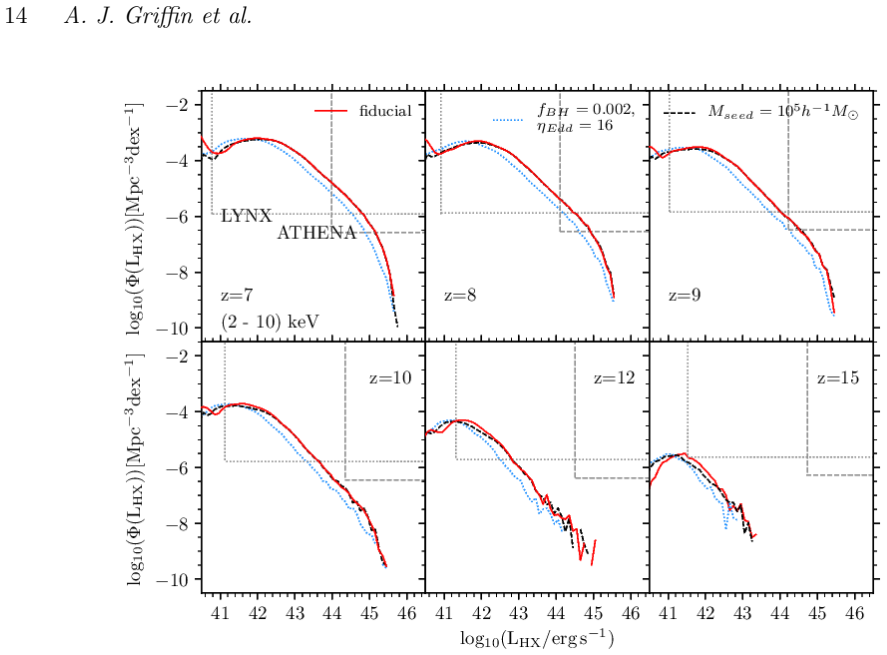
- The Lynx confusion limits extrapolate faint X-ray number counts one hundred to a thousand times below what Chandra has observed; if the true counts flatten at those fluxes, the Lynx detection numbers would come down, a risk earlier X-ray missions could partly retire before Lynx flies.
Signed reviews
Editorial analysis
A structured set of objections, weighed in public.
Referee Report
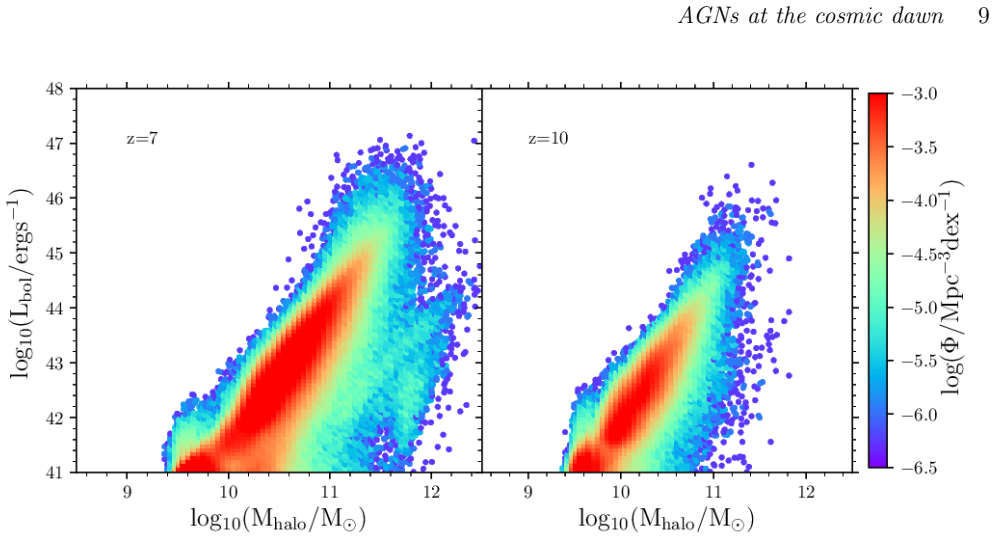
Summary. This paper extends the galform-based SMBH evolution model of Griffin et al. (2019, Paper I) to make predictions for the AGN population at z > 7, expressed as luminosity functions and survey yields for JWST (F200W/F444W), EUCLID (H band, Deep and Wide), ATHENA (soft and hard X-ray), and Lynx. The model allows gas accretion onto SMBHs to exceed the Eddington rate, with a luminosity-suppressed slim-disc prescription (Eq. 2), converts bolometric luminosities to band luminosities with the Marconi et al. (2004) empirical SED, and applies three model variants that differ in the obscuration-corrected 'visible fraction' or in the starburst accretion efficiency, with the alternative variants tuned to reproduce the z = 6 rest-frame UV and soft X-ray luminosity functions. The main results are: (i) the high-z black hole mass function is insensitive to seed mass except at low luminosity and z > 10, but is strongly boosted by super-Eddington accretion, by 1-2.5 dex at z = 7 relative to an Eddington-capped run; (ii) at z = 7 typical detectable SMBHs have M_BH ~ 10^5-8 M_sun and Eddington-normalised accretion rates 0.6-2, hosted by galaxies with M_star ~ 10^8-10 M_sun in haloes of ~10^11-12 M_sun; (iii) the four telescopes select systematically different populations, with EUCLID Wide finding the most massive and fastest-accreting SMBHs and Lynx the least massive. Counts, detection properties, and convergence checks on halo resolution (Fig. A1) and seed mass (Fig.
Significance. The paper delivers what the title promises: concrete, falsifiable forecasts for four upcoming observatories, with counts, black hole masses, Eddington ratios, and host properties given in Tables C1, D1, and D2. The qualitative differential-selection result (EUCLID Wide at the massive, high-accretion end; Lynx at the low-mass end) follows from survey depths and areas and is likely robust to the model variants. The authors are unusually transparent about sensitivities: they show the Eddington-capped mass function (Fig. 1), the seed-mass dependence (Fig. B1), the halo-resolution convergence limit (Fig. A1), a partial SED robustness test against Netzer (2019), and the k-evolution comparison with Jiang et al. (2016). These checks make the paper a useful reference even where the quantitative predictions will be contested. The main weakness is that the headline numbers in Table C1 integrate over a regime calibrated only at z <= 6: super-Eddington accretion dominates the bright end at z > 7, and the parameters controlling it are weakly constrained by the z <= 6 fit, so the claimed counts are conditional on an assumption whose breakdown would change them by an order of magnitude.
major comments (2)
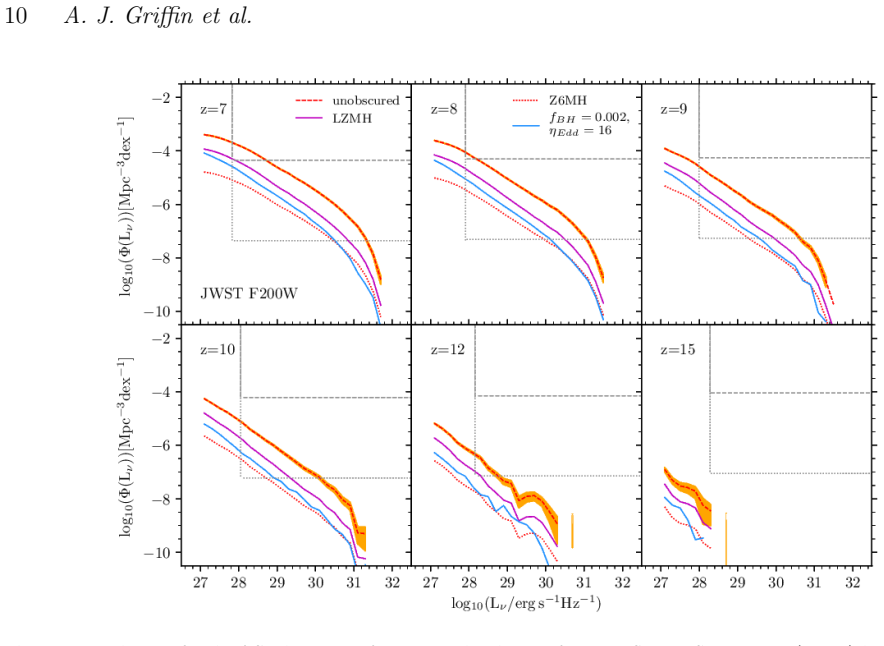
- [§2.2, Fig. 1, Table C1] The survey yields in Table C1 are computed from luminosity functions whose bright end at z > 7 is dominated by super-Eddington objects (Fig. 5, middle panel), but this sensitivity is not propagated into the survey predictions. The Eddington-capped comparison in Fig. 1 reduces the z = 7 SMBH number density by about 1 dex at M_BH = 10^6-10^7 M_sun, 1.5 dex at 10^5 M_sun, and 2.5 dex at 10^8 M_sun, with roughly 2 dex suppression at z = 10, and since the counts in Table C1 (e.g., 90-500 for JWST F200W, 8000-30000 for EUCLID Wide, and 800-900 for Lynx at z = 7) are integrals over these mass and luminosity functions, a physical suppression of super-Eddington accretion would reduce the predicted yields by comparable factors. The parameters that set the super-Eddington regime, eta_Edd and f_q, were calibrated on the bolometric luminosity function at 0 <= z <= 6 in Paper I, where super-Eddington sources are a minority population, so the z > 7 bright end is essentially an unvalidated extrapolation. I request that the Eddington-limited case, and ideally an intermediate cap such as 10 times the Eddington rate, be added to Table C1 and to the property tables, and that the abstract and conclusions state explicitly that the quoted counts assume super-Eddington accretion. Without this, the ranges quoted in Table C1 understate the dominant systematic uncertainty.
- [§5.2, Tables 1-2, Table C1] The Lynx confusion limits in Table 1 are obtained by extrapolating the Lehmer et al. (2012) source-count model to fluxes 100-1000 times fainter than the Chandra data it was fitted to, and the gamma values in Table 2 are evaluated from the same extrapolated model, so the resulting limits are self-consistent but unvalidated. These limits set the luminosity threshold for the signature Lynx results, namely 800-900 detections per field at z = 7 and median black hole masses of about 8 x 10^4 M_sun (Table D1), and for the conclusion that Lynx will best constrain SMBH seeds; a factor-of-two error in the confusion flux would shift the accessible luminosity range and thus the predicted counts and masses. I ask the authors to quantify this dependence, for example by quoting the Lynx yields for confusion fluxes varied by +/-0.3 dex, and to attach the halo-mass-resolution caveat directly to the Lynx rows in Tables C1 and D1, since the Fig. 11 caption states that the low-luminosity Lynx number densities are lower limits and Sec. 5.3 states that the Lynx property values are upper limits.
minor comments (6)
- [Throughout] The manuscript contains several typographical slips that should be corrected: 'inbetween' in the abstract, 'adpoted' in Sec. 4, 'predcit' in Sec. 5.2, 'obects' in Sec. 5.3, and 'very' in place of 'vary' in Sec. 6 ('masses that very from').
- [Tables C1, D1] The asymmetric halo-mass-resolution caveats for Lynx are given in the main text (Fig. 11 caption: number densities are lower limits; Sec. 5.3: black hole properties are upper limits) but not in the tables themselves; adding a footnote to the Lynx rows in Tables C1 and D1 would prevent readers from quoting the numbers without the caveat.
- [§2.2, §5.1] The robustness test against the Netzer (2019) SED is described only in prose; showing the bolometric-correction comparison as a figure would make the factor-of-two X-ray difference transparent, and a sentence noting that neither the Marconi nor the Netzer template covers the slim-disc super-Eddington regime would make the caveat precise, since that regime drives the z = 10 near-infrared counts in Table C1.
- [§3] The model's inability to produce SMBHs more massive than about 3 x 10^8 M_sun at z = 6, in tension with luminous z ~ 6-7 quasars with inferred masses up to ~10^10 M_sun, is acknowledged and plausibly attributed to the (800 Mpc)^3 box, but the abstract's 'typical detectable SMBHs at z = 7' statement should remind the reader that the bright end is incomplete in the simulation volume; the EUCLID Wide maximum masses are already flagged as lower limits in Fig. 13, and a parallel sentence in the conclusions would help.
- [Table C1] The Lynx soft X-ray entry at z = 7 is a single value (800) with no range across the three model variants, unlike all other entries; please clarify whether the three variants genuinely give the same count and, if so, why (e.g., because the count is set by the resolution-limited density floor rather than by the variant-dependent luminosity function).
- [References] Aird et al. (2013) is cited as a preprint with an arXiv number; if the published version (MNRAS 451, 1892) is available, it should be cited instead, and the same check should be applied to other arXiv-only entries that were subsequently published.
Circularity Check
No significant circularity: the z>7 predictions are extrapolations of a model calibrated at lower redshift against external data; no fitted quantity is renamed as a prediction.
full rationale
The derivation chain runs from the galform galaxy formation model (Baugh et al. 2019 recalibration; Lacey et al. 2016) and the SMBH/AGN model of Griffin et al. (2019, Paper I), whose free parameters were calibrated on observed AGN bolometric luminosity functions at 0 <= z <= 6. The present paper does not fit anything to the z > 7 data it predicts: the black hole mass functions, AGN luminosity functions, survey counts in Table C1, and median detectable-object properties in Tables D1 and D2 are direct outputs of the model after applying the stated survey flux limits and areas. The Z6MH and low-accretion-efficiency model variants are tuned to z = 6 observations and then extrapolated to z > 7; that is boundary fitting at the calibration edge, not circularity, because the z > 7 claims are not used to define or calibrate the parameters. The super-Eddington accretion assumption is physically motivated and its impact is quantified, but an uncalibrated assumption is a robustness/correctness concern rather than a definitional circularity. Self-citations to Paper I refer to externally calibrated comparisons with observed AGN properties at z <= 6, not to a uniqueness theorem or an ansatz that already contains the z > 7 result. No load-bearing step reduces to its own input by construction.
Assumptions & free parameters
free parameters (5)
- fBH =
0.005 (fiducial), 0.002 (low accretion efficiency variant)
- eta_Edd =
4 (fiducial), 16 (variant)
- f_q =
not quoted in this paper
- visible fraction coefficients =
LZMH: 0.15, 0.4; Z6MH: 0.04
- seed black hole mass =
10 h^-1 Msun (fiducial); 10^3 and 10^5 h^-1 Msun tested
assumptions (5)
- domain assumption Planck 2014 Lambda-CDM cosmology and P-Millennium dark matter merger trees are accurate enough for z = 7 to 15 predictions.
- domain assumption SMBH gas accretion is not Eddington-limited; super-Eddington rates up to about 100 Eddington are allowed.
- domain assumption The Marconi et al. (2004) empirical AGN SED and its bolometric corrections apply at z > 7 and at the low luminosities probed by Lynx.
- domain assumption Obscuration visible fractions calibrated at lower redshift apply at z > 7, with no obscuration in the 2 to 10 keV band.
- domain assumption Lehmer et al. (2012) X-ray number counts can be extrapolated 100 to 1000 times below Chandra fluxes to set Lynx confusion limits.
Cite this review
Pith. "Pith review of AGNs at the cosmic dawn: predictions for future surveys from a $\Lambda$CDM cosmological model." pith.science (2026). https://pith.science/paper/NL4INUM3
@misc{pith2026190802841,
  author       = {Pith},
  title        = {Pith review of: AGNs at the cosmic dawn: predictions for future surveys from a $\Lambda$CDM cosmological model},
  year         = {2026},
  howpublished = {\url{https://pith.science/paper/NL4INUM3}},
  note         = {Machine review of arXiv:1908.02841}
}
abstract
Telescopes to be launched over the next decade-and-a-half, such as JWST, EUCLID, ATHENA and Lynx, promise to revolutionise the study of the high redshift Universe and greatly advance our understanding of the early stages of galaxy formation. We use a model that follows the evolution of the masses and spins of supermassive black holes (SMBHs) within a semi-analytic model of galaxy formation to make predictions for the Active Galactic Nucleus (AGN) luminosity function at $z\geq7$ in the broadband filters of JWST and EUCLID at near-infrared wavelengths, and ATHENA and Lynx at X-ray energies. The predictions of our model are relatively insensitive to the choice of seed black hole mass, except at the lowest luminosities ($L_{\mathrm{bol}}<10^{43}\mathrm{ergs^{-1}}$) and the highest redshifts ($z>10$). We predict that surveys with these different telescopes will select somewhat different samples of SMBHs, with EUCLID unveiling the most massive, highest accretion rate SMBHs, Lynx the least massive, lowest accretion rate SMBHs, and JWST and ATHENA covering objects inbetween. At $z=7$, we predict that typical detectable SMBHs will have masses, $M_{\mathrm{BH}}\sim10^{5-8}M_{\odot}$, and Eddington normalised mass accretion rates, $\dot{M}/\dot{M}_{\mathrm{Edd}}\sim0.6-2$. The SMBHs will be hosted by galaxies of stellar mass $M_{\star}\sim10^{8-10}M_{\odot}$, and dark matter haloes of mass $M_{\mathrm{halo}}\sim10^{11-12}M_{\odot}$. We predict that the detectable SMBHs at $z=10$ will have slightly smaller black holes, accreting at slightly higher Eddington normalised mass accretion rates, in slightly lower mass host galaxies compared to those at $z=7$, and reside in haloes of mass $M_{\mathrm{halo}}\sim10^{10-11}M_{\odot}$.
Figures

Figures from the paper (12 more)





Reference graph
Works this paper leans on
-
[1]
Abramowicz M. A., Czerny B., Lasota J. P., Szuszkiewicz E., 1988, @doi [ ] 10.1086/166683 , http://adsabs.harvard.edu/abs/1988ApJ...332..646A 332, 646
doi:10.1086/166683 1988
-
[2]
Aird J., et al., 2013, preprint, http://adsabs.harvard.edu/abs/2013arXiv1306.2325A ( @eprint arXiv 1306.2325 )
work page Pith review arXiv 2013
-
[3]
Amarantidis S., et al., 2019, @doi [ ] 10.1093/mnras/stz551 , http://adsabs.harvard.edu/abs/2019MNRAS.485.2694A 485, 2694
-
[4]
Ba \ n ados E., et al., 2018a, @doi [ ] 10.1038/nature25180 , http://adsabs.harvard.edu/abs/2018Natur.553..473B 553, 473
-
[5]
Ba \ n ados E., et al., 2018b, @doi [ ] 10.3847/2041-8213/aab61e , http://adsabs.harvard.edu/abs/2018ApJ...856L..25B 856, L25
-
[6]
Baugh C. M., et al., 2019, @doi [ ] 10.1093/mnras/sty3427 , https://ui.adsabs.harvard.edu/abs/2019MNRAS.483.4922B 483, 4922
-
[7]
Bonoli S., Marulli F., Springel V., White S. D. M., Branchini E., Moscardini L., 2009, @doi [ ] 10.1111/j.1365-2966.2009.14701.x , http://adsabs.harvard.edu/abs/2009MNRAS.396..423B 396, 423
arXiv 2009
-
[8]
Bower R. G., Benson A. J., Malbon R., Helly J. C., Frenk C. S., Baugh C. M., Cole S., Lacey C. G., 2006, @doi [ ] 10.1111/j.1365-2966.2006.10519.x , http://adsabs.harvard.edu/abs/2006MNRAS.370..645B 370, 645
arXiv 2006
Show all 75 references
-
[9]
W., McNamara B
Cavagnolo K. W., McNamara B. R., Wise M. W., Nulsen P. E. J., Br \"u ggen M., Gitti M., Rafferty D. A., 2011, @doi [ ] 10.1088/0004-637X/732/2/71 , http://adsabs.harvard.edu/abs/2011ApJ...732...71C 732, 71
2011 doi
-
[10]
Cicone C., et al., 2015, @doi [ ] 10.1051/0004-6361/201424980 , http://adsabs.harvard.edu/abs/2015A
2015 doi
-
[11]
G., Baugh C
Cole S., Lacey C. G., Baugh C. M., Frenk C. S., 2000, @doi [ ] 10.1046/j.1365-8711.2000.03879.x , http://adsabs.harvard.edu/abs/2000MNRAS.319..168C 319, 168
2000
-
[12]
J., 1974, @doi [ ] 10.1086/152714 , http://adsabs.harvard.edu/abs/1974ApJ...188..279C 188, 279
Condon J. J., 1974, @doi [ ] 10.1086/152714 , http://adsabs.harvard.edu/abs/1974ApJ...188..279C 188, 279
1974 doi
-
[13]
I., Baugh C
Cowley W. I., Baugh C. M., Cole S., Frenk C. S., Lacey C. G., 2018, @doi [ ] 10.1093/mnras/stx2897 , http://adsabs.harvard.edu/abs/2018MNRAS.474.2352C 474, 2352
2018 doi
-
[14]
J., et al., 2006, @doi [ ] 10.1111/j.1365-2966.2005.09675.x , http://adsabs.harvard.edu/abs/2006MNRAS.365...11C 365, 11
Croton D. J., et al., 2006, @doi [ ] 10.1111/j.1365-2966.2005.09675.x , http://adsabs.harvard.edu/abs/2006MNRAS.365...11C 365, 11
2006
-
[15]
David L., et al., 2011, @doi [ ] 10.1088/0004-637X/728/2/162 , http://adsabs.harvard.edu/abs/2011ApJ...728..162D 728, 162
2011 doi
-
[16]
W., 2011, @doi [ ] 10.1088/0004-637X/739/2/56 , http://adsabs.harvard.edu/abs/2011ApJ...739...56D 739, 56
De Rosa G., Decarli R., Walter F., Fan X., Jiang L., Kurk J., Pasquali A., Rix H. W., 2011, @doi [ ] 10.1088/0004-637X/739/2/56 , http://adsabs.harvard.edu/abs/2011ApJ...739...56D 739, 56
2011 doi
-
[17]
Di Matteo T., Springel V., Hernquist L., 2005, @doi [ ] 10.1038/nature03335 , http://adsabs.harvard.edu/abs/2005Natur.433..604D 433, 604
2005 doi
-
[18]
Di Matteo T., Croft R. A. C., Feng Y., Waters D., Wilkins S., 2017, @doi [ ] 10.1093/mnras/stx319 , http://adsabs.harvard.edu/abs/2017MNRAS.467.4243D 467, 4243
2017 doi
-
[19]
Enoki M., Ishiyama T., Kobayashi M. A. R., Nagashima M., 2014, @doi [ ] 10.1088/0004-637X/794/1/69 , http://adsabs.harvard.edu/abs/2014ApJ...794...69E 794, 69
2014 doi
-
[20]
Euclid Collaboration et al., 2019, @doi [ ] 10.1051/0004-6361/201936427 , https://ui.adsabs.harvard.edu/abs/2019A&A...631A..85E 631, A85
2019 doi
-
[21]
Fan X., et al., 2001, @doi [ ] 10.1086/324111 , http://adsabs.harvard.edu/abs/2001AJ....122.2833F 122, 2833
2001 doi
-
[22]
Fan X., et al., 2003, @doi [ ] 10.1086/368246 , http://adsabs.harvard.edu/abs/2003AJ....125.1649F 125, 1649
2003 doi
-
[23]
Fan X., et al., 2004, AJ, 128, 515
2004
-
[24]
Fan X., et al., 2006, @doi [ ] 10.1086/504836 , https://ui.adsabs.harvard.edu/abs/2006AJ....132..117F 132, 117
2006 doi
-
[25]
M., Benson A
Fanidakis N., Baugh C. M., Benson A. J., Bower R. G., Cole S., Done C., Frenk C. S., 2011, @doi [ ] 10.1111/j.1365-2966.2010.17427.x , http://adsabs.harvard.edu/abs/2011MNRAS.410...53F 410, 53
2011
-
[26]
Fanidakis N., et al., 2012, @doi [ ] 10.1111/j.1365-2966.2011.19931.x , http://adsabs.harvard.edu/abs/2012MNRAS.419.2797F 419, 2797
2012
-
[27]
Forman W., et al., 2005, @doi [ ] 10.1086/429746 , http://adsabs.harvard.edu/abs/2005ApJ...635..894F 635, 894
2005 doi
-
[28]
P., et al., 2006, @doi [ ] 10.1007/s11214-006-8315-7 , http://adsabs.harvard.edu/abs/2006SSRv..123..485G 123, 485
Gardner J. P., et al., 2006, @doi [ ] 10.1007/s11214-006-8315-7 , http://adsabs.harvard.edu/abs/2006SSRv..123..485G 123, 485
2006 doi
-
[29]
Giallongo E., et al., 2015, @doi [ ] 10.1051/0004-6361/201425334 , http://adsabs.harvard.edu/abs/2015A
2015 doi
-
[30]
G., Baugh C
Gonzalez-Perez V., Lacey C. G., Baugh C. M., Lagos C. D. P., Helly J., Campbell D. J. R., Mitchell P. D., 2014, @doi [ ] 10.1093/mnras/stt2410 , http://adsabs.harvard.edu/abs/2014MNRAS.439..264G 439, 264
2014 doi
-
[31]
J., Lacey C
Griffin A. J., Lacey C. G., Gonzalez-Perez V., Lagos C. d. P., Baugh C. M., Fanidakis N., 2019, @doi [ ] 10.1093/mnras/stz1216 , https://ui.adsabs.harvard.edu/abs/2019MNRAS.487..198G 487, 198
2019 doi
-
[32]
E., Peterson B
Gunn J. E., Peterson B. A., 1965, @doi [ ] 10.1086/148444 , https://ui.adsabs.harvard.edu/abs/1965ApJ...142.1633G 142, 1633
1965 doi
-
[34]
C., Cole S., Frenk C
Helly J. C., Cole S., Frenk C. S., Baugh C. M., Benson A., Lacey C., 2003, @doi [ ] 10.1046/j.1365-8711.2003.06151.x , http://adsabs.harvard.edu/abs/2003MNRAS.338..903H 338, 903
2003
-
[36]
Hirschmann M., Dolag K., Saro A., Bachmann L., Borgani S., Burkert A., 2014, @doi [ ] 10.1093/mnras/stu1023 , http://adsabs.harvard.edu/abs/2014MNRAS.442.2304H 442, 2304
2014 doi
-
[37]
F., Richards G
Hopkins P. F., Richards G. T., Hernquist L., 2007, @doi [ ] 10.1086/509629 , http://adsabs.harvard.edu/abs/2007ApJ...654..731H 654, 731
2007 doi
-
[38]
Jiang L., et al., 2009, @doi [ ] 10.1088/0004-6256/138/1/305 , http://adsabs.harvard.edu/abs/2009AJ....138..305J 138, 305
2009 doi
-
[39]
Jiang L., et al., 2016, @doi [ ] 10.3847/1538-4357/833/2/222 , http://adsabs.harvard.edu/abs/2016ApJ...833..222J 833, 222
2016 doi
-
[40]
Kalirai J., 2018, @doi [Contemporary Physics] 10.1080/00107514.2018.1467648 , http://adsabs.harvard.edu/abs/2018ConPh..59..251K 59, 251
2018
-
[41]
Khandai N., Feng Y., DeGraf C., Di Matteo T., Croft R. A. C., 2012, @doi [ ] 10.1111/j.1365-2966.2012.21047.x , http://adsabs.harvard.edu/abs/2012MNRAS.423.2397K 423, 2397
2012
-
[42]
Kubota A., Done C., 2018, @doi [ ] 10.1093/mnras/sty1890 , http://adsabs.harvard.edu/abs/2018MNRAS.480.1247K 480, 1247
2018 doi
-
[43]
G., et al., 2016, @doi [ ] 10.1093/mnras/stw1888 , http://adsabs.harvard.edu/abs/2016MNRAS.462.3854L 462, 3854
Lacey C. G., et al., 2016, @doi [ ] 10.1093/mnras/stw1888 , http://adsabs.harvard.edu/abs/2016MNRAS.462.3854L 462, 3854
2016 doi
-
[45]
Laureijs R., et al., 2011, preprint, http://adsabs.harvard.edu/abs/2011arXiv1110.3193L ( @eprint arXiv 1110.3193 )
2011 arXiv
-
[46]
Lawrence A., et al., 2007, @doi [ ] 10.1111/j.1365-2966.2007.12040.x , http://adsabs.harvard.edu/abs/2007MNRAS.379.1599L 379, 1599
2007
-
[47]
D., et al., 2012, @doi [ ] 10.1088/0004-637X/752/1/46 , http://adsabs.harvard.edu/abs/2012ApJ...752...46L 752, 46
Lehmer B. D., et al., 2012, @doi [ ] 10.1088/0004-637X/752/1/46 , http://adsabs.harvard.edu/abs/2012ApJ...752...46L 752, 46
2012 doi
-
[48]
Maiolino R., et al., 2012, @doi [ ] 10.1111/j.1745-3933.2012.01303.x , http://adsabs.harvard.edu/abs/2012MNRAS.425L..66M 425, L66
2012
-
[49]
K., Maiolino R., Salvati M., 2004, @doi [ ] 10.1111/j.1365-2966.2004.07765.x , http://adsabs.harvard.edu/abs/2004MNRAS.351..169M 351, 169
Marconi A., Risaliti G., Gilli R., Hunt L. K., Maiolino R., Salvati M., 2004, @doi [ ] 10.1111/j.1365-2966.2004.07765.x , http://adsabs.harvard.edu/abs/2004MNRAS.351..169M 351, 169
2004
-
[50]
Marulli F., Bonoli S., Branchini E., Moscardini L., Springel V., 2008, @doi [ ] 10.1111/j.1365-2966.2008.12988.x , http://adsabs.harvard.edu/abs/2008MNRAS.385.1846M 385, 1846
2008
-
[51]
Menci N., Fiore F., Lamastra A., 2013, @doi [ ] 10.1088/0004-637X/766/2/110 , http://adsabs.harvard.edu/abs/2013ApJ...766..110M 766, 110
2013 doi
-
[52]
J., et al., 2011, @doi [ ] 10.1038/nature10159 , http://adsabs.harvard.edu/abs/2011Natur.474..616M 474, 616
Mortlock D. J., et al., 2011, @doi [ ] 10.1038/nature10159 , http://adsabs.harvard.edu/abs/2011Natur.474..616M 474, 616
2011 doi
-
[53]
Nandra K., et al., 2013, preprint, http://adsabs.harvard.edu/abs/2013arXiv1306.2307N ( @eprint arXiv 1306.2307 )
2013 arXiv
-
[54]
Narayan R., Yi I., 1994, ApJ, 428, L13
1994
-
[55]
Neistein E., Netzer H., 2014, @doi [ ] 10.1093/mnras/stt2130 , http://adsabs.harvard.edu/abs/2014MNRAS.437.3373N 437, 3373
2014 doi
-
[56]
Netzer H., 2019, @doi [ ] 10.1093/mnras/stz2016 , https://ui.adsabs.harvard.edu/abs/2019MNRAS.488.5185N 488, 5185
2019 doi
-
[57]
Onoue M., et al., 2017, @doi [ ] 10.3847/2041-8213/aa8cc6 , http://adsabs.harvard.edu/abs/2017ApJ...847L..15O 847, L15
2017 doi
-
[58]
Planck Collaboration et al., 2014, @doi [ ] 10.1051/0004-6361/201321591 , http://adsabs.harvard.edu/abs/2014A
2014 doi
-
[59]
Ricarte A., Natarajan P., 2018a, @doi [ ] 10.1093/mnras/stx2851 , http://adsabs.harvard.edu/abs/2018MNRAS.474.1995R 474, 1995
1995 doi
-
[60]
Ricarte A., Natarajan P., 2018b, @doi [ ] 10.1093/mnras/sty2448 , http://adsabs.harvard.edu/abs/2018MNRAS.481.3278R 481, 3278
-
[61]
Ricci F., Marchesi S., Shankar F., La Franca F., Civano F., 2017, @doi [ ] 10.1093/mnras/stw2909 , http://adsabs.harvard.edu/abs/2017MNRAS.465.1915R 465, 1915
2017 doi
-
[62]
G., Schaye J., McAlpine S., Dalla Vecchia C., Frenk C
Rosas-Guevara Y., Bower R. G., Schaye J., McAlpine S., Dalla Vecchia C., Frenk C. S., Schaller M., Theuns T., 2016, @doi [ ] 10.1093/mnras/stw1679 , http://adsabs.harvard.edu/abs/2016MNRAS.462..190R 462, 190
2016 doi
-
[63]
Saxena A., R \"o ttgering H. J. A., Rigby E. E., 2017, @doi [ ] 10.1093/mnras/stx1150 , http://adsabs.harvard.edu/abs/2017MNRAS.469.4083S 469, 4083
2017 doi
-
[64]
Saxena A., et al., 2018, @doi [ ] 10.1093/mnras/sty1996 , http://adsabs.harvard.edu/abs/2018MNRAS.480.2733S 480, 2733
2018 doi
-
[65]
I., Sunyaev R
Shakura N. I., Sunyaev R. A., 1973, , http://adsabs.harvard.edu/abs/1973A
1973
-
[66]
Shirakata H., et al., 2019, @doi [ ] 10.1093/mnras/sty2958 , http://adsabs.harvard.edu/abs/2019MNRAS.482.4846S 482, 4846
2019 doi
-
[67]
F., Nelson D., Hernquist L., 2015, @doi [ ] 10.1093/mnras/stv1340 , http://adsabs.harvard.edu/abs/2015MNRAS.452..575S 452, 575
Sijacki D., Vogelsberger M., Genel S., Springel V., Torrey P., Snyder G. F., Nelson D., Hernquist L., 2015, @doi [ ] 10.1093/mnras/stv1340 , http://adsabs.harvard.edu/abs/2015MNRAS.452..575S 452, 575
2015 doi
-
[68]
The Lynx Team 2018, preprint, http://adsabs.harvard.edu/abs/2018arXiv180909642T ( @eprint arXiv 1809.09642 )
2018 arXiv
-
[69]
P., et al., 2013, @doi [ ] 10.1088/0004-637X/779/1/24 , http://adsabs.harvard.edu/abs/2013ApJ...779...24V 779, 24
Venemans B. P., et al., 2013, @doi [ ] 10.1088/0004-637X/779/1/24 , http://adsabs.harvard.edu/abs/2013ApJ...779...24V 779, 24
2013 doi
-
[70]
M., 2006, @doi [ ] 10.1086/500572 , https://ui.adsabs.harvard.edu/abs/2006ApJ...641..689V 641, 689
Vestergaard M., Peterson B. M., 2006, @doi [ ] 10.1086/500572 , https://ui.adsabs.harvard.edu/abs/2006ApJ...641..689V 641, 689
2006 doi
-
[71]
Volonteri M., 2010, @doi [ ] 10.1007/s00159-010-0029-x , http://adsabs.harvard.edu/abs/2010A
2010 doi
-
[72]
K., Schawinski K., Caplar N., Wong O
Weigel A. K., Schawinski K., Caplar N., Wong O. I., Treister E., Trakhtenbrot B., 2017, @doi [ ] 10.3847/1538-4357/aa803b , http://adsabs.harvard.edu/abs/2017ApJ...845..134W 845, 134
2017 doi
-
[73]
Weinberger R., et al., 2018, @doi [ ] 10.1093/mnras/sty1733 , http://adsabs.harvard.edu/abs/2018MNRAS.479.4056W 479, 4056
2018 doi
-
[74]
J., et al., 2010a, @doi [ ] 10.1088/0004-6256/139/3/906 , http://adsabs.harvard.edu/abs/2010AJ....139..906W 139, 906
Willott C. J., et al., 2010a, @doi [ ] 10.1088/0004-6256/139/3/906 , http://adsabs.harvard.edu/abs/2010AJ....139..906W 139, 906
-
[75]
J., et al., 2010b, @doi [ ] 10.1088/0004-6256/140/2/546 , http://adsabs.harvard.edu/abs/2010AJ....140..546W 140, 546
Willott C. J., et al., 2010b, @doi [ ] 10.1088/0004-6256/140/2/546 , http://adsabs.harvard.edu/abs/2010AJ....140..546W 140, 546
-
[76]
Wu X.-B., et al., 2015, @doi [ ] 10.1038/nature14241 , http://adsabs.harvard.edu/abs/2015Natur.518..512W 518, 512
2015 doi
-
[77]
G., et al., 2000, @doi [ ] 10.1086/301513 , http://adsabs.harvard.edu/abs/2000AJ....120.1579Y 120, 1579
York D. G., et al., 2000, @doi [ ] 10.1086/301513 , http://adsabs.harvard.edu/abs/2000AJ....120.1579Y 120, 1579
2000 doi
-
[78]
Yuan F., Narayan R., 2014, @doi [ ] 10.1146/annurev-astro-082812-141003 , http://adsabs.harvard.edu/abs/2014ARA
2014 doi
Reviewed August 14, 2026 · model on record in the stance chip above.
Discussion (0). Continue with ORCID to comment.