REVIEW 3 major objections 3 minor 9 references
Neumann Data Mass on Perturbed Triangles
T0 review · 3 major / 3 minor · reviewed 2026-08-14 · deepseek-v4-flash
Pith's one-line read The exact triangle identity for Neumann data mass is stable: an epsilon-small bump on one side, or an epsilon-small potential inside, changes each side's boundary L2 mass from side-length over area by at most O(epsilon), uniformly in…
desk verdict Solid extension of an exact equidistribution result; acute case works, but the obtuse case has a real gap in the key lemma and Theorem 2 has a spectral assumption issue. read the letter →
The pith
A machine-rendered reading of the paper's core claim, the machinery that carries it, and where it could break.
The reading
What carries the argument
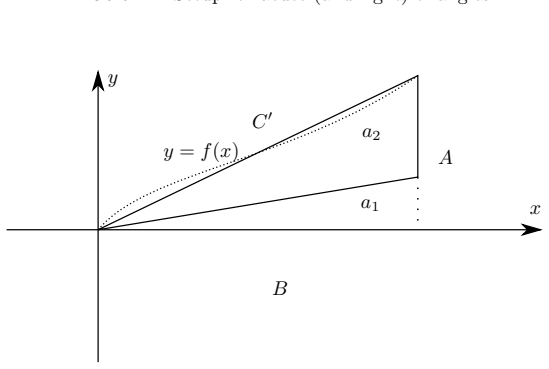
The central mechanism is the commutator identity $[-h^2\Delta-1,X]=-2h^2\Delta$ for the affine vector field $X=(x+m)\partial_x+(y+n)\partial_y$. Because the eigenfunction is normalized, this identity converts the interior norm into the boundary identity $2=\int_{\partial D}(hXu)(h\partial_\nu u)\,dS$. The Dirichlet condition makes the tangential part of $hXu$ vanish, so on each side $hXu$ becomes a known multiple of $h\partial_\nu u$; matching the three sides yields a $3\times 3$ linear system for the three masses $I_A,I_B,I_{C'}$. The smallness assumptions on $g$ and $g'$ enter as $O(\epsilon)$ remainder terms, and Lemma 2.1, proved by separate vector fields $y\partial_y$ and $\psi(x)\partial_x$, provides the uniform bound on $I_{C'}$ needed to close the estimates.
What would settle it
Fix a right triangle and set $g(x)=\epsilon\sin(\pi x/l)$ on one side, then compute $I_A,I_B,I_{C'}$ for a sequence of normalized Dirichlet eigenfunctions as $h\to 0$ at one small $\epsilon$. If for some eigenfunction $I_{C'}$ grows without bound in $h$, or if any of the three integrals deviates from the corresponding side length divided by the area by more than a fixed multiple of $\epsilon$, then Lemma 2.1 or the uniformity in Theorem 1 is false; a numerical search over low-lying eigenfunctions would settle it.
Extended reading notes
Core claim
On a triangle with one side $C$ replaced by the graph $f(x)=a_2 x/l+g(x)$, where $|g|,|g'|\le\epsilon$ and $g(0)=g(l)=0$, the paper proves that for the Dirichlet eigenfunction problem $(-h^2\Delta-1)u=0$ with $\|u\|_{L^2}=1$, the Neumann data masses obey $I_A=a/\operatorname{Area}(D)+O(\epsilon)$, $I_B=b/\operatorname{Area}(D)+O(\epsilon)$, and $I_{C'}=\ell(C')/\operatorname{Area}(D)+O(\epsilon)$, where $I_\cdot=\int_\cdot|h\partial_\nu u|^2\,dS$ and the constants are uniform in $h$ and in the perturbation. For a fixed triangle, the same equalities hold up to $O(\epsilon)$ when the Laplacian is replaced by $-h^2\Delta+w_\epsilon$ with $|w_\epsilon|,|\nabla w_\epsilon|\le\epsilon$. Thus the exact triangle identity is stable: small geometric or operator perturbations change each side's boundary mass only by the size of the perturbation, never by a factor that grows as the frequency goes up.
Load-bearing premise
The whole proof rests on Lemma 2.1: the integral over the perturbed side $C'$ of $|h\partial_\nu u|^2$ must stay bounded by a constant independent of $h$ and $\epsilon$; if that bound fails, the $O(\epsilon)$ errors in the linear system cannot be controlled and the equidistribution formulas collapse.
Editorial extensions
If this is right
- The exact triangle identity extends to a neighborhood of triangles in the $C^1$ topology on the boundary, so the formula is stable under small deformations, not just for polygons.
- Because the error is uniform in $h$, the result applies to every eigenfunction in the whole spectrum, including high-frequency modes where boundary concentration might otherwise be expected.
- Adding an $\epsilon$-small potential does not break the law, so the same equidistribution holds for perturbed Hamiltonians $-h^2\Delta+w_\epsilon$; the formula is robust for operator perturbations as well as domain perturbations.
- The proof supplies explicit bounds from which the $O(\epsilon)$ constants could in principle be extracted from the side lengths and the a priori constant $\Gamma$ of Lemma 2.1.
- The authors expect the analogous statement in all dimensions $n\ge3$ for simplices with perturbed faces, following the same commutator scheme.
Reading between the lines
- A direct consequence the authors leave implicit: because the three boundary masses are measurable, one can recover the area and the three side lengths of an unknown near-triangular domain up to $O(\epsilon)$ from Neumann data alone, a stable inverse problem.
- The mechanism is the commutator identity for a linear scaling vector field, so the result should extend to any domain with three boundary pieces on which the Dirichlet condition turns $Xu$ into a tangential multiple; a polygon with more sides would likely give the analogous statement with side lengths weighted by the $C^1$ mismatch.
- Only $|g|,|g'|\le\epsilon$ are used outside the cut-off argument in Lemma 2.1, so perturbations with large second derivative but small height and slope may probe whether curvature is hidden in the boundedness lemma.
- If the $O(\epsilon)$ error is not just an estimate artifact, the boundary mass distribution on a slightly non-triangular domain could serve as a sensitive probe of the domain's area and side geometry, with no need to know individual eigenfunctions.
Signed reviews
Editorial analysis
A structured set of objections, weighed in public.
Referee Report
Summary. The paper claims two stability results for Christianson's exact Neumann data mass equidistribution on triangles. Theorem 1 replaces one side of a triangle by a smooth curve whose graph distance from the original side is at most epsilon and asserts that, for every normalized Dirichlet eigenfunction of -h^2 Delta - 1, the integral of |h d_nu u|^2 over each side equals the side length divided by the area of the perturbed domain, up to O(epsilon), with constants uniform in h and in the perturbation. Theorem 2 proves the same form of equidistribution, up to O(epsilon), when an epsilon-small potential is added to the Laplacian on a fixed triangle. The proof is based on commutators with affine vector fields and on an a priori bound, Lemma 2.1, for the Neumann data on the perturbed side.
Significance. If the proof is completed, this is a genuinely useful stability statement: the exact triangle identity from [Chr17] is shown to be robust under small boundary and potential perturbations, uniformly in the spectral parameter h and in the perturbation. The argument is elementary, self-contained apart from the zero-perturbation baseline, and no quantity in the conclusion is used as an input, so the derivation is not circular. The main value is as a benchmark for how rigid the triangle equidistribution law is, and the methods could plausibly extend to higher dimensions. The significance is moderate but solid for a specialized analysis paper.
major comments (3)
- [Section 4, obtuse case] In the obtuse case of Lemma 2.1, the vector field X=(y-(a2/l)x)d_y does not have the positivity property used in the acute case. On the side B, parametrized by y=(a1/l)x, the boundary contribution in (4.1) is ((a2-a1)x/b)|h d_nu u|^2 dS, which is negative when a1>a2, while the C' contribution f(x) gamma^{-1}|h d_nu u|^2 is positive for x>=delta. The commutator identity bounds only the signed sum of the boundary terms, so the conclusion int_{C' cap {x>=delta}} |h d_nu u|^2 = O(1) does not follow for all obtuse triangles as written. A likely correction is X=(y-(a1/l)x)d_y, which vanishes on B and makes the C' term positive, but this is not the vector field used in the manuscript.
- [Section 4, obtuse case] The vector field Y=psi(x)(d_x+(a2/l)d_y) is asserted to be tangential to the side B, but B has slope a1/l, so a tangential field is d_x+(a1/l)d_y. As written, Yu does not vanish on B. The subsequent computation on C' uses hYu=psi(x)(-f'/gamma + a1/(l gamma))h d_nu u, which corresponds to the field d_x+(a1/l)d_y, not the displayed one. This inconsistency must be corrected and the boundary estimates rechecked, since the near-corner control of int_{C' cap {0<=x<=delta}} |h d_nu u|^2 depends on it.
- [Section 3, proof of Theorem 2] After equation (3.2), the identity has the form 2+O(epsilon)(1+|m|+|n|) equal to the boundary sum, and the text says 'the rest of the proof proceeds exactly as the proof of Theorem 1.' However, deriving the analogues of (2.2) and (2.3) requires differentiating the identity with respect to m and n. Since the error term depends on m and n, one must justify that differentiation produces only O(epsilon) corrections. This is likely fixable by a direct first-order Taylor expansion in m and n, but it is not written and is load-bearing for Theorem 2.
minor comments (3)
- [Section 2.3] The parametrization of C' in the obtuse case is written as f(x)=a2+a1/l x+g(x), which is inconsistent with the later derivative f'(x)=(a1+a2)/l+g'(x). Presumably f(x)=((a1+a2)/l)x+g(x), and the displayed formula should be corrected.
- [Section 4, acute case] The notation in the proof of Lemma 2.1 is inconsistent: the slope of C' is a2/l+g'(x), but the text uses a/b in the lower-bound estimates, and the B-boundary coefficient is a1/b, not a2/b. Please define all symbols consistently so that the constants in (4.2) and the near-corner estimate can be verified.
- [Remark 1.1] The remark says that g does not have to be of the form epsilon g_tilde, but the domain construction still requires g(0)=g(l)=0 for the perturbed side to close the domain; this endpoint condition should be stated explicitly for the more general g.
Circularity Check
No significant circularity: the derivation starts from the eigenfunction equation and a commutator identity; previous work enters only as the epsilon=0 baseline.
full rationale
The paper's central claims (Theorems 1 and 2) are proved by taking the commutator of the semiclassical operator with the linear vector field X=(x+m)∂_x+(y+n)∂_y, integrating by parts, and expressing 2 (or 2+O(epsilon)) as a sum of boundary integrals over A, B, and C'. Differentiation in the free parameters m,n yields three independent equations, (2.1)-(2.3) in the acute case and (2.7)-(2.8) in the obtuse case, which are then solved for I_A, I_B, and I_C'. No fitted parameter is introduced and no target quantity is used as an input. The exact triangle identity from [Chr17] is invoked only to identify the constant 2/l with a/Area(T); the perturbed equalities are obtained by direct O(epsilon) estimates using |g|≤epsilon and |g'|≤epsilon, and the small-potential theorem is handled by the same commutator with additional O(epsilon) terms from w and Xw. The a priori bound in Lemma 2.1 is proved, not assumed, via commutators with y∂_y (acute case) and with (y-(a2/l)x)∂_y plus a cutoff (obtuse case). The skeptic note identifies a possible sign/cancellation gap in the obtuse-case proof of Lemma 2.1; even if that gap were real, it is a correctness defect in an auxiliary estimate, not a circularity, because the estimate is established independently of the theorem it supports. There is no self-citation chain used to forbid alternatives and no known result repackaged under new names.
Assumptions & free parameters
assumptions (4)
- standard math The paper uses Green's identity and integration by parts with Dirichlet boundary conditions throughout Sections 2 and 3.
- standard math For the linear vector field X = (x+m)d_x + (y+n)d_y, the commutator identity [-h^2 Delta - 1, X] = -2h^2 Delta holds.
- domain assumption The perturbed side function g satisfies g(0)=g(l)=0, |g| <= epsilon, and |g'| <= epsilon, and the potential w satisfies |w| <= epsilon and |grad w| <= epsilon.
- domain assumption The theorem assumes the existence of normalized Dirichlet eigenfunctions u_epsilon solving -h^2 Delta u_epsilon = u_epsilon in D_epsilon or (-h^2 Delta + w_epsilon) u_epsilon = u_epsilon in T.
Cite this review
Pith. "Pith review of Neumann Data Mass on Perturbed Triangles." pith.science (2026). https://pith.science/paper/FFRYUAI4
@misc{pith2026190802863,
  author       = {Pith},
  title        = {Pith review of: Neumann Data Mass on Perturbed Triangles},
  year         = {2026},
  howpublished = {\url{https://pith.science/paper/FFRYUAI4}},
  note         = {Machine review of arXiv:1908.02863}
}
abstract
Based on a previous paper [Chr17] on Neumann data for Dirichlet eigenfunctions on triangles, we extend the study in two ways. First, we investigate the (semi-classical) Neumann data mass on perturbed triangles. Specifically, we replace one side of a triangle by adding a smooth perturbation, and assume that the disparity between the perturbation and the original side is bounded by a small value $\epsilon$. Second, we add a small $\epsilon$ sized potential to the (semi-classical) Laplacian and see how the results change on triangles. In both cases, we find that the $L^2$ norm of Neumann data on each side is close to the length of the side divided by the area of the triangle, and the difference is dominated by $\epsilon$.
Figures


Reference graph
Works this paper leans on
-
[1]
N. Burq, P. G \'e rard, and N. Tzvetkov. Restrictions of the L aplace- B eltrami eigenfunctions to submanifolds. Duke Math. J. , 138(3):445--486, 2007
work page 2007
-
[2]
Equidistribution of N eumann data mass on triangles
Hans Christianson. Equidistribution of N eumann data mass on triangles. Proc. Amer. Math. Soc. , 145(12):5247--5255, 2017
work page 2017
-
[3]
Equidistribution of neumann data mass on simplices and a simple inverse problem
Hans Christianson. Equidistribution of neumann data mass on simplices and a simple inverse problem. Math. Res. Lett. to appear , 2018
work page 2018
-
[4]
Hans Christianson, Andrew Hassell, and John A. Toth. Exterior mass estimates and L^2 -restriction bounds for N eumann data along hypersurfaces. Int. Math. Res. Not. IMRN , (6):1638--1665, 2015
work page 2015
-
[5]
Hans Christianson, John A. Toth, and Steve Zelditch. Quantum ergodic restriction for C auchy data: interior que and restricted que. Math. Res. Lett. , 20(3):465--475, 2013
work page 2013
-
[6]
Ergodic properties of eigenfunctions for the D irichlet problem
Patrick G \'e rard and \'E ric Leichtnam. Ergodic properties of eigenfunctions for the D irichlet problem. Duke Math. J. , 71(2):559--607, 1993
work page 1993
-
[7]
Quantum ergodicity of boundary values of eigenfunctions
Andrew Hassell and Steve Zelditch. Quantum ergodicity of boundary values of eigenfunctions. Comm. Math. Phys. , 248(1):119--168, 2004
work page 2004
-
[8]
J.A. Toth and S. Zelditch. Quantum ergodic restriction theorems, i: interior hypersurfaces in domains with ergodic billiards. Annales Henri Poincar\' e , 13:599--670, 2012
work page 2012
Show all 9 references
-
[9]
Toth and Steve Zelditch
John A. Toth and Steve Zelditch. Quantum ergodic restriction theorems: manifolds without boundary. Geom. Funct. Anal. , 23(2):715--775, 2013
2013
Reviewed August 14, 2026 · model on record in the stance chip above.
Discussion (0). Continue with ORCID to comment.