REVIEW 4 major objections 4 minor 46 references
A Mechanistic Pore-Scale Analysis of the Low-Salinity Effect in Heterogeneously Wetted Porous Media
T0 review · 4 major / 4 minor · reviewed 2026-08-14 · deepseek-v4-flash
Pith's one-line read In mixed-wet porous media, low-salinity waterflooding adds oil only from the oil-wet pore fraction, and only when it increases the sweep of those pores.
desk verdict A credible steady-state pore-network study whose central mechanistic claim holds up, but whose quantitative LSE magnitudes rest on an openly heuristic tracer-timing equation and several 'results not shown' claims. read the letter →
The pith
A machine-rendered reading of the paper's core claim, the machinery that carries it, and where it could break.
The reading
What carries the argument
The machinery is a capillary-dominated steady-state displacement model on a 3D cubic pore network, augmented by a tracer algorithm that estimates salinity after each saturation step. Each pore carries a radius $R$ and a contact angle $\theta$, and water invades in order of capillary entry pressure $2\sigma\cos\theta/R$. After every step the algorithm rewinds the flow and uses Eq. (1) to estimate how long the step took, advects a salinity tracer through connected water, and applies a Heaviside rule (Eq. (2)): if neighbouring water salinity falls below a critical value $C^*$, the contact angle of an oil-occupied pore is reduced by $\Delta\theta$. This dynamic contact-angle map changes the sequence of pore filling, and the timing of the contact-angle reduction relative to the drainage half of the flood is what determines whether microscopic sweep efficiency improves.
What would settle it
Time-resolved micro-CT or micromodel experiments on a mixed-wet rock that image both the salinity front and oil-water contact angles while oil is displaced would settle the core claim: if extra oil appears from pores that were water-wet before the flood, or if oil-wet pores yield incremental oil without an increase in the fraction of oil-wet pores invaded, the mechanism fails. A model-level check is to replace Eq. (1) with a full unsteady-state front calculation and observe whether the predicted connectivity trend and the non-monotonic $S_{wi}$ dependence survive.
Extended reading notes
Core claim
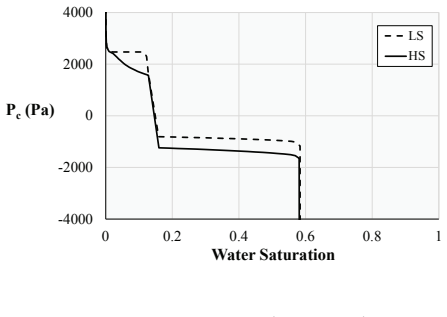
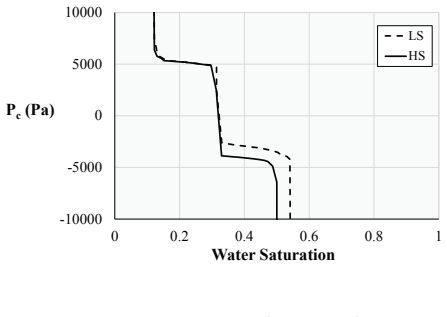
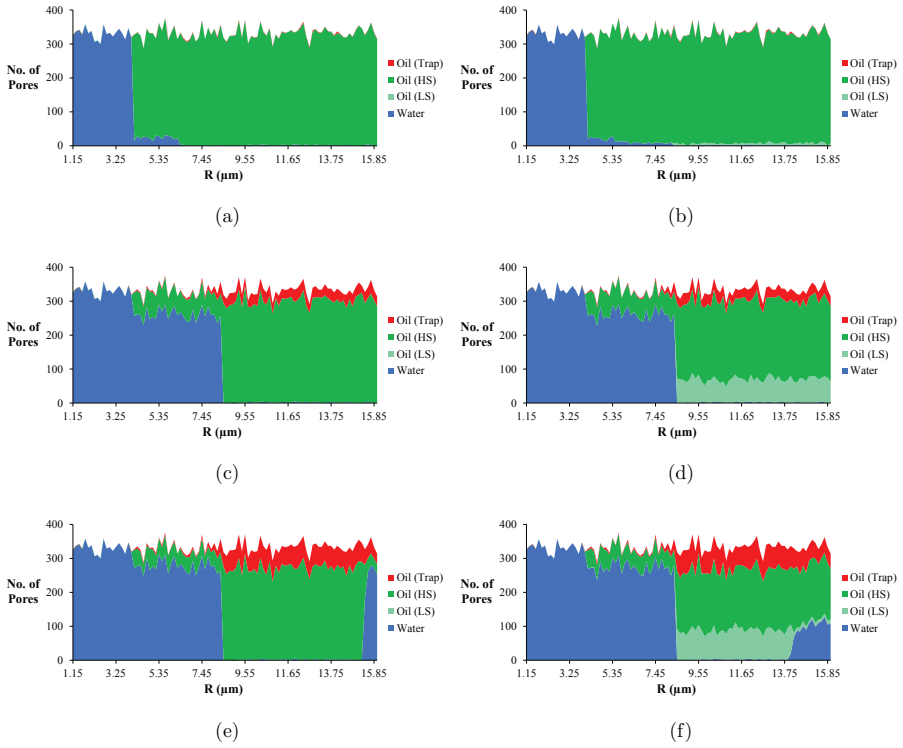
The paper's central claim is that in a network where both water-wet and oil-wet pores form spanning clusters before flooding, the oil-wet pores are the only viable source of incremental oil during low-salinity injection. Making water-wet pores more water-wet does not help, because those pores are already invaded by imbibition in the corresponding high-salinity flood; the two simulations converge to nearly the same water occupancy in the WW fraction. In the OW fraction, the standard drainage sequence fills pores from largest to smallest, so the only route to extra oil is to invade a larger fraction of the OW pores, the 'microscopic sweep efficiency effect'. A necessary but not sufficient condition is that OW contact angles are reduced during the drainage cycle rather than before it; whether this happens is set by how long connate HS brine protects OW pores from freshening. Low network connectivity and an intermediate initial HS-brine saturation delay the salinity front, while extreme $S_{wi}$ values weaken or erase the gain, and the fraction $\alpha$ of OW pores sets the ceiling on what can be recovered.
Load-bearing premise
The simulations assume the heuristic time estimate in Eq. (1) correctly predicts how long each saturation step takes, and that timing decides whether oil-wet pores have already been freshened before the drainage cycle begins; if the timing is wrong, the claimed roles of initial brine saturation and connectivity, and the specific incremental-oil figures, would be artifacts of that assumption.
Editorial extensions
If this is right
- In a mixed-wet reservoir where both wettabilities form through-going clusters, the water-wet pores cannot yield incremental oil to a low-salinity flood; the upper bound on the gain is fixed by the oil-wet fraction.
- A low-salinity flood can weaken oil-wet contact angles and still produce no extra oil, because the required increase in oil-wet sweep efficiency is necessary but not sufficient.
- Poorly connected pore networks should show larger low-salinity benefits, since circuitous flow delays the arrival of fresh brine at oil-wet pores.
- The initial connate-brine saturation acts nonlinearly: too little lets the front freshen too early, too much causes early breakthrough that flushes the protective HS brine out.
- The specific wettability arrangement (mixed-wet large, mixed-wet small, or fractionally wet) becomes decisive only when LS brine changes the wetting class of pores, not when it merely weakens or strengthens the existing wettability.
Reading between the lines
- As an extension of the paper's logic, replacing the heuristic step-time formula with a fully dynamic flow simulation would test whether the predicted $S_{wi}$ and connectivity trends survive in degree or only in direction.
- A practical screening inference follows: low-salinity candidates should be characterised by connate-water saturation and pore connectivity, not only by oil-wet fraction, because those hidden variables can flip a pilot between positive and neutral.
- The delay-until-drainage principle suggests a design rule the paper does not simulate: a short high-salinity pre-flush or a viscosity-moderated front could hold the salinity boundary back and enlarge the incremental-oil window.
- Because the geometric constraint is general, the same two-percolating-cluster argument may apply to other wettability-altering enhanced-oil-recovery agents, not just low-salinity brine.
Signed reviews
Editorial analysis
A structured set of objections, weighed in public.
Referee Report
Summary. The paper extends a steady-state pore-network model, previously developed for uniformly wetted media, to simulate low-salinity (LS) waterflooding in heterogeneously wetted networks that contain spanning clusters of both water-wet (WW) and oil-wet (OW) pores. The model couples capillary-controlled displacement with a tracer algorithm that estimates the spatial evolution of brine salinity, and it applies a Heaviside-type rule for local contact-angle modification when salinity falls below a threshold. The main claims are: (i) in such networks the OW pores are the only viable source of incremental oil; (ii) a LS-induced increase in microscopic sweep efficiency in the OW pore fraction is a necessary but not sufficient condition for additional oil production; and (iii) the OW fraction alpha, network connectivity Zbar, and initial water saturation Swi are key controls on the magnitude of the low-salinity effect (LSE). The central reported result is a secondary-mode simulation that produces roughly 5% more oil with LS brine than with HS brine, attributed to delayed wettability modification of OW pores until the drainage cycle. Sensitivity runs for Swi and Zbar, plus unreported runs for alpha, are used to support the parameter-dependence conclusions.
Significance. If the results hold, the paper provides a falsifiable mechanistic explanation for why LS waterflooding may be ineffective or effective depending on the initial wettability distribution, and it highlights a specific pore-scale mechanism (delayed modification of OW pores during drainage) that could guide experimental coreflood design. A notable strength is that the central logical argument that OW pores are the only incremental oil source follows directly from the stated displacement rules and is not fitted to data; the paper also explicitly lists its idealizations and limitations. The contact-angle change is tied to an experimental measurement, and the tracer algorithm is described in enough detail to be re-implemented. However, the quantitative LSE magnitudes and the Swi/Z/alpha sensitivities rest on the heuristic timing in Eq. (1) and on several unreported simulation sets, so the significance is tempered by the need for validation and more complete reporting.
major comments (4)
- [II.C.1, Eq. (1)] The tracer timing equation T_DeltaV = (DeltaV/Q)[DeltaP_old/(DeltaP_old - DeltaP_new)] is explicitly described as 'chosen to reflect qualitative observations' rather than derived from transport physics. This time controls how far the LS front advances before each pressure step, and via Eq. (2) it determines whether neighbouring OW pores are wettability-modified before or during drainage. The entire positive-LSE mechanism in Section III.B (delayed OW modification producing 4.9% incremental oil) and the reported Swi and Zbar sensitivities are contingent on this functional form. If a defensible transport calculation gave a shorter T_DeltaV, the LS front would modify OW pores earlier and the incremental oil could vanish; if it gave a longer T_DeltaV, even the Swi=6% case could show a larger LSE. I request either a derivation of Eq. (1) from a stated transport model, a validation against the unsteady-state model of Boujelben et al., or a sensitivity analysis showing that the qualitative conclusions are unchanged under alternative plausible forms for T_DeltaV.
- [III.B, Figures 6-10] All reported results appear to come from a single network realization for each parameter set. Pore-network simulations with randomly assigned radii, contact angles, and wettability are stochastic, and the claimed differences (62.2% vs. 58.1% pores displaced; 4.9% vs. 1.9% incremental oil for Swi=6%; 4.9% vs. 1.6% for Z=4.5) could be within realization-to-realization variability. No error bars, ensemble averages, or statistical tests are provided. The paper should either report statistics over multiple independent realizations (even a modest number) or explicitly state that the quantitative trends are single-realization observations; without this, the quantitative sensitivity claims in the abstract and conclusions are not established.
- [IV and III.A] Several load-bearing supporting results are reported only as 'results not shown' or with no explicit simulation output. In particular, the alpha trend in Section IV is given as 2.5% incremental oil for alpha=0.465 and 9.1% for alpha=0.535, and this trend is used in the conclusions to assert that alpha is a critical control on the LSE, but no figure, simulation details, or error information are provided. Similarly, the claims that FW and MWS networks show 'little or no additional oil recovery' (Section III.A) and that delayed LS injection supports the proposed theory (Section III.A) are unverifiable. Given that these results are central to the stated parameter-dependence conclusions, the authors should either present the supporting simulations or explicitly downgrade these statements to preliminary hypotheses.
- [IV, Fig. 11] The abstract and conclusions state that increased microscopic sweep efficiency in the OW pores is necessary but not sufficient to guarantee additional oil production. The 'necessary' part is well supported by the displacement logic and by the reported simulations. The 'not sufficient' part, however, rests on schematic arguments in Fig. 11 and on 'observations from an extensive model sensitivity analysis' for which no explicit numerical results are reported, including cases where OW pores become WW or WW pores become OW. Because this statement appears as a central, abstract-level claim, the authors should provide at least one documented simulation showing increased microscopic sweep efficiency without a net increase in oil production, or explicitly rephrase the claim as a conjecture from the authors' unpublished sensitivity work rather than a demonstrated result.
minor comments (4)
- [II.C.1, Eq. (1)] Equation (1) is undefined when DeltaP_old equals DeltaP_new, and the paper does not specify what happens if the pressure drop increases or stays constant between steps. A short comment on the domain of validity would prevent ambiguity in re-implementation.
- [II.D, Eq. (2)] The Heaviside modification rule treats C_N < C* and C_N > C* but does not specify the boundary case C_N = C*. Since this equality determines whether a pore is modified, the strict inequality should be stated explicitly.
- [III.A] The term 'early tertiary' is used for LS injection commencing at water breakthrough following HS injection; in conventional terminology, tertiary flooding typically follows a secondary flood to near its economic limit. The authors should clarify this definition to avoid confusion with standard experimental protocols.
- [Figures 5 and 7] The pore-size occupancy histograms would be easier to interpret if the y-axis were normalized to the total number of pores in each bin or if the bin totals were stated, since the raw counts differ between the two network configurations and make cross-figure comparison difficult.
Circularity Check
No significant circularity: the paper's central claims are consequences of the stated capillary displacement rules and explicit wettability-modification protocol, not restatements of fitted inputs.
full rationale
The paper's central claim—that in heterogeneously wetted networks with spanning WW and OW clusters the OW pores are the only viable source of incremental oil—follows from the model's explicit displacement rules: WW pores are always imbibed when connected to water, LS injection does not change wetting class, and OW drainage proceeds in a volumetrically favorable largest-to-smallest sequence. This is a derived consequence of capillary entry physics, not a restatement of an input. The tracer algorithm's Eq. (1) is admittedly heuristic ('chosen to reflect qualitative observations from experimental coreflooding studies'), but it is a modeling assumption that shapes the simulations; it is not fitted to the paper's own outcome data, and the paper explicitly disclaims quantitative prediction. The wettability-modification rule (Eq. (2)) and the Δθ = 20° shift are inputs taken from external experimental work (Khishvand et al.), not extracted from a subset of the simulated results. Citations to the authors' prior work (Watson et al. 2017; Boujelben et al. 2018) supply the modeling framework and vocabulary (pore sequence effect, microscopic sweep efficiency), but the relevant equations and displacement rules are restated in full in this paper, so the conclusions do not reduce to those citations. No step makes a prediction equivalent to its own inputs by construction.
Assumptions & free parameters
free parameters (6)
- Critical tracer concentration C* =
0.8
- Contact angle change Delta theta =
20 degrees
- Initial contact angles theta_HS,WW and theta_HS,OW =
60 and 140 degrees
- Network geometry (size, PSD, volumetric exponent, Zbar) =
30x25x25; R in [1,50] or [1,16] micrometers; nu=2 or 0.5; Zbar=5 or 3.5
- Initial water saturation Swi =
0.12 (HS in about 20% of pores)
- Pc step size =
about 100 steps, about 1% of oil-filled pores per step
assumptions (6)
- domain assumption Pore filling obeys the capillary entry criterion Pc = 2 sigma cos(theta)/R with piston-like displacement only.
- domain assumption Viscous forces are negligible; displacement is purely capillary.
- ad hoc to paper Wettability modification follows the Heaviside law in Eq. (2): contact angle changes only when neighbor salinity exceeds C*.
- ad hoc to paper The tracer update time TDeltaV is given by Eq. (1), whose form is chosen to reflect qualitative experimental observations.
- domain assumption Non-spanning water clusters mix HS and LS brines perfectly; spanning clusters mix by advection only.
- domain assumption Connate HS brine resides in the smallest pores and those pores remain water-wet.
Cite this review
Pith. "Pith review of A Mechanistic Pore-Scale Analysis of the Low-Salinity Effect in Heterogeneously Wetted Porous Media." pith.science (2026). https://pith.science/paper/LQ6TRTBC
@misc{pith2026190802874,
  author       = {Pith},
  title        = {Pith review of: A Mechanistic Pore-Scale Analysis of the Low-Salinity Effect in Heterogeneously Wetted Porous Media},
  year         = {2026},
  howpublished = {\url{https://pith.science/paper/LQ6TRTBC}},
  note         = {Machine review of arXiv:1908.02874}
}
read the original abstract
The enhanced oil recovery technique of low-salinity (LS) water flooding is a topic of substantial interest in the petroleum industry. Studies have shown that LS brine injection can increase oil production relative to conventional high-salinity (HS) brine injection, but contradictory results have also been reported and an understanding of the underlying mechanisms remains elusive. We have recently developed a steady-state pore network model to simulate oil recovery by LS brine injection in uniformly wetted pore structures (Watson et al., Transp. Porous Med. 118, 201-223, 2017). We extend this approach here to investigate the low-salinity effect (LSE) in heterogeneously wetted media. We couple a model of capillary force-driven fluid displacement to a novel tracer algorithm and track the salinity front in the pore network as oil and HS brine are displaced by injected LS brine. The wettability of the pore structure is modified in regions where water salinity falls below a critical threshold, and simulations show that this can have significant consequences for oil recovery. For networks that contain spanning clusters of both water-wet and oil-wet (OW) pores prior to flooding, our results demonstrate that the OW pores contain the only viable source of incremental oil recovery by LS brine injection. Moreover, we show that a LS-induced increase in microscopic sweep efficiency in the OW pore fraction is a necessary, but not sufficient, condition to guarantee additional oil production. Simulations suggest that the fraction of OW pores in the network, the average network connectivity and the initial HS brine saturation are key factors that can determine the extent of any improvement in oil recovery in heterogeneously wetted networks following LS brine injection. This study highlights that the mechanisms of the LSE can be markedly different in uniformly wetted and non-uniformly wetted porous media.
Figures


Figures from the paper (8 more)



Reference graph
Works this paper leans on
-
[1]
K. Webb, C. Black, and H. Al-Jeel, Low salinity oil recovery — log-inject-log, Paper SPE 89379 presented at the SPE/DOE 14th Symposium on Improved Oil Recovery, Tulsa (2004)
work page 2004
-
[2]
microscopic sweep efficiency effect
Physical Interpretation Based on the tracer injection methodology described above, it should be clear that the outcome of a given LS waterflooding simulation will intrinsically depend on the number of Pc steps that are taken to displace the resident oil. This is a deliberate feature of the model and reflects the fact that the Pc step size is correlated to t...
-
[3]
P. Gamage and G. Thyne, Comparison of oil recovery by low salinity waterflooding in sec- ondary and tertiary recovery modes, Paper SPE 147375 presented at the SPE Annual Technical Conference and Exhibition, Denver (2011)
work page 2011
-
[4]
H. Mahani, T. Sorop, D. Ligthelm, D. Brooks, P. Vledder, F. Mozahem, and Y. Ali, Analysis of field responses to low-salinity waterflooding in secondary and tertiary mode in Syria, Paper SPE 142960 presented at the SPE EUROPEC/EAGE Annual Conference and Exhibition, Vienna (2011)
work page 2011
-
[5]
S. Berg, A. Cense, E. Jansen, and K. Bakker, Direct experimental evidence of wettability modification by low salinity, Petrophysics 51, 314 (2010)
work page 2010
-
[6]
J. Martin, The effects of clay on the displacement of heavy oil by water, Paper SPE 1411-G presented at the 3rd SPE Venezuelan Annual Meeting, Caracas (1959)
work page 1959
-
[7]
G. Bernard, Effect of floodwater salinity on recovery of oil from cores containing clays, Paper SPE 1725 presented at the 38th SPE California Regional Meeting, Los Angeles (1967). 42
work page 1967
-
[8]
P. Jadhunandan and N. Morrow, Effect of wettability on waterflood recovery for crude- oil/brine/rock systems, SPE Reservoir Eng. 10, 40 (1995)
work page 1995
Show all 46 references
-
[9]
Yildiz and N
H. Yildiz and N. Morrow, Effect of brine composition on recovery of moutray crude oil by waterflooding, J. Pet. Sci. Eng. 14, 159 (1996)
1996
-
[10]
Tang and N
G. Tang and N. Morrow, Salinity, temperature, oil composition and oil recovery by water- flooding, SPE Reserv. Eng. 12, 269 (1997)
1997
-
[11]
Morrow, G.-Q
N. Morrow, G.-Q. Tang, M. Valat, and X. Xie, Prospects of improved oil recovery related to wettability and brine composition, J. Pet. Sci. Eng. 20, 267 (1998)
1998
-
[12]
Tang and N
G. Tang and N. Morrow, Influence of brine composition and fines migration on crude oil/brine/rock interactions and oil recovery, J. Pet. Sci. Eng. 24, 99 (1999)
1999
-
[13]
McGuire, J
P. McGuire, J. Chatham, F. Paskvan, D. Sommer, and F. Carini, Low salinity oil recovery: an exciting new EOR opportunity for Alaska’s North Slope, Paper SPE 93903 presented at the SPE Western Regional Meeting, Irvine (2005)
2005
-
[14]
Ligthelm, J
D. Ligthelm, J. Gronsveld, J. Hofman, N. Brussee, F. Marcelis, and H. van der Linde, Novel waterflooding strategy by manipulation of injection brine composition, Paper SPE 119835 presented at the EUROPEC/EAGE Annual Conference and Exhibition, Amsterdam (2009)
2009
-
[15]
Ashraf, N
A. Ashraf, N. Hadia, O. Torsæter, and M. Tweheyo, Laboratory investigation of low salinity waterflooding as secondary recovery process: effect of wettability, Paper SPE 129012 presented at the SPE Oil and Gas India Conference and Exhibition, Mumbai (2010)
2010
-
[16]
Yousef, S
A. Yousef, S. Al-Saleh, A. Al-Kaabi, and M. Al-Jawfi, Laboratory investigation of novel oil recovery method for carbonate reservoirs, Paper SPE 137634 presented at the Canadian Un- conventional Resources and International Petroleum Conference, Calgary (2010)
2010
-
[17]
Shehata and H
A. Shehata and H. Nasr-El-Din, Role of sandstone mineral compositions and rock quality on the performance of low-salinity waterflooding, Paper IPTC 18176 presented at the Interna- tional Petroleum Technology Conference, Kuala Lumpur (2014)
2014
-
[18]
Q. Xie, D. Ma, J. Wu, Q. Liu, N. Jia, and M. Luo, Low salinity waterflooding in low permeabil- ity sandstone: coreflood experiments and interpretation by thermodynamics and simulation, Paper SPE 174592 presented at the SPE Asia Pacific Enhanced Oil Recovery Conference, Kuala Lump...
2015
-
[19]
Zhang and N
Y. Zhang and N. Morrow, Comparison of secondary and tertiary recovery with change in injection brine composition for crude oil/sandstone combinations, Paper SPE 99757 presented 43 at the SPE/DOE Symposium on Improved Oil Recovery, Tulsa (2006)
2006
-
[20]
Rivet, L
S. Rivet, L. Lake, and G. Pope, A coreflood investigation of low-salinity enhanced oil recov- ery, Paper SPE 134297 presented at the SPE Annual Technical Conference and Exhibition, Florence (2010)
2010
-
[21]
Fjelde, S
I. Fjelde, S. Asen, and A. Omekeh, Low salinity water flooding experiments and interpreta- tion by simulations, Paper SPE 154142 presented at the 18th SPE Improved Oil Recovery Symposium, Tulsa (2012)
2012
-
[22]
Sandengen, M
K. Sandengen, M. Tweheyo, M. Raphaug, A. Kjølhamar, C. Crescente, and V. Kippe, Exper- imental evidence of low salinity water flooding yielding a more oil-wet behaviour, Paper SCA 2011-16 presented at the International Symposium of the Society of Core Analysts, Austin (2011)
2011
-
[23]
Mahani, S
H. Mahani, S. Berg, D. Ilic, W.-B. Bartels, and V. Joekar-Niasar, Kinetics of low-salinity- flooding effect, SPE J. 20, 8 (2015)
2015
-
[24]
Bartels, H
W. Bartels, H. Mahani, S. Berg, R. Menezes, J. van der Hoeven, and A. Fadili, Oil configura- tion under high-salinity and low-salinity conditions at pore scale: a parametric investigation by use of a single-channel micromodel, SPE J. 22, 1 (2017)
2017
-
[25]
Morrow and J
N. Morrow and J. Buckley, Improved oil recovery by low-salinity waterflooding, J. Petrol. Technol. 63, 106 (2011)
2011
-
[26]
Skauge, Low salinity flooding — a critical review, Paper presented at the 17th European Symposium on Improved Oil Recovery, St
A. Skauge, Low salinity flooding — a critical review, Paper presented at the 17th European Symposium on Improved Oil Recovery, St. Petersburg (2013)
2013
-
[27]
Sheng, Critical review of low-salinity waterflooding, J
J. Sheng, Critical review of low-salinity waterflooding, J. Pet. Sci. Eng. 120, 216 (2014)
2014
-
[28]
Spildo, A
K. Spildo, A. Johannessen, and A. Skauge, Low salinity waterflood at reduced capillarity, SPE Paper 154236 presented at the SPE Improved Oil Recovery Symposium, Tulsa (2012)
2012
-
[29]
Austad, A
T. Austad, A. RezaeiDoust, and T. Puntervold, Chemical mechanism of low salinity water flooding in sandstone reservoirs, Paper SPE 129767 presented at the SPE Improved Oil Re- covery Symposium, Tulsa (2010)
2010
-
[30]
Lager, K
A. Lager, K. Webb, C. Black, M. Singleton, and K. Sorbie, Low salinity oil recovery — an experimental investigation, Paper SCA2006-36 presented at the International Symposium of the Society of Core Analysts, Trondheim (2006)
2006
-
[31]
Agbalaka, A
C. Agbalaka, A. Dandekar, S. Patil, S. Khataniar, and J. Hemsath, Coreflooding studies to evaluate the impact of salinity and wettability on oil recovery efficiency, Transp. Porous Med. 44 76, 77 (2009)
2009
-
[32]
Nasralla, M
R. Nasralla, M. Bataweel, and H. Nasr-El-Din, Investigation of wettability alteration by low salinity water, Paper SPE 146322 presented at Offshore Europe, Aberdeen (2011)
2011
-
[33]
Khishvand, A
M. Khishvand, A. Alizadeh, I. Kohshour, M. Piri, and R. Prasad, In situ characterization of wettability alteration and displacement mechanisms governing recovery enhancement due to low-salinity waterflooding, Water Resour. Res. 53, 4427 (2017)
2017
-
[34]
Blunt, Flow in porous media — pore-network models and multiphase flow, Curr
M. Blunt, Flow in porous media — pore-network models and multiphase flow, Curr. Opin. Colloid Interface Sci. 6, 197 (2001)
2001
-
[35]
Joekar-Niasar and S
V. Joekar-Niasar and S. Hassanizadeh, Analysis of fundamentals of two-phase flow in porous media using dynamic pore-network models: a review, Crit. Rev. Environ. Sci. Technol. 42, 1895 (2012)
2012
-
[36]
Blunt, Multiphase flow in permeable media — a pore-scale perspective (Cambridge Univer- sity Press, Cambridge, 2017)
M. Blunt, Multiphase flow in permeable media — a pore-scale perspective (Cambridge Univer- sity Press, Cambridge, 2017)
2017
-
[37]
Sorbie and I
K. Sorbie and I. Collins, A proposed pore-scale mechanism for how low salinity waterflooding works, Paper SPE 129833 presented at the SPE Improved Oil Recovery Symposium, Tulsa (2010)
2010
-
[38]
Watson, I
M. Watson, I. Bondino, G. Hamon, and M. S.R., A pore-scale investigation of low-salinity waterflooding in porous media: uniformly wetted systems, Transp. Porous Med. 118, 201 (2017)
2017
-
[39]
Boujelben, S
A. Boujelben, S. McDougall, M. Watson, I. Bondino, and N. Agenet, Pore network modelling of low salinity water injection under unsteady-state flow conditions, J. Pet. Sci. Eng. 165, 462 (2018)
2018
-
[40]
Buckley, Y
J. Buckley, Y. Liu, X. Xie, and N. Morrow, Asphaltenes and crude oil wetting — the effect of oil composition, SPE J. 2, 107 (1997)
1997
-
[41]
Shaker Shiran and A
B. Shaker Shiran and A. Skauge, Enhanced oil recovery (EOR) by combined low salinity water/polymer flooding, Energ. Fuel. 27, 1223 (2013)
2013
-
[42]
McDougall and K
S. McDougall and K. Sorbie, The impact of wettability on waterflooding: pore-scale simula- tion, SPE Reserv. Eng. 10, 208 (1995)
1995
-
[43]
Skauge, K
A. Skauge, K. Spildo, L. Høiland, and B. Vik, Theoretical and experimental evidence of different wettability classes, J. Pet. Sci. Eng. 57, 321 (2007)
2007
-
[44]
Blunt, Effects of heterogeneity and wetting on relative permeability using pore level mod- 45 elling, SPE J
M. Blunt, Effects of heterogeneity and wetting on relative permeability using pore level mod- 45 elling, SPE J. 2, 70 (1997)
1997
-
[45]
Dixit, S
A. Dixit, S. McDougall, K. Sorbie, and J. Buckley, Pore-scale modelling of wettability effects and their influence on oil recovery, SPE Reserv. Eval. Eng. 2, 25 (1999)
1999
-
[46]
Hamon, Low salinity waterflooding: facts, inconsistencies and way forward, Paper SCA 2015-006 presented at the International Symposium of the Society of Core Analysts, St
G. Hamon, Low salinity waterflooding: facts, inconsistencies and way forward, Paper SCA 2015-006 presented at the International Symposium of the Society of Core Analysts, St. Johns Newfoundland and Labrador (2015). 46
2015
Reviewed August 14, 2026 · model on record in the stance chip above.
Discussion (0). Continue with ORCID to comment.