REVIEW 2 major objections 4 minor 52 references
Hospitalization in the transmission of dengue dynamics: The impact on public health policies
T0 review · 2 major / 4 minor · reviewed 2026-08-14 · deepseek-v4-flash
Pith's one-line read A dengue model with hospitalization shows the reproduction number splits into undiagnosed and hospitalized contributions, making hospital effectiveness the stronger policy lever.
desk verdict The R0 = sqrt(Ru + Rd) decomposition is a genuinely useful result, but the global stability proof has a real gap and a unit error in the human mortality rate distorts the numerical policy story. read the letter →
The pith
A machine-rendered reading of the paper's core claim, the machinery that carries it, and where it could break.
The reading
What carries the argument
The load-bearing object is the next-generation matrix \($FV^{{-1}}$\) of the eight-compartment system, whose dominant eigenvalue gives \(\mathcal{R}_0 = \sqrt{R_u+R_d}\). This identity separates the silent transmission route (undiagnosed infected people who remain in the community) from the managed route (hospitalized patients whose infectious contacts are reduced by the effectiveness factor \(\eta\)), turning \(\mathcal{R}_0\) into a sum of interpretable contributions. The decomposition is what supports the numerical comparison of \(\eta\) versus \(p\) and the sensitivity indices.
What would settle it
Recompute \(\mathcal{R}_0\) and the sensitivity indices with \(1/\mu_h = 25{,}550\) days while keeping every other baseline value from Table 4; if the most likely \(\mathcal{R}_0\) range and the ranking of \(\delta,\eta,p\) change materially, the numerical policy conclusions do not carry through.
Extended reading notes
Core claim
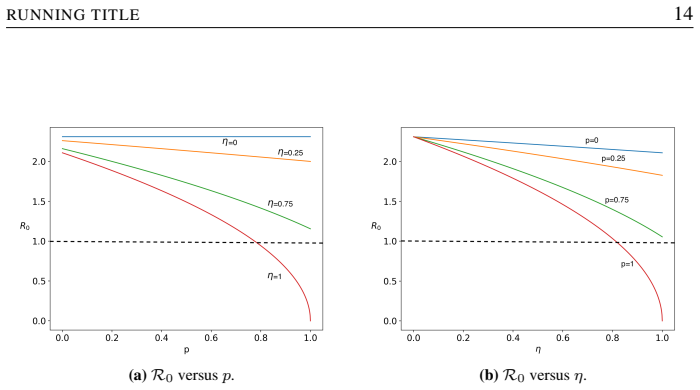
On the paper's own terms, the discovery is the decomposition \(\mathcal{R}_0 = \sqrt{R_u + R_d}\), where \(R_u\) is the contribution of undiagnosed infected humans, \(\frac{\beta_{hv}\beta_{vh}\alpha_h\alpha_v}{(\mu_h+\alpha_h)(\mu_h+\gamma+\delta)\mu_v(\mu_v+\alpha_v)}(1-\eta p)\), and \(R_d\) replaces the factor \((1-\eta p)\) with \(\frac{\delta(1-\eta)}{\mu_h+\gamma}\), the contribution of hospitalized patients. Because hospitalized patients transmit at a reduced rate \((1-\eta)\) and stay in the hospital class for an average \(\frac{1}{\mu_h+\gamma}\), the model yields a closed-form \(\mathcal{R}_0\) whose dependence on the hospitalization effectiveness \(\eta\) is stronger than its dependence on the hospitalization probability \(p\). The paper also proves, via a standard global-stability method, that the disease-free equilibrium is globally asymptotically stable when \(\mathcal{R}_0<1\), meaning the infection cannot persist when the threshold is below one. The sensitivity analysis ranks the vector mortality rate \(\mu_v\) as the most influential parameter and identifies \(\delta\), \(\eta\), and \(p\) as feasible policy levers.
Load-bearing premise
The numerical estimates and policy ranking depend on a human death rate taken from a 70-day lifetime rather than the usual 70-year lifetime; if the intended value is 70 years, the error multiplies \(\mu_h\) by about 365 and changes the reported \(\mathcal{R}_0\) distribution and sensitivity indices.
Editorial extensions
If this is right
- If \(\mathcal{R}_0<1\), the disease-free equilibrium is globally asymptotically stable, so any intervention that pushes the threshold below one is predicted to eliminate transmission from any starting state.
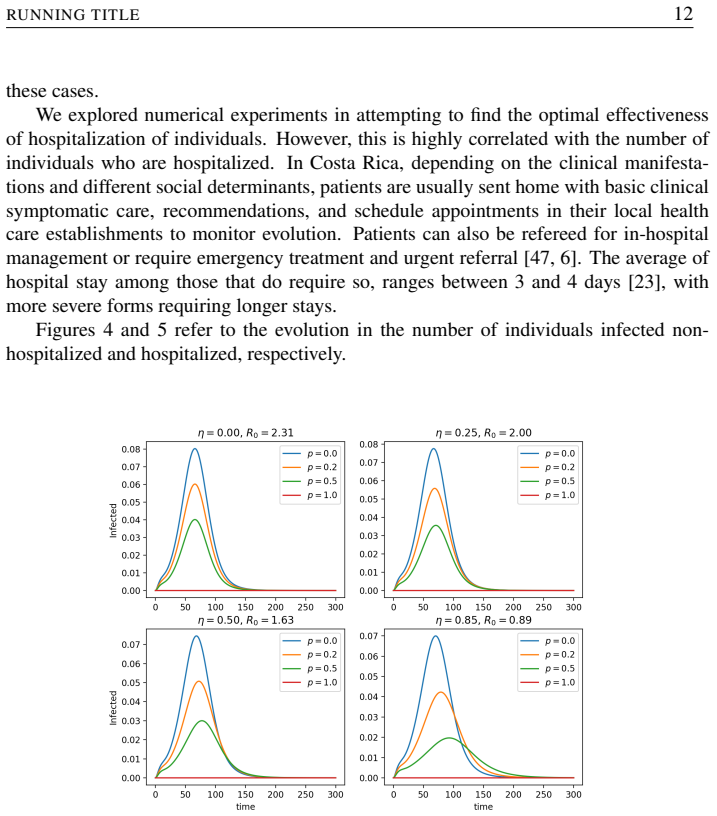
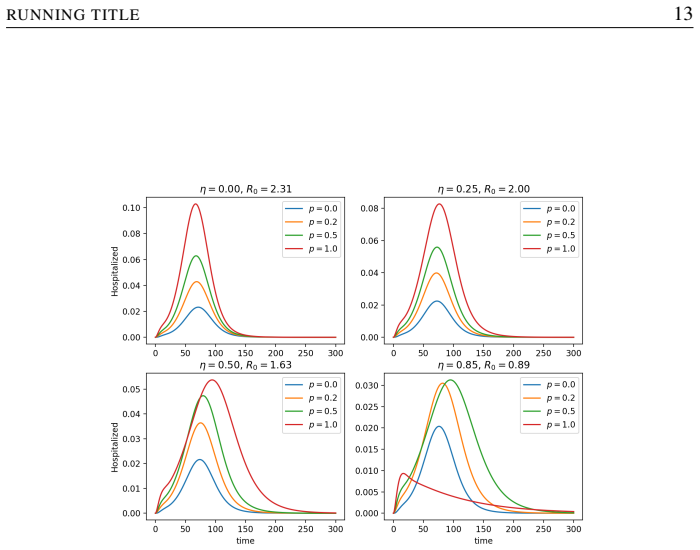
- Increasing the effectiveness of hospitalization \(\eta\) reduces \(\mathcal{R}_0\) more quickly than increasing the proportion of patients hospitalized \(p\), making safer hospital environments and reduced onward transmission from patients the stronger policy lever in the model.
- The uncertainty analysis places the most likely \(\mathcal{R}_0\) between 0.5 and 2 under baseline parameters, suggesting that modest, achievable parameter changes could bring high-transmission settings below threshold.
- The sensitivity indices put vector mortality \(\mu_v\) at the top of the ranking, consistent with continued emphasis on vector control as the central dengue intervention.
Reading between the lines
- If the human lifetime is corrected from 70 days to the usual 70 years, the baseline \(\mathcal{R}_0\), the uncertainty distribution, and the sensitivity ranking would shift; the qualitative ranking of \(\eta\) over \(p\) might survive, but the quantitative thresholds would need recomputation.
- The same \(\sqrt{R_u+R_d}\) structure could be transplanted into models with multiple serotypes or seasonal forcing, where the split between diagnosed and undiagnosed transmission might change optimal vaccination or vector-control timing.
- A field estimation of \(\eta\) from hospital-based studies—how many mosquito bites hospitalized dengue patients receive—would directly fix the model's most policy-relevant parameter.
- The decomposition does not include the cost of hospitalization; combining it with cost data would let a health ministry compare the cost per unit reduction in \(\mathcal{R}_0\) of hospital-safety improvements versus admission-related policies.
Signed reviews
Editorial analysis
A structured set of objections, weighed in public.
Referee Report
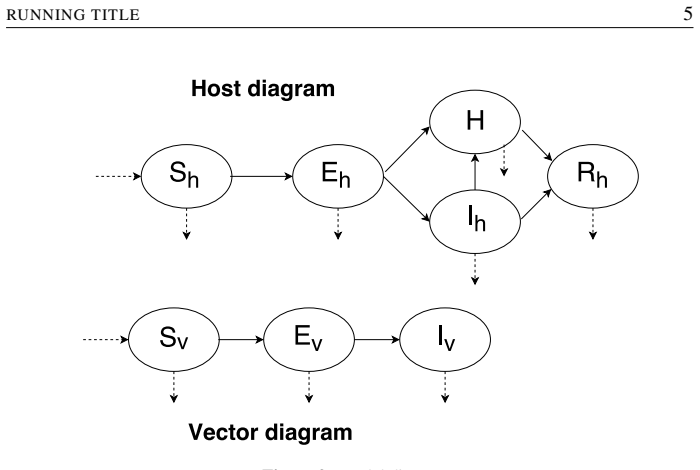
Summary. This paper constructs an eight-compartment dengue transmission model with an explicit hospitalized (diagnosed) human compartment, parameterized using Costa Rican data. The authors derive the basic reproduction number R0 by the next-generation matrix method, decompose R0 into undiagnosed and hospitalized contributions, and prove invariance of the feasible region and stability properties of the disease-free equilibrium. They then perform local sensitivity analysis and global uncertainty quantification for R0, and numerically compare changes in the hospitalization effectiveness parameter (eta) versus the hospitalization probability (p), concluding that increasing eta lowers R0 more efficiently than increasing p. The main public-health policy recommendations are that improving the effectiveness of hospitalization and encouraging early diagnosis can reduce dengue transmission.
Significance. If the technical issues identified below are corrected, the paper would provide a useful framework for quantifying the transmission-reducing effect of hospital-based interventions for dengue. The R0 expression is derived from first principles, cleanly separates hospital-related transmission channels, and is grounded in Costa Rican hospitalization data. The sensitivity analysis and the eta-versus-p scenario comparison are potentially actionable for public health policy. However, the numerical and theoretical claims currently rest on two load-bearing defects: an invalid inequality in the global-stability proof and a misspecified human lifetime parameter that shifts the sensitivity and uncertainty results. The paper does not include reproducible code or machine-checked proofs, and the global stability argument is not valid as written.
major comments (2)
- [Section 3.2, proof of Theorem 3] Condition (3) of the Castillo-Chavez, Feng, and Huang theorem is not established because the fourth component of G-hat(X,Z) is beta_vh (i_h + (1 - eta) h) * (1 - s_v / (1 - eta h)), not beta_vh (i_h + (1 - eta) h) * (1 - s_h / (1 - eta h)). The text asserts s_h <= 1 and s_h / (1 - eta h) <= 1, but the ratio in the actual expression contains s_v, not s_h. Since s_v can equal 1 while h > 0 within the invariant set (for example, s_v = 1 and eta h > 0), the ratio s_v / (1 - eta h) exceeds 1, making G-hat_4 negative whenever i_h + (1 - eta) h > 0. Therefore the claimed global asymptotic stability of the disease-free equilibrium for R0 < 1 is unsupported. This is load-bearing because the abstract and discussion present global stability as a main theoretical result, and the policy implication that R0 < 1 guarantees elimination depends on it.
- [Table 4 and Section 3.3] The baseline value 1/mu_h = 70 days is inconsistent with the cited source [10], which uses a human life expectancy of about 70 years; the correct conversion in daily units is approximately 25,550 days. Using 70 days makes mu_h about 365 times too large. Because mu_h appears in the denominators of the infectious periods and in the exposed survival probability in the R0 formula, this misspecification substantially changes the sensitivity index reported for mu_h (-6.42) and shifts the uncertainty distribution in Figure 3 downward, weakening the stated conclusion that R0 is most likely between 0.5 and 2. The sensitivity rankings and the policy interpretation of Figure 7 need to be recomputed with the corrected human lifetime before the numerical conclusions can be accepted.
minor comments (4)
- [Section 3.4, paragraphs 1 and 2] The paragraph beginning 'We explored numerical experiments in attempting to find the optimal effectiveness of hospitalization of individuals' is repeated verbatim; one copy should be deleted.
- [Section 3.2, solution of F(X,0)] The displayed solution for X(t) in the proof of condition (2) is not correct: it should be (1 + (s_h(0)-1)e^{-mu_h t}, r(0)e^{-mu_h t}, 1 + (s_v(0)-1)e^{-mu_v t}), with the initial conditions made explicit. The printed expression '1 + e^{-mu_h}' is not a feasible solution and appears to be a typographical error.
- [Section 2, proof of Theorem 2] The equilibrium derivation contains several notation inconsistencies: the variable phi appears in the formulas for i_h^* and h^* but is not defined (the model uses p), and the expression for Gamma_v is missing the subscript on alpha. These should be corrected for readability.
- [Section 3.4 and figures] Figure 6 is not referenced in the text, and the text moves from Figures 4 and 5 directly to Figure 7; the figure numbering or references should be adjusted.
Circularity Check
No significant circularity: R0 is derived from the model's next-generation matrix, and the policy conclusions follow algebraically; the only self-cited input is a non-load-bearing baseline parameter.
full rationale
The central derivation chain is self-contained. System (2) is a mechanistic compartmental model, and Section 3.1 computes R0 from the displayed F and V matrices by the standard next-generation operator, yielding R0 = sqrt(Ru + Rd); the split into undiagnosed and hospitalized contributions is an algebraic decomposition, not a fit to data. The comparisons of eta versus p follow from the sensitivity indices in Table 5, which are computed directly from the closed-form R0 expression, so the claim that increasing the effectiveness of hospitalization lowers R0 faster than increasing the hospitalization proportion is a property of the formula rather than a fitted outcome. The only self-cited input is delta = 0.20 from reference [39] (Sanchez et al.), used as a baseline parameter in Table 4; this affects numerical simulations and the uncertainty distribution, but it is not used to construct the R0 formula or the stability theorem, so it is not load-bearing circularity. The Theorem 3 proof in Section 3.2 has a genuine mathematical gap: the Castillo-Chavez condition is checked with s_h/(1 - eta*h), although the fourth component of G-hat contains s_v/(1 - eta*h), which may exceed 1; that is a correctness defect, not a circularity, because the theorem is not assumed or fitted. Therefore no step in the paper reduces by construction to its own inputs; the score of 1 reflects only the minor self-cited parameter value.
Assumptions & free parameters
free parameters (3)
- p (proportion hospitalized/diagnosed) =
0.2 (baseline)
- eta (effectiveness of hospitalization) =
0.8 (baseline)
- 1/mu_h (human lifetime) =
70 days (likely should be ~25,550 days)
assumptions (5)
- domain assumption Human and mosquito population sizes are constant (birth rate equals death rate).
- domain assumption Hospitalized patients transmit at fraction (1-eta) of non-hospitalized patients, and the effective host population for mosquito biting is Nh-eta*H.
- standard math The Castillo-Chavez et al. [5] theorem conditions are sufficient for global stability of the DFE.
- standard math The next-generation operator method [11] applies for R0.
- domain assumption Parameter values in Table 4, including delta from [39] and beta_hv, beta_vh, alpha_h, alpha_v, gamma, mu_v from [24], are representative of dengue/Costa Rica.
Cite this review
Pith. "Pith review of Hospitalization in the transmission of dengue dynamics: The impact on public health policies." pith.science (2026). https://pith.science/paper/7SBP7RNF
@misc{pith2026190802913,
  author       = {Pith},
  title        = {Pith review of: Hospitalization in the transmission of dengue dynamics: The impact on public health policies},
  year         = {2026},
  howpublished = {\url{https://pith.science/paper/7SBP7RNF}},
  note         = {Machine review of arXiv:1908.02913}
}
abstract
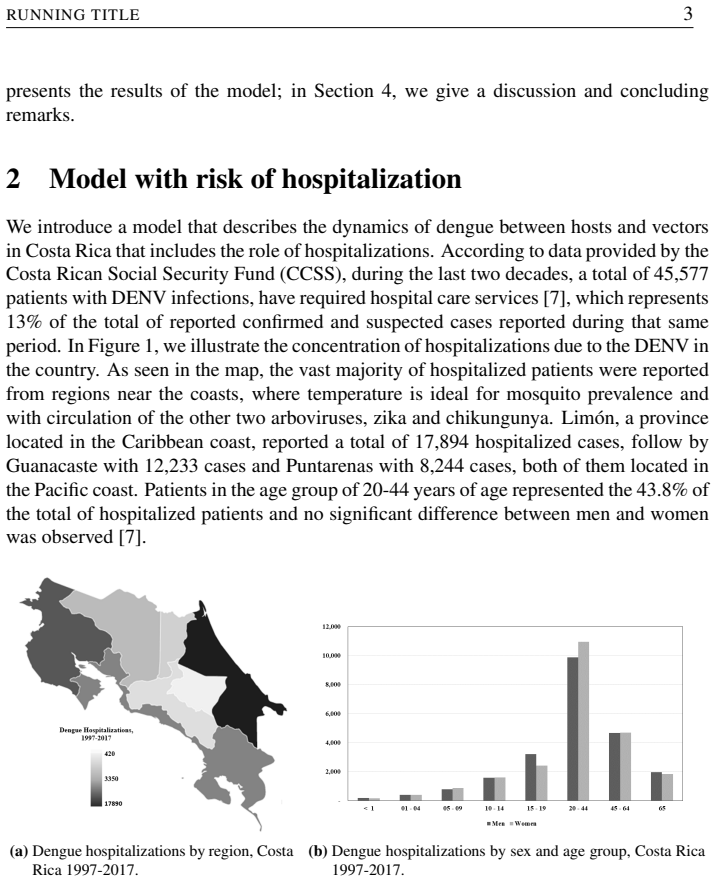
Dengue virus has caused major problems for public health officials for decades in tropical and subtropical countries. We construct a compartmental model that includes the risk of hospitalization and its impact on public health policies. The basic reproductive number, $\mathcal{R}_0$, is computed, as well as a sensitivity analysis on $\mathcal{R}_0$ parameters and discuss the relevance in public health policies. The local and global stability of the disease-free equilibrium is established. Numerical simulations are performed to better determine future prevention/control strategies.
Figures

Figures from the paper (4 more)

Reference graph
Works this paper leans on
-
[10]
Chitnis, N.; Hyman, J.M.; Cushing, J. (2008) “Determining important parameters in the spread of malaria through the sensitivity analysis of a mathematical model”, Bull. Math. Biol., 70, 1272–1296, DOI:10.1007/s11538-008-9299-0
-
[1]
Revisiting dengue virus–host cell interaction: new insights into molecular and cellular virology
Acosta, E.G.; Kumar, A.; Bartenschlager, R. (2014) “Revisiting dengue virus–host cell interaction: new insights into molecular and cellular virology”, Advances in virus research, 88, 1–109, DOI:10.1016/B978-0-12-800098-4.00001-5
-
[2]
Al-Muhandis, N.; Hunter, P.R., (2011) “The value of educational messages embedded in a community-based approach to combat dengue fever: a sys- tematic review and meta regression analysis”, PLoS Negl Trop Dis , 5, 1–9, DOI:10.1371/journal.pntd.0001278
-
[3]
The global distribution and burden of dengue
Bhatt, S.; Gething, P.W.; Brady, O.J.; Messina, J.P.; Farlow, A.W.; et al. (2013) “The global distribution and burden of dengue”, Nature, 5, 504–507, DOI:10.1038/nature12060
-
[4]
Refining the global spatial limits of dengue virus transmission by evidence-based consensus
Brady, O.J.; Gething, P.W.; Bhatt, S.; Messina, J.P.; Brownstein, J.S.; et al. (2012) “Refining the global spatial limits of dengue virus transmission by evidence-based consensus”, PLoS Negl Trop Dis, 6, 115–123, DOI:10.1371/journal.pntd.0001760
-
[5]
On the computation of R0 and its role on global stability
Castillo-Chavez, C.; Feng, Z.; Huang, W.; (2002) “On the computation of R0 and its role on global stability”, in Mathematical Approaches for Emerging and Reemerging Infectious Diseases:An Introduction. The IMA V olumes in Mathematics and its Applications, 1, 229–250
work page 2002
-
[6]
Guía para la Organización de la Atención y Manejo de los Pacientes con Dengue y Dengue Grave
Caja Costarricense de Seguro Social “Guía para la Organización de la Atención y Manejo de los Pacientes con Dengue y Dengue Grave ”, http://www.binasss.sa.cr/protocolos/dengue.pdf
-
[7]
Egresos Hospitalarios debidos a dengue
Caja Costarricense de Seguro Social “Egresos Hospitalarios debidos a dengue" 2018
work page 2018
Show all 52 references
-
[8]
Host genetics and dengue fever
Xavier-Carvalho, C.; Cardoso, C.; de Souza, F.; Pachecho, A.G.; Moraes, M.O. (2017) “Host genetics and dengue fever”, Infect. Genet. Evol. , 56, 99–110, DOI:10.1016/j.meegid.2017.11.009
2017 doi
-
[9]
Disease and economic burdens of dengue
Castro, M.C.; Wilson, M.E.; Bloom, D.E. (2017) “Disease and economic burdens of dengue”, Lancet Infect Dis, 17, 70–78, DOI:10.1016/S1473-3099(16)30545-X. RUNNING TITLE 16
2017 doi
-
[11]
On the definition and the computation of the basic reproduction ratio R0 in models for infec- tious diseases in heterogeneous populations
Diekmann, O.; Heesterbeek, J.A.P.; Mets, J.A.J. (1990) “On the definition and the computation of the basic reproduction ratio R0 in models for infec- tious diseases in heterogeneous populations”, J. Math. Biol , 28, 365–382, DOI:10.1007/BF00178324
1990 doi
-
[12]
Asymp- tomatic humans transmit dengue virus to mosquitoes
Duong, V .; Lambrechts, L.; Paul, R.E.; Ly, S.; Lay, R.S.; et al. (2015) “Asymp- tomatic humans transmit dengue virus to mosquitoes”, Proc. Natl. Acad. Sci , 112, 14688–14693, DOI:10.1073/pnas.1508114112
2015 doi
-
[13]
A model for dengue disease with variable human population
Esteva, L.; Vargas, C. (1999) “A model for dengue disease with variable human population”, J. Math. Biol., 38, 220–240, DOI:10.1007/s002850050147
1999 doi
-
[14]
Competitive exclusion in a vector-host model for the dengue fever
Feng, Z.; Velasco-Hernández, J. (1997) “Competitive exclusion in a vector-host model for the dengue fever”, J. Math. Biol., 35, 523–544
1997
-
[15]
Dengue/dengue hemorrhagic fever: the emergence of a global health problem
Gubler, D.J.; Clark, G.G. (1995) “Dengue/dengue hemorrhagic fever: the emergence of a global health problem”, Emerging Infect. Dis. , 1, 55–57, DOI:10.3201/eid0102.952004
1995
-
[16]
Dengue and Dengue Hemorrhagic Fever
Gubler, D.J. (1998) “Dengue and Dengue Hemorrhagic Fever”, Clin. Microbiol. Rev., 11, 480–496, DOI:10.1128/CMR.11.3.480
1998 doi
-
[17]
Epidemic dengue/dengue hemorrhagic fever as a public health, social and economic problem in the 21st century
Gubler, D.J. (2002) “Epidemic dengue/dengue hemorrhagic fever as a public health, social and economic problem in the 21st century”, Trends Microbiol., 10, 100–103, DOI:10.1016/S0966-842X(01)02288-0
2002 doi
-
[18]
The dengue vector Aedes aegypti: what comes next
Jansen, C.; Beebe, N.W. (2009) “The dengue vector Aedes aegypti: what comes next”, Microbes Infect., 12, 272–279, DOI:10.1016/j.micinf.2009.12.011
2009 doi
-
[19]
Modeling Infectious Diseases in Humans and Animals
Keeling, M.J.; Rohani, P. (2008) “Modeling Infectious Diseases in Humans and Animals”, Princeton University Press, New Yersey
2008
-
[20]
Evaluation of a rapid diagnostic test for detection of dengue infection using a single-tag hybridization chromatographic-printed array strip format
Liles, V .R.; Pangilinan, L.S.; Daroy, M.G.; Dimamay, M.T.A.; Reyes, R.S. (2019) “Evaluation of a rapid diagnostic test for detection of dengue infection using a single-tag hybridization chromatographic-printed array strip format”, Eur . J. Clin. Microbiol. Infect. Dis., 38, 1...
2019 doi
-
[21]
The differ- ences of clinical manifestations and laboratory findings in children and adults with dengue virus infection
Kittigul, L.; Pitakarnjanakul, P.; Sujirarat, D.; Siripanichgon K. (2009) “The differ- ences of clinical manifestations and laboratory findings in children and adults with dengue virus infection”, J. Clin. Virol., 39, 76–81, DOI:10.1016/j.jcv.2007.04.006
2009 doi
-
[22]
Rapid diagnostic tests for determining dengue serostatus: a system- atic review and key informant interviews
Luo, R.; Fongwen, N.; Kelly-Cirino, C.; Harris, E.; Wilder-Smith, A.; Peeling, R.; (2009) “Rapid diagnostic tests for determining dengue serostatus: a system- atic review and key informant interviews”, Clin. Microbiol. Infect. , 25, 659–666, DOI:10.1016/j.cmi.2019.01.002
2009 doi
-
[23]
Patients related diagnostic delay in dengue: an important cause of morbidity and mortality
Mallhi, T.H.; Khan, A.H.; Sarriff, A. (2016) “Patients related diagnostic delay in dengue: an important cause of morbidity and mortality”, Clinical Epidemiology and Global Health, 4, 200–201, DOI:10.1016/j.cegh.2016.08.002 RUNNING TITLE 17
2016 doi
-
[24]
Com- paring dengue and chikungunya emergence and endemic transmission in A. aegypti and A. albopictus
Manore, C.A.; Hickmann, K.S.; Xu, S.; Wearing, H.J.; Hyman J.M. (2014) “Com- paring dengue and chikungunya emergence and endemic transmission in A. aegypti and A. albopictus”, J. Theor . Biol., 356, 174–191, DOI:10.1016/j.jtbi.2014.04.033
2014 doi
-
[25]
El dengue en Costa Rica: evolución histórica, situación actual y desafíos
Morice, A.; Marín R.; Ávila, M. (2010) “El dengue en Costa Rica: evolución histórica, situación actual y desafíos”, La Salud Pública en Costa Rica. Estado actual, retos y perspectivas. San José , Universidad de Costa Rica, San José, 197– 217
2010
-
[26]
Análisis de situación de salud
Ministerio de Salud “Análisis de situación de salud" 2018. Avail- able from: http://www.ministeriodesalud.go.cr/index.php/ vigilancia-de-la-salud/analisis-de-situacion-de-salud
2018
-
[27]
Lineamientos nacionales para el control del dengue
Ministerio de Salud “Lineamientos nacionales para el control del dengue"
-
[28]
Epidemiology of dengue: past, present and future prospects
Murray, N.; Quam, M.B.; Wilder-Smith, A. (2013) “Epidemiology of dengue: past, present and future prospects”, Clin Epidemiol , 5, 299–309, DOI:10.2147/CLEP.S34440
2013 doi
-
[29]
Dynamics of dengue disease severity determined by the interplay between viral genetics and serotype-specific immunity
OhAinle, M.; Balmaseda, A.; Macalalad, A.R.; Tellez Y .; Zody, M.C.; et al. (2011) “Dynamics of dengue disease severity determined by the interplay between viral genetics and serotype-specific immunity”,Sci Transl Med, 3, 114ra128–114ra128.], DOI:10.1126/scitranslmed.3003084
2011 doi
-
[30]
International Experiences in Social Mobilization and Communication for Dengue Prevention and Control
Parks, W.J.; Lloyd, L.S.; Nathan, M.B.; Hosein, E.; Odugleh, A.; et al. (2004) “International Experiences in Social Mobilization and Communication for Dengue Prevention and Control.”, Dengue Bull., 28, 1–7
2004
-
[31]
Blood Feeding Patterns of Aedes ae- gypti and Aedes albopictus in Thailand
Ponlawat, A.; Harrington, L.C. (2005) “Blood Feeding Patterns of Aedes ae- gypti and Aedes albopictus in Thailand”, J. Med. Entomol. , 42, 844–849, DOI:10.1603/0022-2585(2005)042[0844:BFPOAA]2.0.CO;2
2005 doi
-
[32]
In- teractions between serotypes of dengue highlight epidemiological impact of cross- immunity
Reich, N.G.; Shrestha, S.; King, A.A.; Rohani, P.; Lessler, J.; et al. (2013) “In- teractions between serotypes of dengue highlight epidemiological impact of cross- immunity”, J R Soc Interface , 10, DOI:10.1098/rsif.2013.0414
2013
-
[33]
Aedes albopictus and the reemergence of Dengue
Rezza, G. (2012) “Aedes albopictus and the reemergence of Dengue”, BMC Public Health, 12, 72–75, DOI:10.1186/1471-2458-12-72
2012 doi
-
[34]
Achieving sustainability of community-based dengue control in Santiago de Cuba
Toledo, M.E.; Vanlerberghe, V .; Perez, D.; Lefevre, P.; Ceballos, E.; et al. (2007) “Achieving sustainability of community-based dengue control in Santiago de Cuba”, Soc Sci Med, 64, 976–988, DOI:10.1016/j.socscimed.2006.10.033
2007 doi
-
[35]
Roth, G.A.; Abate, D.; Abate, K.H.; Abay, S.M.; Abbafati, C.; et al. (2018) “Global, regional, and national age-sex-specific mortality for 282 causes of death in 195 countries and territories, 1980–2017: a systematic analysis for the Global Bur- den of Disease Study 2017”, The ...
2018 doi
-
[36]
Dengue contingency planning: from research to policy and practice
Runge-Ranzinger, S.; Kroeger, A.; Olliaro, P.; McCall, P.J.; Sánchez-Tejeda, G.; et al. (2016) “Dengue contingency planning: from research to policy and practice”, PLoS Negl Trop Dis, 10, 1–16, DOI:10.1371/journal.pntd.0004916
2016 doi
-
[37]
Mod- els for Dengue Transmission and Control
Sanchez, F.; Engman, M.; Harrington, L.; Castillo-Chavez, C. (2006) “Mod- els for Dengue Transmission and Control”, Contemp. Math. , 410, 311–326, DOI:10.1090/conm/410/07734
2006 doi
-
[38]
Change in host behavior and its impact on the transmission dynamics of dengue
Sanchez, F.; Murillo, D.; Castillo-Chavez, C. (2012) “Change in host behavior and its impact on the transmission dynamics of dengue”, BIOMAT 2011, 191–203, DOI:10.1142/97898143977110013
2012 doi
-
[39]
Comparative anal- ysis of dengue versus chikungunya outbreaks in Costa Rica
Sanchez, F.; Barboza, L.; Burton, D.; Cintrón-Arias, A. (2018) “Comparative anal- ysis of dengue versus chikungunya outbreaks in Costa Rica”, Ric. Mat., 67, 163– 174, DOI:10.1007/s11587-018-0362-3
2018 doi
-
[40]
Molecular Characteriza- tion of Two Major Dengue Outbreaks in Costa Rica
Soto-Garita, C.; Somogyi, T.; Vicente-Santos, A. (2016) “Molecular Characteriza- tion of Two Major Dengue Outbreaks in Costa Rica”, Am. J. Trop. Med. Hyg , 95, 201–2015, DOI:10.4269/ajtmh.15-0835
2016 doi
-
[41]
Barriers and bridges to prevention and control of dengue: the need for a social– ecological approach
Spiegel, J.; Bennett, S.; Hattersley, L.; Hayden, M.H.; Kittayapong,P.; et al. (2005) “Barriers and bridges to prevention and control of dengue: the need for a social– ecological approach”, EcoHealth, 2, 273–290, DOI:10.1007/s10393-005-8388-x
2005 doi
-
[42]
(2012) “Dengue”, N
Simmons, C.P.; Farrar, J.J.; van Vinh Chau, N.; Willis, B. (2012) “Dengue”, N. Engl. J. Med, 12, 1423–1432, DOI:10.1056/NEJMra1110265
2012 doi
-
[43]
Clinical development and regulatory points for consideration for second-generation live attenuated dengue vaccines
Vannice, K.S.; Wilder-Smith, A.; Barrett, A.; Carrijo, K.; Cavaleri, M.; et al. (2018) “Clinical development and regulatory points for consideration for second-generation live attenuated dengue vaccines”, V accine, 36, 3411–3417, DOI:10.1016/j.vaccine.2018.02.062
2018 doi
-
[44]
Dengue in travelers
Wilder-Smith, A.; Schwartz, E. (2005) “Dengue in travelers”, N. Engl. J. Med, 353, 924–932, DOI:10.1056/NEJMra041927
2005 doi
-
[45]
Live-attenuated tetravalent dengue vaccines: the needs and challenges of post-licensure evaluation of vaccine safety and effectiveness
Wichmann, O.; Vannice, K.; Asturias, E.; de Albuquerque Luna E.J.; Longini I.; et al. (2017) “Live-attenuated tetravalent dengue vaccines: the needs and challenges of post-licensure evaluation of vaccine safety and effectiveness”, V accine, 35, 5535– 5542, DOI:10.1016/j.vaccin...
2017 doi
-
[46]
Dengue: guidelines for diagnosis, treatment, pre- vention and control
World Health Organization “Dengue: guidelines for diagnosis, treatment, pre- vention and control" 2009. Available from: https://www.who.int/rpc/ guidelines/9789241547871/en/
2009
-
[47]
Handbook for clinical management of dengue
World Health Organization “Handbook for clinical management of dengue"
-
[48]
Handbook for integrated vector management
World Health Organization “Handbook for integrated vector management" 2012. Available from: https://apps.who.int/iris/bitstream/handle/ 10665/44768/9789241502801_eng.pdf?sequence=1. RUNNING TITLE 19
2012
-
[49]
Dengue Bulletin
World Health Organization “Dengue Bulletin" 2016. Available from: https: //apps.who.int/iris/handle/10665/255696
2016
-
[50]
Dengue serotype-specific differences in clinical manifestation, laboratory parameters and risk of severe disease in adults, Singapore
Yung, C.F.; Lee, K.S.; Thein, T.L.; Tan, L.K.; Gan, V .C.; et al. (2015) “Dengue serotype-specific differences in clinical manifestation, laboratory parameters and risk of severe disease in adults, Singapore”, Am. J. Trop. Med. Hyg., 92, 999–1005, DOI:10.4269/ajtmh.14-0628
2015 doi
-
[2010]
Available from: http://www.solucionesss.com/descargas/ G-Leyes/LINEAMIENTOS_NACIONALES_PARA_EL_CONTROL_DEL_ DENGUE.pdf
-
[2012]
Available from: https://www.who.int/denguecontrol/ 9789241504713/en/
Reviewed August 14, 2026 · model on record in the stance chip above.
Discussion (0). Continue with ORCID to comment.