REVIEW 4 major objections 4 minor 8 references
A neural network approach to GOP-level rate control of x265 using Lookahead
T0 review · 4 major / 4 minor · reviewed 2026-08-14 · deepseek-v4-flash
Pith's one-line read The paper proposes a single-pass, GOP-level rate controller for x265 that predicts each GOP's CRF-bitrate model from lookahead features and adjusts CRF to hit a target bitrate, reporting 84.5% of test clips within 20% bitrate error and…
desk verdict A genuinely new single-pass GOP-level CRF rate-control scheme for x265, undermined by an evaluation that omits end-to-end bitrate accuracy and relies on a small same-platform test set. read the letter →
The pith
A machine-rendered reading of the paper's core claim, the machinery that carries it, and where it could break.
The reading
What carries the argument
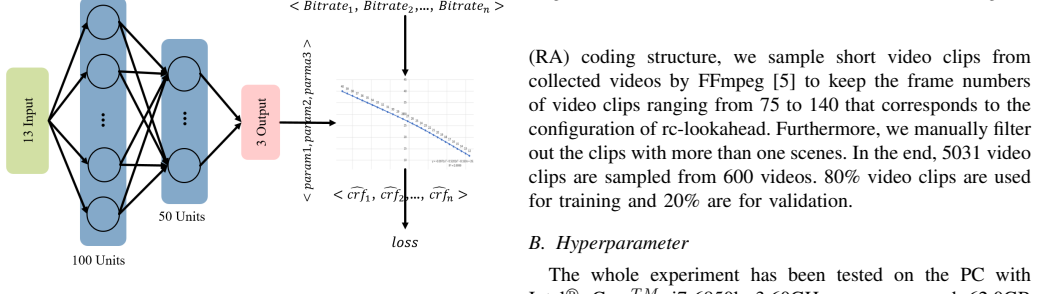
The load-bearing mechanism is the Content Adaptive Rate Factor (CARF) decision module inside the x265 rate-control path. At each I/IDR frame it takes the target bitrate and the current lookahead analysis—already computed for slice-type decisions and MB-tree—and feeds six feature groups into a shallow fully connected network with two hidden layers; the network outputs the CRF-bitrate coefficients, and the module solves for the CRF value applied to the whole GOP. Because lookahead runs on subsampled frames with fixed block size and fast motion search, the features cost almost nothing beyond what x265 already does. The same machinery can later be reused to predict a CRF-quality relationship, which the authors identify as the route to joint bitrate-quality control.
What would settle it
Encode a fixed test set twice: once with the paper's lookahead configuration and once with a different lookahead block size or motion-search effort, reusing the same trained network, and compare the resulting bitrate-error distributions; if the 84.5% within-20% figure changes by more than a few points, the model is fitted to the specific lookahead implementation rather than to content. A cleaner check: train the same network on full-resolution pre-analysis features instead of lookahead features; if accuracy does not drop much, lookahead's cheap features were not essential.
Extended reading notes
Core claim
The central claim is that the lookahead module's cheap analysis can substitute for full encoding statistics when modelling bitrate: a two-hidden-layer network maps per-GOP lookahead features (prediction-cost score, Y/U/V pixel sums and square sums, AC per macroblock, percentage of intra macroblocks in predicted frames, motion-vector lengths) to the coefficients $a$, $b$, $c$ of the second-order model $\operatorname{crf}(v,g) = a(v,g)\ln(R)^2 + b(v,g)\ln(R) + c(v,g)$. Given a target bitrate $R$, CARF inverts this predicted model to choose the CRF for that GOP, and holds it until the next scene cut. The network is trained with mean-absolute-error loss in CRF space, with labels obtained by non-negative least-squares fitting of 15 real encodes at CRF settings 12 through 40. The result is a single-pass, GOP-granularity rate controller that outperforms x265's ABR mode on the tested content.
Load-bearing premise
The load-bearing premise is that the lookahead module's subsampled, fast-search cost estimates predict the real encoder's bitrate-per-CRF behavior closely enough that solving the predicted model for a target bitrate yields a CRF whose actual bitrate lands near target; if that mapping is weak, the whole single-pass advantage collapses.
Editorial extensions
If this is right
- Single-pass rate control can replace two-pass ABR for bitrate-constrained delivery with better or equal quality, since lookahead is computed anyway.
- CRF is no longer a whole-sequence guess: it is recomputed at every scene cut or GOP boundary, adapting to content changes.
- The reported BD-rate reductions (about 4.12% PSNR, 5.35% VMAF, 5.73% SSIM vs single-pass ABR) mean the same average bitrate buys measurably better quality on user-generated content.
- The same feature-to-model route could produce a CRF-quality model, opening joint bitrate-quality control, as the authors state for future work.
- Prediction accuracy has room to grow: since 15.5% of test data still exceeds 20% bitrate error, better features or deeper networks are a direct next step.
Reading between the lines
- If the lookahead cost estimates diverge from full-resolution encoding cost on noisy or fast-motion content, the predicted CRF-bitrate coefficients become biased; the paper does not test this robustness, so the accuracy claim is conditional on that mapping holding.
- Because training fixes resolution at 720p and draws mostly from vlog-style user-generated clips, the 84.5% within-20% figure may not transfer to other resolutions or highly atypical content without retraining.
- The encoding-time overhead (about 48% above single-pass ABR) suggests the practical gain is not free; a production version would need to trim the network lookup or feature extraction to keep the single-pass advantage.
- A direct comparison against a rate controller that predicts bitrate from QP and residual statistics alone, rather than from lookahead features, would isolate how much of the gain comes from the second-order CRF-bitrate model versus the specific feature set.
Signed reviews
Editorial analysis
A structured set of objections, weighed in public.
Referee Report
Summary. The paper proposes CARF, an in-encoder GOP-level rate control for x265 that predicts the parameters of a second-order CRF-bitrate model from lookahead features via a shallow neural network. At each I/IDR frame the encoder computes a CRF value for the GOP from the predicted model and the target bitrate. The authors train on 5031 720p UGC clips, report that 84.5% of validation samples are within 20% bitrate error, and report BD-rate results against x265 single-pass and two-pass ABR on 12 test sequences. The claimed advantages are single-pass operation, fine GOP-level granularity, and better rate-distortion performance than ABR.
Significance. If substantiated, the work is a practical contribution to HEVC rate control: it reuses lookahead statistics already computed by x265, avoids additional pre-encoding passes, and provides content-adaptive CRF at GOP granularity. The idea of predicting CRF-bitrate model parameters rather than CRF directly is sound and follows prior work by Covell et al. and Sun et al. The use of a 5031-clip dataset and a validation CDF for bitrate error is a reasonable evaluation step. However, the headline quality claim rests on only 12 test videos without reported delivered bitrates, and the abstract's 5.23% average BD-rate reduction does not match the body's 4.12%/5.35%/5.73% figures, so the current evidence does not strongly support the central claim as stated.
major comments (4)
- [Section III-D, Table III] The BD-rate comparison against ABR reports only BD-rate values and never reports the actual delivered bitrates of CARF and ABR at each target bitrate (0.5, 0.75, 1.5, 3.5 Mbps). Since BD-rate is computed from actual bitrate-quality operating points, a systematic overshoot by CARF would make the apparent quality improvement illusory. The paper should report the end-to-end bitrate error for every test sequence and target, or otherwise demonstrate that CARF's delivered bitrates are comparable to ABR's, before claiming that CARF outperforms ABR under the bitrate constraint.
- [Abstract and Section III-D] The abstract states an average 5.23% BD-rate reduction, while Section III-D reports averages of 4.12% (PSNR), 5.35% (VMAF), and 5.73% (SSIM) over single-pass ABR and -4.40%, -3.78%, -0.88% over two-pass ABR. The abstract's number is not derivable from the body's tables, and the two-pass SSIM average is close to zero and even positive for several sequences. The authors must clarify which comparison the 5.23% refers to and correct the inconsistency, as the headline result is not reproducible from the reported data.
- [Table III, Sequence 09] For sequence 09 (inside, bright, very fast), the reported BD-rate is -15.02% in PSNR, +13.38% in VMAF, and -12.02% in SSIM over single-pass ABR. A simultaneously large improvement in PSNR and large degradation in VMAF is difficult to explain unless the two rate-control schemes delivered very different actual bitrates or the quality metrics respond differently to the allocation. This outlier is not discussed, and with only 12 test sequences it has a substantial effect on the reported averages; the authors should analyze this case and report the corresponding bitrate errors.
- [Section III-D] The encoding evaluation uses 12 videos from the same platform as the training data, with no confidence intervals, significance tests, or standard deviations for the mean BD-rate values. Given the small sample size and the variability seen in Table III, the claim of consistent improvement over ABR is not statistically supported. The authors should report per-sequence bitrate accuracy and quality-metric differences, along with confidence intervals or a significance test, or at least the full per-point data.
minor comments (4)
- [Section III-E, Eq. (4)] Equation (4) defines Enrv,r but the text refers to Entv and 'Enrv,r'; presumably the running-time metric is the absolute encoding-time difference divided by ABR time. The notation should be fixed and the absolute value should be specified consistently with the caption.
- [Section II-D] The neural network description lacks architectural details needed for reproducibility: number of hidden units, activation function, learning rate, optimizer, epochs or early stopping, and any regularization. The description says only 'shallow fully connected network with two hidden layers'.
- [Section III-B] The hyperparameter list mentions preset, tune, rc-lookahead, and min-keyint, but not the actual GOP size (keyint), the number of frames used for feature extraction, or how the target bitrates for regression evaluation were chosen. Adding these would help replicate the results.
- [General] There are several typos and minor errors, including 'CONCULSIONS' in the concluding section, 'predication target' in Section II-C, and 'the encoders flexibility' in the introduction; a careful proofread is needed.
Circularity Check
No significant circularity: NN regression from lookahead features to fitted CRF-bitrate coefficients is standard supervised learning, and BD-rate is measured against x265 ABR externally.
full rationale
The paper's derivation chain is not circular. The neural network predicts the content-dependent parameters a(v,g), b(v,g), c(v,g) of the CRF-bitrate model from lookahead features, and those parameters are fitted by non-negative least squares to 15 measured CRF-bitrate points per training clip. This is ordinary supervised regression: the features come from the encoder's lookahead analysis and are independent of the target bitrate, while the labels come from actual encoding bitrate measurements. The reported 84.5% bitrate accuracy is evaluated on held-out validation data against a set of target bitrates, so it is an empirical generalization result rather than a tautology. The BD-rate comparison in Section III-D uses x265 ABR as an external anchor and reports measured rate-distortion outcomes, so the central performance claim is falsifiable and not equivalent to the method's inputs. The paper contains no load-bearing self-citations: references [2] and [3] are prior works by other research groups, and the authors do not invoke a uniqueness theorem or an ansatz from their own previous papers. One experimental presentation point is that the blue 'upper bound' curve in Fig. 4 is essentially the fitting error of the NNLS labels on the training data rather than a true upper bound on achievable prediction accuracy, but this is an overstatement in evaluation methodology, not a circular step in the derivation. For the same reason, the inconsistency between the abstract's 5.23% average BD-rate reduction and the body's reported averages of 4.12%, 5.35%, and 5.73% is a reporting inconsistency and not evidence of circularity. Overall, the method's predictions are not defined in terms of the target bitrate, the fitted parameters are not renamed as predictions without independent evaluation, and the empirical comparisons are external benchmarks; therefore no significant circularity is present.
Assumptions & free parameters
free parameters (2)
- a(v,g), b(v,g), c(v,g) =
per GOP via NNLS from bitrate at CRF 12,14,...,40
- NN hyperparameters =
not reported
assumptions (4)
- domain assumption CRF-bitrate relationship for a GOP is a quadratic function of ln(R)
- domain assumption Lookahead metrics predict actual encoding bitrate across CRF values
- domain assumption NNLS-fitted labels from 15 CRF samples are correct ground truth for every GOP
- domain assumption Training clips and BD-rate test clips from the same platform represent general UGC video
Cite this review
Pith. "Pith review of A neural network approach to GOP-level rate control of x265 using Lookahead." pith.science (2026). https://pith.science/paper/H6IEYVWM
@misc{pith2026190802939,
  author       = {Pith},
  title        = {Pith review of: A neural network approach to GOP-level rate control of x265 using Lookahead},
  year         = {2026},
  howpublished = {\url{https://pith.science/paper/H6IEYVWM}},
  note         = {Machine review of arXiv:1908.02939}
}
read the original abstract
To optimize the perceived quality under a specific bitrate constraint, multi-pass encoding is usually performed with the rate control mode of the average bitrate (ABR) or the constant rate factor (CRF) to distribute bits as reasonably as possible in terms of perceived quality, leading to high computational complexity. In this paper, we propose to utilize the video information generated during the encoding to adaptively adjust the CRF setting at GOP level, ensuring the bits of frames in each GOP are allocated reasonably under the bitrate constraint with a single-pass encoding framework. In particular, due to the inherent relationship between CRF values and bitrates, we adopt a shallow neural network (NN) to map video content features to the CRF-bitrate model. The content-related features are collected from the lookahead module inside the x265 encoder, including encoding cost estimation, motion vector and so on. Further, a rate control method, called content adaptive rate factor (CARF), is proposed to adjust the CRF value of each GOP with the requirement of the target bitrate by using the predicted CRF-bitrate models of each GOP. The experimental results show that the proposed approach can make 84.5\% testing data within 20% bitrate error (or better) and outperform the ABR mode in x265, leading to 5.23% BD-rate reduction on average.
Figures


Figures from the paper (1 more)

Reference graph
Works this paper leans on
-
[1]
11em plus .33em minus .07em 4000 4000 100 4000 4000 500 `\.=1000 = #1 \@IEEEnotcompsoconly \@IEEEcompsoconly #1 * [1] 0pt [0pt][0pt] #1 * [1] 0pt [0pt][0pt] #1 * \| ** #1 \@IEEEauthorblockNstyle \@IEEEcompsocnotconfonly \@IEEEauthorblockAstyle \@IEEEcompsocnotconfonly \@IEEEcompsocconfonly \@IEEEauthordefaulttextstyle \@IEEEcompsocnotconfonly \@IEEEauthor...
-
[2]
W. Robitza, ``CRF Guide (Constant Rate Factor in x264, x265 and libvpx),'' http://slhck.info/video/2017/02/24/crf-guide.html
work page 2017
- [3]
-
[4]
Y.n Sun, M. Jin, L. Li, Z. Li, ``A Machine Learning Approach to Accurate Sequence-Level Rate Control Scheme for Video Coding,'' in 25th IEEE International Conference on Image Processing (ICIP), 2018
work page 2018
-
[5]
G.G. Jason, ``A novel macroblock-tree algorithm for highperformance optimization of dependent video coding in H. 264/AVC,'' Tech. Rep., 2009
work page 2009
-
[6]
FFmpeg team, ``A complete, cross-platform solution to record, convert and stream audio and video,'' https://ffmpeg.org/
-
[7]
MulticoreWare Inc, ``x265 HEVC Encoder/H.265 Video Codec,'' https://bitbucket.org/multicoreware/x265/downloads/
-
[8]
Bjontegaard, ``Calculation of average PSNR differences between RD-curves,'' in VCEGM33
G. Bjontegaard, ``Calculation of average PSNR differences between RD-curves,'' in VCEGM33. 2001
work page 2001
Reviewed August 14, 2026 · model on record in the stance chip above.
Discussion (0). Continue with ORCID to comment.