REVIEW 3 major objections 4 minor 20 references
Intrinsically-Typed Mechanized Semantics for Session Types
T0 review · 3 major / 4 minor · reviewed 2026-08-14 · deepseek-v4-flash
Pith's one-line read The paper claims the first fully mechanized proof of type soundness and session fidelity for a realistic functional session-typed calculus, with both properties enforced by the semantics' own typing.
desk verdict A serious and useful Agda artifact whose headline claim outruns the proved results. read the letter →
The pith
A machine-rendered reading of the paper's core claim, the machinery that carries it, and where it could break.
The reading
What carries the argument
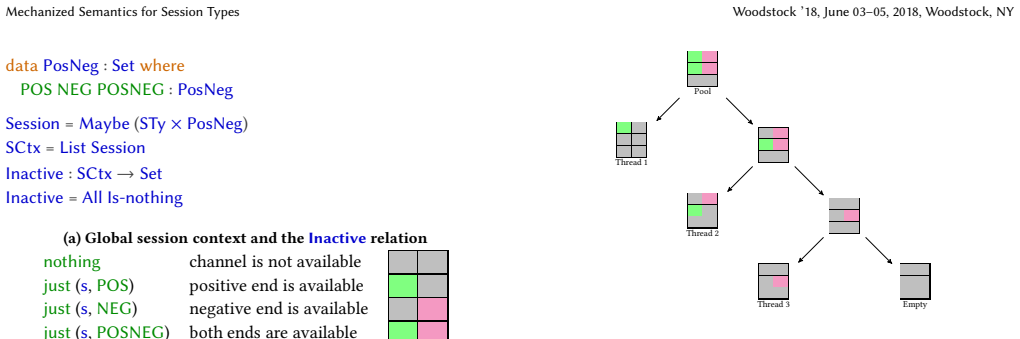
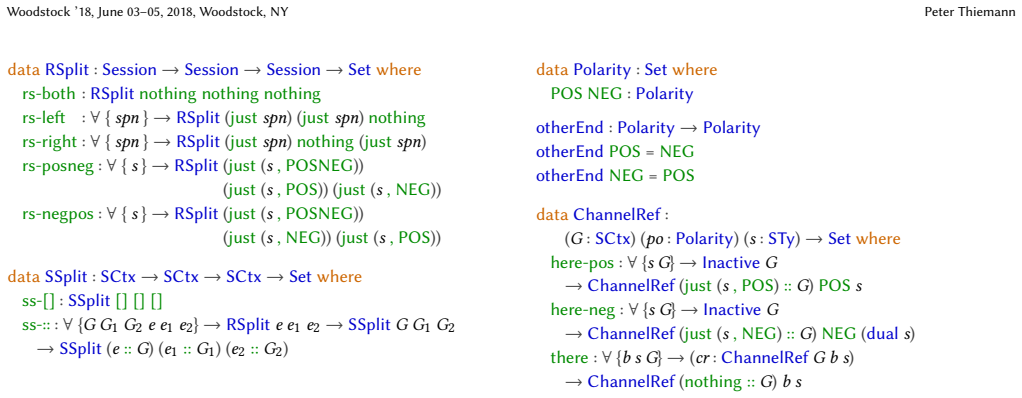
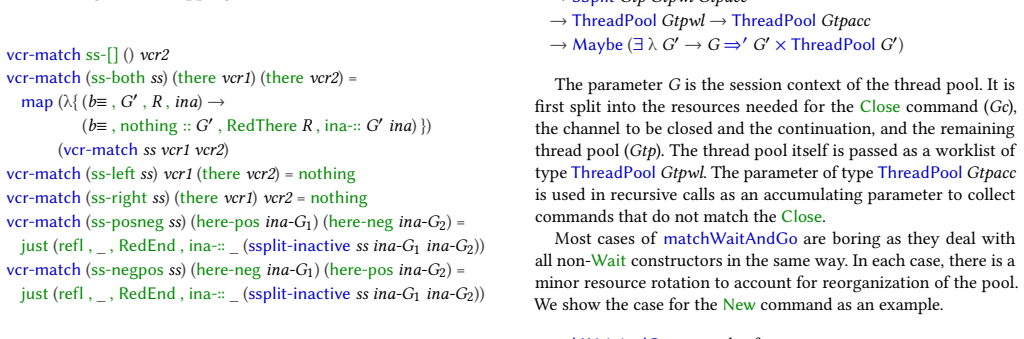
The central object is the resource splitting tree: a binary tree of session-context splittings that distributes channel endpoints across values, environments, continuations, threads, and the thread pool, in parallel with the splitting of the linear typing context. This tree carries the argument because it makes linearity and unique ownership of channel ends structurally enforced: a resource can go entirely left, entirely right, or, when both ends are available, be split into positive and negative ends. The scheduler's step function and its matching functions traverse this tree to perform rendezvous, and the Junction type captures the two nested splittings needed to transfer resources between a sender and a receiver. The CEK machine is stuttering: expression-level decomposition issues Commands and yields to the scheduler for all serious effects such as communication, thread creation, and channel creation.
What would settle it
Take any closed program P and any one-step reduction P to Q in the intended small-step calculus, then run the machine's single-step function on the thread pool for P. If for some general evaluation context E the machine produces a state that is not equivalent to the thread pool for E[Q] after the same number of steps, adequacy fails and the machine-level soundness result cannot be transferred to the calculus; the paper's own properties modules already cover beta and pair reduction in all contexts, so the remaining general-context cases for close, wait, fork, and new are the ones to test.
Extended reading notes
Core claim
The central claim is that type preservation and session fidelity can be made definitional rather than derived. In the Agda formalization of the GV-style calculus, every value, environment, continuation, command, and thread pool is indexed by its type and session context, so the step function cannot produce an ill-typed state. Session fidelity is enforced by representing each channel as a resource whose session type changes by a context reduction on every communication, and by requiring the scheduler to find a matching partner for each close, wait, send, or receive before any transmission can occur. Progress is relative: the scheduler's step function returns Stuck exactly when no thread can take a step and no communication partner exists, giving a machine-checked account of deadlock situations. The formalization covers linear call-by-value PCF with pairs, forking, channel creation, closing, sending and receiving values, internal and external choice, recursive sessions with coinductive subtyping, and an encoding of asynchronous channels as chains of promise channels.
Load-bearing premise
The machine's step relation must faithfully mirror the calculus's own reduction rules in every evaluation context, and the author reports that the proof of this adequacy property for general contexts has not yet been completed.
Editorial extensions
If this is right
- Any program accepted by the intrinsically typed syntax cannot fail by type confusion: a Stuck result from the scheduler indicates a true absence of matching communication partners, not an ill-typed state.
- Session fidelity is maintained when channels are transmitted over other channels: the resource splitting tree moves the endpoint from sender to receiver, and the context reduction updates its session type accordingly.
- The same machine, extended with choice, recursive sessions, and coinductive subtyping, still preserves typing by construction, so the approach scales beyond the minimal calculus.
- The typed encoding of asynchronous channels as promise chains inherits type preservation and session fidelity from the synchronous machine.
- Linearity is preserved throughout execution because the context splitting and resource splitting relations make it impossible to duplicate or discard a linear channel endpoint.
Reading between the lines
- The resource splitting tree is essentially a separation-logic heap in disguise; making that connection explicit could simplify the rotation lemmas and may lead to more modular proofs for larger calculi.
- Because structured gas lets the scheduler rotate the thread pool by arbitrary amounts, the same executable machine can explore every interleaving; that could support machine-checked deadlock-freedom or fairness statements for fragments of the calculus.
- The promise-chain encoding of asynchrony suggests an executable asynchronous semantics can be obtained from the synchronous machine plus forked helper threads, so the framework could be tested by running asynchronous protocols against a directly asynchronous calculus.
Signed reviews
Editorial analysis
A structured set of objections, weighed in public.
Referee Report
Summary. The paper presents an Agda formalization of an intrinsically typed, executable small-step semantics for a functional session type calculus in the style of Gay and Vasconcelos. The core artifact is a multi-threaded CEK machine in which expressions, values, environments, continuations, and a global session context are all type-indexed, with linearity enforced by a context-splitting relation and a resource-splitting tree. The scheduler executes commands such as New, Close, Wait, Send, and Recv, and channel rendezvous is implemented by matching functions that carry equality and session-type-evolution proofs. The paper claims type preservation by construction, a notion of progress embodied in the scheduler's step function, and preliminary adequacy results relating the machine to a small-step semantics. It also sketches extensions for choice, recursive sessions, subtyping, structured gas, and an asynchronous encoding.
Significance. If the advertised claims were fully established, this would be a valuable mechanized semantics contribution: the resource-splitting tree is a genuinely useful technique for maintaining linearity and uniqueness of channel endpoints across threads, and the intrinsically typed CEK machine gives machine-checked type preservation for the machine-level semantics. The GitHub artifact and the honest discussion of what is and is not proved are strengths. However, the paper's central contribution as stated—'the first mechanized proof of type soundness and session fidelity of a realistic, fully-fledged functional session type calculus'—is not yet supported, because the adequacy bridge from the machine to the published calculus is incomplete and because the progress and session-fidelity claims are largely definitional rather than stated as proved theorems.
major comments (3)
- [§5.4, Adequacy] The paper's advertised type-soundness claim is for the GV-style calculus, but the machine-checked results are for the CEK machine. Section 5.4 explicitly states: 'Adequacy does not follow from the intrinsic typedness of the interpreter, but requires separate proofs' and that the proofs 'for general contexts get very complex and we have not been able to complete them.' The only completed adequacy results are for beta and pair reductions in simple contexts plus close/wait/fork/new in very simple contexts. Without a general-context adequacy theorem, a statement about start and schedule gas is a theorem about the machine, not about the expression/process calculus of Figs. 3 and 24. The central claim of calculus-level type soundness therefore overstates what is proved.
- [§7, Conclusions; §4.5, Scheduler] The progress claim is close to definitional. The conclusion asserts that when the step function returns Stuck, 'all remaining communication commands do not have a corresponding partner at the other end of the channel,' but this is an interpretation of the implementation of step, matchWaitAndGo, and the vcr-match functions, not a proved completeness property. In particular, there is no theorem stating that Stuck occurs exactly when no thread can make a step and no matching communication partner exists; the code simply produces Stuck when its matching routines return nothing. Thus the paper's 'relative progress by construction' is a design property of the scheduler, not a metatheorem about the calculus.
- [Abstract, §1, and Section 5.3-5.4] The paper claims a 'first fully mechanized proof of session fidelity,' but no standalone session fidelity theorem is stated or proved. The matching functions such as vcr-match-2-sr include equality proofs (e.g., t1 ≡ t2 and dual s1 ≡ s2) that establish compatibility of matched channel ends, and type preservation of the machine ensures that channel types evolve consistently. However, session fidelity as a property of the calculus—that every communication step in every run follows the stated protocol—is never formulated as a theorem. The authors should either state and prove such a theorem at the machine level and connect it via adequacy to the calculus, or explicitly qualify the session-fidelity claim.
minor comments (4)
- [§1, Introduction] There are typos: 'sychronous' should be 'synchronous' and 'asychronous' should be 'asynchronous' in the bullet list; also the Agda pattern synonym syntax appears as 'pa/t_tern' in several places, which looks like a rendering artifact and should be fixed.
- [§4.5, Figure 13] The type constructor '_,_' : Event → Outcome → Outcome is used to package an event with an outcome, but the notation is easy to confuse with a pair type in Agda. A named record or a comment explaining this constructor would improve readability.
- [§5.4, Adequacy] The modules Properties.StepBeta and Properties.StepPair are mentioned but their exact statements are not reproduced. Since these are the main adequacy results, the paper should state at least the theorem statements in prose or as displayed equations so that the reader can verify what has actually been shown.
- [§6, Related Work] The comparison with Goto et al. [2016] focuses on representation style, but it does not clearly state whether Goto et al.'s 'safety properties' include session fidelity or only subject reduction and deadlock-freedom-like properties. This makes it difficult to assess the novelty of the claimed first session-fidelity proof.
Circularity Check
Relative progress is defined as the step function's failure case, and the adequacy bridge from the CEK machine to the GV-style calculus is explicitly left incomplete; the advertised calculus-level type soundness is therefore partly circular and partly unproven.
-
self definitional
[Section 7 (Conclusions), progress claim; cf. Section 4.5 scheduler step function]
"Progress is embodied in the definition of the step function (Section 4.5). By design, this function returns Stuck, if it cannot make progress. That is, there is no command in the thread pool that can execute immediately and all remaining communication commands do not have a corresponding partner at the other end of the channel. Stating such a relative progress result feels like a futile exercise because its definition and proof mirror exactly the definitions of step, the match*AndGo functions, and the vcr-match* functions."
The paper's central soundness claim includes this 'relative progress' component, but the property is true by construction: Stuck is the event emitted by the step function exactly when it cannot take a step, and the paper itself says a proof would mirror the step/match definitions. There is no independent 'cannot make progress' predicate being verified; the theorem is the failure case of the implementation, so the progress 'result' reduces to the definition of step. The deadlock interpretation is likewise definitional: Section 4.5 says the configuration 'indicates a deadlock because the step function was not able to execute any command in the thread pool.' Type preservation remains a genuine Agda-checked property, but the soundness claim as a whole is partly tautological.
full rationale
The Agda formalization is a substantial, machine-checked development: type preservation, linearity, and resource-splitting invariants are enforced by the intrinsically typed representation, and no load-bearing self-citation or imported uniqueness theorem occurs. However, the headline contribution as stated in the introduction—'the first mechanized proof of the type soundness and session fidelity of a realistic, fully-fledged functional session type calculus'—outruns what the paper establishes. First, the progress half of type soundness is self-definitional: Section 7 states that progress is embodied in the step function and that a proof would mirror the definitions of step, match*AndGo, and vcr-match*, so the property is the step function's failure case by construction. Second, the bridge from the machine to the published calculus is explicitly incomplete: Section 5.4 says 'Adequacy does not follow from the intrinsic typedness of the interpreter, but requires separate proofs' and that the proofs for general contexts 'get very complex and we have not been able to complete them.' Consequently, the machine-level preservation and matching results are not yet theorems about the GV-style process calculus of Figures 3 and 24. Session fidelity, as an advertised calculus property, inherits the same adequacy gap; within the machine it is enforced by the return types of vcr-match functions rather than derived for an independently specified reduction relation. These are internal, textually acknowledged limitations, and the definitional progress step is the concrete circular component. Overall, the central formalization has substantial independent content, but the paper's soundness/fidelity headline is partially circular (progress) and partially unproven (adequacy), warranting a score of 6 rather than a lower or higher value.
Assumptions & free parameters
assumptions (3)
- standard math Agda's type theory, termination checking, and standard library are sound.
- domain assumption Coinductive session types and coinductive subtyping represent recursive sessions and match the intended greatest-fixpoint semantics.
- domain assumption The GV-style process calculus is the intended reference semantics and the CEK machine adequately implements it.
Cite this review
Pith. "Pith review of Intrinsically-Typed Mechanized Semantics for Session Types." pith.science (2026). https://pith.science/paper/27T4U5RN
@misc{pith2026190802940,
  author       = {Pith},
  title        = {Pith review of: Intrinsically-Typed Mechanized Semantics for Session Types},
  year         = {2026},
  howpublished = {\url{https://pith.science/paper/27T4U5RN}},
  note         = {Machine review of arXiv:1908.02940}
}
read the original abstract
Session types have emerged as a powerful paradigm for structuring communication-based programs. They guarantee type soundness and session fidelity for concurrent programs with sophisticated communication protocols. As type soundness proofs for languages with session types are tedious and technically involved, it is rare to see mechanized soundness proofs for these systems. We present an executable intrinsically typed small-step semantics for a realistic functional session type calculus. The calculus includes linearity, recursion, and recursive sessions with subtyping. Asynchronous communication is modeled with an encoding. The semantics is implemented in Agda as an intrinsically typed, interruptible CEK machine. This implementation proves type preservation and a particular notion of progress by construction.
Figures


Figures from the paper (20 more)








Reference graph
Works this paper leans on
-
[1]
2017.Interactive Programming in Agda - Objects and Graphical User Interfaces
Andreas Abel, Stephan Adelsberger, and Anton Setzer. 2017.Interactive Programming in Agda - Objects and Graphical User Interfaces. J. Funct. Program. 27 (2017), e8. Guillaume Allais, James Chapman, Conor McBride, and James M cKinna
work page 2017
-
[2]
Pair Channel Int Channel Figure 25: Splitting among values llambda : ∀ {t1 t2} → (body : Expr (t1 :: Φ) t2) → Expr Φ (TFun LL t1 t2) rec : ∀ {t1 t2} → (unr-Φ : All Unr Φ) → let t = TFun UU t1 t2 in (body : Expr (t :: t1 :: Φ) t2) → Expr Φ t app : ∀ {Φ1 Φ2 lu t1 t2} → (sp : Φ ≜Φ1 ◦ Φ2) → (fun : TFun lu t1 t2 ∈ Φ1) → (arg : t1 ∈ Φ2) → Expr Φ t2 Figure 26: E...
work page 2018
-
[7]
Objects and Session Types. Inf. Comput. 207, 5 (2009), 595–641. Matthias Felleisen and Daniel Friedman
work page 2009
-
[8]
Acta Informatica 42, 2-3 (2005), 191–225
Subtyping for Session Ty pes in the Pi Calculus. Acta Informatica 42, 2-3 (2005), 191–225. Simon J. Gay and Vasco Thudichum Vasconcelos
work page 2005
-
[11]
Foundat ions of Session Types and Behavioural Contracts. ACM Comput. Surv. 49, 1 (2016), 3:1–3:36. Sam Lindley and J. Garrett Morris
work page 2016
-
[14]
Mathematical Structures in Computer Science 28, 9 (2018), 1541–1577
Proof-relevant π -calculus: a constructive ac- count of concurrency and causality. Mathematical Structures in Computer Science 28, 9 (2018), 1541–1577. https://doi.org/10.1017/S09601 2951700010X Benjamin C. Pierce and Davide Sangiorgi
-
[15]
PACMPL 2, POPL (2018), 16:1–16:34
Intrinsically-typed Definitional Interpret ers for Imperative Lan- guages. PACMPL 2, POPL (2018), 16:1–16:34. John C. Reynolds
work page 2018
-
[17]
Context-fre e session types. In Proceedings of the 21st ACM SIGPLAN International Conference on Func- tional Programming, ICFP 2016, Nara, Japan, September 18-22 , 2016 , Jacques Garrigue, Gabriele Keller, and Eijiro Sumii (Eds.). ACM, Na ra, Japan, 462–475. https://doi.org/10.1145/2951913.2951926 Bernardo Toninho, Luís Caires, and Frank Pfenning
arXiv 2016
Show all 20 references
-
[18]
Woodstock ’18, June 03–05, 2018, Woodstock, NY Peter Thiemann A SUPPLEMENTARY MATERIAL A.1 Processes data Proc Φ : Set where exp : (e : Expr Φ TUnit) → Proc Φ par : ∀ {Φ1 Φ2} → (sp : Split Φ Φ1 Φ2) → (P1 : Proc Φ1) → (P2 : Proc Φ2) → Proc Φ res : (s : STy) → (P : Proc (TChan s...
2018
-
[24]
This context only contains bindings for channel endpoints
Processes are also intri nsically typed and hence indexed by a typing context Φ. This context only contains bindings for channel endpoints. A process P is either an expression process ( exp), a parallel execution of processes ( par) which splits the environment for its two sub...
2005
-
[203]
https://doi.org/10.4204/EPTCS.203.1 Scott Owens, Magnus O
1–13. https://doi.org/10.4204/EPTCS.203.1 Scott Owens, Magnus O. Myreen, Ramana Kumar, and Yong Kiam Ta n
-
[2001]
ACM TOPLAS 23, 5 (2001), 657–683
An Indexed Mod el of Recursive Types for Foundational Proof-Carrying Code. ACM TOPLAS 23, 5 (2001), 657–683. https://doi.org/10.1145/504709.504712 Robert Atkey
2001
-
[2005]
Logical Methods in Computer Science 1, 2 (2005)
General Recursion via Coinductiv e Types. Logical Methods in Computer Science 1, 2 (2005). Giuseppe Castagna, Mariangiola Dezani-Ciancaglini, Elen a Giachino, and Luca Padovani
2005
-
[2009]
In Principles and Practice of Declara- tive Programming, PPDP 2009, António Porto and Francisco J
Foundations of Session Types. In Principles and Practice of Declara- tive Programming, PPDP 2009, António Porto and Francisco J. López-Fraguas (Eds.). ACM, Coimbra, Portugal, 219–230. Iliano Cervesato and Frank Pfenning
2009
-
[2010]
Linear Type Theory for Asyn- chronous Session Types. J. Funct. Program. 20, 1 (2010), 19–50. Matthew A. Goto, Radha Jagadeesan, Alan Jeffrey, Corin Pitcher, and James Riely
2010
-
[2012]
Strongly Typed Term Representations in Coq. J. Autom. Reasoning 49, 2 (2012), 141–159. Luís Caires and Frank Pfenning
2012
-
[2013]
http://siek.blogspot.de/2013/05/type-safety-in-thre e-easy-lemmas.html
Type Safety in Three Easy Lemmas. http://siek.blogspot.de/2013/05/type-safety-in-thre e-easy-lemmas.html. (May 2013). Peter Thiemann and Vasco T. Vasconcelos
2013
-
[2015]
In Proceedings Eighth International Workshop on Programming La nguage Ap- proaches to Concurrency- and Communication-cEntric Softw are, PLACES 2015, Lon- don, UK, 18th April
Using Session Types as an Effect Sys- tem. In Proceedings Eighth International Workshop on Programming La nguage Ap- proaches to Concurrency- and Communication-cEntric Softw are, PLACES 2015, Lon- don, UK, 18th April
2015
-
[2016]
Mathematical Structures in Computer Science 26, 3 (2016), 465–509
An Extensible Approach to Session Polymorphism. Mathematical Structures in Computer Science 26, 3 (2016), 465–509. Kohei Honda
2016
-
[2018]
Au- tomated Modular Verification for Relaxed Communication Pro tocols. In Pro- gramming Languages and Systems - 16th Asian Symposium, APLAS 2018, Wellington, New Zealand, December 2-6, 2018, Proceedings (L ecture Notes in Computer Science) , Sukyoung Ryu (Ed.), Vol. 11275. Spri...
2018 doi
Reviewed August 14, 2026 · model on record in the stance chip above.
Discussion (0). Continue with ORCID to comment.