REVIEW 2 major objections 4 minor 1 cited by
From Stellar Halos to Intracluster Light: the physics of the Intra-Halo Stellar Component in cosmological hydrodynamical simulations
T0 review · 2 major / 4 minor · reviewed 2026-08-14 · deepseek-v4-flash
Pith's one-line read Using an adaptive phase-space definition, the diffuse stellar component can be measured consistently from Milky Way-mass halos to galaxy clusters; its mass fraction grows with total stellar mass and, below group masses, tracks the central…
desk verdict Adaptive phase-space definition of diffuse stellar material is a real new tool; the paper's quantitative scatter claims need a shot-noise subtraction before they can stand. read the letter →
The pith
A machine-rendered reading of the paper's core claim, the machinery that carries it, and where it could break.
The reading
What carries the argument
The central object is an adaptive phase-space Friends-of-Friends search that identifies galaxies as six-dimensional phase-space overdensities. The IHSC is defined as all stellar particles not linked to any galaxy in that search, meaning kinematically hot, diffuse background stars and tidal debris. The user-set parameter $f_{l_x,6D}=0.4$ sets the phase-space density threshold separating galaxy from IHSC, and the paper shows that the shapes and slopes of the resulting mass relations are robust to this choice, with only the normalization shifting. The observational proxy that carries the physical argument is the central galaxy's $V/\sigma$, the ratio of rotational velocity to velocity dispersion, because it encodes merger history in a single measurable number.
What would settle it
Measure $V/\sigma$ and the diffuse stellar fraction for a sample of $M_{*,\mathrm{tot}}\sim10^{11}\,M_\odot$ galaxies: the paper predicts that rotation-supported galaxies stay below $f_{M_*,\mathrm{IHSC}}\sim0.1\%$, so finding many high-$V/\sigma$ systems with diffuse fractions above 1% would falsify the claimed anti-correlation.
Extended reading notes
Core claim
The central discovery is that the same adaptive phase-space criterion identifies the diffuse stellar component across the full mass range, and that the resulting $f_{M_*,\mathrm{IHSC}}$ versus $M_{*,\mathrm{tot}}$ relation has a mass-dependent scatter with two distinct regimes. For $M_{*,\mathrm{tot}}<10^{12}\,M_\odot$, the diffuse fraction is strongly anti-correlated with the central galaxy's stellar rotation-to-dispersion ratio $V/\sigma$; high-$V/\sigma$ galaxies sit at $f_{M_*,\mathrm{IHSC}}<0.1\%$, while low-$V/\sigma$ galaxies reach about 5%, and this correlation is the strongest among all halo and galaxy properties examined. At $M_{*,\mathrm{tot}}>10^{12}\,M_\odot$, all centrals are dispersion-supported, and the diffuse fraction instead tracks the dynamical state of the system, quantified by the mass ratio of the largest satellite to the central galaxy; cluster-scale systems reach 10 to 20 percent by $z\sim1$ and then evolve weakly, though the paper cautions that the cluster sample is small. The paper interprets the low-mass regime as reflecting the diversity of accretion histories: quiescent, rotation-supported galaxies simply do not have much stripped stellar material, while dispersion-supported galaxies have experienced active merger histories. A further robustness claim is that the power-law slopes relating IHSC mass, central-galaxy mass, and satellite stellar mass are essentially independent of the user-set phase-space density threshold; only the normalization changes.
Load-bearing premise
The load-bearing premise is that the chosen phase-space density threshold identifies the same physical component that observers measure as stellar halos and intracluster light, because the threshold is calibrated to match those observations rather than derived independently.
Editorial extensions
If this is right
- At a fixed total stellar mass below $10^{12}\,M_\odot$, measuring the central galaxy's $V/\sigma$ predicts the diffuse stellar fraction: high rotation means under 0.1 percent, low rotation about 5 percent.
- The large observed scatter in stellar-halo mass fractions of Milky Way-like galaxies, about 2 dex, is not pure noise but encodes distinct accretion histories, and should correlate with kinematic morphology once dispersion-supported galaxies are included.
- At group and cluster scales the diffuse component reaches 10 to 20 percent of all stars by $z\sim1$ and then stays nearly constant, so the intracluster-light fraction should be a weak function of cluster mass at late times; the paper flags this as tentative because of the small simulated cluster sample.
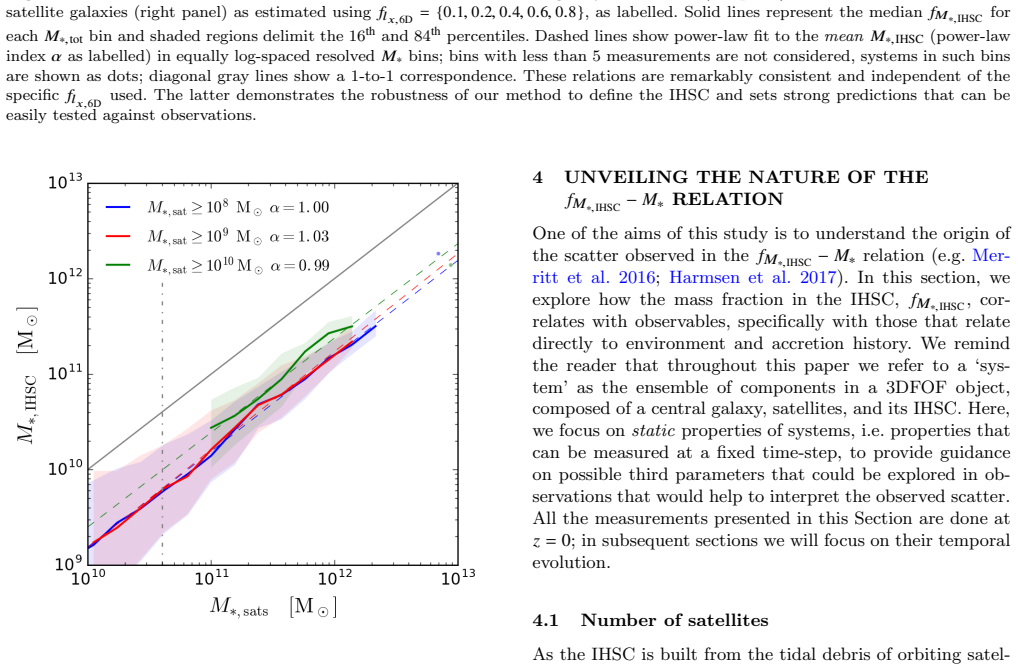
- Because the slope between IHSC mass and satellite stellar mass is about unity and is independent of the phase-space threshold, observational measurements made with different surface-brightness limits should recover the same slope and differ mainly in normalization.
Reading between the lines
- If the $V/\sigma$ correlation survives in observational samples, surveys that already measure galaxy kinematics could statistically infer halo mass fractions without directly detecting the faint diffuse light.
- The same phase-space definition could be applied to other cosmological hydrodynamical simulations; a testable prediction is that the near-unity slope of the IHSC mass versus satellite mass relation is robust across feedback implementations, while the normalization carries information about the subgrid physics.
- The paper's tentative flat evolution at cluster scales suggests a concrete forecast: with dozens of simulated clusters, the intracluster-light fraction should remain within 10 to 20 percent with no monotonic redshift trend, whereas strong evolution would indicate missing physics or a resolution effect.
- Current Milky Way-mass observational samples are dominated by rotationally supported galaxies, so the apparent tension with the simulated relation may disappear once ellipticals with similar stellar masses are measured and found to have systematically higher diffuse fractions.
Signed reviews
Editorial analysis
A structured set of objections, weighed in public.
Referee Report
Summary. The paper introduces an adaptive phase-space definition of the diffuse stellar component, which the authors call the Intra-Halo Stellar Component (IHSC), and applies it to the Horizon-AGN cosmological hydrodynamical simulation. The IHSC is defined as stellar particles not linked to galaxies by a 6D friends-of-friends search, so it represents the kinematically hot, diffuse stellar background around galaxies, groups, and clusters. Using this definition, the paper reports the z = 0 f_M*,IHSC-M*_tot relation, characterizing its slope, normalization, and the mass dependence of its scatter; it then studies correlations of the scatter with the number of satellites, the central-to-satellite mass ratio, the central galaxy's V/sigma, and sSFR. The paper also follows individual systems through cosmic time with merger trees, distinguishing quiescent and merger-rich evolutionary paths and discussing the tentative behavior of galaxy clusters. The central quantitative claims are that f_M*,IHSC increases with total stellar mass on average, that the scatter decreases from roughly 2 dex at M*_tot ~ 1e11 Msun to about 0.3 dex at group masses, and that V/sigma of the central galaxy is the strongest predictor of f_M*,IHSC at fixed mass for M*_tot below about 1e12 Msun.
Significance. If the results are robust, the paper provides a useful unifying framework: the same adaptive, shape-independent definition applies to stellar halos, intra-group light, and intracluster light, which is a genuine improvement over fixed or variable spherical apertures. The stability of the M_IHSC-M_sats power-law slopes across flx,6D = 0.1-0.8 is a credible and falsifiable prediction, and the V/sigma anti-correlation at Milky-Way and group masses gives observers a concrete kinematic proxy for the diffuse stellar mass fraction. The authors are also transparent about the parameter choice that sets the normalization and about the limited cluster sample. The main significance risk is quantitative: part of the reported scatter and of the low-f_M*,IHSC population rests on systems with very few IHSC particles, and the paper does not quantify this counting-noise floor before presenting its headline numbers.
major comments (2)
- [Section 3, Fig. 2; Section 4.3, Fig. 9] The paper quotes a scatter of about 2 dex at M*_tot around 1e11 Msun and uses the low-f_M*,IHSC tail (f < 0.1%) to support the V/sigma anti-correlation, but at these masses a large part of that range contains only tens of IHSC particles. With the stated stellar particle mass of ~3e6 Msun, f_M*,IHSC = 1e-4 at M*_tot = 1e11 Msun corresponds to about 3 particles, and f_M*,IHSC = 1e-3 at M*_tot = 3e10 Msun corresponds to about 10 particles. The blue dashed and dot-dashed lines in Fig. 2 mark the N_IHSC = 100 and N_IHSC = 10 boundaries, but these boundaries are not applied as cuts and no Poisson or jackknife uncertainty in f_M*,IHSC is propagated into the scatter or into the sub-sample medians in Figs. 7-10. The text identifies resolution effects only at M*_tot < 1e10 Msun, yet the same discreteness affects low-f systems at higher masses. Please add a quantitative noise-floor analysis: for example, compute Monte Carlo uncertainties from the IHSC particle counts, show how the scatter-versus-mass trend and the Fig. 9 medians change when N_IHSC >= 100 or N_IHSC >= 1000 cuts are imposed, and verify explicitly that the 2-dex-to-0.3-dex claim and the V/sigma anti-correlation survive such cuts.
- [Section 3.1 and Section 3.2] The parameter flx,6D = 0.4 is adopted in Section 3.1 specifically because it makes the simulated f_M*,IHSC-M* relation agree with the observed stellar-halo and ICL fractions of Merritt et al. (2016), Harmsen et al. (2017), and Morishita et al. (2017). Given that, the statement in Section 3.2 that the method 'predicts' IHSC mass fractions in agreement with observations is circular for the normalization: those anchor points are matched by construction. The shape of the relation, the slope of M_IHSC-M_sats in Fig. 4, and the V/sigma-dependent ordering in Fig. 9 are genuine predictions, but the absolute normalization is not. Please state this distinction explicitly and avoid phrasing that presents the agreement at the calibration points as an independent success.
minor comments (4)
- [Fig. 9 caption] The caption contains two typographical errors: 'as labellled' should read 'as labelled', and 'the medians of each sub-sample do nor overlap' should read 'do not overlap'.
- [Section 4.2, Fig. 8 caption] The word 'fracton' in the caption text should be 'fraction'.
- [Section 5.1.1] The sentence 'At z = 2.12 these systems have total stellar masses between M*_tot~1e10 and 1e10.5 and a f_M*,IHSC ~0.03' is slightly ambiguous; clarify that the ~0.03 value refers to the same redshift.
- [Section 4.3] The discussion of the 2D versus 3D V/sigma difference is noted in the text, but it would help the observational reader to state whether the reported V/sigma values are the 3D values and to indicate the expected size of the projection-induced scatter.
Circularity Check
IHSC mass-fraction normalization is calibrated to the same observations it is later said to 'predict'; the mass-dependence shape and V/sigma trends are independent.
-
fitted input called prediction
[Section 3.1, parameter choice after Fig. 3; invoked again in Section 3.2]
"In this study we adopt flx,6D = 0.4, because it predicts a fM∗,IHSC− M∗ relation that is in better agreement with the estimated stellar halo mass fractions for Milky Way-like galaxies from Merritt et al. (2016) and Harmsen et al. (2017), and recent ICL mass estimations of Morishita et al. (2017)."
The only user-set parameter of the phase-space definition, flx,6D, sets the density threshold that separates galaxies from the IHSC (Eq. 7). The paper explicitly chooses flx,6D = 0.4 so that the simulated f_M*,IHSC-M* relation matches the observed stellar-halo and ICL fractions. Therefore the later statement in Section 3.2 that 'Only our method is capable of predicting IHSC mass fractions that are in agreement with observations' is not an independent prediction: the normalization agreement is imposed by the choice of flx,6D. The qualitative shape of the relation and the V/sigma correlation are not reduced in this way, but the quantitative 'agreement with observations' claim is circular by construction.
full rationale
The identified circular step is real but partial. Equation (7) makes flx,6D the single free linking-length parameter controlling how much stellar material is assigned to galaxies versus the IHSC, and Section 3.1 states that the adopted value 0.4 was selected precisely because it makes f_M*,IHSC match the observed stellar-halo fractions of Merritt et al. (2016) and Harmsen et al. (2017) and the ICL fractions of Morishita et al. (2017). Consequently, Section 3.2's claim that the method 'is capable of predicting IHSC mass fractions that are in agreement with observations' presents a calibrated normalization as a prediction. This is the classic fitted-input-called-prediction pattern. However, I do not treat the mass-dependence itself as circular: Fig. 3 shows that the increasing-then-flattening shape and the decreasing scatter survive for flx,6D values from 0.1 to 0.8, and the slopes of the M_IHSC-M*_ctrl and M_IHSC-M*_sats relations vary by less than 5% (Fig. 4). The V/sigma anti-correlation in Section 4.3 is also independent of the calibration, because V/sigma is measured from central-galaxy stellar particles and is not used to set flx,6D. The paper's self-citations to Canas et al. (2019) and Elahi et al. (2019) describe the structure-finder code and are not invoked as a uniqueness theorem or as the load-bearing physical argument. The explicit caveat about the small number of clusters in Horizon-AGN is an honest limitation, not circularity. The shot-noise and particle-count concerns raised by the skeptic are correctness and robustness risks rather than constructional circularity, so they do not increase this score. Overall, one central 'prediction' reduces by construction to the calibration of the IHSC threshold, while the main physical interpretation retains substantial independent content: score 6.
Assumptions & free parameters
free parameters (2)
- flx,6D (velocity-space linking length scaling for 6DFOF field search) =
0.4 (adopted)
- b (3DFOF linking length parameter) =
0.2
assumptions (4)
- ad hoc to paper The IHSC can be defined operationally as stellar particles not linked to galaxies by a fixed phase-space density threshold; this boundary corresponds to the physically diffuse, kinematically hot component.
- domain assumption Horizon-AGN's subgrid prescriptions for star formation, supernovae, and AGN feedback produce a stellar distribution realistic enough for IHSC mass fractions and their scatter to be meaningful.
- domain assumption The observational estimates of stellar halo and ICL mass fractions used for calibration (Merritt et al. 2016, Harmsen et al. 2017, Morishita et al. 2017) are reliable truth anchors.
- domain assumption A constant mass-to-light ratio makes f_M*,IHSC comparable to observed light fractions.
Cite this review
Pith. "Pith review of From Stellar Halos to Intracluster Light: the physics of the Intra-Halo Stellar Component in cosmological hydrodynamical simulations." pith.science (2026). https://pith.science/paper/2TV2TVDB
@misc{pith2026190802945,
  author       = {Pith},
  title        = {Pith review of: From Stellar Halos to Intracluster Light: the physics of the Intra-Halo Stellar Component in cosmological hydrodynamical simulations},
  year         = {2026},
  howpublished = {\url{https://pith.science/paper/2TV2TVDB}},
  note         = {Machine review of arXiv:1908.02945}
}
abstract
We study the Intra-Halo Stellar Component (IHSC) of Milky Way-mass systems up to galaxy clusters in the Horizon-AGN cosmological hydrodynamical simulation. We identify the IHSC using an improved phase-space galaxy finder algorithm which provides an adaptive, physically motivated and shape-independent definition of this stellar component, that can be applied to halos of arbitrary masses. We explore the IHSC mass fraction-total halo's stellar mass, $f_{M*,IHSC}-M*$, relation and the physical drivers of its scatter. We find that on average the $f_{M*,IHSC}$ increases with $M_{*,tot}$, with the scatter decreasing strongly with mass from 2 dex at $M_{*,tot}\sim10^{11}M_\odot$ to 0.3 dex at group masses. At high masses, $M_{*,tot}>10^{11.5}M_\odot$, $f_{M*,IHSC}$ increases with the number of substructures, and with the mass ratio between the central galaxy and largest satellite, at fixed $M_{*,tot}$. From mid-size groups and systems below $M_{*,tot}<10^{12}M_\odot$, we find that the central galaxy's stellar rotation-to-dispersion velocity ratio, V/{\sigma}, displays the strongest (anti)-correlation with $f_{M*,IHSC}$ at fixed $M_{*,tot}$ of all the galaxy and halo properties explored, transitioning from $f_{M*,IHSC}$<0.1% for high V/{\sigma}, to $f_{M*,IHSC}\sim5$% for low V/{\sigma} galaxies. By studying the $f_{M*,IHSC}$ temporal evolution, we find that, in the former, mergers not always take place, but if they did, they happened early (z>1), while the high $f_{M*,IHSC}$ population displays a much more active merger history. In the case of massive groups and galaxy clusters, $M_{*,tot}>10^{12}M_\odot$, a fraction $f_{M*,IHSC}\sim$10-20% is reached at $z\sim1$ and then they evolve across lines of constant $f_{M*,IHSC}$ modulo some small perturbations. Because of the limited simulation's volume, the latter is only tentative and requires a larger sample of simulated galaxy clusters to confirm.
Figures


Figures from the paper (10 more)



Forward citations
Cited by 1 Pith paper
-
The total stellar halo mass of the Milky Way
By counting red giant stars in Gaia DR2 and separating disc from halo using proper motions, the authors obtain a total stellar halo luminosity of about 8 x 10^8 solar luminosities and a stellar halo mass near 1.4 x 10...
Reference graph
Works this paper leans on
-
[1]
Abraham R. G., van Dokkum P. G., 2014, @doi [ ] 10.1086/674875 , http://adsabs.harvard.edu/abs/2014PASP..126...55A 126, 55
doi:10.1086/674875 2014
-
[2]
Bah \'e Y. M., et al., 2017, @doi [ ] 10.1093/mnras/stx1403 , https://ui.adsabs.harvard.edu/abs/2017MNRAS.470.4186B 470, 4186
-
[3]
Barker M. K., Ferguson A. M. N., Irwin M., Arimoto N., Jablonka P., 2009, @doi [ ] 10.1088/0004-6256/138/5/1469 , http://adsabs.harvard.edu/abs/2009AJ....138.1469B 138, 1469
-
[4]
Barnes J. E., Hernquist L. E., 1991, @doi [ ] 10.1086/185978 , http://adsabs.harvard.edu/abs/1991ApJ...370L..65B 370, L65
doi:10.1086/185978 1991
-
[5]
Barnes D. J., et al., 2017, @doi [ ] 10.1093/mnras/stx1647 , https://ui.adsabs.harvard.edu/abs/2017MNRAS.471.1088B 471, 1088
-
[6]
Bullock J. S., Johnston K. V., 2005, @doi [ ] 10.1086/497422 , http://adsabs.harvard.edu/abs/2005ApJ...635..931B 635, 931
doi:10.1086/497422 2005
-
[7]
Burke C., Hilton M., Collins C., 2015, @doi [ ] 10.1093/mnras/stv450 , http://adsabs.harvard.edu/abs/2015MNRAS.449.2353B 449, 2353
-
[8]
Ca \ n as R., Elahi P. J., Welker C., del P Lagos C., Power C., Dubois Y., Pichon C., 2019, @doi [ ] 10.1093/mnras/sty2725 , https://ui.adsabs.harvard.edu/\#abs/2019MNRAS.482.2039C 482, 2039
Show all 86 references
-
[9]
Contini E., De Lucia G., Villalobos \'A ., Borgani S., 2014, @doi [ ] 10.1093/mnras/stt2174 , http://adsabs.harvard.edu/abs/2014MNRAS.437.3787C 437, 3787
2014 doi
-
[11]
P., D'Souza R., Kauffmann G., Wang J., Boylan-Kolchin M., Guo Q., Frenk C
Cooper A. P., D'Souza R., Kauffmann G., Wang J., Boylan-Kolchin M., Guo Q., Frenk C. S., White S. D. M., 2013, @doi [ ] 10.1093/mnras/stt1245 , http://adsabs.harvard.edu/abs/2013MNRAS.434.3348C 434, 3348
2013 doi
-
[12]
P., Gao L., Guo Q., Frenk C
Cooper A. P., Gao L., Guo Q., Frenk C. S., Jenkins A., Springel V., White S. D. M., 2015, @doi [ ] 10.1093/mnras/stv1042 , http://adsabs.harvard.edu/abs/2015MNRAS.451.2703C 451, 2703
2015 doi
-
[14]
Cui W., et al., 2014, @doi [ ] 10.1093/mnras/stt1940 , http://adsabs.harvard.edu/abs/2014MNRAS.437..816C 437, 816
2014 doi
-
[15]
D'Souza R., Kauffman G., Wang J., Vegetti S., 2014, @doi [ ] 10.1093/mnras/stu1194 , http://adsabs.harvard.edu/abs/2014MNRAS.443.1433D 443, 1433
2014 doi
-
[17]
Davies L. J. M., et al., 2019, @doi [ ] 10.1093/mnras/sty3393 , https://ui.adsabs.harvard.edu/abs/2019MNRAS.483.5444D 483, 5444
2019 doi
-
[18]
S., White S
Davis M., Efstathiou G., Frenk C. S., White S. D. M., 1985, @doi [ ] 10.1086/163168 , http://adsabs.harvard.edu/abs/1985ApJ...292..371D 292, 371
1985 doi
-
[20]
Drory N., et al., 2015, @doi [ ] 10.1088/0004-6256/149/2/77 , https://ui.adsabs.harvard.edu/abs/2015AJ....149...77D 149, 77
2015 doi
-
[23]
Dubois Y., Gavazzi R., Peirani S., Silk J., 2013, @doi [ ] 10.1093/mnras/stt997 , https://ui.adsabs.harvard.edu/abs/2013MNRAS.433.3297D 433, 3297
2013 doi
-
[24]
Dubois Y., et al., 2014, @doi [ ] 10.1093/mnras/stu1227 , http://adsabs.harvard.edu/abs/2014MNRAS.444.1453D 444, 1453
2014 doi
-
[25]
Dubois Y., Peirani S., Pichon C., Devriendt J., Gavazzi R., Welker C., Volonteri M., 2016, @doi [ ] 10.1093/mnras/stw2265 , https://ui.adsabs.harvard.edu/abs/2016MNRAS.463.3948D 463, 3948
2016 doi
-
[26]
Durbala A., et al., 2008, @doi [ ] 10.1088/0004-6256/135/1/130 , http://adsabs.harvard.edu/abs/2008AJ....135..130D 135, 130
2008 doi
-
[28]
J., Ca \ n as R., Poulton R
Elahi P. J., Ca \ n as R., Poulton R. J. J., Tobar R. J., Willis J. S., Lagos C. d. P., Power C., Robotham A. S. G., 2019a, arXiv e-prints, https://ui.adsabs.harvard.edu/abs/2019arXiv190201010E
-
[29]
J., Poulton R
Elahi P. J., Poulton R. J. J., Tobar R. J., Canas R., Lagos C. d. P., Power C., Robotham A. S. G., 2019b, arXiv e-prints, https://ui.adsabs.harvard.edu/abs/2019arXiv190201527E p. arXiv:1902.01527
1902 arXiv
-
[30]
M., Sales L
Elias L. M., Sales L. V., Creasey P., Cooper M. C., Bullock J. S., Rich R. M., Hernquist L., 2018, @doi [ ] 10.1093/mnras/sty1718 , http://adsabs.harvard.edu/abs/2018MNRAS.479.4004E 479, 4004
2018 doi
-
[31]
J., Mihos J
Feldmeier J. J., Mihos J. C., Morrison H. L., Harding P., Kaib N., Dubinski J., 2004, @doi [ ] 10.1086/421313 , http://adsabs.harvard.edu/abs/2004ApJ...609..617F 609, 617
2004 doi
-
[32]
S., McCarthy I
Font A. S., McCarthy I. G., Crain R. A., Theuns T., Schaye J., Wiersma R. P. C., Dalla Vecchia C., 2011, @doi [ ] 10.1111/j.1365-2966.2011.19227.x , http://adsabs.harvard.edu/abs/2011MNRAS.416.2802F 416, 2802
2011
-
[33]
M., 2006, @doi [ ] 10.1086/508860 , http://adsabs.harvard.edu/abs/2006ApJ...653.1180G 653, 1180
Gauthier J.-R., Dubinski J., Widrow L. M., 2006, @doi [ ] 10.1086/508860 , http://adsabs.harvard.edu/abs/2006ApJ...653.1180G 653, 1180
2006 doi
-
[34]
A., Arnaboldi M., Iodice E., Irwin M., Neeser M
Greggio L., Rejkuba M., Gonzalez O. A., Arnaboldi M., Iodice E., Irwin M., Neeser M. J., Emerson J., 2014, @doi [ ] 10.1051/0004-6361/201322759 , http://adsabs.harvard.edu/abs/2014A
2014 doi
-
[35]
F., de Jong R
Harmsen B., Monachesi A., Bell E. F., de Jong R. S., Bailin J., Radburn-Smith D. J., Holwerda B. W., 2017, @doi [ ] 10.1093/mnras/stw2992 , http://adsabs.harvard.edu/abs/2017MNRAS.466.1491H 466, 1491
2017 doi
-
[36]
Ibata R., Chapman S., Ferguson A. M. N., Lewis G., Irwin M., Tanvir N., 2005, @doi [ ] 10.1086/491727 , http://adsabs.harvard.edu/abs/2005ApJ...634..287I 634, 287
2005 doi
-
[37]
S., Remus R.-S., Burkert A., Dolag K., Hoffmann T
Karademir G. S., Remus R.-S., Burkert A., Dolag K., Hoffmann T. L., Moster B. P., Steinwandel U. P., Zhang J., 2019, @doi [ ] 10.1093/mnras/stz1251 , https://ui.adsabs.harvard.edu/abs/2019MNRAS.487..318K 487, 318
2019 doi
-
[38]
Kaviraj S., et al., 2017, @doi [ ] 10.1093/mnras/stx126 , http://adsabs.harvard.edu/abs/2017MNRAS.467.4739K 467, 4739
2017 doi
-
[39]
Komatsu E., et al., 2011, @doi [ ] 10.1088/0067-0049/192/2/18 , http://adsabs.harvard.edu/abs/2011ApJS..192...18K 192, 18
2011 doi
-
[40]
E., Bernstein R
Krick J. E., Bernstein R. A., 2007, @doi [ ] 10.1086/518787 , http://adsabs.harvard.edu/abs/2007AJ....134..466K 134, 466
2007 doi
-
[41]
Lagos C. d. P., et al., 2018a, @doi [ ] 10.1093/mnras/stx2667 , https://ui.adsabs.harvard.edu/abs/2018MNRAS.473.4956L 473, 4956
-
[42]
Lagos C. d. P., Schaye J., Bah \'e Y., Van de Sande J., Kay S. T., Barnes D., Davis T. A., Dalla Vecchia C., 2018b, @doi [ ] 10.1093/mnras/sty489 , https://ui.adsabs.harvard.edu/abs/2018MNRAS.476.4327L 476, 4327
-
[43]
J., Trujillo I., Majewski S
Mart \' nez-Delgado D., Pe \ n arrubia J., Gabany R. J., Trujillo I., Majewski S. R., Pohlen M., 2008, @doi [ ] 10.1086/592555 , http://adsabs.harvard.edu/abs/2008ApJ...689..184M 689, 184
2008 doi
-
[44]
Mart \' nez-Delgado D., et al., 2010, @doi [ ] 10.1088/0004-6256/140/4/962 , http://adsabs.harvard.edu/abs/2010AJ....140..962M 140, 962
2010 doi
-
[45]
W., et al., 2009, @doi [ ] 10.1038/nature08327 , http://adsabs.harvard.edu/abs/2009Natur.461...66M 461, 66
McConnachie A. W., et al., 2009, @doi [ ] 10.1038/nature08327 , http://adsabs.harvard.edu/abs/2009Natur.461...66M 461, 66
2009 doi
-
[46]
Merritt A., van Dokkum P., Abraham R., Zhang J., 2016, @doi [ ] 10.3847/0004-637X/830/2/62 , http://adsabs.harvard.edu/abs/2016ApJ...830...62M 830, 62
2016 doi
-
[47]
C., Hernquist L., 1996, @doi [ ] 10.1086/177353 , http://adsabs.harvard.edu/abs/1996ApJ...464..641M 464, 641
Mihos J. C., Hernquist L., 1996, @doi [ ] 10.1086/177353 , http://adsabs.harvard.edu/abs/1996ApJ...464..641M 464, 641
1996 doi
-
[48]
C., Harding P., Feldmeier J., Morrison H., 2005, @doi [ ] 10.1086/497030 , http://adsabs.harvard.edu/abs/2005ApJ...631L..41M 631, L41
Mihos J. C., Harding P., Feldmeier J., Morrison H., 2005, @doi [ ] 10.1086/497030 , http://adsabs.harvard.edu/abs/2005ApJ...631L..41M 631, L41
2005 doi
-
[49]
C., Harding P., Feldmeier J
Mihos J. C., Harding P., Feldmeier J. J., Rudick C., Janowiecki S., Morrison H., Slater C., Watkins A., 2017, @doi [ ] 10.3847/1538-4357/834/1/16 , http://adsabs.harvard.edu/abs/2017ApJ...834...16M 834, 16
2017 doi
-
[50]
Miyazaki S., et al., 2012, in Ground-based and Airborne Instrumentation for Astronomy IV. p. 84460Z, @doi 10.1117/12.926844
2012 doi
-
[51]
F., Radburn-Smith D
Monachesi A., Bell E. F., Radburn-Smith D. J., Bailin J., de Jong R. S., Holwerda B., Streich D., Silverstein G., 2016, @doi [ ] 10.1093/mnras/stv2987 , http://adsabs.harvard.edu/abs/2016MNRAS.457.1419M 457, 1419
2016 doi
-
[52]
Monachesi A., et al., 2019, @doi [ ] 10.1093/mnras/stz538 , http://adsabs.harvard.edu/abs/2019MNRAS.485.2589M 485, 2589
2019 doi
-
[53]
Montes M., Trujillo I., 2014, @doi [ ] 10.1088/0004-637X/794/2/137 , http://adsabs.harvard.edu/abs/2014ApJ...794..137M 794, 137
2014 doi
-
[54]
Montes M., Trujillo I., 2018, @doi [ ] 10.1093/mnras/stx2847 , http://adsabs.harvard.edu/abs/2018MNRAS.474..917M 474, 917
2018 doi
-
[55]
E., Treu T., Schmidt K
Morishita T., Abramson L. E., Treu T., Schmidt K. B., Vulcani B., Wang X., 2017, @doi [ ] 10.3847/1538-4357/aa8403 , http://adsabs.harvard.edu/abs/2017ApJ...846..139M 846, 139
2017 doi
-
[56]
C., Rich R
Mouhcine M., Ferguson H. C., Rich R. M., Brown T. M., Smith T. E., 2005, @doi [ ] 10.1086/468177 , http://adsabs.harvard.edu/abs/2005ApJ...633..810M 633, 810
2005 doi
-
[57]
Murante G., et al., 2004, @doi [ ] 10.1086/421348 , http://adsabs.harvard.edu/abs/2004ApJ...607L..83M 607, L83
2004 doi
-
[58]
Murante G., Giovalli M., Gerhard O., Arnaboldi M., Borgani S., Dolag K., 2007, @doi [ ] 10.1111/j.1365-2966.2007.11568.x , http://adsabs.harvard.edu/abs/2007MNRAS.377....2M 377, 2
2007
-
[59]
Naab T., et al., 2014, @doi [ ] 10.1093/mnras/stt1919 , https://ui.adsabs.harvard.edu/abs/2014MNRAS.444.3357N 444, 3357
2014 doi
-
[60]
P., Naab T., Johansson P
Oser L., Ostriker J. P., Naab T., Johansson P. H., Burkert A., 2010, @doi [ ] 10.1088/0004-637X/725/2/2312 , https://ui.adsabs.harvard.edu/abs/2010ApJ...725.2312O 725, 2312
2010 doi
-
[61]
Pe \ n arrubia J., McConnachie A., Babul A., 2006, @doi [ ] 10.1086/508656 , http://adsabs.harvard.edu/abs/2006ApJ...650L..33P 650, L33
2006 doi
-
[62]
Peirani S., et al., 2017, @doi [ ] 10.1093/mnras/stx2099 , https://ui.adsabs.harvard.edu/abs/2017MNRAS.472.2153P 472, 2153
2017 doi
-
[63]
Peirani S., et al., 2019, @doi [ ] 10.1093/mnras/sty3475 , https://ui.adsabs.harvard.edu/abs/2019MNRAS.483.4615P 483, 4615
2019 doi
-
[64]
P., Sijacki D., Genel S., 2017, @doi [ ] 10.1093/mnras/stx762 , https://ui.adsabs.harvard.edu/abs/2017MNRAS.468.3883P 468, 3883
Penoyre Z., Moster B. P., Sijacki D., Genel S., 2017, @doi [ ] 10.1093/mnras/stx762 , https://ui.adsabs.harvard.edu/abs/2017MNRAS.468.3883P 468, 3883
2017 doi
-
[65]
Pillepich A., et al., 2014, @doi [ ] 10.1093/mnras/stu1408 , http://adsabs.harvard.edu/abs/2014MNRAS.444..237P 444, 237
2014 doi
-
[66]
Pillepich A., Madau P., Mayer L., 2015, @doi [ ] 10.1088/0004-637X/799/2/184 , http://adsabs.harvard.edu/abs/2015ApJ...799..184P 799, 184
2015 doi
-
[67]
Pillepich A., et al., 2018, @doi [ ] 10.1093/mnras/stx3112 , http://adsabs.harvard.edu/abs/2018MNRAS.475..648P 475, 648
2018 doi
-
[68]
Poulton R. J. J., Robotham A. S. G., Power C., Elahi P. J., 2018, @doi [ ] 10.1017/pasa.2018.34 , https://ui.adsabs.harvard.edu/abs/2018PASA...35...42P 35
2018 doi
-
[69]
Puchwein E., Springel V., Sijacki D., Dolag K., 2010, @doi [ ] 10.1111/j.1365-2966.2010.16786.x , http://adsabs.harvard.edu/abs/2010MNRAS.406..936P 406, 936
2010
-
[70]
J., et al., 2011, @doi [ ] 10.1088/0067-0049/195/2/18 , http://adsabs.harvard.edu/abs/2011ApJS..195...18R 195, 18
Radburn-Smith D. J., et al., 2011, @doi [ ] 10.1088/0067-0049/195/2/18 , http://adsabs.harvard.edu/abs/2011ApJS..195...18R 195, 18
2011 doi
-
[71]
Remus R.-S., Dolag K., Hoffmann T., 2017, @doi [Galaxies] 10.3390/galaxies5030049 , http://adsabs.harvard.edu/abs/2017Galax...5...49R 5, 49
2017 doi
-
[72]
E., et al., 2017, arXiv e-prints, https://ui.adsabs.harvard.edu/abs/2017arXiv170801617R
Robertson B. E., et al., 2017, arXiv e-prints, https://ui.adsabs.harvard.edu/abs/2017arXiv170801617R
2017
-
[73]
Robotham A. S. G., et al., 2014, @doi [ ] 10.1093/mnras/stu1604 , https://ui.adsabs.harvard.edu/abs/2014MNRAS.444.3986R 444, 3986
2014 doi
-
[74]
Rodriguez-Gomez V., et al., 2016, @doi [ ] 10.1093/mnras/stw456 , http://adsabs.harvard.edu/abs/2016MNRAS.458.2371R 458, 2371
2016 doi
-
[75]
S., Mihos J
Rudick C. S., Mihos J. C., McBride C., 2006, @doi [ ] 10.1086/506176 , http://adsabs.harvard.edu/abs/2006ApJ...648..936R 648, 936
2006 doi
-
[76]
S., Mihos J
Rudick C. S., Mihos J. C., McBride C. K., 2011, @doi [ ] 10.1088/0004-637X/732/1/48 , http://adsabs.harvard.edu/abs/2011ApJ...732...48R 732, 48
2011 doi
-
[77]
F., et al., 2011, in Zapatero Osorio M
S \'a nchez S. F., et al., 2011, in Zapatero Osorio M. R., Gorgas J., Ma \' z Apell \'a niz J., Pardo J. R., Gil de Paz A., eds, Highlights of Spanish Astrophysics VI. pp 339--344 ( @eprint arXiv 1012.3002 )
2011 arXiv
-
[78]
Schaye J., et al., 2015, @doi [ ] 10.1093/mnras/stu2058 , http://adsabs.harvard.edu/abs/2015MNRAS.446..521S 446, 521
2015 doi
-
[79]
L., 1963, Boletin de la Asociacion Argentina de Astronomia La Plata Argentina, http://adsabs.harvard.edu/abs/1963BAAA....6...41S 6, 41
S \'e rsic J. L., 1963, Boletin de la Asociacion Argentina de Astronomia La Plata Argentina, http://adsabs.harvard.edu/abs/1963BAAA....6...41S 6, 41
1963
-
[80]
S., Dav \'e R., 2015, @doi [ ] 10.1146/annurev-astro-082812-140951 , http://adsabs.harvard.edu/abs/2015ARA
Somerville R. S., Dav \'e R., 2015, @doi [ ] 10.1146/annurev-astro-082812-140951 , http://adsabs.harvard.edu/abs/2015ARA
2015 doi
-
[81]
Teyssier R., 2002, @doi [ ] 10.1051/0004-6361:20011817 , http://adsabs.harvard.edu/abs/2002A
2002 doi
-
[82]
Toomre A., Toomre J., 1972, @doi [ ] 10.1086/151823 , http://adsabs.harvard.edu/abs/1972ApJ...178..623T 178, 623
1972 doi
-
[83]
Vogelsberger M., et al., 2014, @doi [ ] 10.1093/mnras/stu1536 , https://ui.adsabs.harvard.edu/abs/2014MNRAS.444.1518V 444, 1518
2014 doi
-
[84]
Volonteri M., Dubois Y., Pichon C., Devriendt J., 2016, @doi [ ] 10.1093/mnras/stw1123 , http://adsabs.harvard.edu/abs/2016MNRAS.460.2979V 460, 2979
2016 doi
-
[85]
E., Mihos J
Watkins A. E., Mihos J. C., Harding P., 2015, @doi [ ] 10.1088/2041-8205/800/1/L3 , http://adsabs.harvard.edu/abs/2015ApJ...800L...3W 800, L3
2015 doi
-
[86]
Welker C., Devriendt J., Dubois Y., Pichon C., Peirani S., 2014, @doi [ ] 10.1093/mnrasl/slu106 , http://adsabs.harvard.edu/abs/2014MNRAS.445L..46W 445, L46
2014 doi
-
[87]
White S. D. M., Rees M. J., 1978, @doi [ ] 10.1093/mnras/183.3.341 , http://adsabs.harvard.edu/abs/1978MNRAS.183..341W 183, 341
1978 doi
-
[88]
Zhang Y., et al., 2018, arXiv e-prints, http://adsabs.harvard.edu/abs/2018arXiv181204004Z
2018
-
[89]
Zibetti S., White S. D. M., Schneider D. P., Brinkmann J., 2005, @doi [ ] 10.1111/j.1365-2966.2005.08817.x , http://adsabs.harvard.edu/abs/2005MNRAS.358..949Z 358, 949
2005
-
[90]
Zwicky F., 1952, @doi [ ] 10.1086/126484 , http://adsabs.harvard.edu/abs/1952PASP...64..242Z 64, 242
1952 doi
-
[91]
van de Sande J., et al., 2019, @doi [ ] 10.1093/mnras/sty3506 , http://adsabs.harvard.edu/abs/2019MNRAS.484..869V 484, 869
2019 doi
-
[92]
van der Wel A., et al., 2014, @doi [ ] 10.1088/0004-637X/788/1/28 , https://ui.adsabs.harvard.edu/abs/2014ApJ...788...28V 788, 28
2014 doi
-
[93]
write newline
" write newline "" before.all 'output.state := FUNCTION fin.entry write newline FUNCTION new.block output.state before.all = 'skip after.block 'output.state := if FUNCTION new.sentence output.state after.block = 'skip output.state before.all = 'skip after.sentence 'output.stat...
Reviewed August 14, 2026 · model on record in the stance chip above.
Discussion (0). Continue with ORCID to comment.