REVIEW 3 major objections 3 minor 33 references
Manifest Contracts with Intersection Types
T0 review · 3 major / 3 minor · reviewed 2026-08-14 · deepseek-v4-flash
Pith's one-line read The paper presents PCFvΔH, a manifest contract calculus with intersection types, and proves it type-sound: well-typed programs never get stuck, values of refinement types satisfy their predicates, and run-time contract checking leaves…
desk verdict Solid, well-scoped manifest-contract metatheory with a real fix for intersection casts, but Theorem 1 as printed is not well-formed because essence is undefined on blame. read the letter →
The pith
A machine-rendered reading of the paper's core claim, the machinery that carries it, and where it could break.
The reading
What carries the argument
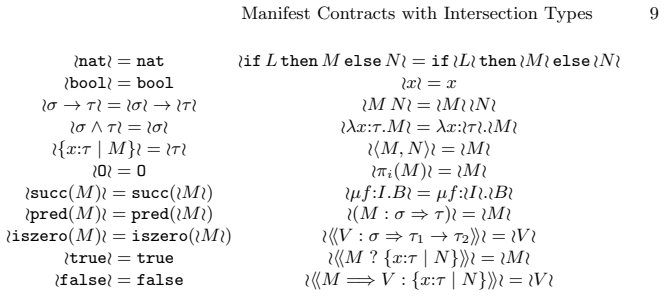
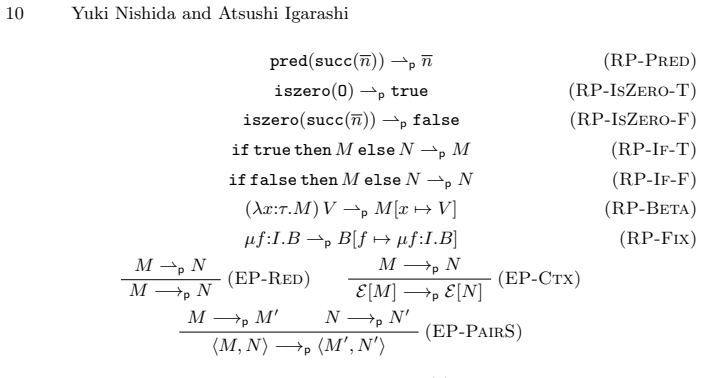
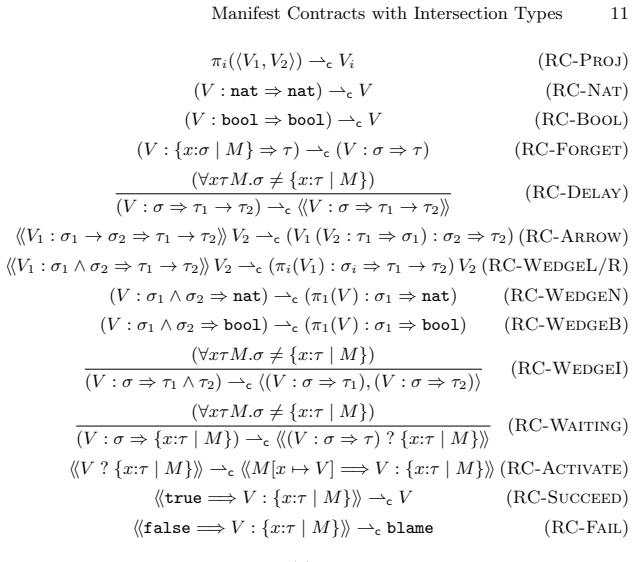
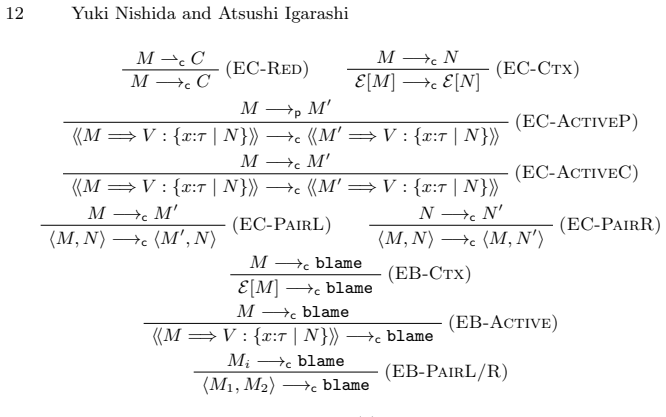
The central object is the essence $\wr M\wr$ of a term: the PCFv program obtained by erasing refinement predicates, casts, and strong-pair structure. The rules are arranged so that dynamic-checking steps never change the essence, while essential steps mirror PCFv reduction; rule (EP-PairS) synchronizes essential reductions inside a strong pair because the two halves must keep the same essence. Alongside the essence are three run-time forms—delayed checks $\langle\langle V:\sigma\Rightarrow\tau_1\to\tau_2\rangle\rangle$, waiting checks $\langle\langle M?\{x:\tau\mid N\}\rangle\rangle$, and active checks $\langle\langle M\Rightarrow V:\{x:\tau\mid N\}\rangle\rangle$—which carry out higher-order cast application, predicate evaluation, and the final success or failure decision. The side condition $\wr\sigma\wr = \wr\tau\wr$ on intersection formation and casts is what keeps the system coherent: it makes the essence of a strong pair well-defined and supplies the compatibility condition that casts must respect.
What would settle it
Find a closed, well-typed PCFvΔH term that is a value of $\{x:\tau\mid M\}$ but whose predicate $M[x:=V]$ does not reduce to true, or a closed, well-typed term that is neither a value nor able to take an essential or checking step. The Section 4 theorems assert that neither exists under the paper's rules; a reader could search for such a term by testing casts between intersection types that violate the side condition $\wr\sigma\wr = \wr\tau\wr$, where the proof's machinery is no longer available.
Extended reading notes
Core claim
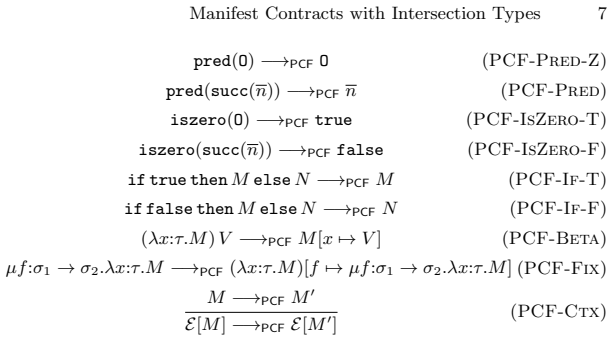
PCFvΔH is call-by-value PCF extended with refinement types $\{x:\tau\mid M\}$, intersection types $\sigma\wedge\tau$, and casts $(M:\sigma\Rightarrow\tau)$. The new device is a relaxed strong pair: a value of $\sigma\wedge\tau$ is a pair $\langle M,N\rangle$ whose components are required only to have the same essence $\wr M\wr = \wr N\wr$, where the essence erases casts, refinement predicates, and pairing structure. This lets one piece of code be typed in different ways while carrying different run-time checks. Casts into an intersection split into a pair of casts; casts out of an intersection into a function type are delayed as wrapped values so the branch choice is postponed until an argument arrives; casts out of an intersection into a first-order type pick the left side. The main theorems are preservation and progress (type soundness), value inversion (a value of $\{x:\tau\mid M\}$ satisfies $M$), and essential equivalence (a well-typed step from $M$ to $N$ implies $\wr M\wr$ reduces to $\wr N\wr$ in PCFv). The consequence stated in the paper is that an intersection type can be read as a finite conjunction of contracts, each individually guaranteed for the corresponding component of a strong-pair value.
Load-bearing premise
The proof assumes intersection types are refinement intersections, so any well-formed intersection $\sigma\wedge\tau$ must have $\wr\sigma\wr = \wr\tau\wr$, and it assumes away dependent function types; if either restriction is dropped, the essence of a strong pair and the compatibility condition on casts stop being well-defined.
Editorial extensions
If this is right
- A well-typed closed program cannot get stuck: it is either a value, takes a step, or reaches blame (Progress, Theorem 4).
- If $\vdash V : \{x:\tau\mid M\}$, then the predicate holds: $M[x:=V]\to^* \mathsf{true}$ (Value Inversion, Theorem 3).
- If $\vdash M : \tau$ and $M\to N$, then the essence reduces in PCFv: $\wr M\wr \to^*_{\mathrm{PCF}} \wr N\wr$, so run-time checking never affects the essential computation (Theorem 1).
- A value of an intersection of refinement types satisfies each conjunct; for first-order values, the same erased value satisfies all the predicates in the conjunction (Remark 1).
- By construction the calculus extends call-by-value PCF conservatively, so existing PCFv programs keep their essential behavior.
Reading between the lines
- Beyond the paper: dropping the same-essence side condition would break the strong-pair synchronization rule (EP-PairS), so any generalization to arbitrary intersections needs a new invariant in place of essence equality.
- A practical reading is that checking can be made exhaustive rather than nondeterministic; one extension is to label casts and try alternative projections, then verify that preservation and progress survive.
- The essence/checking separation points to an optimizing compiler: value inversion certifies which predicates hold, so those casts can be erased; a testable extension would introduce a proof-carrying erased-cast form.
Signed reviews
Editorial analysis
A structured set of objections, weighed in public.
Referee Report
Summary. The paper presents PCFv∆H, a manifest contract calculus with refinement intersection types built on the ∆-calculus. Its central design moves are the relaxation of strong pairs so that the two components coincide up to type annotations and casts, and a nondeterministic dynamic-checking semantics for casts involving intersection types. The paper claims four metatheorems: essential equivalence (Theorem 1), preservation (Theorem 2), value inversion (Theorem 3), and progress (Theorem 4), with the proofs sketched in Section 4 and a Coq mechanization stated to be available externally. The abstract's headline claim is that run-time checking does not affect essential computation.
Significance. If the stated results are correct, the paper makes a genuine contribution: it shows how to integrate refinement intersection types into a manifest contract calculus, it gives a clean solution to the contextual-runtime-checking problem via strong pairs and delayed casts, and it separates essential evaluation from dynamic checking in a way that is useful for hybrid type checking. The claimed Coq mechanization is a notable strength, and the paper is honest about the restrictions it imposes: refinement intersections with equal essences, no dependent function types, and successful-path-only information. However, the current statement of the central equivalence theorem is not well-formed for blame steps, and a related issue affects the printed preservation theorem; both require a formal repair rather than a change of ideas.
major comments (3)
- [Section 3.3 and Theorem 1; Figure 4] Theorem 1 as stated is not well-formed for blame steps. The relation −→ is defined as −→p ∪ −→c, and −→c can produce the command blame, for example through (RC-Fail). The essence function in Figure 4 is defined only on expressions, not on commands, so when M −→ N with N = blame, the right-hand side ≀N≀ is undefined. This case is not vacuous: the well-typed expression (0 : nat ⇒ {x:nat | x>0}) is typable by (T-Cast) and reduces via (RC-Waiting), (RC-Activate), and (RC-Fail) to blame. The theorem should be restricted to expressions and to successful evaluation steps, or the essence function and the statement must be extended to blame; the abstract's 'run-time checking does not affect essential computation' should carry the same caveat. Section 6 already acknowledges that the theory gives useful information only for successful evaluation paths, which confirms the intended repair.
- [Section 4.1, Theorem 2] The preservation theorem has the same well-formedness defect as Theorem 1. Since the typing judgment Γ ⊣ M : τ is defined only for expressions, the conclusion ⊣ N : τ is not syntactically meaningful when N is the command blame. Because −→ includes −→c and well-typed expressions can reduce to blame, the theorem as printed is either false or ill-typed in that case. The statement should be repaired by restricting to non-blame results and formulating preservation for successful reduction paths, or by extending the type system to commands/blame in an explicit way (for example, by allowing a typing judgment for blame), and then checking that the other theorems remain consistent with that choice.
- [Section 4, Lemmas 2 and 3; Theorem 1 proof sketch] The proof sketches for Lemmas 2 and 3 are extremely compressed: Lemma 3 is stated as 'the proof is by induction on the given evaluation derivation' without indicating which cases are nontrivial. In particular, the proof must explicitly handle the side condition in (EP-PairS) and the nondeterministic rules (RC-WedgeL/R), and it must state the domain restriction needed to avoid blame. The Coq mechanization may fill these gaps, but the printed proof sketch should state the intended repair to Theorem 1 and indicate how the induction covers the strong-pair synchronization case.
minor comments (3)
- [Section 2.2, example around Mcast] The example using Mcast does not specify the value V that is cast; the exposition would be clearer if V were named or instantiated, since the correctness of the example depends on V having both even→nat and odd→nat behavior.
- [General presentation] There are a few typos and formatting issues, including 'devision' in the introduction and the inconsistent use of backquotes around succ′ in Section 1.2; these should be cleaned up during revision.
- [Section 4, Theorem 4 proof] The proof of Progress says that 'most cases can be proven as usual' and that one case follows by contradiction because the essence of a PCFv∆H value is a PCFv value in normal form. This is plausible, but the argument should be written out a little more explicitly, especially for the strong-pair case, since the synchronization in (EP-PairS) is a central and unusual feature.
Circularity Check
No significant circularity: the Section 4 metatheorems are proved from the Section 3 definitions, and self-citations are background design ingredients rather than load-bearing evidence.
full rationale
The load-bearing claims are the Section 4 metatheorems: Preservation (Theorem 2), Progress (Theorem 4), Value Inversion (Theorem 3), and Essential Equivalence (Theorem 1). These are derived from the inductively defined typing and evaluation relations of Section 3, not assumed from a prior paper. Theorem 2 is proved by induction on the typing derivation, Theorem 4 by induction on typing with Lemma 2 used for the strong-pair case, and Theorem 3 follows from Lemma 5 by induction on the value typing derivation. The essence side-condition eqv(σ)=eqv(τ) in (W-Wedge) and (T-Pair) is an input design restriction, whereas Lemmas 2 and 3 derive preservation of essence under essential and dynamic evaluation by case analysis on the reduction rules; the essence function is fixed independently in Fig. 4 and is not fitted to force the theorem. Self-citations appear, e.g., the non-intersection cast rules are 'adopted from Sekiyama et al. [26]', but those citations supply design ingredients rather than the central soundness results, and the paper states that the whole system including proofs is mechanized in Coq. The only notable caveat is a formal precision issue, not circularity: Theorem 1 as printed ranges over all reduction steps including steps to blame, while essence is undefined on blame; Section 6 explicitly limits the theoretical result to 'successful evaluation paths.' That limitation is a scope/correctness caveat, not a reduction of the derivation to its own input.
Assumptions & free parameters
assumptions (3)
- standard math Structural induction and capture-avoiding substitution are standard for the term language.
- domain assumption Terms are identified up to α-equivalence, and the mechanization uses locally nameless representation with cofinite quantification.
- ad hoc to paper Only refinement intersection types with equal essences are well-formed, and dependent function types are absent.
Cite this review
Pith. "Pith review of Manifest Contracts with Intersection Types." pith.science (2026). https://pith.science/paper/V3CXD52P
@misc{pith2026190803010,
  author       = {Pith},
  title        = {Pith review of: Manifest Contracts with Intersection Types},
  year         = {2026},
  howpublished = {\url{https://pith.science/paper/V3CXD52P}},
  note         = {Machine review of arXiv:1908.03010}
}
abstract
We present a manifest contract system PCFv$\Delta$H with intersection types. A manifest contract system is a typed functional calculus in which software contracts are integrated into a refinement type system and consistency of contracts is checked by combination of compile- and run-time type checking. Intersection types naturally arise when a contract is expressed by a conjunction of smaller contracts. Run-time contract checking for conjunctive higher-order contracts in an untyped language has been studied but our typed setting poses an additional challenge due to the fact that an expression of an intersection type $\tau_1 \wedge \tau_2$ may have to perform different run-time checking whether it is used as $\tau_1$ or $\tau_2$. We build PCFv$\Delta$H on top of the $\Delta$-calculus, a Church-style intersection type system by Liquori and Stolze. In the $\Delta$-calculus, a canonical expression of an intersection type is a strong pair, whose elements are the same expressions except for type annotations. To address the challenge above, we relax strong pairs so that expressions in a pair are the same except for type annotations and casts, which are a construct for run-time checking. We give a formal definition of PCFv$\Delta$H and show its basic properties as a manifest contract system: preservation, progress, and value inversion. Furthermore, we show that run-time checking does not affect essential computation.
Figures


Figures from the paper (7 more)


Reference graph
Works this paper leans on
- [1]
- [2]
-
[3]
PACMPL 1(ICFP), 41:1–41:28 (2017) Manifest Contracts with Intersection Types 19
Castagna, G., Lanvin, V.: Gradual typing with union and intersection types. PACMPL 1(ICFP), 41:1–41:28 (2017) Manifest Contracts with Intersection Types 19
work page 2017
-
[4]
Castagna, G., Lanvin, V., Petrucciani, T., Siek, J.G.: Gradual typing: A new perspective. Proc. ACM Program. Lang. 3(POPL), 16:1–16:32 (Jan 2019)
work page 2019
-
[5]
Chargu´ eraud, A.: The locally nameless representation. J. Autom. Reasoning 49(3), 363–408 (2012)
work page 2012
-
[6]
Coppo, M., Dezani-Ciancaglini, M., Venneri, B.: Functional characters of solvable terms. Math. Log. Q. 27(2-6), 45–58 (1981)
work page 1981
- [7]
- [8]
Show all 33 references
-
[9]
Findler, R.B., PLT: DrRacket: Programming environment. Tech. Rep. PLT-TR- 2010-2, PLT Design Inc. (2010), https://racket-lang.org/tr2/
2010
-
[10]
In: Proc
Flanagan, C.: Hybrid type checking. In: Proc. of POPL. pp. 245–256 (2006)
2006
-
[11]
In: Proc
Greenberg, M.: Space-efficient manifest contracts. In: Proc. of POPL. pp. 181–194 (2015)
2015
-
[12]
In: Proc
Greenberg, M., Pierce, B.C., Weirich, S.: Contracts made manifest. In: Proc. of POPL. pp. 353–364 (2010)
2010
-
[13]
In: Scheme and Functional Programming Workshop
Gronski, J., Knowles, K., Tomb, A., Freund, S.N., Flanagan, C.: Sage: Hybrid check- ing for flexible specifications. In: Scheme and Functional Programming Workshop. pp. 93–104 (2006)
2006
-
[14]
In: Proc
Keil, M., Thiemann, P.: Blame assignment for higher-order contracts with intersec- tion and union. In: Proc. of ICFP. pp. 375–386 (2015)
2015
-
[15]
ACM Trans
Knowles, K., Flanagan, C.: Hybrid type checking. ACM Trans. Program. Lang. Syst. 32(2), 6:1–6:34 (2010)
2010
-
[16]
In: Proc
Kobayashi, N., Sato, R., Unno, H.: Predicate abstraction and CEGAR for higher- order model checking. In: Proc. of PLDI. pp. 222–233 (2011)
2011
-
[17]
In: Proc
Liquori, L., Stolze, C.: The ∆-calculus: Syntax and types. In: Proc. of FSCD. pp. 28:1–28:20 (2018)
2018
-
[18]
Prentice-Hall (1997)
Meyer, B.: Object-Oriented Software Construction, 2nd Edition. Prentice-Hall (1997)
1997
-
[19]
In: Proc
Nishida, Y., Igarashi, A.: Nondeterministic manifest contracts. In: Proc. of PPDP. pp. 16:1–16:13 (2018)
2018
-
[20]
Plotkin, G.D.: LCF considered as a programming language. Theor. Comput. Sci. 5(3), 223–255 (1977)
1977
-
[21]
Pottinger, G.: A type assignment for the strongly normalizabile λ-terms. To H. B. Curry, Essays in Combinatory Logic, Lambda-Calculus and Formalism pp. 561–577 (1980)
1980
-
[22]
Reynolds, J.C.: Preliminary design of the programming language Forsythe. Tech. Rep. CMU-CS-88-159, Carnegie Mellon University (1988)
1988
-
[23]
In: Proc
Rondon, P.M., Kawaguchi, M., Jhala, R.: Liquid types. In: Proc. of PLDI. pp. 159–169 (2008)
2008
-
[24]
In: Proc
Sekiyama, T., Igarashi, A.: Stateful manifest contracts. In: Proc. of POPL. pp. 530–544 (2017)
2017
-
[25]
ACM Trans
Sekiyama, T., Igarashi, A., Greenberg, M.: Polymorphic manifest contracts, revised and resolved. ACM Trans. Program. Lang. Syst. 39(1), 3:1–3:36 (2017)
2017
-
[26]
In: Proc
Sekiyama, T., Nishida, Y., Igarashi, A.: Manifest contracts for datatypes. In: Proc. of POPL. pp. 195–207 (2015)
2015
-
[27]
In: Proc
Terauchi, T.: Dependent types from counterexamples. In: Proc. of POPL. pp. 119–130 (2010)
2010
-
[28]
In: Proc
Unno, H., Kobayashi, N.: Dependent type inference with interpolants. In: Proc. of PPDP. pp. 277–288 (2009) 20 Yuki Nishida and Atsushi Igarashi
2009
-
[29]
Valentini, S.: An elementary proof of strong normalization for intersection types. Arch. Math. Log. 40(7), 475–488 (2001)
2001
-
[30]
In: Proc
Vazou, N., Seidel, E.L., Jhala, R., Vytiniotis, D., Peyton-Jones, S.: Refinement types for Haskell. In: Proc. of ICFP. pp. 269–282 (2014)
2014
-
[31]
In: Proc
Wadler, P., Findler, R.B.: Well-typed programs can’t be blamed. In: Proc. of ESOP. pp. 1–16 (2009)
2009
-
[32]
Williams, J., Morris, J.G., Wadler, P.: The root cause of blame: Contracts for intersection and union types. Proc. ACM Program. Lang. 2(OOPSLA), 134:1– 134:29 (Oct 2018)
2018
-
[33]
In: Proc
Zhu, H., Jagannathan, S.: Compositional and lightweight dependent type inference for ML. In: Proc. of VMCAI. pp. 295–314 (2013)
2013
Reviewed August 14, 2026 · model on record in the stance chip above.
Discussion (0). Continue with ORCID to comment.