REVIEW 4 major objections 4 minor 1 cited by
Exploring the M-dwarf Luminosity--Temperature--Radius Relationships using Gaia DR2
T0 review · 4 major / 4 minor · reviewed 2026-08-14 · deepseek-v4-flash
Pith's one-line read M-dwarf radii are inflated by 3–7% relative to theoretical models, and the inflated sequence is intrinsically tight, with less than 1–2% spread.
desk verdict Large homogeneous M-dwarf radius sample with a solid core; the tight intrinsic-spread claim leans on a model-dependent correction, and the printed Eq. 4 has a sign error that needs fixing. read the letter →
The pith
A machine-rendered reading of the paper's core claim, the machinery that carries it, and where it could break.
The reading
What carries the argument
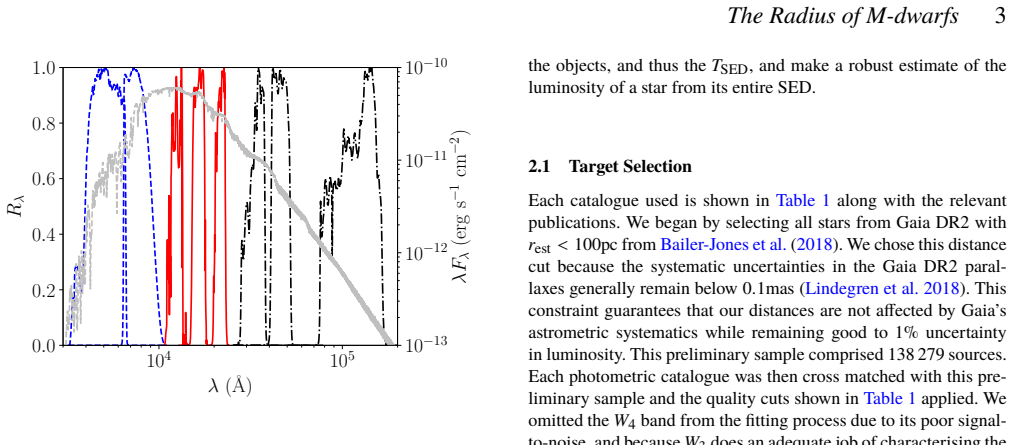
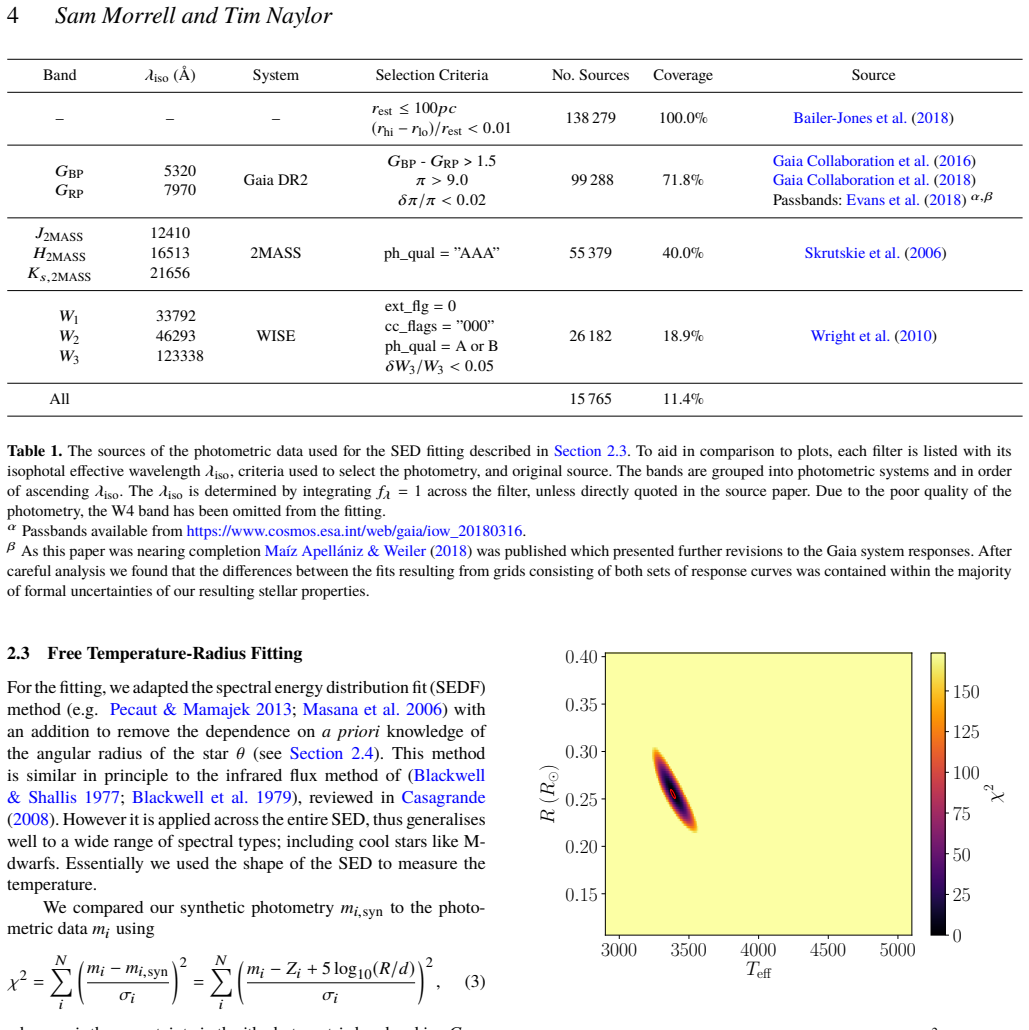
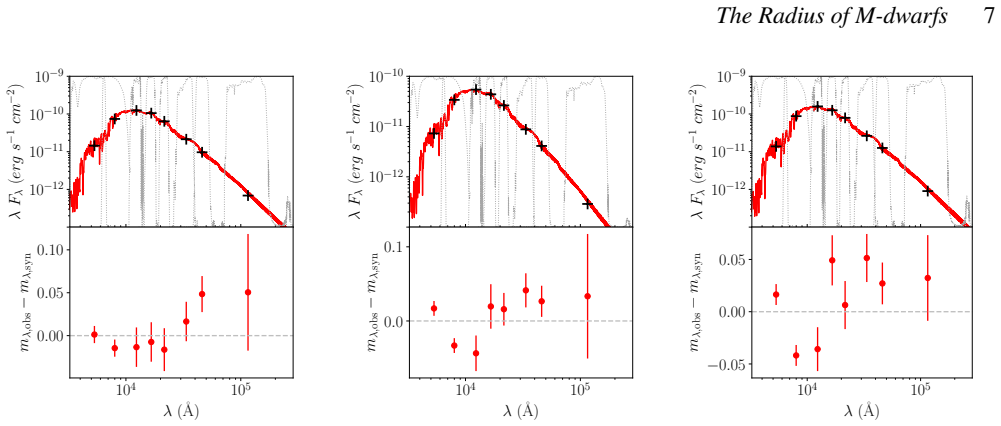
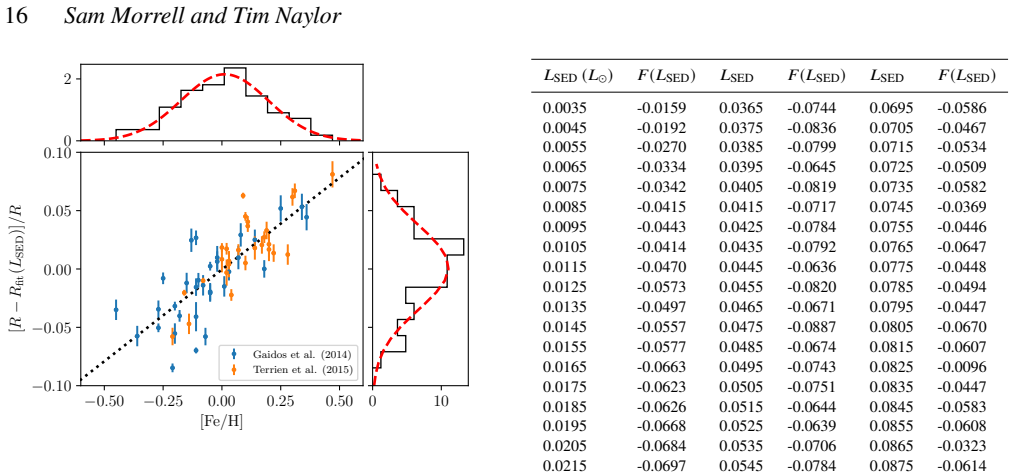
The load-bearing object is the modified spectral energy distribution fit. Synthetic photometry is produced by folding the BT-Settl CIFIST model-atmosphere grid through the Gaia, 2MASS, and AllWISE passbands; the shape of the eight-band SED fixes $T_{\rm SED}$ and $\log(g)$, while the radius is obtained analytically from the dilution factor that minimises $\chi^2$: $\log_{10}(R^2/d^2) = -0.4\,(\sum_i (Z_i-m_i)/\sigma_i^2)/(\sum_i 1/\sigma_i^2)$, with $d$ from Bailer-Jones et al. (2018). Because the fit acts only on the photosphere, it does not assume an interior model, which is what allows the paper to confront interior models with data. Two additional interpolated metallicity grids ($[{\rm M/H}]=\pm 0.25$) provide the correction $F(L_{\rm SED})\,[{\rm Fe/H}]$ that removes the apparent metallicity–radius correlation and reduces the radius scatter to 2.4%.
What would settle it
Interferometric radii for the same stars, derived from Gaia distances and compared band-by-band with the SED-fitted radii, would settle the claim: if the two radius scales disagree by more than the quoted 2.4% in a temperature-dependent way, the model-atmosphere temperature scale is implicated rather than a physical inflation.
Extended reading notes
Core claim
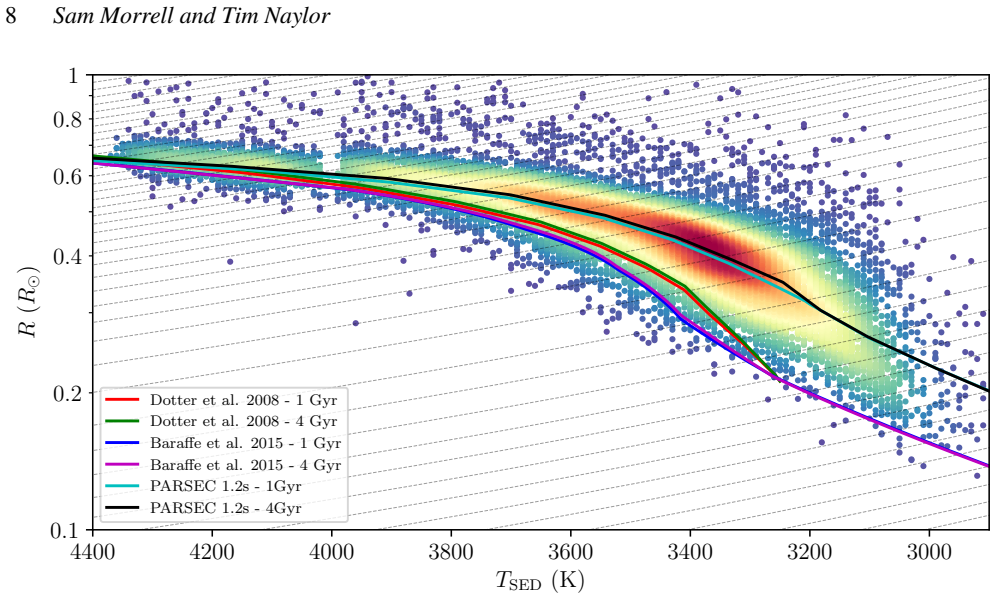
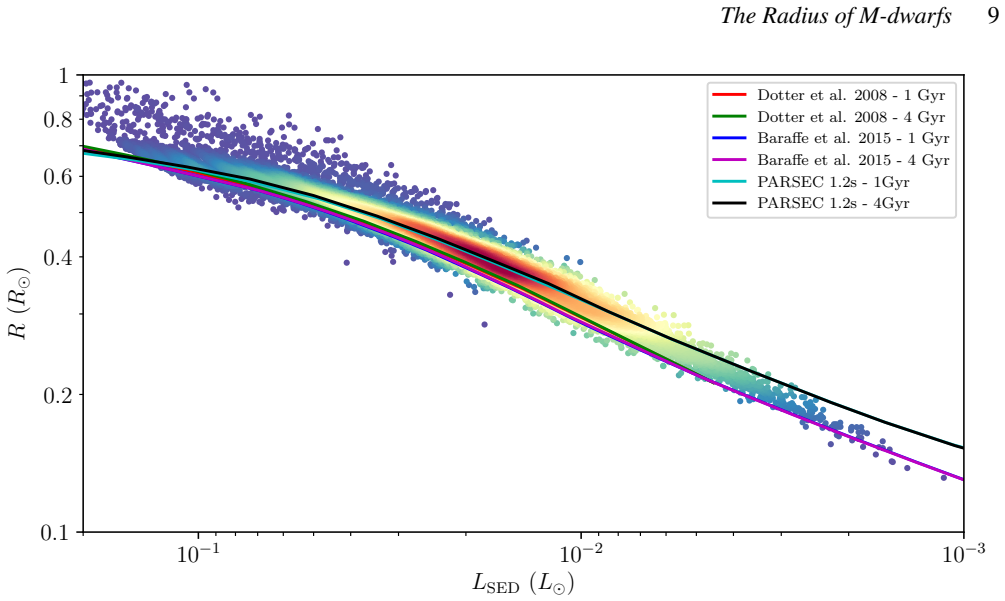
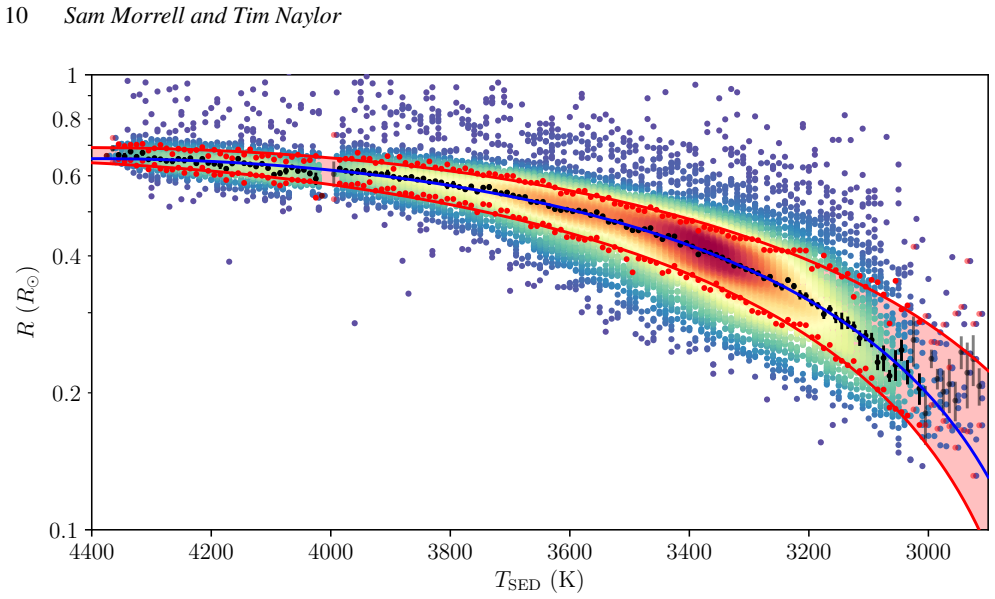
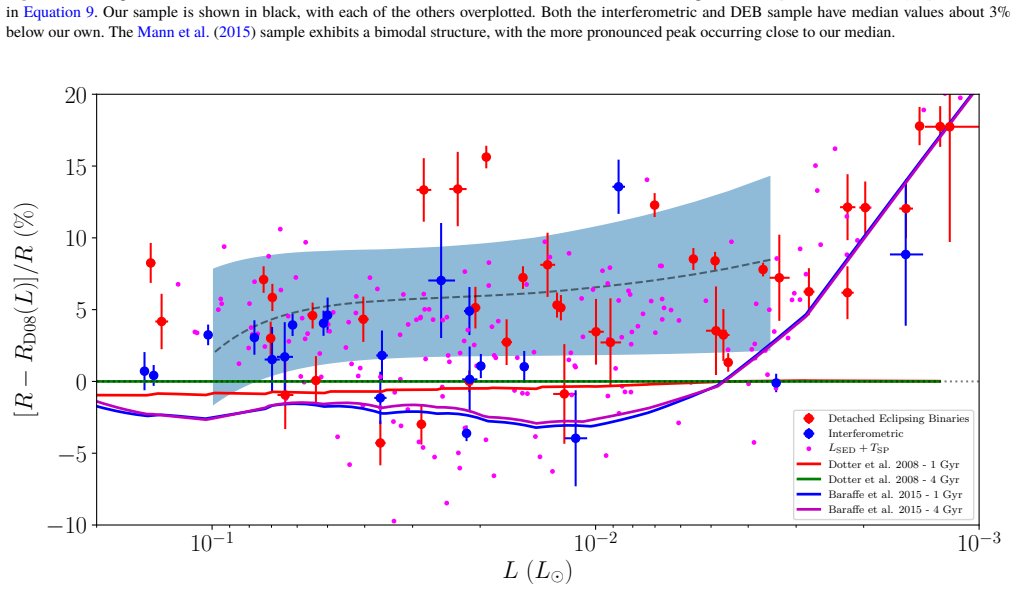
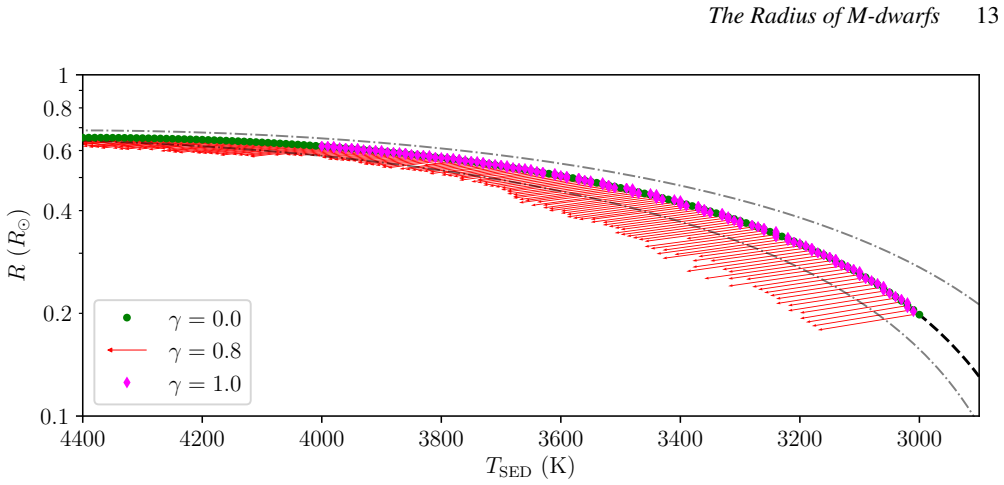
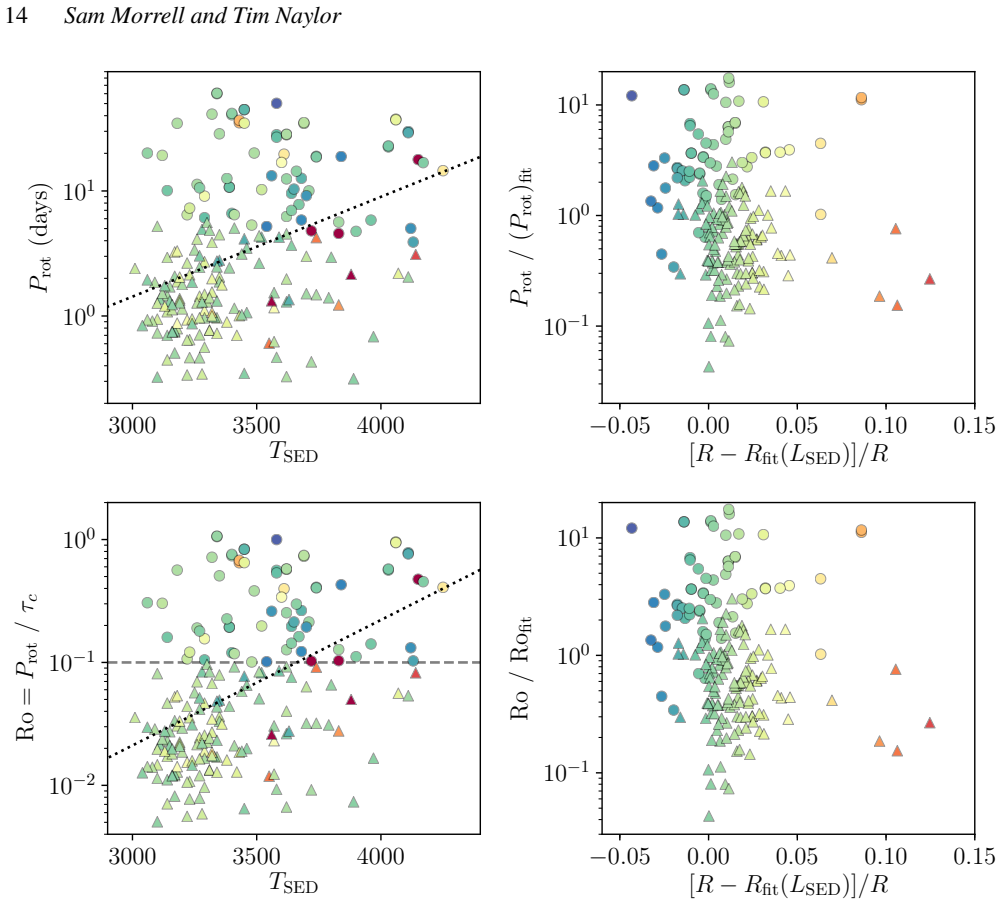
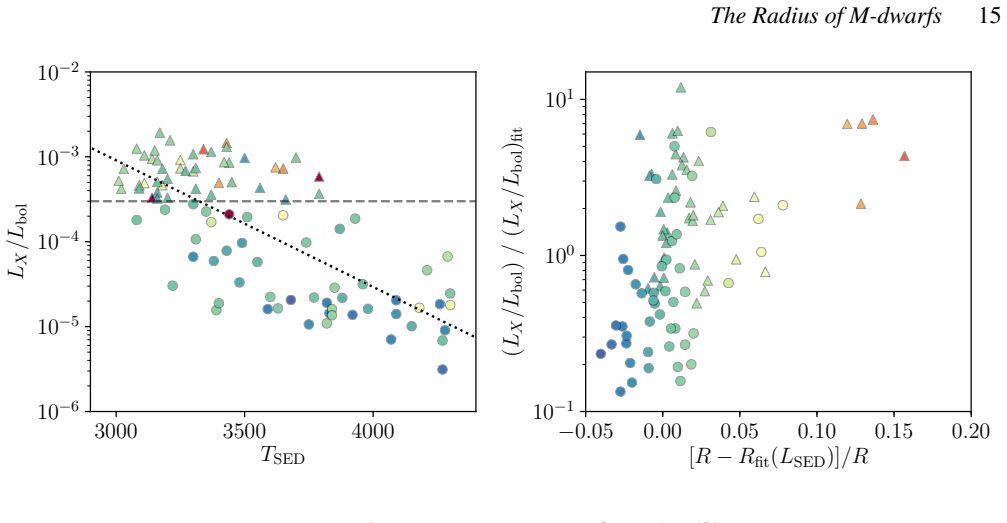
The central claim is that main-sequence M-dwarfs do not match the radii of purely theoretical models: at fixed luminosity, the measured radii are larger by 3–7%, while the empirical PARSEC 1.2S models, which adopt an observationally calibrated temperature–optical-depth relation, trace the inflated sequence. The paper also claims that the inflated sequence is remarkably coherent, with an intrinsic scatter no larger than 1–2%, after accounting for a ~1.7% radius scatter introduced by metallicity measurement uncertainties and the ~1.6% fitting uncertainty. This tightness, plus the lack of correlation between radius residual and rotation period, Rossby number, X-ray luminosity, or H-$\alpha$ activity, leads the authors to conclude that stellar magnetism is currently unable to explain the inflation. The fitted sample yields empirical $R(T_{\rm SED})$ and $R(L_{\rm SED})$ relations, with the luminosity–radius relation expressed as a correction to the Dotter et al. (2008) solar-metallicity isochrone.
Load-bearing premise
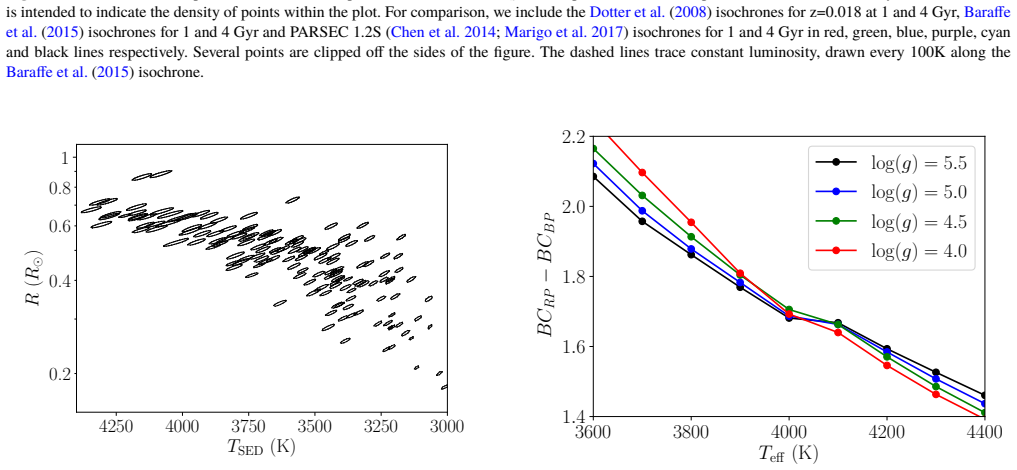
The method trusts that the synthetic model atmospheres predict correct relative fluxes across the eight photometric bands; if they do not—and the paper itself flags a 4000 K discontinuity in the CIFIST grid—the fitted temperatures and radii, and hence the inflation and tightness claims, would shift.
Editorial extensions
If this is right
- Exoplanet transit radii around M-dwarfs could be measured to roughly 2% accuracy from archival photometry plus a metallicity measurement, without new spectra or eclipses.
- Stellar evolution codes that predict smaller radii below 4000 K are missing physics; the empirical $R(L_{\rm SED})$ relation gives them a quantitative target.
- Magnetic inflation models, which predict a spread of radii at fixed mass or luminosity, are constrained to saturate at rotation rates slower than the slowest rotators in the sample if they are to survive.
- The previously reported correlation between M-dwarf radius and metallicity at fixed luminosity is reinterpreted as a fitting artifact of solar-metallicity atmospheres, not a physical structural effect.
- The dominant source of error in M-dwarf radii becomes the precision of metallicity measurements, redirecting effort toward better stellar metallicities.
Reading between the lines
- A reader could test the atmosphere dependence directly: cross-calibrating these SED-fitted radii against interferometric radii for the same stars would expose any temperature-scale bias hidden in the 3–7% inflation claim.
- The 4000 K discontinuity in the CIFIST grid could be used as a natural experiment—comparing bolometric corrections across that gap with independent spectrophotometry would tell whether the gap is a model artifact or a real spectral feature.
- The paper's tight-sequence result implies that spot coverage must be strikingly uniform across M-dwarfs; measuring spot filling factors from rotational light curves of stars spanning the same $T_{\rm SED}$ range would test whether that homogeneity is real.
- The metallicity-correction calibration, built here from two literature samples, could be extended to larger spectroscopic surveys with higher-precision metallicities, which would show whether the 1.7% metallicity-limited scatter is a floor or an artefact of those catalogues.
Signed reviews
Editorial analysis
A structured set of objections, weighed in public.
Referee Report
Summary. This paper develops a spectral energy distribution (SED) fitting method to measure effective temperatures and radii for 15,274 M-dwarfs within 100 pc using Gaia DR2 parallaxes and multi-band photometry (Gaia BP/RP, 2MASS, WISE). The method uses BT-Settl CIFIST model atmospheres to fit the shape of the SED and the dilution factor, with a log(g) prior from Baraffe et al. isochrones. The authors derive empirical TSED-R and LSED-R relations, find radii inflated by 3-7% relative to theoretical isochrones, argue that the intrinsic scatter in the inflated sequence is at most 1-2%, and conclude that magnetic activity is unlikely to explain the inflation. They also provide metallicity-dependent corrections and discuss practical strategies for measuring accurate M-dwarf radii.
Significance. The paper provides the largest homogeneous sample of M-dwarf radii to date and offers a method that can be applied to any star with photometry and a parallax. The derived empirical relations are valuable for exoplanet host star characterization and for testing stellar structure models. The paper is transparent about many systematic checks (spot simulations, contamination, activity correlations) and makes the full catalogue publicly available, which is a strength. The main claims, if confirmed, would significantly constrain the radius inflation mechanism and provide falsifiable predictions that can be tested with future data.
major comments (4)
- [2.4, Eq. (4)] Equation (4) has a sign error. Minimizing χ² = Σ((m_i - Z_i + x)²/σ_i²) over x = 5 log10(R/d) gives x = +Σ((Z_i - m_i)/σ_i²)/Σ(1/σ_i²), so log10(R²/d²) = +0.4 Σ((Z_i - m_i)/σ_i²)/Σ(1/σ_i²). The printed equation has a minus sign. If the analysis code followed the printed equation, the fitted dilution factors—and hence all radii—would be systematically inverted. Please verify the sign in the code and correct Equation (4).
- [4.2.5] The claim of a tight intrinsic sequence with scatter below 1-2% is an upper limit rather than a measured value. After applying the metallicity correction, the residual scatter is 2.4%, which equals the quadrature sum of the 1.6% radius uncertainty and the 1.7% metallicity-induced uncertainty, leaving no statistical budget for an intrinsic spread. The paper should present this as an upper limit (as it does in the text 'at most 1-2%') and avoid stating in the abstract and conclusions that the spread is 'no more than' a measured quantity. In addition, F(LSED) in Equation (16) is computed from the same BT-Settl AGSS2009 atmosphere family used for the fits; if those atmospheres have systematic flux errors, the correction and the resulting tight-sequence conclusion are biased. A sensitivity test with an independent atmosphere grid would significantly strengthen this claim.
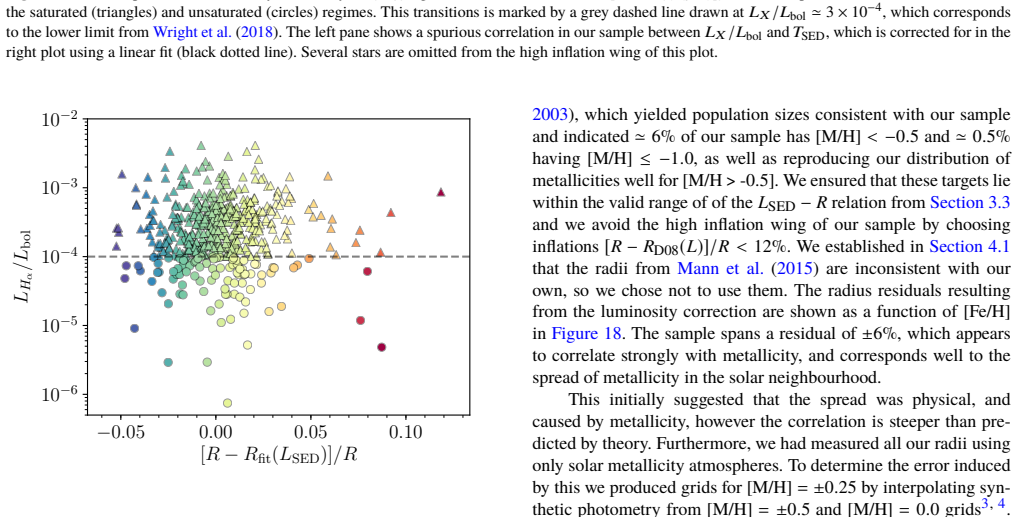
- [4.2.4] The correlations with activity indicators are performed on radius residuals [R−Rfit(LSED)]/R that have not been corrected for metallicity. Figure 18 shows that these uncorrected residuals span ±6% as a function of [Fe/H], so the metallicity-induced scatter can dilute any genuine activity-radius correlation. The authors should re-run these correlation tests on metallicity-corrected radii (Equation 16) or include [Fe/H] as a covariate in the regression before concluding that no correlation exists.
- [2.3] The uncertainty estimates are based on the full 3D grid search for only 158 stars (1% of the sample), and this characteristic uncertainty is then applied to all stars. While this is a reasonable approximation, the paper should explicitly state that this assumes the uncertainty distribution of the 1% subsample is representative of the entire sample, and it should provide some evidence (e.g., a comparison of the distributions of photometric quality or fitted parameters) that this representative assumption holds.
minor comments (4)
- [Abstract] The phrase 'no more than a 1-2% intrinsic spread' should be phrased as 'an upper limit of 1-2%' to reflect the fact that the intrinsic spread is not directly measured but rather bounded by the uncertainty budget.
- [2.2 and throughout] The paper switches between TSED and Teff in the text and figures; for clarity, define TSED as the SED-derived effective temperature and use it consistently, and note explicitly that TSED is assumed equal to the physical Teff.
- [Figure 6] The caption should note that the 68% confidence contours are based on the randomly selected 1% subsample, as stated in the text, so that readers do not infer that these are per-star uncertainties for the full sample.
- [4.2.3] The spot simulation adopts a fixed spot temperature ratio Tspot = 0.8 Timac; the conclusion that spots can reproduce the observed scatter may depend on this choice, and a brief discussion of how varying this ratio affects the results would be useful.
Circularity Check
No circularity found: the radius scale is anchored by external DEB/interferometric comparisons, and the model-based metallicity correction is a forward-model robustness issue, not a by-construction identity.
full rationale
The derivation chain is self-contained. Radii are obtained from the SED dilution factor (Eqs. 2-4) combined with Gaia DR2 distances, not from the stellar-structure models being tested; T_SED comes from the SED shape and L_SED from integrated photometry plus distance. The log(g) tophat prior uses Baraffe et al. (2015) isochrones that also appear in the comparison plots, but this is a weak prior (±0.5 dex) and does not define the radius; the method is validated against external DEB and interferometric samples (Figs. 12-13), so the central inflation claim has independent support. The metallicity correction F(L_SED) in Sec. 4.2.5 is computed by forward-fitting the same BT-Settl/AGSS2009 atmosphere grids, not by fitting the target residual; after applying it, the 2.4% scatter is compared with the quadrature sum of independent radius (1.6%) and metallicity (1.7%) uncertainties. The resulting '<1-2% intrinsic spread' is therefore an error-budget inference, not a quantity that equals an input by construction. The Wilson & Naylor (2017, 2018) self-citations are used only to assess WISE contamination and are not load-bearing. The sign error in Eq. (4) is a correctness concern outside the scope of circularity analysis, since it does not make any predicted quantity equivalent to a fitted input.
Assumptions & free parameters
free parameters (3)
- Photometric uncertainty floor =
0.01 mag
- log(g) prior width =
±0.5 dex
- Spot temperature ratio =
T_spot = 0.8 T_imac
assumptions (5)
- domain assumption BT-Settl CIFIST model atmospheres accurately reproduce the relative broad-band fluxes of M-dwarfs for given Teff and log(g).
- domain assumption Extinction is negligible for stars within 100 pc.
- domain assumption Gaia DR2 systematics are below 0.1 mas and Bailer-Jones et al. (2018) distances are unbiased.
- domain assumption The Baraffe et al. (2015) isochrone provides a reliable log(g) range for M-dwarfs.
- domain assumption Comparison models (Dotter et al., Baraffe et al., PARSEC) are valid representations of M-dwarf structure.
Cite this review
Pith. "Pith review of Exploring the M-dwarf Luminosity--Temperature--Radius Relationships using Gaia DR2." pith.science (2026). https://pith.science/paper/TQNHOTXY
@misc{pith2026190803025,
  author       = {Pith},
  title        = {Pith review of: Exploring the M-dwarf Luminosity--Temperature--Radius Relationships using Gaia DR2},
  year         = {2026},
  howpublished = {\url{https://pith.science/paper/TQNHOTXY}},
  note         = {Machine review of arXiv:1908.03025}
}
abstract
There is growing evidence that M-dwarf stars suffer radius inflation when compared to theoretical models, suggesting that models are missing some key physics required to completely describe stars at effective temperatures $(T_{\rm SED})$ less than about 4000K. The advent of Gaia DR2 distances finally makes available large datasets to determine the nature and extent of this effect. We employ an all-sky sample, comprising of $>$15\,000 stars, to determine empirical relationships between luminosity, temperature and radius. This is accomplished using only geometric distances and multiwave-band photometry, by utilising a modified spectral energy distribution fitting method. The radii we measure show an inflation of $3 - 7\%$ compared to models, but no more than a $1 - 2\%$ intrinsic spread in the inflated sequence. We show that we are currently able to determine M-dwarf radii to an accuracy of $2.4\%$ using our method. However, we determine that this is limited by the precision of metallicity measurements, which contribute $1.7\%$ to the measured radius scatter. We also present evidence that stellar magnetism is currently unable to explain radius inflation in M-dwarfs.
Figures
Figures from the paper (15 more)



Forward citations
Cited by 1 Pith paper
-
Unstable magnetospheric accretion on the T Tauri star TW Hya
TW Hya’s large-scale field is a ~0.83 kG tilted dipole that varies yearly; accretion is unstable (rmag/rcor ≈ 0.33–0.40) and no close-in planet is detected above ~0.3–1 Mjup.
Reference graph
Works this paper leans on
-
[1]
M., 2012, in EAS Publications Series
Allard F., Homeier D., Freytag B., Sharp C. M., 2012, in EAS Publications Series. pp 3--43, @doi 10.1051/eas/1257001
arXiv 2012
-
[2]
Asplund M., Grevesse N., Sauval A. J., Scott P., 2009, @doi [ ] 10.1146/annurev.astro.46.060407.145222 , http://adsabs.harvard.edu/abs/2009ARA\
arXiv 2009
-
[3]
Astropy Collaboration et al., 2013, @doi [ ] 10.1051/0004-6361/201322068 , https://ui.adsabs.harvard.edu/\#abs/2013A&A...558A..33A 558, A33
-
[4]
Bailer-Jones C. A. L., Rybizki J., Fouesneau M., Mantelet G., Andrae R., 2018, preprint, http://adsabs.harvard.edu/abs/2018arXiv180410121B ( @eprint arXiv 1804.10121 )
arXiv 2018
-
[5]
Baraffe I., Homeier D., Allard F., Chabrier G., 2015, @doi [ ] 10.1051/0004-6361/201425481 , http://adsabs.harvard.edu/abs/2015A
-
[6]
Barentsen G., et al., 2014, @doi [ ] 10.1093/mnras/stu1651 , http://adsabs.harvard.edu/abs/2014MNRAS.444.3230B 444, 3230
-
[8]
Berdyugina S. V., 2005, @doi [Living Reviews in Solar Physics] 10.12942/lrsp-2005-8 , http://adsabs.harvard.edu/abs/2005LRSP....2....8B 2, 8
-
[9]
Berger D. H., et al., 2006, @doi [ ] 10.1086/503318 , http://adsabs.harvard.edu/abs/2006ApJ...644..475B 644, 475
Show all 98 references
-
[10]
E., Shallis M
Blackwell D. E., Shallis M. J., 1977, @doi [ ] 10.1093/mnras/180.2.177 , https://ui.adsabs.harvard.edu/abs/1977MNRAS.180..177B 180, 177
1977 doi
-
[11]
E., Shallis M
Blackwell D. E., Shallis M. J., Selby M. J., 1979, @doi [ ] 10.1093/mnras/188.4.847 , https://ui.adsabs.harvard.edu/abs/1979MNRAS.188..847B 188, 847
1979 doi
-
[12]
H., King J
Boone R. H., King J. R., Soderblom D. R., 2006, @doi [ ] 10.1016/j.newar.2006.06.002 , http://adsabs.harvard.edu/abs/2006NewAR..50..526B 50, 526
2006 doi
-
[13]
S., et al., 2012, @doi [ ] 10.1088/0004-637X/757/2/112 , http://adsabs.harvard.edu/abs/2012ApJ...757..112B 757, 112
Boyajian T. S., et al., 2012, @doi [ ] 10.1088/0004-637X/757/2/112 , http://adsabs.harvard.edu/abs/2012ApJ...757..112B 757, 112
2012 doi
-
[14]
S., Browning M
Brun A. S., Browning M. K., 2017, @doi [Living Reviews in Solar Physics] 10.1007/s41116-017-0007-8 , https://ui.adsabs.harvard.edu/abs/2017LRSP...14....4B 14, 4
2017 doi
-
[15]
Caffau E., Ludwig H.-G., Steffen M., Freytag B., Bonifacio P., 2011, @doi [ ] 10.1007/s11207-010-9541-4 , http://adsabs.harvard.edu/abs/2011SoPh..268..255C 268, 255
2011 doi
-
[16]
Casagrande L., 2008, @doi [Physica Scripta Volume T] 10.1088/0031-8949/2008/T133/014020 , https://ui.adsabs.harvard.edu/abs/2008PhST..133a4020C 133, 014020
2008 doi
-
[17]
G., Prasad N
Chaturvedi P., Sharma R., Chakraborty A., Anandarao B. G., Prasad N. J. S. S. V., 2018, @doi [ ] 10.3847/1538-3881/aac5de , http://adsabs.harvard.edu/abs/2018AJ....156...27C 156, 27
2018 doi
-
[18]
Chen Y., Girardi L., Bressan A., Marigo P., Barbieri M., Kong X., 2014, @doi [ ] 10.1093/mnras/stu1605 , http://adsabs.harvard.edu/abs/2014MNRAS.444.2525C 444, 2525
2014 doi
-
[19]
Cort \'e s-Contreras M., et al., 2017, @doi [ ] 10.1051/0004-6361/201629056 , http://adsabs.harvard.edu/abs/2017A
2017 doi
-
[20]
R., Saar S
Cranmer S. R., Saar S. H., 2011, @doi [ ] 10.1088/0004-637X/741/1/54 , https://ui.adsabs.harvard.edu/abs/2011ApJ...741...54C 741, 54
2011 doi
-
[21]
W., 2008, @doi [ ] 10.1086/589654 , http://adsabs.harvard.edu/abs/2008ApJS..178...89D 178, 89
Dotter A., Chaboyer B., Jevremovi \'c D., Kostov V., Baron E., Ferguson J. W., 2008, @doi [ ] 10.1086/589654 , http://adsabs.harvard.edu/abs/2008ApJS..178...89D 178, 89
2008 doi
-
[22]
T., et al., 2014, @doi [ ] 10.1088/0004-637X/795/2/161 , https://ui.adsabs.harvard.edu/abs/2014ApJ...795..161D 795, 161
Douglas S. T., et al., 2014, @doi [ ] 10.1088/0004-637X/795/2/161 , https://ui.adsabs.harvard.edu/abs/2014ApJ...795..161D 795, 161
2014 doi
-
[23]
E., et al., 2005, @doi [ ] 10.1111/j.1365-2966.2005.09330.x , http://adsabs.harvard.edu/abs/2005MNRAS.362..753D 362, 753
Drew J. E., et al., 2005, @doi [ ] 10.1111/j.1365-2966.2005.09330.x , http://adsabs.harvard.edu/abs/2005MNRAS.362..753D 362, 753
2005
-
[24]
E., et al., 2014, @doi [ ] 10.1093/mnras/stu394 , http://adsabs.harvard.edu/abs/2014MNRAS.440.2036D 440, 2036
Drew J. E., et al., 2014, @doi [ ] 10.1093/mnras/stu394 , http://adsabs.harvard.edu/abs/2014MNRAS.440.2036D 440, 2036
2014 doi
-
[25]
W., et al., 2018, @doi [ ] 10.1051/0004-6361/201832756 , http://adsabs.harvard.edu/abs/2018A
Evans D. W., et al., 2018, @doi [ ] 10.1051/0004-6361/201832756 , http://adsabs.harvard.edu/abs/2018A
2018 doi
-
[26]
A., Chaboyer B., 2013, @doi [ ] 10.1088/0004-637X/779/2/183 , http://adsabs.harvard.edu/abs/2013ApJ...779..183F 779, 183
Feiden G. A., Chaboyer B., 2013, @doi [ ] 10.1088/0004-637X/779/2/183 , http://adsabs.harvard.edu/abs/2013ApJ...779..183F 779, 183
2013 doi
-
[27]
Gaia Collaboration et al., 2016, @doi [ ] 10.1051/0004-6361/201629272 , https://ui.adsabs.harvard.edu/#abs/2016A&A...595A...1G 595
2016 doi
-
[28]
Gaia Collaboration Brown A. G. A., Vallenari A., Prusti T., de Bruijne J. H. J., Babusiaux C., Bailer-Jones C. A. L., 2018, preprint, https://ui.adsabs.harvard.edu/#abs/2018arXiv180409365G ( @eprint arXiv 1804.09365 )
2018 arXiv
-
[29]
Gaidos E., et al., 2014, @doi [ ] 10.1093/mnras/stu1313 , https://ui.adsabs.harvard.edu/\#abs/2014MNRAS.443.2561G 443, 2561
2014 doi
-
[30]
A., David T
Gillen E., Hillenbrand L. A., David T. J., Aigrain S., Rebull L., Stauffer J., Cody A. M., Queloz D., 2017, @doi [ ] 10.3847/1538-4357/aa84b3 , https://ui.adsabs.harvard.edu/abs/2017ApJ...849...11G 849, 11
2017 doi
-
[31]
Girardi L., Bertelli G., Bressan A., Chiosi C., Groenewegen M. A. T., Marigo P., Salasnich B., Weiss A., 2002, @doi [ ] 10.1051/0004-6361:20020612 , http://adsabs.harvard.edu/abs/2002A
2002 doi
-
[32]
Han E., et al., 2017, @doi [ ] 10.3847/1538-3881/aa803c , https://ui.adsabs.harvard.edu/abs/2017AJ....154..100H 154, 100
2017 doi
-
[33]
D., et al., 2018, @doi [ ] 10.3847/1538-3881/aaa844 , http://adsabs.harvard.edu/abs/2018AJ....155..114H 155, 114
Hartman J. D., et al., 2018, @doi [ ] 10.3847/1538-3881/aaa844 , http://adsabs.harvard.edu/abs/2018AJ....155..114H 155, 114
2018 doi
-
[34]
G., et al., 2015, @doi [ ] 10.1093/mnras/stu2680 , http://adsabs.harvard.edu/abs/2015MNRAS.448.1945H 448, 1945
He miniak K. G., et al., 2015, @doi [ ] 10.1093/mnras/stu2680 , http://adsabs.harvard.edu/abs/2015MNRAS.448.1945H 448, 1945
2015 doi
-
[35]
Higl J., Weiss A., 2017, @doi [ ] 10.1051/0004-6361/201731008 , http://adsabs.harvard.edu/abs/2017A
2017 doi
-
[36]
D., 2007, @doi [Computing in Science and Engineering] 10.1109/MCSE.2007.55 , https://ui.adsabs.harvard.edu/\#abs/2007CSE.....9...90H 9, 90
Hunter J. D., 2007, @doi [Computing in Science and Engineering] 10.1109/MCSE.2007.55 , https://ui.adsabs.harvard.edu/\#abs/2007CSE.....9...90H 9, 90
2007 doi
-
[37]
G., Browning M
Ireland L. G., Browning M. K., 2018, @doi [ ] 10.3847/1538-4357/aab3da , http://adsabs.harvard.edu/abs/2018ApJ...856..132I 856, 132
2018 doi
-
[38]
J., Jeffries R
Jackson R. J., Jeffries R. D., 2014, @doi [ ] 10.1093/mnras/stu651 , http://adsabs.harvard.edu/abs/2014MNRAS.441.2111J 441, 2111
2014 doi
-
[39]
J., Deliyannis C
Jackson R. J., Deliyannis C. P., Jeffries R. D., 2018, @doi [ ] 10.1093/mnras/sty374 , https://ui.adsabs.harvard.edu/abs/2018MNRAS.476.3245J 476, 3245
2018 doi
-
[40]
Jones E., Oliphant T., Peterson P., et al., 2001, SciPy : Open source scientific tools for Python , http://www.scipy.org/
2001
-
[41]
Y., Muirhead P
Kesseli A. Y., Muirhead P. S., Mann A. W., Mace G., 2018, @doi [ ] 10.3847/1538-3881/aabccb , http://adsabs.harvard.edu/abs/2018AJ....155..225K 155, 225
2018 doi
-
[42]
Y., et al., 2019, @doi [ ] 10.3847/1538-3881/aae982 , https://ui.adsabs.harvard.edu/abs/2019AJ....157...63K 157, 63
Kesseli A. Y., et al., 2019, @doi [ ] 10.3847/1538-3881/aae982 , https://ui.adsabs.harvard.edu/abs/2019AJ....157...63K 157, 63
2019 doi
-
[43]
Kochukhov O., Shulyak D., 2019, arXiv e-prints, http://adsabs.harvard.edu/abs/2019arXiv190204157K
2019
-
[44]
L., Tucker R
Kraus A. L., Tucker R. A., Thompson M. I., Craine E. R., Hillenbrand L. A., 2011, @doi [ ] 10.1088/0004-637X/728/1/48 , http://adsabs.harvard.edu/abs/2011ApJ...728...48K 728, 48
2011 doi
-
[45]
L., et al., 2017, @doi [ ] 10.3847/1538-4357/aa7e75 , http://adsabs.harvard.edu/abs/2017ApJ...845...72K 845, 72
Kraus A. L., et al., 2017, @doi [ ] 10.3847/1538-4357/aa7e75 , http://adsabs.harvard.edu/abs/2017ApJ...845...72K 845, 72
2017 doi
-
[46]
C., et al., 2018, @doi [ ] 10.1051/0004-6361/201833334 , http://adsabs.harvard.edu/abs/2018A
Lanzafame A. C., et al., 2018, @doi [ ] 10.1051/0004-6361/201833334 , http://adsabs.harvard.edu/abs/2018A
2018 doi
-
[47]
N., 1958, @doi [ ] 10.1086/146468 , http://adsabs.harvard.edu/abs/1958ApJ...127..363L 127, 363
Limber D. N., 1958, @doi [ ] 10.1086/146468 , http://adsabs.harvard.edu/abs/1958ApJ...127..363L 127, 363
1958 doi
-
[48]
Lindegren L., et al., 2018, @doi [ ] 10.1051/0004-6361/201832727 , http://adsabs.harvard.edu/abs/2018A
2018 doi
-
[49]
L \'o pez-Morales M., 2007, @doi [ ] 10.1086/513142 , http://adsabs.harvard.edu/abs/2007ApJ...660..732L 660, 732
2007 doi
-
[50]
J., 2014, @doi [ ] 10.1088/0004-637X/787/1/70 , http://adsabs.harvard.edu/abs/2014ApJ...787...70M 787, 70
MacDonald J., Mullan D. J., 2014, @doi [ ] 10.1088/0004-637X/787/1/70 , http://adsabs.harvard.edu/abs/2014ApJ...787...70M 787, 70
2014 doi
-
[51]
J., 2017, @doi [ ] 10.3847/1538-4357/aa9611 , http://adsabs.harvard.edu/abs/2017ApJ...850...58M 850, 58
MacDonald J., Mullan D. J., 2017, @doi [ ] 10.3847/1538-4357/aa9611 , http://adsabs.harvard.edu/abs/2017ApJ...850...58M 850, 58
2017 doi
-
[52]
Ma \' z Apell \'a niz J., Weiler M., 2018, @doi [ ] 10.1051/0004-6361/201834051 , http://adsabs.harvard.edu/abs/2018A
2018 doi
-
[53]
W., Gaidos E., Ansdell M., 2013, @doi [ ] 10.1088/0004-637X/779/2/188 , http://adsabs.harvard.edu/abs/2013ApJ...779..188M 779, 188
Mann A. W., Gaidos E., Ansdell M., 2013, @doi [ ] 10.1088/0004-637X/779/2/188 , http://adsabs.harvard.edu/abs/2013ApJ...779..188M 779, 188
2013 doi
-
[54]
W., Feiden G
Mann A. W., Feiden G. A., Gaidos E., Boyajian T., von Braun K., 2015, @doi [ ] 10.1088/0004-637X/804/1/64 , https://ui.adsabs.harvard.edu/#abs/2015ApJ...804...64M 804
2015 doi
-
[55]
W., et al., 2019, @doi [ ] 10.3847/1538-4357/aaf3bc , http://adsabs.harvard.edu/abs/2019ApJ...871...63M 871, 63
Mann A. W., et al., 2019, @doi [ ] 10.3847/1538-4357/aaf3bc , http://adsabs.harvard.edu/abs/2019ApJ...871...63M 871, 63
2019 doi
-
[56]
Marigo P., et al., 2017, @doi [ ] 10.3847/1538-4357/835/1/77 , http://adsabs.harvard.edu/abs/2017ApJ...835...77M 835, 77
2017 doi
-
[57]
Masana E., Jordi C., Ribas I., 2006, @doi [ ] 10.1051/0004-6361:20054021 , http://adsabs.harvard.edu/abs/2006A
2006 doi
-
[58]
McQuillan A., Aigrain S., Mazeh T., 2013, @doi [ ] 10.1093/mnras/stt536 , http://adsabs.harvard.edu/abs/2013MNRAS.432.1203M 432, 1203
2013 doi
-
[59]
McQuillan A., Mazeh T., Aigrain S., 2014, @doi [ ] 10.1088/0067-0049/211/2/24 , http://adsabs.harvard.edu/abs/2014ApJS..211...24M 211, 24
2014 doi
-
[60]
C., et al., 2009a, @doi [ ] 10.1088/0004-637X/691/2/1400 , http://adsabs.harvard.edu/abs/2009ApJ...691.1400M 691, 1400
Morales J. C., et al., 2009a, @doi [ ] 10.1088/0004-637X/691/2/1400 , http://adsabs.harvard.edu/abs/2009ApJ...691.1400M 691, 1400
-
[61]
C., Torres G., Marschall L
Morales J. C., Torres G., Marschall L. A., Brehm W., 2009b, @doi [ ] 10.1088/0004-637X/707/1/671 , http://adsabs.harvard.edu/abs/2009ApJ...707..671M 707, 671
-
[62]
J., MacDonald J., 2001, @doi [ ] 10.1086/322336 , http://adsabs.harvard.edu/abs/2001ApJ...559..353M 559, 353
Mullan D. J., MacDonald J., 2001, @doi [ ] 10.1086/322336 , http://adsabs.harvard.edu/abs/2001ApJ...559..353M 559, 353
2001 doi
-
[63]
C., Delfosse X., Forveille T., Allard F., Udry S., 2013, @doi [ ] 10.1051/0004-6361/201220574 , http://adsabs.harvard.edu/abs/2013A
Neves V., Bonfils X., Santos N. C., Delfosse X., Forveille T., Allard F., Udry S., 2013, @doi [ ] 10.1051/0004-6361/201220574 , http://adsabs.harvard.edu/abs/2013A
2013 doi
-
[64]
R., Charbonneau D., Irwin J., Berta-Thompson Z
Newton E. R., Charbonneau D., Irwin J., Berta-Thompson Z. K., Rojas-Ayala B., Covey K., Lloyd J. P., 2014, @doi [ ] 10.1088/0004-6256/147/1/20 , http://adsabs.harvard.edu/abs/2014AJ....147...20N 147, 20
2014 doi
-
[65]
R., Irwin J., Charbonneau D., Berlind P., Calkins M
Newton E. R., Irwin J., Charbonneau D., Berlind P., Calkins M. L., Mink J., 2017, @doi [ ] 10.3847/1538-4357/834/1/85 , https://ui.adsabs.harvard.edu/abs/2017ApJ...834...85N 834, 85
2017 doi
-
[66]
E., 2015, Guide to NumPy, 2nd edn
Oliphant T. E., 2015, Guide to NumPy, 2nd edn. CreateSpace Independent Publishing Platform, USA
2015
-
[67]
G., Marsh T
Parsons S. G., Marsh T. R., Copperwheat C. M., Dhillon V. S., Littlefair S. P., G \"a nsicke B. T., Hickman R., 2010, @doi [ ] 10.1111/j.1365-2966.2009.16072.x , http://adsabs.harvard.edu/abs/2010MNRAS.402.2591P 402, 2591
2010
-
[70]
G., et al., 2012c, @doi [ ] 10.1111/j.1365-2966.2012.21773.x , http://adsabs.harvard.edu/abs/2012MNRAS.426.1950P 426, 1950
Parsons S. G., et al., 2012c, @doi [ ] 10.1111/j.1365-2966.2012.21773.x , http://adsabs.harvard.edu/abs/2012MNRAS.426.1950P 426, 1950
2012
-
[71]
G., et al., 2016, @doi [ ] 10.1093/mnras/stw516 , http://adsabs.harvard.edu/abs/2016MNRAS.458.2793P 458, 2793
Parsons S. G., et al., 2016, @doi [ ] 10.1093/mnras/stw516 , http://adsabs.harvard.edu/abs/2016MNRAS.458.2793P 458, 2793
2016 doi
-
[72]
G., et al., 2018, @doi [ ] 10.1093/mnras/sty2345 , http://adsabs.harvard.edu/abs/2018MNRAS.tmp.2233P
Parsons S. G., et al., 2018, @doi [ ] 10.1093/mnras/sty2345 , http://adsabs.harvard.edu/abs/2018MNRAS.tmp.2233P
2018 doi
-
[73]
J., Mamajek E
Pecaut M. J., Mamajek E. E., 2013, @doi [ ] 10.1088/0067-0049/208/1/9 , http://adsabs.harvard.edu/abs/2013ApJS..208....9P 208, 9
2013 doi
-
[74]
Pietrzy \'n ski G., et al., 2013, @doi [ ] 10.1038/nature11878 , http://adsabs.harvard.edu/abs/2013Natur.495...76P 495, 76
2013 doi
-
[75]
Pyrzas S., et al., 2012, @doi [ ] 10.1111/j.1365-2966.2011.19746.x , http://adsabs.harvard.edu/abs/2012MNRAS.419..817P 419, 817
2012
-
[76]
Rabus M., et al., 2019, @doi [ ] 10.1093/mnras/sty3430 , https://ui.adsabs.harvard.edu/\#abs/2019MNRAS.484.2674R 484, 2674
2019 doi
-
[77]
Reiners A., Basri G., Browning M., 2009, @doi [ ] 10.1088/0004-637X/692/1/538 , https://ui.adsabs.harvard.edu/abs/2009ApJ...692..538R 692, 538
2009 doi
-
[78]
C., Reyl \'e C., Derri \`e re S., Picaud S., 2003, @doi [ ] 10.1051/0004-6361:20031117 , https://ui.adsabs.harvard.edu/abs/2003A
Robin A. C., Reyl \'e C., Derri \`e re S., Picaud S., 2003, @doi [ ] 10.1051/0004-6361:20031117 , https://ui.adsabs.harvard.edu/abs/2003A
2003 doi
-
[79]
R., et al., 2016, VizieR Online Data Catalog, http://adsabs.harvard.edu/abs/2016yCat.9050....0R 9050
Rosen S. R., et al., 2016, VizieR Online Data Catalog, http://adsabs.harvard.edu/abs/2016yCat.9050....0R 9050
2016
-
[80]
Rozyczka M., Kaluzny J., Krzeminski W., Mazur B., 2007, , http://adsabs.harvard.edu/abs/2007AcA....57..323R 57, 323
2007
-
[81]
B., 2009, , http://adsabs.harvard.edu/abs/2009AcA....59..385R 59, 385
Rozyczka M., Kaluzny J., Pietrukowicz P., Pych W., Mazur B., Catelan M., Thompson I. B., 2009, , http://adsabs.harvard.edu/abs/2009AcA....59..385R 59, 385
2009
-
[82]
Schweitzer A., et al., 2019, arXiv e-prints, http://adsabs.harvard.edu/abs/2019arXiv190403231S
2019
-
[83]
F., et al., 2006, @doi [ ] 10.1086/498708 , http://adsabs.harvard.edu/abs/2006AJ....131.1163S 131, 1163
Skrutskie M. F., et al., 2006, @doi [ ] 10.1086/498708 , http://adsabs.harvard.edu/abs/2006AJ....131.1163S 131, 1163
2006 doi
-
[84]
H., 2016, in Kastner J
Somers G., Pinsonneault M. H., 2016, in Kastner J. H., Stelzer B., Metchev S. A., eds, IAU Symposium Vol. 314, Young Stars Planets Near the Sun. pp 91--94 ( @eprint arXiv 1510.01702 ), @doi 10.1017/S1743921315006092
2016 arXiv
-
[85]
M., Torres G., Zejda M., eds, Astronomical Society of the Pacific Conference Series Vol
Southworth J., 2015, in Rucinski S. M., Torres G., Zejda M., eds, Astronomical Society of the Pacific Conference Series Vol. 496, Living Together: Planets, Host Stars and Binaries. p. 164 ( @eprint arXiv 1411.1219 )
2015 arXiv
-
[86]
G., Mathieu R
Stassun K. G., Mathieu R. D., Vaz L. P. R., Stroud N., Vrba F. J., 2004, @doi [ ] 10.1086/382353 , http://adsabs.harvard.edu/abs/2004ApJS..151..357S 151, 357
2004 doi
-
[87]
R., et al., 2007, @doi [ ] 10.1086/518961 , http://adsabs.harvard.edu/abs/2007ApJS..172..663S 172, 663
Stauffer J. R., et al., 2007, @doi [ ] 10.1086/518961 , http://adsabs.harvard.edu/abs/2007ApJS..172..663S 172, 663
2007 doi
-
[88]
B., 2006, in Gabriel C., Arviset C., Ponz D., Enrique S., eds, Astronomical Society of the Pacific Conference Series Vol
Taylor M. B., 2006, in Gabriel C., Arviset C., Ponz D., Enrique S., eds, Astronomical Society of the Pacific Conference Series Vol. 351, Astronomical Data Analysis Software and Systems XV. p. 666
2006
-
[89]
C., Fleming S
Terrien R. C., Fleming S. W., Mahadevan S., Deshpande R., Feiden G. A., Bender C. F., Ramsey L. W., 2012, @doi [ ] 10.1088/2041-8205/760/1/L9 , http://adsabs.harvard.edu/abs/2012ApJ...760L...9T 760, L9
2012 doi
-
[90]
C., Mahadevan S., Deshpande R., Bender C
Terrien R. C., Mahadevan S., Deshpande R., Bender C. F., 2015, @doi [The Astrophysical Journal Supplement Series] 10.1088/0067-0049/220/1/16 , https://ui.adsabs.harvard.edu/\#abs/2015ApJS..220...16T 220, 16
2015 doi
-
[91]
Thompson B., Frinchaboy P., Kinemuchi K., Sarajedini A., Cohen R., 2014, @doi [ ] 10.1088/0004-6256/148/5/85 , http://adsabs.harvard.edu/abs/2014AJ....148...85T 148, 85
2014 doi
-
[92]
Torres G., 2013, @doi [Astronomische Nachrichten] 10.1002/asna.201211743 , https://ui.adsabs.harvard.edu/#abs/2013AN....334....4T 334, 4
2013 doi
-
[93]
Torres G., Ribas I., 2002, @doi [ ] 10.1086/338587 , http://adsabs.harvard.edu/abs/2002ApJ...567.1140T 567, 1140
2002 doi
-
[94]
H., Pavlovski K., Feiden G
Torres G., Sandberg Lacy C. H., Pavlovski K., Feiden G. A., Sabby J. A., Bruntt H., Viggo Clausen J., 2014, @doi [ ] 10.1088/0004-637X/797/1/31 , http://adsabs.harvard.edu/abs/2014ApJ...797...31T 797, 31
2014 doi
-
[95]
M., Hawley S
Walkowicz L. M., Hawley S. L., West A. A., 2004, @doi [ ] 10.1086/426792 , https://ui.adsabs.harvard.edu/abs/2004PASP..116.1105W 116, 1105
2004 doi
-
[96]
F., et al., 2015, @doi [ ] 10.1088/0004-637X/809/1/26 , http://adsabs.harvard.edu/abs/2015ApJ...809...26W 809, 26
Welsh W. F., et al., 2015, @doi [ ] 10.1088/0004-637X/809/1/26 , http://adsabs.harvard.edu/abs/2015ApJ...809...26W 809, 26
2015 doi
-
[97]
J., Naylor T., 2017, @doi [ ] 10.1093/mnras/stx629 , http://adsabs.harvard.edu/abs/2017MNRAS.468.2517W 468, 2517
Wilson T. J., Naylor T., 2017, @doi [ ] 10.1093/mnras/stx629 , http://adsabs.harvard.edu/abs/2017MNRAS.468.2517W 468, 2517
2017 doi
-
[98]
J., Naylor T., 2018, @doi [ ] 10.1093/mnras/sty2395 , http://adsabs.harvard.edu/abs/2018MNRAS.481.2148W 481, 2148
Wilson T. J., Naylor T., 2018, @doi [ ] 10.1093/mnras/sty2395 , http://adsabs.harvard.edu/abs/2018MNRAS.481.2148W 481, 2148
2018 doi
-
[99]
L., et al., 2010, @doi [ ] 10.1088/0004-6256/140/6/1868 , http://adsabs.harvard.edu/abs/2010AJ....140.1868W 140, 1868
Wright E. L., et al., 2010, @doi [ ] 10.1088/0004-6256/140/6/1868 , http://adsabs.harvard.edu/abs/2010AJ....140.1868W 140, 1868
2010 doi
-
[100]
J., Drake J
Wright N. J., Drake J. J., Mamajek E. E., Henry G. W., 2011, @doi [ ] 10.1088/0004-637X/743/1/48 , https://ui.adsabs.harvard.edu/#abs/2011ApJ...743...48W 743, 48
2011 doi
-
[101]
J., Newton E
Wright N. J., Newton E. R., Williams P. K. G., Drake J. J., Yadav R. K., 2018, @doi [ ] 10.1093/mnras/sty1670 , https://ui.adsabs.harvard.edu/abs/2018MNRAS.479.2351W 479, 2351
2018 doi
Reviewed August 14, 2026 · model on record in the stance chip above.
Discussion (0). Continue with ORCID to comment.