REVIEW 4 major objections 6 minor 47 references
Efficient Generation of Different Topological Representations of Graphs Beyond-Planarity
T0 review · 4 major / 6 minor · reviewed 2026-08-14 · deepseek-v4-flash
Pith's one-line read The paper establishes exact if-and-only-if characterizations for complete and complete bipartite graphs in beyond-planarity classes by exhaustively generating all non-isomorphic topological drawings.
desk verdict A genuinely useful enumeration technique with several new tight bounds, but the negative results are computational claims that need certificates or a pinned implementation before they can be taken as theorems. read the letter →
The pith
A machine-rendered reading of the paper's core claim, the machinery that carries it, and where it could break.
The reading
What carries the argument
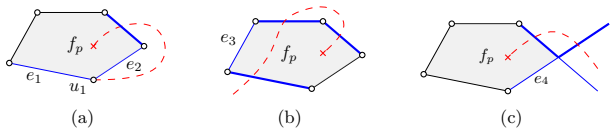
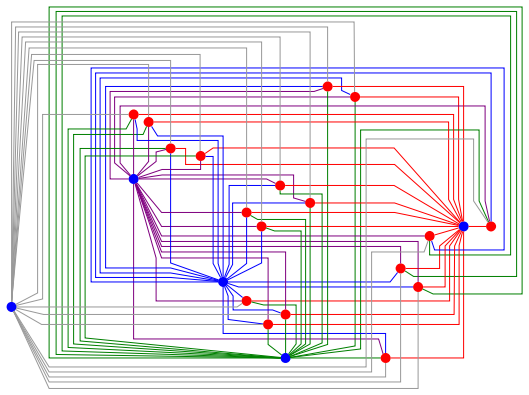
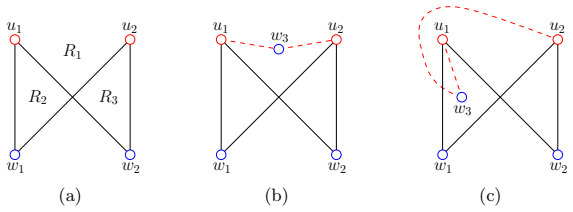
The mechanism is the half-pathway. In the planarization of a drawing, a half-pathway for a vertex $u$ is a path in the dual graph starting at a face incident to $u$ and ending at a destination face; inserting a new vertex $v$ there and drawing edge $(u,v)$ along that path crosses exactly the edges dual to the pathway. A pathway is the same but with the destination a face incident to an existing vertex, so it inserts an edge between two present vertices. The generation procedure builds every drawing by adding vertices one at a time, computing all valid half-pathways for the first new edge and all valid pathways for the remaining incident edges, while a prohibited-edges list keeps the drawing simple and within the class's crossing constraints. At each level it tests isomorphism via a face-boundary-walking bijection and deletes duplicates; this symmetry reduction is what makes exhaustive enumeration feasible.
What would settle it
Find, by independent exhaustive enumeration or by construction, a simple 2-planar drawing of $K_{4,7}$ or $K_{5,5}$, a fan-planar drawing of $K_{5,5}$, or a 2-planar drawing of $K_8$; any one of these would refute the corresponding characterization, as would a single non-simple drawing of $K_{4,7}$ satisfying 2-planarity.
Extended reading notes
Core claim
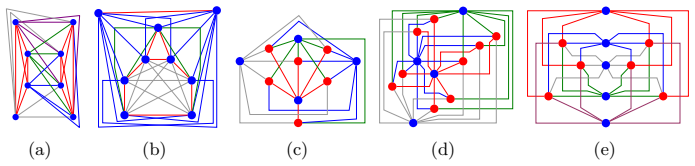
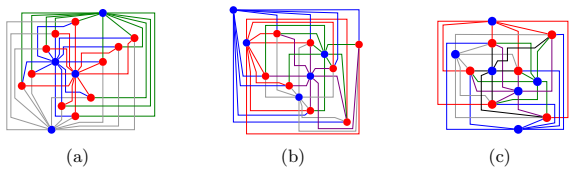
On the paper's own terms, the central discovery is that for complete and complete bipartite graphs, all topological representations belonging to a beyond-planarity class can be generated, up to isomorphism, by a vertex-by-vertex search. Each insertion is routed through valid half-pathways or pathways in the planarization of the current drawing; the search is pruned by maintaining forbidden crossing lists and by testing isomorphism at every step. Theorem 1 states that this generation is complete: for any such graph $G$ and any beyond-planarity class $C$ of topological graphs, $G$ belongs to $C$ if and only if the algorithm returns a valid drawing. The proof-of-concept applications give new tight characterizations, including that $K_8$ is not 2-planar, $K_9$ is not 3-planar, $K_{a,b}$ with $a\le b$ is 3-planar if and only if $a\le 2$, or $a=3$ and $b\le 14$, or $a=4$ and $b\le 9$, or $a=5$ and $b\le 6$, and $K_{5,5}$ is not fan-planar. The paper also provides a combinatorial proof that $K_{a,b}$ is fan-crossing free if and only if $a\le 2$ or ($a\le 4$ and $b\le 6$).
Load-bearing premise
The load-bearing premise is that restricting to simple drawings is without loss of generality for every class considered and that the unverified implementation exhaustively enumerates every simple drawing; if a non-simple drawing belongs to a class, or the search misses one, the if-and-only-if characterizations collapse.
Editorial extensions
If this is right
- The characterization of 2-planar complete bipartite graphs is now tight: $K_{a,b}$ is 2-planar exactly for $a\le 2$, or $a=3$ and $b\le 10$, or $a=4$ and $b\le 6$, so $K_{4,7}$ and $K_{5,5}$ are not 2-planar.
- $K_{5,5}$ is not fan-planar, settling the conjecture that it is not, and since $K_{5,5}$ is gap-planar while $K_{4,9}$ is fan-planar but not gap-planar, the gap-planar and fan-planar classes are incomparable.
- $K_8$ is not 2-planar and $K_9$ is not 3-planar, so the chromatic number of 3-planar graphs is lower bounded by 8, with analogous lower bounds following for higher values of $k$.
- The fan-crossing-free complete bipartite characterization is proven both combinatorially and by the implementation: $K_{a,b}$ is fan-crossing free if and only if $a\le 2$ or $a\le 4$ and $b\le 6$.
- For 4-planar and quasiplanar complete bipartite graphs, full enumeration becomes infeasible—$K_{4,4}$ alone already has tens of thousands of non-isomorphic drawings—so the paper reports only positive certificates obtained with a depth-first variant.
Reading between the lines
- Beyond the paper, the same half-pathway enumeration should apply to any topological class whose forbidden configurations are local crossing constraints expressible on a planarization, so one could read off analogous cutoffs for other classes such as $k$-fan-bundle or crossing-angle constrained drawings.
- The completeness of the enumeration is only as strong as the simple-drawing restriction; if a class's standard definition permits non-simple drawings, the paper's if-and-only-if characterizations may describe a stricter class, and the search would need to be rerun without that restriction.
- The reported drawing counts, such as the 35 non-isomorphic 4-planar drawings of $K_9$, could serve as data for studying the typical crossing structure of extremal drawings or for testing conjectures about rotation systems of complete bipartite graphs.
- A direct testable extension is to run the depth-first variant further on $K_{4,5}$ for the 4-planar and quasiplanar cases: a found certifying drawing would extend the paper's partial positive observations, while a proof of nonexistence would complete those characterizations.
Signed reviews
Editorial analysis
A structured set of objections, weighed in public.
Referee Report
Summary. The paper proposes a generation technique for enumerating simple topological drawings of complete and complete bipartite graphs that satisfy beyond-planarity restrictions. The algorithm builds drawings vertex by vertex, using half-pathways in the planarization to insert edges and an isomorphism filter based on two sufficient conditions (P.1 and P.2). The authors apply the implementation to several classes and report new tight characterizations, including the claims that K8 is not 2-planar, K4,7 and K5,5 are not 2-planar, K4,10, K5,7 and K6,6 are not 3-planar, K5,5 is not fan-planar, and K4,9 is not gap-planar. For the fan-crossing free class, Appendix E contains a detailed human-checkable combinatorial proof of the characterization of complete bipartite graphs. The paper also reports drawing counts and execution times in Appendix D and makes the Java implementation publicly available.
Significance. If the reported characterizations are correct, the paper settles several open bounds for beyond-planarity classes and provides a new computational tool for generating topological representations. The positive certificates (e.g., 3-planar drawings of K4,9 and K5,6, the 4-planar drawings, and the quasiplanar examples) are concrete and useful. The combinatorial proof in Appendix E for the fan-crossing free case is careful and checkable, and the fact that the implementation reproduces known entries such as K6 being 1-planar and K8 being gap-planar is reassuring. However, most of the advertised new results are negative statements that currently rest on the correctness and exhaustiveness of an unverified implementation, and the paper explicitly restricts to simple drawings without proving this is without loss of generality.
major comments (4)
- [Section 4, Table 1, Characterizations 2-7 and Observation 11] The central new results are negative memberhips: e.g., "K8 is not 2-planar" (Characterization 2), "K4,7 and K5,5 are not 2-planar" (Characterization 3), "K4,10, K5,7 and K6,6 are not 3-planar" (Characterization 4), "K5,5 is not fan-planar" (Characterization 7), and "K4,9 is not gap-planar" (Observation 11). In every case the evidence is that the Java implementation in Appendix D failed to find a drawing. Since the implementation is not formally verified and no machine-checkable unsatisfiability certificate is provided, these are computational experiments rather than mathematical theorems. The paper should either supply independent proofs/certificates for each negative entry or explicitly restate these items as computational evidence, separate from the proven characterizations.
- [Section 2, Preliminaries] The paper restricts all drawings to simple drawings and states "this assumption is not without loss of generality [3]." This is load-bearing because the stated if-and-only-if characterizations, such as "Ka,b is 3-planar if and only if ..." are claims about the standard beyond-planarity classes. If those classes admit non-simple drawings, the generated set may miss valid drawings and the negative results may be false. The authors must either prove that for complete and complete bipartite graphs the beyond-planarity classes considered here can be witnessed by simple drawings, or qualify every characterization and theorem as applying only to simple drawings.
- [Section 3, Theorem 1] Theorem 1 is the formal justification that the algorithm is exhaustive, but no proof is given; the text only says "We summarize the above discussion in the following theorem." A rigorous proof is needed that every valid simple drawing can be obtained by the vertex-by-vertex construction, that the half-pathway rules and prohibited-edge conditions exactly characterize validity for each class C, and that the isomorphism filtering does not discard a representative needed to reach a drawing of G. Without this proof, the "only if" direction of Theorem 1 is an assertion rather than a mathematical statement.
- [Section 3, Isomorphism testing] The isomorphism test uses Properties P.1 and P.2, which the authors state are sufficient but not known to be necessary. Consequently, the algorithm may retain isomorphic copies, so the claim that it generates "all non-isomorphic simple drawings" and the "Non-Iso" counts in Tables 2 and 3 are not established. This does not directly invalidate the existence/non-existence characterizations, because retaining extra isomorphic drawings cannot create false negative results, but it is a gap for the enumeration contribution and for any reader who uses the reported counts.
minor comments (6)
- [Section 3, Isomorphism testing] In the paragraph describing the recursive face mapping, "faces incident to e1 end e2" appears to be a typo for "e'1 and e'2".
- [Appendix G, case for Gamma_6] The sentence "we can directly conclude that the drawing Gamma5 cannot be a subdrawing ..." should refer to Gamma6, not Gamma5.
- [Appendix G, Figure 30 discussion] The phrase "the edge (u2,w6) must be crossing-freee" contains a typo: "freee" should be "free".
- [Appendix D] For reproducibility, the paper should pin the exact commit hash of the GitHub repository and state the Java version and any non-standard dependencies; the current reference is only to a repository URL.
- [Section 4, Observations 5 and 13] The "DFS-like variant" of the algorithm is not described in Section 3; a precise description is needed for reproducibility, even though these observations are only positive certificates.
- [Table 1] Some cell formatting is confusing, e.g., the 2-planar complete bipartite row lists "K4,5 K5,5 Char.3 [34]" in a way that mixes membership, non-membership, and references; this should be split into clearly labeled entries.
Circularity Check
No significant circularity: the enumeration is self-contained and the new characterizations are outputs of an exhaustive search, not fitted predictions.
full rationale
The paper's central mechanism is an exhaustive search over half-pathways in planarizations, with no fitted parameters and no quantity defined in terms of the target characterizations. Theorem 1 asserts the search's completeness; although the completeness proof is informal and the negative results ultimately rest on a non-formally-verified Java implementation, that is a verification/correctness limitation, not circularity. The isomorphism test uses only sufficient conditions, so it cannot discard a genuinely valid drawing (it can only retain duplicates), which means the negative outputs are not biased by the test's incompleteness. The only same-author citations ([6] for K3,b k-planarity and [7] for the fan-planar conjecture) are independent published theorems/conjectures used as inputs, not used to force the new a≥4 or complete-graph results. The admitted restriction to simple drawings and the absence of machine-checked certificates are important limitations, but they do not make the derivation equivalent to its own inputs.
Assumptions & free parameters
assumptions (3)
- domain assumption All drawings considered are simple: no self-crossing edges, two edges cross at most once, and adjacent edges do not cross (Section 2).
- domain assumption Every possible placement of a new vertex and its incident edges corresponds to a valid half-pathway or pathway in the planarization (Section 3).
- domain assumption Known results are taken as black boxes, e.g., K3,b is k-planar if and only if b is at most 4k+2 (Angelini et al. [6]) and edge-density bounds for fan-planar bipartite graphs (Angelini et al. [7]).
Cite this review
Pith. "Pith review of Efficient Generation of Different Topological Representations of Graphs Beyond-Planarity." pith.science (2026). https://pith.science/paper/HW64PC7K
@misc{pith2026190803042,
  author       = {Pith},
  title        = {Pith review of: Efficient Generation of Different Topological Representations of Graphs Beyond-Planarity},
  year         = {2026},
  howpublished = {\url{https://pith.science/paper/HW64PC7K}},
  note         = {Machine review of arXiv:1908.03042}
}
read the original abstract
Beyond-planarity focuses on combinatorial properties of classes of non-planar graphs that allow for representations satisfying certain local geometric or topological constraints on their edge crossings. Beside the study of a specific graph class for its maximum edge density, another parameter that is often considered in the literature is the size of the largest complete or complete bipartite graph belonging to it. Overcoming the limitations of standard combinatorial arguments, we present a technique to systematically generate all non-isomorphic topological representations of complete and complete bipartite graphs, taking into account the constraints of the specific class. As a proof of concept, we apply our technique to various beyond-planarity classes and achieve new tight bounds for the aforementioned parameter.
Figures

Figures from the paper (31 more)








Reference graph
Works this paper leans on
-
[3]
Ackerman, E., Tardos, G.: On the maximum number of edges in quasi-planar graphs. J. Comb. Theory, Ser. A 114(3), 563–571 (2007). https://doi.org/10.1016/j.jcta.2006.08.002
-
[1]
´Abrego, B.M., Aichholzer, O., Fern´ andez-Merchant, S., Hackl, T., Pammer, J., Pilz, A., Ramos, P., Salazar, G., Vogtenhuber, B.: All good drawings of small complete graphs. In: EuroCG. pp. 57–60 (2015)
work page 2015
-
[2]
Ackerman, E.: On topological graphs with at most four crossings per edge. CoRR abs/1509.01932 (2015)
arXiv 2015
-
[4]
Combinatorica 17(1), 1–9 (1997)
Agarwal, P.K., Aronov, B., Pach, J., Pollack, R., Sharir, M.: Quasi-planar graphs have a linear number of edges. Combinatorica 17(1), 1–9 (1997). https://doi.org/10.1007/BF01196127
-
[5]
Aigner, M., Ziegler, G.M.: Proofs from THE BOOK (3rd. ed.). Springer (2004)
work page 2004
-
[6]
Angelini, P., Bekos, M.A., Kaufmann, M., Kindermann, P., Schneck, T.: 1- fan-bundle-planar drawings of graphs. Theor. Comput. Sci. 723, 23–50 (2018). https://doi.org/10.1016/j.tcs.2018.03.005
-
[7]
Angelini, P., Bekos, M.A., Kaufmann, M., Pfister, M., Ueckerdt, T.: Beyond-planarity: Tur´ an-type results for non-planar bipartite graphs. In: ISAAC. LIPIcs, vol. 123, pp. 28:1–28:13. Schloss Dagstuhl (2018). https://doi.org/10.4230/LIPIcs.ISAAC.2018.28
-
[8]
Arleo, A., Binucci, C., Di Giacomo, E., Evans, W.S., Grilli, L., Liotta, G., Meijer, H., Montecchiani, F., Whitesides, S., Wismath, S.K.: Visibility rep- resentations of boxes in 2.5 dimensions. Comput. Geom. 72, 19–33 (2018). https://doi.org/10.1016/j.comgeo.2018.02.007
Show all 47 references
-
[9]
Gilyonot Lematematika 3, 2–8 (1966)
Avital, S., Hanani, H.: Graphs. Gilyonot Lematematika 3, 2–8 (1966)
1966
-
[10]
In: Biedl, T.C., Kerren, A
Bachmaier, C., Rutter, I., Stumpf, P.: 1-gap planarity of complete bipartite graphs. In: Biedl, T.C., Kerren, A. (eds.) Graph Drawing and Network Visualization. LNCS, vol. 11282, pp. 646–648. Springer (2018)
2018
-
[11]
Bae, S.W., Baffier, J., Chun, J., Eades, P., Eickmeyer, K., Grilli, L., Hong, S., Korman, M., Montecchiani, F., Rutter, I., T´ oth, C.D.: Gap-planar graphs. Theor. Comput. Sci. 745, 36–52 (2018). https://doi.org/10.1016/j.tcs.2018.05.029
2018 doi
-
[12]
Algorithmica 79(2), 401–427 (2017)
Bekos, M.A., Cornelsen, S., Grilli, L., Hong, S., Kaufmann, M.: On the recognition of fan-planar and maximal outer-fan-planar graphs. Algorithmica 79(2), 401–427 (2017)
2017
-
[13]
Binucci, C., Di Giacomo, E., Didimo, W., Montecchiani, F., Patrignani, M., Symvo- nis, A., Tollis, I.G.: Fan-planarity: Properties and complexity. Theor. Comp. Sci. 589, 76–86 (2015)
2015
-
[14]
In: Graph Drawing
Brandenburg, F.J.: A simple quasi-planar drawing of K10. In: Graph Drawing. LNCS, vol. 9801, pp. 603–604. Springer (2016)
2016
-
[15]
Brandenburg, F.J.: A first order logic definition of beyond-planar graphs. J. Graph Algorithms Appl. 22(1), 51–66 (2018)
2018
-
[16]
Brandenburg, F.J.: On fan-crossing and fan-crossing free graphs. Inf. Process. Lett. 138, 67–71 (2018). https://doi.org/10.1016/j.ipl.2018.06.006
2018 doi
-
[17]
Bruckdorfer, T., Cornelsen, S., Gutwenger, C., Kaufmann, M., Montecchiani, F., N¨ ollenburg, M., Wolff, A.: Progress on partial edge drawings. J. Graph Algorithms Appl. 21(4), 757–786 (2017). https://doi.org/10.7155/jgaa.00438
2017 doi
-
[18]
JoCG 9(1), 213–246 (2018)
Cardinal, J., Felsner, S.: Topological drawings of complete bipartite graphs. JoCG 9(1), 213–246 (2018)
2018
-
[19]
Algorithmica 73(4), 673–695 (2015)
Cheong, O., Har-Peled, S., Kim, H., Kim, H.: On the number of edges of fan-crossing free graphs. Algorithmica 73(4), 673–695 (2015). https://doi.org/10.1007/s00453-014-9935-z
2015 doi
-
[20]
Czap, J., Hud´ ak, D.: 1-planarity of complete multipartite graphs. Disc. App. Math. 160(4-5), 505–512 (2012). https://doi.org/10.1016/j.dam.2011.11.014
2012 doi
-
[21]
Didimo, W., Eades, P., Liotta, G.: A characterization of complete bipartite RAC graphs. Inf. Process. Lett. 110(16), 687–691 (2010)
2010
-
[22]
Didimo, W., Eades, P., Liotta, G.: Drawing graphs with right angle crossings. Theor. Comp. Sci. 412(39), 5156–5166 (2011)
2011
-
[23]
In: Thirty Essays on Geometric Graph Theory, pp
Didimo, W., Liotta, G.: The crossing-angle resolution in graph drawing. In: Thirty Essays on Geometric Graph Theory, pp. 167–184. Springer (2013)
2013
-
[24]
ACM Comput
Didimo, W., Liotta, G., Montecchiani, F.: A survey on graph drawing beyond planarity. ACM Comput. Surv. 52(1), 4:1–4:37 (Feb 2019)
2019
-
[25]
Eades, P., Liotta, G.: Right angle crossing graphs and 1-planarity. Disc. Appl. Math. 161(7–8), 961–969 (2013)
2013
-
[26]
Algorithmica 80(3), 977–994 (2018)
Eppstein, D., Kindermann, P., Kobourov, S.G., Liotta, G., Lubiw, A., Maig- nan, A., Mondal, D., Vosoughpour, H., Whitesides, S., Wismath, S.K.: On the planar split thickness of graphs. Algorithmica 80(3), 977–994 (2018). https://doi.org/10.1007/s00453-017-0328-y
2018 doi
-
[27]
Garey, M., Johnson, D.S.: Computers and Intractability: A Guide to the Theory of NP-Completeness. W. H. Freeman & Co., New York, NY, USA (1979)
1979
-
[28]
Gioan, E.: Complete graph drawings up to triangle mutations. In: WG. LNCS, vol. 3787, pp. 139–150. Springer (2005). https://doi.org/10.1007/11604686 13
2005 doi
-
[29]
Congressus Numerantium 71, 105–114 (1990)
Gronau, H.D.O., Harborth, H.: Numbers of nonisomorphic drawings for small graphs. Congressus Numerantium 71, 105–114 (1990)
1990
-
[30]
Vierteljschr
Hadwiger, H.: ¨Uber eine Klassifikation der Streckenkomplexe. Vierteljschr. Natur- forsch. Ges. Z¨ urich88, 133–143 (1943)
1943
-
[31]
Graphs and Combinatorics 1(1), 311–329 (1985)
Hartsfield, N., Jackson, B., Ringel, G.: The splitting number of the complete graph. Graphs and Combinatorics 1(1), 311–329 (1985). https://doi.org/10.1007/BF02582960
1985 doi
-
[32]
In: PacificVis 2008
Huang, W., Hong, S., Eades, P.: Effects of crossing angles. In: PacificVis 2008. pp. 41–46. IEEE (2008)
2008
-
[33]
CoRR 1403.6184 (2014)
Kaufmann, M., Ueckerdt, T.: The density of fan-planar graphs. CoRR 1403.6184 (2014)
2014 arXiv
-
[34]
Kehribar, Z.: K5,5 kann nicht 2-planar gezeichnet werden: Analyse und Beweis (2018), Bachelor Thesis, Universit¨ at T¨ ubingen
2018
-
[35]
Kynˇ cl, J.: Simple realizability of complete abstract topological graphs in P. Disc. & Comp. Geom. 45(3), 383–399 (2011). https://doi.org/10.1007/s00454-010-9320-x
2011 doi
-
[36]
Kynˇ cl, J.: Improved enumeration of simple topological graphs. Disc. & Comp. Geom. 50(3), 727–770 (2013). https://doi.org/10.1007/s00454-013-9535-8
2013 doi
-
[37]
SIAM Journal on Optimization 11(4), 1065–1080 (2001)
Mutzel, P.: An alternative method to crossing minimization on hierar- chical graphs. SIAM Journal on Optimization 11(4), 1065–1080 (2001). https://doi.org/10.1137/S1052623498334013
2001 doi
-
[38]
Pach, J., Radoiˇ ci´ c, R., Tardos, G., T´ oth, G.: Improving the crossing lemma by finding more crossings in sparse graphs. Disc. Comput. Geom. 36(4), 527–552 (2006)
2006
-
[39]
Combinatorica 17(3), 427–439 (1997)
Pach, J., T´ oth, G.: Graphs drawn with few crossings per edge. Combinatorica 17(3), 427–439 (1997)
1997
-
[40]
https://doi.org/10.1007/s00493-006-0032-z
Pach, J., T´ oth, G.: How many ways can one draw a graph? Combinatorica 26(5), 559–576 (2006). https://doi.org/10.1007/s00493-006-0032-z
2006 doi
-
[41]
Rafla, N.H.: The Good Drawings Dn of the Complete Graph Kn. Ph.D. thesis, McGill. University, Montreal, Quebec (1988)
1988
-
[42]
Ringel, G.: Ein Sechsfarbenproblem auf der Kugel. Abh. Math. Sem. Univ. Hamb. 29, 107–117 (1965)
1965
-
[43]
General”, while the number of the non-isomorphic ones in the column “Non-Iso
Zarankiewicz, K.: On a problem of P. Tur´ an concerning graphs. Fundamenta Math- ematicae 41, 137–145 (1954) Appendix A Preliminary Notions and Definitions In this paper, we consider graphs containing neither multi-edges nor self-loops. Let G = (V,E ) be a graph. A drawing of G...
1954
-
[44]
Similarly, the edge (u1,w 6) must cross (u2,w 4); see dashed dotted blue edges in Fig
To avoid introducing any fan-crossing, edge (u3,w 6) must cross (u2,w 3). Similarly, the edge (u1,w 6) must cross (u2,w 4); see dashed dotted blue edges in Fig. 28b. Next, we argue for vertexw7, which cannot lie in R′ 6, since by the arguments above (u3,w 7) would have to cros...
-
[45]
In fact, this edge is not allowed to cross any edge incident to u2, or one of the edges (u3,w 3), (u3,w 6) and (u1,w 6), or both edges (u1,w 3), (u1,w 2)
But then it is easy to see that ( u2,w 7) yields inevitably a fan-crossing. In fact, this edge is not allowed to cross any edge incident to u2, or one of the edges (u3,w 3), (u3,w 6) and (u1,w 6), or both edges (u1,w 3), (u1,w 2). It remains to consider the case in which w6 in...
-
[46]
As in the previous case, we next argue for w7, which cannot be in R6 (by the arguments above)
To see this, observe that ( u1,w 6) can cross neither any edge incident to u1, nor one of the edges ( u3,w 3) and (u3,w 4), nor both edges (u2,w 4) and (u2,w 5), nor both edges ( u2,w 3) and (u2,w 1). As in the previous case, we next argue for w7, which cannot be in R6 (by the...
-
[47]
They can cross neither (u3,w 3), nor the pair (u1,w 3) and (u1,w 2), nor the pair (u1,w 4) and (u1,w 5)
For both edges (u2,w 6) and (u2,w 7) the following holds. They can cross neither (u3,w 3), nor the pair (u1,w 3) and (u1,w 2), nor the pair (u1,w 4) and (u1,w 5). Thus, both have to cross (u3,w 4), yielding a fan-crossing. From the case analysis above, we conclude that in the ...
Reviewed August 14, 2026 · model on record in the stance chip above.
Discussion (0). Continue with ORCID to comment.