REVIEW 2 major objections 5 minor 31 references
Variability Study of Extreme Blazars with VERITAS
T0 review · 2 major / 5 minor · reviewed 2026-08-14 · deepseek-v4-flash
Pith's one-line read A ~4σ correlation between low- and high-opacity VERITAS light curves of 1ES 1011+496 is consistent with secondary gamma-ray production, because a toy model with 13% primary emission reproduces it.
desk verdict A modest but honest VERITAS variability report: the opacity-bin correlation result is new, and the 'cannot rule out' conclusion holds, but the toy study leans on a single stochastic realization. read the letter →
The pith
A machine-rendered reading of the paper's core claim, the machinery that carries it, and where it could break.
The reading
What carries the argument
The machinery is the z-transformed discrete cross-correlation function (ZDCF) applied to sparsely sampled light curves, together with an opacity-binning scheme. Light curves of each source are split by $\tau$ bins set by the Franceschini et al. (2008) EBL model, and the ZDCF measures correlation versus lag, with significance estimated from Monte Carlo light curves generated from each light curve's power spectral density (PSD). The decisive object is the toy construction $L_{\tau>2}^{\rm sim} = 0.13\,L_{\tau<1}^{\rm primary} + 0.87\,L_{\rm secondary}^{\rm sim}$: the primary piece is the real $\tau<1$ data, and the secondary piece is a PSD realisation of the same light curve after the flare is removed, so that it is smooth. The toy shows that a small primary flare contribution can imprint a correlation even when most of the high-opacity flux is secondary.
What would settle it
Look at the $\tau>3$ light curve of 1ES 1011+496 around a flare like February 2014. The secondary-gamma-ray model predicts a primary fraction below 5% in that bin, so a significant correlation between the $\tau>3$ and $\tau<1$ light curves would refute the paper's conclusion that the current data cannot constrain the model; a smooth, uncorrelated $\tau>3$ light curve would confirm it.
Extended reading notes
Core claim
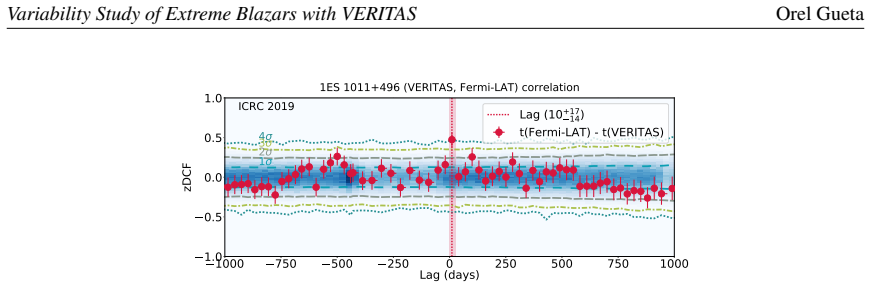
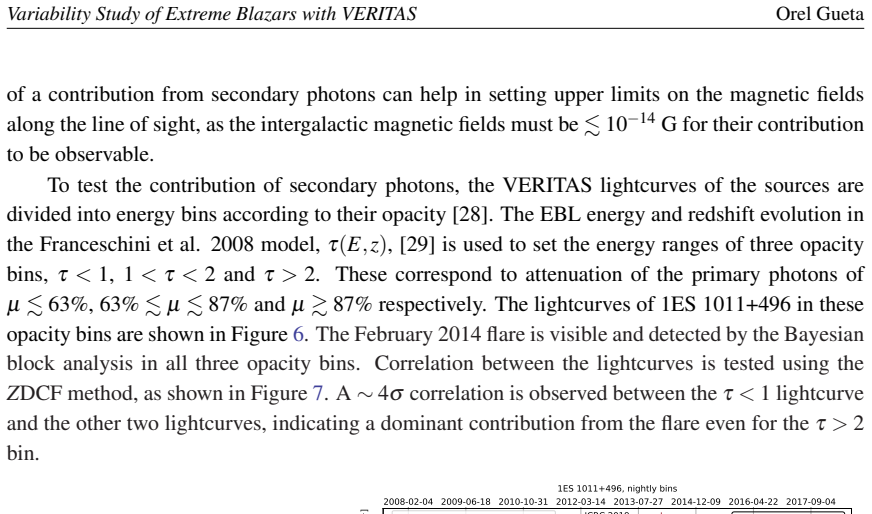
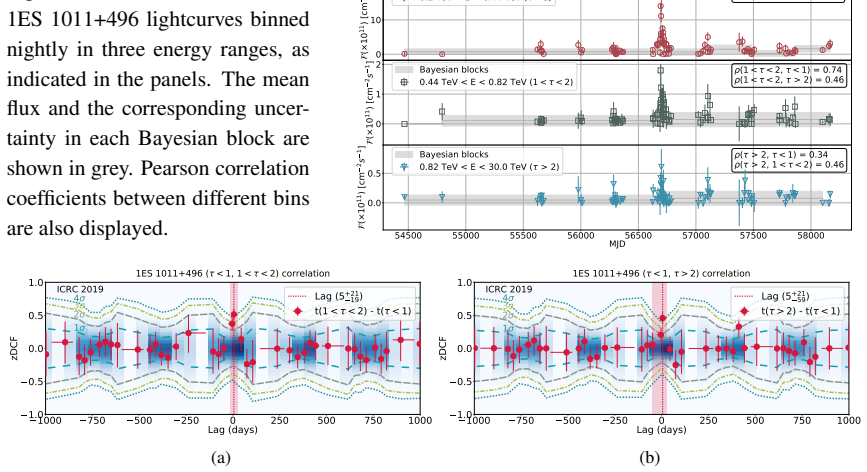
The paper claims that the observed correlations between the opacity-binned VERITAS light curves of 1ES 1011+496 — $\tau<1$, $1<\tau<2$, and $\tau>2$, where $\tau$ is the opacity of the extragalactic background light — do not discriminate between primary and secondary gamma-ray production. The February 2014 flare appears in all three bins and the light curves are correlated at about $4\sigma$. Yet a synthetic $\tau>2$ light curve built from $0.13\,L_{\tau<1}^{\rm primary} + 0.87\,L_{\rm secondary}^{\rm sim}$, with a smooth secondary component simulated from the flare-removed $\tau<1$ power spectrum, reproduces the correlation at the $\sim3\sigma$ level. The paper therefore concludes that the data cannot rule out the model in which ultra-high-energy protons produce secondary gamma rays along the line of sight, and that a $\tau>3$ bin, where the predicted primary fraction is below 5%, would be needed for a real constraint.
Load-bearing premise
The load-bearing premise is that the secondary gamma-ray component is smooth, so it can be represented by a power-spectrum simulation of the flare-removed low-opacity light curve; if secondary emission can track the flare on short timescales, the 13% primary test would not show what the paper says it shows.
Editorial extensions
If this is right
- The ~4σ opacity-bin correlation in 1ES 1011+496 cannot by itself serve as evidence against the ultra-high-energy proton scenario; a 13% primary fraction during the flare is enough to produce it.
- A meaningful test requires a $\tau>3$ opacity bin, where the secondary model predicts the primary contribution is below 5% and no correlation with the $\tau<1$ light curve is expected.
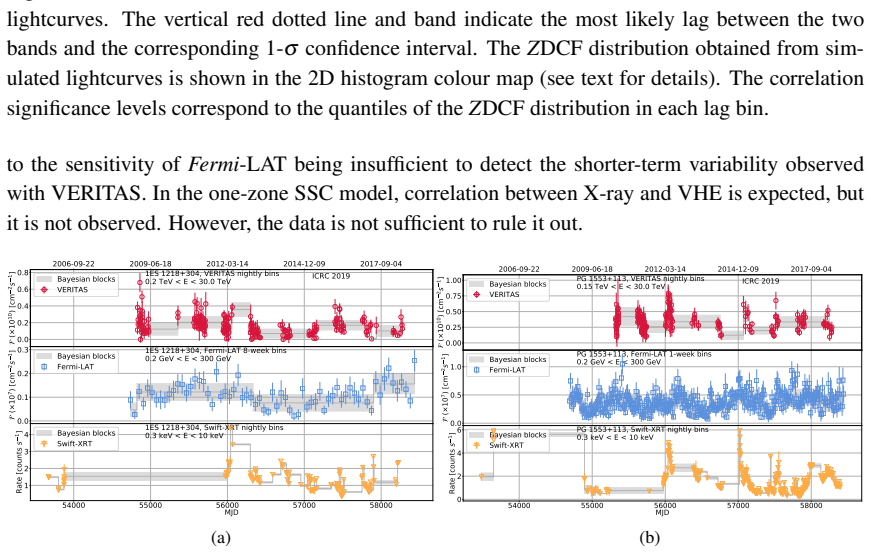
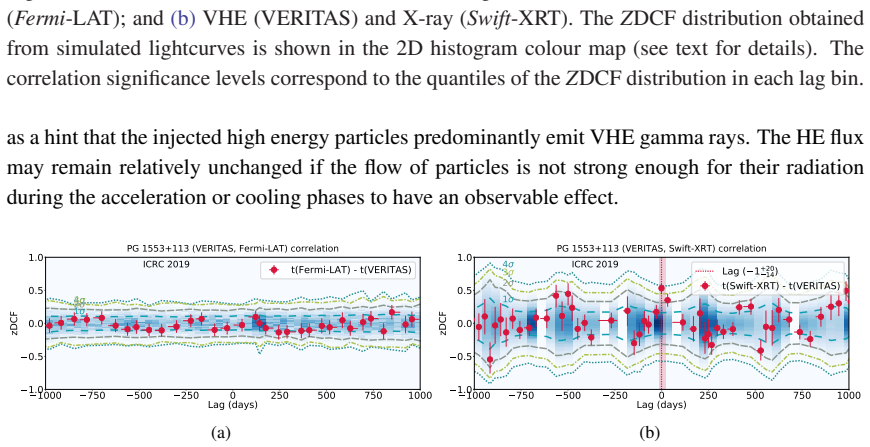
- For PG 1553+113, the 3.8σ VHE–X-ray correlation is compatible with a one-zone SSC interpretation, while the absence of VHE–HE correlation adds tension to that model.
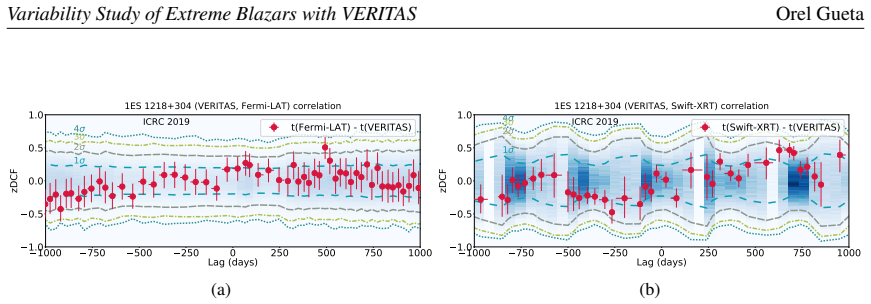
- For 1ES 1218+304, uncorrelated VHE and X-ray short-term variability suggests that different emission zones or particle populations may be at work.
- An overall consequence is that variability correlation measurements of these HBLs can point toward single-zone or multi-zone scenarios, but only the highest-opacity bins can cleanly separate primary from secondary emission.
Reading between the lines
- A natural extension, not pursued in the paper, is to map how the required primary fraction changes with redshift and with the adopted EBL model; if the critical primary fraction needed to reproduce correlations drops below the model prediction for other xHBLs, those sources could constrain the proton scenario even without $\tau>3$ data.
- The toy's reliance on a smooth secondary component is the hinge: if intergalactic magnetic fields are near the upper limit of $\lesssim10^{-14}$ G or the proton beam is broad, cascade emission could vary on shorter timescales, and the 13% test could either under- or over-estimate the correlation.
- The same opacity-binned ZDCF analysis could be applied to the full VERITAS xHBL sample (e.g. 1ES 0229+200, RGB J0710+591) to check whether a small primary fraction always reproduces the observed correlations; a source where it does not would be the most promising place to look for a constraint.
Signed reviews
Editorial analysis
A structured set of objections, weighed in public.
Referee Report
Summary. This proceedings paper presents a variability study of extreme HBLs using VERITAS data, focusing on three sources: 1ES 1011+496, 1ES 1218+304, and PG 1553+113. For each source, multiwavelength light curves (VERITAS, Fermi-LAT, Swift-XRT) are analyzed with Bayesian blocks and the z-transformed discrete cross-correlation function (ZDCF), with significance estimated from Monte Carlo simulations using PSD-based light-curve generation. The novel element is an opacity-binned analysis of the VERITAS light curve of 1ES 1011+496, dividing the VHE band into τ<1, 1<τ<2, and τ>2 bins. A ~4σ correlation is found between the τ<1 and τ>2 bins. To interpret this, the authors construct a toy light curve for the τ>2 bin as 13% of the observed τ<1 light curve plus 87% of a simulated smooth secondary component, and report a ~3σ correlation with the τ<1 light curve. They conclude that the observed correlation cannot rule out the production of secondary gamma rays from ultra-high-energy proton interactions along the line of sight, and that the current dataset cannot constrain this model.
Significance. If the result is correct, it is a valuable null result: it shows that the observed short-timescale correlation between opacity-binned VHE light curves of 1ES 1011+496 is consistent with a secondary gamma-ray model in which primaries contribute only 13% of the highest-opacity flux. The strength of the paper is its careful, conservative wording: the central claim is explicitly a non-detection and non-constraint, and the correlation significances are estimated with a standard Monte Carlo procedure using 100,000 PSD-simulated light curves. The toy study is a transparent, first-step consistency check. The main weakness is the statistical robustness of the toy study, which currently rests on a single stochastic realization and on an unvalidated assumption about the variability properties of the secondary component.
major comments (2)
- [Section 3, toy study (Eq. L_sim_tau>2 = 0.13*L_tau<1 + 0.87*L_sim_secondary)] The toy study uses a single random realization of L_sim_secondary, and the reported '~3σ correlation' is one draw from a distribution. Since L_sim_secondary is generated stochastically from a PSD, different draws will produce different ZDCF significances, and a single realization does not establish that 13% primary is 'sufficient' to reproduce the observed ~4σ correlation. The paper should simulate many realizations (e.g., 1000) and report the distribution of the resulting ZDCF significances, ideally giving the fraction of realizations that produce a correlation at or above the observed value. Without this, the robustness of the central non-constraint claim is not quantified.
- [Section 3, construction of L_sim_secondary] The simulated secondary component is derived from the PSD of the flare-removed τ<1 light curve, which is assumed to represent the smooth secondary emission. However, the model cited in the paper predicts that secondary-dominated emission should show no variability on timescales shorter than ~0.1 year. If the quiescent τ<1 light curve contains significant power on shorter timescales, the simulated secondary may be more variable than physically allowed, which would bias the toy toward higher correlation with the primary and make the conclusion that the secondary model cannot be ruled out easier to reach. The authors should justify that the flare-removed PSD is dominated by long timescales, or repeat the toy with a smoothed secondary component to test whether the conclusion is robust.
minor comments (5)
- [Figure 6 caption] The caption lists Pearson correlation coefficients between opacity bins, while the text states that correlations are tested with the ZDCF. Please clarify whether the Pearson values are shown for illustration or as an alternative statistic, and ensure the notation distinguishes the two methods.
- [Section 2] The text says a Bayesian block analysis is used to determine significant (3σ) change points, but Bayesian blocks do not directly produce a significance level. Please rephrase to avoid implying a false equivalence, for example by stating that blocks correspond to flux changes at an approximate 3σ level as estimated from the data.
- [Section 3] The EBL model adopted is Franceschini et al. (2008). Since opacity bins depend on the EBL model, it would be helpful to state whether the conclusions are sensitive to the choice of EBL model (e.g., using a different recent model such as Gilmore et al. or Domínguez et al.).
- [Abstract / Introduction] The abstract states that 24 of the 39 detected AGNs are HBLs, while the introduction cites 51 HBLs detected so far by the TeV community. Clarify whether the 24 refers only to VERITAS detections, and make the numbers consistent between the abstract and the body.
- [Section 3, final paragraph of Conclusions] The sentence 'A similar short-term variability and correlation needs to be observed with the τ > 3 bin' is grammatically awkward; consider rewording to 'If a similar short-term variability and correlation were observed in the τ > 3 bin, the model would be constrained.'
Circularity Check
No significant circularity: the toy study is an explicit consistency check supporting a null conclusion, not a hidden fit or prediction.
full rationale
The paper's central claim is explicitly a non-exclusion statement: the observed ~4 sigma correlation between opacity-binned lightcurves of 1ES 1011+496 does not rule out the secondary-gamma-ray model. The toy study in Section 3 constructs L_sim_tau>2 = 0.13 * L_tau<1_primary + 0.87 * L_sim_secondary and then asks whether a 13% primary contribution could produce a comparable correlation; this is a consistency check, not a derivation or prediction. The 13% value is taken from the external secondary-gamma-ray model, not fitted to the data. The secondary lightcurve is simulated from the PSD of the flare-removed tau<1 lightcurve, which is a stated modeling assumption rather than a circular reduction: the paper does not claim that the observed correlation follows necessarily, only that it can be reproduced. The ZDCF significance estimation via Monte Carlo pseudo-experiments is standard and parameter-free. Citations to VERITAS collaboration papers are instrument, observing-strategy, and past-detection references; they are not load-bearing theoretical premises. The single-realization stochasticity of the toy secondary lightcurve is a statistical robustness concern, not a circularity, because no fitted parameter is relabeled as a prediction and the conclusion is explicitly that the model cannot be ruled out. The derivation chain is therefore self-contained with no input-output conflation.
Assumptions & free parameters
free parameters (1)
- primary_fraction_in_tau_gt_2 =
0.13
assumptions (4)
- domain assumption The Franceschini et al. 2008 EBL model correctly describes the photon attenuation tau(E,z) used to define the three opacity bins.
- domain assumption Secondary gamma rays from UHE proton interactions with background photons exhibit no variability on timescales shorter than about 0.1 year, so they can be simulated from the PSD of the flare-removed low-opacity lightcurve.
- domain assumption The power spectral density model of Timmer and Koenig (1995) adequately describes the stochastic variability of each lightcurve for the purpose of Monte Carlo significance estimation of the ZDCF.
- domain assumption The observed VHE and HE emission in 1ES 1011+496 arise from the same particle population, as assumed when interpreting the VHE-HE correlation as supporting a single zone.
Cite this review
Pith. "Pith review of Variability Study of Extreme Blazars with VERITAS." pith.science (2026). https://pith.science/paper/SIPTGOSX
@misc{pith2026190803085,
  author       = {Pith},
  title        = {Pith review of: Variability Study of Extreme Blazars with VERITAS},
  year         = {2026},
  howpublished = {\url{https://pith.science/paper/SIPTGOSX}},
  note         = {Machine review of arXiv:1908.03085}
}
read the original abstract
The VERITAS array of imaging atmospheric Cherenkov telescopes has collected nearly 6000 hours of observations of active galactic nuclei (AGNs). It has detected 39 very-high-energy (VHE, >100 GeV) AGNs at redshifts up to z = 0.9, of which 24 are classified as high-frequency-peaked BL Lacertae objects (HBLs). VERITAS has obtained an extensive dataset of HBL, including extreme HBL (xHBL), observations, with lightcurves spanning up to 11 years, allowing the characterization of their long-term and short-term variability. A study of various xHBLs/HBLs in the VERITAS dataset is presented, and the correlation with other energy bands tested. In particular, the short-term variability of xHBLs as a function of energy within the VHE band is examined, exploring the possibility that secondary gamma rays are produced in cosmic-ray interactions with background photons.
Figures

Figures from the paper (4 more)
Reference graph
Works this paper leans on
-
[1]
Fermi-LAT collaboration, 1902.10045
arXiv 1902
-
[2]
A. P. Marscher and W. K. Gear, The Astrophysical Journal 298 (1985)
work page 1985
-
[3]
C. D. Dermer and R. Schlickeiser, The Astrophysical Journal 416 (1993)
work page 1993
- [4]
-
[5]
G. D. Sentürk et al., Astrophys. J. 764 (2013) 119 [1301.3697]
work page Pith review arXiv 2013
-
[6]
A theoretical unifying scheme for gamma-ray bright blazars
G. Ghisellini et al., Mon. Not. Roy. Astron. Soc. 301 (1998) [astro-ph/9807317]
work page Pith review arXiv 1998
-
[7]
E. Lefa, F. M. Rieger and F. Aharonian, The Astrophysical Journal 740 (2011)
work page 2011
- [8]
Show all 31 references
-
[9]
W. B. Atwood et al., The Astrophysical Journal 697 (2009) [0902.1089]
2009 arXiv
-
[10]
Wood et al., PoS ICRC2017 (2017) [1707.09551]
M. Wood et al., PoS ICRC2017 (2017) [1707.09551]
2017 arXiv
-
[11]
D. N. Burrows et al., Space Science Reviews 120 (2005)
2005
-
[12]
P. A. Evans et al., Astron. Astrophys. 469 (2007) [0704.0128]
2007 arXiv
-
[13]
VERITAS collaboration, PoS ICRC2015 (2016) [1508.07070]
2016 arXiv
-
[14]
VERITAS collaboration, PoS ICRC2017 (2018) [1708.02374]
2018 arXiv
-
[15]
J. D. Scargle, J. P. Norris, B. Jackson and J. Chiang, The Astrophysical Journal 764 (2013) 167
2013
-
[16]
Alexander, vol
T. Alexander, vol. 218 of Astrophysics and Space Science Library, 1997, DOI
1997
-
[17]
Timmer and M
J. Timmer and M. Koenig, Astronomy and Astrophysics 300 (1995) 707
1995
-
[18]
Alexander, arXiv e-prints (2013) [1302.1508]
T. Alexander, arXiv e-prints (2013) [1302.1508]
2013 arXiv
-
[19]
V . A. Acciari et al., Astrophysical Journal Letters 709 (2010) [1001.2590]
2010 arXiv
-
[20]
MAGIC collaboration, Astrophys. J. 748 (2012) [1101.2764]
2012 arXiv
- [21]
-
[22]
F ERMI -LAT collaboration, Astrophys. J. 813 (2015) L41 [1509.02063]
2015 arXiv
-
[23]
M. H. Salamon and F. W. Stecker, Astrophys. J. 493 (1998) [astro-ph/9704166]
1998 arXiv
-
[24]
Essey, O
W. Essey, O. E. Kalashev, A. Kusenko and J. F. Beacom, Phys. Rev. Lett. 104 (2010) [0912.3976]
2010 arXiv
-
[25]
Essey, O
W. Essey, O. Kalashev, A. Kusenko and J. F. Beacom, Astrophys. J. 731 (2011) [1011.6340]
2011 arXiv
-
[26]
Aharonian, W
F. Aharonian, W. Essey, A. Kusenko and A. Prosekin, Phys. Rev. D87 (2013) 063002 [1206.6715]
2013 arXiv
-
[27]
Prosekin, W
A. Prosekin, W. Essey, A. Kusenko and F. Aharonian, Astrophys. J. 757 (2012) [1203.3787]
2012 arXiv
- [28]
-
[29]
Franceschini, G
A. Franceschini, G. Rodighiero and M. Vaccari, Astron. Astrophys. 487 (2008) 837 [0805.1841]
2008 arXiv
-
[30]
Caproni, Z
A. Caproni, Z. Abraham, J. C. Motter and H. Monteiro, Astrophys. J. 851 (2017) [1712.06881]
2017 arXiv
-
[31]
Tavani, A
M. Tavani, A. Cavaliere, P. Munar-Adrover and A. Argan, Astrophys. J. 854 (2018) [1801.03335]. 7
2018 arXiv
Reviewed August 14, 2026 · model on record in the stance chip above.
Discussion (0). Continue with ORCID to comment.