REVIEW 2 major objections 4 minor 51 references
Time Dependent Variational Principle for Tree Tensor Networks
T0 review · 2 major / 4 minor · reviewed 2026-08-14 · deepseek-v4-flash
Pith's one-line read A single projector generalizes TDVP to every loop-free tensor network, not just matrix product states.
desk verdict A useful TDVP generalization for arbitrary loop-free tensor networks, with convincing numerics and a real but fixable index error in the vertical-subspace derivation that should be corrected before publication. read the letter →
The pith
A machine-rendered reading of the paper's core claim, the machinery that carries it, and where it could break.
The reading
What carries the argument
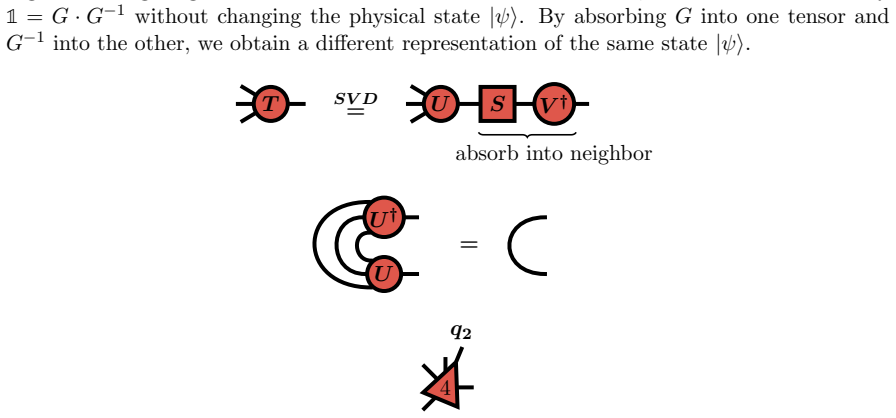
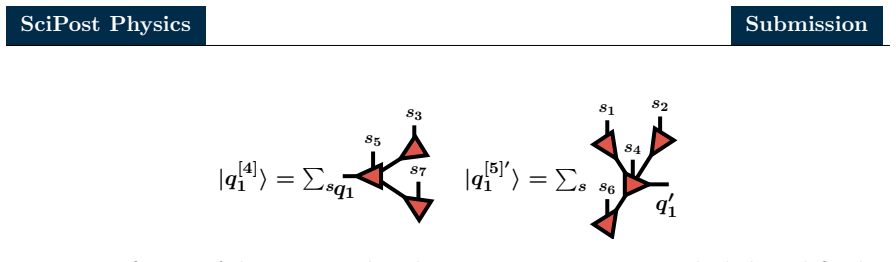
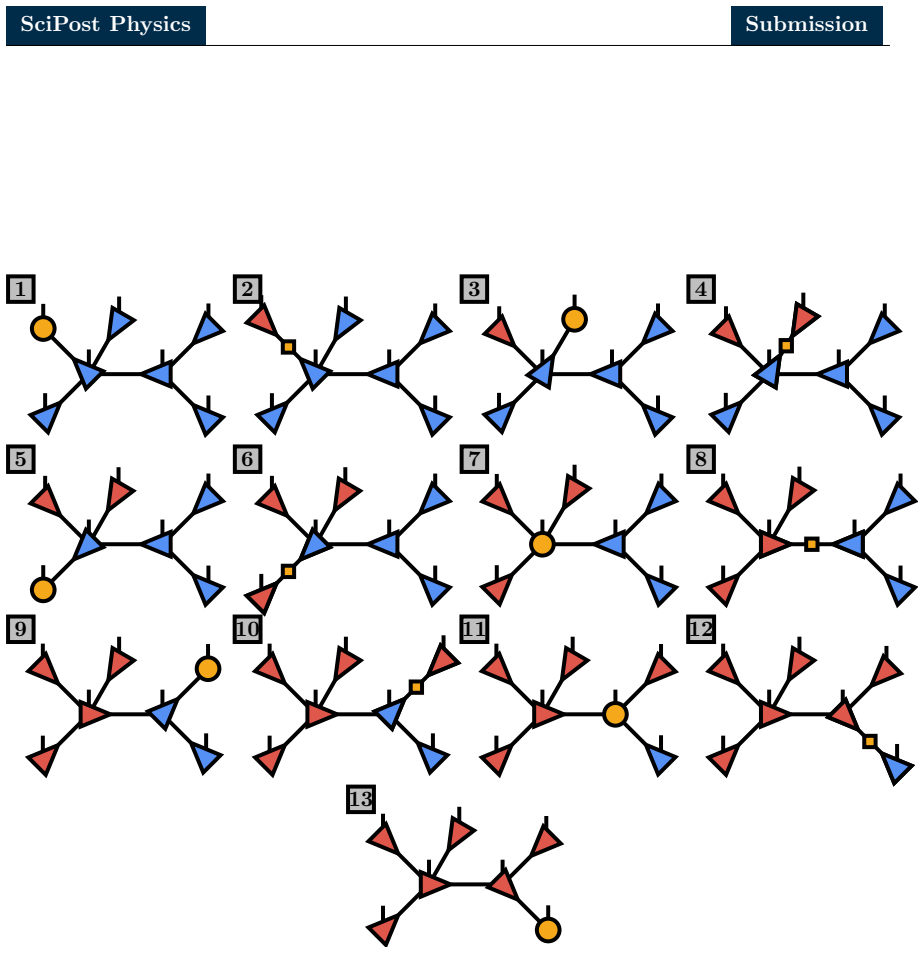
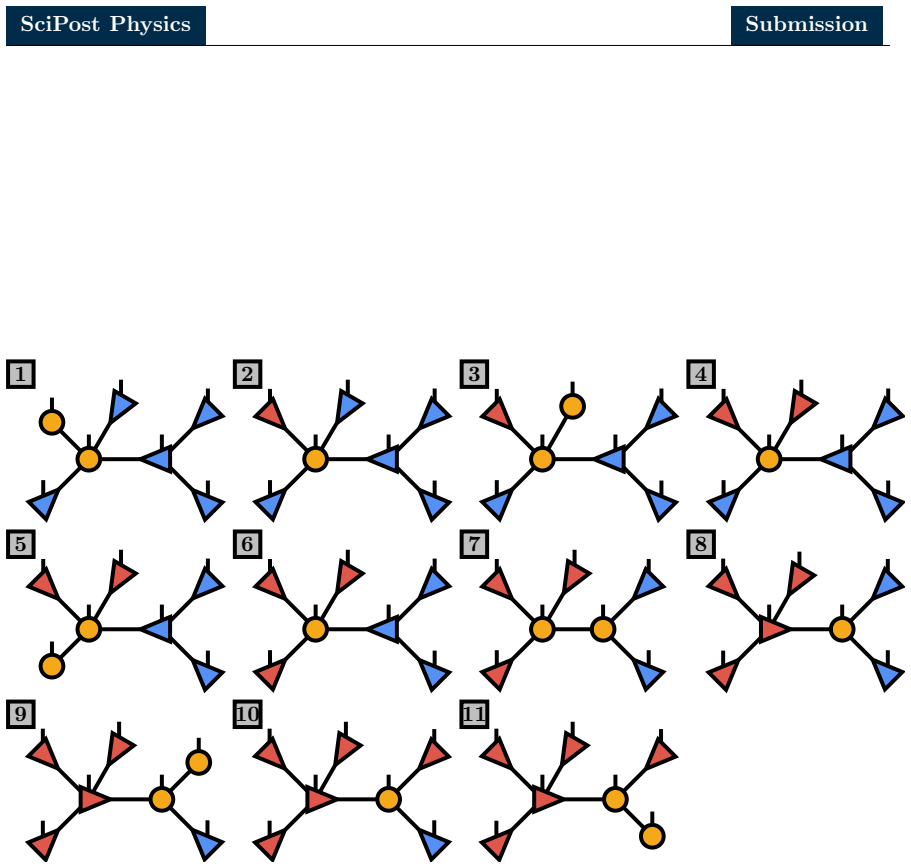
The central object is the tangent-space projector of Eq. (15), built from site tensors $T^{s_i}_{Q_i}$ orthogonalized toward each neighbor (written $T_N^{[q_k]}$) and from the mutually orthogonal link states $|q^{(i)}_k\rangle$ that each cut of the tree defines. This projector decomposes the global projected Schrödinger equation into one-site effective Hamiltonians $H_{(s_i Q_i),(s'_i Q'_i)}$ and link effective Hamiltonians $K_{(q^{(i)}_k q^{(j)}_k),(q^{(i)'}_k q^{(j)'}_k)}$; each local piece is integrated by exponentiating the effective Hamiltonian with Krylov methods. The sweeping order, from a chosen start leaf to a chosen end leaf, turns these local updates into a first-order TDVP step, and reversing the sweep with half time steps gives a second-order integrator. The two-site variant replaces the site and link updates by a two-site effective Hamiltonian followed by an SVD, allowing adaptive bond-dimension growth.
What would settle it
On a small non-binary tree (for example a star graph with three leaves), compute the dimension of the kernel of the linear map from tangent tensors $\{B^{s_i}_{Q_i}\}$ to the state $|\Theta[B]\rangle$. If this dimension is larger than the number of free parameters in the $X$-matrices allowed by Eq. (9) under Eq. (10) — or if a single gauge-equivalent-to-zero perturbation cannot be written in that form — then Eq. (15) is not the full tangent-space projector, and TDVP on such a tree would not be the exact manifold projection.
Extended reading notes
Core claim
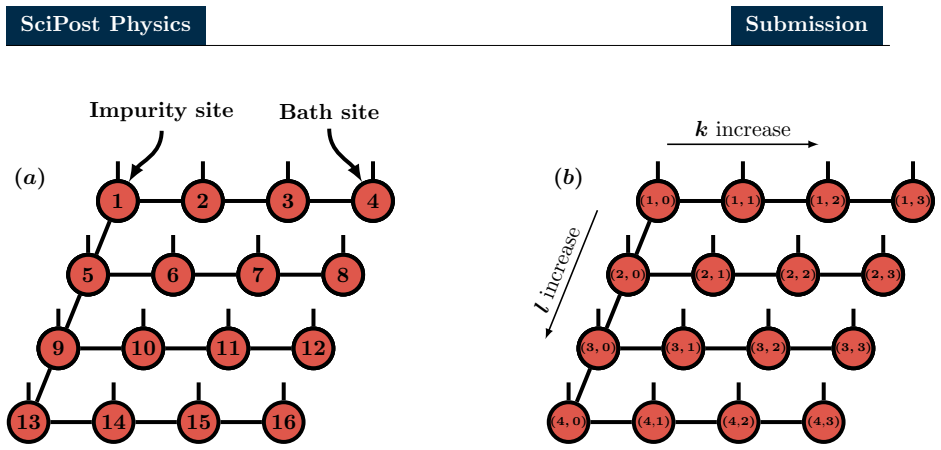
The paper establishes that for any finite loop-free tensor network, the tangent space at a state $|\psi[T]\rangle$ is spanned by local tensor variations, and the orthogonal projector onto it has the explicit form $P_{T|\psi[T]\rangle} = \sum_i \mathbb{1}_{s_i}\otimes\sum_{Q_i}|q^{(i)}_1\cdots q^{(i)}_{r_i}\rangle\langle q^{(i)}_1\cdots q^{(i)}_{r_i}| - \sum_{\langle i,j\rangle_{q_k}}\sum_{q_k q'_k} |q^{(j)'}_k\rangle\langle q^{(j)'}_k|\otimes |q^{(i)}_k\rangle\langle q^{(i)}_k|$ (Eq. 15). The derivation generalizes the MPS construction by parameterizing the vertical subspace with one matrix $X$ per link, fixing the gauge with $N-1$ constraints, and choosing any leaf as end point. Integrating the projected Schrödinger equation term by term with a Suzuki-Trotter breakup yields single-site and two-site TDVP sweeps; the paper verifies the scheme on impurity models, including a non-interacting case with off-diagonal hybridizations where it matches the exact Green's functions.
Load-bearing premise
The argument depends on the assumption that every redundant direction of the tensor network is caught by exactly one matrix per link, with signs set by the chosen end point, and that the $N-1$ gauge conditions fix these matrices uniquely.
Editorial extensions
If this is right
- Any Hamiltonian that admits a representation in the same TTN structure as the state can be time-evolved with TDVP, including long-range couplings that are hard for TEBD.
- The single-site TDVP variant preserves exactly the conserved quantities of the Hamiltonian, because the evolution never leaves the tensor-network manifold.
- The two-site variant provides a controlled truncation and can grow bond dimensions dynamically during the evolution.
- For FTPS impurity solvers, off-diagonal hybridizations (for example from spin-orbit coupling or lattice distortions) can be included without reformulating TEBD.
- Second-order convergence in the time step $\Delta t$ is observed, matching the numerical $\sim \Delta t^2$ scaling reported in the paper.
Reading between the lines
- Beyond the paper: a direct count of the kernel of the map $B \mapsto |\Theta[B]\rangle$ on a small non-binary tree would test whether Eq. (9) really captures all gauge directions; if it does not, the projector needs extra null vectors for high-degree nodes, though the FTPS demonstration would still stand.
- Beyond the paper: because the projector is constructed from the current orthogonalized state, the same local update structure could be combined with a Hamiltonian-adapted sweeping order, possibly reducing the number of long-range terms each sweep must cover.
- Beyond the paper: the non-interacting off-diagonal benchmark is the cleanest reported test; repeating it at finite interaction with a controlled impurity-impurity bond dimension would show whether the method's accuracy survives the interacting regime.
Signed reviews
Editorial analysis
A structured set of objections, weighed in public.
Referee Report
Summary. The paper generalizes the time-dependent variational principle (TDVP) to finite loop-free tensor networks (TTNs). The derivation follows the MPS route of Haegeman et al.: it defines a tangent-space representation, parameterizes the vertical subspace by one matrix per link (Eq. 9), imposes gauge-fixing constraints (Eq. 10), and solves a least-squares problem to obtain a tangent-space projector (Eq. 15). The projector is then integrated by sequential local site and link updates, yielding first- and second-order single-site and two-site sweeping algorithms. As an application, the authors implement TDVP for Fork Tensor Product States (FTPS) and use it to compute impurity Green's functions for multi-orbital Anderson impurity models with off-diagonal hybridizations, benchmarking against TEBD and exact diagonalization. The numerical results in Figs. 10–12 show good agreement and convergence.
Significance. If the central derivation is correct, the paper provides a genuinely useful framework: TDVP for arbitrary tree tensor networks, beyond the MPS and binary-tree cases, with the practical advantage that only a Hamiltonian representation in the same tensor-network structure is needed. The FTPS application targets a real problem in DMFT, namely off-diagonal hybridizations relevant for spin-orbit coupling and lattice distortions. The numerical tests are appropriate and include external benchmarks (TEBD, exact diagonalization) rather than self-referential checks, and the convergence study in Fig. 12 is a strength. The presentation is clear and the claimed generalizations are concrete. However, the derivation of the central projector contains a load-bearing error in the parameterization of the vertical subspace, which currently prevents the main theoretical claim from being accepted as stated. The algorithm may well be correct, but the paper's proof is not.
major comments (2)
- [Sec. 3.1, Eq. (9)] The proposed parameterization of the vertical subspace is incorrect, because it uses right multiplication by the same matrix X on both sides of each link. For a two-site TTN with endpoint N=2, tensors A_{s1,q} and C_{s2,q}, Eq. (9) gives B1 = A X and B2 = -C X. The zero-state condition following from Eq. (8) is B1 C^T + A B2^T = 0. Substituting yields A X C^T - A X^T C^T = A (X - X^T) C^T, which vanishes only for symmetric X. Taking A = C = I_2 and X with the single off-diagonal entry X_{12} = 1 gives |Theta[B]> = |1,2> - |2,1> != 0, so a non-symmetric X is mapped to a nonzero tangent vector. The correct gauge variation on the side of the link away from the endpoint requires the transpose: B2 = -C X^T (equivalently, left multiplication by X). Consequently, Eq. (9) does not reduce to the MPS kernel of Ref. [29], and the derivation of Eqs. (10)–(15) as written is unsupported. The kernel parameterization and the subsequent counting argument must be re-derived with the correct orientation of the X matrices on each side of every link; the final projector may be correct, but the proof needs to be fixed.
- [Sec. 4, Eqs. (16)–(22)] The Hamiltonian representation in the FTPS network is never constructed explicitly. The effective one-site and link Hamiltonians in Eqs. (16) and the two-site Hamiltonian in Eq. (18) presuppose a tensor-network (MPO-like) representation of H in the same FTPS geometry. For the off-diagonal hybridization Eq. (22), the paper only states that the matrix V can be chosen lower-triangular; it does not show how the terms c^†_{l0} c_{l'k} are encoded as operators on the TTN. Since the abstract and introduction emphasize that the method works whenever such a representation is available, and since the FTPS demonstration is a central part of the paper, the explicit construction (or a precise pointer to it) is needed for reproducibility and to substantiate the claim that the off-diagonal case is within the method's scope.
minor comments (4)
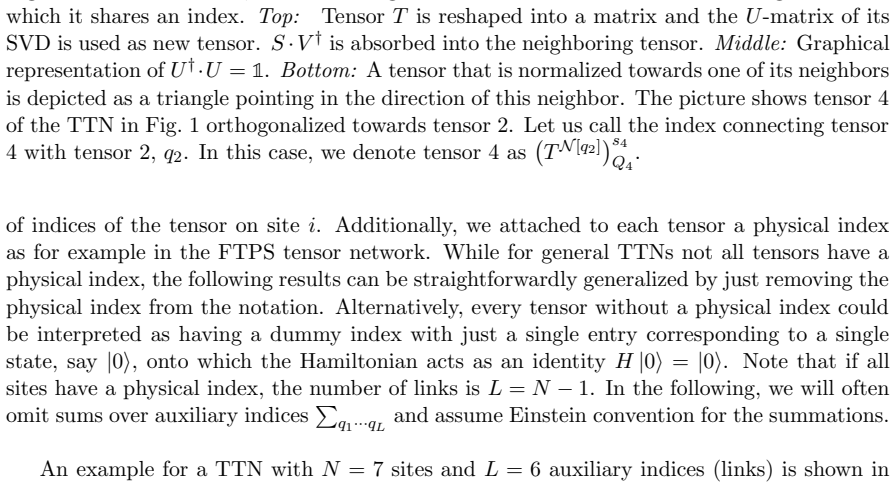
- [Sec. 3.1, Eq. (9) and Sec. 2.2] The notation T_N^{[q_l]} in Eq. (9) is confusing: the subscript N suggests the endpoint of the tree, but the text says this is the tensor on site i orthogonalized towards the neighbor along q_l. It should read T_i^{[q_l]} (or an equivalent site label). The same ambiguity appears in Sec. 2.2 when tensor 4 is denoted as T_N^{[q2]}.
- [Throughout] There are several typos and formatting issues: 'coefficientcs1···sN' in Sec. 2.1, 'Where∑<i,j>qk' after Eq. (15), and '10 −9' in the captions of Figs. 10 and 11 should be corrected to proper mathematical notation.
- [Sec. 4] In the algorithm description, 'for k = Nb : 1' should be written as a decreasing loop (e.g., 'k = N_b, N_b - 1, ..., 1'), and 'impurity tensors itself' should be 'impurity tensors themselves'.
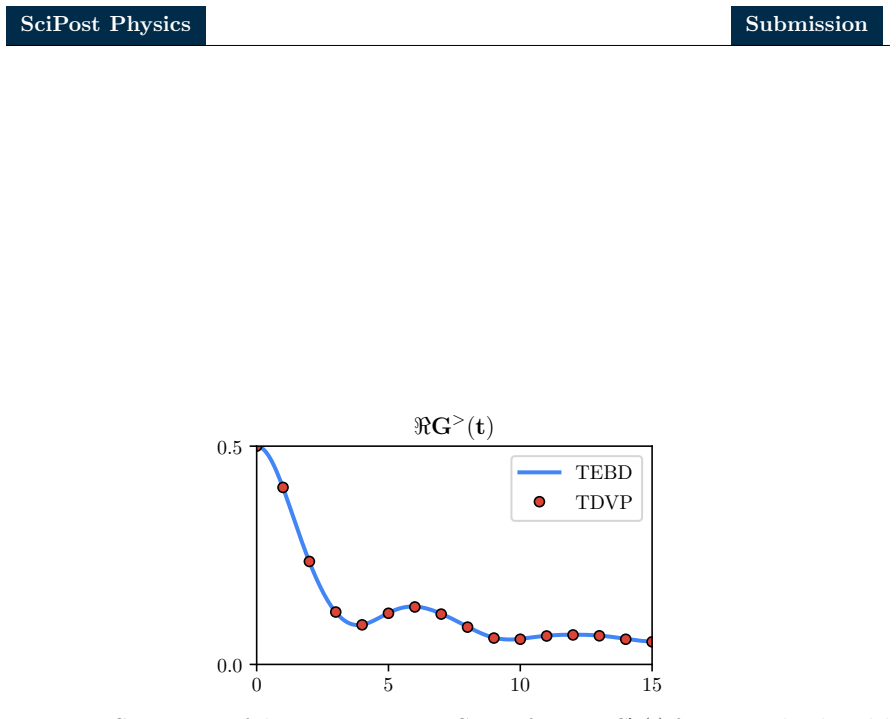
- [Fig. 10 caption] The caption reports TDVP with dt = 0.1 and TEBD with dt = 0.01 and notes that TDVP generally allows larger steps. A brief explanation of why this is the case for the present model, beyond citing Ref. [50], would help the reader.
Circularity Check
No significant circularity: the TTN tangent-space projector is derived from the Schrödinger equation and linear algebra, and the numerical tests are benchmarked against independent TEBD and exact-diagonalization results.
full rationale
The central derivation is self-contained. Equation (15) is obtained from the tangent-space parameterization in Eq. (7), the vertical-subspace characterization in Eq. (9), the gauge-fixing constraints in Eq. (10), and the minimization problem in Eqs. (12)-(14); no fitted quantity or external target is used to produce the projector. The single-site and two-site TDVP updates are then obtained by Trotterized integration of the projected Schrödinger equation, Eq. (6), which is again a direct construction rather than a restatement of an input. The numerical demonstrations compare TDVP against TEBD (Fig. 10) and against exact diagonalization in the non-interacting case (Fig. 11), with convergence checks in Fig. 12, so the reported agreement is verified against independent references rather than encoded in the derivation. Self-citations appear for the FTPS tensor-network construction (Refs. [18,19]) and for a prior performance comparison (Ref. [50]), but these are contextual or comparative and are not load-bearing for the claimed generalization of TDVP to arbitrary TTNs. A skeptical concern about whether Eq. (9) correctly parameterizes the vertical subspace for non-binary or high-degree trees is a mathematical-correctness issue, not a circularity issue: the equation is not derived from the final projector, and if it were false the derivation would be invalid rather than tautological. Therefore no circular step is identified.
Assumptions & free parameters
assumptions (6)
- standard math SVD and QR decompositions provide orthonormal bases for the orthogonalization and Schmidt truncation steps.
- standard math The Trotter-Suzuki decomposition can split the sum of local terms in the tangent-space projector into a sequence of exponentials.
- standard math Krylov subspace methods approximate the action of the matrix exponential accurately enough for the effective Hamiltonians.
- standard math For a finite tree with N sites and N-1 links, the local gauge constraints in Eq. 10 determine the L=N-1 link matrices uniquely.
- domain assumption The Hamiltonian admits a tensor network representation with the same loop-free structure as the state.
- domain assumption Every tensor in the TTN carries a physical index, or can be treated with a dummy single-state index.
Cite this review
Pith. "Pith review of Time Dependent Variational Principle for Tree Tensor Networks." pith.science (2026). https://pith.science/paper/ZHROH27E
@misc{pith2026190803090,
  author       = {Pith},
  title        = {Pith review of: Time Dependent Variational Principle for Tree Tensor Networks},
  year         = {2026},
  howpublished = {\url{https://pith.science/paper/ZHROH27E}},
  note         = {Machine review of arXiv:1908.03090}
}
read the original abstract
We present a generalization of the Time Dependent Variational Principle (TDVP) to any finite sized loop-free tensor network. The major advantage of TDVP is that it can be employed as long as a representation of the Hamiltonian in the same tensor network structure that encodes the state is available. Often, such a representation can be found also for long-range terms in the Hamiltonian. As an application we use TDVP for the Fork Tensor Product States tensor network for multi-orbital Anderson impurity models. We demonstrate that TDVP allows to account for off-diagonal hybridizations in the bath which are relevant when spin-orbit coupling effects are important, or when distortions of the crystal lattice are present.
Figures


Figures from the paper (10 more)




Reference graph
Works this paper leans on
-
[29]
J. Haegeman, C. Lubich, I. Oseledets, B. Vandereycken and F. Verstraete, Unifying time evolution and optimization with matrix product states , Phys. Rev. B 94, 165116 (2016), doi:10.1103/PhysRevB.94.165116
-
[1]
S. R. White, Density matrix formulation for quantum renormalization groups , Phys. Rev. Lett. 69, 2863 (1992), doi:10.1103/PhysRevLett.69.2863
-
[2]
Schollw¨ ock, The density-matrix renormalization group in the age of matrix product states, Ann
U. Schollw¨ ock, The density-matrix renormalization group in the age of matrix product states, Ann. Phys. 326, 96 (2011), doi:10.1016/j.aop.2010.09.012
-
[3]
S. ¨Ostlund and S. Rommer, Thermodynamic limit of density matrix renormalization , Phys. Rev. Lett. 75, 3537 (1995), doi:10.1103/PhysRevLett.75.3537. 20 SciPost Physics Submission
-
[4]
J. Dukelsky, M. A. Martin-Delgado, T. Nishino and G. Sierra, Equivalence of the vari- ational matrix product method and the density matrix renormalization group applied to spin chains, EPL (Europhysics Letters) 43(4), 457 (1998)
work page 1998
-
[5]
F. Verstraete and J. I. Cirac, Renormalization algorithms for Quantum-Many Body Systems in two and higher dimensions , arXiv e-prints cond-mat/0407066 (2004), cond-mat/0407066
arXiv 2004
-
[6]
V. Murg, F. Verstraete and J. I. Cirac, Variational study of hard-core bosons in a two- dimensional optical lattice using projected entangled pair states, Phys. Rev. A 75, 033605 (2007), doi:10.1103/PhysRevA.75.033605
-
[7]
Vidal, Entanglement renormalization , Phys
G. Vidal, Entanglement renormalization , Phys. Rev. Lett. 99, 220405 (2007), doi:10.1103/PhysRevLett.99.220405
Show all 51 references
-
[8]
M. A. Mart´ ın-Delgado, J. Rodriguez-Laguna and G. Sierra, Density-matrix renormalization-group study of excitons in dendrimers , Phys. Rev. B 65, 155116 (2002), doi:10.1103/PhysRevB.65.155116
2002 doi
-
[9]
Depenbrock and F
S. Depenbrock and F. Pollmann, Phase diagram of the isotropic spin- 3 2 model on the z = 3 bethe lattice, Phys. Rev. B 88, 035138 (2013), doi:10.1103/PhysRevB.88.035138
2013 doi
-
[10]
Otsuka, Density-matrix renormalization-group study of the spin- 1 2 XXZ antiferromag- net on the bethe lattice, Phys
H. Otsuka, Density-matrix renormalization-group study of the spin- 1 2 XXZ antiferromag- net on the bethe lattice, Phys. Rev. B 53, 14004 (1996), doi:10.1103/PhysRevB.53.14004
1996 doi
-
[11]
B. Friedman, A density matrix renormalization group approach to interacting quantum systems on cayley trees , Journal of Physics: Condensed Matter 9(42), 9021 (1997), doi:10.1088/0953-8984/9/42/016
1997 doi
-
[12]
Gerster, P
M. Gerster, P. Silvi, M. Rizzi, R. Fazio, T. Calarco and S. Montangero, Unconstrained tree tensor network: An adaptive gauge picture for enhanced performance , Phys. Rev. B 90, 125154 (2014), doi:10.1103/PhysRevB.90.125154
2014 doi
-
[13]
Silvi, V
P. Silvi, V. Giovannetti, S. Montangero, M. Rizzi, J. I. Cirac and R. Fazio, Homogeneous binary trees as ground states of quantum critical hamiltonians , Phys. Rev. A 81, 062335 (2010), doi:10.1103/PhysRevA.81.062335
2010 doi
-
[14]
V. Murg, F. Verstraete, O. Legeza and R. M. Noack, Simulating strongly corre- lated quantum systems with tree tensor networks , Phys. Rev. B 82, 205105 (2010), doi:10.1103/PhysRevB.82.205105
2010 doi
-
[15]
Gunst, F
K. Gunst, F. Verstraete, S. Wouters, ¨O. Legeza and N. D. Van, T3ns: Three-legged tree tensor network states, Journal of Chemical Theory and Computation 14(4), 2026 (2018), doi:https://doi.org/10.1021/acs.jctc.8b00098, Doi: 10.1021/acs.jctc.8b00098
2018 doi
-
[16]
Tagliacozzo, G
L. Tagliacozzo, G. Evenbly and G. Vidal,Simulation of two-dimensional quantum systems using a tree tensor network that exploits the entropic area law , Phys. Rev. B 80, 235127 (2009), doi:10.1103/PhysRevB.80.235127
2009 doi
-
[17]
Shi, L.-M
Y.-Y. Shi, L.-M. Duan and G. Vidal, Classical simulation of quantum many- body systems with a tree tensor network , Phys. Rev. A 74, 022320 (2006), doi:10.1103/PhysRevA.74.022320. 21 SciPost Physics Submission
2006 doi
-
[18]
Bauernfeind, M
D. Bauernfeind, M. Zingl, R. Triebl, M. Aichhorn and H. G. Evertz, Fork tensor-product states: Efficient multiorbital real-time dmft solver , Phys. Rev. X 7, 031013 (2017), doi:10.1103/PhysRevX.7.031013
2017 doi
-
[19]
Bauernfeind, Fork Tensor Product States: Efficient Multi-Orbital Impurity Solver for Dynamical Mean Field Theory , dissertation, Graz University of Technology (2018)
D. Bauernfeind, Fork Tensor Product States: Efficient Multi-Orbital Impurity Solver for Dynamical Mean Field Theory , dissertation, Graz University of Technology (2018)
2018
-
[20]
Eisert, M
J. Eisert, M. Cramer and M. B. Plenio, Colloquium, Rev. Mod. Phys. 82, 277 (2010), doi:10.1103/RevModPhys.82.277
2010 doi
-
[21]
and Gogolin C., Quantum many-body systems out of equi- librium, Nature Physics 11, 124 (2015), doi:https://doi.org/10.1038/nphys3215 10.1038/nphys3215
Eisert J., Friesdorf M. and Gogolin C., Quantum many-body systems out of equi- librium, Nature Physics 11, 124 (2015), doi:https://doi.org/10.1038/nphys3215 10.1038/nphys3215
2015 doi
-
[22]
Gruber and V
M. Gruber and V. Eisler, Magnetization and entanglement after a geometric quench in the XXZ chain , arXiv e-prints arXiv:1902.05834 (2019), 1902.05834
2019 arXiv
-
[23]
Eisler and D
V. Eisler and D. Bauernfeind, Front dynamics and entanglement in the xxz chain with a gradient, Phys. Rev. B 96, 174301 (2017), doi:10.1103/PhysRevB.96.174301
2017 doi
-
[24]
Collura, A
M. Collura, A. De Luca and J. Viti, Analytic solution of the domain-wall nonequilibrium stationary state, Phys. Rev. B 97, 081111 (2018), doi:10.1103/PhysRevB.97.081111
2018 doi
-
[25]
A. J. Daley, C. Kollath, U. Schollw¨ ock and G. Vidal, Time-dependent density-matrix renormalization-group using adaptive effective hilbert spaces , Journal of Statistical Me- chanics: Theory and Experiment 2004(04), P04005 (2004)
2004
-
[26]
S. R. White and A. E. Feiguin, Real-time evolution using the density matrix renormal- ization group, Phys. Rev. Lett. 93, 076401 (2004), doi:10.1103/PhysRevLett.93.076401
2004 doi
-
[27]
Vidal, Efficient Classical Simulation of Slightly Entangled Quantum Computations , Phys
G. Vidal, Efficient Classical Simulation of Slightly Entangled Quantum Computations , Phys. Rev. Lett. 91, 147902 (2003), doi:10.1103/PhysRevLett.91.147902
2003 doi
-
[28]
Vidal, Efficient simulation of one-dimensional quantum many-body systems , Phys
G. Vidal, Efficient simulation of one-dimensional quantum many-body systems , Phys. Rev. Lett. 93, 040502 (2004), doi:10.1103/PhysRevLett.93.040502
2004 doi
-
[30]
Haegeman, J
J. Haegeman, J. I. Cirac, T. J. Osborne, I. Piˇ zorn, H. Verschelde and F. Verstraete, Time-Dependent Variational Principle for Quantum Lattices , Phys. Rev. Lett. 107(7), 070601 (2011), doi:10.1103/PhysRevLett.107.070601
2011 doi
-
[31]
Lubich, I
C. Lubich, I. V. Oseledets and B. Vandereycken, Time integration of tensor trains , SIAM Journal on Numerical Analysis 53(2), 917 (2015), doi:10.1137/140976546, https: //doi.org/10.1137/140976546
2015 doi
-
[32]
Paeckel, T
S. Paeckel, T. K¨ ohler, A. Swoboda, S. R. Manmana, U. Schollw¨ ock and C. Hubig,Time- evolution methods for matrix-product states , arXiv preprint arXiv:1901.05824 (2019). 22 SciPost Physics Submission
2019 arXiv
-
[33]
Rizzi, S
M. Rizzi, S. Montangero and G. Vidal, Simulation of time evolution with mul- tiscale entanglement renormalization ansatz , Phys. Rev. A 77, 052328 (2008), doi:10.1103/PhysRevA.77.052328
2008 doi
-
[34]
H. N. Phien, I. P. McCulloch and G. Vidal, Fast convergence of imaginary time evolution tensor network algorithms by recycling the environment, Phys. Rev. B 91, 115137 (2015), doi:10.1103/PhysRevB.91.115137
2015 doi
-
[35]
Hubig and J
C. Hubig and J. I. Cirac, Time-dependent study of disordered models with infinite projected entangled pair states , SciPost Phys. 6, 31 (2019), doi:10.21468/SciPostPhys.6.3.031
2019 doi
-
[36]
Czarnik, J
P. Czarnik, J. Dziarmaga and P. Corboz, Time evolution of an infinite projected entangled pair state: An efficient algorithm , Phys. Rev. B 99, 035115 (2019), doi:10.1103/PhysRevB.99.035115
2019 doi
-
[37]
W. Li, J. von Delft and T. Xiang, Efficient simulation of infinite tree tensor network states on the bethe lattice , Phys. Rev. B 86, 195137 (2012), doi:10.1103/PhysRevB.86.195137
2012 doi
-
[38]
Nagaj, E
D. Nagaj, E. Farhi, J. Goldstone, P. Shor and I. Sylvester, Quantum transverse-field ising model on an infinite tree from matrix product states , Phys. Rev. B 77, 214431 (2008), doi:10.1103/PhysRevB.77.214431
2008 doi
-
[39]
Suzuki, Fractal decomposition of exponential operators with applications to many-body theories and Monte Carlo simulations , Physics Letters A 146(6), 319 (1990)
M. Suzuki, Fractal decomposition of exponential operators with applications to many-body theories and Monte Carlo simulations , Physics Letters A 146(6), 319 (1990)
1990
-
[40]
Meyer, U
H.-D. Meyer, U. Manthe and L. Cederbaum, The multi-configurational time- dependent hartree approach , Chemical Physics Letters 165(1), 73 (1990), doi:https://doi.org/10.1016/0009-2614(90)87014-I
1990 doi
-
[41]
Manthe, H
U. Manthe, H. Meyer and L. S. Cederbaum, Wave-packet dynamics within the multi- configuration hartree framework: General aspects and application to nocl , The Journal of Chemical Physics 97(5), 3199 (1992), doi:10.1063/1.463007, https://doi.org/10. 1063/1.463007
1992 doi
-
[42]
U. Manthe, A multilayer multiconfigurational time-dependent hartree approach for quan- tum dynamics on general potential energy surfaces , The Journal of Chemical Physics 128(16), 164116 (2008), doi:10.1063/1.2902982, https://doi.org/10.1063/1.2902982
2008 doi
-
[43]
Manthe, Wavepacket dynamics and the multi-configurational time-dependent hartree approach , Journal of Physics: Condensed Matter 29(25), 253001 (2017), doi:10.1088/1361-648x/aa6e96
U. Manthe, Wavepacket dynamics and the multi-configurational time-dependent hartree approach , Journal of Physics: Condensed Matter 29(25), 253001 (2017), doi:10.1088/1361-648x/aa6e96
2017 doi
-
[44]
M. P. Zaletel, R. S. K. Mong, C. Karrasch, J. E. Moore and F. Pollmann, Time-evolving a matrix product state with long-ranged interactions , Phys. Rev. B 91, 165112 (2015), doi:10.1103/PhysRevB.91.165112
2015 doi
-
[45]
M. M. Rams and M. Zwolak, Breaking the entanglement barrier: Tensor network simu- lation of quantum transport , arXiv e-prints arXiv:1904.12793 (2019), 1904.12793. 23 SciPost Physics Submission
2019 arXiv
-
[46]
F. A. Y. N. Schr¨ oder and A. W. Chin, Simulating open quantum dynamics with time- dependent variational matrix product states: Towards microscopic correlation of envi- ronment dynamics and reduced system evolution , Phys. Rev. B 93, 075105 (2016), doi:10.1103/PhysRevB.93.075105
2016 doi
-
[47]
Lubich, T
C. Lubich, T. Rohwedder, R. Schneider and B. Vandereycken, Dynamical approximation by hierarchical tucker and tensor-train tensors , SIAM Journal on Matrix Analysis and Applications 34(2), 470 (2013), doi:10.1137/120885723, https://doi.org/10.1137/ 120885723
2013 doi
-
[48]
Silvi, F
P. Silvi, F. Tschirsich, M. Gerster, J. J¨ unemann, D. Jaschke, M. Rizzi and S. Montangero, The Tensor Networks Anthology: Simulation techniques for many-body quantum lattice systems, SciPost Phys. Lect. Notes p. 8 (2019), doi:10.21468/SciPostPhysLectNotes.8
2019 doi
-
[49]
Kanamori, Electron correlation and ferromagnetism of transition metals , Progress of Theoretical Physics 30(3), 275 (1963), doi:10.1143/PTP.30.275
J. Kanamori, Electron correlation and ferromagnetism of transition metals , Progress of Theoretical Physics 30(3), 275 (1963), doi:10.1143/PTP.30.275
1963 doi
-
[50]
Bauernfeind, M
D. Bauernfeind, M. Aichhorn and H. G. Evertz, Comparison of MPS based real time evolution algorithms for Anderson Impurity Models , arXiv e-prints arXiv:1906.09077 (2019), 1906.09077
2019 arXiv
-
[51]
L. Kohn, P. Silvi, M. Gerster, M. Keck, R. Fazio, G. E. Santoro and S. Montangero, Superfluid to Mott transition in a Bose-Hubbard ring: Persistent currents and defect formation, arXiv e-prints arXiv:1907.00009 (2019), 1907.00009. 24
2019 arXiv
Reviewed August 14, 2026 · model on record in the stance chip above.
Discussion (0). Continue with ORCID to comment.