REVIEW 4 major objections 7 minor 36 references
Mode-Locked Rotating Detonation Waves: Experiments and a Model Equation
T0 review · 4 major / 7 minor · reviewed 2026-08-14 · deepseek-v4-flash
Pith's one-line read Rotating detonation waves are mode-locked states of a driven-dissipative medium, and a one-dimensional model reproduces their observed bifurcations.
desk verdict A useful reduced-order RDE model with a real overreach in the causal claim; the mode-locking analogy is worth taking seriously. read the letter →
The pith
A machine-rendered reading of the paper's core claim, the machinery that carries it, and where it could break.
The reading
What carries the argument
The engine of the argument is a reaction-convection equation for a state $u(x,t)$ (weakly related to density and velocity) and a combustion progress variable $\lambda$, with $u_t + uu_x = (1-\lambda)\omega(u)q_0 + \nu u_{xx} + \epsilon\xi(u,u_0)$ and $\lambda_t = (1-\lambda)\omega(u) - \beta(u,u_p,s)\lambda$ on a one-dimensional periodic domain. Heat release follows a simplified Arrhenius form with an ignition threshold, dissipation acts as a diffusion plus a generic restoring loss, and gain recovery is modeled by an activation-function injector term that is suppressed when the detonation raises the local state, capturing injector blockage and backflow. The key move is recasting the detonation analog as an autowave—a self-sustained wave whose properties are set by the medium rather than initial conditions—so the fronts become attractors of the engine. The mechanism that drives mode-locking is the nonlocal communication established when detonation fronts modulate the injection, allowing waves to exchange strength and phase dispersively until they settle into symmetric, mode-locked configurations.
What would settle it
Run a controlled RDE with continuous ramps of injector area at fixed plenum pressure while recording wave count, speed, and phase differences: the model predicts a staircase of wave-count transitions with mode-locking transients and, for nonlinear losses, a period-halving cascade near the one-to-two wave boundary. A second check: compare integrated pixel luminosity against independent heat-release or pressure measurements; if brightness does not track combustion progress, the experimental foundation for the model comparison is gone.
Extended reading notes
Core claim
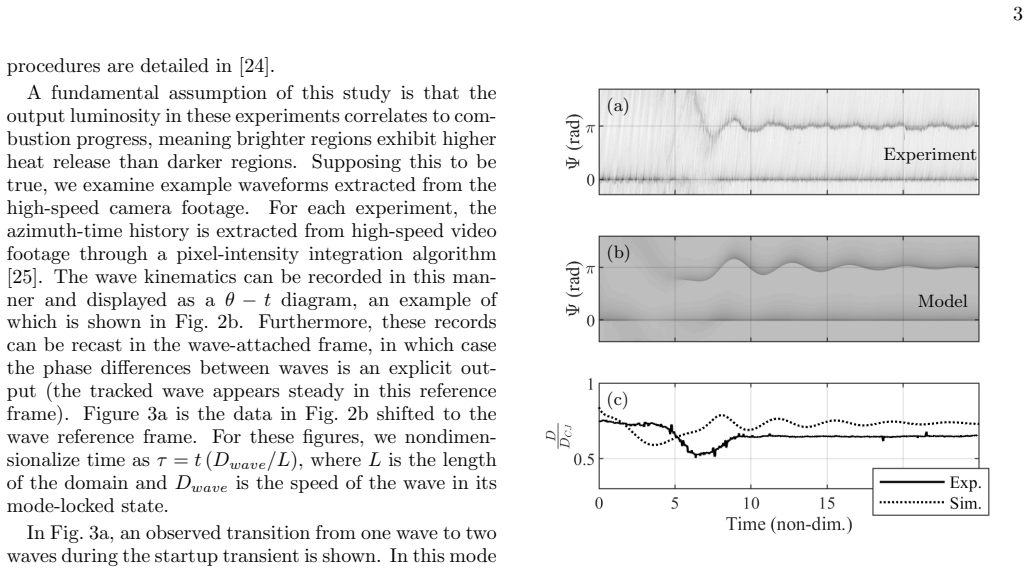
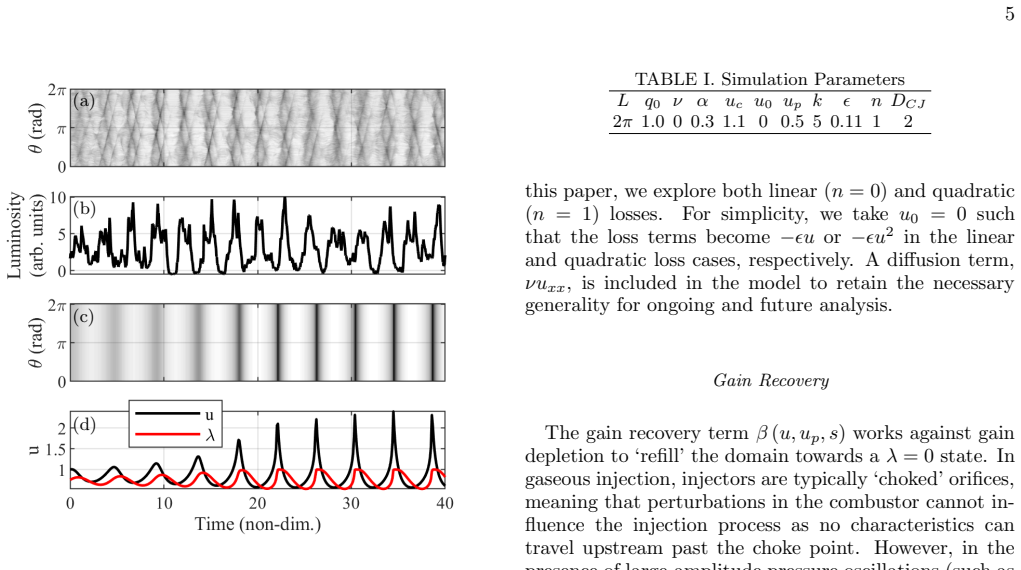
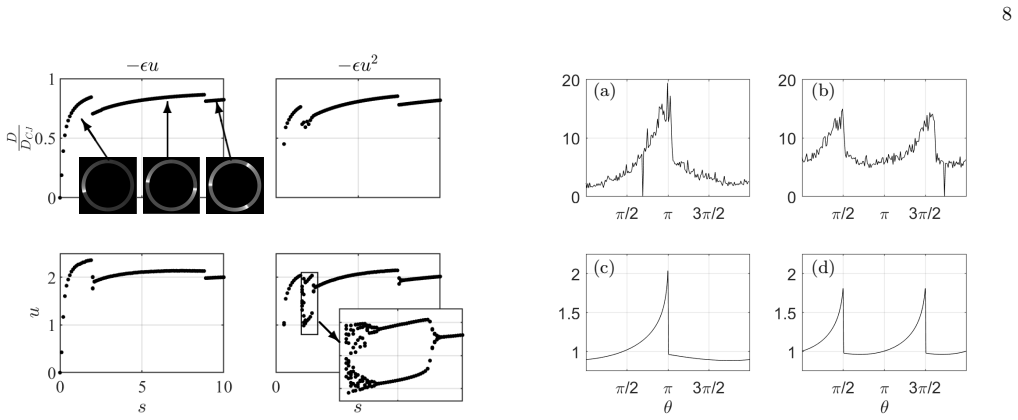
The central claim is that rotating detonation waves are mode-locked states of an autowave equation: the traveling shock fronts are attractors selected by the balance among heat release, finite-rate propellant refill, and dissipation, just as pulses in a mode-locked laser are selected by gain and loss dynamics. The experimental records—phase-asymmetric two-wave startup transients, exponential growth of phase-difference oscillations leading to wave overrun on fuel ramp-down, periodic amplitude and speed modulation with spectral sidebands, and pulsating plane waves—each have a counterpart in simulations of the model. The model is not offered as an engineering predictor but as a demonstration that gain depletion, gain recovery, and loss are the dominant balance physics behind the observed bifurcation structure, including a period-halving cascade and chaotic regimes in the transition from one to two waves.
Load-bearing premise
The load-bearing premise is that luminosity in the high-speed camera frames faithfully tracks combustion progress, so the extracted wave speeds and phase differences are real detonation dynamics rather than imaging artifacts.
Editorial extensions
If this is right
- Wave count, wave speed, and amplitude in an RDE are controlled by a single bifurcation parameter, the propellant injection and mixing rate $s$: increasing $s$ increases the number of waves along a staircase of decreasing wave speeds.
- Because the dynamics are generic driven-dissipative energy balance, the same mathematical structure applies to mode-locked lasers, and the model’s bifurcation diagrams are shared with laser cavities, including chaotic inter-pulse regimes.
- Injector coupling is the communication pathway: detonation fronts modulate injection through the activation function, establishing long-range interaction between waves that lets them behave dispersively and mode-lock.
- Stability criteria for RDE operation can be derived directly from the model, since the bifurcation boundaries in $s$ and loss $\epsilon$ are explicit outputs.
- Strengthening the loss/restoring force increases wave speed relative to the Chapman–Jouguet value and suppresses multi-wave branching, because it clears the chamber of hot products and restores the ambient state.
Reading between the lines
- If the luminosity proxy holds, the model’s qualitative match suggests that observed “mode transitions” are deterministic bifurcations, not stochastic ignition events, meaning a fast feedback controller on injector area or plenum pressure could hold an engine on a desired branch.
- A testable extension, not in the paper, is that the model’s predicted period-halving cascade and chaotic bistability in the one-to-two wave transition could be sought experimentally by a slow continuous ramp of injector area with fixed plenum pressure, tracking phase differences and spectra.
- The mode-locked-laser analogy hints that external periodic modulation of the injection—acting like a saturable absorber for the engine—might suppress chaotic regimes or lock a chosen wave count; this is an inference beyond the paper’s tests.
- The background luminosity, interpreted as para-wave deflagration, is effectively a measurable state variable in the model; tracking it separately from the bright fronts would give a direct experimental check of whether the slow restoring-force mechanism is real.
Signed reviews
Editorial analysis
A structured set of objections, weighed in public.
Referee Report
Summary. The paper presents high-speed-camera observations of rotating detonation waves in an optically accessible RDE and introduces a reduced-order PDE model based on the Majda detonation analog. The model adds heat release, dissipation, and an injector-recovery term to the Burgers-like equation, and numerical solutions reproduce qualitatively several experimentally observed regimes: wave nucleation, mode-locking, wave destruction, speed modulation, and pulsating plane waves. The authors argue that the dominant physics is the balance of gain depletion, gain recovery, and dissipation, and that injector–detonation coupling provides the communication pathway between waves, analogous to mode-locked lasers.
Significance. The paper's strength is in connecting a broad phenomenology of RDE instabilities to a single simple model and to the broader literature on driven-dissipative systems. Direct experimental kinematics at high spatiotemporal resolution are a valuable dataset, and the explicit statement that the model is not intended for engineering prediction is commendable. However, the central causal claim about injector coupling is assumed in the model equations rather than independently tested, and the experimental-model comparison remains qualitative, with hand-chosen parameters and no uncertainty quantification. The significance of the work would be substantially increased by an ablation-type numerical experiment, a quantitative comparison on selected observables, and a validation of the luminosity proxy.
major comments (4)
- [§V.A, Eq. (4)] The causal conclusion that injector–detonation coupling 'drives the observed dynamics' is built into the model rather than tested. Because β(u,s)=s/(1+e^{k(u-u_p)}) is a decreasing sigmoid of u, every traveling-wave solution necessarily involves state-dependent injection; the dispersive phase dynamics in Figs. 3–5 are therefore a consequence of the assumed feedback, not evidence for it. To make the causal claim credible, the authors should show that removing or weakening the coupling (e.g., k=0 or β=const) eliminates or fundamentally changes nucleation, destruction, and modulation, and should ideally support the mechanism with direct plenum-pressure or mass-flow fluctuation measurements synchronized with the luminosity records.
- [§II] The experimental foundation rests on the unvalidated assumption that output luminosity correlates with combustion progress. Wave kinematics, phase differences, and amplitudes are extracted from high-speed camera frames, yet no calibration, no simultaneous pressure measurement, and no uncertainty quantification are reported. Camera nonlinearity or saturation alone could alter the inferred wave speeds and amplitudes. The authors should provide at least one independent validation of the luminosity proxy and error bars on the tracked quantities that enter the qualitative comparisons in Figs. 3–6.
- [§IV, Table I] The model parameters in Table I are chosen by hand, and the comparison between experiment and simulation is solely qualitative. While the side-by-side figures are evocative, the text reports no quantitative measures of oscillation period, growth rate, wave-speed ratios, or bifurcation thresholds, and the many free parameters make qualitative agreement easy to achieve. The claim that the model 'recovers the nonlinear dynamics and bifurcation structure' would be much better supported by a quantitative comparison on one or two selected cases (e.g., phase-difference oscillation frequency and growth rate in Fig. 4 or the wave-speed drop upon a 1→2 transition), together with a robustness scan over injection parameters.
- [§III, §V.B] The physical correspondence between the model variable u and measured experimental quantities is not specified. The paper states that u holds only 'weak relationships to density and velocity,' yet in §V.B the model wave speed is compared quantitatively to the Chapman–Jouguet speed, and in §IV a speed of '117% of the CJ speed' is reported. Without a concrete mapping from u to luminosity or velocity, these percentages are not physically meaningful. Please specify the mapping (or state explicitly that the comparison is only in nondimensional relative terms) and adjust the claims accordingly.
minor comments (7)
- [Abstract] The abstract contains a typo: 'denotative energy release' should read 'detonative energy release.'
- [Section III heading] The section heading 'A QUALIT A TIVE MODEL' contains a spacing error and should read 'A QUALITATIVE MODEL.'
- [Figure 9 caption] The caption contains stray LaTeX artifacts ('J JJ ] 6 C C C O @@ R') that should be removed.
- [§IV, first paragraph] The notation 'βλ' is not defined; it should be written as 'β(u,s)λ' or the arguments should be supplied consistently.
- [Introduction/§II] The term 'mode-locked' is used from the abstract onward but is never formally defined for the detonation context; please add a definition when the wave-attached frame is introduced in §II.
- [§III] The phrase 'In the opinion of the authors' is informal for a research paper; consider rephrasing as a factual statement about the model construction.
- [§III, Table I] Table I lists ν=0, yet the text in §III describes the diffusion term νuxx as part of the dissipation; please clarify whether any runs use a nonzero ν.
Circularity Check
No significant circularity: the model is a proposed analog, not a fit, and the simulations are emergent results.
full rationale
The paper's central contribution is a reduced-order PDE model (Eqs. 1-4) that is explicitly proposed, not derived from the experimental luminosity records. The simulations in Sec. IV are genuine emergent results: the initial sech-pulse or planar initial conditions evolve under the PDE, and the observed nucleation, mode-locking, destruction, modulation, and pulsation are not encoded in the equations by construction. The parameters in Table I are fixed generic constants rather than fitted to the experimental kinematics, so there is no fitted-input-renamed-as-prediction. The V.A 'communication pathway' conclusion attributes the model's dispersive dynamics to the beta(u) injection coupling that is present in Eq. (4); this is a mechanistic interpretation of a simulation, and the paper itself labels the persistence of the underlying physical principles as a hypothesis. A proper ablation test or direct plenum-coupling measurement would strengthen causality, but the absence of such a test is an evidence limitation, not a circular derivation. The self-citations [9,24,33] are background apparatus descriptions and laser-mode-locking analogies; none carries a uniqueness theorem or a parameter that was fitted here. Hence no claim in the paper reduces by construction to its own inputs.
Assumptions & free parameters
free parameters (10)
- q0 =
1
- alpha =
0.3
- uc =
1.1
- u0 =
0
- up =
0.5
- k =
5
- epsilon =
0.11
- n =
1
- s =
varied (e.g., 2, 3.5, sweeps)
- nu =
0
assumptions (6)
- domain assumption Luminosity in the high-speed camera frames correlates with combustion progress (heat release).
- domain assumption The Majda detonation analog is a sufficient starting point for modeling RDE wave dynamics.
- ad hoc to paper The chosen functional forms for heat release, loss, and injection are the simplest viable representations of the physics.
- domain assumption Injector coupling via the activation function is the only long-range communication pathway between waves considered.
- standard math Standard numerical assumptions for the PyClaw finite volume scheme and grid convergence.
- domain assumption The reduced-system Rankine-Hugoniot CJ speed formula is valid for the model.
Cite this review
Pith. "Pith review of Mode-Locked Rotating Detonation Waves: Experiments and a Model Equation." pith.science (2026). https://pith.science/paper/63INRNH5
@misc{pith2026190803116,
  author       = {Pith},
  title        = {Pith review of: Mode-Locked Rotating Detonation Waves: Experiments and a Model Equation},
  year         = {2026},
  howpublished = {\url{https://pith.science/paper/63INRNH5}},
  note         = {Machine review of arXiv:1908.03116}
}
read the original abstract
Direct observation of a Rotating Detonation Engine combustion chamber has enabled the extraction of the kinematics of its detonation waves. These records exhibit a rich set of instabilities and bifurcations arising from the interaction of coherent wave fronts and global gain dynamics. We develop a model of the observed dynamics by recasting the Majda detonation analog as an autowave. The solution fronts become attractors of the engine; i.e., mode-locked rotating detonation waves. We find that detonative energy release competes with dissipation and gain recovery to produce the observed dynamics and a bifurcation structure common to driven-dissipative systems, such as mode-locked lasers.
Figures


Figures from the paper (6 more)




Reference graph
Works this paper leans on
-
[1]
B. A. Rankin, M. L. Fotia, A. G. Naples, C. A. Stevens, J. L. Hoke, T. A. Kaemming, S. W. Theuerkauf, and F. R. Schauer, J. Prop. Power 33, 131 (2017)
work page 2017
-
[2]
C. A. Nordeen, D. Schwer, F. Schauer, J. Hoke, T. Bar- ber, and B. Cetegen, Combustion, Explosion, and Shock Waves 50, 568 (2014)
work page 2014
- [3]
- [4]
-
[5]
J. W. Bennewitz, B. R. Bigler, J. J. Pilgram, and W. A. Hargus, Int. J. Ener. Mat. Chem. Prop. 18, 91 (2019)
work page 2019
- [6]
-
[7]
H. A. Haus, IEEE J. Sel. Top. Quan. Elec.6, 1173 (2000)
work page 2000
-
[8]
The wave steepens and forms a detonation
Because the initial sech-pulse is well above uc, the medium locally and rapidly releases heat. The wave steepens and forms a detonation. This initial pulse trav- els at the CJ speed until it reaches its tail, at which point the wave begins to rapidly dissipate: the limited amount of gain recovery cannot sustain the CJ wave. Ad- ditionally, the rapid heat ...
Show all 36 references
-
[9]
F. Li, P. Wai, and J. N. Kutz, JOSA B 27, 2068 (2010)
2010
-
[10]
R. E. Cullen, J. A. Nicholls, and K. W. Ragland, J. Spacecraft and Rockets 3, 893 (1966)
1966
-
[11]
Note that this is not an over-driven detonation but rather a reference to the CJ wave with a non-elevated ambient state of the domain (u0 = 0). VI. CONCLUSION The significance of the proposed model is twofold. First, although we claim no engineering predictive ca- pabilities, o...
-
[12]
J. N. Kutz, SIAM Review 48, 629 (2006)
2006
-
[13]
S. Liu, W. Liu, Z. Lin, and W. Lin, Combustion Science and Technology 187, 1790 (2015)
2015
-
[14]
F. A. Bykovskii, S. A. Zhdan, and E. F. Vedernikov, J. Prop. Power 22, 1204 (2006)
2006
-
[15]
Bohon, R
M. Bohon, R. Bluemner, C. Paschereit, and E. Gutmark, Experimental Thermal and Fluid Science 102, 28 (2019)
2019
-
[16]
Hishida, T
M. Hishida, T. Fujiwara, and P. Wolanski, Shock Waves 19, 1 (2009)
2009
-
[17]
Anand and E
V. Anand and E. Gutmark, Progress in Energy and Com- bustion Science 73, 182 (2019)
2019
-
[18]
Prakash, R
S. Prakash, R. Fi´ evet, V. Raman, J. Burr, and K. H. Yu, AIAA Journal , 1 (2019)
2019
-
[19]
Zhou and J.-P
R. Zhou and J.-P. Wang, Shock Waves 23, 461 (2013)
2013
-
[20]
Y.-T. Shao, M. Liu, and J.-P. Wang, Combustion Science and Technology 182, 1586 (2010). 10
2010
-
[21]
Schwer and K
D. Schwer and K. Kailasanath, Proc. Comb. Inst. 33, 2195 (2011)
2011
-
[22]
N. A. Adrian Ankiewicz, ed., Dissipative Solitons: From Optics to Biology and Medicine (Springer Berlin Heidel- berg, 2008)
2008
-
[23]
K. M. Spaulding, D. H. Yong, A. D. Kim, and J. N. Kutz, JOSA B 19, 1045 (2002)
2002
-
[24]
J. N. Kutz, Physica D: Nonlinear Phenomena 238, 1468 (2009)
2009
-
[25]
J. W. Bennewitz, B. R. Bigler, S. A. Schumaker, and W. A. Hargus, Review of Scientific Instruments 90, 065106 (2019)
2019
-
[26]
M. C. Cross and P. C. Hohenberg, Reviews of modern physics 65, 851 (1993)
1993
-
[27]
J. A. Boening, E. A. Wheeler, J. D. Heath, J. V. Koch, A. T. Mattick, R. E. Breidenthal, C. Knowlen, and M. Kurosaka, J. Prop. Power 34, 1364 (2018)
2018
-
[28]
These analyses typically oc- cur in the Lagrangian, shock-attached framework under assumptions of complete combustion
have enabled the rigorous mathematical description of detonation stability [29] and detonation dynamics in one (limit cycles and chaos) and two dimensions (cells and pattern formation). These analyses typically oc- cur in the Lagrangian, shock-attached framework under assumpti...
-
[29]
Fickett, in The Mathematics of Combustion (SIAM,
W. Fickett, in The Mathematics of Combustion (SIAM,
-
[30]
R. R. Rosales and A. Majda, SIAM J. Appl. Math. 43, 1086 (1983)
1983
-
[31]
L. M. Faria, A. R. Kasimov, and R. R. Rosales, J. Fluid Mech. 784, 163 (2015)
2015
-
[32]
Lyng and K
G. Lyng and K. Zumbrun, Physica D: Nonlinear Phe- nomena 194, 1 (2004)
2004
-
[33]
V. A. Vasilev, Y. M. Romanovskiii, and V. G. Yakhno, Soviet Physics Uspekhi 22, 615 (1979)
1979
-
[34]
B. S. Kerner and V. V. Osipov, Soviet Physics Uspekhi 32, 101 (1989)
1989
-
[35]
D. I. Ketcheson, K. Mandli, A. J. Ahmadia, A. Alghamdi, M. Q. de Luna, M. Parsani, M. G. Knepley, and M. Em- mett, SIAM Journal on Scientific Computing 34, C210 (2012)
2012
-
[36]
B. G. Bale, K. Kieu, J. N. Kutz, and F. Wise, Optics express 17, 23137 (2009)
2009
Reviewed August 14, 2026 · model on record in the stance chip above.
Discussion (0). Continue with ORCID to comment.