REVIEW 2 major objections 5 minor 32 references
CARL: Aggregated Search with Context-Aware Module Embedding Learning
T0 review · 2 major / 5 minor · reviewed 2026-08-14 · deepseek-v4-flash
Pith's one-line read Blue-link context lifts aggregated search accuracy by 38 percent
desk verdict A solid MDP-style aggregated search model with a genuinely context-aware embedding scheme, but the prose overstates the gains and the closed-loop context leaves the external-validity claim untested. read the letter →
The pith
A machine-rendered reading of the paper's core claim, the machinery that carries it, and where it could break.
The reading
What carries the argument
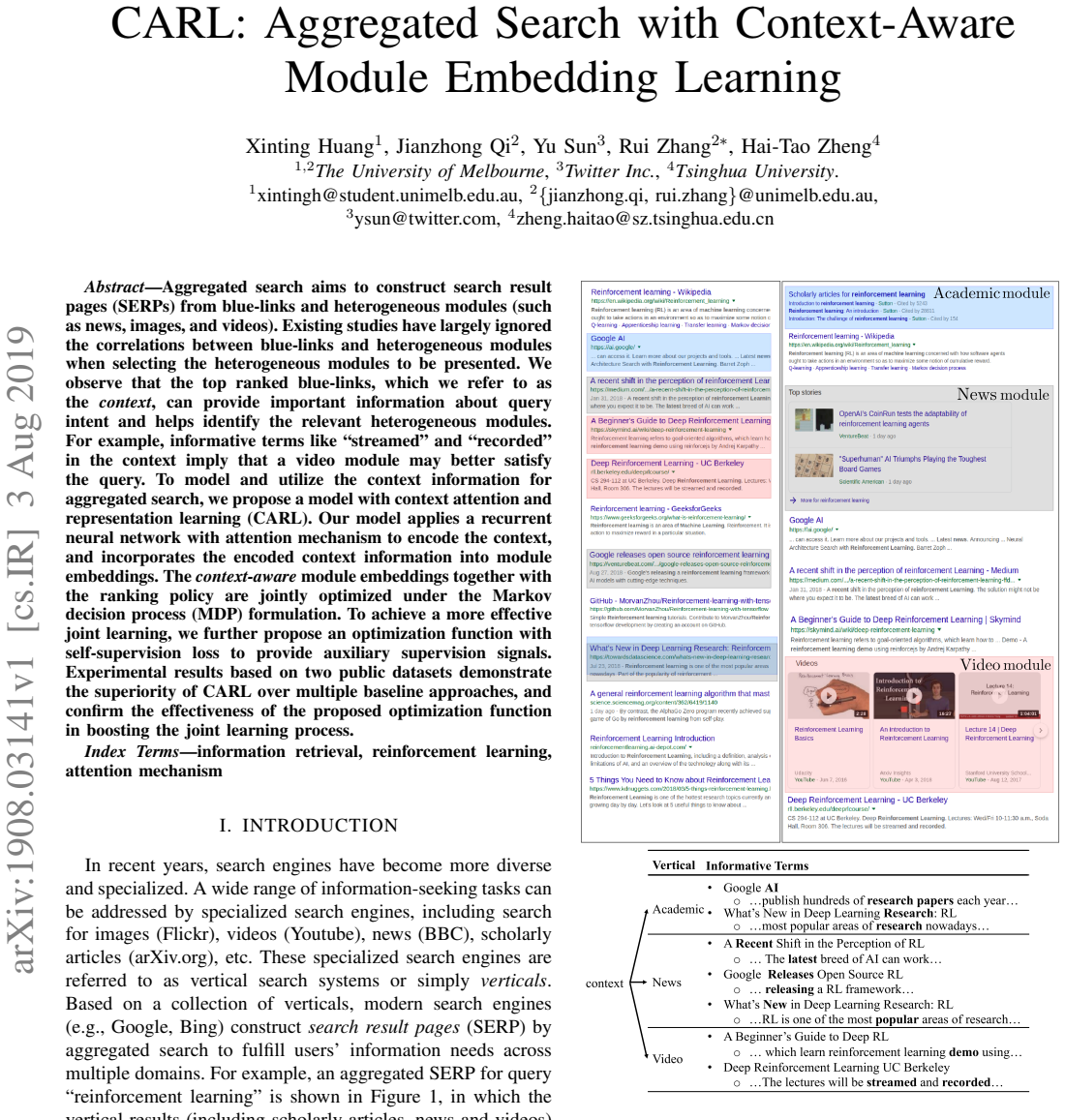
The central object is the pseudo module: for each vertical $v_i$, an attention-weighted combination of the hidden states produced by a GRU reading the context list, $c_i = \sum_{j=1}^{T_c} \alpha_{ij} o_j$, with $\alpha_{ij}$ computed from the query, the context item's hidden state, and a vertical-specific bias. It is called pseudo because it is not an actual module but a learned summary of what that vertical would look like given the query intent inferred from the context. This pseudo module is added to the vertical's projected content embedding $V_i m_i$ to make the module embedding context-aware. The same GRU encodes both the context and the growing result list, forcing the two representations into one semantic space; the policy scores each candidate item by the inner product of its embedding with the encoded state, and the whole system is trained by REINFORCE with an auxiliary self-supervised loss combining a vertical-prediction (inverse) task and a hidden-state-regularization (forward) task.
What would settle it
Run CARL with the context produced by a fixed, independent search engine's top results (for example, precomputed rankings from a strong learning-to-rank baseline) instead of its own policy, and compare SERP quality on the FedWeb13 and FedWeb14 datasets; if the advantage over non-context baselines disappears or reverses when the context comes from outside the model's own distribution, the central claim that context improves module selection would be falsified.
Extended reading notes
Core claim
On the paper's own terms, the central discovery is that treating the contextual blue-link list as a sequence and attending to it per-vertical produces module embeddings that are both informative and comparable, so a single policy can rank blue-links and heterogeneous modules together. The pseudo module $c_i$ for vertical $v_i$ is an attention-weighted sum of the GRU hidden states of the context list, with attention weights $\alpha_{ij}$ that blend the query, each context item, and the vertical. The final module embedding is $x_i = [c_i + V_i m_i]$, where $V_i m_i$ projects the vertical's content features into a common space. This embedding is learned jointly with the policy by maximizing cumulative reward (nDCG or ASDCG), aided by two self-supervised tasks: an inverse pass that predicts which vertical an added item came from, and a forward pass that regularizes the two parts of the embedding to stay comparable. The paper reports that this joint, context-aware model outperforms RankNet, LambdaMART, LTM, MDP-DIV, and DRM on all tested metrics, and that the self-supervision losses give a clear boost when training on click data.
Load-bearing premise
The load-bearing assumption is that the context list CARL learns from is sampled by CARL's own ranking policy, so the distribution of self-generated contexts matches what the model would see from a real general web engine in deployment; if that distribution shifts, the measured gains may not transfer.
Editorial extensions
If this is right
- Aggregated search can be cast as a single sequential decision problem with a unified policy over blue-links and modules, removing the need for a separate module-selection classifier.
- The context-attention weights give an interpretable view of which words in the top blue-links push the model toward each vertical, which could help diagnose or debug SERP construction.
- Because CARL is trained end-to-end on a reward metric, it can be steered toward different notions of SERP quality by swapping the reward function.
- With weak supervision from clicks, the self-supervised losses provide enough extra signal to keep the joint learning stable, suggesting the approach can be trained on logged user behavior.
- Sharing one GRU for context and result-list encoding implies the context representation is not a fixed pretrained vector but is continually adapted during policy learning.
Reading between the lines
- A natural extension is to draw the context from an independent general web engine rather than CARL's own policy; if the gains persist, the context signal is transferable, and if they shrink, the method may be overfitting to its own ranking distribution.
- The per-vertical attention could be repurposed as a query-intent classifier: the attention weights $\alpha_{ij}$ over context items are effectively a soft vertical selector, so the same architecture might serve cold-start verticals with little training data by sharing attention parameters.
- The inverse/forward self-supervision scheme is generic for heterogeneous item ranking and could be applied to other mixed-type ranking tasks, such as blending recommendations from multiple sources into one feed, wherever items have incomparable feature spaces.
Signed reviews
Editorial analysis
A structured set of objections, weighed in public.
Referee Report
Summary. The paper proposes CARL, an MDP-based model for aggregated search that jointly learns a ranking policy and context-aware module embeddings. A ranked list of blue-links (the context) is encoded by a GRU with vertical-specific attention to form a 'pseudo module' for each vertical; this pseudo module is combined with a vertical-specific projection of the module's content into a common embedding space, allowing heterogeneous blue-links and modules to be scored by a single softmax policy. Training uses REINFORCE with reward differences derived from nDCG or ASDCG/ASERR, plus inverse and forward self-supervised losses as auxiliary regularizers. Experiments on FedWeb13 and FedWeb14 under full and weak supervision compare CARL with RankNet, LambdaMART, LTM, MDP-DIV, and DRM, and include ablations on context sampling and on sharing the GRU between context encoding and SERP construction.
Significance. The paper addresses a genuine and under-studied problem: conventional aggregated search pipelines treat module selection and presentation independently and ignore the signal in the surrounding blue-link ranking. The proposed joint MDP formulation with context-attention module embeddings is coherent, and the self-supervised auxiliary losses are a reasonable way to stabilize embedding learning; these are not tautological or circular with respect to the evaluation metrics. The use of two public TREC datasets, 5-fold cross-validation, and paired t-tests is a strength. If the reported gains hold after the numerical corrections and after testing with a genuinely external context distribution, CARL would be a useful contribution to aggregated search. However, the current paper does not directly support the externally-facing claim that blue-links from a general web engine improve module selection, because the experiments use self-generated contexts; the quantitative claims in Section V.B are also inconsistent with the tables.
major comments (2)
- [Section V.B, Tables II and III] The percentage improvements reported in the text do not match the tables. For example, Table II gives FedWeb13 nDCG@5 as 0.4644 for CARL(nDCG) versus 0.4171 for DRM, a relative improvement of about 11.3%, not "more than 28.1%" as stated; ASDCG@10 for CARL(ASDCG) is 0.4327 versus 0.3648, a relative gain of about 18.6%, not 45.8%. The weak-supervision ablation numbers are also inconsistent: Table III gives FedWeb13 nDCG@10 as 0.4243 (CARL) versus 0.3877 (CARL without SSL), a gain of about 9.4%, not 13.0%, and FedWeb14 ASERR@10 as 0.3316 versus 0.2897, a gain of about 14.5%, not 18.9%. These are central quantitative claims, and the reported magnitudes are not reproducible from the tables.
- [Section IV.B and V.B] The context C used in both training and evaluation is generated by CARL's own ranking policy, not by an independent general web engine as motivated in Section I. Equation (6) defines C as the blue-link ranking "using the same policy function under the MDP framework," and Section V.B confirms this setup. The paper's motivating claim is that top blue-links from a production web engine carry query-intent signal, but the experiments only test the model on contexts produced by the model itself or by other rankers trained on the same FedWeb collections. This creates a distribution shift relative to deployment and leaves the externally-facing claim unsupported. Table IV shows that context quality affects performance, but it does not test an external engine's ranking distribution. I ask the authors either to evaluate with a held-out, independent context source (e.g., a fixed pre-trained ranker not updated during CARL training) or to explicitly restrict the claims to self-generated contexts.
minor comments (5)
- [Section IV.B, Eq. (5)] The symbol ci is used in Eq. (5) before it is defined in Eq. (7), and the text alternates between "pseudo module" and "pseudo document" for the same quantity. Please unify the terminology and define all symbols at first use.
- [Section IV.A, Eq. (1) and Eq. (2)] The symbol st is overloaded: it denotes the MDP state in the text, but inside Eq. (1) it is reassigned as the candidate hidden vector produced by the tanh operation, and Eq. (2) then writes ht = [ot, st]. This makes the GRU equations ambiguous and should be clarified with distinct notation for the candidate activation and the cell state.
- [Section V.A] The paper does not report key hyperparameters and training details such as the embedding dimension alpha, context length Tc, target SERP length, learning rate, number of episodes, or initialization of the GRU and projection layers. These are necessary for reproducing the experiments.
- [Table IV] The table header is inconsistent: the "No context" row has no context-quality nDCG@10 value, and the row label "LambdMART" is a typo for LambdaMART. The layout should be cleaned up and the missing value marked explicitly.
- [Section V.C.1] The claim that "our model can still achieve comparable quality" when the context is produced by LTM or LTR approaches is not well supported by Table IV, since the CARL context row is markedly higher than the LTM/LambdaMART context rows on all reported metrics. A statistical comparison across context sources would be more informative.
Circularity Check
CARL's context is generated by the same policy that consumes it, so the reported context benefit is a closed-loop self-consistency check rather than a test of external blue-link context.
-
other
[Section V.C (Effect of Context), first paragraph; see also Section IV.B, Eq. (6)-(9)]
"In CARL, the context (i.e., contextual ranking list) is sampled from blue-link set by the same ranking policy to aggregated SERP."
The paper motivates context as the blue-link ranking 'provided by a general web search engine' (Section I), but in the actual model and experiments the context C is produced by CARL's own policy under the MDP framework. Since that policy is jointly trained to maximize the SERP reward, C is a function of the same parameters that later consume C when selecting modules. The 'Effect of Context' experiments therefore show that a policy-generated context helps that same policy, not that an external web engine's blue-link ranking transfers. The claimed benefit of top blue-links as query-intent signal is tested only in a closed loop, so the externally-facing prediction reduces to self-consistency of the learned policy.
full rationale
The model equations themselves are not tautological: module embeddings, the GRU state, and the attention weights are learned, not algebraically derived from the target metric. The self-supervision losses are auxiliary regularizers, not fitted predictions of the reported SERP metrics. No load-bearing self-citation appears: the cited prior work by the same authors ([7], [31], [32]) is contextual and does not supply the core derivation. The only circularity concern is the context-generation protocol: training and evaluation use the model's own policy to create the blue-link context that the context-attention module consumes, whereas the motivating scenario assumes an external general web engine supplies that context. This makes the context component partly self-referential and limits external validity, but it does not make the central ranking comparison equivalent to its inputs by construction. The percentage-vs-table mismatch in Section V.B is a reporting inconsistency, not a circular argument. Overall, the paper is largely self-contained; the mild context feedback loop warrants a low non-zero score.
Assumptions & free parameters
free parameters (4)
- embedding dimension alpha
- context length T_c
- target SERP length
- learning rate and other RL hyperparameters
assumptions (4)
- domain assumption The evaluation metrics nDCG@k and ASDCG/ASERR accurately measure aggregated search quality.
- domain assumption The contextual blue-links provide signal about query intent that can be captured by a linear attention over GRU hidden states.
- domain assumption The MDP state representation h_t is Markovian enough for the policy.
- standard math REINFORCE with gamma=1 gives an unbiased gradient estimator for the telescoping sum of rewards.
invented entities (1)
-
pseudo module
Cite this review
Pith. "Pith review of CARL: Aggregated Search with Context-Aware Module Embedding Learning." pith.science (2026). https://pith.science/paper/NJROUTKQ
@misc{pith2026190803141,
  author       = {Pith},
  title        = {Pith review of: CARL: Aggregated Search with Context-Aware Module Embedding Learning},
  year         = {2026},
  howpublished = {\url{https://pith.science/paper/NJROUTKQ}},
  note         = {Machine review of arXiv:1908.03141}
}
read the original abstract
Aggregated search aims to construct search result pages (SERPs) from blue-links and heterogeneous modules (such as news, images, and videos). Existing studies have largely ignored the correlations between blue-links and heterogeneous modules when selecting the heterogeneous modules to be presented. We observe that the top ranked blue-links, which we refer to as the \emph{context}, can provide important information about query intent and helps identify the relevant heterogeneous modules. For example, informative terms like "streamed" and "recorded" in the context imply that a video module may better satisfy the query. To model and utilize the context information for aggregated search, we propose a model with context attention and representation learning (CARL). Our model applies a recurrent neural network with an attention mechanism to encode the context, and incorporates the encoded context information into module embeddings. The context-aware module embeddings together with the ranking policy are jointly optimized under the Markov decision process (MDP) formulation. To achieve a more effective joint learning, we further propose an optimization function with self-supervision loss to provide auxiliary supervision signals. Experimental results based on two public datasets demonstrate the superiority of CARL over multiple baseline approaches, and confirm the effectiveness of the proposed optimization function in boosting the joint learning process.
Figures

Reference graph
Works this paper leans on
-
[1]
Sources of evidence for vertical selection,
J. Arguello, F. Diaz, J. Callan, and J.-F. Crespo, “Sources of evidence for vertical selection,” in SIGIR. ACM, 2009, pp. 315–322
work page 2009
-
[2]
Vertical selection in the presence of unlabeled verticals,
J. Arguello, F. Diaz, and J.-F. Paiement, “Vertical selection in the presence of unlabeled verticals,” in SIGIR. ACM, 2010, pp. 691–698
work page 2010
-
[3]
Click-through prediction for news queries,
A. C. K ¨onig, M. Gamon, and Q. Wu, “Click-through prediction for news queries,” in SIGIR. ACM, 2009, pp. 347–354
work page 2009
-
[4]
Reinforcement learning to rank with markov decision process,
Z. Wei, J. Xu, Y . Lan, J. Guo, and X. Cheng, “Reinforcement learning to rank with markov decision process,” in SIGIR. ACM, 2017, pp. 945–948
work page 2017
-
[5]
Adapting markov decision process for search result diversification,
L. Xia, J. Xu, Y . Lan, J. Guo, W. Zeng, and X. Cheng, “Adapting markov decision process for search result diversification,” in SIGIR. ACM, 2017, pp. 535–544
work page 2017
-
[6]
Ranking for relevance and display preferences in complex presentation layouts,
H. Oosterhuis and M. de Rijke, “Ranking for relevance and display preferences in complex presentation layouts,” in SIGIR. ACM, 2018, pp. 845–854
work page 2018
-
[7]
Collaborative intent prediction with real-time contextual data,
Y . Sun, N. J. Yuan, X. Xie, K. McDonald, and R. Zhang, “Collaborative intent prediction with real-time contextual data,” TOIS, vol. 35, no. 4, p. 30, 2017
work page 2017
-
[8]
Q. Wang, W. Xu, X. Huang, and K. Yang, “Enhancing intraday stock price manipulation detection by leveraging recurrent neural networks with ensemble learning,” Neurocomputing, 2019
work page 2019
Show all 32 references
-
[9]
Spatio-temporal prediction of crop dis- ease severity for agricultural emergency management based on recurrent neural networks,
W. Xu, Q. Wang, and R. Chen, “Spatio-temporal prediction of crop dis- ease severity for agricultural emergency management based on recurrent neural networks,” GeoInformatica, pp. 1–19, 2018
2018
-
[10]
Aggregated search,
J. Arguello et al. , “Aggregated search,” Foundations and Trends® in Information Retrieval, vol. 10, no. 5, pp. 365–502, 2017
2017
-
[11]
Beyond ranking: Optimizing whole-page presentation,
Y . Wang, D. Yin, L. Jie, P. Wang, M. Yamada, Y . Chang, and Q. Mei, “Beyond ranking: Optimizing whole-page presentation,” in WSDM. ACM, 2016, pp. 103–112
2016
-
[12]
Learning to aggregate vertical results into web search results,
J. Arguello, F. Diaz, and J. Callan, “Learning to aggregate vertical results into web search results,” in CIKM. ACM, 2011, pp. 201–210
2011
-
[13]
A unified search federation system based on online user feedback,
L. Jie, S. Lamkhede, R. Sapra, E. Hsu, H. Song, and Y . Chang, “A unified search federation system based on online user feedback,” in SIGKDD. ACM, 2013, pp. 1195–1203
2013
-
[14]
On composition of a federated web search result page: using online users to provide pairwise preference for heterogeneous verticals,
A. K. Ponnuswami, K. Pattabiraman, Q. Wu, R. Gilad-Bachrach, and T. Kanungo, “On composition of a federated web search result page: using online users to provide pairwise preference for heterogeneous verticals,” in WSDM. ACM, 2011, pp. 715–724
2011
-
[15]
Evaluating search result diversity using intent hierarchies,
X. Wang, Z. Dou, T. Sakai, and J.-R. Wen, “Evaluating search result diversity using intent hierarchies,” in SIGIR. ACM, 2016, pp. 415–424
2016
-
[16]
A joint optimization approach for personalized recommendation diversifi- cation,
X. Wang, J. Qi, K. Ramamohanarao, Y . Sun, B. Li, and R. Zhang, “A joint optimization approach for personalized recommendation diversifi- cation,” in PAKDD. Springer, 2018, pp. 597–609
2018
-
[17]
Cumulated gain-based evaluation of ir techniques,
K. J ¨arvelin and J. Kek ¨al¨ainen, “Cumulated gain-based evaluation of ir techniques,” TOIS, vol. 20, no. 4, pp. 422–446, 2002
2002
-
[18]
Expected recipro- cal rank for graded relevance,
O. Chapelle, D. Metlzer, Y . Zhang, and P. Grinspan, “Expected recipro- cal rank for graded relevance,” in CIKM. ACM, 2009, pp. 621–630
2009
-
[19]
Evaluating aggre- gated search pages,
K. Zhou, R. Cummins, M. Lalmas, and J. M. Jose, “Evaluating aggre- gated search pages,” in SIGIR. ACM, 2012, pp. 115–124
2012
-
[20]
Learn- ing to collaborate: Multi-scenario ranking via multi-agent reinforcement learning,
J. Feng, H. Li, M. Huang, S. Liu, W. Ou, Z. Wang, and X. Zhu, “Learn- ing to collaborate: Multi-scenario ranking via multi-agent reinforcement learning,” in WWW. ACM, 2018, pp. 1939–1948
2018
-
[21]
Recommenda- tions with negative feedback via pairwise deep reinforcement learning,
X. Zhao, L. Zhang, Z. Ding, L. Xia, J. Tang, and D. Yin, “Recommenda- tions with negative feedback via pairwise deep reinforcement learning,” in SIGKDD. ACM, 2018, pp. 1040–1048
2018
-
[22]
Learning to poke by poking: Experiential learning of intuitive physics,
P. Agrawal, A. V . Nair, P. Abbeel, J. Malik, and S. Levine, “Learning to poke by poking: Experiential learning of intuitive physics,” in NIPS, 2016, pp. 5074–5082
2016
-
[23]
R. S. Sutton and A. G. Barto, Reinforcement learning: An introduction . MIT press, 2018
2018
-
[24]
Overview of the trec 2014 federated web search track,
T. Demeester, D. Trieschnigg, D. Nguyen, K. Zhou, and D. Hiemstra, “Overview of the trec 2014 federated web search track,” in Proceedings of the 23rd Text REtrieval Conference (TREC) , 2014
2014
-
[25]
Composite retrieval of heterogeneous web search,
H. Bota, K. Zhou, J. M. Jose, and M. Lalmas, “Composite retrieval of heterogeneous web search,” in WWW. ACM, 2014, pp. 119–130
2014
-
[26]
Learning to rank using gradient descent,
C. Burges, T. Shaked, E. Renshaw, A. Lazier, M. Deeds, N. Hamilton, and G. Hullender, “Learning to rank using gradient descent,” in ICML. ACM, 2005, pp. 89–96
2005
-
[27]
Adapting boosting for information retrieval measures,
Q. Wu, C. J. Burges, K. M. Svore, and J. Gao, “Adapting boosting for information retrieval measures,” Information Retrieval, 2010
2010
-
[28]
An optimization framework for merging multiple result lists,
C.-J. Lee, Q. Ai, W. B. Croft, and D. Sheldon, “An optimization framework for merging multiple result lists,” in CIKM. ACM, 2015, pp. 303–312
2015
-
[29]
Unbiased learning-to- rank with biased feedback,
T. Joachims, A. Swaminathan, and T. Schnabel, “Unbiased learning-to- rank with biased feedback,” in WSDM. ACM, 2017, pp. 781–789
2017
-
[30]
Distributed representations of sentences and documents,
Q. Le and T. Mikolov, “Distributed representations of sentences and documents,” in ICML, 2014, pp. 1188–1196
2014
-
[31]
Contextual intent tracking for personal assistants,
Y . Sun, N. J. Yuan, Y . Wang, X. Xie, K. McDonald, and R. Zhang, “Contextual intent tracking for personal assistants,” in SIGKDD. ACM, 2016, pp. 273–282
2016
-
[32]
Collaborative nowcasting for contextual recommendation,
Y . Sun, N. J. Yuan, X. Xie, K. McDonald, and R. Zhang, “Collaborative nowcasting for contextual recommendation,” in WWW. ACM, 2016, pp. 1407–1418
2016
Reviewed August 14, 2026 · model on record in the stance chip above.
Discussion (0). Continue with ORCID to comment.