REVIEW 3 major objections 4 minor 28 references
Secular evolution and pseudo-bulges
T0 review · 3 major / 4 minor · reviewed 2026-08-14 · deepseek-v4-flash
Pith's one-line read This review argues that bars and spiral arms drive gas into galaxy centres through gravity torques, building pseudo-bulges and feeding supermassive black holes, but fuel actually reaches the nucleus only in a minority of Seyfert galaxies…
desk verdict A useful proceedings review that synthesizes the author's secular-evolution and ALMA fueling work, with no new results and a couple of overstatements that a careful reader should flag. read the letter →
The pith
A machine-rendered reading of the paper's core claim, the machinery that carries it, and where it could break.
The reading
What carries the argument
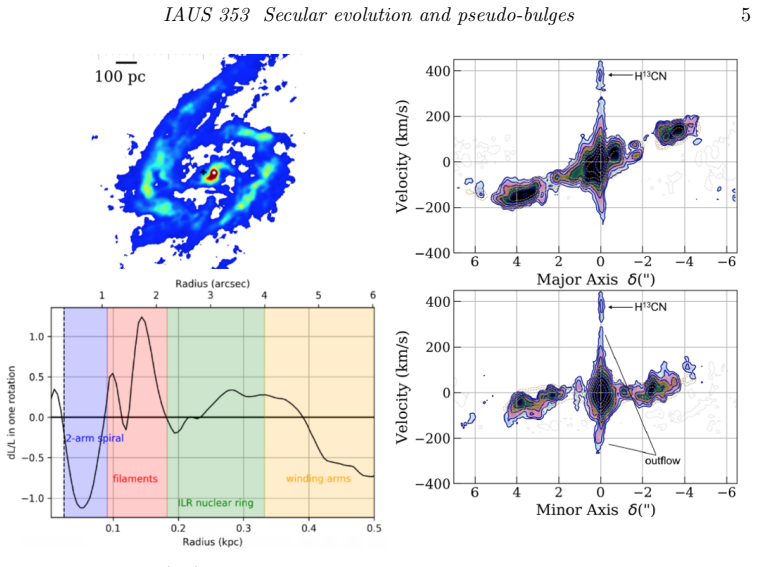
The load-bearing object is the gravity torque exerted by non-axisymmetric structures, bars, nuclear bars, and spirals, on the gas, measured as the sign of the torque along the orbit. The argument converts that torque into a statement about fueling by following the precession-rate curve $\Omega-\kappa/2$: where it falls, elliptical orbits are leading and gas stalls in resonant rings; where it rises, inside the black hole sphere of influence, the nuclear spiral becomes trailing and torques become negative. Supporting machinery includes vertical resonances that puff stars into a peanut-shaped pseudo-bulge, ALMA's 0.05 to 0.1 arcsecond resolution that resolves the inner 10 to 20 pc, and kinematically decoupled molecular tori that trace the last phase of infall.
What would settle it
Measure the CO(3-2) velocity field of the inner 100 pc in a Seyfert with a well-measured black hole mass: if the spiral is trailing but the torques on the gas are positive, or if the winding reversal occurs at a radius unrelated to the sphere of influence, the central claim collapses.
Extended reading notes
Core claim
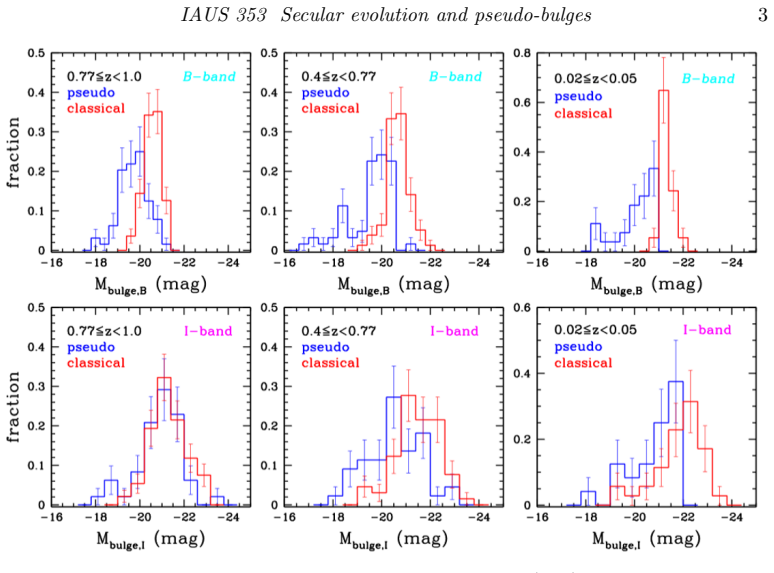
The central claim is that secular evolution, not just mergers, shapes galactic centres. Bars form box-peanut pseudo-bulges through vertical resonances and then funnel gas inward; embedded nuclear bars and spirals take over at small radii and can deliver molecular gas to the black hole. The observational signature of genuine fueling is a nuclear trailing spiral: inside the black hole's sphere of influence the precession rate $\Omega-\kappa/2$ rises again, reversing the spiral's winding and making the torques negative, so gas loses angular momentum in roughly one rotation. This mechanism is observed in NGC 1566, NGC 1808, and NGC 613, sometimes alongside molecular outflows driven by feedback. The review additionally claims that bulges and pseudo-bulges have doubled their mass since $z\sim1$, and that the commonness of bulgeless galaxies today is a problem for the standard cold dark matter picture that modified gravity models avoid.
Load-bearing premise
The load-bearing premise is that the observed nuclear trailing spirals really are inward-flowing gas, which requires that inside the black hole's sphere of influence the precession rate $\Omega-\kappa/2$ rises and reverses the spiral's winding; if the potential near the nucleus is not that simple, or if the spiral is a transient or projection effect, the negative torques and the fuel delivery do not follow.
Editorial extensions
If this is right
- If only about one third of Seyferts show negative torques at about 100 pc, AGN fueling must be episodic: short bursts of a few $10^7$ yr separated by longer phases where gas is trapped in resonant rings or expelled by feedback.
- If nuclear trailing spirals are the small-scale fueling channel, then the radius and winding of such spirals should mark the black hole's dynamical sphere of influence, making them direct probes of AGN accretion at 10 to 20 pc.
- If molecular tori and circumnuclear disks are randomly misaligned with the galaxy disk, then gas memory of the large-scale rotation is lost inside the sphere of influence, and AGN feedback will be randomly oriented relative to the host disk.
- If bulges have doubled in mass since $z\sim1$, late-time secular evolution is a major contributor to bulge growth, not just high-redshift mergers.
- If clumpy high-redshift galaxies do not always produce bulges in modified gravity, then bulgeless galaxies become a test of dark matter theory versus modified gravity.
Reading between the lines
- Beyond the paper: measuring nuclear spiral radii in a sample of Seyferts with known black hole masses would turn the trailing-spiral criterion into a quantitative test, because the winding should reverse at the radius where $\Omega-\kappa/2$ rises, which scales with $M_{\rm BH}$.
- Beyond the paper: the same torque-sign analysis could be applied to lower-luminosity active nuclei and non-active galaxies with central molecular gas, to test whether the one-third fueling fraction is universal or depends on AGN luminosity, bar strength, or gas fraction.
- Beyond the paper: if modified gravity is why bulgeless galaxies are common, then bulgeless galaxies should show systematically weaker merger signatures, such as fewer shells, streams, and low-surface-brightness stellar halos, than the standard dark matter model predicts.
- Beyond the paper: comparing outflow orientation with torus misalignment in the same objects would test whether randomly oriented accretion disks channel jet energy into the disk and thereby quench star formation more efficiently.
Signed reviews
Editorial analysis
A structured set of objections, weighed in public.
Referee Report
Summary. This is a conference proceedings review by F. Combes (IAU Symposium 353) that synthesizes recent work on secular evolution, pseudo-bulges, and gas fueling of galactic nuclei. The paper argues that vertical resonances with bars build pseudo-bulges; that classical bulges and pseudo-bulges have grown substantially since z~1; that the high frequency of bulgeless galaxies at z=0 is difficult to explain in the standard CDM picture but can be avoided in modified gravity models where dynamical friction on dark matter is absent; and that bars and spirals drive gas inward through gravity torques. At 0.1–1 kpc scales, it reports that only about one third of Seyferts show negative torques and molecular inflow, while at 10–20 pc scales ALMA observations of nuclear trailing spirals (NGC 1566, NGC 1808, NGC 613) are interpreted as direct evidence of ongoing AGN fueling, accompanied in some cases by molecular tori, misaligned circumnuclear disks, and outflows. The paper contains no new derivations or simulations; its contribution is a qualitative synthesis of the author's and collaborators' published observational and simulation results.
Significance. As a review, the paper is useful and timely: it collects recent ALMA-based results on nuclear spirals, molecular tori, misalignment, and outflows in nearby Seyferts, and it connects these to the broader secular-evolution narrative. Its main conceptual claim—that a trailing nuclear spiral inside the black hole sphere of influence can serve as a morphological diagnostic of ongoing AGN fueling—is physically plausible and, in principle, falsifiable through direct measurements of the nuclear potential. The review also draws attention to the bulgeless-galaxy problem and to modified gravity as an alternative explanation, which is a valuable perspective even if not universally accepted. The manuscript is clearly organized and well referenced. However, two statements carry more weight than the evidence presented: the claim that the bulgeless-galaxy problem is 'solved' by modified gravity (based on a single simulation study) and the inference that trailing nuclear spirals unambiguously demonstrate fueling (which depends on an assumed precession-rate profile). These issues are local and fixable by qualification, so the paper's central synthesis remains defensible after revision.
major comments (3)
- [§4, Figure 3] The conclusion that a trailing nuclear spiral directly demonstrates ongoing AGN fueling depends on the assumed rise of Ω−κ/2 inside the black hole sphere of influence, but this precession-rate profile is shown from an assumed model of the potential, not measured from the observed velocity field. The text should explicitly state that the winding argument requires (i) a near-point-mass potential within ~50–70 pc so that d(Ω−κ/2)/dr > 0, (ii) near-circular gas orbits for the epicyclic approximation to apply, and (iii) a quasi-steady spiral pattern rather than a transient or projection effect. The paper itself acknowledges a transient leading spiral just inside the ILR ring as an alternative; if any of these conditions fails, the sign of the inferred torque—and hence the fueling claim—is not secure. A concrete test would be to derive the potential directly from the CO kinematics of the nuclear disk and compare the predicted winding direction with the observed spiral.
- [§2 and Abstract] The sentence 'This issue is solved in modified gravity models' overstates the support provided in this review: the cited evidence is a single pair of MOND versus Newtonian+DM simulations with one set of star-forming and feedback recipes (Combes 2014). The text should be softened to 'may be alleviated' or 'can be explained in one class of modified gravity models', and it should acknowledge that the outcome may depend on the adopted subgrid recipes. A concrete robustness test is to confirm that the bulgeless outcome persists across independent MOND hydrodynamical implementations and feedback schemes; until then, the word 'solved' is not supported by the cited literature.
- [§4] The quantitative claim that only about one third of Seyfert galaxies experience molecular inflow and central fueling rests on a sample of ~20 objects observed at ~100 pc resolution (Garcia-Burillo & Combes 2012). Because the sample selection is not described in this review and the resolution is coarse relative to the nuclear scales being discussed, this fraction is not firmly established as a universal statistic. The text should state the sample size, the selection criteria (e.g., activity-selected or flux-limited), and the possible biases, so that the subsequent inference that 'fueling phases are short' is appropriately qualified.
minor comments (4)
- [Throughout] There are numerous typographical errors that should be corrected in a final version: 'particules', 'alco', 'ans', 'simultaneoulsy', 'ad', 'kepkerian', 'rsonance', 'rignt', and the missing accent in 'Sersic'.
- [Figure 3 caption] The caption writes '1=35pc' and does not label the axes or units of the top-right panel; it should read '1″ = 35 pc' and should state where the rotation curve and epicyclic frequencies come from (e.g., assumed potential model versus kinematical fit), since this panel carries the key inference for the trailing-spiral argument.
- [Figure 1 caption] The caption is confusing about which panels correspond to dwarf versus giant galaxies and to MOND versus Newtonian+DM; it should explicitly label the four panels or the curves in the right panels.
- [§5] The statement that 7 out of 8 high-resolution galaxies show molecular tori or circumnuclear disks is based on a very small sample; the text should note the small-number statistics and the possible selection bias toward objects already known to have prominent molecular emission.
Circularity Check
No circularity: this is a review summarizing published observations/simulations; the trailing-spiral interpretation is a stated dynamical model, not a conclusion built into its input.
full rationale
The paper is a proceedings review rather than a derivation. Its abstract claims (torque-driven inflow, one-third of Seyferts showing molecular inflow, nuclear trailing spirals tracing AGN fueling, bulgeless galaxies explained by modified gravity) are summaries of previously published observational and simulation results. The key inference in Section 4—that a trailing nuclear spiral in NGC 1566 implies negative torques and fueling—is a physical syllogism: an observed spiral morphology is interpreted through the epicyclic precession rate Omega−kappa/2, which is displayed in Figure 3 as rising inside the black hole sphere of influence. This interpretation depends on assumptions about the potential and orbital structure, but the observed trailing spiral is not constructed from the conclusion, nor is the precession curve fitted to force the conclusion. The paper leans heavily on the author's own prior ALMA and simulation papers, and those self-citations are extensive, but the cited results are externally published, observable, and falsifiable; they are not parameters fitted within this paper to the claims being made. The modified-gravity argument similarly rests on a published simulation (Combes 2014), not on a definitional identification. No equation or labeled prediction in the paper reduces by construction to its own input, so no circular step can be exhibited. The scientific weakness identified in the skeptic reading—that the precession-rate rise and the trailing-spiral/fueling connection are not directly verified—is a correctness or assumption risk, not a circularity, and therefore does not raise the circularity score.
Assumptions & free parameters
assumptions (4)
- domain assumption High-redshift clumpy galaxies form classical bulges via dynamical friction on dark matter halos in the standard LCDM model.
- ad hoc to paper Modified gravity without dark matter particles suppresses dynamical friction, allowing clumpy galaxies to become bulgeless.
- domain assumption Gravity torques measured from CO maps reliably indicate the sign of angular momentum transfer.
- domain assumption Inside the black hole sphere of influence the precession rate Omega-kappa/2 rises, reversing spiral winding from leading to trailing.
Cite this review
Pith. "Pith review of Secular evolution and pseudo-bulges." pith.science (2026). https://pith.science/paper/5JCGDDTW
@misc{pith2026190803149,
  author       = {Pith},
  title        = {Pith review of: Secular evolution and pseudo-bulges},
  year         = {2026},
  howpublished = {\url{https://pith.science/paper/5JCGDDTW}},
  note         = {Machine review of arXiv:1908.03149}
}
read the original abstract
Through vertical resonances, bars can produce pseudo-bulges, within secular evolution. Bulges and pseudo-bulges have doubled their mass since z=1. The frequency of bulge-less galaxies at z=0 is difficult to explain, especially since clumpy galaxies at high z should create classical bulges in all galaxies. This issue is solved in modified gravity models. Bars and spirals in a galaxy disk, produce gravity torques that drive the gas to the center and fuel central star formation and nuclear activity. At 0.1-1kpc scale, observations of gravity torques show that only about one third of Seyfert galaxies experience molecular inflow and central fueling, while in most cases the gas is stalled in resonant rings. At 10-20pc scale, some galaxies have clearly revealed AGN fueling due to nuclear trailing spirals, influenced by the black hole potential. Thanks to ALMA, and angular resolution of up to 80mas it is possible to reach the central black hole (BH) zone of influence, discover molecular tori, circum-nuclear disks misaligned with the galaxy, and the BH mass can be derived more directly from the kinematics.
Figures


Figures from the paper (1 more)
Reference graph
Works this paper leans on
-
[1]
Audibert, A., Combes, F., Garcia-Burillo, S. et al. 2019, A&A, in press., arXiv1905.01979 IAUS 353 Secular evolution and pseudo-bulges 7
arXiv 2019
-
[2]
Busch, G., Eckart, A., Valencia-S, M. et al. 2017, A&A, 598, A55
work page 2017
- [3]
- [4]
-
[5]
Combes, F., Sanders, R.H 1981, A&A, 96, 164
work page 1981
-
[6]
Combes, F., Garcia-Burillo, S., Casasola, V. et al. 2014, A&A, 565, A97
work page 2014
-
[7]
2014, A&A, 571, A82
Combes, F. 2014, A&A, 571, A82
2014
-
[8]
2019, A&A, 623, A79 Di Matteo, P., Fragkoudi, F., Khoperskov, S
Combes, F., Garcia-Burillo, S., Audibert, A et al. 2019, A&A, 623, A79 Di Matteo, P., Fragkoudi, F., Khoperskov, S. et al. 2019, A&A, 628,A11
work page 2019
Show all 28 references
-
[9]
Emsellem, E., Greusard, D., Combes, F. et al. 2001, A&A, 368, 52
2001
-
[10]
Emsellem, E., Renaud, F., Bournaud, F. et al. 2015, MNRAS, 446, 2468
2015
-
[11]
B., Drory, N
Fisher, D. B., Drory, N. 2010, Ap. J. , 716, 942
2010
-
[12]
2012, JPhCS, 372, a2050
Garcia-Burillo, S., Combes, F. 2012, JPhCS, 372, a2050
2012
-
[13]
1993, A&A, 277, 27
Friedli, D., Martinet, L. 1993, A&A, 277, 27
1993
-
[14]
2008, ASPC, 396, 297
Kormendy, J., Fisher, D.B. 2008, ASPC, 396, 297
2008
-
[15]
J., Lintott, C
Kruk, S. J., Lintott, C. J., Bamford, S. P. et al. 2018, MNRAS, 473, 4731
2018
-
[16]
2017, A&A, 598, A10
Laurikainen, E., Salo, H. 2017, A&A, 598, A10
2017
-
[17]
Laurikainen, E., Salo, H., Buta, R., Knapen, J. H. 2011, MNRAS, 418, 1452
2011
-
[18]
2014, MNRAS, 438, 2882
Melvin, T., Masters, K., Lintott, C., et al. 2014, MNRAS, 438, 2882
2014
-
[19]
M., Debattista, V
Mendez-Abreu, J., Corsini, E. M., Debattista, V. P. et al. 2008, Ap. J. , 679, L73
2008
-
[20]
P., Corsini, E
Mendez-Abreu, J., Debattista, V. P., Corsini, E. M., Aguerri, J. A. L. 2014, A&A, 572, A25
2014
-
[21]
Mendez-Abreu, J., de Lorenzo-Caceres, A., Gadotti, D. A. et al. 2019, MNRAS, 482, L118
2019
-
[22]
K., Wadadekar, Y., Barway, S
Mishra, P. K., Wadadekar, Y., Barway, S. 2017, MNRAS, 467, 2384
2017
-
[23]
P., Fabricius, M
Portaluri, E., Debattista, V. P., Fabricius, M. et al. 2017, MNRAS, 467, 1008
2017
-
[24]
Renaud, F., Bournaud, F., Emsellem, E. et al. 2015, MNRAS, 454, 3299
2015
-
[25]
Sachdeva, S., Saha, K., Singh, H. P. 2017, Ap. J. , 840, 79
2017
-
[26]
Wang, L., Wang, L., Li, C. et al. 2019, MNRAS, 484, 3865
2019
-
[27]
Weinzirl, T., Jogee, S., Khochfar, S. et al. 2009, Ap. J. , 696, 411
2009
-
[28]
2003, A&A, 409, 469
Wozniak, H., Combes, F., Emsellem, E., Friedli, D. 2003, A&A, 409, 469
2003
Reviewed August 14, 2026 · model on record in the stance chip above.
Discussion (0). Continue with ORCID to comment.