REVIEW 1 major objections 5 minor 1 cited by
Hyperluminous starburst gives up its secrets
T0 review · 1 major / 5 minor · reviewed 2026-08-14 · deepseek-v4-flash
Pith's one-line read Black hole in a dusty starburst rivals the starburst's power
desk verdict The broad-line AGN detection in HATLAS J084933-W is solid and worth reporting; the bolometric-luminosity comparison with the starburst is a scaling-relation estimate that the SED does not independently anchor. read the letter →
The pith
A machine-rendered reading of the paper's core claim, the machinery that carries it, and where it could break.
The reading
What carries the argument
The load-bearing diagnostic is the broad Hα emission line, whose width and flux yield the black hole mass through the virial scaling relation, combined with the X-ray power-law spectrum, whose normalisation and slope feed the $\alpha_{\rm OX}$ relation (the correlation between rest-frame 250 nm and 2 keV luminosity) and a bolometric correction that turns the 2--10 keV luminosity into a total accretion luminosity. The panchromatic SED comparison against median submillimetre galaxies and two dusty Type-1 quasars provides the contradiction: the inferred AGN power has no obvious rest-frame ultraviolet, optical, or mid-infrared counterpart.
What would settle it
Measure the broad Balmer decrement by detecting Hβ in deeper rest-frame optical spectroscopy; if the extinction implied by Hα/Hβ is much larger than the X-ray column density of about 5×$10^{21}$ $cm^{-2}$, the AGN is seen through dusty gas and the clear-cavity picture fails, and if broad Hβ is absent entirely, the interpretation of the broad Hα as a Type-1 AGN would need re-examination.
Extended reading notes
Core claim
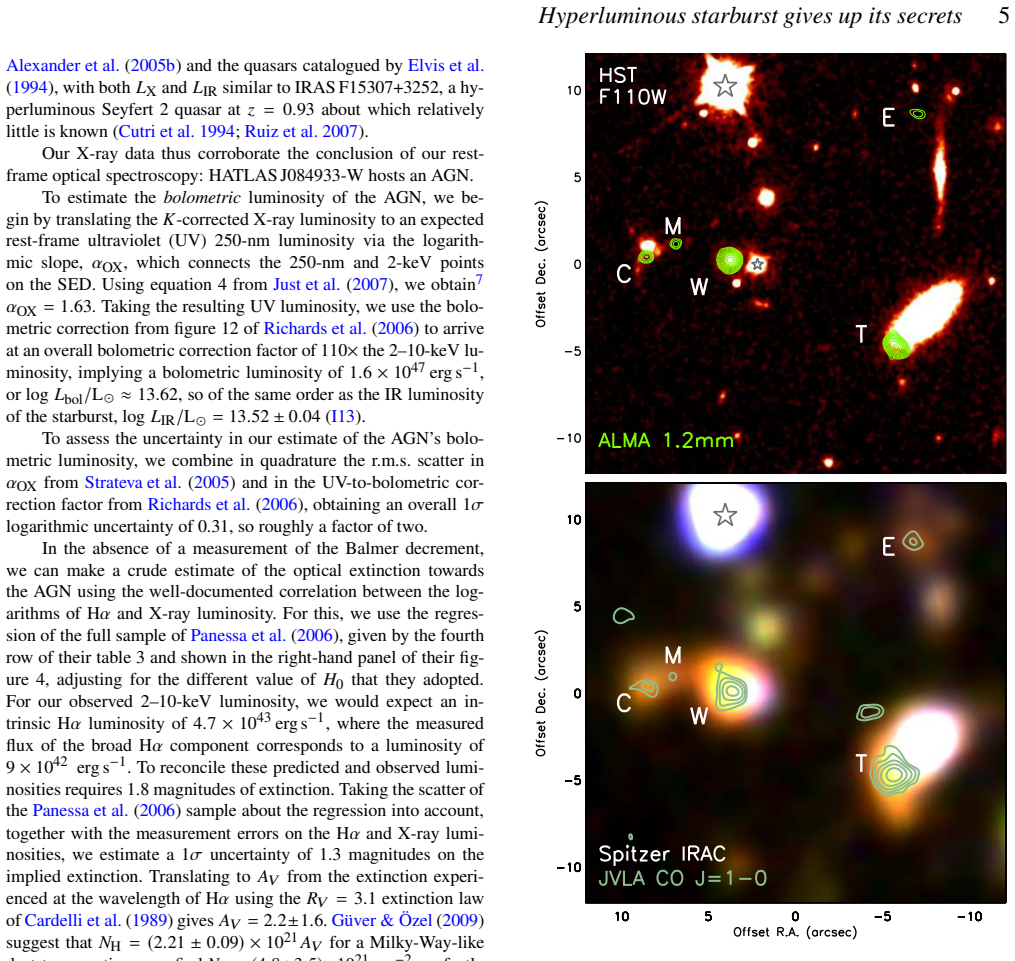
The paper establishes, from the profile of the Hα emission line and from the X-ray spectrum, that component W of the HATLAS J084933 protocluster contains a broad-line Type-1 AGN. The broad Hα line has a FWHM of roughly 9,700 km s$^{-1}$ and implies $M_{\rm bh}\approx 2\times10^9\ M_\odot$; the X-ray spectrum is an absorbed power law with photon index $\alpha=0.8\pm0.1$, intrinsic column $N_{\rm H}\approx 5\times10^{21}$ cm$^{-2}$, and a 2--10 keV luminosity $L_X=1.4\times10^{45}$ erg s$^{-1}$. Using the $\alpha_{\rm OX}$ relation and a bolometric correction, the authors derive a bolometric AGN luminosity of $1.6\times10^{47}$ erg s$^{-1}$ ($\log L_{\rm bol}/L_\odot\approx13.62$), matching the starburst's $\log L_{\rm IR}/L_\odot=13.52$. Yet the panchromatic SED shows at most a mild blue excess relative to typical submillimetre galaxies and is orders of magnitude fainter than known dusty Type-1 quasars across rest-frame 0.15--30 $\mu$m. The paper argues that the accretion power must be emerging somewhere that is not obvious, and proposes three scenarios: a central cavity excavated by the AGN giving a clear line of sight; a second, unseen AGN in a companion galaxy; or a supermassive black hole ejected by asymmetric gravitational radiation, with the resulting lack of feedback explaining the extreme starburst.
Load-bearing premise
The claim that the AGN's accretion power rivals the starburst rests on converting the measured X-ray luminosity to a bolometric luminosity through average quasar SED scaling relations, rather than on direct detection of the AGN's ultraviolet or optical light; the paper itself notes that using the observed optical magnitude would give a lower bolometric luminosity.
Editorial extensions
If this is right
- If the conclusion holds, AGN are ubiquitous among hyperluminous infrared galaxies, not merely present in X-ray-selected examples.
- A roughly $2\times10^9\ M_\odot$ black hole in a galaxy forming stars at thousands of solar masses per year implies that supermassive black hole growth and extreme starburst activity can proceed simultaneously.
- The mismatch between inferred AGN power and the SED calls for a revision of how bolometric AGN luminosity is estimated in dust-rich systems, or for a geometric explanation that hides the accretion light.
- The newly confirmed fifth protocluster member shows that HATLAS J084933 is a structure spanning roughly 120 kpc, so its extreme luminosity is a group property rather than that of a single monolithic galaxy.
Reading between the lines
- If the $\alpha_{\rm OX}$-based bolometric luminosity is too high by even the factor-of-two scatter, the AGN would still be luminous but would no longer rival the starburst, weakening the central tension.
- A direct test of the cavity scenario would be spatially resolved spectroscopy of the ionised gas: a northeast ionisation cone and a deficit of molecular gas along the line of sight would support it.
- The ejected-AGN scenario predicts that the X-ray source and the broad Hα centroid should be measurably offset from the CO dynamical centre; current data cannot resolve this, but sharper X-ray or near-infrared integral-field observations could.
- Because the X-ray emission is unresolved in the existing data, a small contribution from a second, buried AGN in the starburst cannot be excluded; deeper hard X-ray imaging would settle whether the accretion power is really single or dual.
Signed reviews
Editorial analysis
A structured set of objections, weighed in public.
Referee Report
Summary. The paper reports new ALMA, XMM-Newton, and VLT/KMOS observations of the z=2.41 hyperluminous infrared galaxy HATLAS J084933.4+021443. The ALMA data confirm a fifth dusty, gas-rich protocluster member, component E. The KMOS rest-frame optical spectroscopy of the brightest component, W, reveals a very broad H-alpha line (9700 km/s FWHM), and the XMM-Newton data reveal a point-like X-ray source coincident with W. The authors conclude that W hosts a Type-1 AGN with a black hole mass of about 2e9 solar masses, a modest intrinsic column of NH ~5e21 cm^-2, and a 2-10 keV luminosity of 1.4e45 erg/s. Using standard alpha_OX and bolometric-correction scaling relations, they estimate a bolometric AGN luminosity of 1.6e47 erg/s, comparable to the starburst's L_IR, despite the absence of obvious AGN signatures in the rest-frame UV-optical-mid-IR SED. Three scenarios are proposed to explain this configuration: an AGN viewed through a cavity in the host disk, an unseen companion AGN, or an ejected supermassive black hole.
Significance. The detection of a broad-line Type-1 AGN in an unlensed, intrinsically hyperluminous starburst is an important observational result, and the paper makes a strong case for it using independent rest-frame optical and X-ray diagnostics. The measurement of an approximately 2e9 solar mass black hole and the apparent absence of strong X-ray absorption in such a gas-rich system are notable. The data and analysis are generally careful, and the authors are explicit about the statistical weakness of the intrinsic column density detection. The value of the paper would be increased if the bolometric-luminosity claim, which underpins the central 'conundrum', were presented with fuller treatment of the systematic uncertainties in the adopted scaling relations.
major comments (1)
- [Section 3, bolometric luminosity estimate] The statement that the intrinsic absorption is 'little' is based on NH = (5 +/- 3) x 10^21 cm^-2, which is only a 2-sigma detection (Delta chi^2 = 5.9 for NH = 0). The 3-sigma upper limit is 1.2e22 cm^-2. The authors do note in Section 3 that the absorption is only marginally significant, but the abstract and later discussion use the low absorption as a key part of the interpretation. The paper should consistently state that the column is poorly constrained and that the comparison with typical SMGs should be read as an order-of-magnitude statement rather than a precise measurement.
minor comments (5)
- [Section 2.1] The observing programme identifier appears as '094. A - 0214(A)'; the spacing around the dash should be corrected.
- [Table 1] The row 'FWHM CO J=1-0 7.3 +/- 1.8 kpc' is confusing because FWHM normally denotes a velocity width in this context; please label the quantity as a spatial extent or use a different notation.
- [Section 3] The black hole mass estimate from Schulze et al. (2018) is quoted without giving the adopted virial relation or the continuum/luminosity quantity used; please provide the formula and the systematic uncertainty, given the extreme 9700 km/s line width.
- [Figure 1 caption] The sentence about the blue [N II] line having 'a fixed wavelength offset and flux ratio (3.06-1x)' is awkwardly worded; it should say that the red-to-blue [N II] flux ratio is fixed at 3.06.
- [Section 4.1] The statement that the AGN would be 'roughly 5 mag fainter than the prediction for the AGN before obscuration' would benefit from stating the reference magnitude or wavelength used for the prediction.
Circularity Check
No circularity: the Type-1 AGN detection and the bolometric-luminosity estimates rest on new observations plus independent external calibrations, not on recycled outputs.
full rationale
The paper's derivation chain is self-contained against external benchmarks. The central claim that HATLAS J084933-W hosts a broad-line Type-1 AGN follows directly from new, independent data: the KMOS spectrum shows broad H-alpha spanning 9,700 km/s FWHM, and XMM-Newton detects a point-like X-ray source positionally coincident with component W. The black-hole mass estimate uses the external single-epoch H-alpha scaling relation of Schulze et al. (2018); the X-ray column density and power-law index are fitted to the new XMM spectrum; and the bolometric AGN luminosity is obtained by applying the external alpha_OX relation of Just et al. (2007) plus the bolometric correction of Richards et al. (2006), both calibrated on other AGN populations. None of these inputs is defined in terms of the paper's own output. The paper's acknowledged sensitivity of the alpha_OX conversion (footnote 8) is a model-dependence caveat, not a circular step: using the observed optical magnitudes would give alpha_OX ~ 1.1 and a lower L_bol, and the authors explicitly choose the X-ray-based route because the alternative would imply heavy UV obscuration. That is an interpretive assumption, not a prediction forced by fitting. Prior work by the same first author (Ivison et al. 2013) is cited for component identification, CO kinematics, and L_IR, but it is not used to justify the AGN detection or the luminosity conversion. The X-ray NH measurement is marginal (Delta chi^2 = 5.9 for NH = 0), but this is a statistical weakness, not circularity. No fitted parameter is renamed as a prediction, and no load-bearing conclusion reduces to a self-citation. The paper is therefore best assessed as having no significant circularity.
Assumptions & free parameters
free parameters (4)
- Intrinsic column density, N_H =
(5 ± 3) × 10^21 cm^-2
- X-ray power-law index, α =
0.8 ± 0.1
- CO-to-H2 conversion factor, α_CO =
0.8 M_sun (K km/s pc^2)^-1
- Bolometric correction factor =
110× the 2-10 keV luminosity
assumptions (4)
- domain assumption Scaling relation between 250-nm and 2-keV luminosity (αOX) from Just et al. (2007) applies to this object
- domain assumption Single-epoch Hα width and luminosity trace SMBH mass via Schulze et al. (2018)
- domain assumption X-ray-to-Hα luminosity regression of Panessa et al. (2006) applies
- domain assumption Kennicutt (1998) calibration and Chabrier IMF convert L_IR to SFR
invented entities (2)
-
Unseen companion AGN (second SMBH)
-
Ejected SMBH from gravitational-wave recoil
Cite this review
Pith. "Pith review of Hyperluminous starburst gives up its secrets." pith.science (2026). https://pith.science/paper/H2MWVEWO
@misc{pith2026190803199,
  author       = {Pith},
  title        = {Pith review of: Hyperluminous starburst gives up its secrets},
  year         = {2026},
  howpublished = {\url{https://pith.science/paper/H2MWVEWO}},
  note         = {Machine review of arXiv:1908.03199}
}
abstract
HATLAS J084933.4+021443 was identified as a dusty starburst via its rest-frame far-IR emission. Multi-frequency imaging and spectroscopy revealed a cluster of four dusty galaxies at $z = 2.41$, covering 80 kpc. Here, we use ALMA to confirm a more distant, fifth protocluster member, and present X-ray and rest-frame optical imaging spectroscopy of the brightest, an unlensed hyperluminous IR galaxy (HyLIRG). The data reveal broad H \alpha and bright [N II] lines, and bright X-ray emission, characteristics that betray a Type-1 active galactic nucleus (AGN), strengthening evidence that AGN are ubiquitous amongst HyLIRGs. The accreting black hole is super massive, $M_{\rm bh}\approx 2\times 10^9$ M$_\odot$, with little intrinsic absorption, $N_{\rm H}\approx 5\times 10^{21}$ cm$^{-2}$. The X-ray properties suggest the accretion luminosity rivals that of the starburst, yet it is not obvious where this emerges in its panchromatic spectral energy distribution (SED). We outline three scenarios that could give rise to the observed characteristics, and how we might distinguish between them. In the first, we see the AGN through the host galaxy because of the cavity it excavates. In the others, the AGN is not co-spatial with the starburst, having been ejected via asymmetric gravitational radiation, or having evolved towards the naked quasar phase in an unseen companion.
Figures


Figures from the paper (2 more)

Forward citations
Cited by 1 Pith paper
-
Vz-GAL Dusty Star-Forming Galaxies: Revisiting the CO-H2 Conversion Factor Tension
The CO-to-H2 conversion factor in high-z dusty star-forming galaxies is not required to be 0.8; intermediate to near-Galactic values (median ~4-5) remain dynamically viable.
Reference graph
Works this paper leans on
-
[1]
Adelman-McCarthy J. K., et al., 2008, @doi [ ] 10.1086/524984 , http://adsabs.harvard.edu/abs/2008ApJS..175..297A 175, 297
doi:10.1086/524984 2008
-
[2]
Aihara H., et al., 2018, @doi [ ] 10.1093/pasj/psx081 , http://adsabs.harvard.edu/abs/2018PASJ...70S...8A 70, S8
-
[3]
Alexander D. M., Smail I., Bauer F. E., Chapman S. C., Blain A. W., Brandt W. N., Ivison R. J., 2005a, @doi [ ] 10.1038/nature03473 , http://adsabs.harvard.edu/abs/2005Natur.434..738A 434, 738
-
[4]
Alexander D. M., Bauer F. E., Chapman S. C., Smail I., Blain A. W., Brandt W. N., Ivison R. J., 2005b, @doi [ ] 10.1086/444342 , https://ui.adsabs.harvard.edu/abs/2005ApJ...632..736A 632, 736
-
[5]
Baker J. G., Boggs W. D., Centrella J., Kelly B. J., McWilliams S. T., Miller M. C., van Meter J. R., 2008, @doi [ ] 10.1086/590927 , http://adsabs.harvard.edu/abs/2008ApJ...682L..29B 682, L29
doi:10.1086/590927 2008
-
[6]
D., 1973, @doi [ ] 10.1086/152255 , http://adsabs.harvard.edu/abs/1973ApJ...183..657B 183, 657
Bekenstein J. D., 1973, @doi [ ] 10.1086/152255 , http://adsabs.harvard.edu/abs/1973ApJ...183..657B 183, 657
doi:10.1086/152255 1973
-
[7]
Campanelli M., Lousto C., Zlochower Y., Merritt D., 2007, @doi [ ] 10.1086/516712 , http://adsabs.harvard.edu/abs/2007ApJ...659L...5C 659, L5
doi:10.1086/516712 2007
-
[8]
Cardelli J. A., Clayton G. C., Mathis J. S., 1989, @doi [ ] 10.1086/167900 , http://adsabs.harvard.edu/abs/1989ApJ...345..245C 345, 245
doi:10.1086/167900 1989
Show all 123 references
-
[9]
L., et al., 2002, @doi [ ] 10.1086/339306 , http://adsabs.harvard.edu/abs/2002AJ....123.1838C 123, 1838
Carilli C. L., et al., 2002, @doi [ ] 10.1086/339306 , http://adsabs.harvard.edu/abs/2002AJ....123.1838C 123, 1838
2002 doi
-
[10]
Carilli C. L., Riechers D., Walter F., Maiolino R., Wagg J., Lentati L., McMahon R., Wolfe A., 2013, @doi [ ] 10.1088/0004-637X/763/2/120 , http://adsabs.harvard.edu/abs/2013ApJ...763..120C 763, 120
2013 doi
-
[11]
Chabrier G., 2003, @doi [ ] 10.1086/376392 , http://adsabs.harvard.edu/abs/2003PASP..115..763C 115, 763
2003 doi
-
[12]
Cicone C., et al., 2014, @doi [ ] 10.1051/0004-6361/201322464 , http://adsabs.harvard.edu/abs/2014A
2014 doi
-
[13]
Civano F., et al., 2012, @doi [ ] 10.1088/0004-637X/752/1/49 , http://adsabs.harvard.edu/abs/2012ApJ...752...49C 752, 49
2012 doi
-
[14]
M., Huchra J
Cutri R. M., Huchra J. P., Low F. J., Brown R. L., Vanden Bout P. A., 1994, @doi [ ] 10.1086/187276 , https://ui.adsabs.harvard.edu/\#abs/1994ApJ...424L..65C 424, L65
1994 doi
-
[15]
I., 2007, @doi [ ] 10.1111/j.1365-2966.2006.11383.x , http://adsabs.harvard.edu/abs/2007MNRAS.375.1099D 375, 1099
Davies R. I., 2007, @doi [ ] 10.1111/j.1365-2966.2006.11383.x , http://adsabs.harvard.edu/abs/2007MNRAS.375.1099D 375, 1099
2007
-
[16]
I., et al., 2013, @doi [ ] 10.1051/0004-6361/201322282 , http://adsabs.harvard.edu/abs/2013A
Davies R. I., et al., 2013, @doi [ ] 10.1051/0004-6361/201322282 , http://adsabs.harvard.edu/abs/2013A
2013 doi
-
[17]
P., Rawlings S., Marshall P
Deane R. P., Rawlings S., Marshall P. J., Heywood I., Kl \"o ckner H.-R., Grainge K., Mauch T., Serjeant S., 2013, @doi [ ] 10.1093/mnras/sts520 , http://adsabs.harvard.edu/abs/2013MNRAS.430....2D 430, 2
2013 doi
-
[18]
Decarli R., et al., 2018, @doi [ ] 10.3847/1538-4357/aaa5aa , https://ui.adsabs.harvard.edu/abs/2018ApJ...854...97D 854, 97
2018 doi
-
[19]
arXiv:1906.05308
Decarli R., et al., 2019, arXiv e-prints, https://ui.adsabs.harvard.edu/abs/2019arXiv190605308D p. arXiv:1906.05308
2019 arXiv
-
[20]
Y., Wu X.-B., 2016, @doi [ ] 10.3847/0004-637X/824/2/70 , http://adsabs.harvard.edu/abs/2016ApJ...824...70D 824, 70
Dong X. Y., Wu X.-B., 2016, @doi [ ] 10.3847/0004-637X/824/2/70 , http://adsabs.harvard.edu/abs/2016ApJ...824...70D 824, 70
2016 doi
-
[21]
Eales S., et al., 2010, @doi [ ] 10.1086/653086 , http://adsabs.harvard.edu/abs/2010PASP..122..499E 122, 499
2010 doi
-
[22]
Efstathiou A., et al., 2014, @doi [ ] 10.1093/mnrasl/slt131 , https://ui.adsabs.harvard.edu/abs/2014MNRAS.437L..16E 437, L16
2014 doi
-
[23]
L., Viswanathan A., Patton D
Ellison S. L., Viswanathan A., Patton D. R., Bottrell C., McConnachie A. W., Gwyn S., Cuillandre J.-C., 2019, arXiv e-prints, https://ui.adsabs.harvard.edu/abs/2019arXiv190508830E
2019
-
[24]
Elvis M., et al., 1994, @doi [ ] 10.1086/192093 , https://ui.adsabs.harvard.edu/abs/1994ApJS...95....1E 95, 1
1994 doi
-
[25]
Falgarone E., et al., 2017, @doi [ ] 10.1038/nature23298 , http://adsabs.harvard.edu/abs/2017Natur.548..430F 548, 430
2017 doi
-
[26]
L., Malaguti G., Palazzi E., Persic M., 2000, , http://adsabs.harvard.edu/abs/2000A
Franceschini A., Bassani L., Cappi M., Granato G. L., Malaguti G., Palazzi E., Persic M., 2000, , http://adsabs.harvard.edu/abs/2000A
2000
-
[27]
T., Ivison R
Frayer D. T., Ivison R. J., Scoville N. Z., Yun M., Evans A. S., Smail I., Blain A. W., Kneib J., 1998, @doi [ ] 10.1086/311639 , http://adsabs.harvard.edu/abs/1998ApJ...506L...7F 506, L7
1998 doi
-
[28]
T., Maddalena R
Frayer D. T., Maddalena R. J., Ivison R. J., Smail I., Blain A. W., Vanden Bout P., 2018, @doi [ ] 10.3847/1538-4357/aac49a , http://adsabs.harvard.edu/abs/2018ApJ...860...87F 860, 87
2018 doi
-
[29]
M., Ballester P., Forchi V., Garc \' a-Dabl \'o C
Freudling W., Romaniello M., Bramich D. M., Ballester P., Forchi V., Garc \' a-Dabl \'o C. E., Moehler S., Neeser M. J., 2013, @doi [ ] 10.1051/0004-6361/201322494 , http://adsabs.harvard.edu/abs/2013A
2013 doi
-
[30]
Fu H., et al., 2013, @doi [ ] 10.1038/nature12184 , http://adsabs.harvard.edu/abs/2013Natur.498..338F 498, 338
2013 doi
-
[31]
E., et al., 2017, @doi [ ] 10.1093/mnras/stw2721 , http://adsabs.harvard.edu/abs/2017MNRAS.465.1789G 465, 1789
Geach J. E., et al., 2017, @doi [ ] 10.1093/mnras/stw2721 , http://adsabs.harvard.edu/abs/2017MNRAS.465.1789G 465, 1789
2017 doi
-
[32]
S., Messias H., Nagar N
G \'o mez J. S., Messias H., Nagar N. M., Orellana G., Ivison R. J., van der Werf P., 2018, arXiv e-prints, http://adsabs.harvard.edu/abs/2018arXiv180601951G
2018
-
[33]
R., Liu M
Graham J. R., Liu M. C., 1995, @doi [ ] 10.1086/309629 , http://adsabs.harvard.edu/abs/1995ApJ...449L..29G 449, L29
1995 doi
-
[34]
J., et al., 2010, @doi [ ] 10.1051/0004-6361/201014519 , http://adsabs.harvard.edu/abs/2010A
Griffin M. J., et al., 2010, @doi [ ] 10.1051/0004-6361/201014519 , http://adsabs.harvard.edu/abs/2010A
2010 doi
-
[35]
P., Mullaney J
Grimmett L. P., Mullaney J. R., Jin S., Bernhard E., Daddi E., Walters K., 2019, @doi [ ] 10.1093/mnras/stz1558 , https://ui.adsabs.harvard.edu/abs/2019MNRAS.487.4071G 487, 4071
2019 doi
-
[36]
u ver T., \
G \"u ver T., \"O zel F., 2009, @doi [ ] 10.1111/j.1365-2966.2009.15598.x , http://adsabs.harvard.edu/abs/2009MNRAS.400.2050G 400, 2050
2009
-
[37]
I., et al., 2012, @doi [ ] 10.1088/0004-637X/752/2/152 , http://adsabs.harvard.edu/abs/2012ApJ...752..152H 752, 152
Harris A. I., et al., 2012, @doi [ ] 10.1088/0004-637X/752/2/152 , http://adsabs.harvard.edu/abs/2012ApJ...752..152H 752, 152
2012 doi
-
[38]
M., et al., 2016, @doi [ ] 10.1093/mnrasl/slw001 , http://adsabs.harvard.edu/abs/2016MNRAS.457L.122H 457, L122
Harrison C. M., et al., 2016, @doi [ ] 10.1093/mnrasl/slw001 , http://adsabs.harvard.edu/abs/2016MNRAS.457L.122H 457, L122
2016 doi
-
[39]
K., Salvador-Sol \'e E., Wang L., 2018, @doi [ ] 10.1093/mnras/sty2073 , http://adsabs.harvard.edu/abs/2018MNRAS.480.4974H 480, 4974
Hatziminaoglou E., Farrah D., Humphreys E., Manrique A., P \'e rez-Fournon I., Pitchford L. K., Salvador-Sol \'e E., Wang L., 2018, @doi [ ] 10.1093/mnras/sty2073 , http://adsabs.harvard.edu/abs/2018MNRAS.480.4974H 480, 4974
2018 doi
-
[40]
C., Kere s D., Jonsson P., Narayanan D., Cox T
Hayward C. C., Kere s D., Jonsson P., Narayanan D., Cox T. J., Hernquist L., 2011, @doi [ ] 10.1088/0004-637X/743/2/159 , http://adsabs.harvard.edu/abs/2011ApJ...743..159H 743, 159
2011 doi
-
[41]
C., Wills B
Hines D. C., Wills B. J., 1993, @doi [ ] 10.1086/173145 , http://adsabs.harvard.edu/abs/1993ApJ...415...82H 415, 82
1993 doi
-
[42]
A., et al., 2019, @doi [ ] 10.3847/1538-4357/ab1846 , https://ui.adsabs.harvard.edu/abs/2019ApJ...876..130H 876, 130
Hodge J. A., et al., 2019, @doi [ ] 10.3847/1538-4357/ab1846 , https://ui.adsabs.harvard.edu/abs/2019ApJ...876..130H 876, 130
2019 doi
-
[43]
S., et al., 2013, @doi [ ] 10.1093/mnras/sts612 , http://adsabs.harvard.edu/abs/2013MNRAS.430.2513H 430, 2513
Holland W. S., et al., 2013, @doi [ ] 10.1093/mnras/sts612 , http://adsabs.harvard.edu/abs/2013MNRAS.430.2513H 430, 2513
2013 doi
-
[44]
Ikarashi S., et al., 2015, @doi [ ] 10.1088/0004-637X/810/2/133 , http://adsabs.harvard.edu/abs/2015ApJ...810..133I 810, 133
2015 doi
-
[45]
Iono D., et al., 2006, @doi [ ] 10.1086/506344 , http://adsabs.harvard.edu/abs/2006ApJ...645L..97I 645, L97
2006 doi
-
[46]
J., Ibata R
Irwin M. J., Ibata R. A., Lewis G. F., Totten E. J., 1998, @doi [ ] 10.1086/306213 , https://ui.adsabs.harvard.edu/abs/1998ApJ...505..529I 505, 529
1998 doi
-
[47]
G., McMahon R
Isaak K. G., McMahon R. G., Hills R. E., Withington S., 1994, @doi [ ] 10.1093/mnras/269.1.L28 , http://adsabs.harvard.edu/abs/1994MNRAS.269L..28I 269, L28
1994 doi
-
[48]
G., Priddey R
Isaak K. G., Priddey R. S., McMahon R. G., Omont A., Peroux C., Sharp R. G., Withington S., 2002, @doi [ ] 10.1046/j.1365-8711.2002.04966.x , http://adsabs.harvard.edu/abs/2002MNRAS.329..149I 329, 149
2002
-
[49]
J., 1995, , http://ukads.nottingham.ac.uk/abs/1995MNRAS.275L..33I 275, L33
Ivison R. J., 1995, , http://ukads.nottingham.ac.uk/abs/1995MNRAS.275L..33I 275, L33
1995
-
[50]
J., Smail I., Le Borgne J., Blain A
Ivison R. J., Smail I., Le Borgne J., Blain A. W., Kneib J., Bezecourt J., Kerr T. H., Davies J. K., 1998, @doi [ ] 10.1046/j.1365-8711.1998.01677.x , http://adsabs.harvard.edu/abs/1998MNRAS.298..583I 298, 583
1998
-
[51]
J., et al., 2004, @doi [ ] 10.1086/423249 , http://adsabs.harvard.edu/abs/2004ApJS..154..124I 154, 124
Ivison R. J., et al., 2004, @doi [ ] 10.1086/423249 , http://adsabs.harvard.edu/abs/2004ApJS..154..124I 154, 124
2004 doi
-
[53]
J., et al., 2013, @doi [ ] 10.1088/0004-637X/772/2/137 , http://adsabs.harvard.edu/abs/2013ApJ...772..137I 772, 137
Ivison R. J., et al., 2013, @doi [ ] 10.1088/0004-637X/772/2/137 , http://adsabs.harvard.edu/abs/2013ApJ...772..137I 772, 137
2013 doi
-
[54]
W., Brandt W
Just D. W., Brandt W. N., Shemmer O., Steffen A. T., Schneider D. P., Chartas G., Garmire G. P., 2007, @doi [ ] 10.1086/519990 , http://adsabs.harvard.edu/abs/2007ApJ...665.1004J 665, 1004
2007 doi
-
[55]
Karim A., et al., 2013, @doi [ ] 10.1093/mnras/stt196 , http://adsabs.harvard.edu/abs/2013MNRAS.432....2K 432, 2
2013 doi
-
[56]
Kennicutt Jr. R. C., 1998, @doi [ ] 10.1086/305588 , http://adsabs.harvard.edu/abs/1998ApJ...498..541K 498, 541
1998 doi
-
[57]
K., van der Werf P
Knudsen K. K., van der Werf P. P., Jaffe W., 2003, @doi [ ] 10.1051/0004-6361:20031291 , http://adsabs.harvard.edu/abs/2003A
2003 doi
-
[58]
D., et al., 2018, @doi [ ] 10.3847/1538-4365/aab9b4 , http://adsabs.harvard.edu/abs/2018ApJS..236...48K 236, 48
Kocevski D. D., et al., 2018, @doi [ ] 10.3847/1538-4365/aab9b4 , http://adsabs.harvard.edu/abs/2018ApJS..236...48K 236, 48
2018 doi
-
[59]
Koss M., et al., 2011, @doi [ ] 10.1088/2041-8205/735/2/L42 , https://ui.adsabs.harvard.edu/abs/2011ApJ...735L..42K 735, L42
2011 doi
-
[60]
Lacy M., et al., 2004, @doi [ ] 10.1086/422816 , http://adsabs.harvard.edu/abs/2004ApJS..154..166L 154, 166
2004 doi
-
[61]
Leipski C., et al., 2010, @doi [ ] 10.1051/0004-6361/201014718 , https://ui.adsabs.harvard.edu/abs/2010A&A...518L..34L 518, L34
2010 doi
-
[62]
Leung T. K. D., Hayward C. C., Casey C. M., Staguhn J., Kovacs A., Dowell C. D., 2019, @doi [ ] 10.3847/1538-4357/ab11ce , https://ui.adsabs.harvard.edu/abs/2019ApJ...876...48L 876, 48
2019 doi
-
[63]
C., et al., 2019, @doi [ ] 10.3847/1538-4357/aaf057 , http://adsabs.harvard.edu/abs/2019ApJ...870...80L 870, 80
Litke K. C., et al., 2019, @doi [ ] 10.3847/1538-4357/aaf057 , http://adsabs.harvard.edu/abs/2019ApJ...870...80L 870, 80
2019 doi
-
[64]
S., et al., 2005, @doi [ ] 10.1111/j.1365-2966.2005.09413.x , http://adsabs.harvard.edu/abs/2005MNRAS.362.1371L 362, 1371
Loaring N. S., et al., 2005, @doi [ ] 10.1111/j.1365-2966.2005.09413.x , http://adsabs.harvard.edu/abs/2005MNRAS.362.1371L 362, 1371
2005
-
[65]
Loeb A., 2007, @doi [Physical Review Letters] 10.1103/PhysRevLett.99.041103 , http://adsabs.harvard.edu/abs/2007PhRvL..99d1103L 99, 041103
2007 doi
-
[66]
O., Zlochower Y., 2011a, @doi [ ] 10.1103/PhysRevD.83.024003 , http://adsabs.harvard.edu/abs/2011PhRvD..83b4003L 83, 024003
Lousto C. O., Zlochower Y., 2011a, @doi [ ] 10.1103/PhysRevD.83.024003 , http://adsabs.harvard.edu/abs/2011PhRvD..83b4003L 83, 024003
-
[67]
O., Zlochower Y., 2011b, @doi [Physical Review Letters] 10.1103/PhysRevLett.107.231102 , http://adsabs.harvard.edu/abs/2011PhRvL.107w1102L 107, 231102
Lousto C. O., Zlochower Y., 2011b, @doi [Physical Review Letters] 10.1103/PhysRevLett.107.231102 , http://adsabs.harvard.edu/abs/2011PhRvL.107w1102L 107, 231102
-
[68]
Lu N., et al., 2017, @doi [ ] 10.3847/2041-8213/aa77fc , http://adsabs.harvard.edu/abs/2017ApJ...842L..16L 842, L16
2017 doi
-
[69]
H., Warwick R
Lumb D. H., Warwick R. S., Page M., De Luca A., 2002, @doi [ ] 10.1051/0004-6361:20020531 , http://adsabs.harvard.edu/abs/2002A
2002 doi
-
[71]
J., 1999, , http://adsabs.harvard.edu/abs/1999Ap
Lutz D., Tacconi L. J., 1999, , http://adsabs.harvard.edu/abs/1999Ap
1999
-
[72]
Ma Z., Yan H., 2015, @doi [ ] 10.1088/0004-637X/811/1/58 , http://adsabs.harvard.edu/abs/2015ApJ...811...58M 811, 58
2015 doi
-
[73]
Mainieri V., et al., 2005, @doi [ ] 10.1111/j.1365-2966.2004.08600.x , http://adsabs.harvard.edu/abs/2005MNRAS.356.1571M 356, 1571
2005
-
[74]
Maiolino R., et al., 2012, @doi [ ] 10.1111/j.1745-3933.2012.01303.x , http://adsabs.harvard.edu/abs/2012MNRAS.425L..66M 425, L66
2012
-
[75]
Mateos S., et al., 2005, @doi [ ] 10.1051/0004-6361:20041340 , http://adsabs.harvard.edu/abs/2005A
2005 doi
-
[76]
Mateos S., et al., 2010, @doi [ ] 10.1051/0004-6361/200913187 , http://adsabs.harvard.edu/abs/2010A
2010 doi
-
[77]
McAlpine S., et al., 2019, @doi [ ] 10.1093/mnras/stz1692 , https://ui.adsabs.harvard.edu/abs/2019MNRAS.tmp.1605M p. 1605
2019 doi
-
[78]
G., Omont A., Bergeron J., Kreysa E., Haslam C
McMahon R. G., Omont A., Bergeron J., Kreysa E., Haslam C. G. T., 1994, @doi [ ] 10.1093/mnras/267.1.L9L , https://ui.adsabs.harvard.edu/abs/1994MNRAS.267L...9M 267, L9
1994 doi
-
[79]
P., Waters B., Schiebel D., Young W., Golap K., 2007, in Shaw R
McMullin J. P., Waters B., Schiebel D., Young W., Golap K., 2007, in Shaw R. A., Hill F., Bell D. J., eds, Astronomical Society of the Pacific Conference Series Vol. 376, Astronomical Data Analysis Software and Systems XVI. p. 127
2007
-
[80]
J., 2012, @doi [ ] 10.1051/0004-6361/201218896 , http://adsabs.harvard.edu/abs/2012A
Mehdipour M., Branduardi-Raymont G., Page M. J., 2012, @doi [ ] 10.1051/0004-6361/201218896 , http://adsabs.harvard.edu/abs/2012A
2012 doi
-
[81]
W., Swinbank M., Smail I., Ivison R
Men \'e ndez-Delmestre K., Blain A. W., Swinbank M., Smail I., Ivison R. J., Chapman S. C., Gon c alves T. S., 2013, @doi [ ] 10.1088/0004-637X/767/2/151 , http://adsabs.harvard.edu/abs/2013ApJ...767..151M 767, 151
2013 doi
-
[82]
Narayanan D., et al., 2015, @doi [ ] 10.1038/nature15383 , http://adsabs.harvard.edu/abs/2015Natur.525..496N 525, 496
2015 doi
-
[83]
J., et al., 2012, @doi [ ] 10.1111/j.1365-2966.2012.20912.x , http://adsabs.harvard.edu/abs/2012MNRAS.424.1614O 424, 1614
Oliver S. J., et al., 2012, @doi [ ] 10.1111/j.1365-2966.2012.20912.x , http://adsabs.harvard.edu/abs/2012MNRAS.424.1614O 424, 1614
2012
-
[84]
G., Cox P., Kreysa E., Bergeron J., Pajot F., Storrie-Lombardi L
Omont A., McMahon R. G., Cox P., Kreysa E., Bergeron J., Pajot F., Storrie-Lombardi L. J., 1996a, , http://adsabs.harvard.edu/abs/1996A
-
[85]
G., Solomon P
Omont A., Petitjean P., Guilloteau S., McMahon R. G., Solomon P. M., P \'e contal E., 1996b, @doi [ ] 10.1038/382428a0 , http://adsabs.harvard.edu/abs/1996Natur.382..428O 382, 428
-
[86]
Oteo I., et al., 2016, @doi [ ] 10.3847/0004-637X/827/1/34 , http://adsabs.harvard.edu/abs/2016ApJ...827...34O 827, 34
2016 doi
-
[87]
Oteo I., et al., 2017a, preprint, http://adsabs.harvard.edu/abs/2017arXiv170904191O ( @eprint arXiv 1709.04191 )
-
[88]
A., Ivison R
Oteo I., Zwaan M. A., Ivison R. J., Smail I., Biggs A. D., 2017b, @doi [ ] 10.3847/1538-4357/aa5da4 , http://adsabs.harvard.edu/abs/2017ApJ...837..182O 837, 182
-
[89]
Oteo I., et al., 2018, @doi [ ] 10.3847/1538-4357/aaa1f1 , http://adsabs.harvard.edu/abs/2018ApJ...856...72O 856, 72
2018 doi
-
[91]
J., Ho L
Panessa F., Bassani L., Cappi M., Dadina M., Barcons X., Carrera F. J., Ho L. C., Iwasawa K., 2006, @doi [ ] 10.1051/0004-6361:20064894 , http://adsabs.harvard.edu/abs/2006A
2006 doi
-
[92]
Rev.] 10.1103/PhysRev.128.2471 , 128, 2471
Peres A., 1962, @doi [Phys. Rev.] 10.1103/PhysRev.128.2471 , 128, 2471
1962 doi
-
[93]
L., et al., 2010, @doi [ ] 10.1051/0004-6361/201014759 , http://adsabs.harvard.edu/abs/2010A
Pilbratt G. L., et al., 2010, @doi [ ] 10.1051/0004-6361/201014759 , http://adsabs.harvard.edu/abs/2010A
2010 doi
-
[94]
K., et al., 2016, @doi [ ] 10.1093/mnras/stw1840 , http://adsabs.harvard.edu/abs/2016MNRAS.462.4067P 462, 4067
Pitchford L. K., et al., 2016, @doi [ ] 10.1093/mnras/stw1840 , http://adsabs.harvard.edu/abs/2016MNRAS.462.4067P 462, 4067
2016 doi
-
[95]
S., Isaak K
Priddey R. S., Isaak K. G., McMahon R. G., Omont A., 2003, @doi [ ] 10.1046/j.1365-8711.2003.06279.x , http://adsabs.harvard.edu/abs/2003MNRAS.339.1183P 339, 1183
2003
-
[96]
E., 2019, @doi [ ] 10.1093/mnras/stz1093 , https://ui.adsabs.harvard.edu/abs/2019MNRAS.486.4320R 486, 4320
Ramasawmy J., Stevens J., Martin G., Geach J. E., 2019, @doi [ ] 10.1093/mnras/stz1093 , https://ui.adsabs.harvard.edu/abs/2019MNRAS.486.4320R 486, 4320
2019 doi
-
[97]
T., et al., 2006, @doi [ ] 10.1086/506525 , http://adsabs.harvard.edu/abs/2006ApJS..166..470R 166, 470
Richards G. T., et al., 2006, @doi [ ] 10.1086/506525 , http://adsabs.harvard.edu/abs/2006ApJS..166..470R 166, 470
2006 doi
-
[98]
A., et al., 2013, @doi [ ] 10.1038/nature12050 , http://adsabs.harvard.edu/abs/2013Natur.496..329R 496, 329
Riechers D. A., et al., 2013, @doi [ ] 10.1038/nature12050 , http://adsabs.harvard.edu/abs/2013Natur.496..329R 496, 329
2013 doi
-
[99]
A., et al., 2017, @doi [ ] 10.3847/1538-4357/aa8ccf , http://adsabs.harvard.edu/abs/2017ApJ...850....1R 850, 1
Riechers D. A., et al., 2017, @doi [ ] 10.3847/1538-4357/aa8ccf , http://adsabs.harvard.edu/abs/2017ApJ...850....1R 850, 1
2017 doi
-
[100]
R., et al., 2016, @doi [ ] 10.1051/0004-6361/201526416 , https://ui.adsabs.harvard.edu/abs/2016A&A...590A...1R 590, A1
Rosen S. R., et al., 2016, @doi [ ] 10.1051/0004-6361/201526416 , https://ui.adsabs.harvard.edu/abs/2016A&A...590A...1R 590, A1
2016 doi
-
[101]
Rowan-Robinson M., Wang L., 2010, @doi [ ] 10.1111/j.1365-2966.2010.16733.x , https://ui.adsabs.harvard.edu/abs/2010MNRAS.406..720R 406, 720
2010
-
[102]
Rowan-Robinson M., et al., 1991, @doi [ ] 10.1038/351719a0 , http://adsabs.harvard.edu/abs/1991Natur.351..719R 351, 719
1991 doi
-
[103]
J., Panessa F., 2007, @doi [ ] 10.1051/0004-6361:20066708 , http://adsabs.harvard.edu/abs/2007A
Ruiz A., Carrera F. J., Panessa F., 2007, @doi [ ] 10.1051/0004-6361:20066708 , http://adsabs.harvard.edu/abs/2007A
2007 doi
-
[104]
arXiv:1904.04507
Rujopakarn W., et al., 2019, arXiv e-prints, https://ui.adsabs.harvard.edu/abs/2019arXiv190404507R p. arXiv:1904.04507
2019 arXiv
-
[105]
Salom \'e P., Gu \'e lin M., Downes D., Cox P., Guilloteau S., Omont A., Gavazzi R., Neri R., 2012, @doi [ ] 10.1051/0004-6361/201219955 , http://adsabs.harvard.edu/abs/2012A
2012 doi
-
[106]
B., Soifer B
Sanders D. B., Soifer B. T., Elias J. H., Madore B. F., Matthews K., Neugebauer G., Scoville N. Z., 1988, @doi [ ] 10.1086/165983 , http://adsabs.harvard.edu/abs/1988ApJ...325...74S 325, 74
1988 doi
-
[107]
Schulze A., et al., 2018, @doi [ ] 10.3847/1538-4365/aae82f , http://adsabs.harvard.edu/abs/2018ApJS..239...22S 239, 22
2018 doi
-
[108]
M., et al., 2015, @doi [ ] 10.1088/0004-637X/799/1/81 , http://adsabs.harvard.edu/abs/2015ApJ...799...81S 799, 81
Simpson J. M., et al., 2015, @doi [ ] 10.1088/0004-637X/799/1/81 , http://adsabs.harvard.edu/abs/2015ApJ...799...81S 799, 81
2015 doi
-
[109]
M., et al., 2017, @doi [ ] 10.3847/1538-4357/aa65d0 , http://adsabs.harvard.edu/abs/2017ApJ...839...58S 839, 58
Simpson J. M., et al., 2017, @doi [ ] 10.3847/1538-4357/aa65d0 , http://adsabs.harvard.edu/abs/2017ApJ...839...58S 839, 58
2017 doi
-
[110]
R., et al., 2018, @doi [ ] 10.1093/mnras/sty458 , http://adsabs.harvard.edu/abs/2018MNRAS.476.5075S 476, 5075
Stacey H. R., et al., 2018, @doi [ ] 10.1093/mnras/sty458 , http://adsabs.harvard.edu/abs/2018MNRAS.476.5075S 476, 5075
2018 doi
-
[111]
M., et al., 2019, @doi [ ] 10.1093/mnras/stz1536 , https://ui.adsabs.harvard.edu/abs/2019MNRAS.487.4648S 487, 4648
Stach S. M., et al., 2019, @doi [ ] 10.1093/mnras/stz1536 , https://ui.adsabs.harvard.edu/abs/2019MNRAS.487.4648S 487, 4648
2019 doi
-
[112]
V., Brandt W
Strateva I. V., Brandt W. N., Schneider D. P., Vanden Berk D. G., Vignali C., 2005, @doi [ ] 10.1086/431247 , http://adsabs.harvard.edu/abs/2005AJ....130..387S 130, 387
2005 doi
-
[113]
N., Gonz \'a lez-Alfonso E., Reynolds C
Tombesi F., Mel \'e ndez M., Veilleux S., Reeves J. N., Gonz \'a lez-Alfonso E., Reynolds C. S., 2015, @doi [ ] 10.1038/nature14261 , http://adsabs.harvard.edu/abs/2015Natur.519..436T 519, 436
2015 doi
-
[114]
Valiante E., et al., 2016, @doi [ ] 10.1093/mnras/stw1806 , http://adsabs.harvard.edu/abs/2016MNRAS.462.3146V 462, 3146
2016 doi
-
[115]
Veilleux S., et al., 2013, @doi [ ] 10.1088/0004-637X/776/1/27 , http://adsabs.harvard.edu/abs/2013ApJ...776...27V 776, 27
2013 doi
-
[116]
Veilleux S., Bolatto A., Tombesi F., Mel \'e ndez M., Sturm E., Gonz \'a lez-Alfonso E., Fischer J., Rupke D. S. N., 2017, @doi [ ] 10.3847/1538-4357/aa767d , https://ui.adsabs.harvard.edu/abs/2017ApJ...843...18V 843, 18
2017 doi
-
[117]
P., et al., 2018, @doi [ ] 10.3847/1538-4357/aadf35 , https://ui.adsabs.harvard.edu/abs/2018ApJ...866..159V 866, 159
Venemans B. P., et al., 2018, @doi [ ] 10.3847/1538-4357/aadf35 , https://ui.adsabs.harvard.edu/abs/2018ApJ...866..159V 866, 159
2018 doi
-
[118]
Vernet J., Cimatti A., 2001, @doi [ ] 10.1051/0004-6361:20011442 , http://adsabs.harvard.edu/abs/2001A
2001 doi
-
[119]
Wagg J., et al., 2012, @doi [ ] 10.1088/2041-8205/752/2/L30 , http://adsabs.harvard.edu/abs/2012ApJ...752L..30W 752, L30
2012 doi
-
[120]
Wagg J., et al., 2014, @doi [ ] 10.1088/0004-637X/783/2/71 , http://adsabs.harvard.edu/abs/2014ApJ...783...71W 783, 71
2014 doi
-
[121]
L., et al., 2010, @doi [ ] 10.1088/0004-6256/140/6/1868 , http://adsabs.harvard.edu/abs/2010AJ....140.1868W 140, 1868
Wright E. L., et al., 2010, @doi [ ] 10.1088/0004-6256/140/6/1868 , http://adsabs.harvard.edu/abs/2010AJ....140.1868W 140, 1868
2010 doi
-
[122]
D., et al., 2007, @doi [ ] 10.1086/522776 , http://adsabs.harvard.edu/abs/2007ApJ...671.1531Y 671, 1531
Younger J. D., et al., 2007, @doi [ ] 10.1086/522776 , http://adsabs.harvard.edu/abs/2007ApJ...671.1531Y 671, 1531
2007 doi
-
[123]
D., et al., 2008, @doi [ ] 10.1086/591931 , http://adsabs.harvard.edu/abs/2008ApJ...688...59Y 688, 59
Younger J. D., et al., 2008, @doi [ ] 10.1086/591931 , http://adsabs.harvard.edu/abs/2008ApJ...688...59Y 688, 59
2008 doi
-
[124]
S., Carilli C
Yun M. S., Carilli C. L., Kawabe R., Tutui Y., Kohno K., Ohta K., 2000, @doi [ ] 10.1086/308164 , http://adsabs.harvard.edu/abs/2000ApJ...528..171Y 528, 171
2000 doi
-
[125]
J., Papadopoulos P
Zhang Z.-Y., Romano D., Ivison R. J., Papadopoulos P. P., Matteucci F., 2018, @doi [ ] 10.1038/s41586-018-0196-x , http://adsabs.harvard.edu/abs/2018Natur.558..260Z 558, 260
2018 doi
-
[126]
write newline
" write newline "" before.all 'output.state := FUNCTION fin.entry write newline FUNCTION new.block output.state before.all = 'skip after.block 'output.state := if FUNCTION new.sentence output.state after.block = 'skip output.state before.all = 'skip after.sentence 'output.stat...
Reviewed August 14, 2026 · model on record in the stance chip above.
Discussion (0). Continue with ORCID to comment.