REVIEW 4 major objections 7 minor 45 references
Rigid Graph Alignment
T0 review · 4 major / 7 minor · reviewed 2026-08-14 · deepseek-v4-flash
Pith's one-line read Rigid graph alignment—alternating a topological aligner with a rigid-body fit—more than doubles edge overlap on HCP functional connectomes compared with topology alone, from about 20% to 53%.
desk verdict Rigid graph alignment is a genuinely new problem formulation with useful synthetic validation, but the headline HCP result is the algorithm optimizing its own score, and one line in the pseudocode may be a serious error. read the letter →
The pith
A machine-rendered reading of the paper's core claim, the machinery that carries it, and where it could break.
The reading
What carries the argument
The machinery is an expectation-maximization meta-algorithm: one step is any topological network aligner that accepts a prior, and the other is a rigid-body registration via the orthogonal Procrustes problem. The link between them is the prior matrix $L$, built from current coordinates by giving weight $\exp(-\|C_{Ai}-C_{Bj}\|_2^2)$ only to nearby candidate pairs. After the aligner produces a permutation $X$, the coordinates of graph B are permuted and transformed by $\hat{R}, \hat{t}$ that minimize $\|C_A - X C_B\Omega\|_F^2$, and the loop repeats. The algorithm is a meta-algorithm because either component can be swapped; the experiments use a message-passing aligner for topology and an SVD Procrustes solver for structure. The rigidity metric is the residual $\|C_A - X C_B\Omega\|_F$ normalized by vertex count, used as an alignment-quality score.
What would settle it
Register a set of connectomes to a common template with nonlinear warping, then run rigid graph alignment with the true node correspondence hidden; if edge overlap after convergence is no better than the topological aligner alone, or if the rigidity metric no longer separates intra-subject from inter-subject pairs, the reported gains are an artifact of global prestructure rather than of the rigid graph model.
Extended reading notes
Core claim
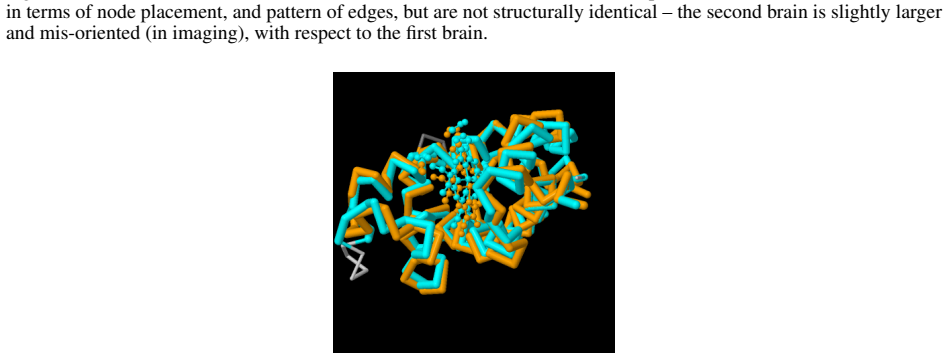
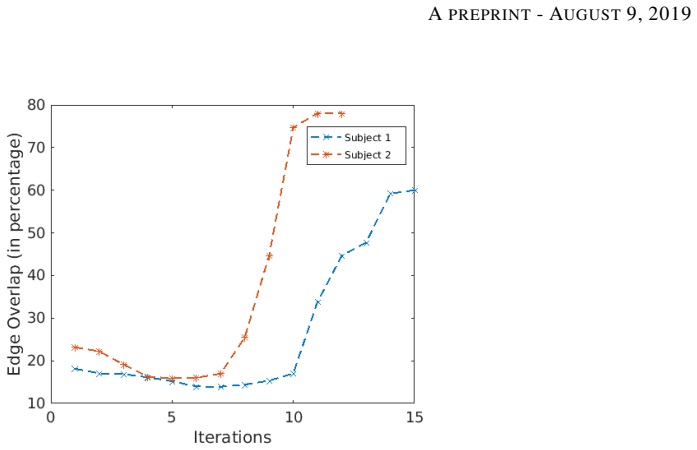
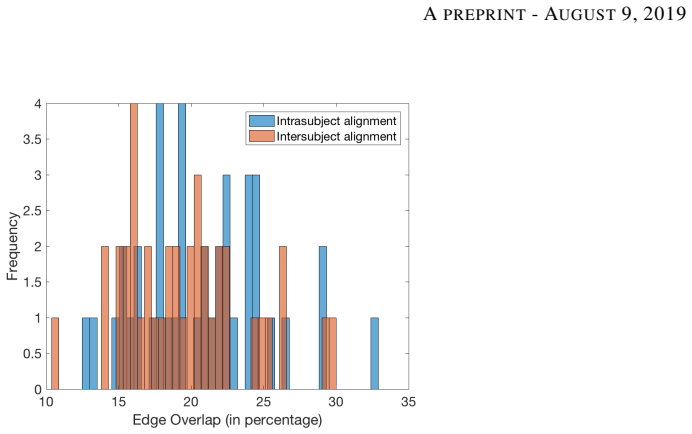
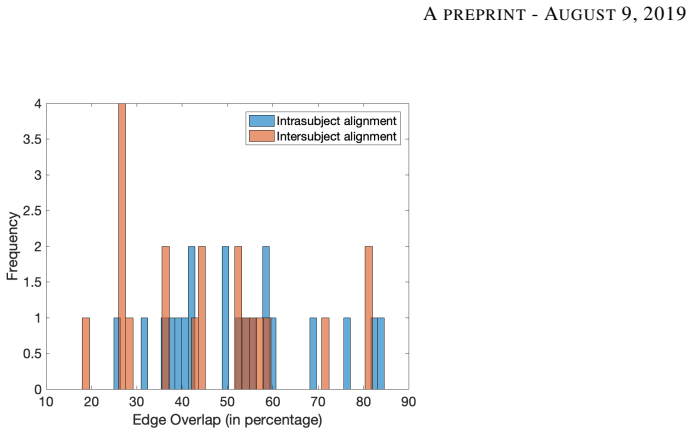
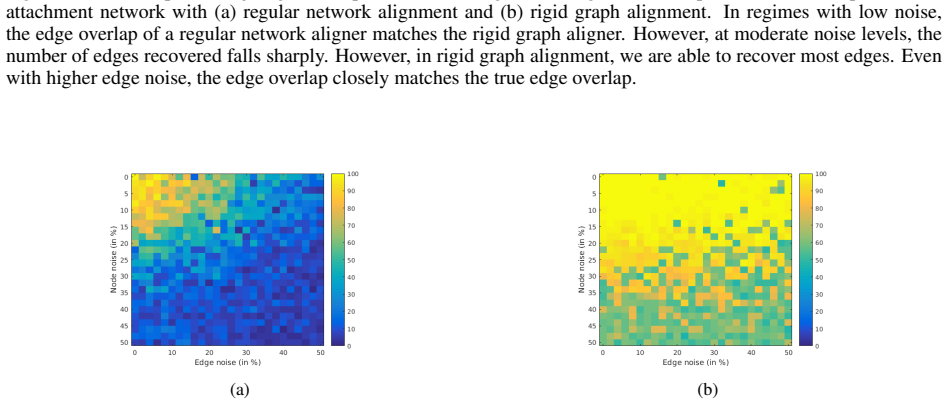
The central claim is that for rigid graphs, structural and topological information reinforce each other and should be optimized jointly. The paper formalizes rigid graph alignment as maximizing $\alpha L\cdot X + \beta A\cdot XBX^T - \gamma\|C_A - X C_B \Omega\|_F^2$ over a permutation $X$ and a rigid transformation $\Omega$, then solves it by alternating: fix $\Omega$, estimate a spatially restricted prior $L$ and run a topological aligner to get $X$; fix $X$, compute the best rotation and translation by an SVD-based solution to the orthogonal Procrustes problem; repeat until convergence. The demonstration is that this alternation substantially improves alignment: reported edge overlap on HCP functional connectomes increases from 20.18±4.2% to 53.05±12.5%, and on synthetic graphs node overlap stays near 97.67±1.21% under edge noise where topological alignment alone falls to 65.85±3.90%. The paper further claims the resulting rigidity metric better distinguishes intra-subject from inter-subject brain alignments than edge overlap.
Load-bearing premise
The load-bearing premise is that the two coordinate sets are related by a single rigid rotation plus translation, so that corresponding edge lengths are preserved and spatial proximity is a valid prior; if true brains are non-rigidly deformed relative to each other, the structural term and the prior are misspecified.
Editorial extensions
If this is right
- For spatially embedded graph databases, node and edge correspondences can be improved by repeatedly alternating topology matching with a rigid-body fit, even when the topological aligner alone performs poorly.
- The meta-algorithm is not bound to one aligner: similar edge-overlap improvements appear with a belief-propagation aligner, Klau's method, and IsoRank, so the gain is attributed to the alternating structure rather than to one topological subroutine.
- In connectome analysis, the residual structural error after rigid alignment can serve as a brain fingerprint score: it distinguishes same-subject session pairs from different-subject pairs more cleanly than edge overlap.
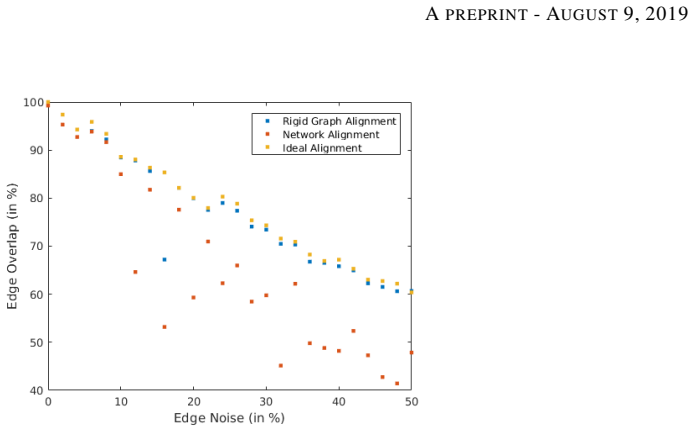
- Under edge noise with exact node positions, rigid graph alignment recovers nearly all true node correspondences (97.67±1.21%) on synthetic preferential-attachment graphs, whereas topological alignment drops to 65.85±3.90%; under node noise both degrade, but rigid alignment remains higher.
- Runtime grows linearly in the number of EM iterations and is dominated by the chosen topological aligner, so the improvement is available at modest computational overhead.
Reading between the lines
- Editorial inference: the model assumes one global rigid transform for all corresponding nodes; for connectomes, which differ by non-rigid cortical deformation, the method's gains may depend on preprocessing already bringing subjects into rough alignment. A testable extension would replace the global Procrustes step with local or piecewise rigid fits.
- Editorial inference: because the prior is built from coordinate distances, the method should also work on graphs with no native coordinates by first embedding them in a metric space, e.g. by spectral embedding; the rigidity assumption would then be an artifact of the embedding rather than physical edge lengths.
- Editorial inference: allowing anisotropic scaling or affine transforms in the structural step would test whether the reported gains come from global rigidity or simply from letting coordinates move closer; this is a natural next experiment that the paper mentions but does not run.
Signed reviews
Editorial analysis
A structured set of objections, weighed in public.
Referee Report
Summary. The paper introduces 'rigid graph alignment,' a problem formulation for graphs embedded in a metric space where node coordinates carry meaning. The proposed objective (Eq. 12) combines a prior term, a topological edge-overlap term, and a structural alignment term; the algorithm alternates between a network aligner and an SVD-based rigid-body transformation fit. The authors report that this meta-algorithm substantially increases edge overlap on HCP functional connectomes (from 20.18% ± 4.2% after the first iteration to 53.05% ± 12.5% after rigid graph alignment) and that it outperforms topological alignment on synthetic graphs with known ground truth. The paper also proposes a 'rigidity metric' for distinguishing intra-subject from inter-subject alignments.
Significance. The idea of jointly exploiting topological and geometric information for aligning spatially embedded graphs is timely and potentially useful for connectomics, molecular matching, and sensor-network applications. The meta-algorithm is modular, and the synthetic experiments with known ground truth are a genuine strength: they show that under the assumed rigid-plus-noise generative model, the method recovers a large fraction of correct node/edge correspondences. The HCP application is also potentially important. However, the central empirical claim rests on an evaluation metric that is part of the optimized objective, and the synthetic validation is conducted under the model's own assumptions. If independently validated, this would be a useful contribution; in its current form, the evidence for the headline 'better alignments' claim is incomplete.
major comments (4)
- [Section 3.1.3, Eqs. (2) and (12)] The central HCP result reports edge overlap rising from 20.18% ± 4.2% to 53.05% ± 12.5%, but edge overlap A•XBX^T is exactly the second term of the objective F being maximized in Eq. (12). The baseline is the first iteration of the same algorithm, not an independently converged topological aligner, and Algorithm 1 rebuilds the spatial prior from transformed coordinates, which can increase the optimized overlap even when many new matches are incorrect. To support the abstract's claim of improved alignment quality, the paper needs an external measure of correspondence quality (e.g., known ground-truth correspondences, or downstream identification accuracy) and a comparison against a converged topological aligner that does not use a spatial prior.
- [Section 2.1, Eq. (5); Algorithm 1, step 7; Section 3.1.2] The model assumes a single global rigid transformation (rotation plus translation) maps the coordinates of corresponding nodes in the two graphs. The HCP preprocessing described in Section 3.1.2 includes motion correction, skull stripping, and resampling, but it does not describe cross-subject registration into a common coordinate frame. Real brains differ by non-rigid deformation, so both the structural alignment term and the spatially restricted prior are potentially misspecified for the HCP experiments. The authors should clarify the coordinate frame used, or compare against a non-rigid registration baseline, before attributing the HCP gains to the rigid graph model.
- [Section 3.2, synthetic graph generation] In the synthetic experiments, the second graph is generated by exactly the model assumed in Eq. (5): a global rotation and translation, followed by independent per-node perturbations and edge noise. The synthetic results therefore validate the method under its own assumptions, but they do not test the non-rigid deformations that separate real connectomes. Adding experiments with spatially varying or elastic deformations, and reporting node/edge recovery under those conditions, would materially strengthen the claim that the method is robust in the intended application domain.
- [Section 3.1.4] The 'rigidity metric' used to distinguish intra-subject from inter-subject alignments is the residual of the structural term that Algorithm 1 minimizes. Reporting that this metric separates the two groups does not by itself show that the alignments are anatomically correct, because the metric is the optimized objective itself. An independent evaluation, such as identification accuracy on held-out pairs or comparison with residuals obtained after a fixed external registration, is needed to rule out circularity.
minor comments (7)
- [Eqs. (14)-(15)] The derivation from Eq. (14) to Eq. (15) drops the constant terms CA•CA and CBΩ•CBΩ and drops a factor of 2 in the last term. Since γ is a free parameter, the omission does not change the optimizer, but the displayed objective is not exactly equivalent to Eq. (12) and should be corrected or explicitly described as absorbing constants.
- [Algorithm 1] The algorithm's input includes α, β, and γ, but the pseudocode body does not show how these weights are used in the calls to align(A,B,L) and transform_coordinates(CA,CB,X). The authors should state explicitly how the weights enter the network alignment step and whether the structural residual is weighted by γ in the convergence check.
- [Section 2.2] The method is described as 'based on expectation maximization,' but the alternating updates in Eqs. (21)-(22) are alternating maximization for a single objective, not a standard EM procedure. This terminology should be revised or qualified.
- [Figure 3 caption] The caption states that the first-iteration result corresponds to a state-of-the-art network alignment technique, but the first iteration uses an initial prior derived from distance-profile correlation. This is not a purely topological alignment result, so the caption should be qualified to avoid overstating the baseline.
- [Eqs. (16)-(18)] The conditions defining the prior entries appear to be typeset incorrectly; the text shows conditions such as 1/||CAi−CBj||^2 ≤ ε, which is dimensionally odd. The authors likely intend ||CAi−CBj||^2 ≤ ε (or ≤ d_k^i), and the equations should be corrected.
- [Section 3.1.3] The robustness test with 100 random transformation matrices shows that the method is invariant to the initial orientation of the coordinates, but it is not a statistical significance test of the improvement over a topological aligner. The wording should be changed to reflect what the experiment actually demonstrates.
- [Section 3.1.4] The rigidity metric is reported as 'normalized by the number of vertices' with values such as 1.52 ± 0.01%, but the units of a squared residual per vertex are not dimensionless percentages. Please clarify the normalization and the units.
Circularity Check
Central rigid-alignment method is independently tested on synthetic ground truth; the HCP 'quality' claims are self-referential because they use the optimized objective terms as metrics.
-
fitted input called prediction
[Section 3.1.3, Equations (2) and (12)]
"For two adjacency matrices A andB, edge overlap is defined as A• XBXT . ... We find that the edge overlap at the end of first iteration is 20.18± 4.2%, whereas the edge overlap after rigid network alignment is 53.05± 12.5%."
Equation (12) defines the rigid graph alignment objective as F = max αL•X + βA•XBXT − γ||CA−XCBΩ||^2_F, and Algorithm 1 alternates to maximize this objective. The HCP improvement is therefore reported on the second term of the very objective being optimized, since edge overlap is exactly A•XBXT. The 20.18% baseline is the algorithm's own first iteration, and no independent ground-truth correspondence is used in the HCP experiment, so the 53.05% figure demonstrates objective maximization rather than externally measured alignment quality. The synthetic experiments do supply ground truth and independently support the method.
-
other
[Section 3.1.4, Equation (7) and Algorithm 1]
"In such applications, where the position of the vertices are of importance, we show that the residual error in structural transformation, which we call “rigidity metric” (Equation 7) is a better indicator of quality of alignment."
The rigidity metric is ||CA−CBΩ||^2_F from Equation (7), which is exactly the structural term −γ||CA−XCBΩ||^2_F that Algorithm 1 minimizes in steps 7–8. Using this minimized residual to claim superior intra-versus-inter-subject distinguishability is thus an evaluation on the algorithm's own optimized loss. It may still be a useful descriptive metric, but the claim that it is a better indicator is not independently validated by ground-truth identity labels in the paper beyond the same optimized residual.
full rationale
Most of the derivation is self-contained and not circular. The objective in Equation (12) combines the standard network alignment objective (Equation 3) with the orthogonal Procrustes structural alignment problem (Equation 7), and Algorithm 1 alternately optimizes a prior-weighted network alignment and a rigid-body transformation. The rigid-body fitting step is a standard external method (Kabsch/SVD), not an assumption smuggled in via self-citation. The synthetic experiments provide the strongest independent check: the second graph is generated under the same rigid transform model, but node overlap and edge overlap are measured against known ground truth, so the central claim that the meta-algorithm improves over topological aligners is supported by externally falsifiable evidence. The self-referential issue is confined to the HCP evaluation: the reported edge-overlap gain and the rigidity-metric brain-fingerprint separation are values of the very objective terms the algorithm optimizes, so they do not by themselves establish that the 20.18% to 53.05% rise corresponds to genuinely better correspondences. No load-bearing self-citation or imported uniqueness theorem appears; the citation to netalignmbp [2] names a co-author but the method is an external published component rather than validation of the present claim. Overall, the paper's central method has independent content, with minor self-evaluative metrics in the real-data section.
Assumptions & free parameters
free parameters (4)
- alpha, beta, gamma (objective weights) =
alpha=beta=gamma in HCP experiments; values for synthetic experiments not reported
- k (nearest-neighbor count in prior) =
not stated
- convergence threshold =
0.1% edge overlap
- top correlation percentile for HCP network edges =
top 5%
assumptions (5)
- standard math The SVD solution to the orthogonal Procrustes problem gives the optimal rigid transformation for fixed correspondences.
- domain assumption Corresponding nodes of the two rigid graphs are related by a single global rigid transformation.
- domain assumption Node coordinates live in a common metric space so that Euclidean distances are meaningful across graphs.
- domain assumption The network aligner netalignmbp produces a good matching for the current sparse spatial prior at each iteration.
- ad hoc to paper Match probabilities for pairs of nodes are independent in the expected-edge-overlap argument.
Cite this review
Pith. "Pith review of Rigid Graph Alignment." pith.science (2026). https://pith.science/paper/6SWIQ5TL
@misc{pith2026190803201,
  author       = {Pith},
  title        = {Pith review of: Rigid Graph Alignment},
  year         = {2026},
  howpublished = {\url{https://pith.science/paper/6SWIQ5TL}},
  note         = {Machine review of arXiv:1908.03201}
}
read the original abstract
Graph databases have been the subject of significant research and development. Problems such as modularity, centrality, alignment, and clustering have been formalized and solved in various application contexts. In this paper, we focus on databases for applications in which graphs have a spatial basis, which we refer to as rigid graphs. Nodes in such graphs have preferred positions relative to their graph neighbors. Examples of such graphs include abstractions of large biomolecules, functional connectomes of the human brain, and mobile device/ sensor communication logs. When analyzing such networks it is important to consider edge lengths; e.g., when identifying conserved patterns through graph alignment, it is important for conserved edges to have correlated lengths, in addition to topological similarity. In contrast to a large body of work on topological graph alignment, rigid graph alignment simultaneously aligns the network, as well as the underlying structure as characterized by edge lengths. We formulate the problem and present a meta-algorithm based on expectation-maximization that alternately aligns the network and the structure. We demonstrate that our meta-algorithm significantly improves the quality of alignments in target applications, compared to topological or structural aligners alone. We apply rigid graph alignment to functional brain networks derived from 20 subjects drawn from the Human Connectome Project (HCP) database, and show over a two-fold increase in quality of alignment over state of the art topological aligners. We evaluate the impact of various parameters associated with input datasets through a study on synthetic graphs, where we fully characterize the performance of our method. Our results are broadly applicable to other applications and abstracted networks that can be embedded in metric spaces -- e.g., through spectral embeddings.
Figures

Figures from the paper (15 more)





Reference graph
Works this paper leans on
-
[1]
Barab ´asi and R
A.-L. Barab ´asi and R. Albert. Emergence of scaling in random networks. Science, 286(5439):509–512, 1999
1999
- [2]
-
[3]
J. Berg and M. L ¨assig. Local graph alignment and motif search in biological networks. Proceedings of the National Academy of Sciences, 101(41):14689–14694, 2004
work page 2004
-
[4]
H. M. Berman, J. Westbrook, Z. Feng, G. Gilliland, T. N. Bhat, H. Weissig, I. N. Shindyalov, and P. E. Bourne. The protein data bank. Nucleic acids research, 28(1), 2000
work page 2000
-
[5]
P. Besl and H. McKay. A method for registration of 3-d shapes. ieee trans pattern anal mach intell. Pattern Analysis and Machine Intelligence, IEEE Transactions on, 14:239–256, 03 1992
work page 1992
-
[6]
S. Bouaziz, A. Tagliasacchi, and M. Pauly. Sparse iterative closest point. In Proceedings of the Eleventh Eurographics/ACMSIGGRAPH Symposium on Geometry Processing , SGP ’13, pages 113–123, Aire-la-Ville, Switzerland, Switzerland, 2013. Eurographics Association
work page 2013
-
[7]
P. Buneman and S. Staworko. Rdf graph alignment with bisimulation. InInternational Conference on Very Large Databases (VLDB), volume 9 of Proceedings of the VLDB Endowment, pages 1149–1160, 2016
work page 2016
-
[8]
D. Chetverikov, D. Svirko, D. Stepanov, and P. Krsek. The trimmed iterative closest point algorithm. In Pattern Recognition, 2002. Proceedings. 16th International Conference on, volume 3, pages 545–548, USA, 2002. IEEE
work page 2002
Show all 45 references
-
[9]
Ciriello, M
G. Ciriello, M. Mina, P. H. Guzzi, M. Cannataro, and C. Guerra. Alignnemo: A local network alignment method to integrate homology and topology. PLOS ONE, 7(6):1–14, 06 2012
2012
-
[10]
B. R. Conroy and P. J. Ramadge. The grouped two-sided orthogonal procrustes problem. In 2011 IEEE Interna- tional Conference on Acoustics, Speech and Signal Processing (ICASSP), pages 3688–3691, May 2011
2011
-
[11]
Eggert, A
D. Eggert, A. Lorusso, and R. Fisher. Estimating 3-d rigid body transformations: a comparison of four major algorithms. Machine Vision and Applications, 9(5):272–290, Mar 1997
1997
-
[12]
Emmert-Streib, M
F. Emmert-Streib, M. Dehmer, and Y . Shi. Fifty years of graph matching, network alignment and network comparison. Inf. Sci., 346(C):180–197, June 2016
2016
-
[13]
D. C. V . Essen, S. M. Smith, D. M. Barch, T. E. Behrens, E. Yacoub, and K. Ugurbil. The wu-minn human connectome project: An overview. NeuroImage, 80:62 – 79, 2013
2013
-
[14]
D. V . Essen, K. Ugurbil, E. Auerbach, D. Barch, T. Behrens, R. Bucholz, A. Chang, L. Chen, M. Corbetta, S. Curtiss, S. D. Penna, D. Feinberg, M. Glasser, N. Harel, A. Heath, L. Larson-Prior, D. Marcus, G. Michalareas, S. Moeller, R. Oostenveld, S. Petersen, F. Prior, B. Schla...
2012
-
[15]
Feizi, G
S. Feizi, G. Quon, M. R. Mendoza, M. M ´edard, M. Kellis, and A. Jadbabaie. Spectral alignment of networks. CoRR, abs/1602.04181, 2016
2016 arXiv
-
[16]
E. S. Finn, X. Shen, D. Scheinost, M. D. Rosenberg, J. Huang, M. M. Chun, X. Papademetris, and R. T. Consta- ble. Functional connectome fingerprinting: identifying individuals using patterns of brain connectivity. Nature Neuroscience, 18(11), 2015
2015
-
[17]
E. N. Gilbert. Random graphs. Ann. Math. Statist., 30(4):1141–1144, 12 1959
1959
-
[18]
Heimann, W
M. Heimann, W. Lee, S. Pan, K.-Y . Chen, and D. Koutra. Hashalign: Hash-based alignment ofmultiple graphs. In D. Phung, V . S. Tseng, G. I. Webb, B. Ho, M. Ganji, and L. Rashidi, editors,Advances in Knowledge Discovery and Data Mining, pages 726–739, Cham, 2018. Springer Inter...
2018
-
[19]
Heimann, H
M. Heimann, H. Shen, T. Safavi, and D. Koutra. Regal. Proceedings of the 27th ACM International Conference on Information and Knowledge Management - CIKM 18, 2018
2018
-
[20]
Jenkinson, P
M. Jenkinson, P. Bannister, M. Brady, and S. Smith. Improved optimization for the robust and accurate linear registration and motion correction of brain images. NeuroImage, 17(2):825 – 841, 2002
2002
-
[21]
W. Kabsch. A solution for the best rotation to relate two sets of vectors. Acta Crystallographica Section A , 32(5):922–923, Sep 1976
1976
-
[22]
A. M. Khan, D. F. Gleich, A. Pothen, and M. Halappanavar. A multithreaded algorithm for network alignment via approximate matching. In Proceedings of the International Conference on High Performance Computing, Networking, Storage and Analysis, SC ’12, pages 64:1–64:11, Los Ala...
2012
-
[23]
G. W. Klau. A new graph-based method for pairwise global network alignment.BMC Bioinformatics, 10(1):S59, Jan 2009
2009
-
[24]
Kollias, S
G. Kollias, S. Mohammadi, and A. Grama. Network similarity decomposition (nsd): A fast and scalable approach to network alignment. IEEE Trans. on Knowl. and Data Eng., 24(12):2232–2243, Dec. 2012
2012
-
[25]
Kuchaiev, T
O. Kuchaiev, T. Milenkovi ´c, V . Memiˇsevi´c, W. Hayes, and N. Pr ˇzulj. Topological network alignment uncovers biological function and phylogeny. Journal of The Royal Society Interface, 2010
2010
-
[26]
C.-S. Liao, K. Lu, M. Baym, R. Singh, and B. Berger. Isorankn: spectral methods for global alignment of multiple protein networks. Bioinformatics, 25(12):i253–i258, 2009
2009
-
[27]
Melnik, H
S. Melnik, H. Garcia-Molina, and E. Rahm. Similarity flooding: a versatile graph matching algorithm and its application to schema matching. In Proceedings 18th International Conference on Data Engineering , pages 117–128. IEEE, 2002
2002
-
[28]
Mohammadi, D
S. Mohammadi, D. F. Gleich, T. G. Kolda, and A. Grama. Triangular alignment tame: A tensor-based approach for higher-order network alignment. IEEE/ACM Trans. Comput. Biol. Bioinformatics , 14(6):1446–1458, Nov. 2017
2017
-
[29]
Murphy, R
K. Murphy, R. M. Birn, D. A. Handwerker, T. B. Jones, and P. A. Bandettini. The impact of global signal regression on resting state correlations: Are anti-correlated networks introduced? NeuroImage, 44(3):893–905, 2009
2009
-
[30]
Nassar, G
H. Nassar, G. Kollias, A. Grama, and D. F. Gleich. Low rank methods for multiple network alignment, 2018
2018
-
[31]
Patro and C
R. Patro and C. Kingsford. Global network alignment using multiscale spectral signatures. Bioinformatics, 28(23):3105–3114, 2012
2012
-
[32]
Riederer, Y
C. Riederer, Y . Kim, A. Chaintreau, N. Korula, and S. Lattanzi. Linking users across domains with location data: Theory and validation. In Proceedings of the 25th International Conference on World Wide Web , WWW ’16, pages 707–719, Republic and Canton of Geneva, Switzerland, ...
2016
-
[33]
Rusinkiewicz and M
S. Rusinkiewicz and M. Levoy. Efficient variants of the icp algorithm. Proc. 3DIM, 2001, 10 2001
2001
-
[34]
Sabata and J
B. Sabata and J. Aggarwal. Estimation of motion from a pair of range images: A review. CVGIP: Image Understanding, 54(3):309 – 324, 1991
1991
-
[35]
P. H. Sch ¨onemann. A generalized solution of the orthogonal procrustes problem. Psychometrika, 31(1):1–10, Mar 1966
1966
-
[36]
Singh, J
R. Singh, J. Xu, and B. Berger. Pairwise global alignment of protein interaction networks by matching neighbor- hood topology. In T. Speed and H. Huang, editors, Research in Computational Molecular Biology, pages 16–31, Berlin, Heidelberg, 2007. Springer Berlin Heidelberg
2007
-
[37]
Singh, J
R. Singh, J. Xu, and B. Berger. Pairwise global alignment of protein interaction networks by matching neigh- borhood topology. In Proceedings of the 11th Annual International Conference on Research in Computational Molecular Biology, RECOMB’07, pages 16–31, Berlin, Heidelberg,...
2007
-
[38]
S. M. Smith. Fast robust automated brain extraction. Human Brain Mapping, 17(3):143 – 155, November 2002
2002
-
[39]
S. M. Smith, C. F. Beckmann, J. Andersson, E. J. Auerbach, J. Bijsterbosch, G. Douaud, E. Duff, D. A. Feinberg, L. Griffanti, M. P. Harms, M. Kelly, T. Laumann, K. L. Miller, S. Moeller, S. Petersen, J. Power, G. Salimi- Khorshidi, A. Z. Snyder, A. T. Vu, M. W. Woolrich, J. Xu...
2013
-
[40]
E. H. Sussenguth. A graph-theoretic algorithm for matching chemical structures. Journal of Chemical Docu- mentation, 5(1):36–43, 1965. 18 A PREPRINT - AUGUST 9, 2019
1965
-
[41]
S. Umeyama. An eigendecomposition approach to weighted graph matching problems. IEEE Transactions on Pattern Analysis and Machine Intelligence, 10(5):695–703, Sep. 1988
1988
-
[42]
Vijayan and T
V . Vijayan and T. Milenkovic. Multiple network alignment via multimagna++.IEEE/ACM Trans. Comput. Biol. Bioinformatics, 15(5):1669–1682, Sept. 2018
2018
-
[43]
B. Zelinka. On a certain distance between isomorphism classes of graphs. asopis pro pest.Mathematiky , 100(4):371–373, 1975
1975
-
[44]
B. Zelinka. Distances between graphs (extended abstract). In Fourth Czechoslovakian Symposium on Combi- natorics, Graphs and Complexity , volume 51 of Annals of Discrete Mathematics , pages 355 – 361. Elsevier, 1992
1992
-
[45]
Zhang and H
S. Zhang and H. Tong. Final: Fast attributed network alignment. In Proceedings of the 22nd ACM SIGKDD International Conference on knowledge discovery and data mining, KDD ’16, pages 1345–1354. ACM, 2016. 19
2016
Reviewed August 14, 2026 · model on record in the stance chip above.
Discussion (0). Continue with ORCID to comment.