REVIEW 2 major objections 3 minor 31 references
Dynamical masses for the Hyades binary 80 Tauri
T0 review · 2 major / 3 minor · reviewed 2026-08-14 · deepseek-v4-flash
Pith's one-line read Using only astrometric observations, the paper measures the components of the ~170-year Hyades binary 80 Tau at 1.63 and 1.11 solar masses, making it the sixth Hyades binary with individual dynamical masses.
desk verdict A credible astrometric-only mass measurement for 80 Tau, worth refereeing; the mass-ratio/barycenter degeneracy is real but not fatal. read the letter →
The pith
A machine-rendered reading of the paper's core claim, the machinery that carries it, and where it could break.
The reading
What carries the argument
The load-bearing quantity is the mass fraction $f = M_B/(M_A+M_B)$, constrained by comparing the Gaia proper motions of the primary and secondary against the simultaneously fitted barycenter proper motion. Because each component's measured proper motion is perturbed by its orbital motion around the barycenter, the ratio of those perturbations is fixed by the masses; this proper-motion-ratio constraint stands in for the missing radial-velocity constraint. The relative visual orbit supplies the geometry, the 24-year Hipparcos-to-Gaia baseline supplies the orbital acceleration scale, and Kepler's third law together with the adopted parallax converts the fitted semimajor axis into the total mass. The paper thus uses the binary itself as an astrometric accelerometer.
What would settle it
Take a new resolved-astrometry epoch for the secondary (e.g., from a future Gaia data release or adaptive-optics imaging) and compare it with the model orbit: the predicted secondary proper motion at that epoch is determined by $f = 0.402$ and the fitted barycenter motion, so a positional or proper-motion residual larger than the astrometric uncertainties would falsify the mass ratio.
Extended reading notes
Core claim
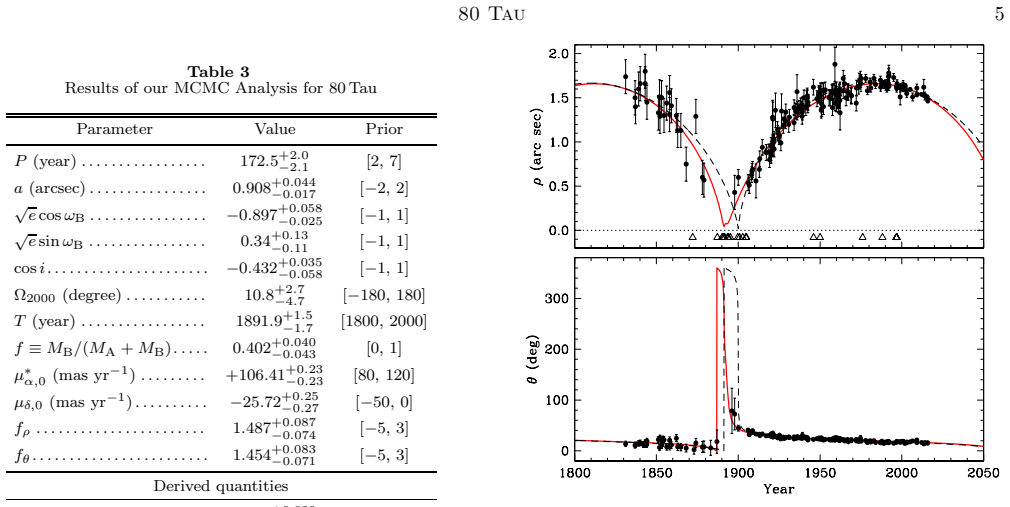
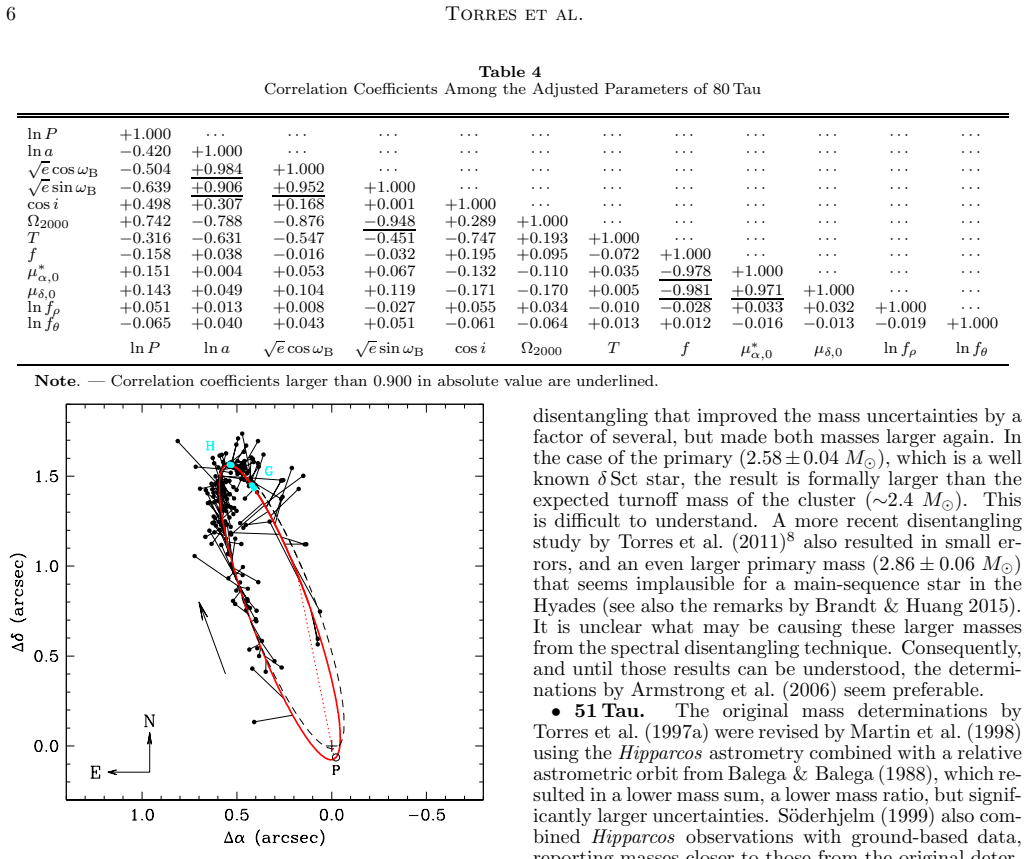
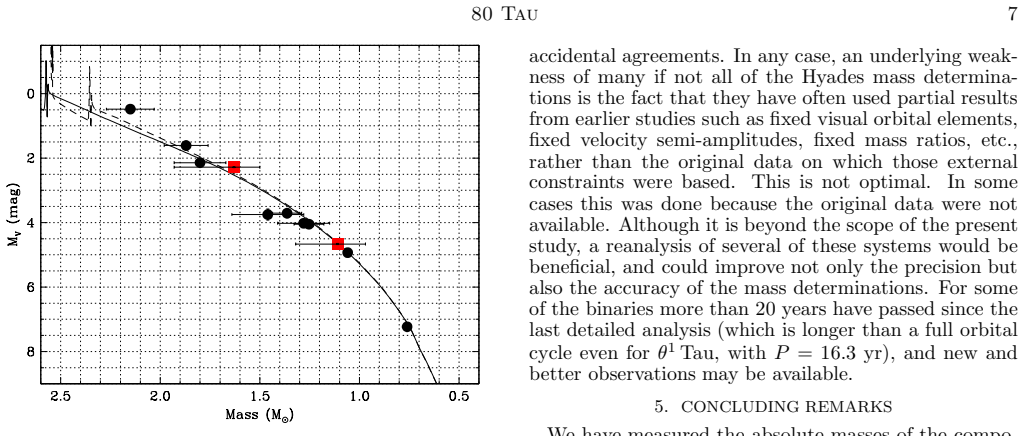
The central discovery is that the mass ratio of a visual binary can be extracted from the difference between the Gaia proper motions of its two components, with no spectroscopy needed. For 80 Tau the fitted mass fraction is $f = M_B/(M_A+M_B) = 0.402^{+0.040}_{-0.043}$, and combining this with the relative orbit and a weighted mean parallax of $20.984 \pm 0.060$ mas gives a total mass of $2.72^{+0.46}_{-0.17}\,M_\odot$ and component masses of $1.63^{+0.30}_{-0.13}\,M_\odot$ and $1.11^{+0.21}_{-0.14}\,M_\odot$. The resulting orbit is very eccentric ($e = 0.915^{+0.020}_{-0.018}$) and highly inclined, bringing the stars to about $3.7$ au at periastron. These masses are consistent, within their 10% or larger uncertainties, with the mass-luminosity relation defined by the five previously known Hyades binaries and with the PARSEC isochrones for the cluster's age and metallicity.
Load-bearing premise
The measurement hangs on the assumption that the small difference between the two stars' Gaia proper motions is a faithful tracer of their mass ratio, since that difference is the only substitute for the missing radial-velocity data.
Editorial extensions
If this is right
- 80 Tau becomes the sixth Hyades binary with individually measured masses, adding a new anchor to the empirical mass-luminosity relation.
- Long-period visual binaries whose primaries are rapid rotators, or whose orbital phase keeps the components moving slowly, become measurable without radial velocities.
- The fitted orbit makes specific predictions: the stars approach to about 3.7 au at periastron, and the current radial-velocity difference is only about 2.1 km/s, so future resolved imaging can check the orbit.
- The new masses sit between 51 Tau and 70 Tau, tightening the empirical relation in the 1.1--1.6 solar-mass range.
Reading between the lines
- If the method generalizes, the many long-period visual binaries with Gaia component proper motions but no usable radial velocities could each yield individual masses, letting the Hyades test be repeated in other clusters and moving groups.
- The strong anticorrelation between the mass fraction and the fitted barycenter proper motion suggests that the mass errors are dominated by uncertainty in the barycenter motion; a third astrometric epoch could break that degeneracy and cut the mass uncertainties below the current 10--20%.
- The paper's note that several older Hyades mass determinations reuse partial results from earlier analyses implies that a single self-consistent reanalysis of all six systems could, on its own, sharpen or shift the empirical mass-luminosity relation before any new observations are taken.
- The same astrometric-acceleration logic applies to unresolved binaries if future astrometry resolves or models their photocenter motion, potentially replacing spectroscopic mass ratios for systems too faint or too rotationally broadened for radial velocities.
Signed reviews
Editorial analysis
A structured set of objections, weighed in public.
Referee Report
Summary. The paper determines the masses of the components of the Hyades visual binary 80 Tau using relative visual astrometry from 1831-2015 together with Hipparcos and Gaia proper motions. A single MCMC fit solves for the relative orbit, the mass fraction f, the barycenter proper motion, and two error-scaling factors; the derived masses, M(A) = 1.63(+0.30/-0.13) M_sun and M(B) = 1.11(+0.21/-0.14) M_sun, agree with the mass-luminosity relation defined by five other Hyades binaries and with PARSEC isochrones. The paper claims this is the first individual dynamical-mass determination in the Hyades that does not use radial velocities.
Significance. If the result holds, 80 Tau becomes the sixth Hyades binary with dynamically measured component masses and the first astrometric-only case, making a useful methodological contribution for long-period binaries with rotationally broadened spectral lines. The study is careful in its use of the 180-year visual record, releases machine-readable tables of all observations and residuals, is explicit about its limitations, and reports a falsifiable prediction for future radial-velocity measurements. The main residual risk is that the individual masses rest on the separation of the mass fraction f from the barycenter proper motion in a strongly correlated fit.
major comments (2)
- [Section 3, Table 4] The correlations between f and the two components of the barycentric proper motion are -0.978 and -0.981, so the posterior for f is essentially a ridge in the (f, mu0) plane. In the adopted likelihood, mu0 appears in all four proper-motion observables, and the Gaia primary-minus-secondary proper-motion difference cancels the f-dependent orbital terms; the mass ratio is therefore identified by how the primary's Hipparcos, Gaia, and HG proper motions are placed relative to the solved mu0. The paper should add a robustness demonstration that this separation is data-driven rather than prior-driven, for example by re-fitting in the mu_HG-subtracted parameterization recommended by Brandt (2018) or by replacing the uniform mu0 priors with an external cluster-membership prior, and should report the resulting f and mass posteriors. Without this check, the central claim that these are secure astrometric-only individual masses remains conditional on the joint (f, mu0) identification.
- [Sections 2.1 and 3] The group errors sigma_rho and sigma_t are set by iterating to achieve balanced residuals, and then the free scaling factors f_rho and f_theta are fit to set the absolute scale. Because the visual observations determine P and a, and hence the total mass and the geometry of the relative orbit, the quoted credible intervals inherit this subjective weighting choice. The alternative three-group treatment described in Section 5 is reassuring but is only one variant; a systematic sensitivity test (e.g., varying group boundaries and the nominal sigma_rho and sigma_t values over a factor of two, or marginalizing over group assignments) would make the mass errors more defensible and would strengthen the mass-luminosity comparison in Section 4.
minor comments (3)
- [Abstract and Section 2.2] The statement that 'Separate proper motion values from Gaia for the primary and secondary provide a direct constraint on the mass ratio' is imprecise in the implemented model, because the difference mu_G,A - mu_G,B is independent of f; the mass ratio is constrained only jointly with the solved barycenter motion. Suggest rephrasing to avoid overstating the role of the primary-secondary proper-motion difference.
- [Table 3] The priors for P and a are listed as [2,7] and [-2,2], while the note says that only P, a, f_rho, and f_theta are log-uniform; the table should state explicitly that these ranges are in log10 units so that the bounds are not misread.
- [Section 3] The proper motions are treated as effectively instantaneous because the Hipparcos and Gaia observing windows are much shorter than the orbital period, but no quantitative estimate of the resulting acceleration error is given; a sentence giving the maximum expected effect at the relevant epochs would be useful.
Circularity Check
No significant circularity: the 80 Tau masses are derived from astrometric data alone, with the mass-luminosity relation used only for a posteriori comparison.
full rationale
The derivation chain for M_A and M_B is self-contained: the visual orbit parameters and the mass fraction f are solved simultaneously with the barycenter proper motion mu0 from the likelihood built from visual separations, position angles, and four proper-motion measurements (Hipparcos primary, Gaia–Hipparcos positional difference, Gaia primary, Gaia secondary). No mass-luminosity relation or stellar model enters the likelihood; the MLR is invoked only in Section 4 after the masses are obtained, to compare them with five previously known Hyades binaries. The only self-citations are the adopted comparison masses for those binaries (Torres et al. 1997a, 1997b, 1997c; Torres & Ribas 2002), and these are not inputs to the 80 Tau fit. The high negative correlations between f and mu0 (Table 4) indicate a statistical degeneracy, but that is a robustness/identifiability concern, not circularity: the paper does not define f in terms of mu0, nor fit one from the other by construction, and it does not use the MLR to set f. The astrometric-only claim is therefore not circular, and the comparison with theory is an independent consistency check rather than an input to the measurement.
Assumptions & free parameters
free parameters (3)
- f_rho (separation error scale factor) =
1.487 (+0.087/-0.074)
- f_theta (tangential position-angle error scale factor) =
1.454 (+0.083/-0.071)
- Group error levels for historical visual measurements (sigma_rho, sigma_t) =
0.13/0.10, 0.06/0.025, 0.03/0.042, 0.014/0.012 arcsec
assumptions (5)
- domain assumption The two stars follow a single Keplerian relative orbit with no unmodeled companions or cluster perturbations.
- domain assumption The Hipparcos and Gaia proper motions can be treated as instantaneous velocities at their catalog mean epochs.
- domain assumption The Brandt (2018) cross-calibration places Hipparcos and Gaia/DR2 proper motions on a common reference frame with valid covariance information.
- domain assumption The weighted average parallax is uncorrelated with the other adjusted parameters and adequately represents the distance to the system.
- domain assumption Extinction toward the Hyades is negligible for the absolute magnitude comparison.
Cite this review
Pith. "Pith review of Dynamical masses for the Hyades binary 80 Tauri." pith.science (2026). https://pith.science/paper/7HTVW6SJ
@misc{pith2026190803215,
  author       = {Pith},
  title        = {Pith review of: Dynamical masses for the Hyades binary 80 Tauri},
  year         = {2026},
  howpublished = {\url{https://pith.science/paper/7HTVW6SJ}},
  note         = {Machine review of arXiv:1908.03215}
}
read the original abstract
The empirical mass-luminosity relation in the Hyades cluster rests on dynamical mass determinations for five binary systems, of which one is eclipsing and the other four are visual or interferometric binaries. The last one was identified and first measured more than 20 years ago. Here we present dynamical mass measurements for a new binary system in the cluster, 80 Tau, which is also a visual pair with a much longer orbital period of about 170 yr. Although we lack the radial-velocity information that has enabled the individual mass determinations in all of the previous binaries, we show that it is still possible to derive the component masses for 80 Tau using only astrometric observations. This is enabled by the accurate proper motion measurements from the Hipparcos and Gaia missions, which constrain the orbital acceleration in the plane of the sky. Separate proper motion values from Gaia for the primary and secondary provide a direct constraint on the mass ratio. Our mass measurements, M(A) = 1.63 (+0.30/-0.13) M(sun) and M(B) = 1.11 (+0.21/-0.14) M(sun), are consistent with the mass-luminosity relation defined by the five previously known systems, which in turn is in good agreement with current models of stellar evolution.
Figures
Reference graph
Works this paper leans on
- [1]
-
[2]
T., Mozurkewich, D., Hajian, A
Armstrong, J. T., Mozurkewich, D., Hajian, A. R., et al. 2006 , AJ, 131, 2643
work page 2006
-
[3]
Balega, I. I., & Balega, Y. Y. 1988, Soviet Astronomy Letters , 14, 393
work page 1988
-
[4]
Brandt, T. D. 2018, ApJS, 239, 31
2018
-
[5]
Brandt, T. D., Dupuy, T. J., & Bowler, B. P. 2019, arXiv e-prints, arXiv:1811.07285
arXiv 2019
- [6]
-
[7]
Burnham, S. W. 1906, A General Catalogue of Double Stars within 121 ◦ of the North Pole, (W ashington: Carnegie Institution of W ashington), p. 388
work page 1906
-
[8]
Chen, Y., Girardi, L., Bressan, A., et al. 2014, MNRAS, 444, 2 525
work page 2014
Show all 31 references
-
[9]
2016, ApJ, 823, 102
Choi, J., Dotter, A., Conroy, C., et al. 2016, ApJ, 823, 102
2016
-
[10]
J., Brandt, T
Dupuy, T. J., Brandt, T. D., Kratter, K. M., et al. 2019, ApJ, 871, L4
2019
-
[11]
201 6, A&A, 585, A75 ESA, ed
Dutra-Ferreira, L., Pasquini, L., Smiljanic, R., et al. 201 6, A&A, 585, A75 ESA, ed. 1997, ESA Special Publication, Vol. 1200, The Hipparcos and Tycho Catalogues
1997
-
[12]
W., Riello, M., De Angeli, F., et al
Evans, D. W., Riello, M., De Angeli, F., et al. 2018, A&A, 616, A4
2018
-
[13]
W., Lang, D., & Goodman, J
Foreman-Mackey, D., Hogg, D. W., Lang, D., & Goodman, J. 2013, PASP, 125, 306
2013
-
[14]
2016, The Journal of Open Source Softwar e, 24, http://dx.doi.org/10.5281/zenodo.45906 Gaia Collaboration, Brown, A
Foreman-Mackey, D. 2016, The Journal of Open Source Softwar e, 24, http://dx.doi.org/10.5281/zenodo.45906 Gaia Collaboration, Brown, A. G. A., Vallenari, A., et al. 20 18, A&A, 616, A1
2016 doi
-
[15]
Gelman, A., & Rubin, D. B. 1992, Statistical Science, 7, 457
1992
-
[16]
2010, Commun
Goodman, J., & W eare, J. 2010, Commun. Appl. Math. Comput. Sci., 5, 65
2010
-
[17]
Gregory, P. C. 2005, ApJ, 631, 1198
2005
-
[18]
Heintz, W. D. 1981, ApJS, 46, 247 Høg, E., Fabricius, C., Makarov, V. V., et al. 2000, A&A, 355, L27
1981
-
[19]
Izmailov, I. S. 2019, Astronomy Letters, 45, 30
2019
-
[20]
2009, American Institute of Physics Conference Series, 446
Lampens, P., Torres, K., Fr´ emat, Y., et al. 2009, American Institute of Physics Conference Series, 446
2009
-
[21]
2001, A&A, 374, 54 0
Lebreton, Y., Fernandes, J., & Lejeune, T. 2001, A&A, 374, 54 0
2001
-
[22]
I., et al
Martin, C., Mignard, F., Hartkopf, W. I., et al. 1998, A&AS, 1 33, 149
1998
-
[23]
McClure, R. D. 1982, ApJ, 254, 606
1982
-
[24]
Perryman, M. A. C., Brown, A. G. A., Lebreton, Y., et al. 1998, A&A, 331, 81
1998
-
[25]
M., & Solensky, R
Peterson, D. M., & Solensky, R. 1988, ApJ, 333, 256
1988
-
[26]
M., Stefanik, R
Peterson, D. M., Stefanik, R. P., & Latham, D. W. 1993, AJ, 105 , 2260
1993
-
[27]
2002, A&A, 393, 897
Royer, F., Grenier, S., Baylac, M.-O., et al. 2002, A&A, 393, 897
2002
-
[28]
J., & Milone, E
Schiller, S. J., & Milone, E. F. 1987, AJ, 93, 1471 S¨ oderhjelm, S. 1999, A&A, 341, 121
1987
-
[29]
Tomkin, J., Pan, X., & McCarthy, J. K. 1995, AJ, 109, 780
1995
-
[30]
2002, ApJ, 567, 1140
Torres, G., & Ribas, I. 2002, ApJ, 567, 1140
2002
-
[31]
Torres, K. B. V., Lampens, P., Fr´ emat, Y., et al. 2011, A&A, 5 25, A50 van Bueren, H. G. 1952, Bull. Astron. Inst. Netherlands, 11, 385 van Leeuwen, F. 2007, Astrophysics and Space Science Librar y
2011
Reviewed August 14, 2026 · model on record in the stance chip above.
Discussion (0). Continue with ORCID to comment.