REVIEW 2 major objections 4 minor 118 references
The subgiant HR 7322 as an asteroseismic benchmark star
T0 review · 2 major / 4 minor · reviewed 2026-08-14 · deepseek-v4-flash
Pith's one-line read A benchmark subgiant star's measured radius is 2.00 ± 0.03 R☉, about 2–2.5σ larger than standard stellar models produce unless the mixing length is reduced by about 0.2.
desk verdict A careful and useful subgiant benchmark, but the model-radius offset is a plausible hint rather than a proven systematic; the unpublished limb-darkening calibration is the main thing to check. read the letter →
The pith
A machine-rendered reading of the paper's core claim, the machinery that carries it, and where it could break.
The reading
What carries the argument
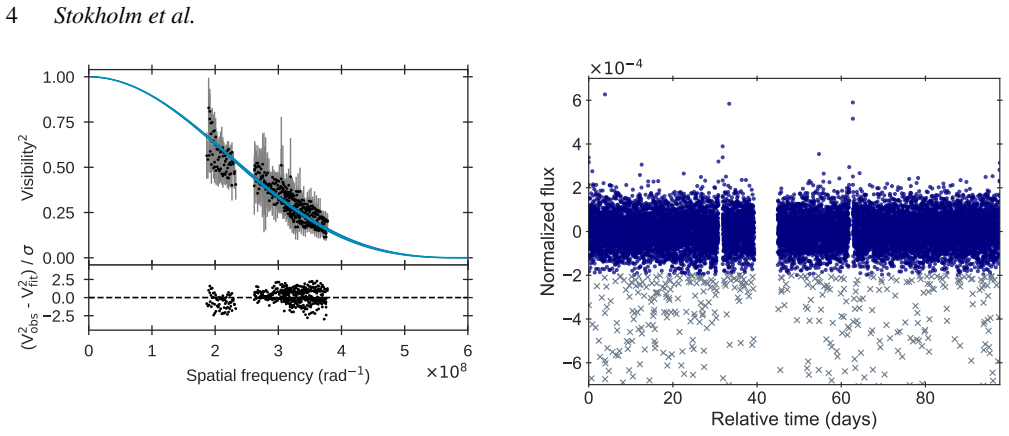
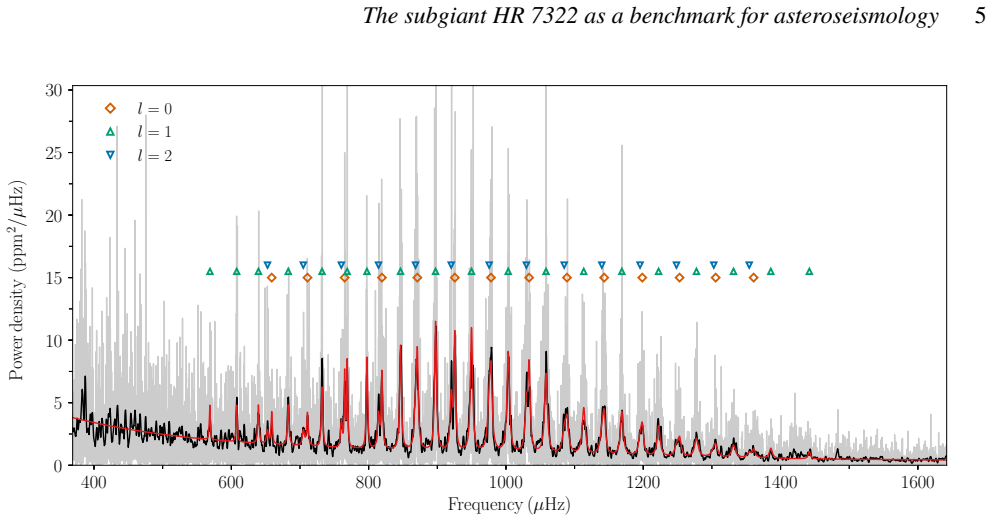
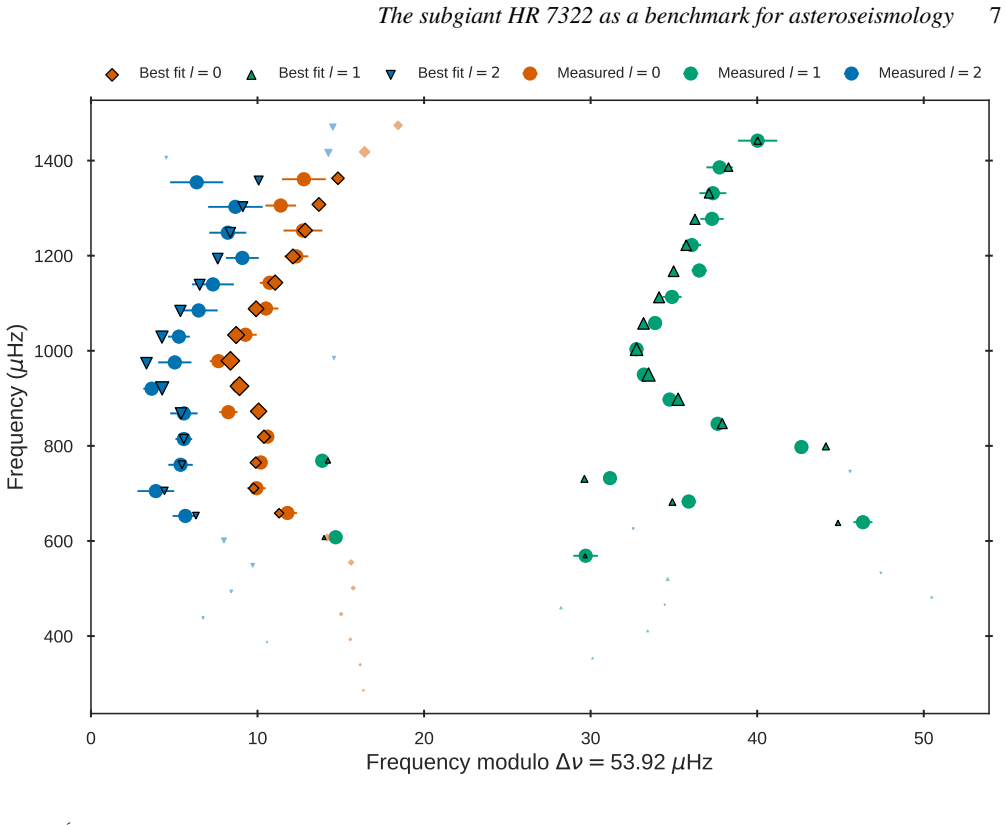
The avoided crossing in the dipole (l = 1) oscillation mode pattern near 780 µHz is the key feature that makes the modelling precise. Because the coupling between p-modes in the envelope and g-modes in the core shifts the dipole mode frequencies, only a narrow range of model ages (about 100 Myr) reproduces the observed pattern, pinning down the stellar parameters much better than the global asteroseismic parameters alone. The paper also uses the linear limb-darkening coefficient uλ = 0.22 ± 0.05 (estimated from an unpublished Teff–uλ relation from White et al., in prep.) to convert the interferometric visibility measurements into a limb-darkened angular diameter via Eq. (7).
What would settle it
Measure the limb-darkening coefficient of HR 7322 directly (e.g., via interferometric imaging at multiple baselines and wavelengths, or via a spectroscopic limb-darkening measurement) and compare it to the assumed uλ = 0.22. If the true uλ is larger than about 0.27, the angular diameter would shrink below 0.436 mas and the radius would drop below about 1.97 R☉, eliminating the tension with the standard solar-αmlt models. Alternatively, detect the helium glitch signature in the oscillation frequencies to independently constrain the helium abundance and the mixing length, which would test the sub-solar αmlt hypothesis.
Extended reading notes
Core claim
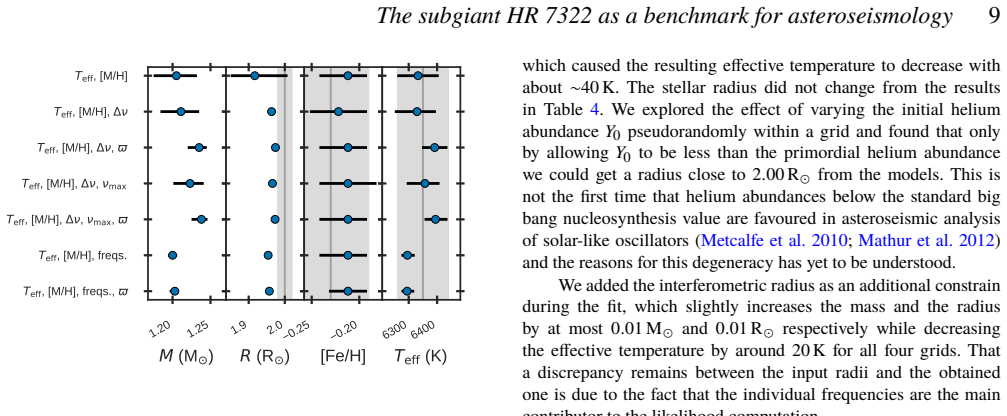
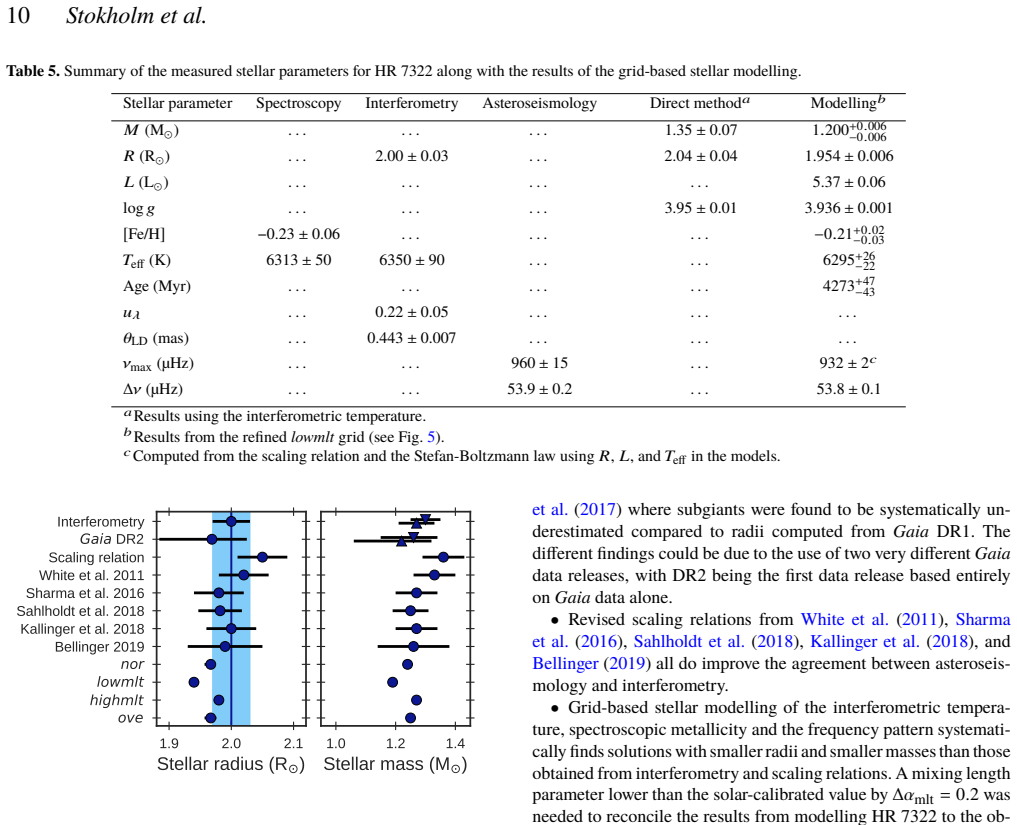
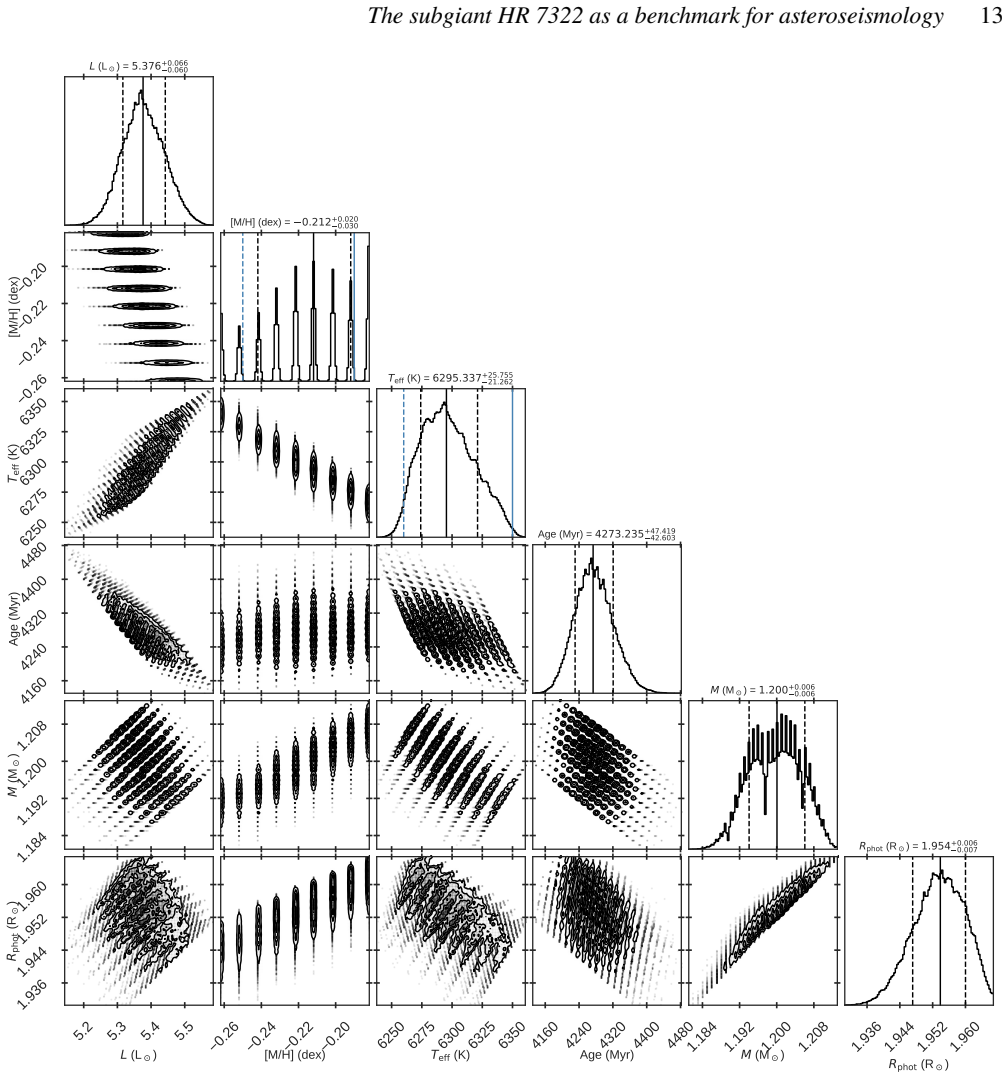
For the bright F6 subgiant HR 7322, combining a limb-darkened angular diameter of 0.443 ± 0.007 mas with a Gaia DR2 distance and bolometric flux yields a linear radius of 2.00 ± 0.03 R☉ and an effective temperature of 6350 ± 90 K. The star shows solar-like oscillations with a clear avoided crossing in the dipole mode pattern, which tightly constrains the age and other parameters. Grid-based modelling that fits the individual frequencies, the interferometric temperature, and the spectroscopic metallicity systematically produces radii around 1.95–1.98 R☉, smaller than the interferometric radius, and masses around 1.20–1.27 M☉, smaller than the scaling-relation masses (about 1.25–1.36 M☉). Only the grid with a sub-solar mixing length (αmlt ≈ 1.6) fits the effective temperature within ~0.5σ, while the solar-αmlt grids are off by ~2–3σ in temperature and the high-αmlt grid is off by ~2.8σ. The paper concludes that no single model parameter they varied (mixing length, helium enrichment, overshooting, or adding the interferometric radius as a constraint) resolves the offset, and that a sub-solar mixing length is needed to reconcile the models with the observations.
Load-bearing premise
The entire comparison of the interferometric radius to models depends on the accuracy of the limb-darkening coefficient uλ = 0.22 ± 0.05, which comes from an unpublished relation that depends only on effective temperature and has a large uncertainty; if this coefficient is biased, the measured radius could shift toward the model predictions.
Editorial extensions
If this is right
- If the sub-solar mixing length is real for HR 7322, then standard solar-calibrated 1D models overestimate the efficiency of convection in subgiant atmospheres of this temperature and metallicity.
- The agreement between the interferometric radius and the radii from various revised asteroseismic scaling relations (White et al. 2011; Sharma et al. 2016; Sahlholdt et al. 2018; Kallinger et al. 2018; Bellinger 2019) validates the use of these corrections for subgiants, contradicting earlier hints from GAIA DR1 that subgiant scaling-relation radii were systematically too small.
- The avoided crossing provides a powerful age diagnostic: with it, the stellar age is constrained to about 4.27 ± 0.05 Gyr, with a few-percent relative uncertainty, demonstrating the value of subgiant asteroseismology for Galactic archaeology.
- The systematic offset between model radii and interferometric radii means that radii and masses from grid-based modelling of subgiants with solar-αmlt should be treated with caution until the mixing-length treatment is improved, with implications for the analysis of the large numbers of subgiants expected from TESS.
- The paper's conclusion that only a sub-solar αmlt fits all observables is supported by 3D hydrodynamical simulations from the STAGGER grid, which predict αmlt ≈ 0.2 lower than solar for HR 7322's parameters.
Reading between the lines
- A direct test of the paper's central claim would be to measure the limb-darkening coefficient uλ of HR 7322 directly via interferometric imaging or via a spectroscopically calibrated relation that includes metallicity and surface gravity; if uλ is overestimated, the angular diameter would shrink and the model discrepancy could shrink or disappear.
- The paper's finding that only sub-solar helium (below the primordial abundance) can bring the model radius up to 2.00 R☉ suggests a possible degeneracy between helium abundance and mixing length that could be broken by adding a helium-sensitive observable such as the helium glitch signature or the acoustic depth of the convective zone.
- If the sub-solar mixing length is a general property of subgiants with thin convective envelopes, then grid-based estimates of subgiant radii and masses from solar-αmlt models in the literature may be systematically biased low by a few percent, which would affect age estimates for subgiant populations.
- The avoided-crossing-based age of ~4.3 Gyr, combined with the thin-disk abundance pattern ([α/Fe] ≈ 0.06), places HR 7322 as a potentially useful calibrator for Galactic chemical evolution models, but this interpretation is the reader's inference, not the paper's.
Signed reviews
Editorial analysis
A structured set of objections, weighed in public.
Referee Report
Summary. This paper presents a multi-technique benchmark analysis of the bright subgiant HR 7322 using CHARA/PAVO optical interferometry, Kepler short-cadence photometry, SONG high-resolution spectroscopy, and GARSTEC stellar models fitted with BASTA. The authors measure a limb-darkened angular diameter of 0.443 ± 0.007 mas, a linear radius of 2.00 ± 0.03 R_sun, and an interferometric effective temperature of 6350 ± 90 K. They derive asteroseismic radii from scaling relations and revisions thereof, finding good agreement with the interferometric radius. In contrast, grid-based modelling of the individual oscillation frequencies, together with [Fe/H] and Teff, yields stellar radii that are systematically below the interferometric value for all four grids considered, and a sub-solar mixing length parameter is required to match the effective temperature. The paper concludes that standard 1D models underpredict the radius of HR 7322 and that a reduced mixing length is needed.
Significance. The paper provides a valuable benchmark: HR 7322 is only the second subgiant with both high-quality Kepler asteroseismology and optical interferometry, and the avoided crossing in the dipole modes gives strong constraints on stellar age and structure. The central comparison is not circular: the interferometric radius is model-free except for the limb-darkening coefficient, and the scaling-relation radii agree with the interferometric radius. If the radius and temperature offsets are confirmed, this target would be an important test of 1D stellar-model radii and of mixing-length prescriptions. The reported precision is high, and the careful accounting of inputs such as the Gaia DR2 parallax, bolometric flux, and surface correction is a strength. The main limitation is that the central claim rests on an unpublished limb-darkening calibration and on deviations that are individually at the 1–2 sigma level.
major comments (2)
- [Section 2.2 and Section 4] The linear limb-darkening coefficient u_lambda = 0.22 ± 0.05 used in Eq. (7) is taken from an unpublished Teff–u_lambda relation (White et al., in prep.) calibrated on 16 PAVO stars plus the Sun, with no quantified dependence on metallicity or log g. It is not stated whether the quoted ±0.05 uncertainty on u_lambda is propagated into the reported theta_LD = 0.443 ± 0.007 mas and R_int = 2.00 ± 0.03 R_sun. As the paper itself notes in Section 4, an overestimated u_lambda would shrink the angular diameter and reduce the model discrepancy. Because the model radii are only 0.03–0.06 R_sun below R_int, a systematic bias in the calibration of order 0.2 in u_lambda, which cannot be excluded for an unpublished relation, could shift theta_LD toward the uniform-disc value and erase the claimed deficit. The authors should provide a sensitivity table of theta_LD and R_int versus u_lambda, include the u_lambda systematic in the final error budget, and give a full reference or appendix for the calibration.
- [Section 4 and Tables 3–4] The central claim of a systematic radius deficit is based on differences that are individually modest: the nor grid (standard alpha_mlt) gives R = 1.967 ± 0.005 R_sun, about 1.1 sigma below the interferometric radius; highmlt is within 0.7 sigma; ove is about 1.1 sigma; and lowmlt, the grid that matches Teff, is about 1.9 sigma off. The conclusion therefore rests on the pattern that no single grid simultaneously satisfies the interferometric Teff and R_int, rather than on a single high-significance discrepancy. I recommend a joint statistical treatment, for example a two-dimensional likelihood in (R, Teff) or a delta-chi-square including both observables, to quantify the significance of the simultaneous tension and to determine whether the preferred lowmlt grid is actually inconsistent with the observed radius at the claimed level when all data are combined.
minor comments (4)
- [Section 4] In the sentence discussing revised scaling relations, "Kallinger et al. (2010)" should read "Kallinger et al. (2018)" to match Table 3 and the reference list.
- [Table 5] The "Modelling" column would benefit from a footnote clarifying that it refers to the refined lowmlt grid, consistent with the discussion in Section 3.3.
- [Section 2.2] The uniform-disc angular diameter theta_UD = 0.435 ± 0.005 mas is reported but not used further; a brief statement of why the limb-darkened value is preferred, or a cross-check using theta_UD, would increase clarity.
- [Section 2.2] Please clarify whether the quoted uncertainty on theta_LD includes the uncertainty in u_lambda; if u_lambda is held fixed in the fit, the reported statistical uncertainty on theta_LD is incomplete as a total error budget.
Circularity Check
No significant circularity: the interferometric radius is an independent measurement and the model radii are outputs, not fitted inputs; the unpublished limb-darkening relation is a systematic-uncertainty concern, not a definitional reduction.
full rationale
The derivation chain is not circular. The claimed tension is between the interferometric radius R_int = 2.00 ± 0.03 R_sun, obtained from the PAVO visibility fit (Eq. 7), the Gaia DR2 parallax and Eq. 5, and F_bol via Eq. 6, and the radii from GARSTEC/BASTA grids that are outputs of fits to individual frequencies, Teff_int, and [Fe/H]. No fitted parameter is relabelled as a prediction: the model radius is a derived quantity, not an input constraint, and adding R_int as a constraint changes the model radius by at most 0.01 R_sun, which shows the radius is not forced by the observable (Sec. 4). The spectroscopic/interferometric iteration (Teff_spec to u_lambda to theta_LD to Teff_int to log g to Teff_spec) is a fixed-point calibration loop, but u_lambda is anchored to an external PAVO-based Teff-u_lambda relation (White et al., in prep.) rather than to the target radius, so it does not make R_int equal to a model input by construction. The paper itself flags the real systematic risk in Sec. 4: 'If the linear limb-darkening coefficient is overestimated, then the angular diameter would be slightly smaller, making the interferometric radius smaller and the agreement between the two methods better.' That is an acknowledged uncertainty in an empirical calibration, not a definitional circularity. Self-citations to BASTA, the KASOC filter, and earlier scaling-relation papers are methodological or provide independent empirical/numerical calibrations; none is a uniqueness theorem invoked to forbid alternatives. Consequently the score is 0.
Assumptions & free parameters
free parameters (6)
- Mixing length parameter alpha_mlt in lowmlt grid =
1.6
- Mixing length parameter alpha_mlt in highmlt grid =
2.0
- Exponential overshoot efficiency f in ove grid =
0.016
- Helium enrichment Delta Y / Delta Z =
1.4 (1.0 explored)
- Initial helium abundance Y0 =
pseudorandom variation; only values below primordial produce R close to 2.00 R_sun
- Linear limb-darkening coefficient u_lambda =
0.22 +/- 0.05
assumptions (6)
- domain assumption Mixing-length theory with a fixed alpha_mlt describes convection in 1D stellar models.
- domain assumption The asteroseismic scaling relations (Eqs. 1 and 2) with solar reference values are applicable to HR 7322.
- domain assumption The Gaia DR2 parallax and the Bailer-Jones distance, including the global zero-point correction, are accurate.
- domain assumption The linear limb-darkening coefficient u_lambda from the Teff-u_lambda relation (White et al., in prep.) is accurate.
- domain assumption The Ball and Gizon surface correction removes the near-surface frequency offset without biasing fitted radii.
- domain assumption The GARSTEC grid parameter space and missing physics (diffusion, overshoot in the standard grid) do not hide a valid standard model.
Cite this review
Pith. "Pith review of The subgiant HR 7322 as an asteroseismic benchmark star." pith.science (2026). https://pith.science/paper/IFNXHY4U
@misc{pith2026190803232,
  author       = {Pith},
  title        = {Pith review of: The subgiant HR 7322 as an asteroseismic benchmark star},
  year         = {2026},
  howpublished = {\url{https://pith.science/paper/IFNXHY4U}},
  note         = {Machine review of arXiv:1908.03232}
}
abstract
We present an in-depth analysis of the bright subgiant HR 7322 (KIC 10005473) using Kepler short-cadence photometry, optical interferometry from CHARA, high-resolution spectra from SONG, and stellar modelling using GARSTEC grids and the Bayesian grid-fitting algorithm BASTA. HR 7322 is only the second subgiant with high-quality Kepler asteroseismology for which we also have interferometric data. We find a limb-darkened angular diameter of $0.443 \pm 0.007$ mas, which, combined with a distance derived using the parallax from Gaia DR2 and a bolometric flux, yields a linear radius of $2.00 \pm 0.03$ R$_{\odot}$ and an effective temperature of $6350 \pm 90$ K. HR 7322 exhibits solar-like oscillations, and using the asteroseismic scaling relations and revisions thereof, we find good agreement between asteroseismic and interferometric stellar radius. The level of precision reached by the careful modelling is to a great extent due to the presence of an avoided crossing in the dipole oscillation mode pattern of HR 7322. We find that the standard models predict radius systematically smaller than the observed interferometric one and that a sub-solar mixing length parameter is needed to achieve a good fit to individual oscillation frequencies, interferometric temperature, and spectroscopic metallicity.
Figures

Figures from the paper (5 more)

Reference graph
Works this paper leans on
-
[1]
W., 2010, Asteroseismology
Aerts C., Christensen-Dalsgaard J., Kurtz D. W., 2010, Asteroseismology
2010
-
[2]
Aizenman M., Smeyers P., Weigert A., 1977, , https://ui.adsabs.harvard.edu/\#abs/1977A&A....58...41A 58, 41
1977
-
[3]
F., et al., 2014, in Revista Mexicana de Astronomia y Astrofisica Conference Series
Andersen M. F., et al., 2014, in Revista Mexicana de Astronomia y Astrofisica Conference Series. p. 83
2014
-
[4]
Andrae R., et al., 2018, @doi [ ] 10.1051/0004-6361/201732516 , https://ui.adsabs.harvard.edu/\#abs/2018A&A...616A...8A 616, A8
-
[5]
Angulo C., et al., 1999, @doi [Nuclear Physics A] 10.1016/S0375-9474(99)00030-5 , http://adsabs.harvard.edu/abs/1999NuPhA.656....3A 656, 3
-
[6]
Appourchaux T., Grundahl F., 2013, arXiv e-prints, https://ui.adsabs.harvard.edu/\#abs/2013arXiv1312.6993A p. arXiv:1312.6993
arXiv 2013
-
[7]
Arenou F., et al., 2018, @doi [ ] 10.1051/0004-6361/201833234 , https://ui.adsabs.harvard.edu/\#abs/2018A&A...616A..17A 616, A17
-
[8]
Bailer-Jones C. A. L., Rybizki J., Fouesneau M., Mantelet G., Andrae R., 2018, @doi [ ] 10.3847/1538-3881/aacb21 , https://ui.adsabs.harvard.edu/\#abs/2018AJ....156...58B 156, 58
Show all 118 references
-
[9]
H., Gizon L., 2014, @doi [ ] 10.1051/0004-6361/201424325 , http://adsabs.harvard.edu/abs/2014A26A...568A.123B 568, A123
Ball W. H., Gizon L., 2014, @doi [ ] 10.1051/0004-6361/201424325 , http://adsabs.harvard.edu/abs/2014A26A...568A.123B 568, A123
2014 doi
-
[10]
S., 2006, @doi [ ] 10.1086/508515 , http://adsabs.harvard.edu/abs/2006AJ....132.2326B 132, 2326
Balser D. S., 2006, @doi [ ] 10.1086/508515 , http://adsabs.harvard.edu/abs/2006AJ....132.2326B 132, 2326
2006 doi
-
[11]
J., 2017, Asteroseismic Data Analysis: Foundations and Techniques
Basu S., Chaplin W. J., 2017, Asteroseismic Data Analysis: Foundations and Techniques. Princeton University Press
2017
-
[12]
Bazot M., et al., 2011, @doi [ ] 10.1051/0004-6361/201015679 , http://adsabs.harvard.edu/abs/2011A26A...526L...4B 526, L4
2011 doi
-
[13]
R., et al., 2007, @doi [ ] 10.1086/518593 , http://adsabs.harvard.edu/abs/2007ApJ...663.1315B 663, 1315
Bedding T. R., et al., 2007, @doi [ ] 10.1086/518593 , http://adsabs.harvard.edu/abs/2007ApJ...663.1315B 663, 1315
2007 doi
-
[14]
J., Dupret M
Belkacem K., Goupil M. J., Dupret M. A., Samadi R., Baudin F., Noels A., Mosser B., 2011, @doi [ ] 10.1051/0004-6361/201116490 , https://ui.adsabs.harvard.edu/#abs/2011A&A...530A.142B 530, A142
2011 doi
-
[15]
P., 2019, arXiv e-prints, http://adsabs.harvard.edu/abs/2019arXiv190303110B
Bellinger E. P., 2019, arXiv e-prints, http://adsabs.harvard.edu/abs/2019arXiv190303110B
2019
-
[16]
Benomar O., et al., 2014, @doi [ ] 10.1088/2041-8205/781/2/L29 , https://ui.adsabs.harvard.edu/\#abs/2014ApJ...781L..29B 781, L29
2014 doi
-
[17]
S., 2000, @doi [ ] 10.1086/316598 , http://adsabs.harvard.edu/abs/2000PASP..112..961B 112, 961
Bessell M. S., 2000, @doi [ ] 10.1086/316598 , http://adsabs.harvard.edu/abs/2000PASP..112..961B 112, 961
2000 doi
-
[18]
S., et al., 2009, @doi [ ] 10.1088/0004-637X/691/2/1243 , http://adsabs.harvard.edu/abs/2009ApJ...691.1243B 691, 1243
Boyajian T. S., et al., 2009, @doi [ ] 10.1088/0004-637X/691/2/1243 , http://adsabs.harvard.edu/abs/2009ApJ...691.1243B 691, 1243
2009 doi
-
[19]
S., van Belle G., von Braun K., 2014, @doi [ ] 10.1088/0004-6256/147/3/47 , http://adsabs.harvard.edu/abs/2014AJ....147...47B 147, 47
Boyajian T. S., van Belle G., von Braun K., 2014, @doi [ ] 10.1088/0004-6256/147/3/47 , http://adsabs.harvard.edu/abs/2014AJ....147...47B 147, 47
2014 doi
-
[20]
M., et al., 2011, @doi [ ] 10.1051/0004-6361/201015370 , http://adsabs.harvard.edu/abs/2011A26A...527A..37B 527, A37
Brand \ a o I. M., et al., 2011, @doi [ ] 10.1051/0004-6361/201015370 , http://adsabs.harvard.edu/abs/2011A26A...527A..37B 527, A37
2011 doi
-
[21]
M., Gilliland R
Brown T. M., Gilliland R. L., 1994, @doi [ ] 10.1146/annurev.aa.32.090194.000345 , http://adsabs.harvard.edu/abs/1994ARA26A..32...37B 32, 37
1994
-
[22]
M., Gilliland R
Brown T. M., Gilliland R. L., Noyes R. W., Ramsey L. W., 1991, @doi [ ] 10.1086/169725 , https://ui.adsabs.harvard.edu/\#abs/1991ApJ...368..599B 368, 599
1991 doi
-
[23]
Campante T. L., 2018, @doi [Asteroseismology and Exoplanets: Listening to the Stars and Searching for New Worlds] 10.1007/978-3-319-59315-9_3 , http://adsabs.harvard.edu/abs/2018ASSP...49...55C 49, 55
2018 doi
-
[24]
Carrier F., Eggenberger P., Bouchy F., 2005, @doi [ ] 10.1051/0004-6361:20042140 , http://adsabs.harvard.edu/abs/2005A26A...434.1085C 434, 1085
2005 doi
-
[25]
Casagrande L., Sch \"o nrich R., Asplund M., Cassisi S., Ram \' rez I., Mel \'e ndez J., Bensby T., Feltzing S., 2011, @doi [ ] 10.1051/0004-6361/201016276 , http://adsabs.harvard.edu/abs/2011A26A...530A.138C 530, A138
2011 doi
-
[26]
J., Miglio A., 2013, @doi [Annual Review of Astronomy and Astrophysics] 10.1146/annurev-astro-082812-140938 , 51, 353
Chaplin W. J., Miglio A., 2013, @doi [Annual Review of Astronomy and Astrophysics] 10.1146/annurev-astro-082812-140938 , 51, 353
2013 doi
-
[27]
J., et al., 2014, @doi [ ] 10.1088/0067-0049/210/1/1 , http://adsabs.harvard.edu/abs/2014ApJS..210....1C 210, 1
Chaplin W. J., et al., 2014, @doi [ ] 10.1088/0067-0049/210/1/1 , http://adsabs.harvard.edu/abs/2014ApJS..210....1C 210, 1
2014 doi
-
[28]
Christensen-Dalsgaard J., 2008, @doi [ ] 10.1007/s10509-007-9689-z , https://ui.adsabs.harvard.edu/\#abs/2008Ap&SS.316..113C 316, 113
2008 doi
-
[29]
R., Houdek G., Kjeldsen H., Rosenthal C., Trampedach H., Monteiro M
Christensen-Dalsgaard J., Bedding T. R., Houdek G., Kjeldsen H., Rosenthal C., Trampedach H., Monteiro M. J. P. F. G., Nordlund A., 1995, in Stobie R. S., Whitelock P. A., eds, Astronomical Society of the Pacific Conference Series Vol. 83, IAU Colloq. 155: Astrophysical Applic...
1995 arXiv
-
[30]
D., Bless R
Code A. D., Bless R. C., Davis J., Brown R. H., 1976, @doi [ ] 10.1086/154093 , https://ui.adsabs.harvard.edu/\#abs/1976ApJ...203..417C 203, 417
1976 doi
-
[31]
R., et al., 2016, @doi [ ] 10.1093/mnras/stv2593 , http://adsabs.harvard.edu/abs/2016MNRAS.456.2183D 456, 2183
Davies G. R., et al., 2016, @doi [ ] 10.1093/mnras/stv2593 , http://adsabs.harvard.edu/abs/2016MNRAS.456.2183D 456, 2183
2016 doi
-
[32]
Deheuvels S., Michel E., 2011, @doi [ ] 10.1051/0004-6361/201117232 , https://ui.adsabs.harvard.edu/\#abs/2011A&A...535A..91D 535, A91
2011 doi
-
[33]
S., Lebreton Y., Appourchaux T., 2016, @doi [ ] 10.1051/0004-6361/201527967 , http://adsabs.harvard.edu/abs/2016A26A...589A..93D 589, A93
Deheuvels S., Brand \ a o I., Silva Aguirre V., Ballot J., Michel E., Cunha M. S., Lebreton Y., Appourchaux T., 2016, @doi [ ] 10.1051/0004-6361/201527967 , http://adsabs.harvard.edu/abs/2016A26A...589A..93D 589, A93
2016 doi
-
[34]
Derekas A., et al., 2011, @doi [Science] 10.1126/science.1201762 , http://adsabs.harvard.edu/abs/2011Sci...332..216D 332, 216
2011 doi
-
[35]
W., Alexander D
Ferguson J. W., Alexander D. R., Allard F., Barman T., Bodnarik J. G., Hauschildt P. H., Heffner-Wong A., Tamanai A., 2005, @doi [ ] 10.1086/428642 , http://adsabs.harvard.edu/abs/2005ApJ...623..585F 623, 585
2005 doi
-
[36]
Formicola A., et al., 2004, @doi [Physics Letters B] 10.1016/j.physletb.2004.03.092 , https://ui.adsabs.harvard.edu/\#abs/2004PhLB..591...61F 591, 61
2004 doi
-
[37]
G., Steffen M., 1996, , https://ui.adsabs.harvard.edu/\#abs/1996A&A...313..497F 313, 497
Freytag B., Ludwig H. G., Steffen M., 1996, , https://ui.adsabs.harvard.edu/\#abs/1996A&A...313..497F 313, 497
1996
-
[38]
Gaia Collaboration ., 2018, Gaia Data Release 2 (DR2) gaia\_source light, VO resource provided by the GAVO Data Center, http://dc.zah.uni-heidelberg.de/tableinfo/gaia.dr2light
2018
-
[39]
Gaia Collaboration et al., 2016a, @doi [ ] 10.1051/0004-6361/201629272 , https://ui.adsabs.harvard.edu/\#abs/2016A&A...595A...1G 595, A1
-
[40]
Gaia Collaboration et al., 2016b, @doi [ ] 10.1051/0004-6361/201629512 , https://ui.adsabs.harvard.edu/\#abs/2016A&A...595A...2G 595, A2
-
[41]
Gaia Collaboration et al., 2018, @doi [ ] 10.1051/0004-6361/201833051 , https://ui.adsabs.harvard.edu/\#abs/2018A&A...616A...1G 616, A1
2018 doi
-
[42]
A., 2015, in EAS Publications Series
Garc \' a R. A., 2015, in EAS Publications Series. pp 193--259 ( @eprint arXiv 1510.02651 ), @doi 10.1051/eas/1573004
2015 arXiv
-
[43]
L., et al., 2010, @doi [ ] 10.1086/650399 , http://adsabs.harvard.edu/abs/2010PASP..122..131G 122, 131
Gilliland R. L., et al., 2010, @doi [ ] 10.1086/650399 , http://adsabs.harvard.edu/abs/2010PASP..122..131G 122, 131
2010 doi
-
[44]
A., 1977, @doi [ ] 10.1086/155043 , http://adsabs.harvard.edu/abs/1977ApJ...212..243G 212, 243
Goldreich P., Keeley D. A., 1977, @doi [ ] 10.1086/155043 , http://adsabs.harvard.edu/abs/1977ApJ...212..243G 212, 243
1977 doi
-
[45]
M., et al., 2015, @doi [ ] 10.1088/0004-637X/810/1/25 , http://adsabs.harvard.edu/abs/2015ApJ...810...25G 810, 25
Green G. M., et al., 2015, @doi [ ] 10.1088/0004-637X/810/1/25 , http://adsabs.harvard.edu/abs/2015ApJ...810...25G 810, 25
2015 doi
-
[46]
M., et al., 2018, @doi [ ] 10.1093/mnras/sty1008 , http://adsabs.harvard.edu/abs/2018MNRAS.478..651G 478, 651
Green G. M., et al., 2018, @doi [ ] 10.1093/mnras/sty1008 , http://adsabs.harvard.edu/abs/2018MNRAS.478..651G 478, 651
2018 doi
-
[47]
J., 1998, @doi [ ] 10.1023/A:1005161325181 , http://adsabs.harvard.edu/abs/1998SSRv...85..161G 85, 161
Grevesse N., Sauval A. J., 1998, @doi [ ] 10.1023/A:1005161325181 , http://adsabs.harvard.edu/abs/1998SSRv...85..161G 85, 161
1998 doi
-
[48]
Grundahl F., et al., 2017, @doi [ ] 10.3847/1538-4357/836/1/142 , http://adsabs.harvard.edu/abs/2017ApJ...836..142G 836, 142
2017 doi
-
[49]
G., Nordlund ., Plez B., 2008, @doi [ ] 10.1051/0004-6361:200809724 , http://adsabs.harvard.edu/abs/2008A26A...486..951G 486, 951
Gustafsson B., Edvardsson B., Eriksson K., J rgensen U. G., Nordlund ., Plez B., 2008, @doi [ ] 10.1051/0004-6361:200809724 , http://adsabs.harvard.edu/abs/2008A26A...486..951G 486, 951
2008 doi
-
[50]
W., et al., 2005, @doi [ ] 10.1016/j.nuclphysa.2005.05.066 , https://ui.adsabs.harvard.edu/\#abs/2005NuPhA.758..363H 758, 363
Hammer J. W., et al., 2005, @doi [ ] 10.1016/j.nuclphysa.2005.05.066 , https://ui.adsabs.harvard.edu/\#abs/2005NuPhA.758..363H 758, 363
2005 doi
-
[51]
Hanbury Brown R., Davis J., Lake R. J. W., Thompson R. J., 1974, @doi [ ] 10.1093/mnras/167.3.475 , http://adsabs.harvard.edu/abs/1974MNRAS.167..475H 167, 475
1974 doi
-
[52]
N., 2014, @doi [ ] 10.1093/mnras/stu1823 , http://adsabs.harvard.edu/abs/2014MNRAS.445.2698H 445, 2698
Handberg R., Lund M. N., 2014, @doi [ ] 10.1093/mnras/stu1823 , http://adsabs.harvard.edu/abs/2014MNRAS.445.2698H 445, 2698
2014 doi
-
[53]
Hekker S., Christensen-Dalsgaard J., 2017, @doi [ ] 10.1007/s00159-017-0101-x , http://adsabs.harvard.edu/abs/2017A26ARv..25....1H 25, 1
2017 doi
-
[54]
H g E., et al., 2000, , https://ui.adsabs.harvard.edu/\#abs/2000A&A...355L..27H 355, L27
2000
-
[55]
R., Chaplin W
Huber D., Stello D., Bedding T. R., Chaplin W. J., Arentoft T., Quirion P. O., Kjeldsen H., 2009, Communications in Asteroseismology, https://ui.adsabs.harvard.edu/\#abs/2009CoAst.160...74H 160, 74
2009
-
[56]
Huber D., et al., 2011, @doi [ ] 10.1088/0004-637X/743/2/143 , http://adsabs.harvard.edu/abs/2011ApJ...743..143H 743, 143
2011 doi
-
[57]
Huber D., et al., 2012, @doi [ ] 10.1088/0004-637X/760/1/32 , http://adsabs.harvard.edu/abs/2012ApJ...760...32H 760, 32
2012 doi
-
[58]
Huber D., et al., 2017, @doi [ ] 10.3847/1538-4357/aa75ca , http://adsabs.harvard.edu/abs/2017ApJ...844..102H 844, 102
2017 doi
-
[59]
arXiv:1901.01643
Huber D., et al., 2019, arXiv e-prints, https://ui.adsabs.harvard.edu/\#abs/2019arXiv190101643H p. arXiv:1901.01643
2019 arXiv
-
[60]
A., Rogers F
Iglesias C. A., Rogers F. J., 1996, @doi [ ] 10.1086/177381 , https://ui.adsabs.harvard.edu/\#abs/1996ApJ...464..943I 464, 943
1996 doi
-
[61]
J., et al., 2008, in Optical and Infrared Interferometry
Ireland M. J., et al., 2008, in Optical and Infrared Interferometry. p. 701324, @doi 10.1117/12.788386
2008 doi
-
[62]
A., et al., 2014, @doi [ ] 10.1088/0004-637X/794/1/15 , http://adsabs.harvard.edu/abs/2014ApJ...794...15J 794, 15
Johnson J. A., et al., 2014, @doi [ ] 10.1088/0004-637X/794/1/15 , http://adsabs.harvard.edu/abs/2014ApJ...794...15J 794, 15
2014 doi
-
[63]
J rgensen A. C. S., Weiss A., Mosumgaard J. R., Silva Aguirre V., Sahlholdt C. L., 2017, @doi [ ] 10.1093/mnras/stx2226 , http://adsabs.harvard.edu/abs/2017MNRAS.472.3264J 472, 3264
2017 doi
-
[64]
Kallinger T., et al., 2010, @doi [ ] 10.1051/0004-6361/201015263 , http://adsabs.harvard.edu/abs/2010A26A...522A...1K 522, A1
2010 doi
-
[65]
G., Stello D., Garcia R
Kallinger T., Beck P. G., Stello D., Garcia R. A., 2018, @doi [ ] 10.1051/0004-6361/201832831 , https://ui.adsabs.harvard.edu/\#abs/2018A&A...616A.104K 616, A104
2018 doi
-
[66]
Kippenhahn R., Weigert A., Weiss A., 2012, Stellar Structure and Evolution , @doi 10.1007/978-3-642-30304-3
2012 doi
-
[67]
R., 1995, , https://ui.adsabs.harvard.edu/\#abs/1995A&A...293...87K 293, 87
Kjeldsen H., Bedding T. R., 1995, , https://ui.adsabs.harvard.edu/\#abs/1995A&A...293...87K 293, 87
1995
-
[68]
Kjeldsen H., Frandsen S., 1992, @doi [ ] 10.1086/133014 , http://adsabs.harvard.edu/abs/1992PASP..104..413K 104, 413
1992 doi
-
[69]
R., Viskum M., Frandsen S., 1995, @doi [ ] 10.1086/117363 , https://ui.adsabs.harvard.edu/\#abs/1995AJ....109.1313K 109, 1313
Kjeldsen H., Bedding T. R., Viskum M., Frandsen S., 1995, @doi [ ] 10.1086/117363 , https://ui.adsabs.harvard.edu/\#abs/1995AJ....109.1313K 109, 1313
1995 doi
-
[70]
G., et al., 2010, @doi [ ] 10.1088/2041-8205/713/2/L79 , http://adsabs.harvard.edu/abs/2010ApJ...713L..79K 713, L79
Koch D. G., et al., 2010, @doi [ ] 10.1088/2041-8205/713/2/L79 , http://adsabs.harvard.edu/abs/2010ApJ...713L..79K 713, L79
2010 doi
-
[71]
J., 2014, @doi [ ] 10.1051/0004-6361/201423797 , http://adsabs.harvard.edu/abs/2014A
Lebreton Y., Goupil M. J., 2014, @doi [ ] 10.1051/0004-6361/201423797 , http://adsabs.harvard.edu/abs/2014A
2014 doi
-
[72]
R., Kjeldsen H., Stello D., Christensen-Dalsgaard J., Deng L., 2019, @doi [ ] 10.1093/mnras/sty3000 , https://ui.adsabs.harvard.edu/\#abs/2019MNRAS.483..780L 483, 780
Li T., Bedding T. R., Kjeldsen H., Stello D., Christensen-Dalsgaard J., Deng L., 2019, @doi [ ] 10.1093/mnras/sty3000 , https://ui.adsabs.harvard.edu/\#abs/2019MNRAS.483..780L 483, 780
2019 doi
-
[73]
Lind K., Bergemann M., Asplund M., 2012, @doi [ ] 10.1111/j.1365-2966.2012.21686.x , http://adsabs.harvard.edu/abs/2012MNRAS.427...50L 427, 50
2012
-
[74]
Lindegren L., et al., 2016, @doi [ ] 10.1051/0004-6361/201628714 , http://adsabs.harvard.edu/abs/2016A26A...595A...4L 595, A4
2016 doi
-
[75]
Lindegren L., et al., 2018, @doi [ ] 10.1051/0004-6361/201832727 , https://ui.adsabs.harvard.edu/\#abs/2018A&A...616A...2L 616, A2
2018 doi
-
[76]
N., et al., 2014, @doi [ ] 10.1051/0004-6361/201424326 , http://adsabs.harvard.edu/abs/2014A
Lund M. N., et al., 2014, @doi [ ] 10.1051/0004-6361/201424326 , http://adsabs.harvard.edu/abs/2014A
2014 doi
-
[77]
N., et al., 2017, @doi [ ] 10.3847/1538-4357/835/2/172 , http://adsabs.harvard.edu/abs/2017ApJ...835..172L 835, 172
Lund M. N., et al., 2017, @doi [ ] 10.3847/1538-4357/835/2/172 , http://adsabs.harvard.edu/abs/2017ApJ...835..172L 835, 172
2017 doi
-
[78]
Maestro V., et al., 2013, @doi [ ] 10.1093/mnras/stt1092 , http://adsabs.harvard.edu/abs/2013MNRAS.434.1321M 434, 1321
2013 doi
-
[79]
Magic Z., Weiss A., Asplund M., 2015, @doi [ ] 10.1051/0004-6361/201423760 , http://adsabs.harvard.edu/abs/2015A26A...573A..89M 573, A89
2015 doi
-
[80]
Mathur S., et al., 2012, @doi [ ] 10.1088/0004-637X/749/2/152 , http://adsabs.harvard.edu/abs/2012ApJ...749..152M 749, 152
2012 doi
-
[81]
S., et al., 2010, @doi [ ] 10.1088/0004-637X/723/2/1583 , http://adsabs.harvard.edu/abs/2010ApJ...723.1583M 723, 1583
Metcalfe T. S., et al., 2010, @doi [ ] 10.1088/0004-637X/723/2/1583 , http://adsabs.harvard.edu/abs/2010ApJ...723.1583M 723, 1583
2010 doi
-
[82]
Miglio A., 2012, @doi [Astrophysics and Space Science Proceedings] 10.1007/978-3-642-18418-5_2 , http://adsabs.harvard.edu/abs/2012ASSP...26...11M 26, 11
2012 doi
-
[83]
D., 2003, @doi [Reports on Progress in Physics] 10.1088/0034-4885/66/5/203 , http://adsabs.harvard.edu/abs/2003RPPh...66..789M 66, 789
Monnier J. D., 2003, @doi [Reports on Progress in Physics] 10.1088/0034-4885/66/5/203 , http://adsabs.harvard.edu/abs/2003RPPh...66..789M 66, 789
2003 doi
-
[84]
R., Ball W
Mosumgaard J. R., Ball W. H., Silva Aguirre V., Weiss A., Christensen- Dalsgaard J., 2018, @doi [ ] 10.1093/mnras/sty1442 , https://ui.adsabs.harvard.edu/#abs/2018MNRAS.478.5650M 478, 5650
2018 doi
-
[85]
Neckel H., Labs D., 1994, @doi [ ] 10.1007/BF00712494 , http://adsabs.harvard.edu/abs/1994SoPh..153...91N 153, 91
1994 doi
-
[86]
E., 2015, @doi [ ] 10.1051/0004-6361/201526269 , http://adsabs.harvard.edu/abs/2015A26A...579A..52N 579, A52
Nissen P. E., 2015, @doi [ ] 10.1051/0004-6361/201526269 , http://adsabs.harvard.edu/abs/2015A26A...579A..52N 579, A52
2015 doi
-
[87]
Nissen P. E., Silva Aguirre V., Christensen-Dalsgaard J., Collet R., Grundahl F., Slumstrup D., 2017, @doi [ ] 10.1051/0004-6361/201731845 , http://adsabs.harvard.edu/abs/2017A26A...608A.112N 608, A112
2017 doi
-
[88]
E., 1994, @doi [ ] 10.1086/173713 , https://ui.adsabs.harvard.edu/\#abs/1994ApJ...422..158O 422, 158
O'Donnell J. E., 1994, @doi [ ] 10.1086/173713 , https://ui.adsabs.harvard.edu/\#abs/1994ApJ...422..158O 422, 158
1994 doi
-
[89]
Osaki J., 1975, Publications of the Astronomical Society of Japan, https://ui.adsabs.harvard.edu/\#abs/1975PASJ...27..237O 27, 237
1975
-
[90]
R., et al., 2014, in Space Telescopes and Instrumentation 2014: Optical, Infrared, and Millimeter Wave
Ricker G. R., et al., 2014, in Space Telescopes and Instrumentation 2014: Optical, Infrared, and Millimeter Wave. p. 914320 ( @eprint arXiv 1406.0151 ), @doi 10.1117/12.2063489
2014 arXiv
-
[91]
J., Nayfonov A., 2002, @doi [ ] 10.1086/341894 , http://adsabs.harvard.edu/abs/2002ApJ...576.1064R 576, 1064
Rogers F. J., Nayfonov A., 2002, @doi [ ] 10.1086/341894 , http://adsabs.harvard.edu/abs/2002ApJ...576.1064R 576, 1064
2002 doi
-
[92]
L., Silva Aguirre V., Casagrande L., Mosumgaard J
Sahlholdt C. L., Silva Aguirre V., Casagrande L., Mosumgaard J. R., Bojsen-Hansen M., 2018, @doi [ ] 10.1093/mnras/sty319 , http://adsabs.harvard.edu/abs/2018MNRAS.476.1931S 476, 1931
2018 doi
-
[93]
Salaris M., Cassisi S., Weiss A., 2002, @doi [Publications of the Astronomical Society of the Pacific] 10.1086/342498 , https://ui.adsabs.harvard.edu/abs/2002PASP..114..375S 114, 375
2002 doi
-
[94]
E., 1955, @doi [ ] 10.1086/145971 , https://ui.adsabs.harvard.edu/\#abs/1955ApJ...121..161S 121, 161
Salpeter E. E., 1955, @doi [ ] 10.1086/145971 , https://ui.adsabs.harvard.edu/\#abs/1955ApJ...121..161S 121, 161
1955 doi
-
[95]
H., Wilcox J
Scherrer P. H., Wilcox J. M., Christensen-Dalsgaard J., Gough D. O., 1983. pp 75--87, @doi 10.1007/BF00145547
1983 doi
-
[96]
R., 2016, @doi [ ] 10.3847/0004-637X/822/1/15 , http://adsabs.harvard.edu/abs/2016ApJ...822...15S 822, 15
Sharma S., Stello D., Bland-Hawthorn J., Huber D., Bedding T. R., 2016, @doi [ ] 10.3847/0004-637X/822/1/15 , http://adsabs.harvard.edu/abs/2016ApJ...822...15S 822, 15
2016 doi
-
[97]
Silva Aguirre V., et al., 2012, @doi [ ] 10.1088/0004-637X/757/1/99 , https://ui.adsabs.harvard.edu/\#abs/2012ApJ...757...99S 757, 99
2012 doi
-
[98]
Silva Aguirre V., et al., 2015, @doi [ ] 10.1093/mnras/stv1388 , http://adsabs.harvard.edu/abs/2015MNRAS.452.2127S 452, 2127
2015 doi
-
[99]
Silva Aguirre V., et al., 2017, @doi [ ] 10.3847/1538-4357/835/2/173 , http://adsabs.harvard.edu/abs/2017ApJ...835..173S 835, 173
2017 doi
-
[100]
F., et al., 2006, @doi [ ] 10.1086/498708 , http://adsabs.harvard.edu/abs/2006AJ....131.1163S 131, 1163
Skrutskie M. F., et al., 2006, @doi [ ] 10.1086/498708 , http://adsabs.harvard.edu/abs/2006AJ....131.1163S 131, 1163
2006 doi
-
[101]
J., Basu S., Elsworth Y., Bedding T
Stello D., Chaplin W. J., Basu S., Elsworth Y., Bedding T. R., 2009, @doi [ ] 10.1111/j.1745-3933.2009.00767.x , http://adsabs.harvard.edu/abs/2009MNRAS.400L..80S 400, L80
2009
-
[102]
Takeda Y., et al., 2005, @doi [ ] 10.1093/pasj/57.1.13 , http://adsabs.harvard.edu/abs/2005PASJ...57...13T 57, 13
2005 doi
-
[103]
Tassoul M., 1980, @doi [The Astrophysical Journal Supplement Series] 10.1086/190678 , https://ui.adsabs.harvard.edu/\#abs/1980ApJS...43..469T 43, 469
1980 doi
-
[104]
R., Yang W., 2015, @doi [ ] 10.1051/0004-6361/201525968 , https://ui.adsabs.harvard.edu/\#abs/2015A&A...580A..44T 580, A44
Tian Z., Bi S., Bedding T. R., Yang W., 2015, @doi [ ] 10.1051/0004-6361/201525968 , https://ui.adsabs.harvard.edu/\#abs/2015A&A...580A..44T 580, A44
2015 doi
-
[105]
F., Christensen-Dalsgaard J., Nordlund ., Asplund M., 2014, @doi [ ] 10.1093/mnras/stu2084 , http://adsabs.harvard.edu/abs/2014MNRAS.445.4366T 445, 4366
Trampedach R., Stein R. F., Christensen-Dalsgaard J., Nordlund ., Asplund M., 2014, @doi [ ] 10.1093/mnras/stu2084 , http://adsabs.harvard.edu/abs/2014MNRAS.445.4366T 445, 4366
2014 doi
-
[106]
K., 1986, @doi [ ] 10.1086/184700 , https://ui.adsabs.harvard.edu/\#abs/1986ApJ...306L..37U 306, L37
Ulrich R. K., 1986, @doi [ ] 10.1086/184700 , https://ui.adsabs.harvard.edu/\#abs/1986ApJ...306L..37U 306, L37
1986 doi
-
[107]
M., Basu S., Mazumdar A., 2014, @doi [ ] 10.1088/0004-637X/794/2/114 , http://adsabs.harvard.edu/abs/2014ApJ...794..114V 794, 114
Verma K., Antia H. M., Basu S., Mazumdar A., 2014, @doi [ ] 10.1088/0004-637X/794/2/114 , http://adsabs.harvard.edu/abs/2014ApJ...794..114V 794, 114
2014 doi
-
[108]
M., Mazumdar A., Basu S., Lund M
Verma K., Raodeo K., Antia H. M., Mazumdar A., Basu S., Lund M. N., Silva Aguirre V., 2017, @doi [ ] 10.3847/1538-4357/aa5da7 , https://ui.adsabs.harvard.edu/abs/2017ApJ...837...47V 837, 47
2017 doi
-
[109]
S., Basu S., Chaplin W
Viani L. S., Basu S., Chaplin W. J., Davies G. R., Elsworth Y., 2017, @doi [ ] 10.3847/1538-4357/aa729c , http://adsabs.harvard.edu/abs/2017ApJ...843...11V 843, 11
2017 doi
-
[110]
Weiss A., Schlattl H., 2008, @doi [ ] 10.1007/s10509-007-9606-5 , http://adsabs.harvard.edu/abs/2008Ap26SS.316...99W 316, 99
2008 doi
-
[111]
R., Bedding T
White T. R., Bedding T. R., Stello D., Christensen-Dalsgaard J., Huber D., Kjeldsen H., 2011, @doi [ ] 10.1088/0004-637X/743/2/161 , https://ui.adsabs.harvard.edu/\#abs/2011ApJ...743..161W 743, 161
2011 doi
-
[112]
R., et al., 2013, @doi [ ] 10.1093/mnras/stt802 , http://adsabs.harvard.edu/abs/2013MNRAS.433.1262W 433, 1262
White T. R., et al., 2013, @doi [ ] 10.1093/mnras/stt802 , http://adsabs.harvard.edu/abs/2013MNRAS.433.1262W 433, 1262
2013 doi
-
[113]
Zernike F., 1938, @doi [Physica] 10.1016/S0031-8914(38)80203-2 , http://adsabs.harvard.edu/abs/1938Phy.....5..785Z 5, 785
1938 doi
-
[114]
C., Pinsonneault M
Zinn J. C., Pinsonneault M. H., Huber D., Stello D., 2018, arXiv e-prints, https://ui.adsabs.harvard.edu/\#abs/2018arXiv180502650Z p. arXiv:1805.02650
2018 arXiv
-
[115]
A., et al., 2005, @doi [ ] 10.1086/430729 , http://adsabs.harvard.edu/abs/2005ApJ...628..453T 628, 453
ten Brummelaar T. A., et al., 2005, @doi [ ] 10.1086/430729 , http://adsabs.harvard.edu/abs/2005ApJ...628..453T 628, 453
2005 doi
-
[116]
H., 1934, @doi [Physica] 10.1016/S0031-8914(34)90026-4 , http://adsabs.harvard.edu/abs/1934Phy.....1..201V 1, 201
van Cittert P. H., 1934, @doi [Physica] 10.1016/S0031-8914(34)90026-4 , http://adsabs.harvard.edu/abs/1934Phy.....1..201V 1, 201
1934 doi
-
[117]
van Leeuwen F., 2007, @doi [ ] 10.1051/0004-6361:20078357 , http://adsabs.harvard.edu/abs/2007A26A...474..653V 474, 653
2007 doi
-
[118]
write newline
" write newline "" before.all 'output.state := FUNCTION fin.entry write newline FUNCTION new.block output.state before.all = 'skip after.block 'output.state := if FUNCTION new.sentence output.state after.block = 'skip output.state before.all = 'skip after.sentence 'output.stat...
Reviewed August 14, 2026 · model on record in the stance chip above.
Discussion (0). Continue with ORCID to comment.