REVIEW 3 major objections 5 minor 1 cited by
Neural-Learning Trajectory Tracking Control of Flexible-Joint Robot Manipulators with Unknown Dynamics
T0 review · 3 major / 5 minor · reviewed 2026-08-14 · deepseek-v4-flash
Pith's one-line read Learned neural feedforward cuts flexible-joint robot tracking error by 30–50% without a dynamics model.
desk verdict A useful empirical comparison of RNN-based feedforward schemes on a Baxter, but the main claim that learned dynamics drive the improvement is undercut by an untested preview baseline. read the letter →
The pith
A machine-rendered reading of the paper's core claim, the machinery that carries it, and where it could break.
The reading
What carries the argument
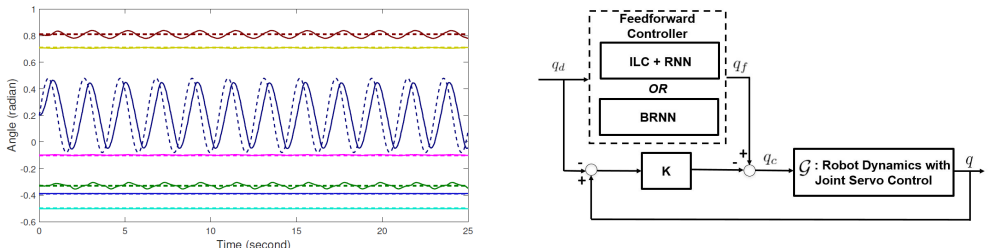
The carrying object is a pair of recurrent networks sharing one dataset: a 4-layer unidirectional GRU network that maps a 50-step window of commanded joint positions to the joint configuration 50 steps later, and a 2-layer bidirectional GRU network (BRNN) that maps a 50-step window of measured joint positions centered at time $t$ back to the command at time $t$. The BRNN is what makes the inverse-dynamics approach work: because the stable inverse of a strictly proper or non-minimum-phase system is non-causal, each feedforward command must look both backward and forward along the desired trajectory, and the centered window supplies that context. The forward RNN feeds a gradient-based ILC update $u^{k+1} = u^k - \alpha_k G^*(s) e_q$, where $G^*(s)$ is the adjoint of the learned forward model; the BRNN simply filters the desired trajectory to produce the feedforward command. Both outputs are added to a proportional feedback term to form the commanded joint setpoint.
What would settle it
Record a set of held-out command-response pairs, feed each measured response into the BRNN to get a predicted command, replay that command on the robot, and measure the resulting error; if the replayed output deviates as much as or more than the baseline proportional controller, the learned inverse is not doing the work claimed. A lighter check is to run a test trajectory whose manipulability falls outside the light-blue training region in Fig. 4 and see whether the 30–50% improvement disappears.
Extended reading notes
Core claim
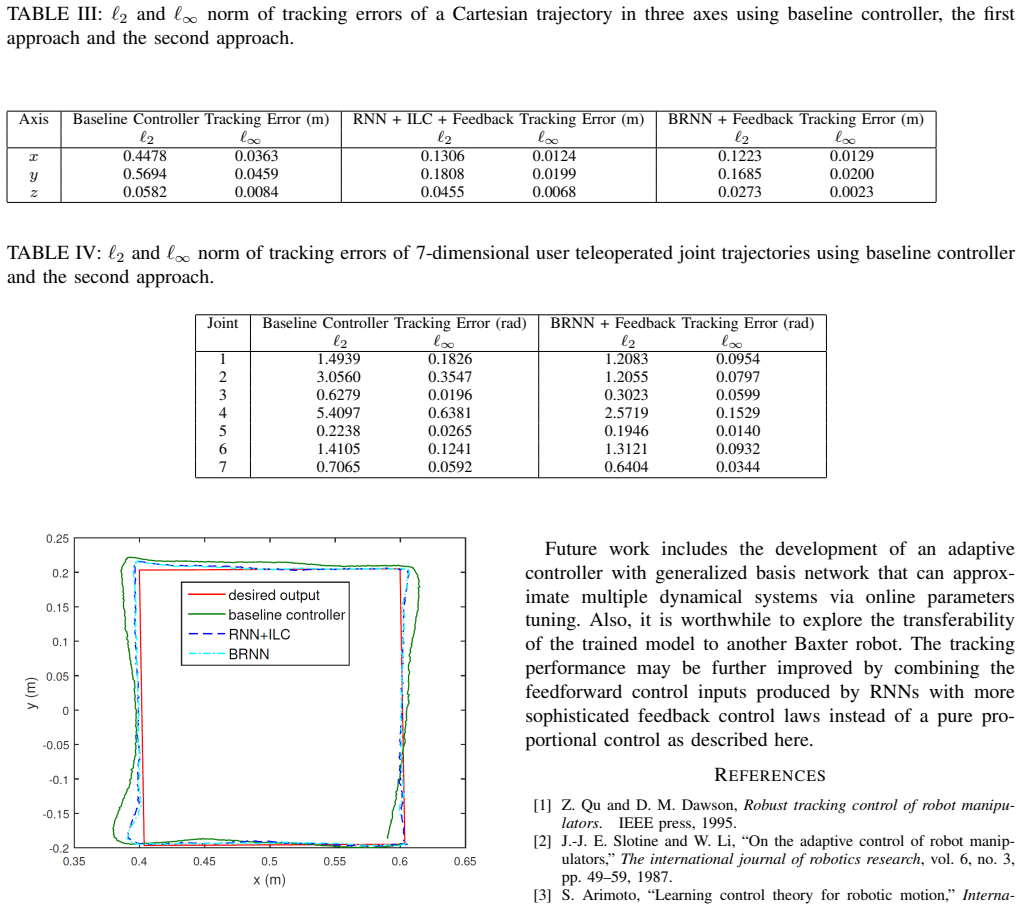
On its own terms, the paper's claim is that the inner-loop command-to-response dynamics of a flexible-joint manipulator can be learned directly from recorded command and response trajectories, and the learned map can be used for feedforward compensation in two ways. First, a unidirectional RNN approximates the forward dynamics and supplies the model for an offline gradient-based iterative learning control that refines the command before execution. Second, a bidirectional RNN trained on the same data with output and command swapped approximates the (generally non-causal) inverse dynamics, so the desired trajectory can be filtered directly to produce feedforward commands in real time. Experiments on the Baxter left arm show average reductions in $\ell^2$ tracking error of more than 50% for sinusoidal and Cartesian trajectories, over 40% for random joint trajectories, and over 30% for teleoperated trajectories, compared with a proportional feedback baseline; the BRNN method is slightly more accurate than RNN-ILC in most of the reported cases.
Load-bearing premise
The whole scheme rests on the assumption that the command-to-response map of the robot is invertible over the tested region and that a 50-step bidirectional window plus the training trajectories capture that inverse well enough; the paper never separately verifies the learned inverse's prediction accuracy.
Editorial extensions
If this is right
- A robot's unknown joint-flexibility dynamics can be compensated for from measurement data alone, without torque-level models or system identification.
- A single offline-trained BRNN can produce feedforward commands in real time for trajectories that are not known in advance, such as teleoperated motion.
- The learned forward RNN makes iterative learning control practical offline, avoiding slow iterations on the physical robot.
- The reported reductions in $\ell^2$ tracking error generalize across unseen sinusoidal, random, and Cartesian trajectories, with further improvement available from additional physical ILC iterations.
- Between the two approaches, the inverse-dynamics BRNN is preferred for online use since it needs only a forward pass, while RNN-ILC requires the entire trajectory ahead of time.
Reading between the lines
- A testable extension is to measure the BRNN's inverse-model prediction error on held-out command–response pairs; if the inverse mapping is not accurate, the feedforward can amplify error instead of reducing it, which the paper does not assess.
- The same bidirectional-inversion recipe should transfer to other actuation chains with delay or flexibility—hydraulic actuators, cable-driven arms, or soft robots—where the stable inverse is likewise non-causal.
- The reported 0.24 s look-ahead delay at 100 Hz suggests a tunable trade-off: a shorter BRNN window would reduce teleoperation latency but may lose the non-causal information the inverse needs.
- Combining the learned feedforward with a more sophisticated feedback law (the paper uses pure proportional gain) is the obvious next step; stability margins of the closed loop with the learned inverse are not analyzed here.
Signed reviews
Editorial analysis
A structured set of objections, weighed in public.
Referee Report
Summary. This paper addresses trajectory tracking of a flexible-joint Baxter robot whose inner torque servo has unknown dynamics. The authors propose two feedforward compensation schemes: an offline iterative learning control (ILC) that uses a unidirectional RNN trained to predict the forward dynamics, and a direct inversion scheme in which a bidirectional RNN (BRNN) trained on (actual response, commanded setpoint) pairs is used to filter the desired trajectory into a feedforward command. The feedforward is added to a proportional feedback baseline. Experiments on sinusoidal, random joint, Cartesian square, and teleoperated trajectories report a 30-50% reduction in l2 tracking error relative to the baseline. The paper argues that the learned models capture the coupled, flexible-joint dynamics and that the BRNN's bidirectional window captures the noncausality of the inverse system.
Significance. If the improvement is causally attributable to the learned internal dynamics, the paper would provide a practical, data-driven way to improve tracking of collaborative robots that expose only a joint-setpoint interface, without requiring torque-level control or an accurate simulator. The study has genuine strengths: experiments on a real Baxter with series-elastic actuators, joint coupling explicitly demonstrated, a comparison of two learning-based architectures for the same data set, and a large training corpus (500 trajectories, 1.2M samples). It also makes a conceptually interesting use of a BRNN as a noncausal inverse filter. However, the causal attribution is currently under-supported: the BRNN is not validated as an inverse model, the teleoperation comparison does not control for a 0.24 s preview advantage, and the ILC update for the nonlinear RNN is stated only for a linear adjoint. These issues must be resolved before the central claim can be accepted.
major comments (3)
- [IV.B.3, Eq. (4)] The ILC update in Eq. (4) is written for the adjoint G*(s) of a linear time-invariant system, but the forward model used to generate the gradient is the trained nonlinear RNN. The paper does not derive the corresponding adjoint for the RNN, nor does it explain how G*(s)eq is computed (e.g., by backpropagation through time or by linearization). Because the first approach's feedforward command is the output of this ILC, the method is under-specified and not reproducible as it stands. Please provide the gradient computation for the RNN or justify that the linear ILC update applies.
- [IV.C.1 and V (Tables I-III)] The BRNN is trained on pairs (q, qd) in which the input is the measured response and the output is the commanded setpoint, but at inference it is applied to desired trajectories qd to produce qf. This presumes the command-to-response map is invertible and that the learned network generalizes from response windows to desired windows. No held-out prediction error for the BRNN is reported, and no ablation is given against a simpler noncausal feedforward (e.g., qf(t)=qd(t+delta)). Since the BRNN sees a +-25-step window (Eq. (5)) whereas the baseline controller (Eq. (2)) uses only qd(t+1), the reported 30-50% improvements may be largely due to preview rather than to a learned inverse. Please validate the inverse model and compare with a matched-preview baseline.
- [V.D] In the teleoperation experiment, the BRNN requires 24 future user inputs, which the authors obtain by delaying the commanded trajectory by 0.24 s. Table IV compares this delayed, preview-enhanced controller against a baseline feedback controller that does not have access to future setpoints and is not delayed in the same way. The 30% improvement therefore cannot be unambiguously attributed to the learned inverse dynamics. The authors should compare against a baseline that has the same 0.24 s preview (e.g., a time-shifted desired trajectory) or otherwise control for latency.
minor comments (5)
- [V.C] The claim that additional ILC iterations on the physical robot further improve performance is not supported by any reported results; please report these experiments or remove the claim.
- [IV.C.2] There is a notational slip: the sentence 'for each input qd and output trajectory q' should read 'for each input q and output trajectory qd', since the BRNN maps response to command. Also, the sample counts 1225000 and 1225500 differ from the formula (2500-T or 2501-T times 500); please check the arithmetic.
- [IV.B.2 and IV.C.2] The choice T=50 is justified only qualitatively; since T determines the preview length and the network memory, a sensitivity study (or at least a statement of the tradeoff) would help the reader understand the role of this hyperparameter.
- [Fig. 4] The four testing trajectories are hard to distinguish from the training-trajectory background; using distinct colors or markers would improve clarity.
- [V (Tables I-IV)] All tables report single-run errors without error bars or statistical tests; over repeated trials this would make the improvement claims more robust.
Circularity Check
No significant circularity: the learned feedforward is evaluated against an external baseline on separate test trajectories.
full rationale
Walked the derivation chain. The forward RNN plus ILC and BRNN inverse-dynamics feedforwards are trained on offline collected commanded/response pairs, while the four test trajectories are explicitly unseen and the manipulability plot (Fig. 4) distinguishes training from testing data. The baseline is an external proportional-feedback controller (Eq. 2), so the improvements in Tables I-IV are empirical and not forced by construction: no fitted parameter is renamed as a prediction, and no test trajectory is used as a training label. The self-citations to [22], [26], and [27] are methodological references for gradient-based ILC and resolved-velocity teleoperation; the ILC update is stated in Eq. (4) rather than being justified solely by citation, and the teleoperation controller is an input-generation tool rather than the source of the tracking-error reduction. The lack of a separate validation of the learned inverse and the absence of a simple lead/preview feedforward baseline are experimental-design or correctness concerns, not circularity. No step in the paper reduces by definition or by fitted input to its own output.
Assumptions & free parameters
free parameters (3)
- Feedback gain k =
not reported
- RNN memory window T =
50 time steps (0.5 s at 100 Hz)
- Network architecture and training hyperparameters =
4-layer unidirectional GRU RNN; 2-layer bidirectional GRU BRNN; dropout 0.5; Adam lr 1e-3; batch 256; 10000 iterations
assumptions (3)
- domain assumption The Baxter closed-loop dynamics are deterministic, time-invariant, and representable by a 50-step recurrent model.
- ad hoc to paper The gradient-based ILC update (4), derived for a linear system, converges when applied through the nonlinear trained RNN.
- ad hoc to paper The command-response pairs (qd, q) define an invertible map, so the BRNN trained on (q -> qd) can be used as an inverse filter (qd -> qf).
Cite this review
Pith. "Pith review of Neural-Learning Trajectory Tracking Control of Flexible-Joint Robot Manipulators with Unknown Dynamics." pith.science (2026). https://pith.science/paper/3TODG5VY
@misc{pith2026190803269,
  author       = {Pith},
  title        = {Pith review of: Neural-Learning Trajectory Tracking Control of Flexible-Joint Robot Manipulators with Unknown Dynamics},
  year         = {2026},
  howpublished = {\url{https://pith.science/paper/3TODG5VY}},
  note         = {Machine review of arXiv:1908.03269}
}
read the original abstract
Fast and precise motion control is important for industrial robots in manufacturing applications. However, some collaborative robots sacrifice precision for safety, particular for high motion speed. The performance degradation is caused by the inability of the joint servo controller to address the uncertain nonlinear dynamics of the robot arm, e.g., due to joint flexibility. We consider two approaches to improve the trajectory tracking performance through feedforward compensation. The first approach uses iterative learning control, with the gradient-based iterative update generated from the robot forward dynamics model. The second approach uses dynamic inversion to directly compensate for the robot forward dynamics. If the forward dynamics is strictly proper or is non-minimum-phase (e.g., due to time delays), its stable inverse would be non-causal. Both approaches require robot dynamical models. This paper presents results of using recurrent neural networks (RNNs) to approximate these dynamical models-forward dynamics in the first case, inverse dynamics (possibly non-causal) in the second case. We use the bi-directional RNN to capture the noncausality. The RNNs are trained based on a collection of commanded trajectories and the actual robot responses. We use a Baxter robot to evaluate the two approaches. The Baxter robot exhibits significant joint flexibility due to the series-elastic joint actuators. Both approaches achieve sizable improvement over the uncompensated robot motion, for both random joint trajectories and Cartesian motion. The inverse dynamics method is particularly attractive as it may be used to more accurately track a user input as in teleoperation.
Figures


Figures from the paper (4 more)



Forward citations
Cited by 1 Pith paper
-
Dynamic Evaluation of Classical and Control-Aware Optimal Trajectory Planning in Robot Manipulators
Under identical nonlinear PID execution, a finite-horizon control-effort-aware trajectory planner reduces tracking error, corrective torque, and execution cost versus classical kinematic planners on a simplified UR5.
Reference graph
Works this paper leans on
- [1]
-
[2]
On the adaptive control of robot manip- ulators,
J.-J. E. Slotine and W. Li, “On the adaptive control of robot manip- ulators,” The international journal of robotics research , vol. 6, no. 3, pp. 49–59, 1987
work page 1987
-
[3]
Learning control theory for robotic motion,
S. Arimoto, “Learning control theory for robotic motion,” Interna- tional Journal of Adaptive Control and Signal Processing , vol. 4, no. 6, pp. 543–564, 1990
work page 1990
-
[4]
Feedback- error-learning neural network for trajectory control of a robotic ma- nipulator,
H. Miyamoto, M. Kawato, T. Setoyama, and R. Suzuki, “Feedback- error-learning neural network for trajectory control of a robotic ma- nipulator,” Neural Networks , vol. 1, no. 3, pp. 251 – 265, 1988
work page 1988
-
[5]
Global tracking controllers for flexible-joint manipulators: a comparative study,
B. Brogliato, R. Ortega, and R. Lozano, “Global tracking controllers for flexible-joint manipulators: a comparative study,” Automatica, vol. 31, no. 7, pp. 941–956, 1995
work page 1995
-
[6]
A simple iterative learning controller for manipulators with flexible joints,
D. Wang, “A simple iterative learning controller for manipulators with flexible joints,” Automatica, vol. 31, no. 9, pp. 1341–1344, 1995
work page 1995
-
[7]
T. H. Lee and C. J. Harris, Adaptive neural network control of robotic manipulators. World Scientific, 1998, vol. 19
work page 1998
-
[8]
Nonlinear Systems Identification Using Deep Dynamic Neural Networks,
O. Ogunmolu, X. Gu, S. Jiang, and N. Gans, “Nonlinear Systems Identification Using Deep Dynamic Neural Networks,” arXiv e-prints, p. arXiv:1610.01439, Oct 2016
arXiv 2016
Show all 28 references
-
[9]
Bidirectional recurrent neural net- works,
M. Schuster and K. K. Paliwal, “Bidirectional recurrent neural net- works,” IEEE Trans. Signal Processing, vol. 45, pp. 2673–2681, 1997
1997
-
[10]
A brief review of neural networks based learning and control and their applications for robots,
Y . Jiang, C. Yang, J. Na, G. Li, Y . Li, and J. Zhong, “A brief review of neural networks based learning and control and their applications for robots,” Complexity, vol. 2017, pp. 1–14, 10 2017
2017
-
[11]
Robot manipulator control using neural networks: A survey,
L. Jin, S. Li, J. Yu, and J. He, “Robot manipulator control using neural networks: A survey,” Neurocomputing, vol. 285, pp. 23 – 34, 2018
2018
-
[12]
Adaptive output feedback control of flexible-joint robots using neural networks: Dynamic surface design approach,
S. J. Yoo, J. B. Park, and Y . H. Choi, “Adaptive output feedback control of flexible-joint robots using neural networks: Dynamic surface design approach,” IEEE Transactions on Neural Networks , vol. 19, no. 10, pp. 1712–1726, Oct 2008. Fig. 8: Comparison of tracking performanc...
2008
-
[13]
Identification and control of class of non-linear systems with non- symmetric deadzone using recurrent neural networks,
J. H. Perez-Cruz, I. Chairez, J. de Jesus Rubio, and J. Pacheco, “Identification and control of class of non-linear systems with non- symmetric deadzone using recurrent neural networks,” IET Control Theory Applications , vol. 8, no. 3, pp. 183–192, Feb 2014
2014
-
[14]
Adaptive neural impedance control of a robotic manipulator with input saturation,
W. He, Y . Dong, and C. Sun, “Adaptive neural impedance control of a robotic manipulator with input saturation,” IEEE Transactions on Systems, Man, and Cybernetics: Systems , vol. 46, no. 3, pp. 334–344, March 2016
2016
-
[15]
Neural learning control of flexible joint manipulator with predefined tracking performance and application to baxter robot,
M. Wang, H. Ye, and Z. Chen, “Neural learning control of flexible joint manipulator with predefined tracking performance and application to baxter robot,” Complexity, vol. 2017, pp. 7 683 785:1–7 683 785:14, 2017
2017
-
[16]
Neural-learning-based control for a constrained robotic manipulator with flexible joints,
W. He, Z. Yan, Y . Sun, Y . Ou, and C. Sun, “Neural-learning-based control for a constrained robotic manipulator with flexible joints,” IEEE Transactions on Neural Networks and Learning Systems , vol. 29, no. 12, pp. 5993–6003, Dec 2018
2018
-
[17]
Neural-learning-based telerobot control with guaranteed performance,
C. Yang, X. Wang, L. Cheng, and H. Ma, “Neural-learning-based telerobot control with guaranteed performance,” IEEE Transactions on Cybernetics , vol. 47, no. 10, pp. 3148–3159, Oct 2017
2017
-
[18]
Inverse dynamics control of flexible-link manipulators using neural networks,
H. A. Talebi, R. V . Patel, and K. Khorasani, “Inverse dynamics control of flexible-link manipulators using neural networks,” in Proceedings. 1998 IEEE International Conference on Robotics and Automation (Cat. No.98CH36146) , vol. 1, May 1998, pp. 806–811 vol.1
1998
-
[19]
Deep neural networks for improved, impromptu trajectory tracking of quadrotors,
Q. Li, J. Qian, Z. Zhu, X. Bao, M. K. Helwa, and A. P. Schoellig, “Deep neural networks for improved, impromptu trajectory tracking of quadrotors,” in 2017 IEEE International Conference on Robotics and Automation (ICRA) , May 2017, pp. 5183–5189
2017
-
[20]
Learning inverse dynamics models with contacts,
R. Calandra, S. Ivaldi, M. P. Deisenroth, E. Rueckert, and J. Peters, “Learning inverse dynamics models with contacts,” in 2015 IEEE International Conference on Robotics and Automation (ICRA) , May 2015, pp. 3186–3191
2015
-
[21]
Learning inverse dynamics models in O(n) time with LSTM networks,
E. Rueckert, M. Nakatenus, S. Tosatto, and J. Peters, “Learning inverse dynamics models in O(n) time with LSTM networks,” in 2017 IEEE-RAS 17th International Conference on Humanoid Robotics (Humanoids), Nov 2017, pp. 811–816
2017
-
[22]
Industrial Robot Trajectory Tracking Using Multi-Layer Neural Networks Trained by Iterative Learning Control,
S. Chen and J. T. Wen, “Industrial Robot Trajectory Tracking Using Multi-Layer Neural Networks Trained by Iterative Learning Control,” arXiv e-prints , p. arXiv:1903.00082, Feb 2019
1903 arXiv
-
[23]
A second-order gradient method for determining optimal trajectories of non-linear discrete-time systems,
B. D. MAYNE, “A second-order gradient method for determining optimal trajectories of non-linear discrete-time systems,” International Journal of Control , vol. 3, no. 1, pp. 85–95, 1966
1966
-
[24]
Manipulability of robotic mechanisms,
T. Yoshikawa, “Manipulability of robotic mechanisms,” The Interna- tional Journal of Robotics Research , vol. 4, no. 2, pp. 3–9, 1985
1985
-
[25]
Dropout: A simple way to prevent neural networks from overfitting,
N. Srivastava, G. Hinton, A. Krizhevsky, I. Sutskever, and R. Salakhut- dinov, “Dropout: A simple way to prevent neural networks from overfitting,” Journal of Machine Learning Research, vol. 15, pp. 1929– 1958, 2014
1929
-
[26]
High performance motion tracking control for electronic manufacturing,
B. Potsaid, J. T. Wen, M. Unrath, D. Watt, and M. Alpay, “High performance motion tracking control for electronic manufacturing,” Journal of Dynamic Systems Measurement and Control , vol. 129, p. 767776, 11 2007
2007
-
[27]
Software framework for robot-assisted large structure as- sembly,
S. Chen, Y . C. Peng, J. Wason, J. Cui, G. Saunders, S. Nath, and J. T. Wen, “Software framework for robot-assisted large structure as- sembly,” in the ASME 2018 13th International Manufacturing Science and Engineering Conference , June 2018
2018
-
[28]
Robot raconteur: A communication ar- chitecture and library for robotic and automation systems,
J. D. Wason and J. Wen, “Robot raconteur: A communication ar- chitecture and library for robotic and automation systems,” in IEEE International Conference on Automation Science and Engineering , 08 2011, pp. 761–766
2011
Reviewed August 14, 2026 · model on record in the stance chip above.
Discussion (0). Continue with ORCID to comment.