REVIEW 4 major objections 5 minor 20 references
Domains without dense Steklov nodal sets
T0 review · 4 major / 5 minor · reviewed 2026-08-14 · deepseek-v4-flash
Pith's one-line read Steklov eigenfunctions on a dense family of analytic domains can remain nonzero on a fixed-radius ball, so their nodal sets are not dense at shrinking scales.
desk verdict A genuinely new negative answer to a named Steklov open problem, with a coherent proof built on one load-bearing imported estimate that deserves referee scrutiny. read the letter →
The pith
A machine-rendered reading of the paper's core claim, the machinery that carries it, and where it could break.
The reading
What carries the argument
The central device is the tunneling condition, defined via boundary Fourier coefficients of the pulled-back eigenfunction $u=\varphi\circ f$ on the unit disk: for any $K$ there is $C_0$ such that $|\hat u(k)|\le C_0^{|k-m|}A_m$ for $|k|\le K\sigma$, where $A_m=(\sum_{k=m-m_0}^{m+m_0}|\hat u(k)|^2)^{1/2}$. Lemma 4.1 turns this into a lower bound $e^{-C\sigma}\|\hat u\|_{\ell^2}\le A_m$ on the low-frequency mass, so the interior harmonic extension cannot become exponentially negligible. Theorem 3 proves the tunneling condition for BBLCN domains, i.e. domains whose conformal mapping $f$ has $|\partial_z f|$ boundary-band-limited and nonconstant on $\partial\mathbb{D}$, for example $f(z)=\int p(w)^2\,dw$ with polynomial $p$ having no roots in the disk. Corollary 2.2 approximates any analytic simply-connected domain arbitrarily closely in $C^k$ by such domains. Theorem 2 then uses the $r^{|k|}$ decay of Fourier harmonics to dominate high modes, leaving a low-frequency polynomial that cannot vanish throughout any fixed-radius ball.
What would settle it
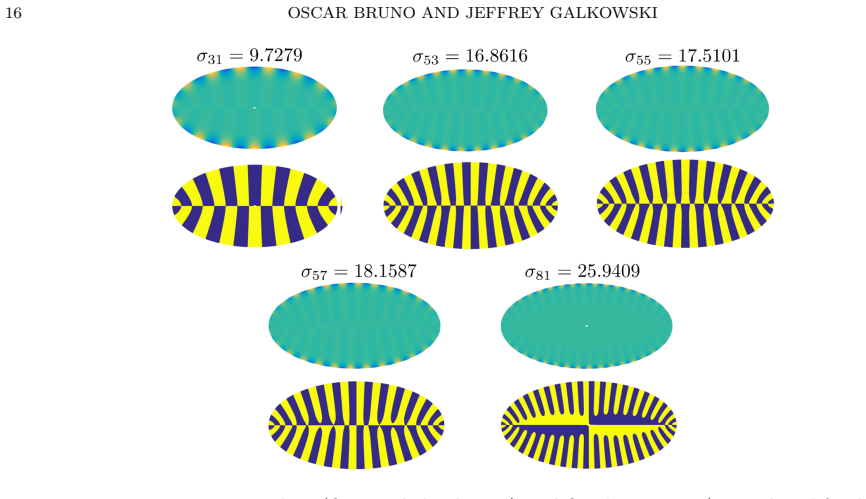
Compute boundary Fourier coefficients of high Steklov eigenfunctions on a non-BBLCN analytic domain, such as the ellipse with semiaxes 2 and 1; if for some sequence $\sigma_j\to\infty$ the mass in the window $|k-m|\le 2\sigma_j$ falls below $(1-Ce^{-\sigma_j/C})$ of the total mass, the exponential-concentration input to Lemma 4.1 fails and the proof chain collapses. A direct check of the paper's conclusion would be to search for a high eigenfunction whose zero set intersects every ball of radius $r_1$ inside the domain for every $r_1>0$.
Extended reading notes
Core claim
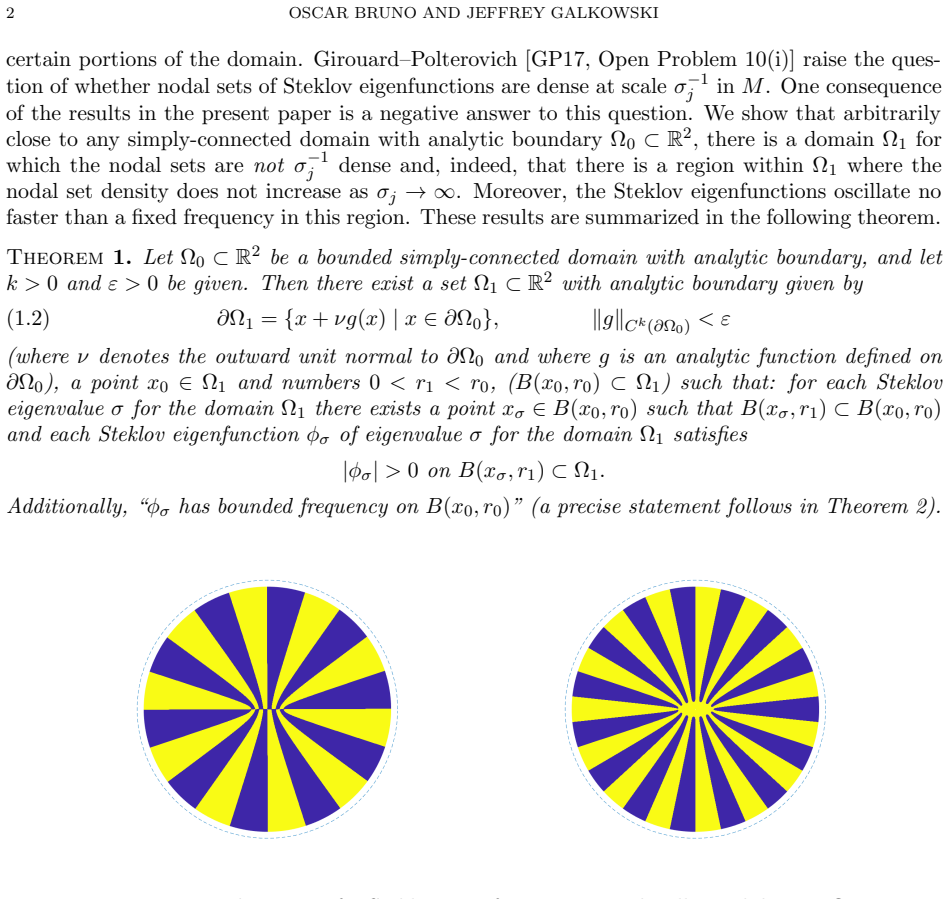
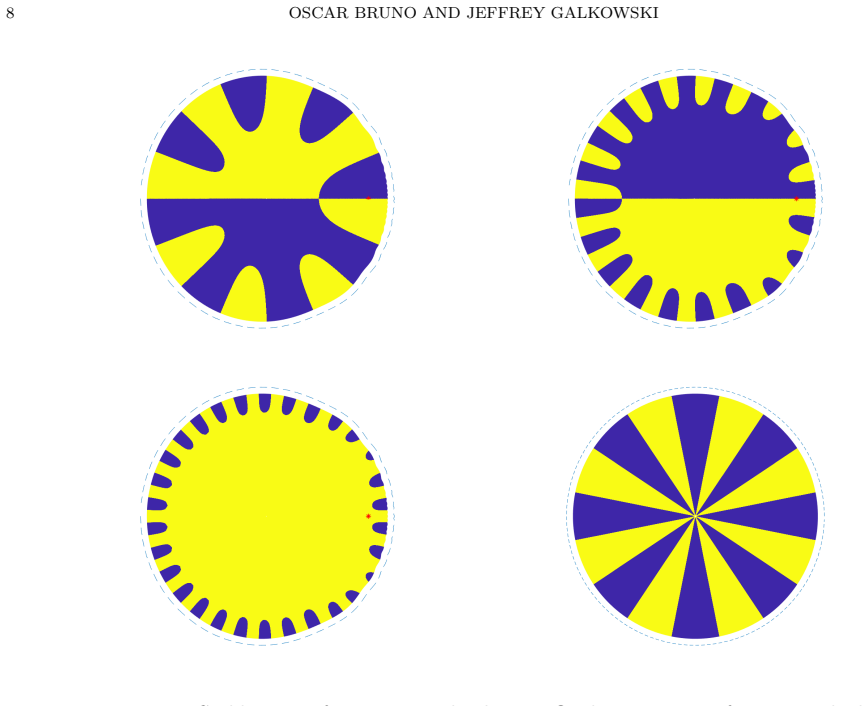
The paper's central discovery is that high-frequency Steklov eigenfunctions can be frozen inside a domain. Theorem 1 states that, starting from any bounded simply-connected analytic domain $\Omega_0$, one can make an arbitrarily small analytic boundary perturbation (of size $\varepsilon$ in $C^k$) to obtain a domain $\Omega_1$ with a point $x_0$ and radii $0<r_1<r_0$ such that every Steklov eigenfunction of every eigenvalue $\sigma$ is nonzero on some ball $B(x_\sigma,r_1)$ inside $B(x_0,r_0)$. The point $x_\sigma$ may depend on $\sigma$, but $r_1$ does not. Since the expected oscillation scale is $\sigma^{-1}$, this is incompatible with the nodal set being dense at that scale, giving a negative answer to Open Problem 10(i) of [GP17]. The refined Theorem 2 shows that on a small ball the eigenfunction is approximated in $C^N$ by finitely many Fourier modes, with relative error $C_N(\delta m^{-N-m_0-1}+e^{-c\sigma})$, and Theorem 3 identifies a dense class of domains, the BBLCN domains, for which the necessary tunneling estimate holds.
Load-bearing premise
The whole chain depends on an imported exponential concentration estimate for the boundary Fourier coefficients of a Steklov eigenfunction; if that estimate fails for some high eigenvalue, the low-frequency mass bound and the resulting constant-sign ball are not established.
Editorial extensions
If this is right
- Open Problem 10(i) of [GP17] has a negative answer: in the constructed domains, Steklov nodal sets are not dense at scale $\sigma^{-1}$, and a fixed-radius ball of constant sign exists for every eigenfunction.
- The class of simply-connected analytic domains exhibiting this behavior is dense in the $C^k$ boundary topology, so the phenomenon is not confined to special shapes.
- On such domains, interior Steklov eigenfunctions are well approximated by finitely many Fourier modes: the $C^N$ error on a small ball is bounded by $C_N(\delta m^{-N-m_0-1}+e^{-c\sigma})$ relative to the $L^2$ norm.
- The eigenfunctions have bounded frequency on a fixed interior neighborhood, so their oscillation rate does not grow with $\sigma$ in that region.
- Every analytic simply-connected domain can be approximated arbitrarily closely by a BBLCN domain, and every BBLCN domain is tunneling.
Reading between the lines
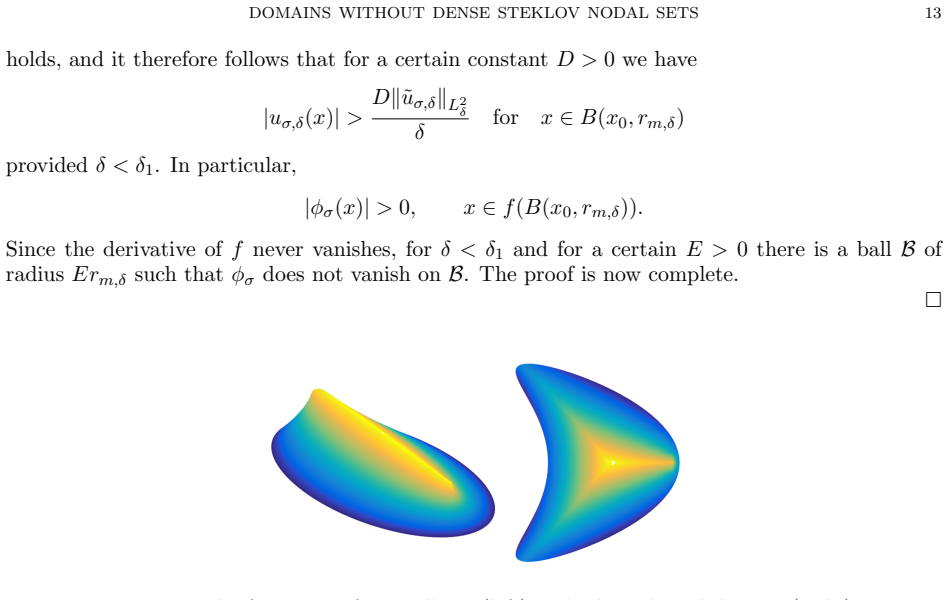
- If the tunneling conjecture stated in the paper is true, the fixed-radius sign-ball behavior would extend to every analytic non-circular domain, making non-density generic; the ellipse and kite numerics already show the expected opening.
- The proof reframes interior Steklov decay as an exponential tunneling effect, suggesting that interior Steklov eigenfunctions localize away from some regions in a way high-energy Laplace eigenfunctions do not; a comparison of nodal length asymptotics on the same domain could test this distinction.
- A parameter-free extension would be to run the BBLCN construction with rational maps instead of polynomial squares, allowing the method to reach multiply connected or higher-genus geometries once the band-limited algebra is verified.
- A quick numerical check of the mechanism is to perturb the unit disk by one low-order Fourier mode and track the largest sign-definite ball as $\sigma$ grows; the theory predicts the radius stays bounded below, whereas for the exact disk it shrinks like $\sigma^{-1}$.
Signed reviews
Editorial analysis
A structured set of objections, weighed in public.
Referee Report
Summary. The paper studies Steklov eigenfunctions in bounded simply-connected planar domains with analytic boundaries. It constructs a dense family of such domains for which, for every sufficiently large Steklov eigenvalue, every eigenfunction has a ball of sigma-independent radius on which it does not vanish, thereby giving a negative answer to Open Problem 10(i) of Girouard and Polterovich (J. Spectr. Theory 2017). The proof combines an approximation theorem by boundary-band-limited conformal domains (Corollary 2.2), a new 'tunneling' condition (Definition 1.1) shown to hold for BBLCN domains (Theorem 3), an exponential lower bound on low-frequency Fourier mass (Lemma 4.1), and a finite-mode approximation of interior eigenfunctions (Theorem 2). The paper also contains numerical experiments for elliptical and kite-shaped domains.
Significance. If the main theorem holds, the result is significant: it establishes that Steklov eigenfunctions on a dense class of analytic planar domains can have slowly oscillating, sign-definite regions of fixed size, in stark contrast to high-energy Laplace eigenfunctions. The tunneling mechanism is a new and interesting idea, and the construction of BBLCN approximating domains is explicit and uses no fitted parameters. The proof of Theorem 3 is a clean recurrence argument. However, the central chain depends on an imported spectral concentration estimate from [GT19] and on a quantifier in the statement of Theorem 1 that is stronger than what the proof appears to establish; both points need to be addressed before the paper can be accepted.
major comments (4)
- [Section 1, Theorem 1] The statement 'there exists a point x_sigma in B(x0,r0) such that ... each Steklov eigenfunction phi_sigma of eigenvalue sigma satisfies |phi_sigma|>0 on B(x_sigma,r1)' requires a single x_sigma common to all eigenfunctions in the eigenspace of sigma. The proof, around equations (4.4)-(4.10), chooses x0 from the maximum of the finite-mode approximation tilde u_{sigma,delta,m} for one eigenfunction, so it proves the conclusion only for that eigenfunction. If the Steklov spectrum of the constructed domain has an eigenvalue of multiplicity at least two, no common point can work: given two independent eigenfunctions positive at a proposed x_sigma, a suitable linear combination vanishes at x_sigma. Thus the theorem as stated is either false for eigenspaces of dimension greater than one or at least not proved. Please restate the theorem in the per-eigenfunction form used in the abstract, or add a genericity argument ensuring the constructed domains have simple Steklov spectrum.
- [Section 4, Lemma 4.1] The proof of Lemma 4.1 imports the estimate [GT19, Corollary 1.3] in the form sum_{|k-m|<=2sigma}|hat u(k)|^2 >= ||hat u||_{ell^2}^2(1 - C e^{-sigma/C}) without stating its precise hypotheses or proof. This estimate is load-bearing: it is the only source of the exponential lower bound e^{-C sigma}||hat u|| <= A_m, and without it the high-frequency tail estimate in Theorem 2 and the fixed-radius positivity in Theorem 1 fail. Since the corollary is external and is co-authored by the second author, a reader cannot certify it from the text alone. Please state the exact statement, confirm that it applies to the mapped Steklov problem on the unit disk with the weight |partial_z f|, and verify the m=0 case, which is used in the proof of Theorem 2 even though Lemma 4.1 as stated is for m>0.
- [Section 4, proof of Lemma 4.1] The displayed application of Lemma 3.1 appears to have an indexing error: the sums are written with factors C_0^{2k} and C_0^{2|k|}, whereas Lemma 3.1 gives the bound C_0^{2|k-m|} for the coefficients in the window |k-m|<=2sigma. With the printed exponents, the subsequent bound by (2(2C_0^{4sigma+2}-1)/(C_0^2-1)) A_m^2 does not follow, particularly when m is large. This is likely a typographical error, but it must be corrected because the lower bound for A_m depends on this step.
- [Section 4, proof of Theorem 2 and Section 1, Theorem 1] The proof of Theorem 1 uses the C^1 bound of tilde u_{sigma,delta,m} on a ball B(x0,r_{m,delta}) but the preceding estimates were obtained on B(0,delta). To ensure B(x0,r_{m,delta}) is contained in the unit disk and that the image f(B(x0,r_{m,delta})) lies in Omega_1 with the stated ball inclusion B(x_sigma,r1) subset B(x0,r0), the proof should specify the choice of delta and r_{m,delta} more carefully, e.g. taking 2delta<1 and r_{m,delta}<delta. The current text says r_{m,delta}<delta but does not state the required containment in the domain of definition of the approximation.
minor comments (5)
- [Definition 1.1] The tunneling condition does not explicitly quantify over eigenfunctions; please state that the inequality is required for every Steklov eigenfunction u_sigma (or for every member of an orthonormal basis).
- [Notation] The notation switches between u_{sigma_j}, u_sigma, and tilde u_{sigma,delta}; please define these consistently near (1.3), (1.7), and Theorem 2.
- [Lemma 2.1] The proof approximates w by a polynomial p_epsilon and then factors p_epsilon = beta_0 prod (z-beta_i)^{N_i}. To ensure the zeros satisfy |beta_i|>1 rather than merely |beta_i|>=1, one should note that a small additional perturbation can push boundary zeros slightly outside the closed disk; as written this point is implicit.
- [Corollary 2.2] The implicit-function-theorem argument for expressing partial Omega_{epsilon} as a normal graph is terse; for instance, the periodicity and C^k regularity of s(theta) and omega(theta) are asserted rather than shown. A few clarifying sentences would help.
- [Figures and tables] There are small presentation errors: Figure 2's caption contains the typo 'eignfunction', and Table 2's caption says 'Same as Figure (1)' where 'Table 1' is meant.
Circularity Check
No significant circularity: the construction of BBLCN approximants and the tunneling condition are genuine new inputs, and the only self-citation [GT19, Cor 1.3] is an external parameter-free estimate used as a lemma.
full rationale
The paper's derivation chain is: Corollary 2.2 approximates any analytic domain by BBLCN domains using polynomial approximation of ∂_z f; Theorem 3 proves that BBLCN domains satisfy the tunneling condition (Definition 1.1) via the band-limited recurrence (3.2)-(3.3); Lemma 4.1 combines Lemma 3.1 with the imported concentration estimate [GT19, Cor. 1.3] to obtain low-frequency Fourier mass; Theorem 2 derives the finite-mode truncation estimate (1.8) from the tunneling condition; Theorem 1 then combines Theorem 2 with the density of BBLCN domains. Each step is a proof rather than a definitional identification. The tunneling condition is a genuine hypothesis about exponential concentration of boundary Fourier coefficients near a frequency window; it is not defined in terms of nodal-set non-density, and the conclusion of positivity on a fixed-size ball is not inserted into the condition. The only self-citation is [GT19, Cor. 1.3], a published parameter-free estimate on Steklov eigenfunctions; the paper uses it as an external lemma, it is not derived from the target result, and it does not presuppose the existence of domains with non-dense nodal sets. Consequently, the citation is load-bearing for the proof but not circular. Internal wording issues, such as Lemma 4.1 being stated for m>0 but later applied with m=0, are correctness or typographical concerns rather than circularity. The central claim does not reduce to a fit, a renamed known result, or a self-citation chain.
Assumptions & free parameters
assumptions (3)
- standard math Riemann mapping theorem and Bell-Krantz [BK87] smooth extension of conformal maps to the boundary for analytic simply-connected domains.
- standard math Implicit function theorem used to show the perturbed curve ∂Ω_ε is a normal graph over ∂Ω (Corollary 2.2).
- domain assumption [GT19, Corollary 1.3]: exponential concentration of boundary Fourier coefficients of Steklov eigenfunctions in the window |k-m|≤2σ.
Cite this review
Pith. "Pith review of Domains without dense Steklov nodal sets." pith.science (2026). https://pith.science/paper/PDUQFWJM
@misc{pith2026190803307,
  author       = {Pith},
  title        = {Pith review of: Domains without dense Steklov nodal sets},
  year         = {2026},
  howpublished = {\url{https://pith.science/paper/PDUQFWJM}},
  note         = {Machine review of arXiv:1908.03307}
}
abstract
This article concerns the asymptotic geometric character of the nodal set of the eigenfunctions of the Steklov eigenvalue problem $$ -\Delta \phi_{\sigma_j}=0,\quad\text{ on }\Omega,\qquad\qquad \partial_\nu \phi_{\sigma_j}=\sigma_j \phi_{\sigma_j}\quad \text{ on }\partial\Omega $$ in two-dimensional domains $\Omega$. In particular, this paper presents a dense family $\mathcal{A}$ of simply-connected two-dimensional domains with analytic boundaries such that, for each $\Omega\in \mathcal{A}$, the nodal set of the eigenfunction $\phi_{\sigma_j}$ "is $not$ dense at scale $\sigma_j^{-1}$". This result addresses a question put forth under "Open Problem 10" in Girouard and Polterovich, J. Spectr. Theory, 321-359 (2017). In fact, the results in the present paper establish that, for domains $\Omega\in \mathcal{A}$, the nodal sets of the eigenfunctions $\phi_{\sigma_j}$ associated with the eigenvalue $\sigma_j$ have starkly different character than anticipated: they are not dense at any shrinking scale. More precisely, for each $\Omega\in \mathcal{A}$ there is a value $r_1>0$ such that for each $j$ there is $x_j\in \Omega$ such that $\phi_{\sigma_j}$ does not vanish on the ball of radius $r_1$ around $x_j$.
Figures
Figures from the paper (2 more)

Reference graph
Works this paper leans on
-
[1]
Eldar Akhmetgaliyev. Fast numerical methods for mixed, singular Helmholtz boundary value problems and Laplace eigenvalue problems-with applications to antenna design, sloshing, electromagnetic scattering and spectral geometry . PhD thesis, California Institute of Technology, 2016
work page 2016
-
[2]
Steven R. Bell and Steven G. Krantz. Smoothness to the boundary of conformal maps. Rocky Mountain J. Math. , 17(1):23--40, 1987
work page 1987
-
[3]
Nodal sets of S teklov eigenfunctions
Katar\' i na Bellov\' a and Fang-Hua Lin. Nodal sets of S teklov eigenfunctions. Calc. Var. Partial Differential Equations , 54(2):2239--2268, 2015
work page 2015
-
[4]
Carl M. Bender and Steven A. Orszag. Advanced mathematical methods for scientists and engineers. I . Springer-Verlag, New York, 1999. Asymptotic methods and perturbation theory, Reprint of the 1978 original
work page 1999
-
[5]
Spectral geometry of the S teklov problem (survey article)
Alexandre Girouard and Iosif Polterovich. Spectral geometry of the S teklov problem (survey article). J. Spectr. Theory , 7(2):321--359, 2017
work page 2017
-
[6]
Alexandre Girouard, Leonid Parnovski, Iosif Polterovich, and David A. Sher. The S teklov spectrum of surfaces: asymptotics and invariants. Math. Proc. Cambridge Philos. Soc. , 157(3):379--389, 2014
work page 2014
-
[7]
Polynomial upper bound on interior Steklov nodal sets
Bogdan Georgiev and Guillaume Roy-Fortin. Polynomial upper bound on interior S teklov nodal sets. arXiv:1704.04484 , 2017
work page Pith review arXiv 2017
-
[8]
Jeffrey Galkowski and John A. Toth. Pointwise bounds for S teklov eigenfunctions. J. Geom. Anal. , 29(1):142--193, 2019
work page 2019
Show all 20 references
-
[9]
Hislop and Carl V
Peter D. Hislop and Carl V. Lutzer. Spectral asymptotics of the D irichlet-to- N eumann map on multiply connected domains in R^d . Inverse Problems , 17(6):1717--1741, 2001
2001
-
[10]
Linear integral equations , volume 82 of Applied Mathematical Sciences
Rainer Kress. Linear integral equations , volume 82 of Applied Mathematical Sciences . Springer, 3 edition, 2014
2014
-
[11]
Sloshing, steklov and corners: Asymptotics of sloshing eigenvalues
Michael Levitin, Leonid Parnovski, Iosif Polterovich, and David A Sher. Sloshing, steklov and corners: Asymptotics of sloshing eigenvalues. arXiv preprint arXiv:1709.01891 , 2017
2017 arXiv
-
[12]
Strongly elliptic systems and boundary integral equations
William McLean and William Charles Hector McLean. Strongly elliptic systems and boundary integral equations . Cambridge university press, 2000
2000
-
[13]
Nodal length of S teklov eigenfunctions on real-analytic R iemannian surfaces
Iosif Polterovich, David Sher, and John Toth. Nodal length of S teklov eigenfunctions on real-analytic R iemannian surfaces. to appear in J. Reine Angew. Math
-
[14]
S. E. Shamma. Asymptotic behavior of S tekloff eigenvalues and eigenfunctions. SIAM J. Appl. Math. , 20:482--490, 1971
1971
-
[15]
Sogge, Xing Wang, and Jiuyi Zhu
Christopher D. Sogge, Xing Wang, and Jiuyi Zhu. Lower bounds for interior nodal sets of S teklov eigenfunctions. Proc. Amer. Math. Soc. , 144(11):4715--4722, 2016
2016
-
[16]
Michael E. Taylor. Partial differential equations II . Q ualitative studies of linear equations , volume 116 of Applied Mathematical Sciences . Springer, New York, second edition, 2011
2011
-
[17]
A lower bound for the nodal sets of S teklov eigenfunctions
Xing Wang and Jiuyi Zhu. A lower bound for the nodal sets of S teklov eigenfunctions. Math. Res. Lett. , 22(4):1243--1253, 2015
2015
-
[18]
Hausdorff measure of nodal sets of analytic S teklov eigenfunctions
Steve Zelditch. Hausdorff measure of nodal sets of analytic S teklov eigenfunctions. Math. Res. Lett. , 22(6):1821--1842, 2015
2015
-
[19]
Geometry and interior nodal sets of S teklov eigenfunctions
Jiuyi Zhu. Geometry and interior nodal sets of S teklov eigenfunctions. arXiv:1510.07300 , 2015
2015 arXiv
-
[20]
Interior nodal sets of S teklov eigenfunctions on surfaces
Jiuyi Zhu. Interior nodal sets of S teklov eigenfunctions on surfaces. Anal. PDE , 9(4):859--880, 2016
2016
Reviewed August 14, 2026 · model on record in the stance chip above.
Discussion (0). Continue with ORCID to comment.