REVIEW 3 major objections 7 minor 55 references
Multi-modal Synthesis of Regular Expressions
T0 review · 3 major / 7 minor · reviewed 2026-08-14 · deepseek-v4-flash
Pith's one-line read Combining English with examples solves 80% of regex benchmarks, the paper reports.
desk verdict A solid synthesis paper with a genuinely new multi-modal idea, but the headline 80% accuracy number is an oracle-in-the-loop figure, not a one-shot user number. read the letter →
The pith
A machine-rendered reading of the paper's core claim, the machinery that carries it, and where it could break.
The reading
What carries the argument
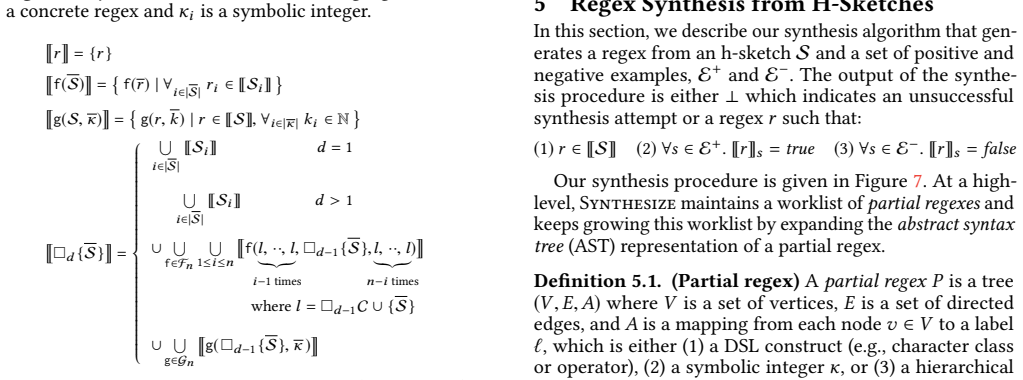
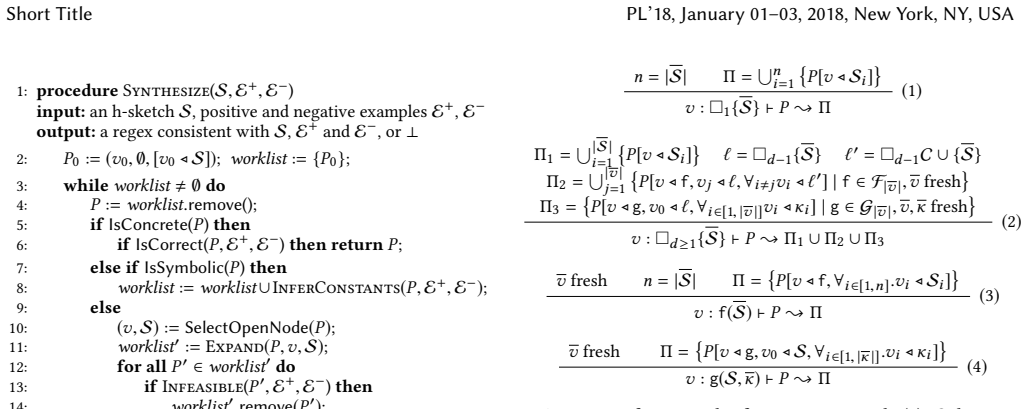
The load-bearing object is the hierarchical sketch, or h-sketch: a regex abstract syntax tree in which leaves may be constrained holes, written $\square_d{S}$, meaning the unknown sub-regex has depth at most $d$ and must contain at least one of the hinted components in $S$ as a leaf. The h-sketch guides top-down enumerative search over partial regexes, and for each partial regex the engine computes over- and under-approximations from the sketch's hints to reject infeasible branches without losing completeness. Repeat bounds are represented as symbolic integers, encoded into an SMT formula over string lengths, and used to prune families of regexes at once rather than enumerating every constant. The sketch itself is produced from English by a semantic parser with a learned ranking over candidate derivations.
What would settle it
A controlled experiment in which human participants, not an oracle, provide the next examples after each incorrect regex on the same 322 benchmarks would settle whether the 80% accuracy survives realistic feedback; if the accuracy collapses toward the example-only baseline, the multimodal advantage depends on perfect counterexample selection rather than on the sketch mechanism itself.
Extended reading notes
Core claim
The paper's central claim is that a natural-language-derived hierarchical sketch is the decisive ingredient for regex synthesis: it lets a programming-by-example engine prioritize which partial regexes to expand and which to prune, and it supports a symbolic representation of repeat bounds that the engine refines with an SMT solver. The headline empirical claim is that, with up to four rounds of counterexample feedback, Regel synthesizes the intended regex for 80% of 322 benchmarks, whereas the English-only baseline succeeds on 43% and the example-only baseline on 26%. The paper also claims that both pruning ideas contribute measurably to speed, and that in a 20-participant user study users solved 73.3% of tasks with Regel versus 28.3% without it.
Load-bearing premise
The evaluation assumes that whenever Regel returns a wrong regex, an oracle immediately supplies two new examples guaranteed to rule out exactly that regex; real users cannot usually produce such perfectly targeted counterexamples without already knowing the answer.
Editorial extensions
If this is right
- If the central claim holds, a multimodal specification is substantially more effective for regex synthesis than either English alone or examples alone, with accuracy roughly doubling over the language-only baseline.
- The sketch-guided pruning and symbolic-integer reasoning make the search fast enough for interactive use, so a user can receive candidate regexes within seconds and refine them with new examples.
- The synthesis method is agnostic to the particular NLP technique: any component that emits hierarchical sketches could replace the semantic parser without changing the PBE engine.
- On the harder StackOverflow benchmark subset, Regel reaches 60.7% accuracy where the language-only baseline reaches 2.4%, suggesting the multimodal advantage grows with task difficulty.
- The user-study result, if it transfers, implies that tool assistance roughly doubles the chance that a non-expert finishes a regex task correctly within a time budget.
Reading between the lines
- The paper's headline accuracy depends on an oracle that, after every wrong regex, supplies two new examples guaranteed to rule out exactly that regex; real users cannot reliably produce such perfectly targeted counterexamples without already knowing the target pattern, so interactive accuracy in practice may be lower.
- The same h-sketch-plus-PBE recipe could transfer to other synthesis domains where English gives structural hints but examples pin down details, such as data transformation or query synthesis.
- A testable extension would replace the oracle with human-generated counterexamples on the same 322 benchmarks and measure how quickly the accuracy curve approaches 80%; the paper's user study measures task success, not this curve.
- The failure analysis suggests the main ceiling is not search but sketch quality: failures cluster on high-level concepts like dates and ranges that the grammar does not know, so enriching the grammar with domain concepts is a plausible next step.
Signed reviews
Editorial analysis
A structured set of objections, weighed in public.
Referee Report
Summary. The paper presents Regel, a tool that synthesizes regular expressions from a combination of natural-language descriptions and positive/negative examples. The natural-language input is parsed into a hierarchical sketch (h-sketch) by a SEMPRE-based semantic parser, and a programming-by-example engine then searches for a concrete regex that completes the sketch and satisfies the examples. The search is made practical by sketch-guided over- and under-approximations for pruning, and by representing repetition counts as symbolic integers whose feasible ranges are constrained via an SMT encoding over string lengths. The paper evaluates Regel on 200 adapted DeepRegex benchmarks and 122 StackOverflow benchmarks, reporting that Regel solves 80% of the combined 322 benchmarks, versus 43% for DeepRegex and 26% for a PBE-only baseline. It also reports an ablation showing the PBE engine is substantially faster than an adapted AlphaRegex, and a 20-participant user study in which participants complete tasks more often with Regel than without it.
Significance. If the reported results hold, this is a useful contribution to program synthesis from weak specifications: the hierarchical-sketch idea is natural, the combination of semantic parsing with PBE is well motivated, and the appendices provide detailed correctness proofs for the approximation and SMT-encoding procedures. The evaluation is unusually careful in several respects: the authors disclose how the DeepRegex data set was filtered and adapted, they provide ablations isolating the two pruning mechanisms, and they include a user study with explicit disclaimers about its scope. The qualitative conclusion that adding a natural-language sketch to a PBE engine improves both success rate and speed is credible and well supported by the iteration-0 results on the DeepRegex set. However, the headline 80% accuracy number is not a user-attainable accuracy as stated, because it depends on an oracle that supplies perfectly targeted counterexamples over up to four interaction rounds; this is the central load-bearing issue for the paper's main quantitative claim.
major comments (3)
- [Section 9.1, Result 1, and Abstract] The headline accuracy of 80% is achieved only after up to four rounds in which the evaluator provides 'two additional examples that are guaranteed to rule out the returned incorrect regex' (Section 9.1). Producing such examples requires knowing the intended regex, so this is an oracle simulation rather than a realistic user-facing accuracy. On the DeepRegex set, Regel already solves 151/200 at iteration 0 and reaches 185/200 only after oracle iterations; the combined iteration-0 accuracy over all 322 benchmarks is not reported in the text. The user study (Section 9.3 and Appendix F) does not close this gap: participants are allowed to enter any two new examples, and the study records only final task success, not whether participants could produce counterexamples that are guaranteed to discriminate the synthesized regex from the intended one. The abstract and Result 1 should report the iteration-0 accuracy as the primary user-facing number, or the paper should provide direct evidence about users' ability to supply discriminating counterexamples.
- [Section 8 and Appendix C] The DeepRegex comparison is performed on a substantially adapted and filtered subset of the original DeepRegex data: benchmarks corresponding to the empty language were removed, examples inconsistent with the target regex were discarded, and only 200 of 800 annotated tasks were retained after filtering. This is a defensible way to construct a multi-modal benchmark, but it changes the difficulty and the input format relative to the original DeepRegex data set. The statement that 'DeepRegex solves only 43%' should be explicitly qualified as applying to this reconstructed, filtered set; otherwise a reader may reasonably interpret the number as a statement about DeepRegex on the original data set, where the task and inputs are different.
- [Appendix E and Section 6.3] The semantic-parser training labels are derived from the target regexes. For the DeepRegex set, the h-sketches used for training are generated by replacing the root operator of the target regex with a hole; for the StackOverflow set, the h-sketches are manually constructed by the authors, who knew the target regex while reading each English description. This is not circular in the narrow sense that test-time sketches are produced by the parser, but it means the natural-language component is trained and evaluated on sketches that encode ground-truth structural information. The paper should discuss the sensitivity of the reported accuracy to the quality of the parser supervision; at minimum, an experiment with coarser or automatically derived sketches for the StackOverflow set would help establish that the multi-modal advantage is not an artifact of manually crafted sketches.
minor comments (7)
- [Abstract and Conclusion] The abstract and conclusion should state that the 80% figure is obtained after up to four interaction rounds under the oracle-counterexample protocol; the current wording presents it as a single-shot accuracy.
- [Figure 14] The combined iteration-0 counts for Regel and the baselines should be reported in the text; currently only the StackOverflow final value (74/122) is stated, and the initial values are only visible graphically.
- [Section 9.2, Result 2] The '10x faster' claim is based on 'the first 1000 sketches that can be solved by all variants'; this is a selective workload, and reporting total solved versus time or area under the curve would make the comparison more robust.
- [Related Work and Section 9.1] The paper cites SemRegex [50] as a recent NL-only regex synthesizer but does not compare against it, despite calling DeepRegex 'state-of-the-art'; the characterization should be qualified.
- [Appendix A, Theorem A.3] The proof of Theorem A.3 refers to 'Theorem A' where it presumably means the correctness theorem for Encode (Theorem A.4); the cross-reference should be fixed.
- [Section 5.2, footnote 5] Bounding every symbolic integer by MAX, the length of the longest example, is only complete when the repeated sub-regex cannot match the empty string; this assumption should be stated explicitly.
- [Section 2 and Figure 5] The overview uses constrained holes written as □{S} without the depth parameter d that is introduced formally in Figure 5; aligning the notation early would reduce confusion.
Circularity Check
No significant circularity: the main claims are evaluated against external benchmarks with supervised training separated from test, and the SMT and approximation constraints are derived from examples and sketch semantics rather than from target regexes.
full rationale
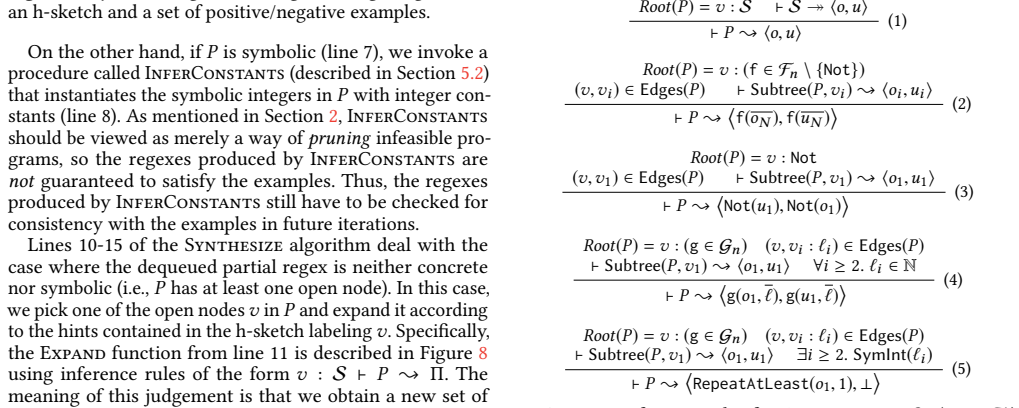
Walking the derivation chain: the h-sketch language (Fig. 5) is defined by a grammar over DSL constructs and holes, with semantics in Fig. 6; a sketch denotes a family of regexes, and the target regex is not an input to that definition. The PBE engine (Fig. 7) enumerates completions and prunes using over/under-approximations (Fig. 9-10) and SMT constraints on string lengths derived from positive examples (Fig. 12). The correctness theorems (5.4, 5.7, A.2-A.4) state soundness and completeness with respect to the examples and sketch semantics; none of these equations assumes the intended regex. The NLP-to-sketch component is trained on labeled data: for the DeepRegex split the labels are generated by replacing the root operator of ground-truth regexes, but training uses 6,500 separate sentences and the 200 evaluation benchmarks are disjoint; for StackOverflow the labels are manually written from descriptions and evaluated with 5-fold cross-validation, so the parser's output on test sketches is not a re-statement of the test target. The interactive evaluation assumes an oracle that can supply two examples 'guaranteed to rule out the returned incorrect regex' (Section 9.1); this is a strong assumption about user behavior and the paper itself disclaims that the user study is not an in-the-wild study (Section 9.3), but it is an evaluation limitation, not a definitional or fitted-input circularity. The only self-citation, [10], is the arXiv version of the same paper and carries no load. I therefore find no step in which a prediction reduces by construction to its inputs.
Assumptions & free parameters
free parameters (3)
- Semantic parser feature weights theta =
Learned from training data, values not reported
- Time budget t and result-list size k =
t=10s and k=1 for DeepRegex; t=60s and k=5 for StackOverflow
- MAX bound for symbolic integers =
Length of the longest example in the current benchmark
assumptions (4)
- domain assumption The Z3 SMT solver is sound for the nonlinear integer constraints generated by Encode.
- domain assumption The Brics automaton library correctly implements membership and equivalence checks for the DSL, including And and Not at the automaton level.
- domain assumption The h-sketch semantics in Figure 6 correctly characterize the space of target regexes for the chosen benchmarks.
- domain assumption The DSL (Figure 4) is expressive enough to represent the benchmark target regexes.
Cite this review
Pith. "Pith review of Multi-modal Synthesis of Regular Expressions." pith.science (2026). https://pith.science/paper/I4SVOUHD
@misc{pith2026190803316,
  author       = {Pith},
  title        = {Pith review of: Multi-modal Synthesis of Regular Expressions},
  year         = {2026},
  howpublished = {\url{https://pith.science/paper/I4SVOUHD}},
  note         = {Machine review of arXiv:1908.03316}
}
read the original abstract
In this paper, we propose a multi-modal synthesis technique for automatically constructing regular expressions (regexes) from a combination of examples and natural language. Using multiple modalities is useful in this context because natural language alone is often highly ambiguous, whereas examples in isolation are often not sufficient for conveying user intent. Our proposed technique first parses the English description into a so-called hierarchical sketch that guides our programming-by-example (PBE) engine. Since the hierarchical sketch captures crucial hints, the PBE engine can leverage this information to both prioritize the search as well as make useful deductions for pruning the search space. We have implemented the proposed technique in a tool called Regel and evaluate it on over three hundred regexes. Our evaluation shows that Regel achieves 80% accuracy whereas the NLP-only and PBE-only baselines achieve 43% and 26% respectively. We also compare our proposed PBE engine against an adaptation of AlphaRegex, a state-of-the-art regex synthesis tool, and show that our proposed PBE engine is an order of magnitude faster, even if we adapt the search algorithm of AlphaRegex to leverage the sketch. Finally, we conduct a user study involving 20 participants and show that users are twice as likely to successfully come up with the desired regex using Regel compared to without it.
Figures


Figures from the paper (9 more)


Reference graph
Works this paper leans on
-
[1]
2016. Class: Regexp (Ruby 2.4.0). https://ruby-doc.org/core-2.4.0/Regexp.html
work page 2016
-
[2]
2019. Pattern (Java Platform SE 8 ). https://docs.oracle.com/javase/7/docs/api/java/util/regex/Pattern.html
work page 2019
-
[3]
Aws Albarghouthi, Sumit Gulwani, and Zachary Kincaid. 2013. Recur- sive program synthesis. In International conference on computer aided verification. Springer, 934–950
work page 2013
-
[4]
R. Alquezar and A. Sanfeliu. 1994. Incremental Grammatical Inference From Positive And Negative Data Using Unbiased Finite State Au- tomata. In In Proceedings of the ACLâĂŹ02 Workshop on Unsupervised PL’18, January 01–03, 2018, New York, NY, USA Qiaochu Chen, Xinyu Wang, Xi Ye, Greg Durrett, and Isil Dillig Lexical Acquisition. 291–300
work page 1994
-
[5]
Dana Angluin. 1978. On the complexity of minimum inference of regular sets. Information and Control 39, 3 (1978), 337 – 350
work page 1978
-
[6]
Dana Angluin. 1987. Learning Regular Sets from Queries and Coun- terexamples. Inf. Comput. 75, 2 (1987), 87–106
work page 1987
-
[7]
Jonathan Berant, Andrew Chou, Roy Frostig, and Percy Liang. 2013. Semantic Parsing on Freebase from Question-Answer Pairs. InProceed- ings of the 2013 Conference on Empirical Methods in Natural Language Processing. 1533–1544
work page 2013
-
[8]
James Bornholt, Emina Torlak, Dan Grossman, and Luis Ceze. 2016. Optimizing synthesis with metasketches. In ACM SIGPLAN Notices, Vol. 51. ACM, 775–788
work page 2016
Show all 55 references
-
[9]
Bob Carpenter. 1998. Type-logical Semantics. MIT Press, Cambridge, MA, USA
1998
-
[10]
Qiaochu Chen, Xinyu Wang, Xi Ye, Greg Durrett, and Isil Dillig. 2019. Multi-modal Synthesis of Regular Expressions. arXiv:cs.PL/1908.03316
2019 arXiv
-
[11]
Yanju Chen, Ruben Martins, and Yu Feng. 2019. Maximal Multi-layer Specification Synthesis. In Proceedings of the 2019 27th ACM Joint Meeting on European Software Engineering Conference and Symposium on the Foundations of Software Engineering (ESEC/FSE 2019). ACM, New York, NY,...
2019
-
[12]
Leonardo De Moura and Nikolaj Bjørner. 2008. Z3: An Efficient SMT Solver. In Proceedings of the Theory and Practice of Software, 14th Inter- national Conference on Tools and Algorithms for the Construction and Analysis of Systems (TACAS’08/ETAPS’08). Springer-Verlag, 337–340
2008
-
[13]
Yu Feng, Ruben Martins, Osbert Bastani, and Isil Dillig. 2018. Pro- gram Synthesis Using Conflict-driven Learning. In Proceedings of the 39th ACM SIGPLAN Conference on Programming Language Design and Implementation (PLDI 2018). ACM, 420–435
2018
-
[14]
Yu Feng, Ruben Martins, Jacob Van Geffen, Isil Dillig, and Swarat Chaudhuri. 2017. Component-based Synthesis of Table Consolida- tion and Transformation Tasks from Examples. In Proceedings of the 38th ACM SIGPLAN Conference on Programming Language Design and Implementation (PL...
2017
-
[15]
Feser, Swarat Chaudhuri, and Isil Dillig
John K. Feser, Swarat Chaudhuri, and Isil Dillig. 2015. Synthesiz- ing Data Structure Transformations from Input-output Examples. In Proceedings of the 36th ACM SIGPLAN Conference on Programming Language Design and Implementation (PLDI ’15) . ACM, 229–239
2015
-
[16]
Laura Firoiu, Tim Oates, and Paul R. Cohen. 1998. Learning Regular Languages from Positive Evidence. In Proceedings of the Twentieth Annual Conference of the Cognitive Science Society . 350–355
1998
-
[17]
E Mark Gold. 1978. Complexity of automaton identification from given data. Information and Control 37, 3 (1978), 302 – 320
1978
-
[18]
Sumit Gulwani. 2011. Automating String Processing in Spreadsheets Using Input-output Examples. In Proceedings of the 38th Annual ACM SIGPLAN-SIGACT Symposium on Principles of Programming Languages (POPL ’11). ACM, 317–330
2011
-
[19]
Sumit Gulwani, Susmit Jha, Ashish Tiwari, and Ramarathnam Venkate- san. 2011. Synthesis of Loop-free Programs. SIGPLAN Not. 46, 6 (June 2011), 62–73
2011
-
[20]
Sumit Gulwani and Mark Marron. 2014. NLyze: Interactive Program- ming by Natural Language for Spreadsheet Data Analysis and Manipu- lation. In Proceedings of the 2014 ACM SIGMOD International Conference on Management of Data (SIGMOD ’14) . ACM, 803–814
2014
-
[21]
Tihomir Gvero and Viktor Kuncak. 2015. Synthesizing Java Expres- sions from Free-form Queries. InProceedings of the 2015 ACM SIGPLAN International Conference on Object-Oriented Programming, Systems, Languages, and Applications (OOPSLA 2015) . ACM, 416–432
2015
-
[22]
Tihomir Gvero, Viktor Kuncak, Ivan Kuraj, and Ruzica Piskac. 2013. Complete Completion Using Types and Weights. In Proceedings of the 34th ACM SIGPLAN Conference on Programming Language Design and Implementation (PLDI ’13). ACM, New York, NY, USA, 27–38. https: //doi.org/10.11...
2013
-
[23]
Po-Sen Huang, Chenglong Wang, Rishabh Singh, Wen-tau Yih, and Xiaodong He. 2018. Natural Language to Structured Query Generation via Meta-Learning. In Proceedings of the 2018 Conference of the North American Chapter of the Association for Computational Linguistics: Human Langu...
2018
-
[24]
Seshia, and Ashish Tiwari
Susmit Jha, Sumit Gulwani, Sanjit A. Seshia, and Ashish Tiwari. 2010. Oracle-guided Component-based Program Synthesis. In Proceedings of the 32Nd ACM/IEEE International Conference on Software Engineering - Volume 1 (ICSE ’10). ACM, New York, NY, USA, 215–224
2010
-
[25]
Nate Kushman and Regina Barzilay. 2013. Using Semantic Unification to Generate Regular Expressions from Natural Language. In Proceed- ings of the 2013 Conference of the North American Chapter of the Asso- ciation for Computational Linguistics: Human Language Technologies . Ass...
2013
-
[26]
Vu Le and Sumit Gulwani. 2014. FlashExtract: A Framework for Data Extraction by Examples. In Proceedings of the 35th ACM SIGPLAN Con- ference on Programming Language Design and Implementation (PLDI ’14). ACM, 542–553. https://doi.org/10.1145/2594291.2594333
2014
-
[27]
Mina Lee, Sunbeom So, and Hakjoo Oh. 2016. Synthesizing Regular Expressions from Examples for Introductory Automata Assignments. In Proceedings of the 2016 ACM SIGPLAN International Conference on Generative Programming: Concepts and Experiences (GPCE 2016) . ACM, 70–80
2016
-
[28]
A Solar Lezama. 2008. Program synthesis by sketching . Ph.D. Disserta- tion
2008
-
[29]
Xi Victoria Lin, Chenglong Wang, Luke Zettlemoyer, and Michael D. Ernst. 2018. NL2Bash: A Corpus and Semantic Parser for Natural Language Interface to the Linux Operating System. In Proceedings of the Eleventh International Conference on Language Resources and Evaluation (LREC...
2018
-
[30]
Nicholas Locascio, Karthik Narasimhan, Eduardo De Leon, Nate Kush- man, and Regina Barzilay. 2016. Neural Generation of Regular Expres- sions from Natural Language with Minimal Domain Knowledge. In Proceedings of the 2016 Conference on Empirical Methods in Natural Language Pro...
2016
-
[31]
Bill Maccartney. 2009. Natural Language Inference. Ph.D. Dissertation. Stanford, CA, USA. Advisor(s) Manning, Christopher D. AAI3364139
2009
-
[32]
Mehdi Manshadi, Daniel Gildea, and James Allen. 2013. Integrat- ing programming by example and natural language programming. In Proceedings of the Twenty-Seventh AAAI Conference on Artificial Intelligence. AAAI Press, 661–667
2013
-
[33]
Anders Møller. 2017. dk.brics.automaton – Finite-State Automata and Regular Expressions for Java. http://www.brics.dk/automaton/
2017
-
[34]
Le, Martín Abadi, Andrew McCallum, and Dario Amodei
Arvind Neelakantan, Quoc V. Le, Martín Abadi, Andrew McCallum, and Dario Amodei. 2016. Learning a Natural Language Interface with Neural Programmer. CoRR abs/1611.08945 (2016). arXiv:1611.08945 http://arxiv.org/abs/1611.08945
2016 arXiv
-
[35]
Nye, Luke B
Maxwell I. Nye, Luke B. Hewitt, Joshua B. Tenenbaum, and Armando Solar-Lezama. 2019. Learning to Infer Program Sketches. CoRR abs/1902.06349 (2019). arXiv:1902.06349 http://arxiv.org/abs/1902. 06349
2019 arXiv
-
[36]
Peter-Michael Osera and Steve Zdancewic. 2015. Type-and-example- directed program synthesis. In ACM SIGPLAN Notices, Vol. 50. ACM, 619–630
2015
-
[37]
Rong Pan, Qinheping Hu, Gaowei Xu, and Loris D’Antoni. 2019. Auto- matic Repair of Regular Expressions.Proc. ACM Program. Lang. 3, OOP- SLA, Article 139 (Oct. 2019), 29 pages. https://doi.org/10.1145/3360565
2019 doi
-
[38]
Rajesh Parekh and Vasant Honavar. 1996. An incremental interactive algorithm for regular grammar inference. In Grammatical Interference: Learning Syntax from Sentences, Laurent Miclet and Colin de la Higuera (Eds.). Springer Berlin Heidelberg, Berlin, Heidelberg, 238–249
1996
-
[39]
Rajesh Parekh and Vasant Honavar. 2001. Learning DFA from Simple Examples. Machine Learning 44, 1 (01 Jul 2001), 9–35. https://doi.org/ 10.1023/A:1010822518073
2001 doi
-
[40]
Chris Quirk, Raymond Mooney, and Michel Galley. 2015. Language to Code: Learning Semantic Parsers for If-This-Then-That Recipes. In Proceedings of the 53rd Annual Meeting of the Association for Com- putational Linguistics and the 7th International Joint Conference on Natural L...
2015
-
[41]
Mohammad Raza, Sumit Gulwani, and Natasa Milic-Frayling. 2015. Compositional Program Synthesis from Natural Language and Exam- ples. In IJCAI
2015
-
[42]
R. L. Rivest and R. E. Schapire. 1989. Inference of Finite Automata Using Homing Sequences. In Proceedings of the Twenty-first Annual ACM Symposium on Theory of Computing (STOC ’89) . ACM, 411–420. Short Title PL’18, January 01–03, 2018, New York, NY, USA
1989
-
[43]
Ashish Tiwari, Adrià Gascón, and Bruno Dutertre. 2015. Program Synthesis Using Dual Interpretation. In Automated Deduction - CADE- 25, Amy P. Felty and Aart Middeldorp (Eds.). Springer International Publishing, 482–497
2015
-
[44]
Xinyu Wang, Sumit Gulwani, and Rishabh Singh. 2016. FIDEX: Filter- ing Spreadsheet Data Using Examples. In Proceedings of the 2016 ACM SIGPLAN International Conference on Object-Oriented Programming, Systems, Languages, and Applications (OOPSLA 2016) . ACM, 195–213
2016
-
[45]
Yushi Wang, Jonathan Berant, and Percy Liang. 2015. Building a se- mantic parser overnight. In Proceedings of the 53rd Annual Meeting of the Association for Computational Linguistics and the 7th Interna- tional Joint Conference on Natural Language Processing (Volume 1: Long Pa...
2015
-
[46]
Navid Yaghmazadeh, Christian Klinger, Isil Dillig, and Swarat Chaud- huri. 2016. Synthesizing transformations on hierarchically structured data. In ACM SIGPLAN Notices, Vol. 51. ACM, 508–521
2016
-
[47]
Navid Yaghmazadeh, Yuepeng Wang, Isil Dillig, and Thomas Dillig
-
[48]
Zelle and Raymond J
John M. Zelle and Raymond J. Mooney. 1996. Learning to Parse Data- base Queries Using Inductive Logic Programming. In Proceedings of the Thirteenth National Conference on Artificial Intelligence - Volume 2 (AAAI’96). AAAI Press, 1050–1055
1996
-
[49]
Zettlemoyer and Michael Collins
Luke S. Zettlemoyer and Michael Collins. 2005. Learning to Map Sentences to Logical Form: Structured Classification with Probabilistic Categorial Grammars. In Proceedings of the Conference on Uncertainty in Artificial Intelligence
2005
-
[50]
Zexuan Zhong, Jiaqi Guo, Wei Yang, Jian Peng, Tao Xie, Jian-Guang Lou, Ting Liu, and Dongmei Zhang. 2018. SemRegex: A Semantics- Based Approach for Generating Regular Expressions from Natural Language Specifications. In Proceedings of the 2018 Conference on Em- pirical Methods...
2018
-
[52]
For any string s, suppose there exists a regexr∈ ⟦S⟧ such that r = StartsWith(r1) such that we haveMatch(r , s)
We first prove that o satisfies (i). For any string s, suppose there exists a regexr∈ ⟦S⟧ such that r = StartsWith(r1) such that we haveMatch(r , s). From the semantic of h-sketch from Figure 6, we know that r1 ∈ ⟦S1⟧. By induction, we know that (i) holds forS1. Thus, we have ...
-
[53]
For any string s, suppose Match(u, s) is true, then there exist a string s1 such that Match(u1, s1) and u = StartsWith(u1)
We now prove thatu satisfies (ii). For any string s, suppose Match(u, s) is true, then there exist a string s1 such that Match(u1, s1) and u = StartsWith(u1). From the inductive hypothesis, we know that Match(u1, s1) holds for any r1 ∈ ⟦S1⟧. Now consider any regex r∈ ⟦P⟧, beca...
-
[54]
Given a string s, sup- pose there exists a concrete regex r∈ ⟦S⟧ such that Match(r , s) is true
We first prove o satisfies (i). Given a string s, sup- pose there exists a concrete regex r∈ ⟦S⟧ such that Match(r , s) is true. From the semantic of Not, we know that ¬Match(r1, s), where r1 ∈ ⟦S1⟧. From the induction hypothesis, we know that ¬Match(u1, s), whereu1 is the und...
-
[55]
regex”, “regular expression
We then prove u satisfies (ii). For any string s, suppose Match(u, s) is true. Since we have u = Not(o1), whereo1 is the over-approximation forS1, Match(o1, s) is false (from the semantics of Not). From the inductive hypothesis, we know that for any r1∈ ⟦S1⟧,¬Match(r1, s). The...
2018
-
[2017]
SQLizer: Query Synthesis from Natural Language. Proc. ACM Program. Lang. 1, OOPSLA, Article 63 (Oct. 2017), 26 pages
2017
Reviewed August 14, 2026 · model on record in the stance chip above.
Discussion (0). Continue with ORCID to comment.