REVIEW 3 major objections 5 minor 36 references
Coordinated Hybrid Precoding for Interference Exploitation in Heterogeneous Networks
T0 review · 3 major / 5 minor · reviewed 2026-08-14 · deepseek-v4-flash
Pith's one-line read Coordinated hybrid precoding exploits interference to cut transmit power.
desk verdict Clean extension of CI hybrid precoding to HetNets, but the headline power-savings claim rests on an unvalidated reuse of a single-cell CI SER curve for the ZF baselines. read the letter →
The pith
A machine-rendered reading of the paper's core claim, the machinery that carries it, and where it could break.
The reading
What carries the argument
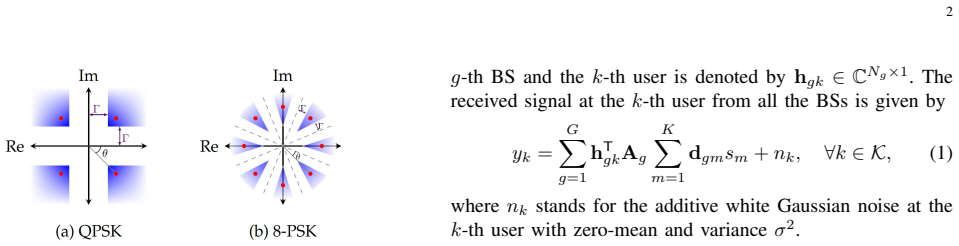
The load-bearing object is the constructive-interference (CI) region of the PSK constellation: for each user, the received signal (after rotation by the conjugate of the intended symbol) must satisfy the cone constraint $\left|\operatorname{Im}(\cdot)\right| \le (\operatorname{Re}(\cdot) - \gamma_k) \tan\theta$, where $\theta = \pi/M$ and $\gamma_k$ is the threshold margin controlling QoS. These constraints, together with the bilinear coupling of constant-modulus analog and digital precoders, make the joint problem nonconvex. The paper's mechanism for handling this is a three-stage decomposition: first a mixed-integer linear program assigns each RF chain to a user (maximizing total channel gain with fairness), then analog precoders are fixed as either phase-conjugated channel responses (continuous case) or codebook beams (codebook case), and finally the remaining digital precoding problem is convex and solved with standard tools. The CI constraints are what convert interference from an obstacle into a resource.
What would settle it
Perform end-to-end Monte Carlo simulation in the same three-base-station heterogeneous network (macro with 64 antennas, two picos with 32 antennas, 64 QPSK users), transmitting actual symbols through the proposed coordinated CI hybrid precoder and the coordinated zero-forcing baseline, detecting with a maximum-likelihood rule, and plotting symbol error rate against transmit power; if zero-forcing achieves the same symbol error rate at lower or equal power than the CI scheme, or if the CI scheme's measured symbol error rate does not match the mapped values in Figure 3, the reported savings would be refuted.
Extended reading notes
Core claim
The central claim is that inter-base-station interference, normally a nuisance in heterogeneous networks, can be exploited as a useful signal component if the precoders across base stations are designed jointly. By steering each user's received symbol into its constructive-interference region — the part of the PSK constellation cone that lies away from the decision boundaries — the coordinated hybrid precoder can fulfill quality-of-service constraints with less total transmit power than conventional zero-forcing hybrid precoding. The paper demonstrates this in simulation for a macro base station with 64 antennas and two pico base stations with 32 antennas each, serving 64 QPSK users, and additionally shows that the coordinated constructive-interference scheme reduces the backhaul load because it exchanges only $R_g$ digital coefficients per base station per symbol instead of $R_g \times K$. The performance gain is reported empirically, not supported by an analytic performance bound.
Load-bearing premise
The comparison assumes that the measured relationship between signal quality and symbol error rate from an earlier single-cell experiment holds unchanged for the coordinated multi-base-station scheme and for the zero-forcing baselines.
Editorial extensions
If this is right
- Coordinated CI hybrid precoding can meet the same symbol error rate as coordinated zero-forcing hybrid precoding while using less total transmit power, according to the paper's simulations.
- The three-stage decomposition keeps the computation practical: the analog and RF-chain assignment stages are handled separately from the convex digital precoding stage.
- Codebook-based analog precoding, which avoids full-resolution phase shifters, works within the same coordinated framework and trades a modest performance loss for cheaper hardware.
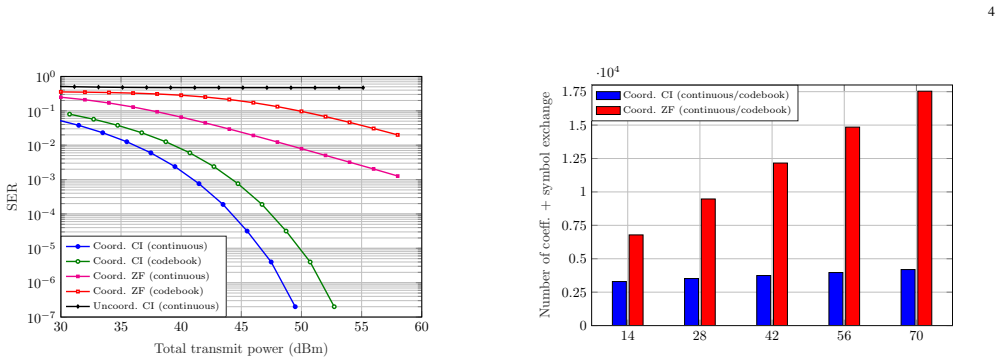
- The backhaul overhead of coordination is lower than for zero-forcing, because each base station receives $R_g$ digital coefficients per symbol rather than $R_g \times K$.
- The CI formulation is stated for PSK symbols but the paper indicates it extends to other modulation formats.
Reading between the lines
- If the power savings persist under imperfect channel state information, coordinated CI hybrid precoding could let operators run dense heterogeneous networks with cheaper, lower-power small cells; the paper assumes perfect CSI and does not test this.
- The paper's symbol error rate values are produced through an empirical signal-quality-to-error-rate mapping from a single-cell study rather than direct symbol-level simulation; reproducing the comparison with end-to-end modulation and detection would test whether the reported savings are an artifact of that mapping.
- The MILP-based RF-chain assignment could become a computational bottleneck in networks with many more base stations or users; a greedy or distributed assignment would be a natural testable extension.
- The coordinated CI idea could combine with prior work on phase-error robustness to address hardware imperfections in the analog phase shifters.
Signed reviews
Editorial analysis
A structured set of objections, weighed in public.
Referee Report
Summary. The paper proposes a coordinated hybrid precoding scheme for a downlink multiuser massive MIMO heterogeneous network. The base stations, connected to a central controller, jointly exploit constructive interference rather than suppress it, with the goal of minimizing total transmit power while satisfying per-user quality-of-service thresholds. The problem is formulated as a nonconvex optimization and solved via a three-stage heuristic: an MILP-based RF-chain/user assignment, analog precoder design (either continuous or codebook-based), and a convex digital precoding stage. Simulation results in Figure 3 are used to claim that the coordinated CI-based hybrid precoders require substantially lower total transmit power than coordinated zero-forcing and uncoordinated CI baselines at the same symbol error rate. A backhaul-overhead analysis in Figure 4 shows that the CI method exchanges fewer coefficients and symbols than ZF.
Significance. The idea of coordinating multiple base stations to exploit inter-cell interference in hybrid precoding is timely and, if valid, would represent a useful step toward energy-efficient dense networks. The problem reformulation in equations (2)-(3) is clean, and formulating the RF-chain assignment as an MILP for both continuous and codebook analog precoding is a reasonable design contribution. However, the central performance claim currently rests on an indirect evaluation method that maps empirical SNR/TNR-to-SER curves from a prior single-cell study to the coordinated multi-BS setting and to the ZF baselines. Because this mapping is not justified for either the proposed method or the baselines, the numerical evidence is not convincing. The paper would be significantly improved by direct symbol-level simulations or a validated analytical error-probability model for each compared scheme.
major comments (3)
- [Section IV, Fig. 3 and footnote 4] The SER values for all plotted schemes, including the ZF baselines, are computed by mapping the simulated TNR or SNR to SER using the empirical curve from Fig. 10 of [28], which was obtained for the authors' earlier single-cell CI hybrid precoding. This is not a valid comparison procedure. The SER-vs-SNR relationship for zero-forcing precoding is fundamentally different from the SER-vs-TNR relationship for CI-based precoding (for QPSK, ZF roughly follows 2Q(sqrt(SNR)) while CI follows a different law tied to the threshold margin). Applying the CI-derived curve to ZF results in an unknown shift of the ZF curves in Fig. 3, and the reported power savings at SER=10^-4 may be an artifact of this shift rather than a genuine advantage of the proposed scheme. The authors must replace this indirect mapping with direct symbol-level simulations for every scheme, or at minimum use the theoretical Q-function relationship for ZF and a separately validated CI SER curve for the coordinated setting.
- [Section IV, Fig. 3 and footnote 4] Even for the proposed coordinated CI schemes themselves, the empirical SER-vs-TNR curve from [28] was obtained for a single-cell, non-coordinated system with a specific antenna configuration and analog precoding method. The coordinated multi-BS setup in this paper has different per-BS antenna counts (N_macro=64, N_pico=32), a different number of users (K=64), and a different suboptimal three-stage solution, all of which can alter the actual SER-vs-TNR relationship. No argument or measurement is given that the [28] curve transfers to this new setting. Consequently, the quantitative gain of the proposed scheme over the baselines is not established by the current evidence.
- [Section III and IV] The paper provides no theoretical performance bound or optimality gap analysis for the proposed three-stage decomposition. Since the original problem (2) is nonconvex and the solution is suboptimal, the claim that the scheme achieves 'superior performance' depends entirely on the numerical results. Given that the numerical results are obtained through the problematic empirical mapping described above, the central claim is currently unsupported. The authors should either prove a performance guarantee (e.g., a bound on the transmit power relative to the optimal solution) or supply direct simulation results that verify the SER curves in Fig. 3.
minor comments (5)
- [Section IV] The simulation section omits several parameters needed for reproducibility: the size of the analog codebook and its design, the value of the fairness scaling factor epsilon in (4) and (5), the per-BS user distribution or user-association rule for the uncoordinated scheme, and the specific TNR values swept for the CI methods. Please provide these details.
- [Equation (1)] The channel vector h_gk is used with a transpose (h^T) in the received signal model, but for complex baseband channels the Hermitian transpose (h^H) is the standard form. Please clarify the notation or correct it to avoid confusion.
- [Section IV] The figure caption for Fig. 3 does not mention that the SER values are derived from the empirical mapping in footnote 4 rather than from direct symbol error counting. The axis label 'SER' should be qualified (e.g., 'estimated SER') to alert the reader to the indirect evaluation.
- [Section IV] The results are averaged over 10,000 Monte Carlo runs, but no confidence intervals or error bars are shown. Given the indirect SER estimation, it would be useful to indicate the variance of the estimated SER across runs.
- [Section II] The paper assumes a fully-connected hybrid architecture with analog precoding coefficients of identical magnitude a, but the value of a is not specified. Please state whether a is set to unit magnitude or some other value, and confirm that the power constraint (2c) accounts for this normalization.
Circularity Check
Fig. 3's SER values are mapped from an empirical SNR/TNR-SER curve in the authors' earlier paper [28], so the headline power-saving claim is partly inherited from a prior fitted result rather than from independent simulation.
-
fitted input called prediction
[Section IV (Numerical Results), footnote 4 (page 4) and Fig. 3]
"Finally, using the empirical relationship between SNR/TNR and SER given in Fig. 10 of [28] we compute the corresponding SERs for both CI-based and ZF-based methods."
The vertical axis of Fig. 3 is not produced by simulating the actual bit/symbol error events of the proposed coordinated CI precoders or of the ZF baselines. Instead, both SER curves are computed by plugging simulated TNR/SNR values into an empirical SNR/TNR-to-SER curve taken from [28], the authors' earlier single-cell CI hybrid precoding paper. For the ZF baselines, this mapping is not justified: ZF error probability follows the standard post-detection SNR law, and there is no reason the CI-specific empirical curve should describe it.
full rationale
The core optimization derivations in Sections III (RF assignment, analog precoding, digital precoding) are self-contained and not circular: the MILPs in (4)-(5) and the convex digital precoding reformulation are formulated directly from the system model and CI constraints. However, the headline claim of superior performance rests on Fig. 3, whose SER values are obtained, by the paper's own footnote 4, through the empirical SNR/TNR-to-SER relationship of Fig. 10 of [28], a prior paper by the same authors. No direct symbol-level simulation of the proposed coordinated scheme or of the ZF baselines is reported, and no evidence is given that the single-cell CI curve transfers to the multi-BS coordinated setting or to ZF precoding. This makes the main comparison partially circular: the proposed scheme's SER is inherited from a fitted curve, and the ZF baseline is evaluated with a curve that was not derived for ZF. The paper also omits the codebook size, the scaling factor epsilon in (4), and per-BS user counts, which further impede independent reproduction. These issues are specific to the evaluation, not to the formulation itself; hence a score of 6 rather than higher.
Assumptions & free parameters
free parameters (2)
- epsilon (fairness scaling factor in MILP objectives (4a) and (5a)) =
not specified
- QoS threshold margin Gamma_k and TNR sweep =
swept, exact values not reported
assumptions (4)
- domain assumption The CI-region constraint (2b) is the correct QoS characterization for M-PSK and follows from the geometry in [22,28], including gamma_k = Gamma_k / sin(theta).
- domain assumption All phase shifters at each BS have identical magnitude a (constraint (2d)), and the analog precoding is fixed independently of the data symbols after RF assignment.
- domain assumption The central controller has perfect global CSI and all user symbols, connected to each BS by low-latency backhaul.
- ad hoc to paper The proposed three-stage decomposition is a valid approximation of the original problem (2), i.e., the MILP-based RF assignment and heuristic analog precoding do not destroy the power-minimization potential.
Cite this review
Pith. "Pith review of Coordinated Hybrid Precoding for Interference Exploitation in Heterogeneous Networks." pith.science (2026). https://pith.science/paper/IXQF5BAZ
@misc{pith2026190803359,
  author       = {Pith},
  title        = {Pith review of: Coordinated Hybrid Precoding for Interference Exploitation in Heterogeneous Networks},
  year         = {2026},
  howpublished = {\url{https://pith.science/paper/IXQF5BAZ}},
  note         = {Machine review of arXiv:1908.03359}
}
read the original abstract
We consider a downlink multiuser massive MIMO system comprising multiple heterogeneous base stations with hybrid precoding architectures. To enhance the energy efficiency of the network, we propose a novel coordinated hybrid precoding technique, where the coordination between the base stations is aimed at exploiting interference as opposed to mitigating it as per conventional approaches. We formulate an optimization problem to compute the coordinated hybrid precoders that minimize the total transmit power while fulfilling the required quality of service at each user. Furthermore, we devise a low-complexity suboptimal precoding scheme to compute approximate solutions of the precoding problem. The simulation results reveal that the proposed coordinated hybrid precoding yields superior performance when compared to the conventional hybrid precoding schemes.
Figures

Reference graph
Works this paper leans on
-
[28]
Interference exploitation-based hybrid precoding with robustness against phase errors,
G. Hegde, C. Masouros, and M. Pesavento, “Interference exploitation-based hybrid precoding with robustness against phase errors,” IEEE Trans. Wireless Commun. , vol. 18, no. 7, pp. 3683–3696, Jul. 2019
work page 2019
-
[1]
Are we approaching the fundamental limits of wireless network densification?
J. G. Andrews, X. Zhang, G. D. Durgin, and A. K. Gupta, “Are we approaching the fundamental limits of wireless network densification?” IEEE Commun. Mag. , vol. 54, no. 10, pp. 184– 190, Oct. 2016
work page 2016
-
[2]
J. G. Andrews, S. Buzzi, W. Choi, S. V . Hanly, A. Lozano, A. C. K. Soong, and J. C. Zhang, “What will 5G be?” IEEE J. Select. Areas Commun. , vol. 32, no. 6, pp. 1065–1082, Jun. 2014
work page 2014
-
[3]
Mas- sive MIMO and small cells: How to densify heterogeneous networks,
K. Hosseini, J. Hoydis, S. ten Brink, and M. Debbah, “Mas- sive MIMO and small cells: How to densify heterogeneous networks,” in Proc. IEEE Int. Conf. on Commun. (ICC) , Jun. 2013, pp. 5442–5447
work page 2013
-
[4]
A survey on 3GPP heterogeneous networks,
A. Damnjanovic, J. Montojo, Y . Wei, T. Ji, T. Luo, M. Va- japeyam, T. Yoo, O. Song, and D. Malladi, “A survey on 3GPP heterogeneous networks,” IEEE Trans. Wireless Com- mun., vol. 18, no. 3, pp. 10–21, Jun. 2011
work page 2011
-
[5]
Optimal resource block allocation and muting in heterogeneous networks,
G. Hegde, O. D. Ramos-Cantor, Y . Cheng, and M. Pesavento, “Optimal resource block allocation and muting in heterogeneous networks,” in Proc. IEEE Int. Conf. on Acoustics, Speech and Signal Process. (ICASSP) , Shanghai, China, Mar. 2016, pp. 3581–3585
work page 2016
-
[6]
Joint resource allocation and user association for heterogeneous wireless cellular net- works,
D. Fooladivanda and C. Rosenberg, “Joint resource allocation and user association for heterogeneous wireless cellular net- works,” IEEE Trans. Wireless Commun. , vol. 12, no. 1, pp. 248–257, Jan. 2013
work page 2013
-
[7]
Enhanced intercell interfer- ence coordination challenges in heterogeneous networks,
D. Lopez-Perez, I. Guvenc, G. de la Roche, M. Kountouris, T. Q. S. Quek, and J. Zhang, “Enhanced intercell interfer- ence coordination challenges in heterogeneous networks,” IEEE Wireless Commun., vol. 18, no. 3, pp. 22–30, Jun. 2011
work page 2011
Show all 36 references
-
[8]
Coordinated multipoint transmission and reception in LTE-Advanced: Deployment scenarios and operational challenges,
D. Lee, H. Seo, B. Clerckx, E. Hardouin, D. Mazzarese, S. Nagata, and K. Sayana, “Coordinated multipoint transmission and reception in LTE-Advanced: Deployment scenarios and operational challenges,” IEEE Commun. Mag. , vol. 50, no. 2, pp. 148–155, Feb. 2012
2012
-
[9]
Centralized coordinated scheduling in LTE-Advanced networks,
O. D. Ramos-Cantor, J. Belschner, G. Hegde, and M. Pe- savento, “Centralized coordinated scheduling in LTE-Advanced networks,” EURASIP Journal on Wireless communications and Networking, vol. 2017, no. 1, p. 122, Jul. 2017
2017
-
[10]
Joint base station selection and linear precoding for cellular networks with multi- cell processing,
Y . Zeng, E. Gunawan, Y . L. Guan, and J. Liu, “Joint base station selection and linear precoding for cellular networks with multi- cell processing,” in TENCON, Nov. 2010, pp. 1976–1981
2010
-
[11]
Joint network opti- mization and downlink beamforming for CoMP transmissions using mixed integer conic programming,
Y . Cheng, M. Pesavento, and A. Philipp, “Joint network opti- mization and downlink beamforming for CoMP transmissions using mixed integer conic programming,” IEEE Trans. Signal Process., vol. 61, no. 16, pp. 3972–3987, Aug. 2013
2013
-
[12]
Massive MIMO: Ten myths and one critical question,
E. Björnson, E. G. Larsson, and T. L. Marzetta, “Massive MIMO: Ten myths and one critical question,” IEEE Commun. Mag., vol. 54, no. 2, pp. 114–123, Feb. 2016
2016
-
[13]
Massive MIMO in the UL/DL of cellular networks: How many antennas do we need?
J. Hoydis, S. ten Brink, and M. Debbah, “Massive MIMO in the UL/DL of cellular networks: How many antennas do we need?” IEEE J. Select. Areas Commun. , vol. 31, no. 2, pp. 160–171, Feb. 2013
2013
-
[14]
An overview of massive MIMO: Benefits and challenges,
L. Lu, G. Y . Li, A. L. Swindlehurst, A. Ashikhmin, and R. Zhang, “An overview of massive MIMO: Benefits and challenges,” IEEE J. Select. Topics in Signal Process. , vol. 8, no. 5, pp. 742–758, Oct. 2014
2014
-
[15]
Spatially sparse precoding in millimeter wave MIMO systems,
O. E. Ayach, S. Rajagopal, S. Abu-Surra, Z. Pi, and R. W. Heath, “Spatially sparse precoding in millimeter wave MIMO systems,” IEEE Trans. Wireless Commun. , vol. 13, no. 3, pp. 1499–1513, Mar. 2014
2014
-
[16]
Beamforming for multiuser massive MIMO systems: Digital versus hybrid analog-digital,
T. E. Bogale and L. B. Le, “Beamforming for multiuser massive MIMO systems: Digital versus hybrid analog-digital,” in Proc. IEEE Global Commun. Conf. (GLOBECOM) , Austin, TX, USA, Dec. 2014, pp. 4066–4071
2014
-
[17]
Hybrid beamforming for large-scale MIMO systems using uplink-downlink duality,
G. Hegde, Y . Cheng, and M. Pesavento, “Hybrid beamforming for large-scale MIMO systems using uplink-downlink duality,” in Proc. IEEE Int. Conf. on Acoustics, Speech and Signal Process. (ICASSP), New Orleans, USA, Mar. 2017
2017
-
[18]
Joint user selection and hybrid analog-digital beamforming in massive MIMO systems,
G. Hegde and M. Pesavento, “Joint user selection and hybrid analog-digital beamforming in massive MIMO systems,” in Proc. IEEE Sensor Array and Multichannel Signal Process. Workshop (SAM), Sheffield, UK, Jul. 2018
2018
-
[19]
Iterative multiuser uplink and downlink beamforming under SINR constraints,
M. Schubert and H. Boche, “Iterative multiuser uplink and downlink beamforming under SINR constraints,” IEEE Trans. Signal Process., vol. 53, no. 7, pp. 2324–2334, Jul. 2005
2005
-
[20]
Optimal and suboptimal transmit beamforming,
M. Bengtsson and B. Ottersten, “Optimal and suboptimal transmit beamforming,” Handbook of Antennas in Wireless Commun., Aug. 2001
2001
-
[21]
Hybrid analog-digital millimeter-wave MU-MIMO transmission with virtual path selection,
A. Li and C. Masouros, “Hybrid analog-digital millimeter-wave MU-MIMO transmission with virtual path selection,” IEEE Commun. Letters , vol. 21, no. 2, pp. 438–441, Feb. 2017
2017
-
[22]
Exploiting known interference as green signal power for downlink beamforming optimization,
C. Masouros and G. Zheng, “Exploiting known interference as green signal power for downlink beamforming optimization,” IEEE Trans. Signal Process. , vol. 63, no. 14, pp. 3628–3640, Jul. 2015
2015
-
[23]
Large scale antenna selec- tion and precoding for interference exploitation,
P. V . Amadori and C. Masouros, “Large scale antenna selec- tion and precoding for interference exploitation,” IEEE Trans. Commun., vol. 65, no. 10, pp. 4529–4542, Oct. 2017
2017
-
[24]
Construc- tive interference based secure precoding: A new dimension in physical layer security,
M. R. A. Khandaker, C. Masouros, and K. K. Wong, “Construc- tive interference based secure precoding: A new dimension in physical layer security,” IEEE Trans. on Inform. F orensics and Security, vol. 13, no. 9, pp. 2256–2268, Sep. 2018
2018
-
[25]
Ex- ploiting constructive interference for simultaneous wireless in- formation and power transfer in multiuser downlink systems,
S. Timotheou, G. Zheng, C. Masouros, and I. Krikidis, “Ex- ploiting constructive interference for simultaneous wireless in- formation and power transfer in multiuser downlink systems,” IEEE J. Select. Areas Commun. , vol. 34, no. 5, pp. 1772–1784, May 2016
2016
-
[26]
Rethinking the role of interference in wireless networks,
G. Zheng et al., “Rethinking the role of interference in wireless networks,” IEEE Commun. Mag. , vol. 52, no. 11, pp. 152–158, Nov. 2014
2014
-
[27]
Analog beam- former design for interference exploitation based hybrid beam- forming,
G. Hegde, C. Masouros, and M. Pesavento, “Analog beam- former design for interference exploitation based hybrid beam- forming,” in Proc. IEEE Sensor Array and Multichannel Signal Process. Workshop (SAM) , Sheffield, UK, Jul. 2018
2018
-
[29]
Coordinated multipoint transmission/reception tech- niques for LTE-Advanced,
M. Sawahashi, Y . Kishiyama, A. Morimoto, D. Nishikawa, and M. Tanno, “Coordinated multipoint transmission/reception tech- niques for LTE-Advanced,” IEEE Wireless Communications , vol. 17, no. 3, pp. 26–34, Jun. 2010
2010
-
[30]
Exploiting constructive mutual cou- pling in P2P MIMO by analog-digital phase alignment,
A. Li and C. Masouros, “Exploiting constructive mutual cou- pling in P2P MIMO by analog-digital phase alignment,” IEEE Trans. Wireless Commun. , vol. 16, no. 3, pp. 1948–1962, Mar. 2017
1948
-
[31]
Low-complexity hybrid pre- coding in massive multiuser MIMO systems,
L. Liang, W. Xu, and X. Dong, “Low-complexity hybrid pre- coding in massive multiuser MIMO systems,” IEEE Wireless Commun. Letters , vol. 3, no. 6, pp. 653–656, Dec. 2014
2014
-
[32]
CVX: Matlab software for disciplined convex programming, version 2.1,
M. Grant and S. Boyd, “CVX: Matlab software for disciplined convex programming, version 2.1,” http://cvxr.com/cvx, Mar. 2014
2014
-
[33]
Limited feedback hybrid precoding for multi-user millimeter wave systems,
A. Alkhateeb, G. Leus, and R. W. Heath, “Limited feedback hybrid precoding for multi-user millimeter wave systems,”IEEE Trans. Wireless Commun., vol. 14, no. 11, pp. 6481–6494, Nov. 2015
2015
-
[34]
Channel estimation and hybrid precoding for millimeter wave cellular systems,
A. Alkhateeb, O. E. Ayach, G. Leus, and R. W. Heath, “Channel estimation and hybrid precoding for millimeter wave cellular systems,” IEEE J. Select. Topics in Signal Process., vol. 8, no. 5, pp. 831–846, Oct. 2014
2014
-
[35]
Mobility management challenges in 3GPP heterogeneous networks,
D. Lopez-Perez, I. Guvenc, and X. Chu, “Mobility management challenges in 3GPP heterogeneous networks,” IEEE Commun. Mag., vol. 50, no. 12, pp. 70–78, Dec. 2012
2012
-
[36]
User association for load balancing in het- erogeneous cellular networks,
Q. Ye, B. Rong, Y . Chen, M. Al-Shalash, C. Caramanis, and J. G. Andrews, “User association for load balancing in het- erogeneous cellular networks,” IEEE Trans. Wireless Commun. , vol. 12, no. 6, pp. 2706–2716, Jun. 2013
2013
Reviewed August 14, 2026 · model on record in the stance chip above.
Discussion (0). Continue with ORCID to comment.