REVIEW 4 major objections 5 minor 56 references
Abundances of alpha-Process Elements in Thin-Disk, Thick-Disk, and Halo Stars of the Galaxy: Non-LTE Analysis
T0 review · 4 major / 5 minor · reviewed 2026-08-14 · deepseek-v4-flash
Pith's one-line read The ratios [Mg/Fe], [Si/Fe], [Ca/Fe], and [Ti/Fe] stay constant at about 0.3 in thick-disk and halo stars of low metallicity, then fall in the thick disk as Type Ia supernovae add iron.
desk verdict A valuable, carefully assembled NLTE abundance sample, but the headline claims of a universal 0.3 alpha plateau and halo distance-independence depend on cross-sample comparisons that lack a zero-point calibration. read the letter →
The pith
A machine-rendered reading of the paper's core claim, the machinery that carries it, and where it could break.
The reading
What carries the argument
The central object is the [α/Fe]–versus–[Fe/H] plane for Mg, Si, Ca, and Ti across the thin-disk, thick-disk, and halo populations. The argument is carried by a non-LTE line-formation analysis on classical one-dimensional model atmospheres, with surface gravities checked against astrometric parallaxes, and by population assignments that combine kinematic probabilities with stellar ages from evolutionary tracks. The plateau values and the metallicity at which the thick disk departs from them are the concrete quantities that the conclusions rest on.
What would settle it
A reclassification of the few old, kinematically thin-disk stars into the thin disk—based on independent age or chemical-tagging evidence—would break the thick-disk plateau and its claimed uniformity; alternatively, thick-disk stars with [Fe/H] < −0.4 whose [Si/Fe] or [Ca/Fe] falls clearly below 0.2 would disprove the claim that all four elements plateau at the same level.
Extended reading notes
Core claim
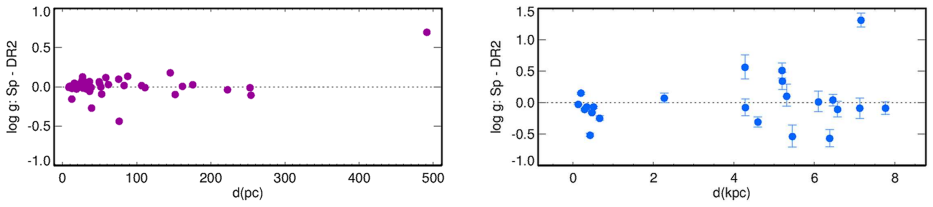
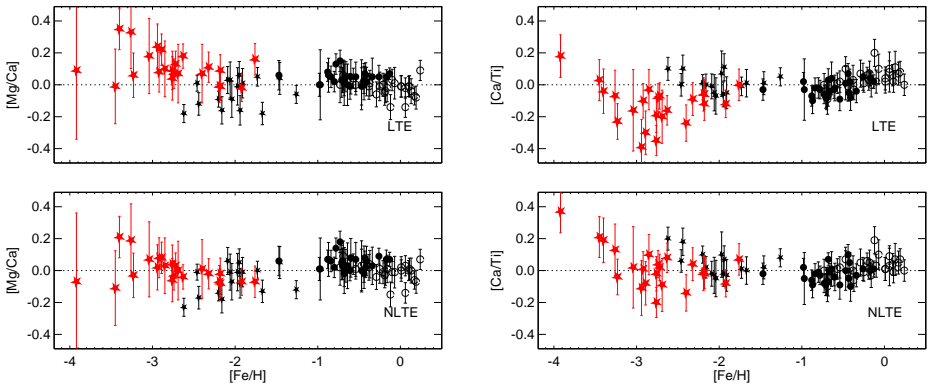
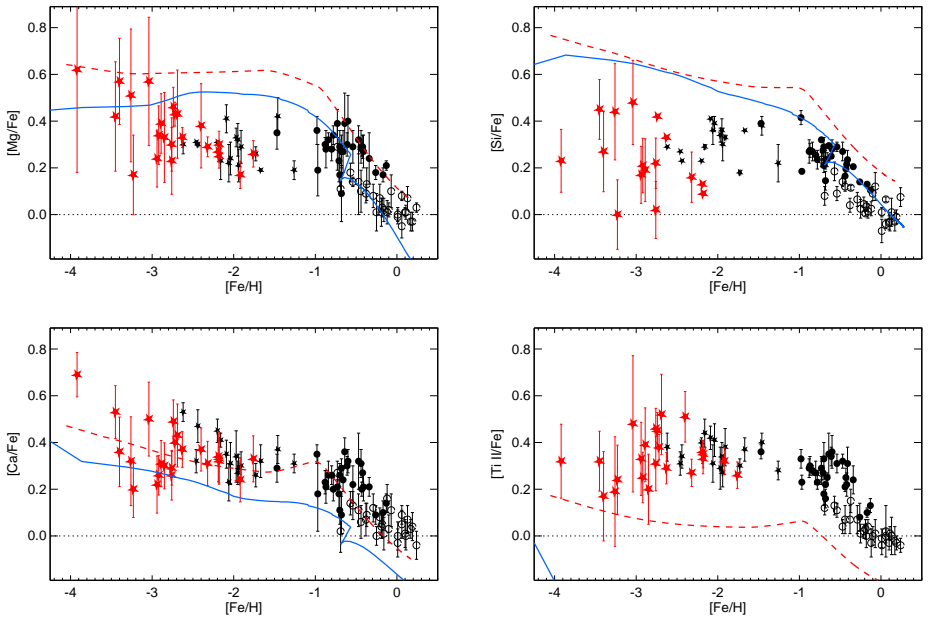
The paper claims that the abundance ratios [Mg/Fe], [Si/Fe], [Ca/Fe], and [Ti/Fe] are constant and mutually similar at the level of about 0.3 dex in thick-disk stars when [Fe/H] ≤ −0.4, and that halo stars show the same ∼0.3 dex excess whether they lie in the solar neighborhood or up to ∼8 kpc away. At higher metallicities the thick disk's ratios fall off, which the authors attribute to the onset of iron production in Type Ia supernovae. The paper also finds that for [Fe/H] ≤ −2.6 the star-to-star scatter of each alpha element relative to iron increases while the scatter among the alpha elements themselves stays small, a pattern they interpret as incomplete mixing of nucleosynthesis products in the earliest stellar generations. Along the way, the paper demonstrates that spectroscopically determined surface gravities from a non-LTE iron ionization balance agree with parallax-based gravities, validating the spectroscopic approach for stars beyond the reach of current astrometry.
Load-bearing premise
The load-bearing premise is that stars can be reliably assigned to the thin disk, thick disk, or halo using kinematic probabilities combined with ages from evolutionary tracks, and specifically that old stars with high thin-disk probabilities actually belong to the thick disk.
Editorial extensions
If this is right
- Thick-disk stars with [Fe/H] ≤ −0.4 require nucleosynthesis models to produce Mg, Si, Ca, and Ti in identical relative amounts, all at about 0.3 dex above iron.
- The onset of the thick disk's alpha decline near [Fe/H] ∼ −0.4 dates the arrival of Type Ia supernova iron to this metallicity, constraining the timescale of thick-disk formation.
- Halo stars out to ∼8 kpc share the same alpha enhancement as nearby halo dwarfs, implying that the early Galaxy's enrichment was uniform over this volume.
- The growing scatter in [α/Fe] at [Fe/H] ≤ −2.6, with small inter-alpha scatter, points to incomplete mixing of supernova ejecta during the formation of the most metal-poor stars.
- Spectroscopic non-LTE gravities from iron ionization balance are reliable for distant stars, where parallax data are not yet accurate enough.
Reading between the lines
- If the identical ∼0.3 dex plateaus survive larger samples, they would provide a sharper test of supernova yield calculations than the current qualitative agreement between models and data.
- The paper's age-based reassignment of a few kinematically thin-disk stars to the thick disk suggests that kinematic-only membership in large spectroscopic surveys could systematically blur abundance trends near the thin/thick disk boundary.
- A direct extension would be to measure [α/Fe] in thick-disk candidates with [Fe/H] between −0.6 and −0.2 to map how sharply the plateau breaks, pinning down the Type Ia supernova onset metallicity.
- The universality claim could be stress-tested by observing halo giants at distances beyond 8 kpc with next-generation astrometry; a gradient there would overturn the constant-halo picture.
Signed reviews
Editorial analysis
A structured set of objections, weighed in public.
Referee Report
Summary. The paper determines non-LTE abundances of Mg, Si, Ca, and Ti for 20 previously unanalyzed stars using Gaia DR2 parallaxes and FOCES spectra, and combines these with 74 stars from the authors' earlier studies (51 nearby dwarfs/subdwarfs from Sitnova et al. 2015 and Zhao et al. 2016, and 23 halo giants from Mashonkina et al. 2017) to form a sample of 94 stars spanning [Fe/H] from -4 to +0.3. The authors verify spectroscopic surface gravities against Gaia DR2 astrometry and find good agreement. On this basis they claim three new results: (1) in the thick disk, [Mg/Fe], [Si/Fe], [Ca/Fe], and [Ti/Fe] are constant and similar to each other at about 0.3 dex for [Fe/H] ≤ -0.4 and decline for higher metallicities, indicating the onset of Type Ia supernova iron production; (2) halo stars have the same α/Fe enhancement independent of distance out to ~8 kpc; (3) for [Fe/H] ≤ -2.6, the star-to-star scatter in [α/Fe] increases while the scatter among different α-elements remains small.
Significance. If the claims hold, the paper provides a valuable homogeneous non-LTE abundance dataset for three Galactic populations and confirms a single α-element plateau near 0.3 dex for the thick disk and halo, which would be an important constraint for models of Galactic chemical evolution. The Gaia-based verification of spectroscopic gravities is a useful methodological check. The main strengths are the consistent non-LTE treatment across elements, the differential line-by-line abundance method, and the explicit comparison with literature results and chemical evolution models. However, the two new headline conclusions depend on several fragile steps: population assignments based partly on age estimates with limited precision, and the combination of subsamples analyzed with different spectra, line sets, and signal-to-noise without a common-star zero-point calibration. These issues are not fatal in themselves but require additional robustness analysis before the claims can be accepted.
major comments (4)
- [§4.1] The assignment of HD 112758, HD 144579, and HD 32923 to the thick disk is based exclusively on age estimates (10, 13.5, and 11 Gyr) despite kinematic thin-disk probabilities of 88%, 83%, and 97%, respectively. The paper itself notes that ages for some stars have large uncertainties (e.g., HD 40397 and HD 135204, whose ages are described as uncertain because they are far from leaving the main sequence). Since these stars lie exactly in the metallicity range that defines the thick-disk plateau and its falloff, the population classification is load-bearing. The authors should test the robustness of the plateau and of the decline at [Fe/H] > -0.4 by recomputing the thick-disk mean values with these borderline stars removed or moved to the thin disk, and by specifying the age-uncertainty effect on each assignment.
- [§2.1, §4.2] The full 94-star sample combines 51 dwarfs/subdwarfs from Sitnova et al. (2015) and Zhao et al. (2016), 23 halo giants from Mashonkina et al. (2017), and 20 new FOCES stars, which were analyzed with different instruments, spectral ranges, line lists, and signal-to-noise ratios. No star is analyzed in more than one pipeline, so the zero points of [X/H] and [Fe/H] are not independently tied between subsamples. This matters directly for the 'halo stars have the same [α/Fe] independent of distance' conclusion, which is essentially a dwarf-giant comparison, and also for the thick-disk plateau, which mixes the new sample with previous data. An uncalibrated relative zero-point offset of ~0.1 dex in [X/H] or [Fe/H] between subsamples would shift the claimed universal level of ~0.3 and could create or erase the apparent distance independence. The authors should either calibrate subsample zero points using common stars or, if that is not feasible, provide a quantitative error budget that propagates intersample systematic uncertainties through the derived mean [α/Fe] values.
- [§4.2 and Table 4] The halo distance-independence claim is based on a restricted set of elements for the giant subsample: for halo giants, [Si/Fe] is not averaged because of large scatter (only the Si I 3905 line, low SNR, strong blending), and Table 4 lists no [Ti/Fe] for halo giants. Thus the conclusion that halo stars at distances up to ~8 kpc have the same [α/Fe] as nearby dwarfs rests on [Mg/Fe] and [Ca/Fe] alone. The paper should explicitly state this elemental limitation, and, if available, present any Ti or additional Si measurements for the giants, or otherwise temper the claim to 'the available elements'.
- [§4.1] The claimed decline of [α/Fe] in the thick disk for [Fe/H] > -0.4 is based on only four stars, a point the text acknowledges. With such a small sample, the apparent steep falloff could reflect errors in a single object's classification or abundance rather than an astrophysical onset of Type Ia supernovae. The authors should mark this as tentative and compare with the larger literature samples (e.g., Bensby et al. 2014, Adibekyan et al. 2012, Buder et al. 2019) in a quantitative way, for example by overlaying their four stars on those samples and testing whether the decline is statistically significant when all samples are combined.
minor comments (5)
- [Section 3] The Si model atom used for the silicon abundances is described only as 'being prepared for publication,' which prevents readers from reproducing the [Si/Fe] results. A description or reference to an available source should be provided in the final version.
- [Throughout] There are several typographical errors: 'substracted' should be 'subtracted,' 'parantheses' should be 'parentheses,' 'ageement' should be 'agreement,' and in Table 1 the column heading for microturbulence contains a stray 'Рљ' character.
- [Figure 1 caption] The caption states 'differences in the log g values... as a function of the distances from [5]' without defining reference [5] beyond the bibliography. Specify that the distances are from Bailer-Jones et al. (2018) and label the horizontal axis explicitly.
- [Figure 3 caption] The dashed lines supposedly denote the mean values for halo giants, halo dwarfs, and thick-disk stars with [Fe/H] ≤ -0.4, but the caption does not identify which line style corresponds to which population. Add a legend or explicitly distinguish the line styles (e.g., short-dashed, long-dashed) for each subsample.
- [Abstract and §4.1] The abstract states 'when [Fe/H] < -0.4,' while the main text (e.g., the thick-disk definition and Table 4) uses '[Fe/H] ≤ -0.4.' Please reconcile this inequality.
Circularity Check
No circularity: abundances are measured from spectra and population conclusions are empirical averages, not derived from fitted inputs.
full rationale
The paper's derivation chain is self-contained in the relevant sense. Atmospheric parameters come from Gaia DR2 parallaxes, IRFM temperatures, and evolutionary-track masses; abundances of Mg, Si, Ca, and Ti are obtained by fitting synthetic NLTE spectra to observed line profiles; iron abundances come from Fe II lines; and population membership is assigned from kinematics and ages, with the paper explicitly stating that chemical properties were not used in the assignment. The headline conclusions (thick-disk plateau near [alpha/Fe] ~ 0.3 for [Fe/H] <= -0.4, and similar halo [alpha/Fe] at different distances) are computed averages of measured ratios, not outputs of a model fitted to those claims. The numerous self-citations are to earlier method and data papers (model atoms, microturbulence formula, previously published abundance samples) rather than to the target result; none of these citations defines or forces the plateau or distance-independence conclusion. Possible systematic zero-point offsets between subsamples analyzed in different papers are a legitimate external-validity concern, but they are not circularity under the rules: no equation in the paper reduces to its own input, and no fitted parameter is renamed as a prediction.
Assumptions & free parameters
free parameters (1)
- Adopted mass for halo giants =
0.8 M_sun
assumptions (5)
- domain assumption Classical 1D plane-parallel MARCS model atmospheres adequately represent the stellar photospheres of the sample stars.
- domain assumption The non-LTE model atoms for Mg I, Si I-II, Ca I, and Fe I-II, including the quantum-mechanical Ca I+H I collision rates of Mitrushchenkov et al. (2017), are accurate.
- ad hoc to paper Kinematic probabilities from Mishenina et al. (2004) combined with evolutionary-track ages from Yi et al. (2004) can correctly classify stars by Galactic population, including several stars whose kinematics favor a different population.
- domain assumption The halo giants in the sample have not undergone internal mixing that changes their surface chemical abundances.
- domain assumption The distance scale (Gaia DR2 parallaxes and Bailer-Jones et al. 2018 distances) is accurate for the verification of surface gravities.
Cite this review
Pith. "Pith review of Abundances of alpha-Process Elements in Thin-Disk, Thick-Disk, and Halo Stars of the Galaxy: Non-LTE Analysis." pith.science (2026). https://pith.science/paper/EVEHO5AC
@misc{pith2026190803370,
  author       = {Pith},
  title        = {Pith review of: Abundances of alpha-Process Elements in Thin-Disk, Thick-Disk, and Halo Stars of the Galaxy: Non-LTE Analysis},
  year         = {2026},
  howpublished = {\url{https://pith.science/paper/EVEHO5AC}},
  note         = {Machine review of arXiv:1908.03370}
}
read the original abstract
The atmospheric parameters and abundances of Mg, Si, Ca, and Ti have been determined for 20 stars using the Gaia DR2 parallaxes, high-resolution spectra, and the non-local thermodynamic equilibrium (non-LTE) line formation modeling. A sample of stars with homogeneous data on the abundances of alpha-process elements has thus been increased to 94. It is shown that applying a non-LTE approach and classical 1D atmospheric models with spectroscopically determined surface gravities based on Fe~I and Fe~II lines yields reliable results. Analysis of the full sample confirms the conclusions of earlier studies indicating enhancements of Mg, Si, Ca, and Ti relative to Fe for halo and thick-disk stars, and larger enhancements for the thick-disk stars compared to the thin-disk stars of similar metallicities. The following new results are obtained. The ratios [Mg/Fe], [Si/Fe], [Ca/Fe], and [Ti/Fe] in the thick disk remain constant and similar to each other at the level 0.3 when [Fe/H] < -0.4, and fall off when the metallicity becomes higher, suggesting the onset of the production of iron in Type Ia supernovae. Halo stars have the same [alpha/Fe] values independent of their distance (within ~ 8 kpc of the Sun), providing evidence for a universal evolution of the abundances of alpha-process elements in different parts of the Galaxy. The enhancements relative to iron for halo stars are, on average, similar, at the level 0.3 dex, for Mg, Si, Ca, and Ti. These data are important for constraining the nucleosynthesis models. The star-to-star scatter of [alpha/Fe] increases for [Fe/H] < -2.6, while the scatter of the ratios between the different alpha-process elements remains small, possibly indicating incomplete mixing of nucleosynthesis products at the epoch of the formation of these stars.
Figures

Figures from the paper (1 more)
Reference graph
Works this paper leans on
-
[1]
V. Z. Adibekyan, S. G. Sousa, N. C. Santos, E. Delgado Mena , J. I. Gonz´ alez Hern´ andez, G. Israelian, M. Mayor, and G. Khachatryan, Ast ron. Astrophys. 545, A32 (2012)
work page 2012
- [2]
- [3]
- [4]
-
[5]
C. A. L. Bailer-Jones, J. Rybizki, M. Fouesneau, et al., A stron. J. 156, 58 (2018)
work page 2018
- [6]
- [7]
-
[8]
M. Bergemann, R. Collet, R. Sch¨ onrich, R. Andrae, M. Kov alev, G. Ruchti, C. J. Hansen, and Z. Magic, Astrophys. J. 847, 16 (2017)
work page 2017
Show all 56 references
-
[9]
Bonifacio, M
P. Bonifacio, M. Spite, R. Cayrel, V. Hill, et al., Astron . Astrophys. 501, 519 (2009)
2009
-
[10]
A. G. A. Brown, A. Vallenari, T. Prusti, J. H. J. de Bruijn e, et al., Astron. Astrophys. 616, A1 (2018)
2018
-
[11]
Buder, M
S. Buder, M. Asplund, L. Duong, J. Kos, et al., Mon. Not. R . Astron. Soc. 478, 4513 (2018)
2018
-
[12]
Buder, K
S. Buder, K. Lind, M. K. Ness, M. Asplund, et al., Astron. Astrophys. 624, A19 (2019)
2019
-
[13]
Butler, J
K. Butler, J. Giddings, Newsletter on Analysis of Astro nomical Spectra 9, University of London 723 (1985)
1985
-
[14]
Casagrande, I
L. Casagrande, I. Ram ´ ırez, J. Mel´ endez, M. Bessell, and M. Asplund, Astron. Astro- phys. 512, A54 (2010)
2010
-
[15]
Casagrande, R
L. Casagrande, R. Sch¨ onrich, M. Asplund, S. Cassisi, I . Ram ´ ırez, J. Mel´ endez, T. Bensby, and S. Feltzing, Astron. Astrophys. 530, A138 (2011)
2011
-
[16]
Cayrel, E
R. Cayrel, E. Depagne, M. Spite, V. Hill, et al., Astron. Astrophys. 416, 1117 (2004)
2004
-
[17]
J. G. Cohen, N. Christlieb, I. Thompson, A. McWilliam, S . Shectman, D. Reimers, L. Wisotzki, and E. Kirby, Astrophys. J. 778, 56 (2013)
2013
-
[18]
Drawin, Zeitschrift f¨ ur Physik 211, 404 (1968)
H.-W. Drawin, Zeitschrift f¨ ur Physik 211, 404 (1968)
1968
-
[19]
Famaey, A
B. Famaey, A. Jorissen, X. Luri, M. Mayor, S. Udry, H. Dej onghe, and C. Turon, Astron. Astrophys. 430, 165 (2005)
2005
-
[20]
Fuhrmann, Astron
K. Fuhrmann, Astron. Astrophys. 338, 161 (1998)
1998
-
[21]
Fuhrmann, Astron
K. Fuhrmann, Astron. Nachr. 325, 3 (2004)
2004
-
[22]
Gilmore and N
G. Gilmore and N. Reid, Mon. Not. R. Astron. Soc. 202, 1025 (1983)
1983
-
[23]
G. A. Gontcharov, Astron. Lett. 32, 759 (2006)
2006
-
[24]
J. I. Gonz´ alez Hern´ andez and P. Bonifacio, Astron. Astrophys. 497, 497 (2009)
2009
-
[25]
Gratton, E
R. Gratton, E. Carretta, F.Matteucci, and C. Sneden, in Formation of the Galactic Halo... Inside and Out, Ed. by H. L. Morrison and A. Sarajedin i, ASP Conf. Ser. 92, 307 (1996)
1996
-
[26]
Gustafsson, B
B. Gustafsson, B. Edvardsson, K. Eriksson et al., Astro n. Astrophys. 486, 951 (2008)
2008
-
[27]
M. N. Ishigaki, M. Chiba, and W. Aoki, Astrophys. J. 753, 64 (2012). 18
2012
-
[28]
R. L. Kurucz, I, Furenlid, J. Brault, L. Testerman, Sola r Flux Atlas from 296 to 1300 nm Nat. Solar Obs., Sunspot, New Mexico (1984)
1984
-
[29]
S. R. Majewski, R. P. Schiavon, P. M. Frinchaboy, C. Alle nde Prieto, et al., Astron. J. 154, 94 (2017)
2017
-
[30]
D. Maoz, F. Mannucci, and T. D. Brandt, Mon. Not. R. Astro n. Soc. 426, 3282 (2012)
2012
-
[31]
Masana, C
E. Masana, C. Jordi, and I. Ribas, Astron. Astrophys. 450, 735 (2006)
2006
-
[32]
Mashonkina, Astron
L. Mashonkina, Astron. Astrophys. 550, A28 (2013)
2013
-
[33]
Mashonkina, T
L. Mashonkina, T. Gehren, C. Travaglio, & T. Borkova, As tron. Astrophys. 397, 275 (2003)
2003
-
[34]
Mashonkina, T
L. Mashonkina, T. Gehren, J.-R., Shi, et al., Astron. As trophys. 528, A87 (2011)
2011
-
[35]
Mashonkina and T
L. Mashonkina and T. Gehren, Astron. Astrophys. 364, 249 (2000)
2000
-
[36]
Mashonkina, P
L. Mashonkina, P. Jablonka, Y. Pakhomov, et al., Astron . Astrophys. 604, A129 (2017)
2017
-
[37]
Mashonkina, P
L. Mashonkina, P. Jablonka, T. Sitnova, Y. Pakhomov, an d P. North, Astron. As- trophys. 608, A89 (2017)
2017
-
[38]
Mashonkina, T
L. Mashonkina, T. Sitnova, and A. K. Belyaev, Astron. As trophys. 605, A53 (2017)
2017
-
[39]
T. V. Mishenina, C. Soubiran, V. V. Kovtyukh, and S. A. Ko rotin, Astron. Astrophys. 418, 551 (2004)
2004
-
[40]
Mitrushchenkov, M
A. Mitrushchenkov, M. Guitou, A. K. Belyaev, S. A. Yakov leva, A. Spielfiedel, and N. Feautrier, J. Chem. Phys. 146, 014304 (2017)
2017
-
[41]
Prusti, J.H
T. Prusti, J.H. J. de Bruijne,A.G. A. Brown, A. Vallenar i, et al., Astron. Astrophys. 595, A1 (2016)
2016
-
[42]
Ram ´ ırez and J
I. Ram ´ ırez and J. Mel´ endez, Astrophys. J.626, 446 (2005)
2005
-
[43]
Randich, G
S. Randich, G. Gilmore, and Gaia-ESO Consortium, The Me ssenger 154, 47 (2013)
2013
-
[44]
Recio-Blanco, P
A. Recio-Blanco, P. de Laverny, G. Kordopatis, A. Helmi , et al., Astron. Astrophys. 567, A5 (2014)
2014
-
[45]
Romano, A
D. Romano, A. I. Karakas, M. Tosi, and F. Matteucci, Astr on. Astrophys. 522, A32 (2010)
2010
-
[46]
Ryabchikova, N
T. Ryabchikova, N. Piskunov, R. L. Kurucz et al., Physic a Scripta, 90, 054005 (2015)
2015
-
[47]
Sitnova, Astron
T.M. Sitnova, Astron. Lett. 42, 734 (2016)
2016
-
[48]
Sitnova, G
T. Sitnova, G. Zhao, L. Mashonkina, Y. Chen, et al., Astr ophys. J. 808, 148 (2015)
2015
-
[49]
Sitnova and L
T.M. Sitnova and L. I. Mashonkina, Astron. Lett. 44, 411 (2018). 19
2018
-
[50]
Sneden, J
C. Sneden, J. J. Cowan, C. Kobayashi, M. Pignatari, J. E. Lawler, E. A. Den Hartog, and M. P. Wood, Astrophys. J. 817, 53 (2016)
2016
-
[51]
Tsymbal, T
V. Tsymbal, T. Ryabchikova, T. Sitnova, in Physics of Ma gnetic Stars. ASP Confer- ence Series 518, 247 (2019)
2019
-
[52]
J. A. Valenti and N. Piskunov, Astrophysics Source Code Library, 1202.013 (2012)
2012
-
[53]
van Leeuwen, Astron
F. van Leeuwen, Astron. Astrophys. 474, 653 (2007)
2007
-
[54]
S. K. Yi, P. Demarque, and Y.-C. Kim, Astrophys. Space Sc i. 291, 261 (2004)
2004
-
[55]
D. Yong, J. E. Norris, M. S. Bessell, N. Christlieb, et al ., Astrophys. J. 762, 26 (2013)
2013
-
[56]
G. Zhao, L. Mashonkina, H. L. Yan, et al., Astrophys. J. 833, 225 (2016) 20
2016
Reviewed August 14, 2026 · model on record in the stance chip above.
Discussion (0). Continue with ORCID to comment.