REVIEW 4 major objections 5 minor 95 references
Bond particle theory for the pseudogap phase of underdoped cuprates
T0 review · 4 major / 5 minor · reviewed 2026-08-14 · deepseek-v4-flash
Pith's one-line read A dimer-averaged bond-particle treatment of the t-J model yields Fermi pockets of area $x/2$ centered near $(\pi/2,\pi/2)$, plus a gapped triplet spin mode.
desk verdict A genuinely new averaging method for bond-particle theory, but the headline x/2 Fermi surface is an input and the fitted ζ controls the spin gap at the 0.1% level. read the letter →
The pith
A machine-rendered reading of the paper's core claim, the machinery that carries it, and where it could break.
The reading
What carries the argument
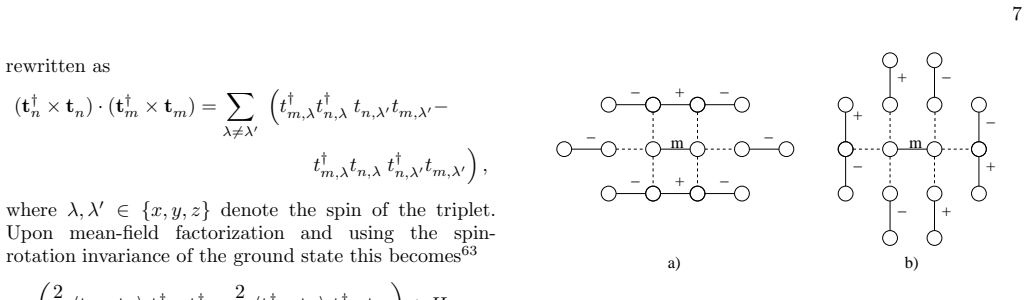
The central object is the bond-particle representation of the t-J model: each dimer of an arbitrary covering has singlet and triplet states encoded as bosons and odd-electron states as fermions, with the constraint of one particle per dimer. The argument treats the singlet as an inert vacuum, replaces the singlet operators by unity, and then averages the inter-dimer Hamiltonian over dimer coverings, which in the approximate form multiplies all inter-dimer couplings by a single factor $\zeta\approx 1/12$, treated as an adjustable parameter near $0.11$. Mean-field factorization then decouples a triplet boson problem, governed by $2\times2$ matrices $\epsilon_k$ and $\Delta_k$, from a four-band fermion problem; self-consistency fixes the anomalous averages $\eta$, $\theta$, and $\chi$. This machinery produces the two central outputs: the gapped triplet dispersion and the hole-pocket Fermi surface.
What would settle it
Measure the low-temperature Fermi-surface volume of a clean underdoped cuprate by quantum oscillations in a field high enough to suppress charge order; a hole-like pocket area that is not $x/2$ would falsify the central claim, as would a numerical evaluation of the exact dimer-covering average showing that a single scalar cannot reproduce its effective couplings.
Extended reading notes
Core claim
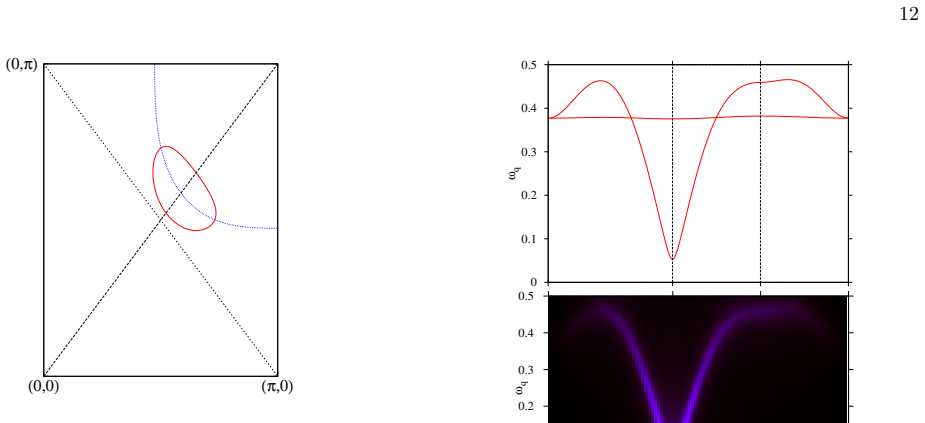
The paper's central claim is that the lightly doped paramagnetic Mott insulator - the pseudogap state - can be described by a translationally invariant mean-field theory whose elementary excitations are triplet bond bosons and spin-1/2 bond fermions representing the doped holes. Because the bond-particle Hamiltonian is exact for any dimer covering, observable quantities should not depend on the covering; the paper approximates the covering average by a single factor multiplying inter-dimer couplings and solves the resulting boson and fermion problems self-consistently. The solution gives a hole pocket centered near $(\pi/2,\pi/2)$ with total area $x/2$, a gapped triplet band with minimum at $(\pi,\pi)$, and a k-dependent spectral weight that is weaker on the side of the pocket facing $(\pi,\pi)$, matching the qualitative shape of ARPES Fermi arcs. The paper explicitly notes that in this mean-field approximation the pocket sits too close to $(\pi,\pi)$, the quasiparticle band is too wide, and the spectral-weight drop is too smooth, but argues that hole-triplet coupling beyond mean field may correct these deficiencies.
Load-bearing premise
Every result depends on the assumption that averaging over all ways of pairing the lattice into dimers can be replaced by one number that shrinks all couplings between pairs, and that number is guessed from crude counting and then tuned rather than computed.
Editorial extensions
If this is right
- The pseudogap state below $T^*$ is a Fermi liquid whose carriers are the doped holes themselves, carrying spin $1/2$, with a Fermi surface whose total enclosed area is $x/2$ rather than $(1\pm x)/2$.
- ARPES should see the visible side of the hole pocket as a temperature-independent arc whose length grows with $x$, while the side facing $(\pi,\pi)$ carries too little spectral weight to be observed.
- A gapped triplet mode exists around $(\pi,\pi)$; the doping at which its gap closes marks the onset of antiferromagnetic order, and the upper branch of the mode resembles the hourglass excitation seen in neutron scattering.
- Transport and optical quantities that scale with carrier density $n_c=x$, such as the $T^2$ resistivity coefficient $A\propto x$, the Drude weight, and a hole-like Hall response, follow naturally from the low-density spin-1/2 fermion picture.
Reading between the lines
- A beyond-mean-field treatment coupling the holes to triplet bosons could plausibly sharpen the dark side of the pocket and narrow the quasiparticle band, potentially resolving the paper's own noted mismatches with ARPES; the paper gestures at this but does not carry it out.
- A more faithful evaluation of the dimer-covering average, for instance by sampling coverings on finite clusters, would test whether one scalar $\zeta$ can capture the physics or whether effective couplings develop momentum-dependent structure that changes the pocket topology.
- If the theory is right, the doping dependence of the spin gap offers a quantitative target: the energy of the $(\pi,\pi)$ magnetic mode should soften roughly linearly with $x$ and close near the experimental crossover concentration.
- The same bond-particle construction could be applied to other doped Mott insulators, where it would predict a carrier-density crossover from small hole pockets to a large Fermi surface.
Signed reviews
Editorial analysis
A structured set of objections, weighed in public.
Referee Report
Summary. The paper develops a bond-particle theory of the lightly doped t-J model as a candidate description of the underdoped cuprate pseudogap phase. Starting from an arbitrary dimer covering of the square lattice, the author derives an exact representation of the t-J Hamiltonian in terms of singlet/triplet bosons and hole-like fermions. To restore translational invariance, the bond-particle Hamiltonian is averaged over all dimer coverings, with the entire averaging effect represented by a single dimensionless factor zeta. The averaged Hamiltonian is then treated in a self-consistent Hartree-Fock-type mean-field approximation. For representative parameters (J=0.4, t'=-0.2, t''=0.1, x=0.1, zeta=0.11) the author finds hole-like quasiparticle pockets centered near (pi/2,pi/2) with total Fermi-surface area x/2 and a gapped triplet boson mode with minimum at (pi,pi), which is interpreted as the magnetic resonance mode of the pseudogap phase. The results are compared qualitatively with ARPES, transport, Hall-effect, optical, and neutron-scattering measurements on underdoped cuprates.
Significance. The paper's starting point is exact, the bond-particle representation is carefully derived, and the self-consistent numerical solution is a concrete, falsifiable calculation. The author is also transparent about the uncontrolled steps, including the crude estimate of zeta, the neglect of hard-core constraints, and the presence of zero-weight artifact bands. If the dimer-covering average could be controlled, the resulting picture - spin-1/2 hole fermions with small Fermi pockets and a gapped triplet mode, without static order - would be an important contribution to the pseudogap problem. As it stands, however, the central quantitative claims are conditional on an unverified collapse of the covering average to a single fitted scalar and on a fermion-counting condition that fixes the Fermi-surface area by construction. The qualitative pocket topology and the existence of a gapped collective triplet mode are nontrivial outputs, but the advertised x/2 area and the precise doping dependence of the spin gap are not robustly derived.
major comments (4)
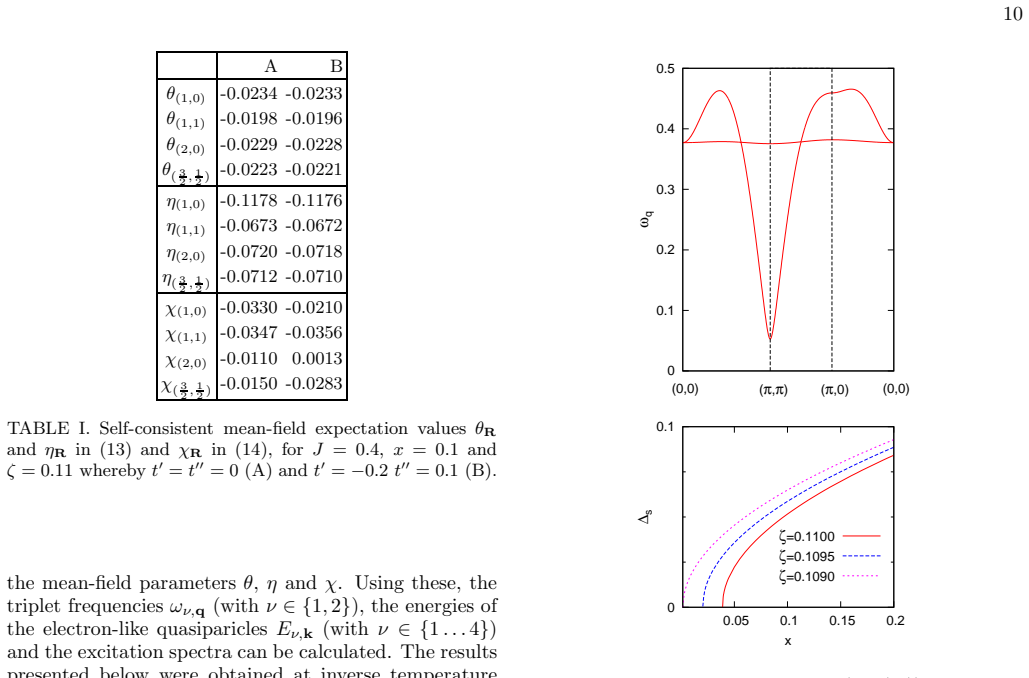
- [Section II.D / Eq. (10) / Fig. 6] The dimer-covering average is the central approximation, yet it is reduced to a single scalar zeta, first estimated by crude counting as zeta ~ 1/12 and then treated as an adjustable parameter set to zeta = 0.11 'because the values which give reasonable results always are around zeta=0.1'. This is not a harmless rescaling: Fig. 6 (bottom) shows that the doping at which Delta_S(pi,pi) vanishes, interpreted as the onset of antiferromagnetic order, changes substantially when zeta is varied from 0.1090 to 0.1100, i.e., in the fourth decimal place. Since the abstract's claim of a gapped triplet band at a given x depends on this choice, and since the crude counting estimate does not determine zeta to anywhere near this precision, the central quantitative result is not robust. The authors should either compute the covering average in a controlled way (e.g., by explicit summation over small clusters or a systematic expansion) or demonstrate stability of the qualitative conclusions over a wide range of zeta.
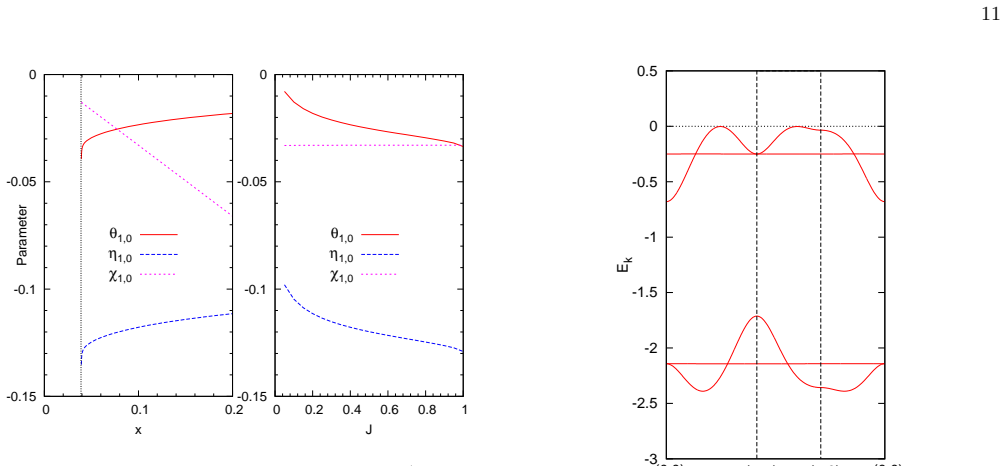
- [Section II.D / Eq. (11)] The advertised Fermi-surface area x/2 is an input, not an output. In the original dimer representation, Eq. (11) fixes the number of fermions relative to the hole concentration, with the sum running over the N/2 dimers. After the averaging step, the number of bond sites is increased to 2N, but Eq. (11) is retained with the same normalization, so the total fermion number in the averaged system is N x. For a spin-1/2 Fermi liquid, this implies via Luttinger's theorem a Fermi-surface volume fraction of exactly x/2; the mean-field solution is therefore constrained to produce this area. The shape and location of the pockets in Figs. 10 and 11 remain nontrivial results, but the area quoted in the abstract is imposed by construction. This should be stated explicitly, and the text should not present the x/2 area as a derived prediction.
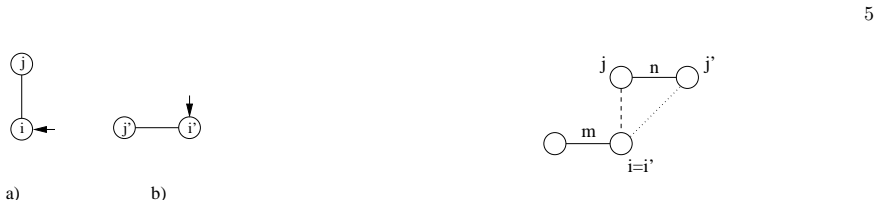
- [Section II.D / Eq. (9) / Fig. 4] The neglect of the hard-core constraint (9) and of the infinitely strong repulsion between bond particles that 'cross' and share a site (Fig. 4) is justified solely by the smallness of the densities shown in Fig. 8. The densities are small, but the constraints are singular and act at short distances, and the spin gap is extremely sensitive to the bosonic parameters (Fig. 6). A low-density argument does not by itself control the effect of an infinite contact repulsion on the self-consistent parameters theta, eta, and chi, nor on the effective value of zeta. The authors should quantify the leading correction, for example by a Gutzwiller-type projection or by comparing with the treatment of the Kondo-lattice bond-particle constraint cited in the text.
- [Section IV / Figs. 9, 10, 12] The averaged mean-field spectrum contains dispersionless bands whose coherent spectral weight is exactly zero, which the author identifies as artifacts of the enlarged bond basis. This demonstrates that the averaged Hilbert space contains unphysical sectors that are not removed by the mean-field calculation. Because the self-consistent parameters are computed in the full averaged Hilbert space, these spurious sectors can in principle contaminate the physical bands even if the latter carry all the spectral weight. The paper should explain why the zero-weight bands do not affect the physical subspace, or implement the projection explicitly; otherwise the reliability of the pocket dispersion and the triplet mode is not established.
minor comments (5)
- [Title] The title contains a typo: 'c uprates' should be 'cuprates'.
- [Section I] The introduction contains several typos and stylistic issues, including 'paricularly', 'dependendence', 'oberservation', and inconsistent capitalization of 'fermi' versus 'Fermi'; a careful proofread is needed.
- [Section II.D] The statement that 'the values which give reasonable results always are around zeta=0.1' is not a well-defined criterion; please specify how zeta is chosen and what 'reasonable' means quantitatively.
- [Eq. (11)] After the averaging, Eq. (11) is ambiguous: the sum over m should specify whether it runs over the N/2 original dimers or over the 2N bonds of the averaged lattice.
- [References] Reference [41] is incomplete, as it lacks the article title and journal information.
Circularity Check
Fermi-surface volume is imposed by the retained hole-number formula, and the gapped triplet mode is locked in by fitting ζ to 0.11; the two headline predictions are substantially constructed rather than derived.
-
self definitional
[Section II.D, Eq. (11)]
"Upon averaging we increase the number of bonds which can be occupied by a particle from N/2 to 2 N. However, we retain the expression (11) which guarantees a fermi surface with a volume propertional to the number of doped holes."
The averaged mean-field Hamiltonian is a free-fermion problem with the chemical potential fixed by Eq. (11), which defines x as the total fermion density. In a two-dimensional spin-degenerate Fermi liquid the enclosed Fermi-surface area is fixed by the particle density alone, so the abstract's 'total area of x/2' is a direct consequence of this normalization choice, not a dynamical output of the t-J Hamiltonian. The sentence 'guarantees a fermi surface with a volume proportional to the number of doped holes' concedes that the headline volume is put in by construction.
-
fitted input called prediction
[Section II.D and Section IV, Fig. 6 bottom]
"Later on, it will be seen that e.g. the spin gap depends sensitively on the value of ζ and we will consider it as an adjustable parameter but the values which give 'reasonable' results always are around ζ = 0.1. ... Since the precise value of x where antiferromagnetic order sets in is unknown we fix ζ = 0.11 from now on."
The crude estimate ζ=1/12≈0.083 is abandoned in favor of ζ=0.11, selected because it gives 'reasonable' results. Fig. 6 bottom shows the spin gap (the abstract's 'gapped spin-wave-like band') closing at a doping that shifts substantially when ζ changes at the fourth decimal (0.1090, 0.1095, 0.1100). The existence and size of the headline triplet gap at a given x is therefore an artifact of the fitted value, not a robust prediction of the dimer-averaging procedure.
full rationale
The central derivation is not fully circular: the bond-particle representation is exact for a fixed dimer covering, and the pocket shape and triplet dispersion are genuine outputs of the subsequent mean-field calculation. However, two headline results reduce to inputs. First, the Fermi-surface area x/2 is not derived dynamically; retaining Eq. (11) after the averaging step fixes the fermion density to x, and in a spin-degenerate two-dimensional Fermi liquid the enclosed area is then x/2 by construction. The paper itself says this retention 'guarantees' the volume. Second, the gapped spin-wave-like triplet band is obtained only after promoting ζ from the estimated 1/12 to the fitted 0.11, with the spin gap depending sensitively on the fourth decimal of ζ. This is a fitted parameter renamed as a prediction. The self-citations (refs. 11-13, 36, 37, 44, 45, 59) are used as motivation and comparison, not as load-bearing justifications in the derivation chain, so they do not add circularity. Because the Fermi-volume claim is imposed by normalization and the spin-gap claim is secured by parameter fitting, the paper earns a partial circularity score of 7 rather than a clean non-finding.
Assumptions & free parameters
free parameters (3)
- zeta (dimer-covering renormalization factor) =
0.11 (crude initial estimate 1/12 ~ 0.083)
- t' (next-nearest-neighbor hopping) =
-0.2
- t'' (third-nearest-neighbor hopping) =
0.1
assumptions (8)
- domain assumption The t-J model is the relevant microscopic model for the CuO2 planes at low doping
- standard math The bond-particle representation restricted to the 9 dimer states is exact (completeness of the dimer basis)
- ad hoc to paper Singlet operators can be replaced by unity (the 'singlet soup')
- ad hoc to paper Empty-dimer bosons and direct exchange between holes contribute only at order x^2 and are dropped
- ad hoc to paper The hard-core constraint (one bond particle per dimer, Eq. 9) can be neglected because the particle density is low
- ad hoc to paper The repulsion between 'crossing' bond particles that share a site in the averaged Hamiltonian can be neglected
- domain assumption The ground state is spin-rotation invariant, so expectation values of t_m and t-dagger_m x t_n vanish
- ad hoc to paper The crude combinatorial estimate zeta=1/12 approximates the true average over dimer coverings
Cite this review
Pith. "Pith review of Bond particle theory for the pseudogap phase of underdoped cuprates." pith.science (2026). https://pith.science/paper/EH6NORNJ
@misc{pith2026190803450,
  author       = {Pith},
  title        = {Pith review of: Bond particle theory for the pseudogap phase of underdoped cuprates},
  year         = {2026},
  howpublished = {\url{https://pith.science/paper/EH6NORNJ}},
  note         = {Machine review of arXiv:1908.03450}
}
read the original abstract
We present a theory for the lightly doped t-J model which is of possible relevance for the normal state of underdoped cuprates. Starting from an arbitrary dimer covering of the plane an exact representation of the t-J Hamiltonian in terms of bond bosons and fermions can be derived. Since all dimer coverings must give identical results for observable quantities we construct an approximate but translationally invariant Hamiltonian by averaging the bond particle Hamiltonian over all possible dimer coverings. Treating the resulting Hamiltonian in mean-field approximation we find fermi pockets centered near (pi/2,pi/2) with a total area of x/2 (with x the hole concentration) and a gapped spin-wave-like band of triplet excitations.
Figures

Figures from the paper (4 more)

Reference graph
Works this paper leans on
-
[1]
Keimer, S
B. Keimer, S. A. Kivelson, M. R. Norman, S. Uchida, J. Zaanen Nature 518 , 179 (2015)
2015
-
[2]
A. G. Loeser, Z.-X. Shen, D. S. Dessau, D. S. Marshall, C. H. Park, P. Fournier, and A. Kapitulnik, Science 273 , 325 (1996)
1996
-
[3]
H. Ding, T. Yokoya, J. C. Campuzano, T. Takahashi, M. Randeria, M. R. Norman, T. Mochiku, K. Kadowaki, and J. Giapintzakis, Nature 382 , 51 (1996)
1996
-
[4]
Damascelli, Z
A. Damascelli, Z. Hussain, and Z.-X. Shen, Rev. Mod. Phys. 75 , 473 (2003)
2003
-
[5]
B. O. Wells, Z.-X. Shen, A. Matsuura, D. M. King, M. A. Kastner, M. Greven, and R. J. Birgeneau, Phys. Rev. Lett. 74 , 964 (1995)
1995
-
[6]
Ronning, C
F. Ronning, C. Kim, D. L. Feng, D. S. Marshall, A. G. Loeser, L. L. Miller, J. N. Eckstein, L. Bozovic, and Z.-X. Shen, Science 282 , 2067 (1998)
1998
-
[7]
Kondo, A
T. Kondo, A. D. Palczewski, Y. Hamaya, T. Takeuchi, J. S. Wen, Z. J. Xu, G. Gu, and A. Kaminski, Phys. Rev. Lett. 111 , 157003 (2013)
2013
-
[8]
H.-B. Yang, J. D. Rameau, Z.-H. Pan, G. D. Gu, P. D. Johnson, H. Claus, D. G. Hinks, and T. E. Kidd, Phys. Rev. Lett. 107 , 047003 (2011)
2011
Show all 95 references
-
[9]
Tanaka, W
K. Tanaka, W. S. Lee, D. H. Lu, A. Fujimori, T. Fujii, Risdiana, I. Terasaki, D. J. Scalapino, T. P. Devereaux, Z. Hussain, Z.-X. Shen, Science 314 , 1910 (2006)
2006
-
[10]
Hashimoto, R.-H
M. Hashimoto, R.-H. He, K. Tanaka, J.-P. Testaud, W. Meevasana, R. G. Moore, D. Lu, H. Yao, Y. Yoshida, H. Eisaki, T. P. Devereaux, Z. Hussain, and Z.-X. Shen, Nature Phys. 6 , 414 (2010)
2010
-
[11]
Eskes and R
H. Eskes and R. Eder, Phys. Rev. B. 54 , R14226 (1996)
1996
-
[12]
Eder und K
R. Eder und K. W. Becker, Phys. Rev. B 44 , 6982 (1991)
1991
-
[13]
O. P. Sushkov, G. A. Sawatzky, R. Eder and H. Eskes, Phys. Rev. B. 56 , 11769 (1997)
1997
-
[14]
J. M. Tranquada, B. J. Sternlieb, J. D. Axe, Y. Nakamura,S. Uchida, Nature 375, 561 (1995)
1995
-
[15]
Howald, H
C. Howald, H. Eisaki, N. Kaneko, M. Greven, and A. Kapitulnik, Phys. Rev. B 67 , 014533 (2003)
2003
-
[16]
Ghiringhelli, M
G. Ghiringhelli, M. Le Tacon, M. Minola, S. Blanco-Canosa, C. Mazzoli, N. B. Brookes, G. M. De Luca, A. Frano, D. G. Hawthorn, F. He, T. Loew, M. Moretti Sala, D. C. Peets, M. Salluzzo, E. Schierle, R. Sutarto, G. A. Sawatzky, E. Weschke, B. Keimer2, and L. Braicovich, Science...
2012
-
[17]
S. I. Mirzaei, D. Stricker, J. N. Hancock, C. Berthod, A. Georges, E. van Heumen, M. K. Chan, X. Zhao, Y. Li, M. Greven, N. Barisic, and D. van der Marel, Proc. Natl. Acad. Sci. U.S.A. 110 , 5774 (2013)
2013
-
[18]
Y. Ando, Y. Kurita, S. Komiya, S. Ono, and K. Segawa, Phys. Rev. Lett. 92 , 197001 (2004)
2004
-
[19]
Barisic, M
N. Barisic, M. K. Chan, Y. Li, G. Yu, X. Zhao, M. Dressel, A. Smontara, and M. Greven, Proc. Natl. Acad. Sci. U.S.A. 110 , 12235 (2013)
2013
-
[20]
Grissonnanche, F
G. Grissonnanche, F. Laliberte, S. Dufour-Beausejour, M. Matusiak, S. Badoux, F. F. Tafti, B. Michon, A. Riopel, O. Cyr-Choiniere, J. C. Baglo, B. J. Ramshaw, R. Liang, D. A. Bonn, W. N. Hardy, S. Kramer, D. LeBoeuf, D. Graf, N. Doiron-Leyraud, and L. Taillefer, Phys. Rev. B 9...
2016
-
[21]
M. K. Chan, M. J. Veit, C. J. Dorow, Y. Ge, Y. Li, W. Tabis, Y. Tang, X. Zhao, N. Barisic, and M. Greven, Phys. Rev. Lett. 113 , 177005 (2014)
2014
-
[22]
J. W. Loram, K. A. Mirza, J. M. Wade, J. R. Cooper, N. Athanassopoulou, and W. Y. Liang, Advances in Superconductivity VII, K. Yamafuji and T. Morishita, (Eds.) Springer (1995)
1995
-
[23]
Badoux, W
S. Badoux, W. Tabis, F. Laliberte, G. Grissonnanche, B. Vignolle, D. Vignolles, J. Beard, D. A. Bonn, W. N. Hardy, R. Liang, N. Doiron-Leyraud, L. Taillefer, and C. Proust, Nature 531 , 210 (2016)
2016
-
[24]
Collignon, S
C. Collignon, S. Badoux, S. A. A. Afshar, B. Michon, F. Laliberte, O. Cyr-Choiniere, J.-S. Zhou, S. Licciardello, S. Wiedmann, N. Doiron-Leyraud, and L. Taillefer, Phys. Rev. B 95 , 224517 (2017)
2017
-
[25]
N. P. Ong, Z. Z. Wang, J. Clayhold, J. M. Tarascon, L. H. Greene, and W. R. McKinnon Phys. Rev. B 35 , 8807 (1987)
1987
-
[26]
Takagi, T
H. Takagi, T. Ido, S. Ishibashi, M. Uota, S. Uchida, and Y. Tokura, Phys. Rev. B 40 , 2254 (1989)
1989
-
[27]
W. J. Padilla, Y. S. Lee, M. Dumm, G. Blumberg, S. Ono, K. Segawa, S. Komiya, Y. Ando, and D. N. Basov Phys. Rev. B 72 , 060511(R) (2005)
2005
-
[28]
Tallon and J
J. Tallon and J. Loram, Physica C 349 , 53 (2001)
2001
-
[29]
Doiron-Leyraud, C
N. Doiron-Leyraud, C. Proust, D. LeBoeuf, J. Levallois, J.-B. Bonnemaison, R. Liang, D. A. Bonn, W. N. Hardy, and L. Taillefer, Nature 447 , 565 (2007)
2007
-
[30]
S. E. Sebastian, N. Harrison, M. M. Altarawneh, C. H. Mielke, R. Liang, D. A. Bonn, and G. G. Lonzarich, Proc. Natl. Acad. Sci. U.S.A. 107 , 6175 (2010)
2010
-
[31]
M. K. Chan, N. Harrison, R. D. McDonald, B. J. Ramshaw, K. A. Modic, N. Barisic, and M. Greven, Nature Communications 7 , 12244 (2016)
2016
-
[32]
Proust, B
C. Proust, B. Vignolle, J. Levallois, S. Adachi, N. E. Hussey, Proc. Natl. Acad. Sci. U.S.A. 113 , 13654 (2016)
2016
-
[33]
LeBoeuf, N
D. LeBoeuf, N. Doiron-Leyraud, J. Levallois, R. Daou, J.-B. Bonnemaison, N. E. Hussey, L. Balicas, B. J. Ramshaw, R. Liang, D. A. Bonn, W. N. Hardy, S. Adachi, C. Proust, and L. Taillefer, Nature 450 , 533 (2007)
2007
-
[34]
Ramshaw, B
B.J. Ramshaw, B. Vignolle, J. Day, R. Liang, W. Hardy, C. Proust, and D.A. Bonn, Nature Phys. 7 234 (2011)
2011
-
[35]
Comin, A
R. Comin, A. Frano, M. M. Yee, Y. Yoshida, H. Eisaki, E. Schierle, E. Weschke, R. Sutarto, F. He, A. Soumyanarayanan, Yang He, M. Le Tacon, I. S. Elfimov, J. E. Hoffman, G. A. Sawatzky, B. Keimer, and A. Damascelli, Science, 343 , 390 (2014)
2014
-
[36]
Eder and Y
R. Eder and Y. Ohta, Phys. Rev. B 51 , 6041 (1995)
1995
-
[37]
Nishimoto, Y
S. Nishimoto, Y. Ohta, and R. Eder, Phs. Rev. B 57 , R5590 (1998)
1998
-
[38]
D. L. Feng, N. P. Armitage, D. H. Lu, A. Damascelli, J. P. Hu, P. Bogdanov, A. Lanzara, F. Ronning, K. M. Shen, H. Eisaki, C. Kim, J.-i. Shimoyama, K. Kishio, and Z.-X. Shen, Phys. Rev. Lett. 86 , 5550 (2001)
2001
-
[39]
Chuang, A
Y.-D. Chuang, A. D. Gromko, A. Fedorov, Y. Aiura, K. Oka, Yoichi Ando, H. Eisaki, S. I. Uchida, and D. S. Dessau, Phys. Rev. Lett. 87 , 117002 (2001)
2001
-
[40]
Plate, J
M. Plate, J. D. F. Mottershead, I. S. Elfimov, D. C. Peets, Ruixing Liang, D. A. Bonn, W. N. Hardy, S. Chiuzbaian, M. Falub, M. Shi, L. Patthey, and A. Damascelli Phys. Rev. Lett. 95 , 077001 (2005)
2005
-
[41]
N. E. Hussey, M. Abdel-Jawad, A. Carrington, A. P. Mackenzie, and L. Balicas,
-
[42]
Vignolle, A
B. Vignolle, A. Carrington, R. A. Cooper, M. M. J. French, A. P. Mackenzie, C. Jaudet, D. Vignolles, C. Proust and N. E. Hussey, Nature 455 , 952 (2008)
2008
-
[43]
Nakamae, K
S. Nakamae, K. Behnia, N. Mangkorntong, M. Nohara, H. Takagi, S. J. C. Yates, and N. E. Hussey, Phys. Rev. B 68 , 100502(R) (2003)
2003
-
[44]
Eder and Y
R. Eder and Y. Ohta, Phys. Rev. B 51 , 11683 (1995)
1995
-
[45]
R. Eder, Y. Ohta, and S. Maekawa, Phys. Rev. Lett. 74 , 5124 (1995)
1995
-
[46]
Sachdev and R
S. Sachdev and R. N. Bhatt, Phys. Rev. B 41 , 9323 (1990)
1990
-
[47]
Chakravarty, C
S. Chakravarty, C. Nayak, and S. Tewari, Phys. Rev. B 68 , 100504(R) (2003)
2003
-
[48]
Chakravarty and H.-Y
S. Chakravarty and H.-Y. Kee, Proc. Natl. Acad. Sci. USA 105, 8835 (2008)
2008
-
[49]
Qi and S
Y. Qi and S. Sachdev Phys. Rev. B 81 , 115129 (2010)
2010
-
[50]
Eun Gook Moon and Subir Sachdev Phys. Rev. B 83 , 224508 (2011)
2011
-
[51]
Punk and S
M. Punk and S. Sachdev, Phys. Rev. B 85 , 195123 (2012)
2012
-
[52]
M. Holt, J. Oitmaa, W. Chen, and O. P. Sushkov, Phys. Rev. Lett. 109 , 037001 (2012)
2012
-
[53]
M. Holt, J. Oitmaa, W. Chen, and O. P. Sushkov Phys. Rev. B 87 , 075109 (2013)
2013
-
[54]
Senechal and A.-M
D. Senechal and A.-M. S. Tremblay, Phys. Rev. Lett. 92 , 126401 (2004)
2004
-
[55]
Kyung, S
B. Kyung, S. S. Kancharla, D. Senechal, A.-M. S. Tremblay, M. Civelli, and G. Kotliar, Phys. Rev. B 73 , 165114 (2006)
2006
-
[56]
T. M. Rice, K.-Y. Yang, and F. C. Zhang, Rep. Prog. Phys. 75 016502 (2012)
2012
-
[57]
Li, C.-Q
J.-X. Li, C.-Q. Wu, and D.-H. Lee, Phys. Rev. B 74, 184515 (2006)
2006
-
[58]
Hubbard, Proc
J. Hubbard, Proc. Roy. Soc. London, Ser. A 277, 237 (1964)
1964
-
[59]
R. Eder, P. Wrobel, and Y. Ohta, Phys. Rev. B 82 , 155109 (2010)
2010
-
[60]
M. Punk, A. Allais, and S. Sachdev, Proc. Natl. Acad. Sci. U.S.A. 112 , 9552 (2015)
2015
-
[61]
Huber, J
S. Huber, J. Feldmeier, and M. Punk, Phys. Rev. B 97 , 075144 (2018)
2018
-
[62]
Feldmeier, S
J. Feldmeier, S. Huber, and M. Punk, Phys. Rev. Lett. 120 , 187001 (2018)
2018
-
[63]
Gopalan, T
S. Gopalan, T. M. Rice, and M. Sigrist, Phys. Rev. B 49 , 8901 (1994)
1994
-
[64]
O. P. Sushkov, Phys. Rev. B 60 , 3289 (1999)
1999
-
[65]
Jurecka and W
C. Jurecka and W. Brenig, Phys. Rev. B 63 , 094409 (2001)
2001
-
[66]
Vojta and K
M. Vojta and K. W. Becker, Phys. Rev. B 60 , 15201 (1999)
1999
-
[67]
Ray and M
S. Ray and M. Vojta, Phys. Rev. B 98 , 115102 (2018)
2018
-
[68]
O. P. Sushkov, Phys. Rev. B 63 , 174429 (2001)
2001
-
[69]
Park and S
K. Park and S. Sachdev, Phys. Rev. B 64 , 184510 (2001)
2001
-
[70]
Siahatgar, B
M. Siahatgar, B. Schmidt, G. Zwicknagl, and P. Thalmeier, New J. Phys. 14 , 103005 (2014)
2014
-
[71]
K. A. Chao, J. Spalek, A. M. Oles, J. Phys. C10, L 271 (1977)
1977
-
[72]
F. C. Zhang, T. M. Rice, Phys. Rev. B 37 , 3759 (1988)
1988
-
[73]
V. M. Galitskii, Sov. Phys. JETP. 7 , 104 (1958)
1958
-
[74]
S. T. Beliaev, Sov. Phys. JETP. 7 , 299 (1958)
1958
-
[75]
V. N. Kotov, O. Sushkov, ZhengWeihong, and J. Oitmaa, Phys. Rev. Lett. 80 , 5790 (1998)
1998
-
[76]
P. V. Shevchenko, A. W. Sandvik, and O. P. Sushkov Phys. Rev. B 61 , 3475 (2000)
2000
-
[77]
D. D. Johnson, Phys. Rev. B. 38 , 12807, (1988)
1988
-
[78]
Fujita, H
M. Fujita, H. Hiraka, M. Matsuda, M. Matsuura, J. M. Tranquada, S. Wakimoto, G. Xu, and K. Yamada, J. Phys. Soc. Jpn. 81 , 011007 (2012)
2012
-
[79]
M. K. Chan, C. J. Dorow, L. Mangin-Thro, Y. Tang, Y. Ge, M. J. Veit, G. Yu, X. Zhao, A. D. Christianson, J. T. Park, Y. Sidis, P. Steffens, D. L. Abernathy, P. Bourges, and M. Greven, Nature Communications 7 , 10819 (2016)
2016
-
[80]
Le Tacon, G
M. Le Tacon, G. Ghiringhelli, J. Chaloupka, M. Moretti Sala, V. Hinkov, M. W. Haverkort, M. Minola, M. Bakr, K. J. Zhou, S. Blanco-Canosa, C. Monney, Y. T. Song, G. L. Sun, C. T. Lin, G. M. De Luca, M. Salluzzo, G. Khaliullin, T. Schmitt, L. Braicovich, and B. Keimer, Nature P...
2011
-
[81]
L. N. Bulaevskii, E. L. Nagaev, and D. L. Khomskii, Sov. Phys. JETP. 27 , 836 (1968)
1968
-
[82]
S. A. Trugman, Phys. Rev. 37, 1597 (1988); ibid Phys. Rev. B 41 , 892 (1990)
1988
-
[83]
Eder and K
R. Eder and K. W. Becker, Z. Phys. B 78 , 219 (1990)
1990
-
[84]
Martinez and P
G. Martinez and P. Horsch, Phys. Rev. B 44 , 317 (1991)
1991
-
[85]
Chen and O
W. Chen and O. P. Sushkov Phys. Rev. B 88 , 184501 (2013)
2013
-
[86]
R. Eder, K. Grube, and P. Wr\'obel, Phys. Rev. B 93 , 165111 (2016)
2016
-
[87]
Eder and P
R. Eder and P. Wr\'obel, Phys. Rev. B 98 , 245125 (2018)
2018
-
[88]
Eder, Phys
R. Eder, Phys. Rev. B 99 , 085134 (2019)
2019
-
[89]
P. A. Lee, N. Nagaosa, and X.-G. Wen, Rev. Mod. Phys. 78 , 17 (2006)
2006
-
[90]
Chen and O
W. Chen and O. P. Sushkov Phys. Rev. B 88 , 184501 (2013). mv symm.eps fig1.eps mv bonds_new.eps fig2.eps mv cross.eps fig3.eps mv t1.eps fig4.eps mv spindisplot.eps fig5.eps mv par_vs_doping.eps fig6.eps mv den_vs_x.eps fig7.eps mv holedisplot.eps fig8.eps mv spex.eps fig9.ep...
2013
-
[91]
A. J. H. Borne, J. P. Carbotte, and E. J. Nicol, Phys. Rev. B 82, 024521 (2010)
2010
-
[92]
R. M. Konik, T. M. Rice, and A. M. Tsvelik, Phys. Rev. Lett. 96 , 086407 (2006)
2006
-
[93]
C. M. Varma, J. Phys.: Condens. Matter 26 , 505701 (2014)
2014
-
[94]
K. Y. Yang, T. M. Rice, and F. C. Zhang, Phys. Rev. B 73 , 174501 (2006)
2006
-
[95]
Chakravarty and H.-Y
S. Chakravarty and H.-Y. Kee, Proc. Natl. Acad. Sci. USA 105, 8835 (2008). Hot spots and pseudogaps for hole- and electron-doped high-temperature superconductors. D. Senechal and & A.-M. S. Tremblay, Phys. Rev. Lett. 92 ,126401 (2004). Ferrero, M. et al. Pseudogap opening and ...
2008
Reviewed August 14, 2026 · model on record in the stance chip above.
Discussion (0). Continue with ORCID to comment.