REVIEW 3 major objections 5 minor 98 references
A study of accretion and disk diagnostics in the NGC 2264 cluster
T0 review · 3 major / 5 minor · reviewed 2026-08-14 · deepseek-v4-flash
Pith's one-line read The paper claims that inner dust holes in transition disks do not stop accretion: 82% of the 28 identified candidates accrete at the same level as full disk systems.
desk verdict A useful accretion/disk census for NGC 2264 with seven new transition disk candidates, but the 'dust hole' interpretation is weakened by the model grid's missing anemic-disk state and the hole sizes have no error bars. read the letter →
The pith
A machine-rendered reading of the paper's core claim, the machinery that carries it, and where it could break.
The reading
What carries the argument
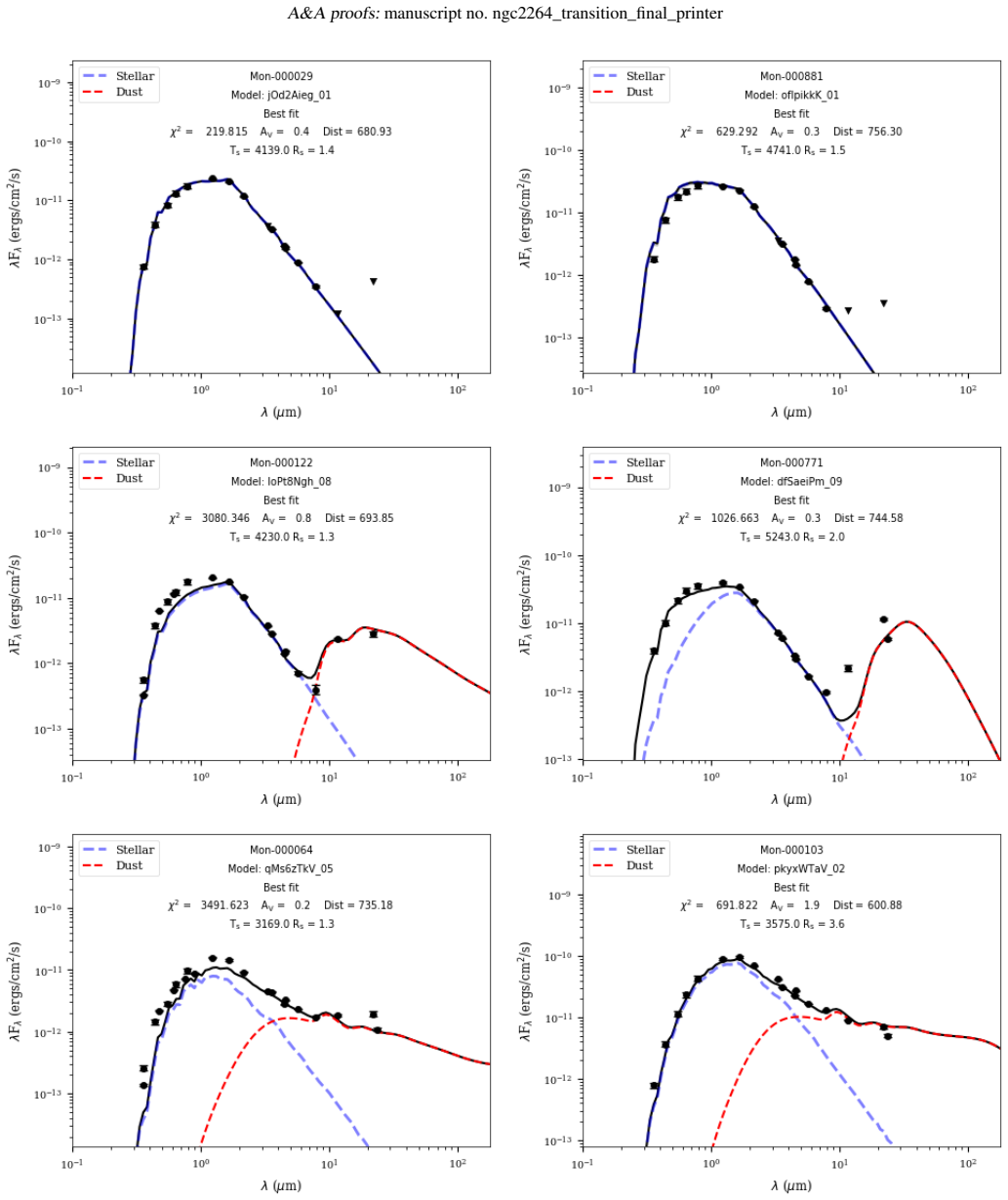
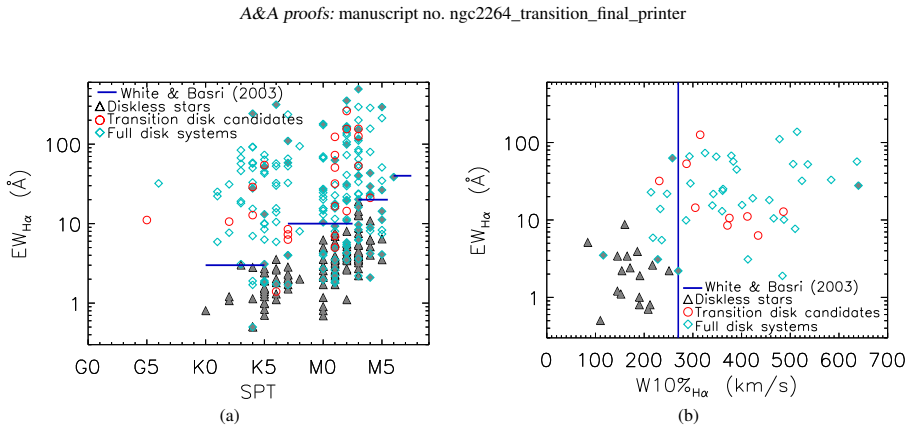
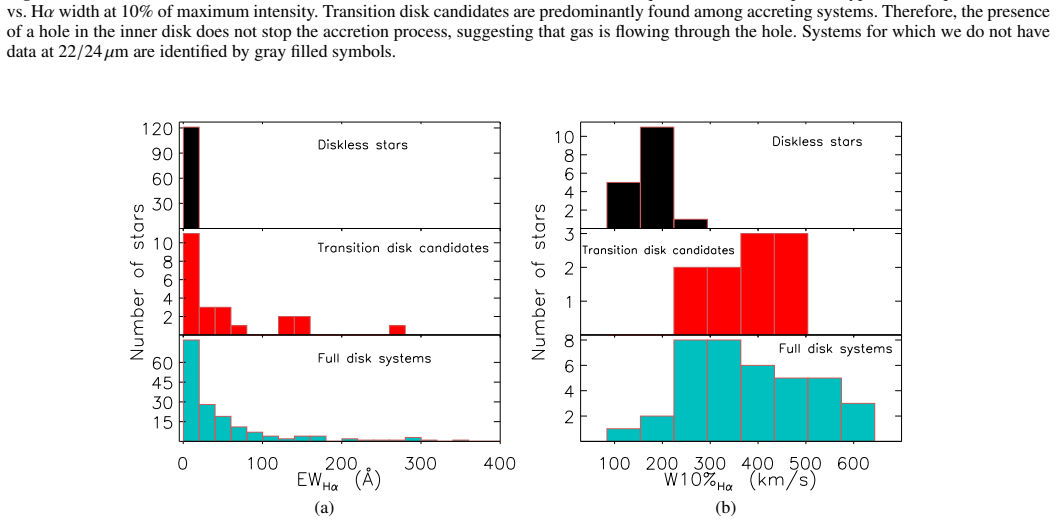
The central machinery is SED fitting with the Hyperion radiative-transfer model grid, comparing three model families: a star only, a star plus passive disk, and a star plus passive disk with an inner hole. A star is classified as a transition disk candidate when the best fit returns an inner disk radius R_in larger than the dust sublimation radius R_sub and when the 24 micron flux exceeds the 10 micron flux. Accretion is diagnosed by H-alpha equivalent width and width, UV excess, and derived mass accretion rates, and the inferred hole sizes are compared against a published X-ray photoevaporation criterion to test whether radiation could have opened the hole.
What would settle it
High-resolution millimeter imaging (for example with ALMA) of the 28 transition disk candidates: if most show continuous inner-disk dust or no central cavity, or if deep observations reveal holes among the stars without 22/24 micron detections, the SED-based classification and the 82% accreting fraction would be wrong. Mid-infrared spectroscopy of the 5.7-14 micron region could directly test whether inner dust is truly depleted in these systems.
Extended reading notes
Core claim
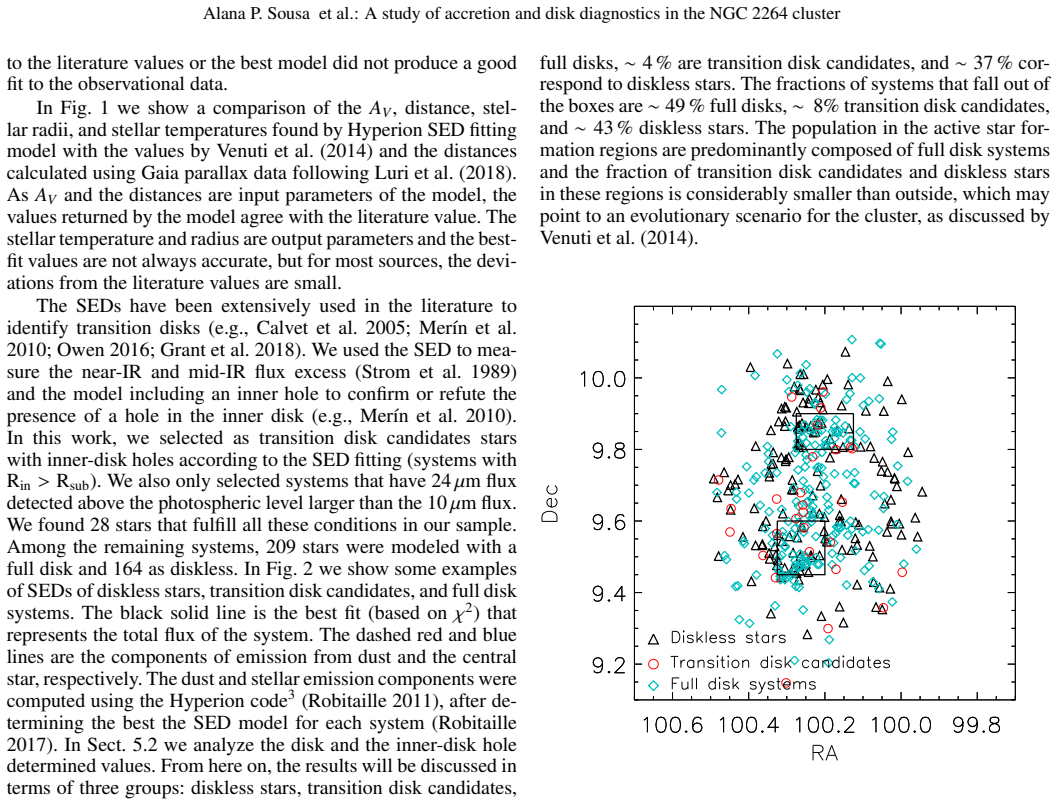
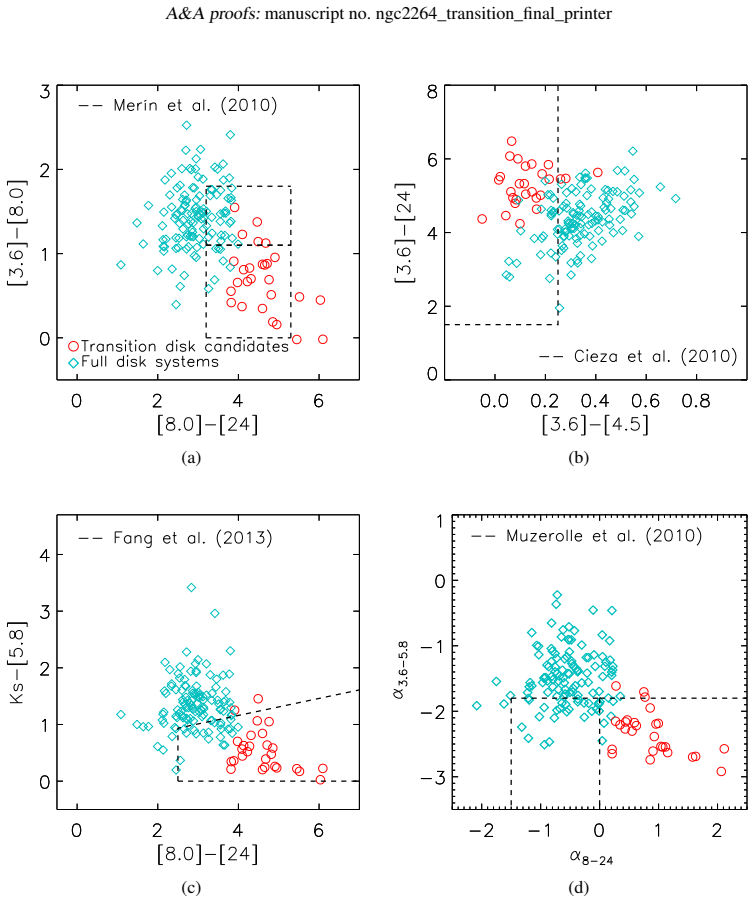
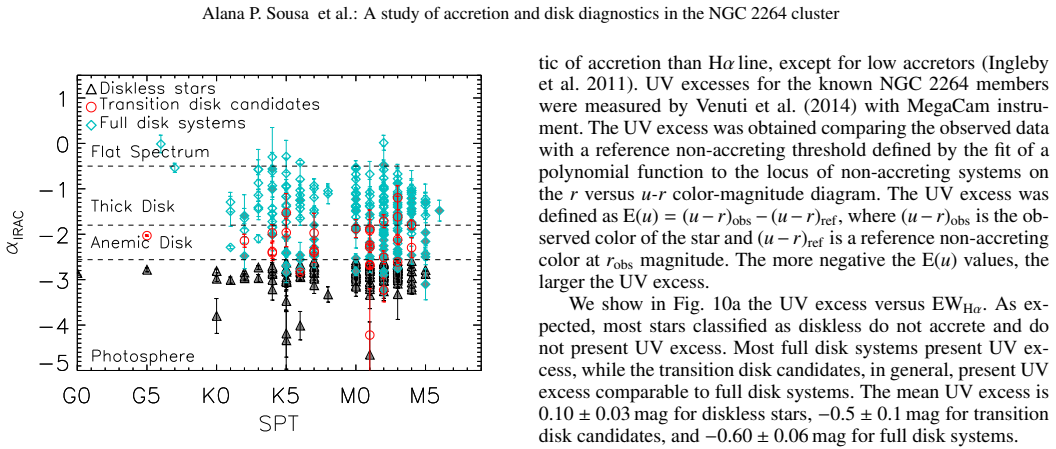
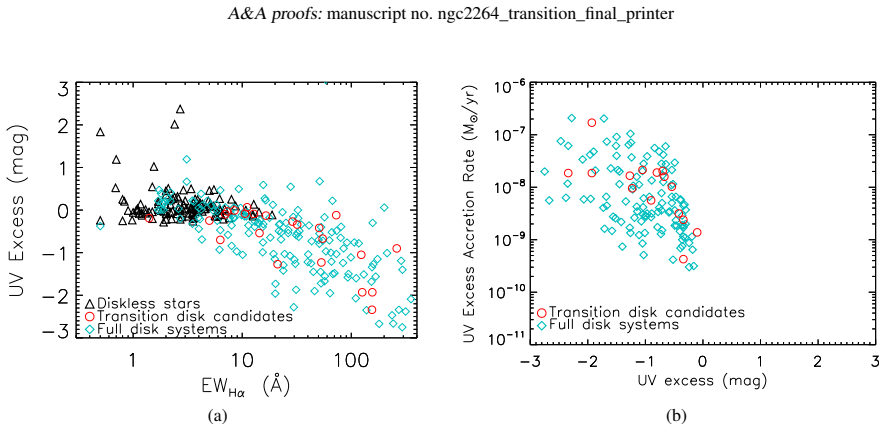
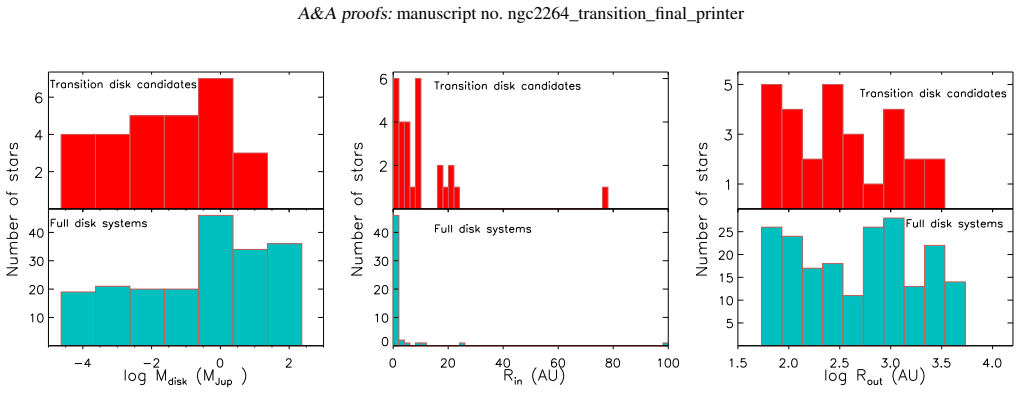
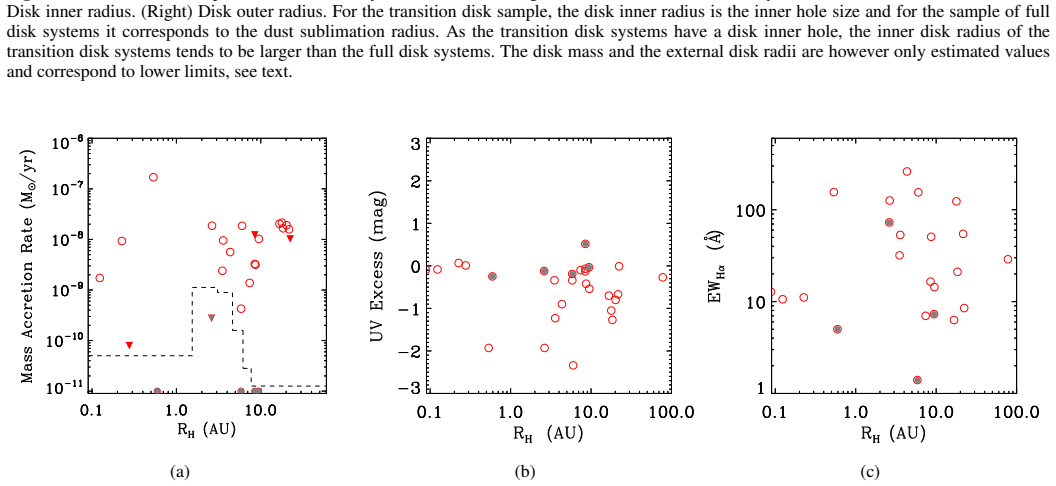
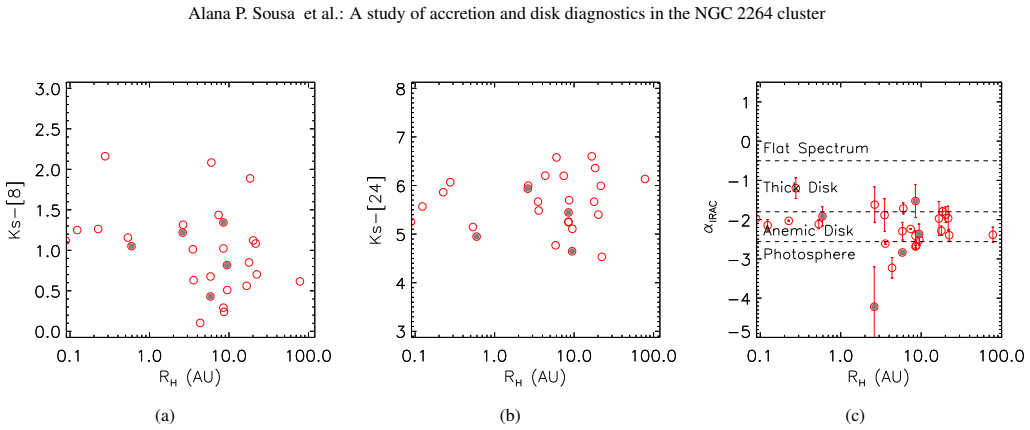
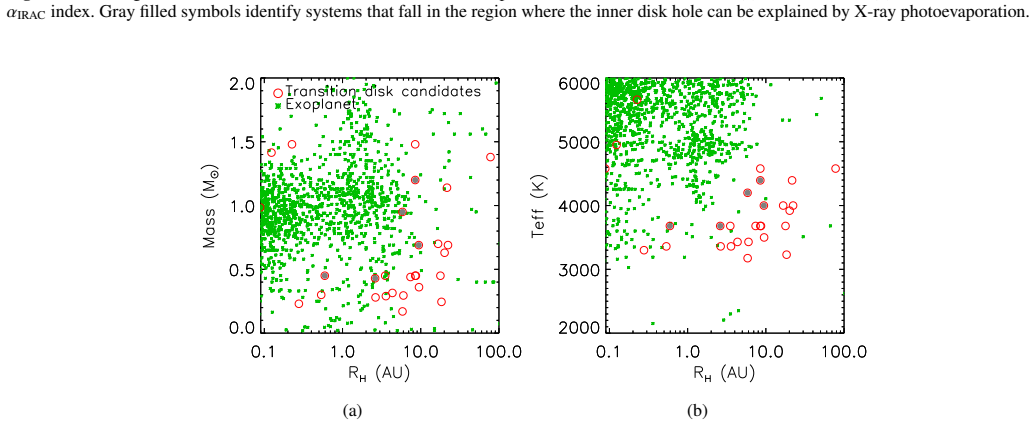
The paper's claim is that the presence of a dust hole in the inner disk does not stop the accretion process. From spectral energy distribution fits of 401 stars in NGC 2264, it identifies 28 transition disk candidates (7 previously unrecognized) and shows that about 82% of them accrete, displaying H-alpha emission, UV excess, and mass accretion rates at the same level as full disk systems. Hole sizes range from 0.09 to 78 AU, with a mean of 10.4 +/- 2.8 AU, and only about 18% of the candidates fall in the region where X-ray photoevaporation alone could have opened the hole; most holes require another mechanism, plausibly planet formation. The paper also reports that transition disk candidates have inner-disk dust similar to anemic disks, that they are found preferentially outside the most active star-forming regions, and that their hole sizes overlap the semimajor axes of confirmed exoplanets.
Load-bearing premise
Everything rests on the assumption that fitting passive-disk models to photometry from the U band to 24 microns correctly reveals which stars have inner dust holes and how large those holes are.
Editorial extensions
If this is right
- About 82% of NGC 2264 transition disk candidates accrete at full-disk levels, so a cleared dust hole does not imply a stopped accretion flow.
- Only about 18% of the holes are consistent with X-ray photoevaporation, so most holes need a different origin, such as a forming planet.
- Seven newly identified transition disk candidates expand the census of objects available for planet-formation follow-up.
- Hole sizes of 0.09 to 78 AU overlap the semimajor axes of confirmed exoplanets around similar-mass stars.
- Anemic disk systems, identified by their intermediate infrared slope, are viable transition disk candidates, linking two previously separate disk classifications.
Reading between the lines
- If the 82% accreting fraction survives better data, gas must be flowing through the dust hole; a direct test would be detecting accreting gas or ro-vibrational CO emission inside the cavity for at least a few candidates.
- The paper's own caveat that 47 anemic disks lack 22/24 micron data implies the true transition disk fraction in NGC 2264 could be higher than 7%.
- Because the SED model includes only passive disks, inferred hole sizes may be underestimated; accretion-heated models or longer-wavelength data could shift the 18% photoevaporation fraction.
- A prediction of the planet-opening scenario is that accreting transition disks with large holes should show gap or cavity substructure in millimeter observations, which ALMA can directly test.
Signed reviews
Editorial analysis
A structured set of objections, weighed in public.
Referee Report
Summary. The paper analyzes 401 T Tauri stars in NGC 2264 using SED fitting with the Hyperion code, classifying each system as a full disk, diskless, or transition disk candidate based on the best-fit model and the inner disk radius. The authors identify 28 transition disk candidates (seven new), estimate inner hole sizes from 0.09 to 78 AU, and find that 82% of the candidates accrete, showing Hα, UV excess, and mass accretion rates similar to full disk systems. They conclude that a dust hole in the inner disk does not stop accretion and that only ~18% of the holes can be explained by X-ray photoevaporation, with the remainder attributed to planet formation.
Significance. If the SED-based identification of dust holes is reliable, the paper provides a valuable cluster sample showing that inner dust clearing does not halt accretion, and the seven new candidates are useful targets for follow-up. A clear strength is that the accretion diagnostics (Hα, UV excess, mass accretion rates) are measured independently of the SED fitting, so the main accretion result is not circular. The paper also carefully compares its selection with several literature criteria. However, the central conclusion is weakened by the lack of an optically thin inner-disk model in the SED grid, by the absence of uncertainties on the fitted hole sizes, and by an unsupported attribution of the non-photoevaporating systems to planet formation. The paper is therefore of moderate significance, more as a catalog and a cautionary empirical result than as a definitive test of disk-clearing mechanisms.
major comments (3)
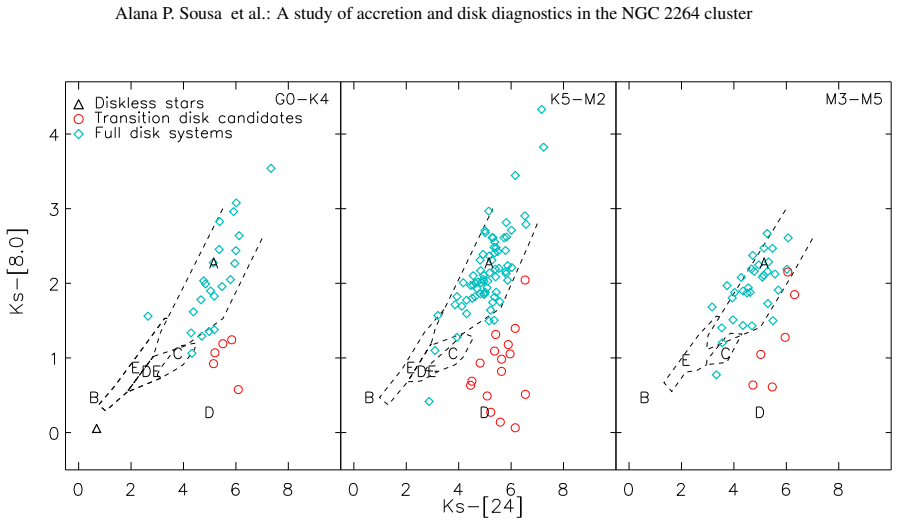
- [§3.1, §5.2] The SED grid used for classification includes only three geometries: a photosphere, a passive disk with Rin = Rsub, and a passive disk with a sharp inner hole (Rin > Rsub). The best-fit Rin in model 3 defines both the transition disk candidacy and the hole size, but the grid does not include an optically thin (anemic) inner disk. Table 1 shows that 17 of the 28 candidates have alpha_IRAC in the anemic range (-2.56 to -1.80), and the paper itself states that the candidates 'present dust in the inner disk similar to anemic disks.' An anemic inner disk with reduced surface density can produce a near-IR deficit without a truly empty cavity, so the fitted Rin > Rsub may simply parameterize a depleted inner region rather than a physical hole. Since the central claim that a dust hole does not stop accretion requires that the candidates actually have holes, the authors should test an alternative model with an optically thin inner disk or explicitly restate the conclusion in terms of inner-disk dust depletion.
- [§5.2, Table 4] The hole sizes and the photoevaporation versus non-photoevaporation split rest on best-fit Rin values with no reported uncertainties. The quoted mean of 10.4 ± 2.8 AU is the standard error of the sample mean, not an uncertainty on individual fits. Without confidence intervals on Rin, for example from the Δχ2 criterion used in Appendix A, the placement of each system in Fig. 14a and the resulting 18%/82% statement are not robust. Please provide per-object uncertainties or demonstrate that the classification into the two regimes is insensitive to reasonable variations in Rin within the fitted range.
- [§5.2, §6] The inference that the ~82% of transition disk candidates not explained by X-ray photoevaporation 'could be explained by planet formation in different evolutionary stages' is not supported by the analysis. The paper only shows that these systems lie outside the photoevaporation region of Fig. 14a; it does not test a planet-formation model or exclude other clearing mechanisms such as dead zones, MHD winds, or dust evolution. The comparison with exoplanet orbital separations in Fig. 16 is suggestive but not a quantitative test. This claim should be toned down or explicitly presented as a hypothesis rather than a conclusion.
minor comments (5)
- [§3.1] The paper states that the sample is not complete and that disk frequencies are unreliable, but the abstract still quotes 52%, 41%, and 7% without qualification. Please add a caveat near these numbers in the abstract.
- [Table 4] Mon-000824 and Mon-000879 have identical best-fit parameters for T*, R*, disk mass, RH, Rin, Rsub, and Rmax; this may be a transcription error and should be checked.
- [Appendix A] The caption of Fig. A.1 says 'all the model with (χ2 − χ2best) > 3ndata' but the standard criterion for acceptable fits is Δχ2 < 3ndata; the inequality appears to be reversed.
- [References] Several references lack page numbers or have incomplete bibliographic data (e.g., Konigl 1989, Shu et al. 1994, Safier 1993); please complete these entries.
- [§4.2] The sentence 'As a star moves from a full disk to a diskless system, it moves in different ways in the IR color-color diagrams in Fig. 4' could be clarified by specifying whether the movement is with time or across the evolutionary sequence.
Circularity Check
No significant circularity: the 82% accretion result uses independent Hα/UV diagnostics, not the SED fit that defines the transition-disk sample.
full rationale
The central quantitative claim—that 82% of transition disk candidates accrete and show Hα, UV excess, and mass accretion rates at the same level as full disk systems—is not forced by the SED modeling used to define the sample. The transition-disk classification is based on the Hyperion/Robitaille passive-disk grid returning an inner radius R_in > R_sub (Section 3.1), but the accretion diagnostics (EW Hα, W10%Hα, UV excess, Ṁ) come from independent FLAMES spectroscopy (Sousa et al. 2016; Dahm & Simon 2005), MegaCam photometry (Venuti et al. 2014), and the CTTS/WTTS thresholds of White & Basri (2003). No equation in the paper redefines these diagnostics in terms of R_in, so the 82% is an empirical count rather than a construction. The fitted parameter R_in is reported as an 'estimated' hole size (Section 5.2, Table 4), not relabeled as a prediction; the hole-size versus photoevaporation comparison is an interpretation of the fitted output against external models (Owen et al. 2011, 2017), not a circular derivation. Self-citations to Teixeira et al. (2012) for αIRAC and to Sousa et al. (2016) for Hα provide observational catalog/spectroscopic data with stated external methods; they are not unverified theoretical uniqueness claims and do not make the argument circular. The paper itself flags the anemic-disk ambiguity (Section 4.2 and 5.2), which is a model-degeneracy/correctness risk—the grid has no optically thin inner-disk state—but the accretion measurement is independent of that model choice. No circular step rises to the standard of Eq. X = Eq. Y by construction or fitted parameter renamed as prediction.
Assumptions & free parameters
free parameters (1)
- Inner disk radius R_in (per star) =
1.4 to 696.8 Rsub; hole sizes 0.09 to 78 AU (Table 4)
assumptions (4)
- domain assumption The Hyperion model grid (model sets v1.1) contains adequate SED models so the best fit identifies the correct disk geometry (full disk, transition disk, or diskless).
- domain assumption The inner hole size equals the fitted inner disk radius R_in, with dust sublimation radius computed from the Whitney et al. (2004) relation with Tsub = 1600 K.
- domain assumption A passive disk model without accretion heating is sufficient; possible systematics toward smaller holes are acknowledged but not corrected.
- domain assumption The Owen et al. (2011, 2017) X-ray photoevaporation region in the accretion rate vs hole size plane applies to NGC 2264.
Cite this review
Pith. "Pith review of A study of accretion and disk diagnostics in the NGC 2264 cluster." pith.science (2026). https://pith.science/paper/S3YEDHKI
@misc{pith2026190803487,
  author       = {Pith},
  title        = {Pith review of: A study of accretion and disk diagnostics in the NGC 2264 cluster},
  year         = {2026},
  howpublished = {\url{https://pith.science/paper/S3YEDHKI}},
  note         = {Machine review of arXiv:1908.03487}
}
abstract
Understanding disk dissipation is essential for studying how planets form. Disk gaps and holes, which almost correspond to dust-free regions, are inferred from infrared observations of T Tauri stars (TTS), indicating the existence of a transitional phase between thick accreting disks and debris disks. Transition disks are usually referred to as candidates for newly formed planets. We searched for transition disk candidates belonging to NGC 2264. We characterized accretion, disk, and stellar properties of transition disk candidates and compared them to systems with a full disk and diskless stars We modeled the spectral energy distribution (SED) of a sample of 401 TTS, with Hyperion SED fitting code using photometric data from the U band to the MIPS band. We used the SED modeling to distinguish transition disk candidates, full disk systems, and diskless stars. We classified $52\%$ of the sample as full disk systems, $41\%$ as diskless stars, and $7\%$ of the systems as transition disk candidates, among which seven systems are new transition disk candidates belonging to the NGC 2264 cluster. The sample of transition disk candidates present dust in the inner disk similar to anemic disks, according to the $\alpha_{IRAC}$ classification, which shows that anemic disk systems can be candidate transition disks. We show that the presence of a dust hole in the inner disk does not stop the accretion process since $82\%$ of transition disk candidates accrete and show $H\alpha$, UV excess, and mass accretion rates at the same level as full disk systems. We estimate the inner hole sizes, ranging from 0.1 to $78AU$, for the sample of transition disk candidates. In only $18\%$ of the transition disk candidates, the hole size could be explained by X-ray photoevaporation from stellar radiation.
Figures
Figures from the paper (13 more)

Reference graph
Works this paper leans on
-
[1]
, " * write output.state after.block = add.period write newline
ENTRY address author booktitle chapter edition editor howpublished institution journal key month note number organization pages publisher school series title type volume year label extra.label sort.label short.list INTEGERS output.state before.all mid.sentence after.sentence after.block FUNCTION init.state.consts #0 'before.all := #1 'mid.sentence := #2 '...
-
[2]
write newline
" write newline "" before.all 'output.state := FUNCTION n.dashify 't := "" t empty not t #1 #1 substring "-" = t #1 #2 substring "--" = not "--" * t #2 global.max substring 't := t #1 #1 substring "-" = "-" * t #2 global.max substring 't := while if t #1 #1 substring * t #2 global.max substring 't := if while FUNCTION word.in bbl.in " " * FUNCTION format....
-
[3]
C., Hollenbach , D., Laughlin , G., & Gorti , U
Adams , F. C., Hollenbach , D., Laughlin , G., & Gorti , U. 2004, ApJ, 611, 360
2004
-
[4]
2013, MNRAS, 430, 1433
Affer , L., Micela , G., Favata , F., Flaccomio , E., & Bouvier , J. 2013, MNRAS, 430, 1433
2013
-
[5]
Alencar , S. H. P., Teixeira , P. S., Guimar \ a es , M. M., et al. 2010, A&A, 519, A88
2010
-
[6]
2014, Protostars and Planets VI, 475
Alexander , R., Pascucci , I., Andrews , S., Armitage , P., & Cieza , L. 2014, Protostars and Planets VI, 475
2014
-
[7]
M., Huang , J., P \'e rez , L
Andrews , S. M., Huang , J., P \'e rez , L. M., et al. 2018, ApJL, 869, L41
2018
-
[8]
M., Wilner , D
Andrews , S. M., Wilner , D. J., Espaillat , C., et al. 2011, ApJ, 732, 42
2011
Show all 98 references
-
[9]
M., Wilner , D
Andrews , S. M., Wilner , D. J., Zhu , Z., et al. 2016, ApJL, 820, L40
2016
-
[10]
P., van der Marel , N., et al
Ansdell , M., Williams , J. P., van der Marel , N., et al. 2016, ApJ, 828, 46
2016
-
[11]
L., & Matthews , J
Bouvier , J., Cabrit , S., Fernandez , M., Martin , E. L., & Matthews , J. M. 1993, A&A, 272, 176
1993
-
[12]
2015, A&A, 578, A23
Bustamante , I., Mer \' n , B., Ribas , \'A ., et al. 2015, A&A, 578, A23
2015
-
[13]
2002, ApJ, 568, 1008
Calvet , N., D'Alessio , P., Hartmann , L., et al. 2002, ApJ, 568, 1008
2002
-
[14]
M., et al
Calvet , N., D'Alessio , P., Watson , D. M., et al. 2005, ApJL, 630, L185
2005
-
[15]
& Gullbring , E
Calvet , N. & Gullbring , E. 1998, ApJ, 509, 802
1998
-
[16]
L., Stapelfeldt , K
Cieza , L., Padgett , D. L., Stapelfeldt , K. R., et al. 2007, APJ, 667, 308
2007
-
[17]
A., Schreiber , M
Cieza , L. A., Schreiber , M. R., Romero , G. A., et al. 2010, ApJ, 712, 925
2010
-
[18]
J., Gendrin , A., & Sotomayor , M
Clarke , C. J., Gendrin , A., & Sotomayor , M. 2001, MNRAS, 328, 485
2001
-
[19]
M., Stauffer , J., Baglin , A., et al
Cody , A. M., Stauffer , J., Baglin , A., et al. 2014, AJ, 147, 82
2014
-
[20]
M., Stauffer , J
Cody , A. M., Stauffer , J. R., Micela , G., Baglin , A., & CSI 2264 Team . 2013, Astronomische Nachrichten, 334, 63
2013
-
[21]
Dahm , S. E. & Simon , T. 2005, AJ, 129, 829
2005
-
[22]
Dullemond , C. P. & Dominik , C. 2005, A&A, 434, 971
2005
-
[23]
& Pascucci , I
Ercolano , B. & Pascucci , I. 2017, Royal Society Open Science, 4, 170114
2017
-
[24]
L., Muzerolle , J., & D'Alessio , P
Espaillat , C., Calvet , N., Luhman , K. L., Muzerolle , J., & D'Alessio , P. 2008, ApJL, 682, L125
2008
-
[25]
2012, ApJ, 747, 103
Espaillat , C., Ingleby , L., Hern \'a ndez , J., et al. 2012, ApJ, 747, 103
2012
-
[26]
2014, Protostars and Planets VI, 497
Espaillat , C., Muzerolle , J., Najita , J., et al. 2014, Protostars and Planets VI, 497
2014
-
[27]
S., van Boekel , R., et al
Fang , M., Kim , J. S., van Boekel , R., et al. 2013, , 207, 5
2013
-
[28]
2009, A&A, 504, 461
Fang , M., van Boekel , R., Wang , W., et al. 2009, A&A, 504, 461
2009
-
[29]
G., Hora , J
Fazio , G. G., Hora , J. L., Allen , L. E., et al. 2004, ApJS, 154, 10
2004
-
[30]
Fitzpatrick , E. L. 1999, PASP, 111, 63
1999
-
[31]
2006, A&A, 455, 903
Flaccomio , E., Micela , G., & Sciortino , S. 2006, A&A, 455, 903
2006
-
[32]
Fonseca , N. N. J., Alencar , S. H. P., Bouvier , J., Favata , F., & Flaccomio , E. 2014, A&A, 567, A39
2014
-
[33]
Gaia Collaboration , Brown , A. G. A., Vallenari , A., et al. 2018, A&A, 616, A1
2018
-
[34]
Gaia Collaboration , Prusti , T., de Bruijne , J. H. J., et al. 2016, A&A, 595, A1
2016
-
[35]
2013, ApJ, 764, 146
Garaud , P., Meru , F., Galvagni , M., & Olczak , C. 2013, ApJ, 764, 146
2013
-
[36]
L., Espaillat , C
Grant , S. L., Espaillat , C. C., Megeath , S. T., et al. 2018, ApJ, 863, 13
2018
-
[37]
E., Carr , M., Rockosi , C., et al
Gunn , J. E., Carr , M., Rockosi , C., et al. 1998, AJ, 116, 3040
1998
-
[38]
E., Lada , E
Haisch , Jr., K. E., Lada , E. A., & Lada , C. J. 2001, ApJL, 553, L153
2001
-
[39]
1998, , 495, 385
Hartmann , L., Calvet , N., Gullbring , E., & D'Alessio , P. 1998, , 495, 385
1998
-
[40]
2007, , 671, 1784
Hern \'a ndez , J., Calvet , N., Brice \ n o , C., et al. 2007, , 671, 1784
2007
-
[41]
2005, ApJ, 631, 1180
Hollenbach , D., Gorti , U., Meyer , M., et al. 2005, ApJ, 631, 1180
2005
-
[42]
M., Andrews , S
Hughes , A. M., Andrews , S. M., Espaillat , C., et al. 2009, ApJ, 698, 131
2009
-
[43]
S., Babler , B
Indebetouw , R., Mathis , J. S., Babler , B. L., et al. 2005, ApJ, 619, 931
2005
-
[44]
2011, APJ, 743, 105
Ingleby , L., Calvet , N., Bergin , E., et al. 2011, APJ, 743, 105
2011
-
[45]
& Bouvier , J
Irwin , J. & Bouvier , J. 2009, in IAU Symposium, Vol. 258, IAU Symposium, ed. E. E. Mamajek , D. R. Soderblom , & R. F. G. Wyse , 363--374
2009
-
[46]
H., Watson , D
Kim , K. H., Watson , D. M., Manoj , P., et al. 2013, ApJ, 769, 149
2013
-
[47]
H., Watson , D
Kim , K. H., Watson , D. M., Manoj , P., et al. 2009, ApJ, 700, 1017
2009
-
[48]
M., Ercolano , B., Dale , J., et al
Koepferl , C. M., Ercolano , B., Dale , J., et al. 2013, MNRAS, 428, 3327
2013
-
[49]
1989, ApJ, 342
Konigl, A. 1989, ApJ, 342
1989
-
[50]
1987, in Star Forming Regions, Vol
Lada, C. 1987, in Star Forming Regions, Vol. 115, 1--17
1987
-
[51]
J., Muench , A
Lada , C. J., Muench , A. A., Luhman , K. L., et al. 2006, ApJ, 131, 1574
2006
-
[52]
H., Bailer-Jones , C
Lamm , M. H., Bailer-Jones , C. A. L., Mundt , R., Herbst , W., & Scholz , A. 2004, A&A, 417, 557
2004
-
[53]
H., Mundt , R., Bailer-Jones , C
Lamm , M. H., Mundt , R., Bailer-Jones , C. A. L., & Herbst , W. 2005, A&A, 430, 1005
2005
-
[54]
Luri , X., Brown , A. G. A., Sarro , L. M., et al. 2018, , 616, A9
2018
-
[55]
F., Testi , L., Natta , A., et al
Manara , C. F., Testi , L., Natta , A., et al. 2014, A&A, 568, A18
2014
-
[56]
F., Testi , L., Rigliaco , E., et al
Manara , C. F., Testi , L., Rigliaco , E., et al. 2013, A&A, 551, A107
2013
-
[57]
2007, A&A, 463, 1081
Marilli , E., Frasca , A., Covino , E., et al. 2007, A&A, 463, 1081
2007
-
[58]
T., Alencar , S
McGinnis , P. T., Alencar , S. H. P., Guimar \ a es , M. M., et al. 2015, A&A, 577, A11
2015
-
[59]
M., Oliveira , I., et al
Mer \' n , B., Brown , J. M., Oliveira , I., et al. 2010, ApJ, 718, 1200
2010
-
[60]
E., Megeath , S
Muzerolle , J., Allen , L. E., Megeath , S. T., Hern \'a ndez , J., & Gutermuth , R. A. 2010, ApJ, 708, 1107
2010
-
[61]
R., Strom , S
Najita , J. R., Strom , S. E., & Muzerolle , J. 2007, MNRAS, 378, 369
2007
-
[62]
W., Spaans , M., & Tielens , A
Ormel , C. W., Spaans , M., & Tielens , A. G. G. M. 2007, A&A, 461, 215
2007
-
[63]
Owen , J. E. 2016, PASA, 33, e005
2016
-
[64]
E., Ercolano , B., & Clarke , C
Owen , J. E., Ercolano , B., & Clarke , C. J. 2011, MNRAS, 412, 13
2011
-
[65]
E., Ercolano , B., & Clarke , C
Owen , J. E., Ercolano , B., & Clarke , C. J. 2017, MNRAS, 472, 2955
2017
-
[66]
& Terquem, C
Papaloizou, J. & Terquem, C. 1999, ApJ, 521, 823
1999
-
[67]
& Pudritz, R
Pelletier, G. & Pudritz, R. 1992, ApJ, 394, 117
1992
-
[68]
A., Pipher , J
Rapson , V. A., Pipher , J. L., Gutermuth , R. A., et al. 2014, ApJ, 794, 124
2014
-
[69]
Rebull , L. M. 2001, AJ, 121, 1676
2001
-
[70]
M., Makidon , R
Rebull , L. M., Makidon , R. B., Strom , S. E., et al. 2002, AJ, 123, 1528
2002
-
[71]
M., Stauffer , J
Rebull , L. M., Stauffer , J. R., Cody , A. M., et al. 2018, AJ, 155, 196
2018
-
[72]
2013, A&A, 552, A115
Ribas , \'A ., Mer \' n , B., Bouy , H., et al. 2013, A&A, 552, A115
2013
-
[73]
Ribas , \'A ., Mer \' n , B., Bouy , H., & Maud , L. T. 2014, A&A, 561, A54
2014
-
[74]
H., Young , E
Rieke , G. H., Young , E. T., Engelbracht , C. W., et al. 2004, ApJS, 154, 25
2004
-
[75]
Robitaille , T. P. 2011, A&A, 536, A79
2011
-
[76]
Robitaille , T. P. 2017, A&A, 600, A11
2017
-
[77]
P., Whitney , B
Robitaille , T. P., Whitney , B. A., Indebetouw , R., & Wood , K. 2007, ApJS, 169, 328
2007
-
[78]
Roquette , J., Bouvier , J., Alencar , S. H. P., Vaz , L. P. R., & Guarcello , M. G. 2017, A&A, 603, A106
2017
-
[79]
P., Ercolano , B., Owen , J
Rosotti , G. P., Ercolano , B., Owen , J. E., & Armitage , P. J. 2013, MNRAS, 430, 1392
2013
-
[80]
1993, ApJ, 408, 115
Safier, P. 1993, ApJ, 408, 115
1993
-
[81]
& Clarke , C
Scally , A. & Clarke , C. 2001, MNARS, 325, 449
2001
-
[82]
1994, ApJ, 429
Shu, F., Najita, J., Ostriker, E., et al. 1994, ApJ, 429
1994
-
[83]
P., Alencar , S
Sousa , A. P., Alencar , S. H. P., Bouvier , J., et al. 2016, A&A, 586, A47
2016
-
[84]
M., Baglin , A., et al
Stauffer , J., Cody , A. M., Baglin , A., et al. 2014, AJ, 147, 83
2014
-
[85]
M., Strom , S
Strom , K. M., Strom , S. E., Edwards , S., Cabrit , S., & Skrutskie , M. F. 1989, AJ, 97, 1451
1989
-
[86]
R., & Bessell , M
Sung , H., Stauffer , J. R., & Bessell , M. S. 2009, AJ, 138, 1116
2009
-
[87]
S., Lada , C
Teixeira , P. S., Lada , C. J., Marengo , M., & Lada , E. A. 2012, A&A, 540, A83
2012
-
[88]
W., van Terwisga , S., et al
van der Marel , N., Verhaar , B. W., van Terwisga , S., et al. 2016, A&A, 592, A126
2016
-
[89]
Vasconcelos , M. J. & Bouvier , J. 2015, A&A, 578, A89
2015
-
[90]
M., et al
Venuti , L., Bouvier , J., Cody , A. M., et al. 2017, A&A, 599, A23
2017
-
[91]
2014, A&A, 570, A82
Venuti , L., Bouvier , J., Flaccomio , E., et al. 2014, A&A, 570, A82
2014
-
[92]
2015, A&A, 581, A66
Venuti , L., Bouvier , J., Irwin , J., et al. 2015, A&A, 581, A66
2015
-
[93]
Walker , M. F. 1956, APJS, 2, 365
1956
-
[94]
W., Roellig , T
Werner , M. W., Roellig , T. L., Low , F. J., et al. 2004, APJS, 154, 1
2004
-
[95]
White , R. J. & Basri , G. 2003, ApJ, 582, 1109
2003
-
[96]
A., Indebetouw , R., Bjorkman , J
Whitney , B. A., Indebetouw , R., Bjorkman , J. E., & Wood , K. 2004, ApJ, 617, 1177
2004
-
[97]
L., Eisenhardt , P
Wright , E. L., Eisenhardt , P. R. M., Mainzer , A. K., et al. 2010, AJ, 140, 1868
2010
-
[98]
P., Hartmann , L., Espaillat , C., & Calvet , N
Zhu , Z., Nelson , R. P., Hartmann , L., Espaillat , C., & Calvet , N. 2011, ApJ, 729, 47
2011
Reviewed August 14, 2026 · model on record in the stance chip above.
Discussion (0). Continue with ORCID to comment.