REVIEW 1 major objections 5 minor 33 references
EXPSPACE-Completeness of the Logics K4xS5 and S4xS5 and the Logic of Subset Spaces, Part 2: EXPSPACE-Hardness
T0 review · 1 major / 5 minor · reviewed 2026-08-14 · deepseek-v4-flash
Pith's one-line read The logics K4×S5, S4×S5, and SSL are EXPSPACE-hard under logspace reduction.
desk verdict Genuinely new EXPSPACE lower bounds for three modal logics, with a careful ATM simulation; the only real gap is an omitted standard lemma that the logspace reductions depend on. read the letter →
The pith
A machine-rendered reading of the paper's core claim, the machinery that carries it, and where it could break.
The reading
What carries the argument
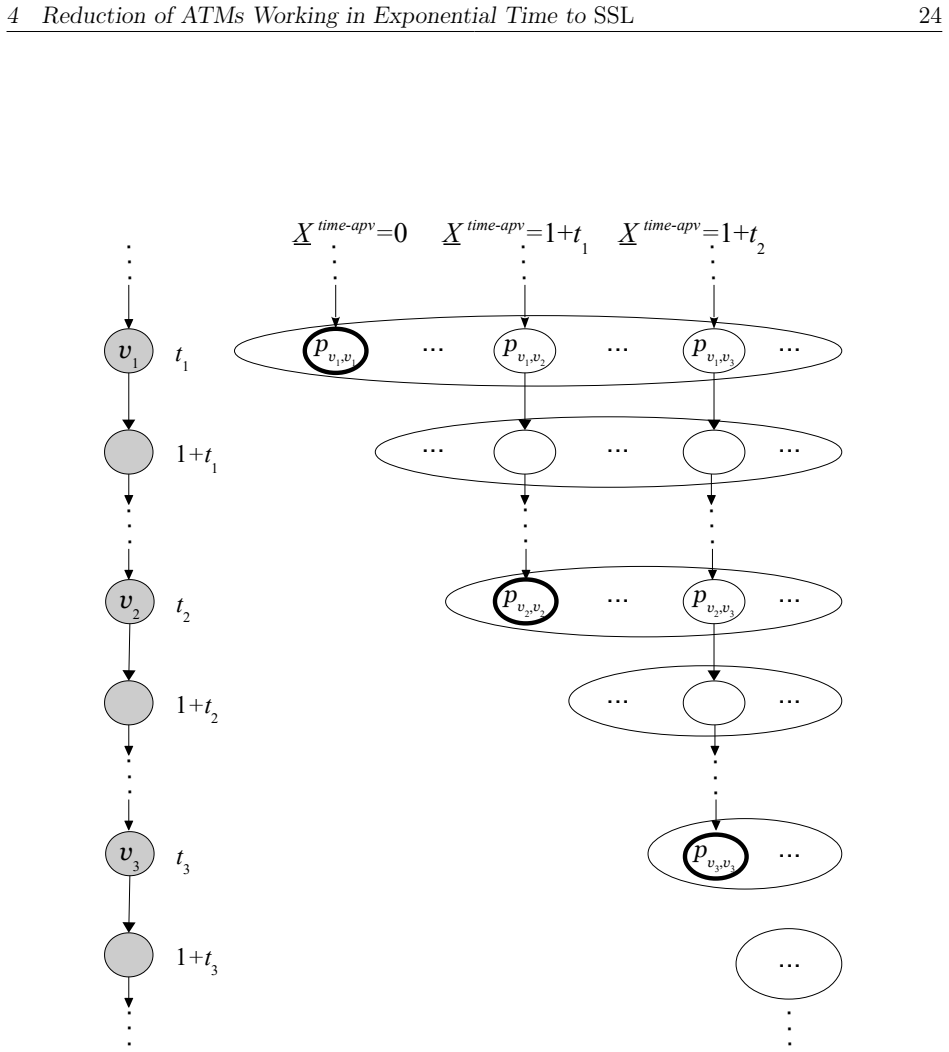
The load-bearing device is the shared variable: in SSL it is the formula $\alpha_i := \mathsf{L}(A_i \land \Box_L B)$, and in S4×S5 it is the simpler $\alpha_i := \mathsf{L}\,A_i$. A shared variable is constant along $\mathsf{L}$-equivalence classes (the clouds) but can change along the vertical $\lozenge$-direction, while ordinary propositional variables have the opposite persistence; this lets the encoding copy and update bit vectors for time, tape-head position, state, and written symbol. These vectors feed binary-counter formulas that force a staircase of points $p_i \xrightarrow{\mathsf{L}} p'_i \xrightarrow{\lozenge} p_{i+1}$, so any model of the reduction contains an accepting tree of the alternating Turing machine realized as clouds. The later translations between logics work by adding a fresh variable $\mathit{main}$ whose false points act as universal successors, and by forcing reflexivity instances for the modal subformulas involved.
What would settle it
Test the omitted lemma directly: for families of bimodal formulas with deeply nested $\mathsf{K}$ and $\Box$ prefixes, try to decide well-formedness using only logarithmic working space; any concrete family that provably exceeds logarithmic space would falsify the lemma and break the logspace strength of all three reductions.
Extended reading notes
Core claim
The central claim is Theorem 1.1: the satisfiability problems of K4×S5, S4×S5, and SSL are each EXPSPACE-hard under logspace reduction. Starting from EXPSPACE = AEXPTIME, the paper fixes an alternating Turing machine M running in time $2^{p(n)}$ and builds, for input w, a bimodal formula $f_{SSL}(w)$ that is satisfiable in a cross-axiom model exactly when M has an accepting tree on w. In such a model, $\mathsf{L}$-equivalence classes (clouds) stand for computation-tree nodes; shared variables carry time, head position, state, and read and written symbols; and the cross property lets a later cloud retrieve the symbol written at an earlier visit to the same tape cell. The formula has polynomial size and is generated in logarithmic space, and both directions of the satisfiability equivalence are verified. The paper then gives a logspace translation of SSL formulas into S4×S5 formulas and of S4×S5 formulas into K4×S5 formulas, so the lower bound transfers. With the companion upper bound, Theorem 1.2 follows: all three logics are EXPSPACE-complete under logspace reduction.
Load-bearing premise
The load-bearing premise is that checking whether a string is a well-formed bimodal formula can be done in logarithmic space; the paper states this as Lemma 5.6, explicitly says the proof is omitted, and every logspace claim in the reduction chain depends on that fact.
Editorial extensions
If this is right
- The three satisfiability problems are EXPSPACE-complete, not merely NEXPTIME-hard or PSPACE-hard as previously known.
- Any solver for SSL, S4×S5, or K4×S5 must face instances that require exponentially much space on infinitely many inputs, unless EXPSPACE collapses to a smaller class.
- The logspace chain SSL ≤ S4×S5 ≤ K4×S5 transfers lower bounds uniformly, so future lower-bound proofs for any one of these logics immediately apply to the others.
- The direct reduction in the appendix shows that exponential-time alternating Turing machine computations can be encoded straight into S4×S5, without passing through subset-space semantics.
- The previously open conjecture reported in the introduction—that K4×S5 and S4×S5 are EXPSPACE-complete—is confirmed by the paper together with its companion.
Reading between the lines
- Editorial inference: the shared-variable construction is a reusable encoding trick for any bimodal logic with an equivalence relation in one dimension, a preorder in the other, and a cross property: such logics can simulate alternating time-bounded computation directly.
- Editorial inference: the delicate subformula is the one that recovers the symbol written at the previous visit to a tape cell; streamlining that bookkeeping could adapt the reduction to prove lower bounds for fragments with fewer propositional variables or restricted modal depth.
- Editorial inference: because Lemma 5.6 is stated without proof, any reuse of these reductions should first supply the omitted ALOGTIME membership argument; a reader who wants only the satisfiability equivalence rather than the logspace strength can bypass that lemma.
Signed reviews
Editorial analysis
A structured set of objections, weighed in public.
Referee Report
Summary. This paper establishes EXPSPACE-hardness under logspace reductions for the satisfiability problems of three bimodal logics: K4×S5, S4×S5, and the logic SSL of subset spaces (Theorem 1.1). The proof proceeds in three stages. Section 4 gives the main construction: a logspace reduction from AEXPTIME (= EXPSPACE) to SSL satisfiability. The reduction encodes accepting trees of exponential-time alternating Turing machines by cross axiom models, using shared variables and binary counters (Section 3) to store time, tape head position, state, and read/written symbols, and to propagate the content of revisited cells via the cross property. Both directions are verified: from accepting trees one constructs a model (Section 4.3), and from any model one extracts an accepting tree by an extension argument on partial trees (Section 4.4, Lemma 4.2). Sections 5 and 6 then give logspace translations SSL→S4×S5 and S4×S5→K4×S5; their correctness is proved as Propositions 5.3 and 6.3, and their logspace computability relies on Corollary 5.7 (the language of bimodal formulas is in LOGSPACE), which rests on Lemma 5.6 (L ∈ ALOGTIME). An appendix provides an alternative direct logspace reduction from AEXPTIME to S4×S5. With the ESPACE upper bounds of the companion paper [8], the paper concludes EXPSPACE-completeness (Theorem 1.2).
Significance. The result is substantial and, if the logspace gap discussed below is closed, settles a conjecture of Marx reported in Kurucz et al. [13, Problem 6.67], improving the known NEXPTIME lower bounds for K4×S5 and S4×S5 and the PSPACE lower bound for SSL to the presumably optimal EXPSPACE bound matching the upper bounds of [8]. The paper's strengths include the original 'shared variable' mechanism for SSL, the explicit binary counters in cross axiom models, and the unusually detailed bidirectional verification of the ATM simulation: the model construction (Section 4.3) and the partial-tree extraction (Section 4.4) are spelled out with full case analyses, and the appendix's direct S4×S5 reduction provides an independent route to the same lower bound for S4×S5. The logspace computability of the Section 4 reduction is argued directly with counter bounds; the only load-bearing missing piece is the proof of Lemma 5.6.
major comments (1)
- [§5.3, Lemma 5.6 and Corollary 5.7; also used in §6] The logspace claim for two of the three reductions rests on an unproved lemma. Lemma 5.6 states that the language L of bimodal formulas is in ALOGTIME, and Corollary 5.7 concludes L ∈ LOGSPACE. The proof of Lemma 5.6 is explicitly omitted ('we omit the proof of Lemma 5.6'). This lemma is load-bearing in two places: the SSL→S4×S5 reduction (§5.3) first decides membership of the input string in L and then parses ϕ to locate subformulas, match parentheses, and count modal subformulas; the S4×S5→K4×S5 reduction (proof of Theorem 6.1) likewise invokes Corollary 5.7 before any parsing. If L were not decidable in logspace, Theorems 5.1 and 6.1 would only yield polynomial-time reductions, and Theorem 1.1 would be reduced to a polynomial-time hardness statement for S4×S5 and K4×S5. The lemma is standard (a Buss-style ALOGTIME argument should suffice), but as written the paper contains a load-bearing gap. Please supply a proof of Lemma 5.6 or replace Corollary 5.7 with a direct logspace parsing algorithm that also justifies the subformula-extraction steps.
minor comments (5)
- [§5.2/§5.3 (Definition 5.2)] Definition 5.2 chooses main as the alphabetically first propositional variable not occurring in sf(ϕ), while the algorithm in §5.3 searches for the numerically smallest index j with xbin(j)∉sf(ϕ); these two orders need not coincide, and although any fresh variable works semantically, the definition and the implementation should be reconciled.
- [Appendix A.1 (Proposition A.2)] In Proposition A.2(2), the statement 'p0|= counter SSL,n' should read 'p0|= counterS4×S5,n', since the proposition concerns S4×S5 models.
- [Abstract and §1] The paper uses both 'ESPACE' and 'EXPSPACE' for exponential space; please either standardize the notation or state explicitly on first use that the two names denote the same class.
- [§6 (Proposition 6.3)] In the backward direction of Proposition 6.3, the verification that the constructed model M is an S4×S5-commutator model and the K-case of the induction are both delegated to 'similar' arguments without stating the key observation that every L'-successor and every ♦'-successor of a point in W lies in W; stating this observation explicitly would make the proof easier to check.
- [§2] Several definitions used throughout the paper (cross axiom models, the induced cloud relation, the exact syntax of bimodal formulas) are deferred to the companion paper [8]; given that Theorem 1.2 is conditional on [8], it would improve self-containedness to restate the most load-bearing definitions.
Circularity Check
No significant circularity: the hardness proofs are self-contained reductions with one acknowledged non-circular proof gap.
full rationale
The paper's claimed derivations are self-contained against external computational-complexity benchmarks rather than against their own conclusions. The EXPSPACE-hardness proof for SSL in Section 4 works by reducing an arbitrary AEXPTIME language to SSL satisfiability, using the external fact AEXPTIME = EXPSPACE, and then gives a full model construction and a converse accepting-tree extraction argument; no step defines SSL satisfiability in terms of the constructed formula or fits parameters to the target data. The reductions in Sections 5 and 6 are logical translations whose satisfiability equivalences are proven directly in Lemmas 5.4, 5.5, and Proposition 6.3, without invoking the paper's own upper-bound result. The only load-bearing gap is Lemma 5.6, where the paper says 'we omit the proof of Lemma 5.6' and relies on that lemma for the logspace computability of the SSL-to-S4xS5 and S4xS5-to-K4xS5 reductions. That omitted proof is a genuine correctness concern, but it is not circularity: the lemma is presented as a standard ALOGTIME fact supported by Buss's external work, and the semantic equivalence of the reductions is established independently of it. The companion paper [8] by the same authors is cited for terminology and for the matching ESPACE upper bound, but the EXPSPACE-hardness derivations do not reduce to that citation. No fitted input is relabeled as a prediction, no uniqueness theorem from the authors is imported to force a choice, and no known result is merely renamed. The central claim therefore has independent mathematical content, and the circularity score is 0.
Assumptions & free parameters
assumptions (4)
- standard math AEXPTIME = EXPSPACE
- standard math One-tape alternating Turing machines simulate multi-tape ATMs with polynomial time overhead
- domain assumption Bimodal formulas can be recognized in logarithmic space (Lemma 5.6)
- domain assumption The semantics of SSL, K4×S5, and S4×S5 are as defined in the companion paper [8]
Cite this review
Pith. "Pith review of EXPSPACE-Completeness of the Logics K4xS5 and S4xS5 and the Logic of Subset Spaces, Part 2: EXPSPACE-Hardness." pith.science (2026). https://pith.science/paper/N5DUQHGA
@misc{pith2026190803509,
  author       = {Pith},
  title        = {Pith review of: EXPSPACE-Completeness of the Logics K4xS5 and S4xS5 and the Logic of Subset Spaces, Part 2: EXPSPACE-Hardness},
  year         = {2026},
  howpublished = {\url{https://pith.science/paper/N5DUQHGA}},
  note         = {Machine review of arXiv:1908.03509}
}
read the original abstract
It is known that the satisfiability problems of the product logics K4xS5 and S4xS5 are NEXPTIME-hard and that the satisfiability problem of the logic SSL of subset spaces is PSPACE-hard. We improve these lower bounds for the complexity of these problems by showing that all three problems are EXPSPACE-hard under logspace reduction. In another paper we show that these problems are in ESPACE. This shows that all three problems are EXPSPACE-complete.
Figures


Figures from the paper (4 more)


Reference graph
Works this paper leans on
-
[8]
P. Hertling and G. Krommes. EXPSPACE-completeness of the logics K4× S5 and S4× S5 and the logic of subset spaces, part 1:ESPACE-algorithms, 8 2019. Submitted for publication
work page 2019
-
[1]
S. R. Buss. The Boolean formula value problem is in ALOGTIME. In A. V. Aho, editor, Proceedings of the 19th Annual ACM Symposium on Theory of Computing, New York, pages 123–131. ACM, 1987
work page 1987
-
[2]
A. K. Chandra, D. C. Kozen, and L. J. Stockmeyer. Alternation.ACM, 28(1):114–133, Jan. 1981
work page 1981
-
[3]
A. K. Chandra and L. J. Stockmeyer. Alternation. In 17th Annual Symposium on Foundations of Computer Science, 1976, pages 98–108. IEEE, 1976
work page 1976
-
[4]
P. Clote. Computation models and function algebras. In Handbook of Computabil- ity Theory, volume 140 ofStud. Logic Found. Math., pages 589–681. North-Holland, Amsterdam, 1999
work page 1999
-
[5]
A. Dabrowski, L. S. Moss, and R. Parikh. Topological reasoning and the logic of knowl- edge. Ann. Pure Appl. Logic, 78:73–110, 1996
work page 1996
- [6]
- [7]
Show all 33 references
-
[9]
O. H. Ibarra, T. Jiang, and B. Ravikumar. Some subclasses of context-free languages in NC1. Information Processing Letters, 29(3):111–117, 1988
1988
-
[10]
D. Kozen. On parallelism in Turing machines. In17th Annual Symposium on Founda- tions of Computer Science, pages 89–97. IEEE, 1976
1976
-
[11]
G. Krommes. A new proof of decidability for the modal logic of subset spaces. InEighth ESSLLI Student Session, pages 137–148. Citeseer, 2003
2003
-
[12]
G. Krommes. Untersuchungen zur modalen Logik von Mengenräumen: Vollständigkeit, Entscheidbarkeit, Komplexität. Master’s thesis, FernUniversität Hagen, 2003
2003
-
[13]
Kurucz, F
A. Kurucz, F. Wolter, M. Zakharyaschev, and D. M. Gabbay.Many-Dimensional Modal Logics: Theory and Applications, Volume 148 (Studies in Logic and the Foundations of Mathematics). North Holland, 2003
2003
-
[14]
Lange and C
M. Lange and C. Lutz. 2-EXPTIME lower bounds for propositional dynamic logics with intersection. The Journal of Symbolic Logic, 70(4):1072–1086, 2005. References 49
2005
-
[15]
M. Marx. Complexity of products of modal logics.Journal of Logic and Computation, 9(2):197–214, 1999
1999
-
[16]
C. H. Papadimitriou. Computational Complexity. Amsterdam: Addison-Wesley Pub- lishing Company, 1994
1994
-
[17]
Parikh, L
R. Parikh, L. S. Moss, and C. Steinsvold. Topology and epistemic logic. InHandbook of Spatial Logics, pages 299–341. Springer, 2007
2007
-
[18]
shared variables
W. J. Paul, E. J. Prauß, and R. Reischuk. On alternation.Acta Informatica, 14(3):243– 255, 1980. A Reduction of ATMs Working in Exponential Time to S4× S5 50 A Reduction of Alternating Turing Machines Working in Exponential Time to S4× S5 In Section 4 we have shown that any la...
1980
-
[19]
First me make an L →-step from the point pi to a point p′ i where we store the number i + 1 in a vectorX := Xn−1,...,X 0 of usual propositional variables by demanding that p′ i|= (X =α,>k )∧ rightmost_one(X,k )
-
[20]
Note that the value ofX is copied fromp′ i to its ♦ →-successorpi+1 because by the formula persistent(X) we force the vectorX of propositional variables to be persistent
Then we make a ♦ →-step from the pointp′ i to a pointpi+1 in the cloudCi+1 and demand that pi+1|= (X =α). Note that the value ofX is copied fromp′ i to its ♦ →-successorpi+1 because by the formula persistent(X) we force the vectorX of propositional variables to be persistent. ...
-
[21]
For all n∈ N\{ 0}, for every S4× S5-commutator model of counterS4×S5,n and for every pointp0 in this model withp0|= counter SSL,n there exist a sequence of2n− 1 pointsp1,p 2,...,p 2n−1 and a sequence of2n− 1 pointsp′ 0,p′ 1,...,p ′ 2n−2 such that • for 0≤i≤ 2n− 1, pi|= (α = bi...
-
[22]
We define an S4-frame(W1,R ♦) by W1 :={0,..., 2n− 1} and, fori,i′∈W1, iR♦i′ :⇐⇒ i≤i′
We construct an S4× S5-product model M with a point (0, 0) in M such that M, (0, 0)|= counterS4×S5,n as follows; see Figure 6. We define an S4-frame(W1,R ♦) by W1 :={0,..., 2n− 1} and, fori,i′∈W1, iR♦i′ :⇐⇒ i≤i′. A Reduction of ATMs Working in Exponential Time to S4× S5 53 Bina...
-
[23]
staircase
The proof forS4× S5-commutator models of the formulacounterS4×S5,n is very similar to the proof for cross axiom models of the formulacounterSSL,n in Proposition 3.2. For completeness sake we explicate it in detail. Suppose there are anS4× S5-commutator modelM oftheformula coun...
-
[24]
The functionfS4×S5 can be computed in logarithmic space
-
[25]
can be mapped to
For anyw∈ Σ∗, w∈L ⇐⇒ the bimodal formulafS4×S5(w) is S4× S5-satisfiable. The first claim is shown in the following section. The two directions of the equivalence in the second claim are shown afterwards in separate sections. A.3 LOGSPACE Computability of the Reduction We wish to...
-
[26]
So, we shall assume thatr1 ♦ →x, for allv∈W1, andRL =W2×W2
By structural induction one shows that for any bimodal formulaϕ and for any(v,x )∈W′ 1×W′ 2, (W1×W2, ♦ →, L →,σ ), (v,x )|=ϕ ⇐⇒ (W′ 1×W′ 2, ♦ → ′ , L → ′ ,σ ), (v,x )|=ϕ. So, we shall assume thatr1 ♦ →x, for allv∈W1, andRL =W2×W2. Note that this implies that ifϕ is a formula w...
-
[27]
2.{(π(v),π (v′)) : v,v′∈V and vEv′}⊆ R♦
π(root) =r1. 2.{(π(v),π (v′)) : v,v′∈V and vEv′}⊆ R♦
-
[28]
A Reduction of ATMs Working in Exponential Time to S4× S5 72
(∀v∈V\{ root}) (∃x∈W2) (π(v),x )|= ( (αprevpos = binN+1(pos(pred(v))))∧αwritten written(v) ) . A Reduction of ATMs Working in Exponential Time to S4× S5 72
-
[29]
partial tree ofM on inputw
(∀v∈V ) (∃x∈W2) (π(v),x )|= ( (αtime = binN(time(v)))∧ (αpos = binN+1(pos(v))) ∧αstate state(v)∧αread read(v) ) . We say thatT can be mapped toModel if there exists a morphism fromT to Model. Below we shall prove the following lemma. Lemma A.3. If a partial treeT = (V,E,c ) of...
-
[30]
The conditionπ(root) =r1 is true by definition
-
[31]
So, the second condition is satisfied
The treeT0 does not have any edges, that is, its setE of edges is empty. So, the second condition is satisfied
-
[32]
The third condition does not apply to the treeT0 because T0 has only one node, its root
-
[33]
a partial tree ofM on inputw
On the one hand, we have time(root) = 0, pos(root) = 2N− 1, state(root) =q0, and read(root) = #. A Reduction of ATMs Working in Exponential Time to S4× S5 73 On the other hand, the condition(r1,r 2)|= start says (r1,r 2)|= ( (αtime = binN(0))∧ (αpos = binN+1(2N− 1))∧αstate q0 ...
Reviewed August 14, 2026 · model on record in the stance chip above.
Discussion (0). Continue with ORCID to comment.