REVIEW 2 major objections 6 minor 77 references
Cubulating Surface-by-free Groups
T0 review · 2 major / 6 minor · reviewed 2026-08-14 · deepseek-v4-flash
Pith's one-line read A hyperbolic surface-by-free group is cubulable and virtually special whenever its free factor preserves an $L$-tight $R$-thick tree of homologous non-separating curves, via a quasiconvex stairstep track.
desk verdict Strong construction paper that likely delivers the first cubulable surface-by-free groups with free quotient rank >1, but the proof leans on a companion preprint and Theorem 1.8 is not explicitly proved in full generality. read the letter →
The pith
A machine-rendered reading of the paper's core claim, the machinery that carries it, and where it could break.
The reading
What carries the argument
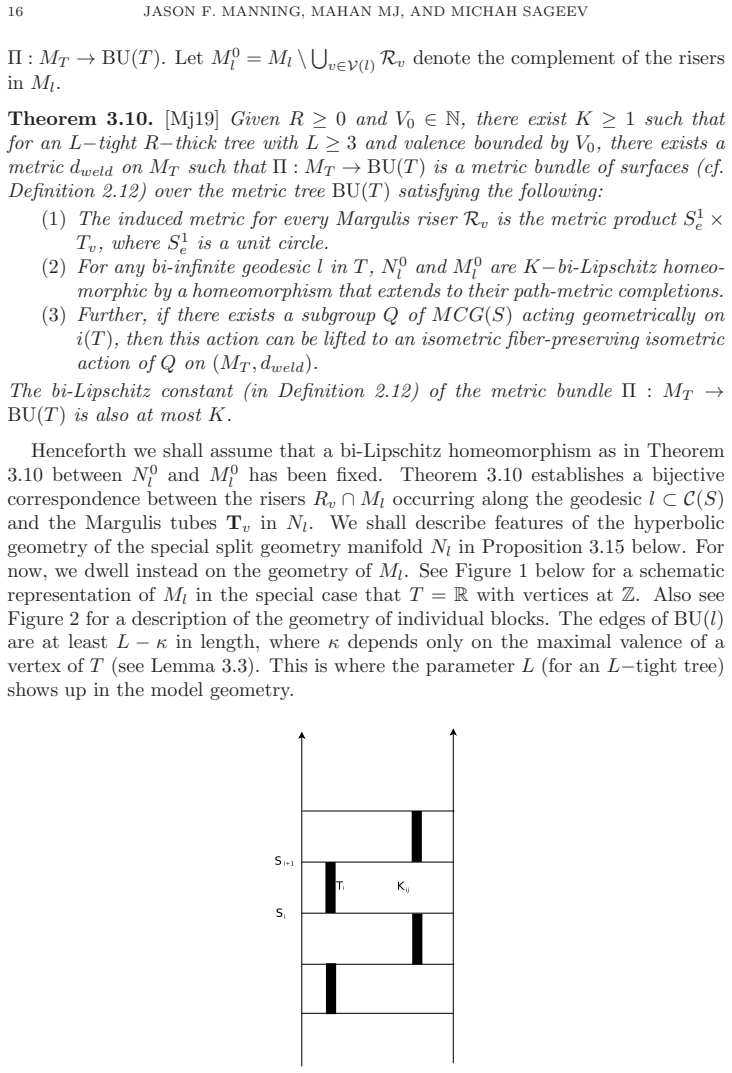
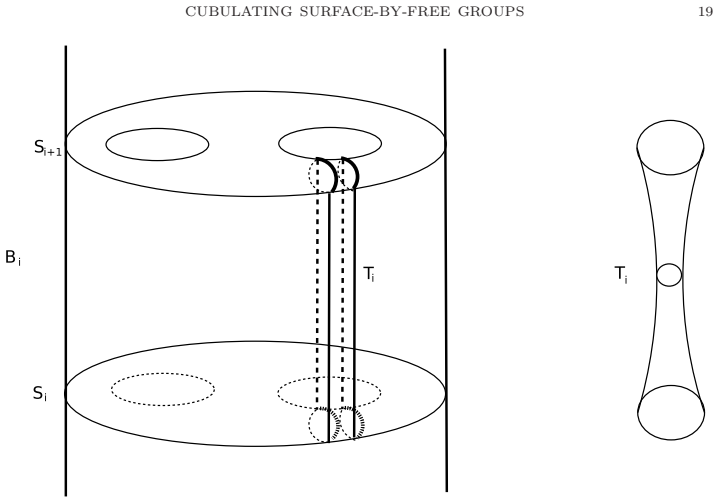
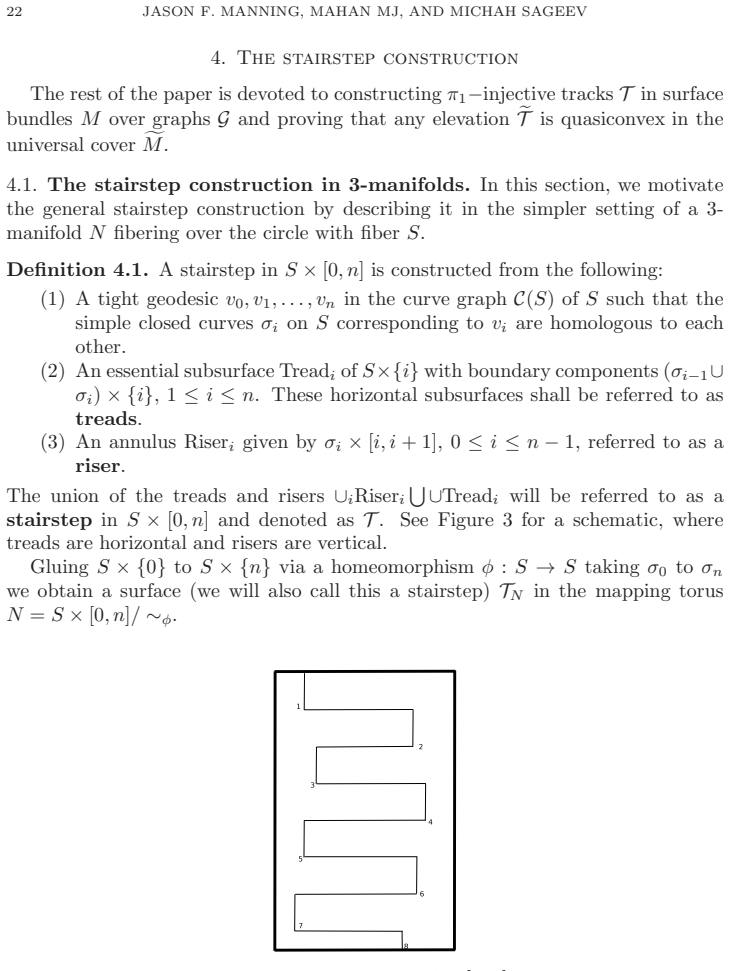
The carrying object is the tree-stairstep $T_T$. In the topological model $M_T=S\times \mathrm{BU}(T)$, each pair of adjacent vertices $v,w$ of the tree $T$ contributes a tread $\mathrm{Tread}_{vw}$, an essential subsurface of the mid-surface $S_{vw}$ with boundary $i(v)\cup i(w)$, and each vertex $v$ contributes a Margulis riser $\mathrm{Riser}_v$, a copy of the curve times a tree-link $T_v$; the union is $T_T$. This track switches from one homologous curve to the next while staying coarsely horizontal, and the argument shows that this switch forces incompressibility and quasiconvexity. The proof works in the tube-electrified metric $d_{\mathrm{te}}$, which collapses the circle direction in each riser and makes the model uniformly hyperbolic; the individual treads are uniformly quasiconvex there, and the large separations forced by $L$-tightness let the local-to-global principle for quasigeodesics promote this to quasiconvexity of the whole track.
What would settle it
Build the model bundle for an explicit sequence of $L$-tight $R$-thick trees of homologous non-separating curves whose tree-links have heights tending to infinity, and compute the quasi-isometric embedding constants of the corresponding stairstep elevations in $d_{\mathrm{te}}$; if these constants fail to remain bounded, Theorem 4.5 is false.
Extended reading notes
Core claim
The central claim, Theorem 4.5, is that for fixed thickness $R>0$ and valence bound $V_0\in\mathbb{N}$, there exist constants $\delta$, $L_0$, and $C$ such that whenever $i:T\to C(S)$ is an $L$-tight $R$-thick tree of non-separating homologous curves with $L\ge L_0$ and valence at most $V_0$, the tree-stairstep $T_T$ in the model bundle $M_T=S\times \mathrm{BU}(T)$ is incompressible and every elevation $\widetilde{T}_T$ is $C$-quasi-isometrically embedded in the tube-electrified universal cover $(\widetilde{M}_T,d_{\mathrm{te}})$. If additionally the tree-links have a uniform upper bound $L_1$, the welded metric $(\widetilde{M}_T,d_{\mathrm{weld}})$ is hyperbolic and the elevation is quasiconvex there as well. Combining this with the reduction that an essential incompressible quasiconvex track makes a hyperbolic surface bundle over a finite graph cubulable gives groups with a quasiconvex hierarchy, hence cubulable and virtually special groups fitting the surface-by-free exact sequence. The proof shows each tread is uniformly quasiconvex using ending laminations and geometric limits, then assembles treads and risers via the local-to-global principle for quasigeodesics in hyperbolic spaces.
Load-bearing premise
The argument assumes without re-proving that the companion paper's constructed model metrics are uniformly hyperbolic, and relatively hyperbolic after welding; if that imported assertion fails, the quasiconvexity of the track collapses.
Editorial extensions
If this is right
- Any hyperbolic group fitting $1\to\pi_1(S)\to G\to F_n\to 1$ whose quotient $F_n$ preserves an $L$-tight $R$-thick tree of homologous curves satisfying the bounded-hierarchy condition admits a quasiconvex hierarchy, so it is cubulable and virtually special.
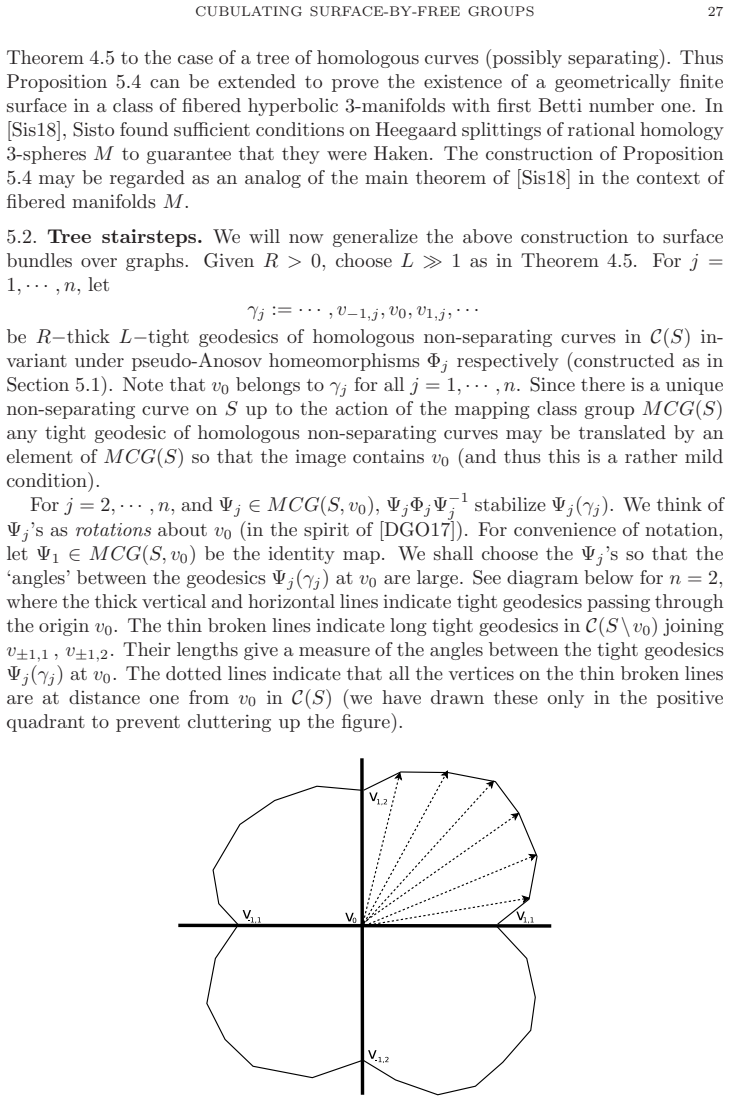
- In the fibered 3-manifold case, large powers of pseudo-Anosov maps in the complements of a tight sequence of homologous curves produce an embedded incompressible geometrically finite surface in the mapping torus, even when the first Betti number is one.
- The EIQ track cuts the surface bundle into pieces whose fundamental groups are free or free products of subsurfaces, so the quasiconvex hierarchy theorem applies even though the fiber subgroup itself is not quasiconvex.
- When the tree-links have uniformly bounded diameter, the welded metric on the universal model is hyperbolic and the elevation of the track is quasiconvex in that metric, not only in the tube-electrified metric.
- Groups satisfying these hypotheses also virtually algebraically fiber: they admit a surjection to $\mathbb{Z}$ with finitely generated kernel.
Reading between the lines
- The same EIQ-track route suggests a template for a non-quasiconvex combination theorem: any hyperbolic graph of virtually special groups whose edge group is realized by an incompressible quasiconvex track in a bundle over a finite graph should be cubulable, regardless of how distorted the fiber subgroup is.
- The proof notes that quasiconvexity of the track in the welded metric does not really need the extra $L_1$ bound; a testable extension is to remove that bound and prove relative hyperbolicity of the welded metric still suffices for quasiconvexity, which would show the extra hypothesis in Theorem 4.5(4) is unnecessary.
- The construction probably yields a direct dual cube complex whose hyperplanes are indexed by lifts of the treads and risers, giving an explicit CAT(0) cube complex that reflects the curve-tree structure rather than only an abstract hierarchy argument.
Signed reviews
Editorial analysis
A structured set of objections, weighed in public.
Referee Report
Summary. The paper studies hyperbolic extensions 1 → π1(S) → G → F_n → 1, where S is a closed surface of genus at least 2. The authors give sufficient conditions, phrased in terms of tight R-thick trees of homologous curves in the curve graph, for the surface-by-free group G to be cubulable and virtually special. The proof strategy is to build an essential incompressible quasiconvex (EIQ) track in a surface bundle over a graph, then apply the quasiconvex hierarchy theorem of Wise and the virtual specialness theorem of Agol. The track is constructed as a tree-stairstep from a tight tree, and its quasiconvexity is proved using model geometries imported from the companion paper [Mj19]. The paper also constructs explicit examples: free convex cocompact subgroups generated by large rotations about a common curve, giving rank-n surface-by-free groups, and new embedded geometrically finite surfaces in fibered hyperbolic 3-manifolds that need not be transverse to the suspension flow.
Significance. Conditional on the companion results in [Mj19], this paper provides a substantial new combination theorem for cubulable hyperbolic groups when the amalgamating subgroup is not quasiconvex. The reduction of cubulability to the existence of an EIQ track (Theorem 2.7) is clean and likely useful beyond this specific setting. The explicit constructions of rank at least 2 surface-by-free cubulable groups appear to be new, as are the examples of geometrically finite surfaces in fibered 3-manifolds that cannot be isotoped to be transverse to the suspension flow (Remark 4.3). The paper is careful and detailed in the reduction steps and in the quasiconvexity arguments of Sections 6 and 7, and it makes explicit the dependence on the model geometry from [Mj19]. The significance is tempered, however, by the fact that the announced main theorem in the introduction is not proved in its stated generality, and by the heavy reliance on imported hyperbolicity results whose uniformity in the bounded-valence tree case is not verified in this manuscript.
major comments (2)
- [§1.2 and §5.2] The announced Theorem 1.8 is not proved in the manuscript. The body proves Theorem 4.5 and then proves Theorem 5.8 only for the specific class of groups generated by large rotations about a common vertex as in Proposition 5.7. No argument is given that the general hypotheses of Theorem 1.8 (tight tree, large links, homologous curves, subordinate hierarchy paths small) imply its conclusions, and condition (4) of Theorem 1.8 is never defined formally. The introduction should either be revised so that the main theorem is the one actually proved, or a proof of Theorem 1.8 should be supplied.
- [§3.3, Theorem 3.13] The hyperbolicity of (~MT,dte) with constant δ0 independent of L and of the tree-link geometry, together with the relative hyperbolicity of (~MT,dweld), is imported from the companion paper [Mj19]. This is load-bearing: Theorem 4.5(1) restates Theorem 3.13(1), and Theorem 4.5(2) uses that hyperbolicity through Proposition 3.24. The new rank-at-least-2 examples in §5.2 require uniformity for trees with vertices of valence at least 3 and arbitrarily large L. The paper should either include the precise statement from [Mj19] that covers this regime, or provide a proof, so that the uniformity claim can be verified by the reader.
minor comments (6)
- [Abstract and §2] The abstract says that an appendix by Manning, Mj, and Sageev proves the reduction theorem, but the manuscript contains Theorem 2.7 in the main text and no separate appendix. This should be reconciled.
- [§1.2, Theorems 1.8 and 1.9] The notation Qn in the exact sequences 1 → π1(S) → G → Qn → 1 is undefined; it should be Q or F_n consistently.
- [§1.2, Theorem 1.8] Condition (2) uses the informal expression d_{C(S\i(v))}(i(v1),i(v2)) ≫ 1; since the proof relies on a quantitative threshold L, the statement should use an explicit parameter L.
- [§5.1, Definition 5.1] The text reads 'the sequence ψn is said to said to be renormalized'; this is a typo and should read 'is said to be renormalized'.
- [§7, Remark 7.1] Remark 7.1 claims quasiconvexity of ~TT in (MT,dweld) without the L1 upper bound, but (MT,dweld) is not hyperbolic in that case; the notion of quasiconvexity in a non-hyperbolic space should be clarified or the remark should be removed.
- [§8, Theorem 8.4] Theorem 8.4 for separating curves and balanced trees is asserted with the comment that the earlier proof goes through 'mutatis mutandis'; since the balanced condition introduces new parameters D,k and the geometric limit argument in Lemma 6.13 is delicate, the paper should either provide the details or explicitly label this generalization as conditional.
Circularity Check
Theorem 4.5's hyperbolicity clause is imported verbatim from co-author Mj's companion paper [Mj19]; the remaining track/quasiconvexity arguments build on that black box.
-
self citation load bearing
[Section 3.3, Theorem 3.13; Section 7, Proof of Theorem 4.5]
"The main theorem of [Mj19] states: Theorem 3.13. Given R >0, V0 ∈ N there exists δ0,L0 such that the following holds. Let i :T → C(S) be an L−tight R−thick tight tree of non-separating curves with L ≥L0 such that the valence of any vertex of T is at most V0. Then (1) (~MT,d te) is δ0−hyperbolic. ... Proof. The first conclusion of the theorem follows from Theorem 3.13."
Theorem 4.5(1) is not proved in this paper; it is a verbatim restatement of Theorem 3.13(1) from the companion paper [Mj19], written by one of the present authors. The proof of Theorem 4.5 simply cites that theorem, and the subsequent quasiconvexity and incompressibility arguments in Sections 6 and 7 use this imported hyperbolicity of (~MT,dte) as a black box. Thus the load-bearing geometric input of the main technical theorem reduces to a same-author citation rather than an independent derivation in this manuscript. This is not a fitted-parameter or definitional circularity, and the ultimate cubulability claim retains independent content, but the model-geometry premise is self-citation-dependent.
full rationale
No internal parameter fitting or definitional circularity occurs: the track construction, the stairstep geometry, the reduction of cubulability to an EIQ track (Theorem 2.7), and the examples are developed in the paper itself and do not assume the conclusion that G is cubulable. The only significant circularity-adjacent issue is the heavy reliance on the companion paper [Mj19] by one of the authors. In particular, Theorem 4.5(1) is exactly Theorem 3.13(1) restated, and its proof is a citation to [Mj19]; the proofs of Theorem 4.5(2)-(4) and of the tread quasiconvexity results use that theorem and related [Mj19] machinery as black boxes. If [Mj19]'s constants or hypotheses do not cover bounded-valence trees uniformly in L, the central theorem would fail in exactly the regime used for the main new examples. This is a genuine dependency and self-citation concern, but it is not a collapse of the whole derivation: the reduction theorem and the construction of tracks provide independent content, and no conclusion is assumed in its own proof. Score 4 reflects 'some self-citation; central claim still has independent content.'
Assumptions & free parameters
assumptions (8)
- standard math Wise's quasiconvex hierarchy theorem: a hyperbolic group with a quasiconvex hierarchy is virtually special cubulable [Wis11].
- standard math Agol's theorem: every hyperbolic cubulable group is virtually special [Ago13].
- standard math Masur-Minsky subsurface projection distance estimates and the bounded geodesic image theorem [MM99, MM00].
- domain assumption The companion paper [Mj19] provides the metric bundle (MT,dweld), the tube-electrified metric (MT,dte), hyperbolicity and relative hyperbolicity (Theorems 3.10 and 3.13), tight-tree isometric embedding (Proposition 3.2), and the hallway flare criterion (Proposition 3.24).
- standard math Ending lamination theorem and model geometry for doubly degenerate Kleinian surface groups [Min94, Min10, BCM12, Mj14].
- standard math Existence of Cannon-Thurston maps for hyperbolic surface-by-free extensions [Mit97, Mit98, MR18].
- standard math Dowdall-Kent-Leininger theorem: for 1 -> pi1(S) -> G -> F -> 1 with F free, every finitely generated infinite index subgroup of pi1(S) is quasiconvex in G [DKL14].
- standard math Kielak's virtual fibering theorem: a cubulable group virtually algebraically fibers if and only if its first L2 Betti number vanishes [Kie18].
Cite this review
Pith. "Pith review of Cubulating Surface-by-free Groups." pith.science (2026). https://pith.science/paper/HP7MQDGE
@misc{pith2026190803545,
  author       = {Pith},
  title        = {Pith review of: Cubulating Surface-by-free Groups},
  year         = {2026},
  howpublished = {\url{https://pith.science/paper/HP7MQDGE}},
  note         = {Machine review of arXiv:1908.03545}
}
abstract
Let $$1 \to H \to G \to Q \to 1$$ be an exact sequence where $H= \pi_1(S)$ is the fundamental group of a closed surface $S$ of genus greater than one, $G$ is hyperbolic and $Q$ is finitely generated free. The aim of this paper is to provide sufficient conditions to prove that $G$ is cubulable and construct examples satisfying these conditions. The main result may be thought of as a combination theorem for virtually special hyperbolic groups when the amalgamating subgroup is not quasiconvex. Ingredients include the theory of tracks, the quasiconvex hierarchy theorem of Wise, the distance estimates in the mapping class group from subsurface projections due to Masur-Minsky and the model geometry for doubly degenerate Kleinian surface groups used in the proof of the ending lamination theorem. An appendix to this paper by Manning, Mj, and Sageev proves a reduction theorem by showing that cubulability of $G$ follows from the existence of an essential incompressible quasiconvex track in a surface bundle over a graph with fundamental group $G$.
Figures
Figures from the paper (1 more)
Reference graph
Works this paper leans on
-
[1]
I. Agol. The virtual Haken conjecture (With an appendix by Ian Agol, Daniel Groves, and Jason Manning) . Doc. Math. 18 , pages 1045--1087, 2013
work page 2013
-
[2]
J. F. Brock, R. D. Canary, and Y. N. Minsky. The C lassification of K leinian surface groups II : T he E nding L amination C onjecture. Ann. of Math. 176 (1), arXiv:math/0412006 , pages 1--149, 2012
arXiv 2012
-
[3]
Brock and Nathan M
Jeffrey F. Brock and Nathan M. Dunfield. Norms on the cohomology of hyperbolic 3-manifolds. Invent. Math. , 210(2):531--558, 2017
2017
-
[4]
Bestvina and M
M. Bestvina and M. Feighn. A C ombination theorem for N egatively C urved G roups. J. Diff. Geom., vol 35 , pages 85--101, 1992
1992
-
[5]
M. Bestvina, M. Feighn, and M. Handel. Laminations, trees, and irreducible automorphisms of free groups. Geom. Funct. Anal. , 7(2):215--244, 1997
work page 1997
-
[6]
M. Bridson and A. Haefliger. Metric spaces of non-positive curvature. Grundlehren der Mathematischen Wissenschaften [Fundamental Principles of Mathematical Sciences], 319. Springer-Verlag, Berlin , pages xxii+643 pp., 1999
work page 1999
-
[7]
Jason A. Behrstock and Yair N. Minsky. Dimension and rank for mapping class groups. Ann. of Math. (2) , 167(3):1055--1077, 2008
work page 2008
-
[8]
F. Bonahon. Bouts de varietes hyperboliques de dimension 3. Ann. Math. vol.124 , pages 71--158, 1986
1986
Show all 77 references
-
[9]
Bowditch
Brian H. Bowditch. Cut points and canonical splittings of hyperbolic groups. Acta Math. , 180(2):145--186, 1998
1998
-
[10]
B. H. Bowditch. Relatively hyperbolic groups. Internat. J. Algebra and Computation. 22, 1250016, 66pp , 2012
2012
-
[11]
Bergeron and D
N. Bergeron and D. T. Wise. A boundary criterion for cubulation. Amer. J. Math. 134, no. 3 , pages 843--859, 2012
2012
-
[12]
R. D. Canary. Ends of hyperbolic 3 manifolds. J. Amer. Math. Soc. , pages 1--35, 1993
1993
-
[13]
R. D. Canary. A covering theorem for hyperbolic 3 manifolds. Topology 35 , pages 751--778, 1996
1996
-
[14]
R. D. Canary, D. B. A. Epstein, and P. Green. Notes on N otes of T hurston. in Analytical and Geometric Aspects of Hyperbolic Spaces , pages 3--92, 1987
1987
-
[15]
Coulbois, A
T. Coulbois, A. Hilion, and M. Lustig. Non-unique ergodicity, observers' topology and the dual algebraic lamination for R-trees. Illinois J. Math., 51(3) , pages 897--911, 2007
2007
-
[16]
Cooper, D
D. Cooper, D. D. Long, and A. Reid. Bundles and finite foliations. Invent. Math. 118 , pages 255--283, 1994
1994
-
[17]
Warren Dicks and M. J. Dunwoody. Groups acting on graphs , volume 17 of Cambridge Studies in Advanced Mathematics . Cambridge University Press, Cambridge, 1989
1989
-
[18]
Sur l'accessibilit\' e acylindrique des groupes de pr\' e sentation finie
Thomas Delzant. Sur l'accessibilit\' e acylindrique des groupes de pr\' e sentation finie. Ann. Inst. Fourier (Grenoble) , 49(4):1215--1224, 1999
1999
-
[19]
Dahmani, V
F. Dahmani, V. Guirardel, and D. Osin. Hyperbolically embedded subgroups and rotating families in groups acting on hyperbolic spaces. Mem. Amer. Math. Soc. , 245(1156):v+152, 2017
2017
-
[20]
Dowdall, R
S. Dowdall, R. P. Kent, and C. Leininger. Pseudo-anosov subgroups of fibered 3-manifold groups. Groups Geom. Dyn. 8 no. 4 , pages 1247--1282, 2014
2014
-
[21]
Dahmani and M
F. Dahmani and M. Mj. Height, graded relative hyperbolicity and quasiconvexity. J. \'Ec. polytech. Math. , 4:515--556, 2017
2017
-
[22]
M. J. Dunwoody and M. E. Sageev. J SJ -splittings for finitely presented groups over slender groups. Invent. Math. , 135(1):25--44, 1999
1999
-
[23]
G. Dufour. Cubulations de varietes hyperboliques compactes. PhD thesis, Universite Paris-Sud XI, http://tel.archives-ouvertes.fr/tel-00690334/ , 2012
2012
-
[24]
M. J. Dunwoody. The accessibility of finitely presented groups. Invent. Math. , 81(3):449--457, 1985
1985
-
[25]
B. Farb. Relatively hyperbolic groups. Geom. Funct. Anal. 8 , pages 810--840, 1998
1998
-
[26]
Fathi, M
A. Fathi, M. Laudenbach, and V. Poenaru. Travaux de T hurston sur les surfaces. Asterisque 66-67 , pages 1--284, 1979
1979
-
[27]
Farb and L
B. Farb and L. Mosher. Convex cocompact subgroups of mapping class groups. Geom. Topol. 6 , pages 91--152, 2002
2002
-
[28]
Fujiwara and P
K. Fujiwara and P. Papasoglu. J SJ -decompositions of finitely presented groups and complexes of groups. Geom. Funct. Anal. , 16(1):70--125, 2006
2006
-
[29]
Invariants l^2 de relations d'\' e quivalence et de groupes
Damien Gaboriau. Invariants l^2 de relations d'\' e quivalence et de groupes. Publ. Math. Inst. Hautes \' E tudes Sci. , (95):93--150, 2002
2002
-
[30]
F. Gautero. Geodesics in Trees of Hyperbolic and Relatively Hyperbolic Spaces . Proc. Edinburgh. Math. Soc. 59(3) , pages 701--740, 2016
2016
-
[31]
Hamenstaedt
U. Hamenstaedt. Word hyperbolic extensions of surface groups . preprint, arXiv:math/0505244 , 2005
2005 arXiv
-
[32]
3-manifolds
John Hempel. 3-manifolds . AMS Chelsea Publishing, Providence, RI, 2004. Reprint of the 1976 original
2004
-
[33]
Sebastian Hensel, Piotr Przytycki, and Richard C. H. Webb. 1-slim triangles and uniform hyperbolicity for arc graphs and curve graphs. J. Eur. Math. Soc. (JEMS) , 17(4):755--762, 2015
2015
-
[34]
Haglund and D
F. Haglund and D. T. Wise. A combination theorem for special cube complexes. Ann. of Math. (2) 176, no. 3 , pages 1427--1482, 2012
2012
-
[35]
Hagen and Daniel T
Mark F. Hagen and Daniel T. Wise. Cubulating hyperbolic free-by-cyclic groups: the general case. Geom. Funct. Anal. , 25(1):134--179, 2015
2015
-
[36]
Hsu and D
T. Hsu and D. T. Wise. Cubulating malnormal amalgams . Invent. Math. 199, no. 2 , pages 293--331, 2015
2015
-
[37]
Hagen and Daniel T
Mark F. Hagen and Daniel T. Wise. Cubulating hyperbolic free-by-cyclic groups: the irreducible case. Duke Math. J. , 165(9):1753--1813, 2016
2016
-
[38]
D. Jansen. Notes on pointed G romov- Hausdorff convergence. preprint, arXiv:1703.09595 , 2017
2017 arXiv
-
[39]
Kapovich
M. Kapovich. Hyperbolic Manifolds and Discrete Groups . Progress in Mathematics, vol. 183, Birkhauser , 2001
2001
-
[40]
A. Kent. The theory of normal surfaces. based on Lecture Notes by Cameron McA. Gordon, https://www.math.wisc.edu/ kent/normal.pdf , 2001
2001
-
[41]
Residually finite rationally-solvable groups and virtual fibring
Dawid Kielak. Residually finite rationally-solvable groups and virtual fibring. preprint, arXiv:1809.09386 , 2018
2018 arXiv
-
[42]
R. P. Kent and C. Leininger. Shadows of mapping class groups: capturing convex cocompactness. Geom. Funct. Anal. 18 no. 4 , pages 1270--1325, 2008
2008
-
[43]
Kapovich and M
I. Kapovich and M. Lustig. Intersection form, laminations and currents on free groups. Geom. Funct. Anal. 19, no. 5 , pages 1426--1467, 2010
2010
-
[44]
Kapovich and M
I. Kapovich and M. Lustig. Cannon–Thurston fibers for iwip automorphisms of F_N . J. Lond. Math. Soc. (2) 91, no. 1 , pages 203--224, 2015
2015
-
[45]
Klarreich
E. Klarreich. The boundary at infinity of the curve complex and the relative T eichm \"u ller space. preprint, http://nasw.org/users/klarreich/research.htm , 1999
1999
-
[46]
Kahn and V
J. Kahn and V. Markovic. Immersing almost geodesic surfaces in a closed hyperbolic three manifold. Ann. of Math. (2) 175, no. 3 , pages 1127--1190, 2012
2012
-
[47]
Kropholler and G
P. Kropholler and G. Walsh. in preparation. 2019
2019
-
[48]
Y. N. Minsky. On R igidity, L imit S ets, and E nd I nvariants of H yperbolic 3- M anifolds. J. Amer. Math. Soc., vol.7 , pages 539--588, 1994
1994
-
[49]
Y. N. Minsky. End invariants and the classification of hyperbolic 3-manifolds. Current Developments in Mathematics, 2002, Int. Press Sommerville, MA , pages 181--217, 2003
2002
-
[50]
Y. N. Minsky. The Classification of Kleinian surface groups I: Models and Bounds . Ann. of Math. 171(1), math.GT/0302208 , pages 1--107, 2010
2010
-
[51]
M. Mitra. Ending L aminations for H yperbolic G roup E xtensions. Geom. Funct. Anal. vol.7 No. 2 , pages 379--402, 1997
1997
-
[52]
M. Mitra. Cannon- T hurston M aps for H yperbolic G roup E xtensions. Topology 37 , pages 527--538, 1998
1998
-
[53]
M. Mitra. On a theorem of S cott and S warup. Proc. Amer. Math. Soc. v. 127 no. 6 , pages 1625--1631, 1999
1999
-
[54]
M. Mj. Relative Rigidity, Quasiconvexity and C-Complexes . Algebraic and Geometric Topology 8 , pages 1691--1716, 2008
2008
-
[55]
M. Mj. Cannon-Thurston Maps for Surface Groups . Ann. of Math., 179(1) , pages 1--80, 2014
2014
-
[56]
M. Mj. Tight trees and effective hyperbolization of surface bundles. preprint, arXiv:1901.02170 , 2019
1901 arXiv
-
[57]
H. A. Masur and Y. N. Minsky. Geometry of the complex of curves I : H yperbolicity. Invent. Math.138 , pages 103--139, 1999
1999
-
[58]
H. A. Masur and Y. N. Minsky. Geometry of the complex of curves II : H ierarchical structure. Geom. Funct. Anal. 10 , pages 902--974, 2000
2000
-
[59]
Mj and A
M. Mj and A. Pal. Relative Hyperbolicity, Trees of Spaces and Cannon-Thurston Maps . Geom. Dedicata 151 , pages 59--78, 2011
2011
-
[60]
Mj and L
M. Mj and L. Reeves. A Combination Theorem for Strong Relative Hyperbolicity . Geom. Topol. 12 , pages 1777 -- 1798, 2008
2008
-
[61]
Mj and K
M. Mj and K. Rafi. Algebraic ending laminations and quasiconvexity. Algebr. Geom. Topol. , 18(4):1883--1916, 2018
1916
-
[62]
Mj and P
M. Mj and P. Sardar. A combination theorem for metric bundles . Geom. Funct. Anal. 22, no. 6 , pages 1636--1707, 2012
2012
-
[63]
Group cocycles and the ring of affiliated operators
Jesse Peterson and Andreas Thom. Group cocycles and the ring of affiliated operators. Invent. Math. , 185(3):561--592, 2011
2011
-
[64]
Rips and Z
E. Rips and Z. Sela. Structure and rigidity in hyperbolic groups. I . Geom. Funct. Anal. , 4(3):337--371, 1994
1994
-
[65]
M. Sageev. Ends of group pairs and non-positively curved cube complexes. Proc. London Math. Soc. 71 , pages 585--617, 1995
1995
-
[66]
A. Sisto. Many Haken Heegaard splittings. J. Topol. Anal. (to appear) , 2018
2018
-
[67]
G. P. Scott and G. A. Swarup. Geometric finiteness of certain K leinian groups. Proc. Amer. Math. Soc. , 109(3):765--768, 1990
1990
-
[68]
Peter Scott and Gadde A. Swarup. Regular neighbourhoods and canonical decompositions for groups. Ast\' e risque , pages vi+233, 2003
2003
-
[69]
Scott and C
P. Scott and C. T. C. Wall. Topological M ethods in G roup T heory. Homological group theory (C. T. C. Wall, ed.), London Math. Soc. Lecture Notes Series, vol. 36, Cambridge Univ. Press , 1979
1979
-
[70]
W. P. Thurston. The G eometry and T opology of 3- M anifolds. Princeton University Notes , 1980
1980
-
[71]
W. P. Thurston. Three dimensional manifolds, Kleinian groups and hyperbolic geometry . Bull. Amer. Math. Soc. , pages 357--382, 1982
1982
-
[72]
W. P. Thurston. Hyperbolic S tructures on 3- M anifolds, I : D eformations of acylindrical manifolds. Ann. of Math. 124 , pages 203--246, 1986
1986
-
[73]
W. P. Thurston. Hyperbolic S tructures on 3- M anifolds, II : S urface G roups and 3- M anifolds which F iber over the C ircle. preprint, arXiv:math.GT/9801045 , 1986
1986
-
[74]
Thurston
William P. Thurston. A norm for the homology of 3 -manifolds. Mem. Amer. Math. Soc. , 59(339):i--vi and 99--130, 1986
1986
-
[75]
D. T. Wise. The structure of groups with a quasiconvex hierarchy . preprint , 2011
2011
-
[76]
Daniel T. Wise. From riches to raags: 3-manifolds, right-angled A rtin groups, and cubical geometry , volume 117 of CBMS Regional Conference Series in Mathematics . Published for the Conference Board of the Mathematical Sciences, Washington, DC; by the American Mathematical So...
2012
-
[77]
Daniel T. Wise. The cubical route to understanding groups. In Proceedings of the I nternational C ongress of M athematicians--- S eoul 2014. V ol. II , pages 1075--1099. Kyung Moon Sa, Seoul, 2014
2014
Reviewed August 14, 2026 · model on record in the stance chip above.
Discussion (0). Continue with ORCID to comment.