REVIEW 3 major objections 6 minor 56 references
Topological properties of epidemic aftershock processes
T0 review · 3 major / 6 minor · reviewed 2026-08-14 · deepseek-v4-flash
Pith's one-line read In the standard ETAS model of aftershocks, the expected topology of triggering trees is fixed by just two parameters: the average branching ratio and the exponent ratio.
desk verdict A mostly solid review-plus-numerics paper on ETAS tree topology: the analytic two-parameter collapse is correct, but the new leaf-depth exponent gamma_d is a numerical result that needs error bars and a softened 'proof' claim before it can be used for swarm/burst classification. read the letter →
The pith
A machine-rendered reading of the paper's core claim, the machinery that carries it, and where it could break.
The reading
What carries the argument
The load-bearing object is the Galton-Watson branching process representation of ETAS combined with the Harris-path encoding of a tree as a one-dimensional walk. After integrating out magnitudes, each event's number of offspring is an independent draw from the distribution in Eq. (8), so every topological statistic is a functional of that one distribution, parametrized only by $N_b$ and $\alpha/b$. The Harris path maps tree size and generational depth to random-walk observables, which explains the diffusive $\gamma_d = 0.5$ scaling when the offspring variance is finite and its breakdown once the power-law tail makes $\alpha/b > 0.5$.
What would settle it
Build synthetic catalogs from a branching model with the same fitted $N_b$ and $\alpha/b$ but with aftershock magnitudes that depend on the parent event's magnitude, reconstruct the triggering trees, and compare their tree-size distribution and leaf-depth versus tree-size relation with the paper's predictions; a systematic mismatch would show that the two-parameter collapse fails when the i.i.d.-magnitude assumption is broken.
Extended reading notes
Core claim
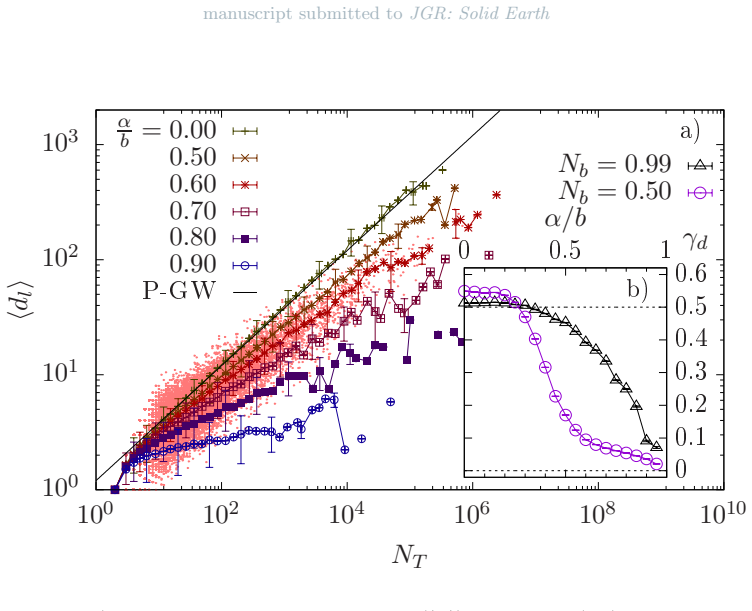
The central claim is that the full tree topology of the standard ETAS model collapses onto two parameters once the model is represented as a Galton-Watson branching process. Because magnitudes are independent and identically distributed, the Gutenberg-Richter magnitude law combined with the productivity relation yields a single offspring distribution $p_1(k)$ whose tail is a power law $k^{-(b/\alpha+1)}$; all trees are then generated by independent draws from that distribution. The paper shows that the tree-size distribution has two power-law regimes separated by a crossover size $N_c \approx (1-N_b)^{1/(1-\alpha/b)}$, with the low-size exponent moving from $1.5$ toward $2$ as $\alpha/b$ grows and the high-size exponent equal to $1+b/\alpha$. It further reports a numerical scaling $\langle d_l \rangle \propto N_T^{\gamma_d}$, where $\gamma_d = 0.5$ in the Poisson limit and decreases toward zero as $\alpha/b \to 1$, which it reads as the topological signature separating swarm-like from burst-like clusters.
Load-bearing premise
The argument collapses to two parameters because magnitudes are assumed independent and identically distributed, so each event's aftershock count is a Poisson variable whose mean depends only on that event's magnitude; if magnitudes carry correlations or memory across events, the tree topology may depend on more than $(N_b, \alpha/b)$.
Editorial extensions
If this is right
- A fitted $(N_b, \alpha/b)$ pair yields concrete predictions for $p_1(k)$, $p_T(K)$, the family size $B$, and the $\langle d_l \rangle$-$N_T$ curve, so ETAS can be validated against reconstructed trees without extra assumptions.
- In the $\alpha=0$ limit, tree sizes follow the Borel distribution with a $3/2$ power-law body, matching the statistics of mean-field avalanche processes.
- In the $\alpha=b$ limit, tree sizes follow a single power law with exponent about $2$ and leaf depth becomes nearly independent of tree size, the signature that the paper associates with burst-like clusters.
- Because natural catalogs often have $\alpha \approx b$, the burst/swarm distinction is predicted to be a consequence of the exponent ratio, not of exogenous background forcing.
- Observing a leaf-depth exponent $\gamma_d > 0.5$ in a catalog is not expected from a Galton-Watson process, so such an observation would point to memory or other structure beyond the standard ETAS model.
Reading between the lines
- A natural extension is to test the two-parameter collapse directly: trees with different $N_b$ but the same $\alpha/b$ should fall on one master curve after rescaling by $N_c$, and any residual spread would reveal non-Galton-Watson structure.
- The same predictions should apply to acoustic-emission and rock-fracture experiments, so the $\gamma_d(\alpha/b)$ curve is lab-testable on controlled fracture populations.
- If the collapse holds, tree topology itself could be inverted to estimate $\alpha/b$ and $N_b$ directly from reconstructed clusters, giving an independent cross-check on standard likelihood-based ETAS parameter fits.
- Finite observation windows will bias leaf and root identification, so a practical extension is to compute the predicted topology under the same spatial-temporal censoring applied to real catalogs and use the censored predictions rather than the infinite-catalog ones.
Signed reviews
Editorial analysis
A structured set of objections, weighed in public.
Referee Report
Summary. The paper revisits the standard Epidemic Type Aftershock Sequence (ETAS) model viewed as a Galton-Watson (GW) branching process and claims that all key topological properties of triggering trees—the offspring distribution p1(k), the tree-size distribution pT(K), the expected family size B, and the average leaf-depth versus tree-size relation—depend only on two parameters: the average branching ratio Nb and the exponent ratio α/b. The offspring distribution is derived analytically in Eq. (8), the tree-size distribution is verified numerically against Saichev et al. (2005), and Monte Carlo simulations with up to 10^7 trees are used to characterize the leaf-depth scaling. The paper proposes the GW model as a null model for distinguishing burst-like from swarm-like clusters in empirical catalogs.
Significance. If established, the two-parameter collapse would provide a simple and powerful null model: a fitted (Nb, α/b) pair would fully specify the expected shapes of declustered triggering trees, directly linking ETAS parameters to the burst/swarm classification of Zaliapin and Ben-Zion. The analytic derivation of Eq. (8) is clean, the reproduction of the Borel limit at α=0 is correct, and the numerical verification of the tree-size distribution agrees with existing theory. The paper also explicitly acknowledges limitations such as magnitude-magnitude correlations and finite-catalog effects. However, the leaf-depth scaling in Eq. (10) is presented as a numerical result without derivation, without error bars on γd, and with acknowledged distortion at low Nb, and the Introduction overstates that this relation is proved. The paper does not fit to data, so its value is primarily as a theoretical benchmark rather than a directly validated classification tool.
major comments (3)
- [Section 4, Eq. (10), Fig. 4] The load-bearing claim that the average leaf-depth scales as a power law in tree size with exponent γd determined only by Nb and α/b is not established. The paper explicitly states, immediately after Eq. (10), that "we only introduce the numerical results and leave the mathematical derivation, if possible, as an open question." The exponent γd is fitted over the limited range 30 < NT < 1000 with no confidence intervals, and the text concedes both that the power law "gets distorted for low values of Nb" and that "the effective exponent γd depends on Nb for intermediate values of α/b." Because the swarm/burst classification is specifically tied to γd ≈ 0.5 versus γd ≈ 0, a fitting artifact or a stronger Nb-dependence than reported would change the paper's main practical conclusion. Please either provide a derivation, or report robust error bars and sensitivity to the fitting range and lower cutoff, or explicitly label the two-parameter collapse for γd as a numerical conjecture that requires further support.
- [Section 1 and Section 6] The Introduction announces as a main result that the paper will "prove that the relation between average leaf-depths and cluster sizes depends exclusively on the probabilistic nature of the individual branching ratios, determined in the ETAS model by the ratio of parameters b/α and the average branching rate," but the body of the paper does not provide such a proof and instead leaves the derivation as an open question. The Conclusions similarly state that "all topological properties depend only on two parameters" without the caveat that the leaf-depth relation is numerical, distorted at low Nb, and dependent on the fitting range. This overclaim should be corrected in both places so that the abstract and introduction match the level of support actually provided.
- [Section 4, Harris path argument] The random-walk analogy invoked for the Harris path is stated to hold when the offspring distribution has a well-defined variance, and the paper notes that this excludes the ETAS model for α/b > 0.5 because Eq. (8) then has infinite variance. Nevertheless, the interpretation of the numerical γd < 0.5 values still draws on the diffusive picture (e.g., "the P-GW limit is recovered" for α/b < 0.5). The manuscript should make explicit that for α/b > 0.5 there is no theoretical argument for the power-law form or the value of γd, and that the reported transition is based purely on simulations.
minor comments (6)
- [Eq. (9)] The Borel distribution is written as p_T(K|nb) = (nbK)^{K-1} e^{-nb k}/K!, mixing K and k in the same expression; please make the notation consistent.
- [Section 3, family size paragraph] The statement that p1(0) provides "a good approximation to the average family size ⟨B⟩" is imprecise: p1(0) is the expected fraction of leaves per event, while B is a nonlinear functional of the whole tree. Please state the exact relationship or justify the approximation.
- [Fig. 4 caption] The caption reports error bars as the standard deviation of the conditional distribution of ⟨dl⟩, but no uncertainties are shown for the fitted exponent γd in the inset. Please state the fitting method (e.g., maximum likelihood or least squares) and provide uncertainties for γd.
- [Fig. 3 caption] The caption contains the stray editorial note "(don't need b)", which should be removed before submission.
- [Section 3, paragraph after Fig. 2] The text contains a typo "a chacateristic NT value" which should read "a characteristic NT value."
- [Section 4] The sentence "The branching ratio Nb changes the range of the distribution in NT as well as the dependence on the bivariate distribution" is vague; please specify precisely how the bivariate distribution changes with Nb.
Circularity Check
No significant circularity: the topological statistics are derived from the ETAS/Galton-Watson model's own definitions, and the numerical leaf-depth exponent is openly presented as an empirical model result, not a data fit.
full rationale
The paper's central computation is a mathematical derivation from the standard ETAS assumptions (Eqs. 3–8): magnitudes are i.i.d. with Gutenberg–Richter distribution, each event produces a Poisson number of aftershocks with mean nb(mi) = kc 10^{α(mi−mc)}, and the resulting offspring distribution p1(k) is integrated over the magnitude distribution to yield a power-law form depending only on Nb and α/b. All subsequent topology results (tree-size distribution, leaf fraction, family size) follow from this p1(k) in a Galton–Watson framework; the Borel limit for α=0 is a known mathematical fact, and the scale-free limit for α=b is a direct consequence. The paper does not fit any parameters to external data and then call the fit a prediction; it generates Monte-Carlo trees from the model itself. The leaf-depth exponent γ_d is explicitly flagged as a numerical result, with the text saying "we only introduce the numerical results and leave the mathematical derivation, if possible, as an open question" (Section 4), so it is not dressed up as an analytically predicted quantity. Self-citations (e.g., Baró & Vives 2012 for maximum-likelihood exponent estimation) are methodological and non-load-bearing; the citation to Saichev et al. (2005) for the tree-size distribution is independent prior work. No uniqueness theorems or circular definitions are invoked. The two-parameter collapse is an honest consequence of the model's structure, and the comparison with Zaliapin and Ben-Zion's empirical clusters is presented as an interpretive benchmark, not as a fitted constraint. Hence no step in the derivation reduces to its own inputs.
Assumptions & free parameters
free parameters (2)
- Nb (average branching ratio) =
scanned values 0.30, 0.50, 0.80, 0.90, 0.99
- alpha/b (exponent ratio) =
scanned values 0, 0.4, 0.6, 0.8, 0.99
assumptions (4)
- domain assumption The linear Hawkes process can be represented as a branching process with unique causal links.
- domain assumption Magnitudes are iid and independent of triggering, so the marginal offspring distribution p1(k) fully determines tree topology.
- standard math The tree size distribution for the ETAS model given by Saichev et al. (2005) is correct.
- ad hoc to paper The average leaf-depth versus tree-size relation is a power law with exponent gamma_d for large trees.
Cite this review
Pith. "Pith review of Topological properties of epidemic aftershock processes." pith.science (2026). https://pith.science/paper/GTJJ46ZF
@misc{pith2026190803554,
  author       = {Pith},
  title        = {Pith review of: Topological properties of epidemic aftershock processes},
  year         = {2026},
  howpublished = {\url{https://pith.science/paper/GTJJ46ZF}},
  note         = {Machine review of arXiv:1908.03554}
}
abstract
Earthquakes in seismological catalogs and acoustic emission events in lab experiments can be statistically described as a linear Hawkes point process, where the spatio-temporal rate of events is a linear superposition of background intensity and the aftershock clusters triggered by preceding activity. Traditionally, statistical seismology has interpreted this model as the outcome of an epidemic branching process, where one-to-one causal links can be established between mainshocks and aftershocks. Declustering techniques have been used to infer the underlying triggering trees and relate their topological properties with epidemic branching models. Here, we review how the standard Epidemic Type Aftershock Sequence (ETAS) model extends from the Galton-Watson (GW) branching processes and bridges two extreme cases: Poisson sampling and scale-free power-law trees. We report the most essential topological properties expected in GW epidemic trees: the branching probability, the distribution of tree size, the expected family size, and the relation between average leaf-depth and tree size. We find that such topological properties depend exclusively on two sampling parameters of the standard ETAS model: the average branching ratio $N_b$ and the exponent ratio $\alpha/b$ determining the branching probability distribution. From these results, one can use the memory-less GW as a null-model for empirical triggering processes and assess the validity of the ETAS model to reproduce the statistics of natural and artificial catalogs.
Figures


Figures from the paper (1 more)
Reference graph
Works this paper leans on
-
[1]
Aldous1991b APACrefauthors Aldous, D. APACrefauthors \ 1991 . The continuum random tree II: an overview The continuum random tree ii: an overview . Stochastic analysis 167 23--70
work page 1991
-
[2]
Baiesi2004 APACrefauthors Baiesi, M. \ Paczuski, M. APACrefauthors \ 2004 Jun . Scale-free networks of earthquakes and aftershocks Scale-free networks of earthquakes and aftershocks . Phys. Rev. E 69 066106 . APACrefURL https://link.aps.org/doi/10.1103/PhysRevE.69.066106 APACrefURL APACrefDOI doi:10.1103/PhysRevE.69.066106 APACrefDOI
-
[3]
Baro2013 APACrefauthors Bar\'o, J. , Corral, A. , Illa, X. , Planes, A. , Salje, E K H. , Schranz, W. Vives, E. APACrefauthors \ 2013 Feb . Statistical Similarity between the Compression of a Porous Material and Earthquakes Statistical similarity between the compression of a porous material and earthquakes . Phys. Rev. Lett. 110 088702 . APACrefURL https:...
-
[4]
Baro2017 APACrefauthors Bar \'o , J. \ Davidsen, J. APACrefauthors \ 2017 . Are Triggering Rates of Labquakes Universal? Inferring Triggering Rates From Incomplete Information Are triggering rates of labquakes universal? inferring triggering rates from incomplete information . The European Physical Journal Special Topics 226 3211--3225 . APACrefDOI doi:10...
-
[5]
Baro2018a APACrefauthors Bar\'o, J. \ Davidsen, J. APACrefauthors \ 2018 Mar . Universal avalanche statistics and triggering close to failure in a mean-field model of rheological fracture Universal avalanche statistics and triggering close to failure in a mean-field model of rheological fracture . Phys. Rev. E 97 033002 . APACrefURL https://link.aps.org/d...
-
[6]
Baro2012 APACrefauthors Bar\'o, J. \ Vives, E. APACrefauthors \ 2012 Jun . Analysis of power-law exponents by maximum-likelihood maps Analysis of power-law exponents by maximum-likelihood maps . Phys. Rev. E 85 066121 . APACrefURL https://link.aps.org/doi/10.1103/PhysRevE.85.066121 APACrefURL APACrefDOI doi:10.1103/PhysRevE.85.066121 APACrefDOI
-
[7]
Benioff1951 APACrefauthors Benioff, H. APACrefauthors \ 1951 . Earthquakes and rock creep:(Part I: Creep characteristics of rocks and the origin of aftershocks) Earthquakes and rock creep:(part i: Creep characteristics of rocks and the origin of aftershocks) . Bulletin of the Seismological Society of America 41 1 31--62
work page 1951
-
[8]
Bennies2000 APACrefauthors Bennies, J. \ Kersting, G. APACrefauthors \ 2000 Jul 01 . A Random Walk Approach to Galton--Watson Trees A random walk approach to galton--watson trees . Journal of Theoretical Probability 13 3 777--803 . APACrefURL https://doi.org/10.1023/A:1007862612753 APACrefURL APACrefDOI doi:10.1023/A:1007862612753 APACrefDOI
Show all 56 references
-
[9]
, Lenzi, E K
Costa2016 APACrefauthors Costa, L S. , Lenzi, E K. , Mendes, R S. \ Ribeiro, H V. APACrefauthors \ 2016 jun . Extensive characterization of seismic laws in acoustic emissions of crumpled plastic sheets Extensive characterization of seismic laws in acoustic emissions of crumple...
2016 doi
-
[10]
\ Baiesi, M
Davidsen2016 APACrefauthors Davidsen, J. \ Baiesi, M. APACrefauthors \ 2016 Aug . Self-similar aftershock rates Self-similar aftershock rates . Phys. Rev. E 94 022314 . APACrefURL https://link.aps.org/doi/10.1103/PhysRevE.94.022314 APACrefURL APACrefDOI doi:10.1103/PhysRevE.94...
2016 doi
-
[11]
\ Green, A
Davidsen2011 APACrefauthors Davidsen, J. \ Green, A. APACrefauthors \ 2011 Mar . Are Earthquake Magnitudes Clustered? Are earthquake magnitudes clustered? Phys. Rev. Lett. 106 108502 . APACrefURL https://link.aps.org/doi/10.1103/PhysRevLett.106.108502 APACrefURL APACrefDOI doi...
2011 doi
-
[12]
, Kwiatek, G
Davidsen2017 APACrefauthors Davidsen, J. , Kwiatek, G. , Charalampidou, E M. , Goebel, T. , Stanchits, S. , R\"uck, M. \ Dresen, G. APACrefauthors \ 2017 Aug . Triggering Processes in Rock Fracture Triggering processes in rock fracture . Physical Review Letters 119 068501 . AP...
2017 doi
-
[13]
APACrefauthors \ 1994
Dieterich1994 APACrefauthors Dieterich, J. APACrefauthors \ 1994 . A constitutive law for rate of earthquake production and its application to earthquake clustering A constitutive law for rate of earthquake production and its application to earthquake clustering . Journal of G...
1994 doi
-
[14]
APACrefauthors \ 2013
Ellsworth2013 APACrefauthors Ellsworth, W L. APACrefauthors \ 2013 . Injection-Induced Earthquakes Injection-induced earthquakes . Science 341 6142 . APACrefURL https://science.sciencemag.org/content/341/6142/1225942 APACrefURL APACrefDOI doi:10.1126/science.1225942 APACrefDOI
2013 doi
-
[15]
, Arrowsmith, R J
Field2014 APACrefauthors Field, E H. , Arrowsmith, R J. , Biasi, G P. , Bird, P. , Dawson, T E. , Felzer, K R. Zeng, Y. APACrefauthors \ 2014 . Uniform California Earthquake Rupture Forecast, Version 3 (UCERF3)—The Time‐Independent ModelUniform California Earthquake Rupture Fo...
2014
-
[16]
, Dahmen, K
Fisher1996 APACrefauthors Fisher, D S. , Dahmen, K. , Ramanathan, S. \ Ben-Zion, Y. APACrefauthors \ 1997 Jun . Statistics of Earthquakes in Simple Models of Heterogeneous Faults Statistics of earthquakes in simple models of heterogeneous faults . Phys. Rev. Lett. 78 4885--488...
1997 doi
-
[17]
, De Natale, G
Gaeta1998 APACrefauthors Gaeta, F S. , De Natale, G. , Peluso, F. , Mastrolorenzo, G. , Castagnolo, D. , Troise, C. Rossano, S. APACrefauthors \ 1998 . Genesis and evolution of unrest episodes at Campi Flegrei caldera: The role of thermal fluid-dynamical processes in the geoth...
1998
-
[18]
, Schumann, A Y
Gu2013 APACrefauthors Gu, C. , Schumann, A Y. , Baiesi, M. \ Davidsen, J. APACrefauthors \ 2013 . Triggering cascades and statistical properties of aftershocks Triggering cascades and statistical properties of aftershocks . Journal of Geophysical Research: Solid Earth 118 8 42...
2013 doi
-
[19]
\ Ogata, Y
Guo1995 APACrefauthors Guo, Z. \ Ogata, Y. APACrefauthors \ 1995 . Correlation between characteristic parameters of aftershock distributions in time, space and magnitude Correlation between characteristic parameters of aftershock distributions in time, space and magnitude . Ge...
1995 doi
-
[20]
\ Richter, C F
Gutenberg1944 APACrefauthors Gutenberg, B. \ Richter, C F. APACrefauthors \ 1944 . Frequency of earthquakes in California Frequency of earthquakes in california . Bulletin of the Seismological Society of America 34 4 185--188
1944
-
[21]
, Zöller, G
Hainzl1999 APACrefauthors Hainzl, S. , Zöller, G. \ Kurths, J. APACrefauthors \ 1999 . Similar power laws for foreshock and aftershock sequences in a spring-block model for earthquakes Similar power laws for foreshock and aftershock sequences in a spring-block model for earthq...
1999 doi
-
[22]
APACrefauthors \ 1951
Harris1951 APACrefauthors Harris, T E. APACrefauthors \ 1951 . First passage and recurrence distributions First passage and recurrence distributions \ . RAND CORP SANTA MONICA CA
1951
-
[23]
\ Oakes, D
Hawkes1974 APACrefauthors Hawkes, A G. \ Oakes, D. APACrefauthors \ 1974 . A cluster process representation of a self-exciting process A cluster process representation of a self-exciting process . Journal of Applied Probability 11 3 493–503 . APACrefDOI doi:10.2307/3212693 APACrefDOI
1974 doi
-
[24]
APACrefauthors \ 1987
Hirata1987 APACrefauthors Hirata, T. APACrefauthors \ 1987 . Omori's Power Law aftershock sequences of microfracturing in rock fracture experiment Omori's power law aftershock sequences of microfracturing in rock fracture experiment . Journal of Geophysical Research: Solid Ear...
1987 doi
-
[25]
\ Kolton, A B
Jagla2010 APACrefauthors Jagla, E A. \ Kolton, A B. APACrefauthors \ 2010 . A mechanism for spatial and temporal earthquake clustering A mechanism for spatial and temporal earthquake clustering . Journal of Geophysical Research: Solid Earth 115 B5 . APACrefURL https://agupubs....
2010 doi
-
[26]
, de Arcangelis, L
Lippiello2008 APACrefauthors Lippiello, E. , de Arcangelis, L. \ Godano, C. APACrefauthors \ 2008 Jan . Influence of Time and Space Correlations on Earthquake Magnitude Influence of time and space correlations on earthquake magnitude . Phys. Rev. Lett. 100 038501 . APACrefURL ...
2008 doi
-
[27]
, Ben-Zion, Y
Lyakhovsky2005 APACrefauthors Lyakhovsky, V. , Ben-Zion, Y. \ Agnon, A. APACrefauthors \ 2005 . A viscoelastic damage rheology and rate-and state-dependent friction A viscoelastic damage rheology and rate-and state-dependent friction . Geophysical Journal International 161 1 179--190
2005
-
[28]
APACrefauthors \ 1997
Michael1997 APACrefauthors Michael, A J. APACrefauthors \ 1997 . Testing prediction methods: Earthquake clustering versus the Poisson Model Testing prediction methods: Earthquake clustering versus the poisson model . Geophysical Research Letters 24 15 1891-1894 . APACrefURL ht...
1997 doi
-
[29]
, Ouillon, G
Nadan2017 APACrefauthors Nandan, S. , Ouillon, G. , Wiemer, S. \ Sornette, D. APACrefauthors \ 2017 . Objective estimation of spatially variable parameters of epidemic type aftershock sequence model: Application to California Objective estimation of spatially variable paramete...
2017 doi
-
[30]
APACrefauthors \ 1988
Ogata1988 APACrefauthors Ogata, Y. APACrefauthors \ 1988 . Statistical Models for Earthquake Occurrences and Residual Analysis for Point Processes Statistical models for earthquake occurrences and residual analysis for point processes . Journal of the American Statistical Asso...
1988
-
[31]
\ Zhuang, J
Ogata2006 APACrefauthors Ogata, Y. \ Zhuang, J. APACrefauthors \ 2006 . Space–time ETAS models and an improved extension Space–time etas models and an improved extension . Tectonophysics 413 1 13 - 23 . APACrefURL http://www.sciencedirect.com/science/article/pii/S0040195105004...
2006 doi
-
[32]
APACrefauthors \ 2006
Pitman2006 APACrefauthors Pitman, J. APACrefauthors \ 2006 . Combinatorial Stochastic Processes: Ecole d'Et \'e de Probabilit \'e s de Saint-Flour XXXII-2002 Combinatorial stochastic processes: Ecole d'et \'e de probabilit \'e s de saint-flour xxxii-2002 . Springer
2006
-
[33]
, Costa, L S
Ribeiro2015 APACrefauthors Ribeiro, H V. , Costa, L S. , Alves, L G A. , Santoro, P A. , Picoli, S. , Lenzi, E K. \ Mendes, R S. APACrefauthors \ 2015 Jul . Analogies Between the Cracking Noise of Ethanol-Dampened Charcoal and Earthquakes Analogies between the cracking noise o...
2015 doi
-
[34]
, Bell, A F
Roberts2016 APACrefauthors Roberts, N S. , Bell, A F. \ Main, I G. APACrefauthors \ 2016 . Mode switching in volcanic seismicity: El Hierro 2011–2013 Mode switching in volcanic seismicity: El hierro 2011–2013 . Geophysical Research Letters 43 9 4288-4296 . APACrefURL https://a...
2016 doi
-
[35]
, Rollins, C
Ross2017 APACrefauthors Ross, Z E. , Rollins, C. , Cochran, E S. , Hauksson, E. , Avouac, J P. \ Ben-Zion, Y. APACrefauthors \ 2017 . Aftershocks driven by afterslip and fluid pressure sweeping through a fault-fracture mesh Aftershocks driven by afterslip and fluid pressure sw...
2017 doi
-
[36]
, Helmstetter, A
Saichev2005 APACrefauthors Saichev, A. , Helmstetter, A. \ Sornette, D. APACrefauthors \ 2005 Jun 01 . Power-law Distributions of Offspring and Generation Numbers in Branching Models of Earthquake Triggering Power-law distributions of offspring and generation numbers in branch...
2005 doi
-
[37]
\ Sornette, D
Saichev2004 APACrefauthors Saichev, A. \ Sornette, D. APACrefauthors \ 2004 Oct . Anomalous power law distribution of total lifetimes of branching processes: Application to earthquake aftershock sequences Anomalous power law distribution of total lifetimes of branching process...
2004 doi
-
[38]
, Dahmen, K
Sethna1992 APACrefauthors Sethna, J P. , Dahmen, K. , Kartha, S. , Krumhansl, J A. , Roberts, B W. \ Shore, J D. APACrefauthors \ 1993 May . Hysteresis and hierarchies: Dynamics of disorder-driven first-order phase transformations Hysteresis and hierarchies: Dynamics of disord...
1993 doi
-
[39]
, Ellsworth, W L
Shelly2016 APACrefauthors Shelly, D R. , Ellsworth, W L. \ Hill, D P. APACrefauthors \ 2016 . Fluid-faulting evolution in high definition: Connecting fault structure and frequency-magnitude variations during the 2014 Long Valley Caldera, California, earthquake swarm Fluid-faul...
2016
-
[40]
, Holliday, J R
Turcotte2007 APACrefauthors Turcotte, D L. , Holliday, J R. \ Rundle, J B. APACrefauthors \ 2007 . BASS, an alternative to ETAS Bass, an alternative to etas . Geophysical Research Letters 34 12 . APACrefURL https://agupubs.onlinelibrary.wiley.com/doi/abs/10.1029/2007GL029696 A...
2007 doi
-
[41]
\ Kato, A
Ueda2019 APACrefauthors Ueda, T. \ Kato, A. APACrefauthors \ 2019 . Seasonal Variations in Crustal Seismicity in San-in District, Southwest Japan Seasonal variations in crustal seismicity in san-in district, southwest japan . Geophysical Research Letters 46 6 3172-3179 . APACr...
2019 doi
-
[42]
, Ogata, Y
Utsu1995 APACrefauthors Utsu, T. , Ogata, Y. \ . APACrefauthors \ 1995 . The centenary of the Omori formula for a decay law of aftershock activity The centenary of the omori formula for a decay law of aftershock activity . Journal of Physics of the Earth 43 1 1--33
1995
-
[43]
APACrefauthors \ 2017
Elst2017 APACrefauthors van der Elst, N J. APACrefauthors \ 2017 . Accounting for orphaned aftershocks in the earthquake background rate Accounting for orphaned aftershocks in the earthquake background rate . Geophysical Journal International 211 2 1108-1118 . APACrefURL https...
2017 doi
-
[44]
, Eftaxias, K
Varotsos1996 APACrefauthors Varotsos, P. , Eftaxias, K. , Vallianatos, F. \ Lazaridou, M. APACrefauthors \ 1996 . Basic principles for evaluating an earthquake prediction method Basic principles for evaluating an earthquake prediction method . Geophysical Research Letters 23 1...
1996 doi
-
[45]
APACrefauthors \ 2005
Vere2005 APACrefauthors Vere-Jones, D. APACrefauthors \ 2005 . A class of self-similar random measure A class of self-similar random measure . Advances in Applied Probability 37 4 908–914 . APACrefDOI doi:10.1239/aap/1134587746 APACrefDOI
2005
-
[46]
\ Davies, R
Vere1966 APACrefauthors Vere-Jones, D. \ Davies, R. APACrefauthors \ 1966 . A statistical survey of earthquakes in the main seismic region of New Zealand: Part 2—Time series analyses A statistical survey of earthquakes in the main seismic region of new zealand: Part 2—time ser...
1966
-
[47]
\ Ozaki, T
Vere1982 APACrefauthors Vere-Jones, D. \ Ozaki, T. APACrefauthors \ 1982 . Some examples of statistical estimation applied to earthquake data Some examples of statistical estimation applied to earthquake data . Annals of the Institute of Statistical Mathematics 34 1 189--207 ....
1982 doi
-
[48]
\ Zapperi, S
Vespignani1998 APACrefauthors Vespignani, A. \ Zapperi, S. APACrefauthors \ 1998 Jun . How self-organized criticality works: A unified mean-field picture How self-organized criticality works: A unified mean-field picture . Phys. Rev. E 57 6345--6362 . APACrefURL https://link.a...
1998 doi
-
[49]
\ Knopoff, L
Yamashita1987 APACrefauthors Yamashita, T. \ Knopoff, L. APACrefauthors \ 1987 . Models of aftershock occurrence Models of aftershock occurrence . Geophysical Journal International 91 1 13--26
1987
-
[50]
\ Ben-Zion, Y
Zaliapin2013b APACrefauthors Zaliapin, I. \ Ben-Zion, Y. APACrefauthors \ 2013 1 . Earthquake clusters in southern California II: Classification and relation to physical properties of the crust Earthquake clusters in southern california ii: Classification and relation to physi...
2013 doi
-
[51]
\ Ben-Zion, Y
Zaliapin2013a APACrefauthors Zaliapin, I. \ Ben-Zion, Y. APACrefauthors \ 2013 2 . Earthquake clusters in southern California I: Identification and stability Earthquake clusters in southern california i: Identification and stability . Journal of Geophysical Research: Solid Ear...
2013 doi
-
[52]
\ Ben-Zion, Y
Zaliapin2016 APACrefauthors Zaliapin, I. \ Ben-Zion, Y. APACrefauthors \ 2016 . A global classification and characterization of earthquake clusters A global classification and characterization of earthquake clusters . Geophysical Journal International 207 1 608-634 . APACrefUR...
2016 doi
-
[53]
, Lauritsen, K B
Zapperi1995 APACrefauthors Zapperi, S. , Lauritsen, K B. \ Stanley, H E. APACrefauthors \ 1995 Nov . Self-Organized Branching Processes: Mean-Field Theory for Avalanches Self-organized branching processes: Mean-field theory for avalanches . Phys. Rev. Lett. 75 4071--4074 . APA...
1995 doi
-
[54]
\ Shcherbakov, R
Zhang2016 APACrefauthors Zhang, X. \ Shcherbakov, R. APACrefauthors \ 2016 . Power-law rheology controls aftershock triggering and decay Power-law rheology controls aftershock triggering and decay . Scientific Reports 6 . APACrefURL https://doi.org/10.1038/srep36668 APACrefURL...
2016 doi
-
[55]
, Ogata, Y
Zhuang2002 APACrefauthors Zhuang, J. , Ogata, Y. \ Vere-Jones, D. APACrefauthors \ 2002 . Stochastic Declustering of Space-Time Earthquake Occurrences Stochastic declustering of space-time earthquake occurrences . Journal of the American Statistical Association 97 458 369-380 ...
2002 doi
-
[56]
, Ogata, Y
Zhuang2004 APACrefauthors Zhuang, J. , Ogata, Y. \ Vere-Jones, D. APACrefauthors \ 2004 . Analyzing earthquake clustering features by using stochastic reconstruction Analyzing earthquake clustering features by using stochastic reconstruction . Journal of Geophysical Research: ...
2004 doi
Reviewed August 14, 2026 · model on record in the stance chip above.
Discussion (0). Continue with ORCID to comment.