REVIEW 2 major objections 4 minor 50 references
High-degree gravity modes in the single sdB star HD4539
T0 review · 2 major / 4 minor · reviewed 2026-08-14 · deepseek-v4-flash
Pith's one-line read The K2 light curve of the sdB star HD 4539 contains g-modes of angular degree up to l=12, claimed as the first l=12 modes seen in an sdB star.
desk verdict Careful K2 analysis with robust l<=8 sequences, but the l=12 'first detection' claim outruns the evidence. read the letter →
The pith
A machine-rendered reading of the paper's core claim, the machinery that carries it, and where it could break.
The reading
What carries the argument
The load-bearing object is the asymptotic period-spacing relation for high-order g-modes, $\Delta P_\ell = \Delta\Pi / \sqrt{\ell(\ell+1)}$, which predicts that modes of angular degree $\ell$ are evenly spaced in period with a spacing that shrinks as $\ell$ grows. The paper derives a single reduced period spacing $\Delta\Pi\approx 362.76$ s from the clean $\ell=1$ and $\ell=2$ sequences and then uses that value to generate the expected spacings for higher $\ell$, converting observed sequences of evenly spaced periods in echelle diagrams into degree assignments. This relation, together with a two-step prewhitening frequency extraction at 5.4$\sigma$ significance (plus 4$\sigma$ candidates), is what carries the claim of high-degree modes up to $\ell=12$.
What would settle it
A direct test is to re-fit the crowded short-period region with all candidate degrees allowed simultaneously and check whether the assigned $\ell=12$ sequence (e.g., peaks near 1019.9, 968.0, 942.1, 877.0, 855.8, and 835.4 $\mu$Hz) aligns on the predicted $\Delta P_{12}\approx29$ s period spacing to within the ~0.15 $\mu$Hz frequency resolution; if those peaks instead align with $\ell=7$, 9, or 10 spacings, the first-$\ell=12$ claim fails. A longer-duration observation, for example with TESS, would also show whether the suspected $\ell=12$ modes remain coherent and continue the sequence at longer periods.
Extended reading notes
Core claim
HD 4539 is a long-period V1093 Her-type sdB pulsator whose K2 amplitude spectrum is unusually dense. Measured period spacings for the $\ell=1$ and $\ell=2$ sequences give a reduced period spacing $\Delta\Pi\approx 362.76$ s; assuming the asymptotic relation $\Delta P_\ell = \Delta\Pi / \sqrt{\ell(\ell+1)}$, modes with $\ell=4,5,6,7,8,9,10$, and $12$ are identified from their evenly spaced periods, with amplitudes down to a few ppm. The paper states this is the first detection of $\ell=12$ modes in an sdB star and the first clear recognition of sequences of consecutive modes with $\ell\ge4$ up to at least $\ell=8$; in the crowded short-period region, however, many peaks are also consistent with $\ell=7$, $9$, or $10$, and only about 29% of the identified modes receive a unique robust $\ell\le8$ assignment. The absence of rotational splitting points to a rotation period longer than the 78.7-day run, a pole-on orientation, or both. The star also shows a few p-modes, making it a hybrid pulsator close to the cool boundary of the g-mode instability strip.
Load-bearing premise
The highest-degree labels assume that every g-mode sequence follows the same asymptotic period-spacing law, and in the crowded short-period region a peak labelled $\ell=12$ can often be relabelled $\ell=7$, 9, or 10 without contradicting the data.
Editorial extensions
If this is right
- If the $\ell=12$ identifications are correct, pulsation models for sdB stars must explain a g-mode excitation window reaching angular degree 12 at amplitudes of only a few ppm, adding a strong constraint on mode driving and damping.
- Because HD 4539 also shows p-modes, the same star can in principle tie the period-spacing core diagnostic to envelope p-mode frequencies, making it a benchmark hybrid for seismic modeling.
- The absence of rotational splitting and the stability of several single peaks imply a very slow rotation and/or a near pole-on orientation; this removes multiplet confusion and makes HD 4539 a clean object for verifying mode identifications in other stars.
- The measured reduced period spacing and the overtone ranges for each degree provide direct input for future model fits that aim to recover the star's internal structure and evolutionary state.
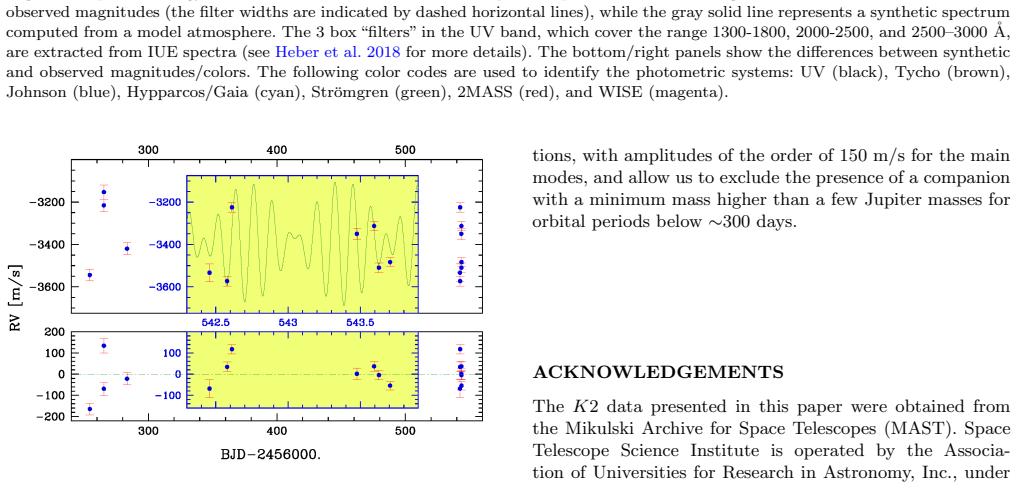
- The radial-velocity data exclude companions above a few Jupiter masses out to about 300 days, supporting a genuinely single-star status that is relevant to the question of how single sdB stars form.
Reading between the lines
- High-degree g-modes at the few-ppm level may be common among bright, slowly rotating sdB pulsators; if so, HD 4539 could be the prototype of a class rather than an isolated case, and the same period-spacing search could be applied systematically to other K2 and TESS targets.
- A quantitative model comparison using amplitudes and phases, not just period spacings, could resolve the $\ell=7/9/10/12$ degeneracies in the crowded region; this would be a natural follow-up that the paper does not perform.
- The large number of high-degree modes implies strong horizontal wavenumber diversity; multi-band or spectroscopic observations could test the geometric cancellation predicted for $\ell=12$ modes, linking photometric and spectroscopic mode visibility.
- If the absence of rotational splitting is due to a very long rotation period, the star offers a clean environment to search for slow effects such as magnetic frequency shifts or nonlinear mode interactions in future longer light curves.
Signed reviews
Editorial analysis
A structured set of objections, weighed in public.
Referee Report
Summary. This paper presents a detailed asteroseismic analysis of the bright subdwarf B pulsator HD 4539 using 78.7 days of K2 short-cadence photometry, combined with new low- and high-resolution spectroscopy. The authors extract 169 pulsation frequencies (124 considered robust) and identify g-mode sequences with harmonic degrees l=1, 2, 4, 5, 6, 7, 8, 9, 10, and 12, claiming the first detection of l=12 g-modes in an sdB star. They also derive atmospheric parameters from spectroscopy (Teff=22,800±160 K, log g=5.20±0.02, log(N(He)/N(H))=-2.34±0.05) and SED fitting (Teff=23,470+650-210 K, R=0.26±0.01 Rsun, M=0.40±0.08 Msun), detect pulsation-induced radial velocity variations of ~150 m/s, and place upper limits on a potential companion mass. The paper argues that the absence of rotational splitting implies a very long rotation period and/or a very low inclination.
Significance. If the l=12 identification holds, this is a genuinely novel result: high-degree g-modes have rarely been seen in any pulsating star, and never before in an sdB star. The paper's strengths include a careful two-step prewhitening procedure with explicit detection thresholds, a strong internal consistency check between the l=1 and l=2 period spacings (reduced spacings of 362.75 s and 362.77 s), and complementary spectroscopic analyses that substantially improve the star's fundamental parameters. The claimed l≤8 sequences, many with unique labels, provide useful targets for future seismic modeling. However, the headline l=12 detection currently rests on mode identifications that are mostly tentative or ambiguous, and no statistical test is offered to show that the apparent ~29 s l=12 spacing could not arise by chance in a crowded period spectrum. Thus the paper's central new claim is not yet falsifiable, and the significance of the result depends on strengthening this evidence.
major comments (2)
- [Table 1; Section 2.3; Fig. 4] The claim, stated in the abstract and Section 5, that HD 4539 shows g-modes up to l=12 is not supported by unique identifications. In Table 1, the l=12 assignments are either marked 'TI' (e.g., f31, f41, f47, f59, f68, f83, f90, f105) or have alternative lower-degree solutions (e.g., f26, f48, f52, f53, f63, f64, f71, f73, f86, f92, f93, f95, f96, f98, f99, f100). Several of these are 4.0σ candidate detections shown in brackets (f52, f73, f86, f93, f98), which Section 2.1 states are 'considered only as candidates.' Section 2.3 explicitly acknowledges that the high concentration of peaks makes mode identification very difficult, and the Fig. 4 caption says the l=12 sequence is only partially recognized. The paper provides no quantitative test, such as a false-alarm probability or Monte Carlo simulation, of whether the expected l=12 spacing of ~29 s could arise by chance among the dense peaks in the short-period region. Without such a test, the first-detection claim is not falsifiable. Please either add a statistical uniqueness/chance-alignment analysis or downgrade the l=12 detection to a candidate interpretation throughout the paper.
- [Section 2.3, Eq. (1)] The paper applies the asymptotic period-spacing relation ΔP_l = ΔΠ / sqrt(l(l+1)) to modes with l=12 and radial order n≈37–69, where n is only ~3–6 times l. The asymptotic approximation strictly requires n≫l, and its accuracy for these relatively low-n, high-l modes is not demonstrated. A small deviation from the asymptotic spacing in this regime would break the sequence alignment and alter the identification. Please include a quantitative check of the asymptotic relation (e.g., against a stellar model or a higher-order asymptotic expansion) or discuss the expected size of the deviation and its effect on the l≥9 identifications.
minor comments (4)
- [Throughout] There are several typographical errors: 'treshold' (Section 2.1) should be 'threshold', 'wavelenghts' (Section 3) should be 'wavelengths', and 'Harps-N' (Section 4) should be 'HARPS-N'. The reference 'Vandenburg & Johnson 2014' should be 'Vanderburg & Johnson 2014'.
- [Fig. 4 caption] The sentence 'The high concentration of peaks at short periods implies that modes with high degree, up to at least l=12, must be present in this star' is an inference rather than a direct statement of what the figure shows; the caption should clarify which sequences are directly identified and which are inferred.
- [Section 2.3] The echelle diagrams in Fig. 5 show only identified modes; the paper should state how many of the 169 detected frequencies remain unidentified and whether those unidentified modes could host additional sequences, since this affects the completeness of the proposed identifications.
- [References] The citation 'Charpinet et al. 2019, A&A, submitted' is not a complete reference; please update it with the final publication status or remove it if it is not needed.
Circularity Check
No significant circularity: the high-degree mode identifications are tested against an asymptotic period-spacing ladder derived from the independently identified l=1 and l=2 sequences.
full rationale
The paper's central derivation is self-contained and non-circular. Section 2.3 first identifies the l=1 and l=2 sequences directly from evenly spaced periods (Delta P1=256.5 s, Delta P2=148.1 s), checks them against the asymptotic relation (both give Delta Pi about 362.76 s), and only then computes the expected spacings for l>2: 'from which we can compute the expected period spacing for the modes with higher degree.' The l=4-12 identifications in Table 1 and Figs 3-5 are matched to this a-priori ladder; the ladder is not fitted to the high-degree peaks, so the high-degree claim is not an input renamed as a prediction. The l=12 cases are admittedly tentative and degenerate (TI flags and alternative l=7/9/10 solutions), and Fig. 4 says identification is 'very difficult' in the dense short-period region; this is a statistical-confidence/robustness limitation, not circularity. Self-citations (Baran et al. 2015 for the 5.4-sigma K2 false-alarm threshold; Telting et al. 2014a for earlier l=8 detections) are independent calibration/context results and are not load-bearing for the l=12 claim. No equation or fitted parameter is recycled as a derived result.
Assumptions & free parameters
free parameters (3)
- Reduced period spacing ΔΠ =
362.76 s (mean of 362.75 and 362.77 s from l=1 and l=2)
- Detection thresholds (5.4σ, 4.0σ) =
5.4σ for robust detections, 4.0σ for candidate detections
- Atmospheric parameters (Teff, log g, He/H) =
22,800 K, 5.20, -2.34
assumptions (5)
- standard math For high-order g-modes in the asymptotic limit, the period spacing is ΔP_l = ΔΠ / sqrt(l(l+1)) with constant ΔΠ.
- domain assumption The evenly spaced frequency sequences observed are consecutive overtones n=1,2,3,... with no significant mode trapping or missing modes affecting the spacing in the identified sequences.
- domain assumption The 5.4σ threshold corresponds to a 95% confidence level for K2 data (Baran et al. 2015).
- domain assumption Rotation splitting is absent or unresolved, so each peak in the amplitude spectrum corresponds to a single (l, m=0) mode and not an unresolved multiplet.
- domain assumption LTE model atmospheres (Heber et al. 2000 grid) are adequate for the atmospheric parameter determination.
Cite this review
Pith. "Pith review of High-degree gravity modes in the single sdB star HD4539." pith.science (2026). https://pith.science/paper/TDFESVSJ
@misc{pith2026190803558,
  author       = {Pith},
  title        = {Pith review of: High-degree gravity modes in the single sdB star HD4539},
  year         = {2026},
  howpublished = {\url{https://pith.science/paper/TDFESVSJ}},
  note         = {Machine review of arXiv:1908.03558}
}
read the original abstract
HD4539 (alias PG0044+097 or EPIC220641886) is a bright (V=10.2) long-period V1093 Her-type subdwarf B (sdB) pulsating star that was observed by the Kepler spacecraft in its secondary (K2) mission. We use the K2 light curve (78.7 days) to extract 169 pulsation frequencies, 124 with a robust detection. Most of these frequencies are found in the low-frequency region typical of gravity (g-)modes, but some higher frequencies corresponding to pressure (p-)modes are also detected. Therefore HD4539 is a hybrid pulsator and both the deep and surface layers of the star can potentially be probed through asteroseismology. The lack of any frequency splitting in its amplitude spectrum suggests that HD4539 has a rotation period longer than the K2 run and/or that it is seen pole-on. From asymptotic period spacing we see many high-degree modes, up to l=12, in the spectrum of HD4539, with amplitudes as low as a few ppm. A large fraction of these modes can be identified and for ~29% of them we obtain a unique and robust identification corresponding to l<=8. Our study includes also a new determination of the atmospheric parameters of the star. From low-resolution spectroscopy we obtain Teff=22,800+-160 K, logg=5.20+-0.02 and log(N(He)/N(H))=-2.34+-0.05. By fitting the SED we obtain Teff=23,470+650-210 K, R_star=0.26+-0.01 Rsun and M_star=0.40+-0.08 Msun. Moreover, from 11 high-resolution spectra we see the radial velocity variations caused by the stellar pulsations, with amplitudes of ~150~m/s for the main modes, and we can exclude the presence of a companion with a minimum mass higher than a few Jupiter masses for orbital periods below ~300 days.
Figures


Figures from the paper (7 more)



Reference graph
Works this paper leans on
-
[1]
Baran A., Pigulski A., Kozie D., Og oza W., Silvotti R., Zo a S., 2005, , 360, 737
work page 2005
-
[2]
Baran A., Koen C., Pokrzywka B., 2015, , 448, L16
work page 2015
-
[3]
Baschek B., Sargent W.\,L.\,W, Searle L., 1972, , 173, 611
work page 1972
- [4]
- [5]
- [6]
-
[7]
Charpinet S., Fontaine G., Brassard P., Dorman B., 1996, , 471, L103
work page 1996
-
[8]
Charpinet S., Fontaine G., Brassard P., Chayer P., 1997, , 483, L123
work page 1997
Show all 50 references
-
[9]
Charpinet S., Brassard P., Van Grootel V., Fontaine G., 2014, ASPC, 481, 179
2014
-
[10]
et al., 2013, VizieR Online Data Catalog, 2328
Cutri R.\,M. et al., 2013, VizieR Online Data Catalog, 2328
2013
-
[11]
Charpinet S., Giammichele N., Zong W., Van Grootel V., Brassard P., Fontaine G., 2018, Open Astronomy, 27, 112
2018
-
[12]
et al., 2019, , submitted
Charpinet S. et al., 2019, , submitted
2019
-
[13]
Kjeldsen, T.\,R
Dziembowski W.\,A., Balona L.\,A., Goupil M.-J., Pamyatnykh A.\,A., 1998, ``The First MONS Workshop: Science with a Small Space Telescope'', Eds.: H. Kjeldsen, T.\,R. Bedding, Aarhus Universitet, p. 127
1998
-
[14]
ESA, 1997, The Hipparcos and Tycho Catalogues, ESA SP-1200
1997
-
[15]
Fontaine G., Brassard P., Charpinet S., Green E.\,M., Chayer P., Bill \`e res M., Randall S.\,K., 2003, , 597, 518
2003
-
[16]
Fontaine G., Brassard P., Charpinet S., Green E.\,M., Randall S.\,K., Van Grootel V., 2012, , 539, A12
2012
-
[17]
Gaia Collaboration et al., 2018, , 616, A1
2018
-
[18]
Geier S., Heber U., 2012, , 543, A149
2012
-
[19]
et al., 2010, PASP, 122, 131
Gilliland R.\,L. et al., 2010, PASP, 122, 131
2010
-
[20]
et al., 2003, , 583, L31
Green E.\,M. et al., 2003, , 583, L31
2003
-
[21]
Heber U., Langhans G., 1986, ESASP, 263, 279
1986
-
[22]
Heber U., Reid I.\,N., Werner K., 2000, , 363, 198
2000
-
[23]
Heber U., 2016, PASP, 128, 966
2016
-
[24]
Heber U., Irrgang A., Schaffenroth J., 2018, Open Astronomy, 27, 35
2018
-
[25]
et al., 2014, PASP, 126, 398
Howell S.\,B. et al., 2014, PASP, 126, 398
2014
-
[26]
Jeffery C.S., Saio H., 2006, 371, 659
2006
-
[27]
Kern J.\,W., Reed M.\,D., Baran A.\,S., stensen R.\,H.,Telting J.\,H., 2017, , 465, 1057
2017
-
[28]
Kern J.\,W., Reed M.\,D., Baran A.\,S., Telting J.\,H., stensen R.\,H., 2018, , 474, 4709
2018
-
[29]
Kilkenny D., Koen C., O'Donoghue D., Stobie R.\,S., 1997, , 285, 640
1997
-
[30]
et al., 2012, , 542, A24
Mantegazza L. et al., 2012, , 542, A24
2012
-
[31]
Ochsenbein F., Bauer P., Marcout J., 2000, , 143, 23O
2000
-
[32]
et al., 2010, , 513, A6
stensen R.\,H. et al., 2010, , 513, A6
2010
-
[33]
et al., 2011, , 414, 2860
stensen R.\,H. et al., 2011, , 414, 2860
2011
-
[34]
stensen R.\,H., Reed M.\,D., Baran A.\,S., Telting J.\,H., 2014, , 564, L14
2014
-
[35]
Pesnell W.\,D., 1985, , 292, 238
1985
-
[36]
Randall S.\,K., Fontaine G., Brassard P., Bergeron, P., 2005, , 161, 456
2005
-
[37]
et al., 2011, , 414, 2885
Reed M.\,D. et al., 2011, , 414, 2885
2011
-
[38]
Foster H., Telting J.\,H., stensen R.\,H., Farris L.\,H., Oreiro R., Baran A.\,S., 2014, , 440, 3809
Reed M.\,D. Foster H., Telting J.\,H., stensen R.\,H., Farris L.\,H., Oreiro R., Baran A.\,S., 2014, , 440, 3809
2014
-
[39]
et al., 2018, Open Astronomy, 27, 157
Reed M.\,D. et al., 2018, Open Astronomy, 27, 157
2018
-
[40]
Saffer R.\,A., Bergeron P., Koester D., Liebert J., 1994, , 432, 351
1994
-
[41]
Sale S.\,E., Schoenaers C., Lynas-Gray A.\,E., 2008, ASPC, 392, 109
2008
-
[42]
Schindewolf M., N\'emeth, P., Heber U., Battich T., Miller Bertolami M.\,M., Irrgang A., Latour M., 2018, , 620, A36
2018
-
[43]
Schneider D., Irrgang A., Heber U., Nieva, M.\,F., Przybilla N., 2018, , 618, A86
2018
-
[44]
in Asteroseismology, 151, 67
Schoenaers C., Lynas-Gray A.\,E., 2007, Comm. in Asteroseismology, 151, 67
2007
-
[45]
Schuh S., Huber J., Dreizler S., Heber U., O'Toole S.\,J., Green E.\,M., Fontaine G., 2006, , 445, L31
2006
-
[46]
Skrutskie M.\,F. et al. 2006, , 131, 1163
2006
-
[47]
et al., 2014a, , 570, A129
Telting J.\,H. et al., 2014a, , 570, A129
-
[48]
Telting J.\,H., stensen R.\,H., Reed M., Farris L., Baran A., Oreiro R., O'Toole S., 2014b, ASPC, 481, 287
-
[49]
Vandenburg A., Johnson J.\,A., 2014, , 126, 948
2014
-
[50]
Zong W., Charpinet S., Fu J.-N., Vauclair G., Niu J.-S., Su J., 2018, , 853, 98
2018
Reviewed August 14, 2026 · model on record in the stance chip above.
Discussion (0). Continue with ORCID to comment.